http://dx.doi.org/10.4236/ars.2015.44023
Forest Fires and Climate Correlation in
Mexico State: A Report Based on MODIS
Xanat Antonio1, Edward Alan Ellis21Autonomous University of Mexico State, Geography Faculty, Toluca, Mexico 2Tropical Research Center (CITRO), Universidad Veracruzana, Veracruz, Mexico
Received 9 October 2015; accepted 30 November 2015; published 3 December 2015
Copyright © 2015 by authors and Scientific Research Publishing Inc.
This work is licensed under the Creative Commons Attribution International License (CC BY).
http://creativecommons.org/licenses/by/4.0/
Abstract
Forest fires are one of the most important threats for forests in the State of Mexico. Therefore, understanding their geographical patterns is a priority for the design of forest management strat-egies. We processed the records obtained with the MOD14A2 product (for thermal anomalies and fire) of MODIS sensor. Such scenes correspond to dry seasons (from March 15 to June 30) from 2000 to 2012 in the State of Mexico. We analyzed such records in a GIS environment to learn their spatial patterns and establish their geographical correlations as a first step to understand the causal agents of forest fires. As a result, forest fires in the State of Mexico showed a clustered spa-tial trend with a southwest tendency and a slight spaspa-tial relation with total winter precipitation and maximal temperature in summer.
Keywords
Forest Fires, MODIS Product, State of Mexico, Spatial Patterns
1. Introduction
Mexico during dry seasons from 2000 to 2012.
2. Method
It consists on the study area description, the construction of a geodatabase, and the search for spatial relation-ships.
2.1. Study Area
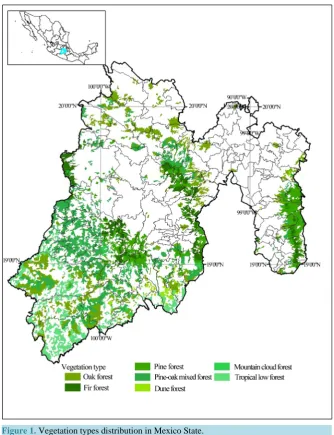
The State of Mexico is located between latitudes 18˚21'15" and 20˚19'00" north and longitudes 98˚35'30" and 100˚37'00" west, between the Trans-Mexican Volcanic Belt and Sierra Madre del Sur [12]. According to [13], the dominant vegetation types are (ordered by extension): Pine forest (250 thousand hectares), Oak forest (199 thousand hectares), deciduous and semi-deciduous rain forest (186 thousand hectares) and sacred fir forest (83 thousand hectares). The 513,500 hectares comprised in this State forest are mainly located in the southwest and on mountainous terrains (Figure 1).
[image:2.595.146.481.285.721.2]The presence of forest fires is complex to explain. However, in this region there are several factors that facili-tate them: as well the high elevation that increases sun exposition, the presence of dry winters and summer
droughts followed by heavy rain periods promote vegetation growth, illegal logging, grass burning, urban and agricultural encroachment, and intentional fires threaten the forests in this State, which holds the first national place in forest fire incidence for the period 1995-2010, except in 2002 and 2004 when it held the second place
[14].
2.2. Geographical Database Construction
We downloaded the MODIS-Terra product named MOD14A2 from LPDACC website of USGS EROS center (https://lpdaac.usgs.gov/get_data). This product bases on “detection by localizing the occurrence of fast changes in daily reflectivity data, in short, of the NIR region (band 2) and SWIR (band 5) [15]. This detection takes into account the reflectivity estimated for each pixel, inverting a bidirectional reflectivity model (BDRF), from a several-day fixed temporary window. The algorithm differences between seasonal changes of some coverages similar to those burned (such as shades) and more time-persisting changes as a consequence of those caused by fire. At a second stage, from contextual criteria that begin in the detected change pixels, the algorithm allows completing the perimeters of burned areas that were not mapped in the previous phase” [16]. We selected the scenes h8v6 and h8v7 of 8 days for the hottest and driest period of the year (between March 15 and June 31); once obtained, we projected them with Modis Projection Tool, mosaicked them and extracted the polygons with the burned areas using GIS query. We built climate layers using records from the National Meteorological Ser-vice, specifically the records of maximum value for the maximal temperature in May and the total sum of winter precipitation, which were added to the punctual location of the stations and interpolated using the IDW method.
2.3. Spatial Patterns and Relationships
We explored several descriptors of the spatial pattern on the burned forest areas using ArcGIS: central mean value, dispersion ellipse, and Moran I index. The first points at the average coordinates of the group, whilst the second graphically expresses how the data disperses over the territory. The third is a measure that allows estab-lishing if the data are clumped, random or regular in their distribution. Once we learnt that the burned areas have a grouped pattern, we exported the data to IDRISI in order to establish their spatial relation to the maximal tem-perature in May and the total precipitation in winter. To validate these results, we contrasted them with the cli-mate and forest fires records reported by CNA and CONAFOR from 1970 to 2006 for the State of Mexico.
3. Results
In Figure 2, we show the forest burned areas of Mexico State for the 2000-2011 period.
During the driest and hottest periods of the year forest fires in the State of Mexico tend to concentrate and ex-tend over the southwest region, showing considerable variability between years. On average, there are 93 forest fires each year, and 51% of the burned areas have an extension of 10.9 ha or are smaller. In this State, forest fires are very frequent but mostly small. The majority of the affected areas are persistent over the years and are located in the municipalities of Valle de Bravo, Ixtapan del Oro, Tlatlaya, Amatepec, Nuevo Santo Tomás, Zacazonapan, San Martín Otzoloapan, Tejupilco de Hidalgo, Sultepec, Temascaltepec and San Simón de Guerrero (Figure 3).
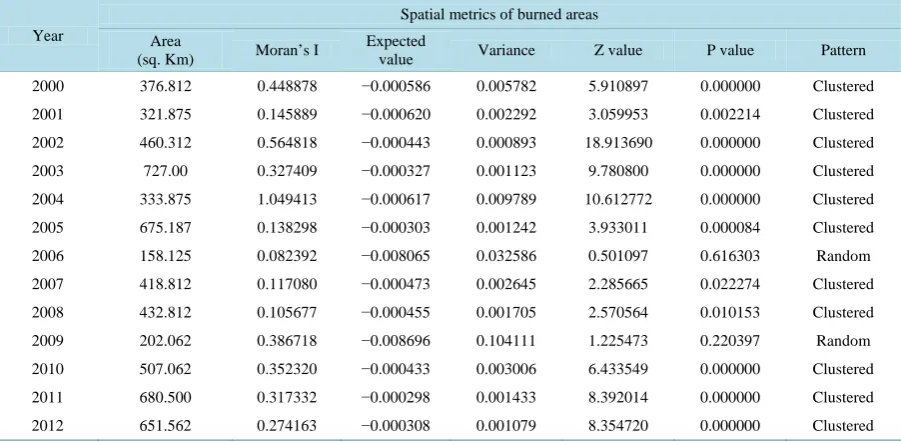
Moran’s I index reveals that burned forest areas tend to be clustered (Table 1) during the period 2000-2012; only in two years, 2006 and 2009, they had a random pattern.
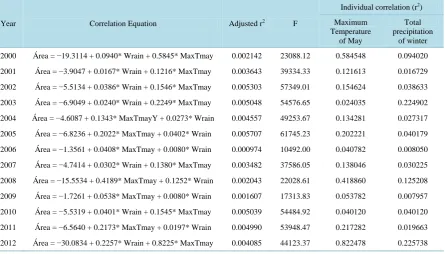
In Table 2, we concentrate the indicators of the spatial relation between burned areas and total precipitation in winter (Wrain) and Maximum temperature in May (Max Tmay).
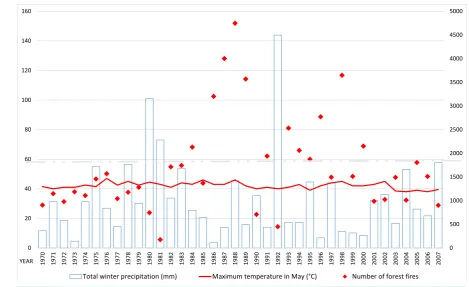
Maximum temperature in May strongly correlates with burned areas in 2012, but slightly in 2000 and 2008. Total precipitation in winter slightly correlates with burned areas in 2003 and 2012. This agrees with long-term records for the State of Mexico (1970-2007) in which forest fires are more frequent in winters with few precipi-tation followed by high values of maximal temperature in May (Figure 4). However, for the period and dataset studied the combination of these variables is not sufficient to predict the extent of the burned surfaces. This is explained by the complexity of forest fires.
4. Conclusion
2000 2001 2002 2003
2004 2005 2006 2007
2008 2009 2010 2011
[image:4.595.93.533.80.455.2] [image:4.595.88.539.500.722.2]2012
Figure 2. Burned forest areas in Mexico state 2000-2012, as detected by the MOD14A2 product.
Table 1. Spatial pattern of forest burned areas in Mexico State, accordingo to Moran’s I index.
Year
Spatial metrics of burned areas
Area
(sq. Km) Moran’s I
Expected
value Variance Z value P value Pattern
2000 376.812 0.448878 −0.000586 0.005782 5.910897 0.000000 Clustered
2001 321.875 0.145889 −0.000620 0.002292 3.059953 0.002214 Clustered
2002 460.312 0.564818 −0.000443 0.000893 18.913690 0.000000 Clustered
2003 727.00 0.327409 −0.000327 0.001123 9.780800 0.000000 Clustered
2004 333.875 1.049413 −0.000617 0.009789 10.612772 0.000000 Clustered
2005 675.187 0.138298 −0.000303 0.001242 3.933011 0.000084 Clustered
2006 158.125 0.082392 −0.008065 0.032586 0.501097 0.616303 Random
2007 418.812 0.117080 −0.000473 0.002645 2.285665 0.022274 Clustered
2008 432.812 0.105677 −0.000455 0.001705 2.570564 0.010153 Clustered
2009 202.062 0.386718 −0.008696 0.104111 1.225473 0.220397 Random
2010 507.062 0.352320 −0.000433 0.003006 6.433549 0.000000 Clustered
2011 680.500 0.317332 −0.000298 0.001433 8.392014 0.000000 Clustered
Figure 3. Mean central point and ellipse of dispersion for the burned forest areas in Mexico State 2000-20012.
Table 2. Burned areas correlation with Total precipitation of winter (Wrain) and Maximum temperature of May (MaxTmay).
Year Correlation Equation Adjusted r2 F
Individual correlation (r2)
Maximum Temperature
of May
Total precipitation
of winter
2000 Área = −19.3114 + 0.0940* Wrain + 0.5845* MaxTmay 0.002142 23088.12 0.584548 0.094020
2001 Área = −3.9047 + 0.0167* Wrain + 0.1216* MaxTmay 0.003643 39334.33 0.121613 0.016729
2002 Área = −5.5134 + 0.0386* Wrain + 0.1546* MaxTmay 0.005303 57349.01 0.154624 0.038633
2003 Área = −6.9049 + 0.0240* Wrain + 0.2249* MaxTmay 0.005048 54576.65 0.024035 0.224902
2004 Área = −4.6087 + 0.1343* MaxTmayY + 0.0273* Wrain 0.004557 49253.67 0.134281 0.027317
2005 Área = −6.8236 + 0.2022* MaxTmay + 0.0402* Wrain 0.005707 61745.23 0.202221 0.040179
2006 Área = −1.3561 + 0.0408* MaxTmay + 0.0080* Wrain 0.000974 10492.00 0.040782 0.008050
2007 Área = −4.7414 + 0.0302* Wrain + 0.1380* MaxTmay 0.003482 37586.05 0.138046 0.030225
2008 Área = −15.5534 + 0.4189* MaxTmay + 0.1252* Wrain 0.002043 22028.61 0.418860 0.125208
2009 Área = −1.7261 + 0.0538* MaxTmay + 0.0080* Wrain 0.001607 17313.83 0.053782 0.007957
2010 Área = −5.5319 + 0.0401* Wrain + 0.1545* MaxTmay 0.005039 54484.92 0.040120 0.040120
2011 Área = −6.5640 + 0.2173* MaxTmay + 0.0197* Wrain 0.004990 53948.47 0.217282 0.019663
[image:5.595.94.540.470.724.2]Figure 4. Total precipitation of winter, maximum temperature of may and fores fires frequency in Mexico State.
the State of Mexico are small, clustered, persistent and related to total precipitation in winter and maximum temperature in May. Although further studies with greater temporal and spatial precision are required, this study suggests the implementation of a spatial index that incorporates these climatic factors in order to select the areas with the most proneness to forest fires.
Acknowledgements
The “Autonomous University of the State of Mexico (UAEMEX) fund for research” supplied the resources for this research (24796/2007). This report takes part of the postdoctoral research carried by Dra. Antonio at CITRO.
The LPDACC website administrated by EROS Data center of the USGS (www.usgs.gov) was the source of the MYD14 product of MODIS tool and the MODIS projection tool, indispensable materials for this research.
References
[1] Chuvieco, E. (1999) Remote Sensing of Large Wildfires in the Mediterranean European Basin. Springer, Berlin.
http://dx.doi.org/10.1007/978-3-642-60164-4
[2] Ganteaume, A., Camia, A., Jappiot, M., San-Miguel-Ayanz, J., Long-Fournel, M. and Lampin, C. (2013) A Review of the Main Driving Factors of Forest Fire Ignition over Europe. Environment Management, 51, 651-662.
http://dx.doi.org/10.1007/s00267-012-9961-z
[3] Barrett, K., Kasischke, E.S., McGuire, A.D., Turetsky, M.R. and Kane, E.S. (2010) Modeling Fire Severity in Black Spruce Stands in the Alaskan Boreal Forest Using Spectral and Non-Spectral Geospatial Data. Remote Sensing of En-vironment, 114, 1494-1503. http://dx.doi.org/10.1016/j.rse.2010.02.001
[4] Durão, R.M., Pereira, M.J., Branquinho, C. and Soares, A. (2010) Assessing Spatial Uncertainty of the Portuguese Fire Risk through Direct Sequential Simulation. Ecological Modelling, 221, 27-33.
http://dx.doi.org/10.1016/j.ecolmodel.2009.09.004
[5] Romero-Calcerrada, R., Barrio-Parra, F., Millington, J.D.A. and Novillo, C.J. (2010) Spatial Modelling of Socioeco-nomic Data to Understand Patterns of Human-Caused Wildfire Ignition Risk in the SW of Madrid (Central Spain).
Ecological Modelling, 221, 34-45. http://dx.doi.org/10.1016/j.ecolmodel.2009.08.008
0 500 1000 1500 2000 2500 3000 3500 4000 4500 5000 0 20 40 60 80 100 120 140 160 19 70 19 71 19 72 19 73 19 74 19 75 19 76 19 77 19 78 19 79 19 80 19 81 19 82 19 83 19 84 19 85 19 86 19 87 19 88 19 89 19 90 19 91 19 92 19 93 19 94 19 95 19 96 19 97 19 98 19 99 20 00 20 01 20 02 20 03 20 04 20 05 20 06 20 07 YEAR
[6] Massada, A.B., Radeloff, V.C., Stewart, S.I. and Hawbaker, T.J. (2009) Wildfire Risk in the Wildland-Urban Interface: A Simulation Study in Northwestern Wisconsin. Forest Ecology and Management, 258, 1990-1999.
http://dx.doi.org/10.1016/j.foreco.2009.07.051
[7] Carmel, Y., Paz, S., Jahashan, F. and Shoshany, M. (2009) Assessing Fire Risk Using Monte Carlo Simulations of Fire Spread. Forest Ecology and Management, 257, 370-377. http://dx.doi.org/10.1016/j.foreco.2008.09.039
[8] Villers, M.A. (2006) Incendios Forestales. Ciencias, 81, 60-66.
http://www.redalyc.org/pdf/644/64408110.pdf
[9] Muñoz-Robles, C.A., Treviño-Garza, E.J., Verástegui-Chávez, J., Jiménez-Pérez, J. and Aguirre-Calderón, O.A. (2005) Desarrollo de un modelo espacial para la evaluación del peligro de incendios forestales en la Sierra Madre Oriental de México. Investigaciones Geográficas, 56, 101-117. http://www.redalyc.org/articulo.oa?id=56905608
[10] Avila-Flores, D., Pompa-Garcia, M., Antonio-Nemiga, X., Rodriguez-Trejo, D.A., Vargas-Perez, E. and Santillan- Perez, J. (2010) Driving Factors for Forest Fire Occurrence in Durango State of Mexico: A Geospatial Perspective. Chinese Geographical Science, 20, 491-497. http://dx.doi.org/10.1007/s11769-010-0437-x
[11] Rivas, I., Fragoso, N.J., García, J., Rivas, E., Díaz, E.P. and Sanchez J.C. (2000) Incendios Forestales en el Estado de México en el periodo de Diciembre de 1997 a junio de 1998. Ciencia Ergo Sum, 6, 301-309.
http://www.redalyc.org:9081/home.oa?cid=275957
[12] IGECEM (2013) Información geográfica del estado de México. Instituto de Información e investigación geográfica, estadística y catastral del Estado de México (IGECEM). Gobierno del Estado de México.
http://igecem.edomex.gob.mx/indole_social
[13] Nava, G., Endara A., Regil, H.H., Estrada, C., Arriaga, C. and Mass, S. (2009) Atlas Forestal del Estado de México. 1era. Edición. Universidad Autónoma del Estado de México-ICAR. Toluca, Estado de México.
[14] INEGI (2015) Estadísticas Históricas de México. Instituto Nacional de Estadística Geografía e Informática (INEGI). Aguascalientes, México.
http://www.inegi.org.mx/prod_serv/contenidos/espanol/bvinegi/productos/nueva_estruc/HyM2014/22.%20MedioAmbi ente.pdf
[15] Roy, D., Lewis, P.E. and Justice, C.O. (2002) Burned Area Mapping Using Multi-Temporal Moderate Spatial Resolu-tion Data-a Bi-DirecResolu-tional Reflectance Model-Based ExpectaResolu-tion Approach. Remote Sensing of Environment, 83, 263- 286. http://dx.doi.org/10.1016/S0034-4257(02)00077-9
[16] Bastarrika, A., Chuvieco, E. and Martín, M.P. (2008) Comparación de productos de área quemada obtenidos mediante imágenes de satélite en la Península ibérica. UNED. Espacio, Tiempo y Forma, 1, 33-47.