http://dx.doi.org/10.4236/jss.2014.27002
Group Ranking Sequence Decision for
Recommendation of Messaging APP
Wei-Feng Tung
Department of Information Management, Fu-Jen Catholic University, New Taipei City, Chinese Taipei Email: [email protected]
Received May 2014
Abstract
This research is to develop a novel recommendation service using a unique group ranking se-quence technique “Mining Maximum Consensus Sese-quences from all Users’ Partial Ranking Lists (MCSP)”. MCSP is capable of determining the product’s sequence recommendations based on k-item candidate sequences and maximum consensus sequences. This paper also illustrates the complete decision procedures of group ranking sequences. In terms of popular information prod-ucts, we select “messaging app” to reveal the MCSP’s group ranking sequence decision. The rec-ommendation service provides that query users search for the product’s recrec-ommendation (i.e., messaging app) according to the preference sequences from query users themselves and a great deal of preference sequences from the other users. This paper consists of the definitions, proce-dures, implementation, and experiment analysis, as well as system demonstrations of MCSP re-spectively. This research contributes to a kind of systematic service innovation.
Keywords
MCSP, Group Ranking Sequences, Recommendation Service, Messaging APP
1. Introduction
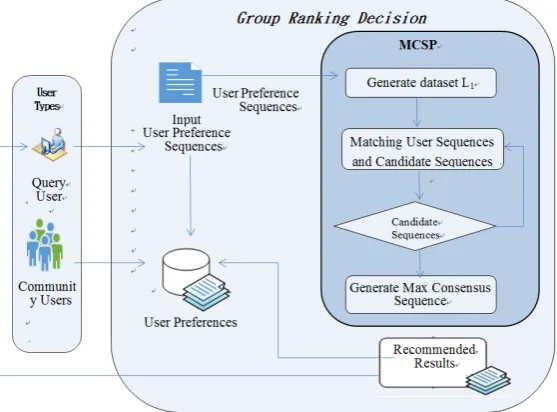
Figure 1. MCSP’s procedures for group ranking decision.
group ranking decision technique for varied product recommendations. MCSP also can be developed to be a de-cision support system (DSS) for further Web 2.0 applications. MCSP can be applied to estimate varied products or brand [6]-[9]. For the service innovation research, this research also can enhance the service innovation of the virtual community [4] [5] [10]-[15].
MCSP Implementation
A k-item sequence includes 1 to N items sequence in a dataset. Ck would be a set of candidates with k-sequence. Ck is a set of k-sequence that reaches to the consensus threshold. The beginning stage is to search for a consen-sus ranking. In order for the ranking majority users agree, the algorithm is to estimate the cmp_sup (complying support) and cf_sup (conflict support) of the candidate sequence Cs. While cmp_minsup = 0.3 and cf_maxsup = 0.25, the consensus sequence reaches to cmpsup sup cs( )≥0.3 and cf_ sup sup cs
( )
≤0.25, the sequence will be in-cluded into theset of Lk-1, which also can be inin-cluded into the set of candidate sequence Ck. When all se-quences in Lk-1 cannot generate the k-sequence anymore, the highest consensus ranking should be determined.Both predefined values for cmp_minsup and cf_maxsup will make the difference of recommendation results. If the two thresholds are too high, the sequence results will be fewer than the low thresholds. In this study, we predefine the two thresholds (cmp_minsup = 0.3, cf_maxsup = 0.25) and also can be adjusted depend on the different problems. While the dataset includes 14 sequences, S represents the sequential number of users and S1, 2 means the second sequence of User1 (Table 1).
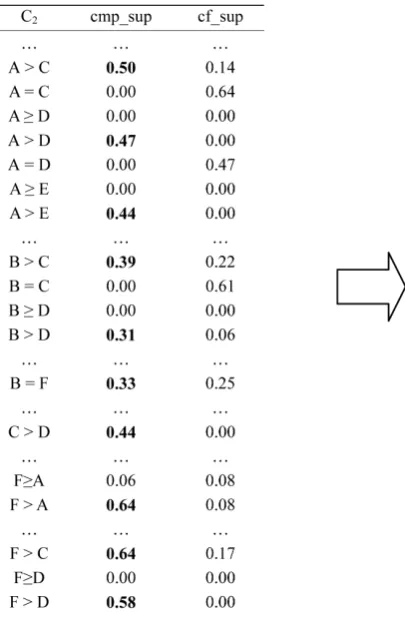
The first procedure is to divide the sample data into all 2-item sequences to be a set of candidate sequences C2
(Table 2).
In order for the first candidate sequence generate, all sequences will be selected from set I. All items can be selected for ranking to be L1 = {A, B, C, D, E, F}. L1⊕L1 can compare all pairs of L1 and then generate the
sequence C2 (Table 3). According to equation 2 to 8, all the sequences in C2 (Si, j) and compare with the
cmp_sup and cf_sup of user preference sequences. All sequences include {A > C}, {A > D}, {A > E}, {B > C}, {B > D}, {B = F}, {C > D}, {F > A}, {F > C}, {F > D}, and {F > E}, which will be selected into the set of consensus sequence L2.
The 3-itme sequences list includes the two consensus sequences, the 2-items sequences would be deleted without fitting the thresholds. In L2, the 2-items sequences, {B > D}{B > C} {B = F}, won’t be select into the other more k-item sequence anymore. Therefore, the three sequences become the highest consensus sequence.
Table 1. Sample data of 6 users and 14 sequences.
User ID Si,1 Si,2 Si,3
u1 B = F > A > C F > A > D > E
u2 F > C > A = B > D A > B = D > E F > A > D > E
u3 C > B = F > D C > B = F > A > E
u4 A > B ≥ F > C > E B = F > C > D
u5 F > A > C > D > E F > A = B > C > D
[image:3.595.156.440.249.388.2]u6 F > A > B ≥ C F > A = B > C F ≥ A > C > D
Table 2. All 2-item sequences in the set of C2.
C2
A ≥ B B ≥ A C ≥ A D ≥ A E ≥ A F ≥ A
A > B B > A C > A D > A E > A F > A
A = B B = A C = A D = A E = A F = A
… … … …
A ≥ F B ≥ F C ≥ F D ≥ F E ≥ F F ≥ E
A > F B > F C > F D > F E > F F > E
A = F B = F C = F D = F E = F F = E
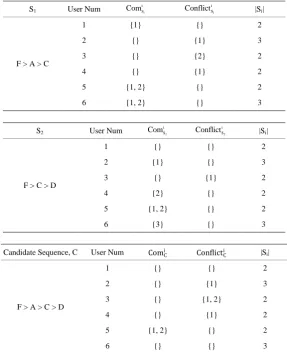
[image:3.595.194.397.414.723.2]In Table 4, {F > A > C} and {F > C > D} can combine to 4-itme {F > A > C > D}. The two sequences just fit for S5, 1 and S5, 2. As for conflict sequence, any sequence related to {F > A > C} or {F > C > D} need to be es-timated if they meet conflict. The sequence will not to recommend if one of sequence meets conflict. Thus, the process needs to present all unions of sequence.
Table 4. 3-item candidate set.
Table 5. Consensus sequence with 4-item.
S1 User Num 1 i S
Com
1 i S
Conflict |Si|
F > A > C
1 {1} {} 2
2 {} {1} 3
3 {} {2} 2
4 {} {1} 2
5 {1, 2} {} 2
6 {1, 2} {} 3
S2 User Num 2
i S
Com
2 i S
Conflict |Si|
F > C > D
1 {} {} 2
2 {1} {} 3
3 {} {1} 2
4 {2} {} 2
5 {1, 2} {} 2
6 {3} {} 3
Candidate Sequence, C User Num ComCi ConflictCi |Si|
F > A > C > D
1 {} {} 2
2 {} {1} 3
3 {} {1, 2} 2
4 {} {1} 2
5 {1, 2} {} 2
[image:4.595.153.441.367.720.2]Table 6. Max consensus sequences.
Max Consensus Sequences No of
sequences cmp_sup cf_sup LINE > We Chat {B > C} 0.39 0.22 LINE > WhatsAPP {B > D} 0.31 0.06 LINE = Skype {B = F} 0.33 0.25 Skype > QQ > We Chat {F > A > C} 0.36 0.14 Skype > QQ > WhatsAPP {F > A > D} 0.36 0.00 Skype > QQ > Viber {F > A > E} 0.31 0.08 Skype > We Chat > WhatsAPP {F > C > D} 0.36 0.08
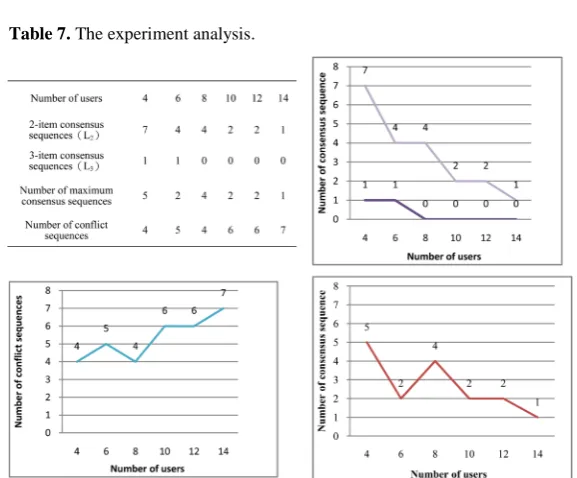
Table 7. The experiment analysis.
Since {F > A > C > D} does not meet the threshold, so it is not able to list for the consensus sequences. The four 3-item sequences then can be listed into the max consensus sequence {F > A > C}, {F > A > D}, {F > A > E}, and {F > C > D}, because no one else reach the set of consensus sequence.
2. Experiment Analysis
As the algorithm of group ranking (MCSP) for group recommendations is based on the other users’ preference sequences, the experiments show the comparisons of L2 and L3 based on the number of users. When MCSP provides the results of group ranking, the more number of users, the fewer number of consensus sequences. The more number of users, the more number of conflict sequences in this experiments.
In addition, this research tests our sample users to answer the questions about the system usages. From the user feed backs of Questionnaires, the research proposes some critical implications. The analysis unfolds that the more maximum consensus sequences and level of averaged user satisfactions will be verified if the more num-bers of preference sequences users provided. On the other hand, the fewer preference sequences made the less maximum consensus and the levels of user satisfactions (Table 8).
3. System Demonstration
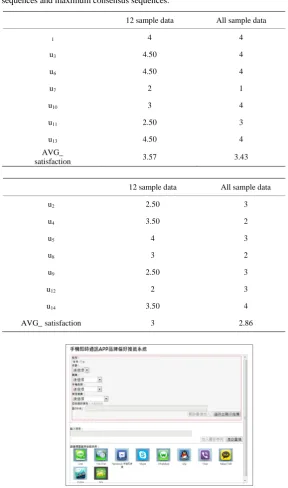
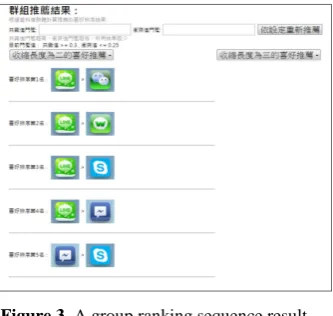
[image:5.595.168.457.240.479.2]is used to develop a product recommendation service in messaging app in this study. When the query users input their preference sequences, the Web-based system platform can generate some group ranking sequences for query users. The input and get of the prototype system of conducting group ranking sequences are shown in
Figure 2 and Figure 3.
4. Conclusion
This research utilizes a unique technique of group ranking sequences decision “Mining Maximum Consensus Sequences from all Users’ Partial Ranking Lists (MCSP)” to develop an innovative online recommendation ser-
Table 8. Averaged levels of satisfactions depends on the number of preference sequences and maximum consensus sequences.
12 sample data All sample data
1 4 4
u3 4.50 4
u6 4.50 4
u7 2 1
u10 3 4
u11 2.50 3
u13 4.50 4
AVG_
satisfaction 3.57 3.43
12 sample data All sample data
u2 2.50 3
u4 3.50 2
u5 4 3
u8 3 2
u9 2.50 3
u12 2 3
u14 3.50 4
[image:6.595.156.440.226.738.2]AVG_satisfaction 3 2.86
Figure 3.A group ranking sequence result.
vice of messaging app of mobile phones. This paper consists of the definitions, procedures, implementation, and experiment analysis, as well as system demonstrations of MCSP respectively. The section of MCSP implemen-tation shows how MCSP conducts a decision process of determining group ranking sequence. The section of experiment analysis is to verify the effects of MCSP. Finally, a prototype system can demonstrate input and output of recommendation service of messaging app. However, this research still has some research limitations of the number of sequences and the time complexity.
References
[1] Herrear, F., Herrera-Viedma, E., and Verdegay, J.L. (1996) Direct Approach in Group Decision Making Using Lin-guistic OWA Operators. Fuzzy Sets and Systems, 79, 175-190. http://dx.doi.org/10.1016/0165-0114(95)00162-X [2] Hevner, R.A., Salvatore, T.M. and Jinsoo, P. (2004) Design Science in Information Systems Research. MIS Quarterly,
28, 75-105.
[3] Hwang, C.L. and Lin, M.J. (1987) Group Decision Making Under Multiple Criteria: Methods and Applications. Sprin-ger-Verlag, Berlin Heidelberg. http://dx.doi.org/10.1007/978-3-642-61580-1
[4] Chen, Y.L. and Cheng, L.C. (2010) An Approach to Group Ranking Decisions in ADynamic Environment. Decision Support Systems, 48, 622-634. http://dx.doi.org/10.1016/j.dss.2009.12.003
[5] Chen, Y.L. and Cheng, L.C. (2009) Mining Maximum Consensus Sequences From Group Ranking Data. European Journal of Operational Research, 198, 241-251. http://dx.doi.org/10.1016/j.ejor.2008.09.004
[6] Aaker, D.A. (1991) Managing Brand Equity. The Free Press, New York.
[7] Aaker, D.A. (1995) Building Strong Brand. The Press, New York.
[8] Aaker, D.A. (1996) Measuring Brand Personality across Products and Markets. California Management Review, 38, 102-120. http://dx.doi.org/10.2307/41165845
[9] Aaker, J.L. (1997) Dimension of Brand Personality. Journal of Marketing Research, 34, 347-356. http://dx.doi.org/10.2307/3151897
[10] Basole, R.C. and Rouse, W.B. (2008) Complexity of Service Value Networks: Conceptualization and Empirical Inves-tigation. IBM Systems Journal, 47, 53-68. http://dx.doi.org/10.1147/sj.471.0053
[11] Bitner, M.J., Ostrom, A.L. and Morgan, F.N. (2008) Service Blueprinting: A Practical Technique for Service Innova-tion. California Management Review, 50, 66-94. http://dx.doi.org/10.2307/41166446
[12] Chesbrough, H. and Spohrer, J. (2006) A Research Manifesto for Services Science. Communications of the ACM, 49, 35-40. http://dx.doi.org/10.1145/1139922.1139945
[13] Cook, W.D., Golany, B., Kress, M., Penn, M. and Raviv, T. (2005) Optimal Allocation of Proposals to Reviewers to Facilitate Effective Ranking. Management Science, 51, 655-661. http://dx.doi.org/10.1287/mnsc.1040.0290
[14] Eggert, A. and Ulaga, W. (2002) Customer Perceived Value: a Substitute for Satisfaction in Business Markets? The Journal of Business & Industrial Marketing, 17, 107-118. http://dx.doi.org/10.1108/08858620210419754