Citation:
Sawalha, M and Brierley, C and Atwell, E (2014) Automatically generated, phonemic Arabic-IPA
pronunciation tiers for the boundary annotated Qur’an dataset for machine learning (version 2.0).
Proceedings of LRE-Rel 2: 2nd Workshop on Language Resource and Evaluation for Religious
Texts, LREC 2014 post-conference workshop 31st May 2014, Reykjavik, Iceland. 42 - 47.
Link to Leeds Beckett Repository record:
http://eprints.leedsbeckett.ac.uk/2136/
Document Version:
Article
The aim of the Leeds Beckett Repository is to provide open access to our research, as required by
funder policies and permitted by publishers and copyright law.
The Leeds Beckett repository holds a wide range of publications, each of which has been
checked for copyright and the relevant embargo period has been applied by the Research Services
team.
We operate on a standard take-down policy.
If you are the author or publisher of an output
and you would like it removed from the repository, please
contact us
and we will investigate on a
case-by-case basis.
Automatically generated, phonemic Arabic-IPA pronunciation tiers for the
Boundary
Annotated Qur'an Dataset for Machine Learning
(version 2.0)
Majdi Sawalha
1,2, Claire Brierley
2, Eric Atwell
2University of Jordan1 and University of Leeds2
1
Computer Information Systems Dept., King Abdullah II School for IT, University of Jordan, Amman 11942, Jordan
2
School of Computing, University of Leeds, LS2 9JT, UK
E-mail: [email protected], [email protected], [email protected]
Abstract
In this paper, we augment the Boundary Annotated Qur’an dataset published at LREC 2012 (Brierley et al2012; Sawalha et al 2012a) with automatically generated phonemic transcriptions of Arabic words. We have developed and evaluated a comprehensive grapheme-phoneme mapping from Standard Arabic > IPA (Brierley et al under review), and implemented the mapping in Arabic transcription technology which achieves 100% accuracy as measured against two gold standards: one for Qur’anic or Classical Arabic, and one for Modern Standard Arabic (Sawalha et al [1]). Our mapping algorithm has also been used to generate a pronunciation guide for a subset of Qur’anic words with heightened prosody (Brierley et al 2014). This is funded research under the EPSRC "Working Together" theme.
Keywords: IPA phonemic transcription; SALMA Tagger; Arabic transcription technology
1.
Introduction: the Boundary Annotated
Qur’an dataset for machine learning
For LREC 2012, we reported on a Qur’an dataset for Arabic speech and language processing, with multiple annotation tiers stored in tab-separated format for speedy text extraction and ease of use (Brierley et al 2012). One novelty of this dataset is Arabic words mapped to a prosodic boundary scheme derived from traditional tajwīd (recitation) mark-up in the Qur’an as well as syntactic categories. Thus we used our dataset for experiments in Arabic phrase break prediction: a classification task that simulates human chunking strategies by assigning prosodic-syntactic boundaries (phrase breaks) to unseen text (Sawalha et al2012a; 2012b). In this paper, we report on version 2.0 of this dataset with 4 new prosodic and linguistic annotation tiers. It features novel, fully automated transcriptions of each Arabic word using the International Phonetic Alphabet (IPA), with an IPA > Arabic mapping scheme based on Quranic recitation, traditional Arabic linguistics, and modern phonetics (Brierley et al under rveiew).
2.
The
Boundary Annotated Qur’an
for
Arabic phrase break prediction
Phrase break prediction is a classification task in supervised machine learning, where the classifier is trained on a substantive sample of “gold-standard” boundary-annotated text, and tested on a smaller, unseen sample from the same source minus the boundary annotations. The task equates to classifying words, or the junctures (i.e. whitespaces) between them, via a finite set of category labels: in most cases, a binary set of breaks
versus non-breaks; and less commonly, a tripartite set of {major; minor; none}.
2.1 Boundary annotations
A boundary-annotated and part-of-speech tagged corpus is a prerequisite for developing phrase break classifiers. One novelty of our dataset is that we derived a coarse-grained, prosodic-syntactic boundary annotation scheme for Arabic from traditional recitation mark-up, known as tajwīd. Tajwīd boundary annotations are very fine-grained, delineating eight different boundary types, namely: three major boundary types, four minor boundary types, and one prohibited stop. For our initial experimental purposes, we collapsed these eight degrees of boundary strength into the familiar {major, minor, none} sets of British and American English speech
corpora (Taylor and Knowles 1988; Beckman and Hirschberg 1994). Another novelty is that we used certain stop types (i.e. compulsory, recommended, and prohibited stops) to segment the text into 8230 sentences.
2.2 Syntactic annotations: the efficacy of
traditional Arabic syntactic category labels
Phrase break prediction assumes part-of-speech (PoS) tagged input text as well as prior sentence segmentation, since syntax and punctuation are traditionally used as classificatory features. Traditional Arabic grammar
(Wright, 1996; Ryding, 2005; Al-Ghalayyni, 2005) classifies words in terms of just three syntactic categories {nouns; verbs; particles}, and another novelty of our
dataset is that we retained this traditional feature set as the default. Subsequently, we added a second syntactic annotation tier differentiating a limited selection of ten subcategories extracted from fully parsed sections of an early version of the Quranic Arabic Corpus (Dukes 2010). These comprise {nouns; pronouns; nominals; adverbs; verbs; prepositions; ‘lām prefixes; conjunctions; particles; disconnected letters}.
accuracy (85.56%), using the traditional, tripartite, syntactic feature set (Sawalha et al2012a; Sawalha et al 2012b). A sample from version 1.0 of the multi-tiered Boundary Annotated Qur’an dataset is shown in Fig 1. The 8 columns of Fig 1 are: (1) Arabic words in Othmani
script, (2) Arabic words in MSA script, (3) three POS tags of the word, (4) ten POS tags of the word, (5) verse ending symbol, (6) tripartite boundary annotation tag, (7) binary boundary annotation tag, and (8) sentence terminal.
OTH MSA Syntax:
NVP
Syntax: 10 PoS
Verse ends Boundaries: tripartite
Boundaries: binary
Sentences
ِﻢْﺴِﺑ
ِﻢْﺴِﺑ
N NOUN - - non-break -ِﻪﻠﻟٱ
ِﻪﻠﻟا
N NOUN - - non-break -ِﻦَْٰﲪﺮﻟٱ
ِﻦَْﲪﺮﻟا
N NOMINAL - - non-break -ِﻢﻴ ِﺣﺮﻟٱ
ِﻢﻴ ِﺣﺮﻟا
N NOMINAL ۞ || break terminalُﺪْﻤَْﳊٱ
ُﺪْﻤَْﳊا
N NOUN - - non-break -ِﻪﻠِﻟ
ِﻪﻠِﻟ
N NOUN - - non-break -بَر
بَر
N NOUN - - non-break - [image:3.595.47.555.131.277.2]َﲔِﻤَﻠَٰﻌْﻟٱ
َﲔِﻤَﻟﺎَﻌْﻟا
N NOUN ۞ || break terminalFigure 1: Sample tiers from the Boundary-Annotated Qur’an dataset version 1.0
3.
IPA transcription tiers for the
Boundary
Annotated Qur’an
(version 2.0): rationale
One of our objectives in the EPSRC-funded Working Together project is to automate Arabic transcription using a carefully defined subset of the International Phonetic Alphabet (IPA). This task matches the definition of transcription, as opposed to transliteration and romanisation for Arabic, as described in Habash et al (2007). The output of our algorithm is a phonemic pronunciation for each Arabic word as an element of its citation form, similar to entries in the OALD1 and LDOCE2 for English, to enhance Arabic dictionaries, to facilitate Arabic language learning, and for Arabic natural language engineering applications involving speech recognition and speech synthesis.
A corpus of fully vowelised Arabic text was essential for developing and evaluating both the comprehensive grapheme-phoneme mapping from Standard Arabic > IPA, and the mapping algorithm itself. The Qur’an is an iconic text and an excellent gold standard for modeling and evaluating Arabic NLP, since it arguably subsumes other forms of Arabic, including regional dialects (Harrag and Mohamadi 2007), and MSA (Sharaf 2012). Hence we have developed our mapping and our mapping algorithm on the Boundary-Annotated Qur’an dataset, which includes the entire text of the Qur’an in fully vowelised MSA as well as traditional Othmani script.
A further research objective in Working Together is stylistic and stylometric analysis of the Qur’an, and a phonemic representation of the entire text via our MSA > IPA mapping will facilitate this. Version 2.0 of the Boundary Annotated Qur’an dataset has emerged as a result, featuring Arabic words tagged with two alternative pausal, phonemic transcriptions in IPA (one with and one without short vowel case endings), plus a Buckwalter-style transliteration and an Arabic root where applicable.
1
Oxford Advanced Learner’s Dictionary
2
Longman Dictionary of Contemporary English
4.
The Arabic > IPA mapping: linguistic
underpinning
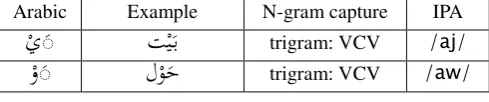
In general, Arabic spelling is a phonemic system with one-to-one letter to sound correspondence. Nevertheless, our mapping scheme is original due to its treatment of certain character sequences as compounds requiring transcription. This differentiates our scheme from the machine readable Speech Assessment Methods Phonetic Alphabet or SAMPA for Arabic (Wells 2002), where many more hand-crafted rules would need to be developed before implementing automatic Arabic > SAMPA transcription due to the sparseness of the scheme itself. Therefore, as well as the usual transcription of consonants, long and short vowels, and diacritic marks, we have compiled a dictionary of mapped MSA > IPA pairings that both anticipates and documents grapheme-phoneme relationships extending beyond a single letter to the immediate right-left context in fully vowelised Arabic text. For example, Arabic has two diphthongs which are each realised orthographically via the trigram sequence VCV, where V represents a short vowel or other diacritic mark and C is a consonant or semi-vowel (Fig. 2).
Arabic Example N-gram capture IPA
ْيَ◌
ﺖْﻴَـﺑ
trigram: VCV /aj/ْوَ◌
لْﻮَﺣ
trigram: VCV /aw/Figure 2: Two diphthongs represented by a trigram character sequence
[image:3.595.302.547.608.659.2]5.
The Arabic > IPA mapping algorithm
The Arabic > IPA mapping algorithm automates phonetic transcription of Arabic words and outputs a phonemic pronunciation for each word. The algorithm has two stages: the pre-processing stage where Arabic word letters are mapped to their IPA character equivalent on a one-to-one basis; and a second stage which involves the development and application of phonetic rules that modify the IPA string produced in the first stage to produce the correct IPA transcription of the input Arabic word. The following subsections briefly describe the stages of the algorithm. The algorithm is explained in detail in (Sawalha et al, 2014a).
5.1
Pre-processing stage
During this project, a carefully defined subset of the International Phonetic Alphabet (IPA) for Arabic transcription was defined (Brierley et al under review). This includes mapping Arabic consonant letters into one IPA alphabet such as (... ،ث ،ت ،ب) > (/b/, /t/, /θ/), or into two IPA alphabets such as (... ،ط ،ض ،ص ) > (/sȥ/, /dȥ/,/tȥ/). IPA alphabets for both long and short vowels
are also defined, long vowels such as (ي ،و ،ا)>
(/aə/,/uə/,/iə/), and short vowels such as
(ِ ، ُ ، َ◌)>(/a/,/u/,/i/). hamzah (ئ ،ؤ ،أ ،ء), regardless of form or shape, is represented by the IPA character (Ȥ). IPA alphabets for tanwῑn are defined such that ( ٍ◌ ، ٌ◌ ، ً◌) >
(/an/, /un/, /in/); sukūn is not mapped to any IPA
character because sukūn represents silence. Using these carefully defined sets of IPA alphabets, a 58-entry dictionary was constructed to facilitate the Arabic > IPA one-to-one mapping. Appendix I shows a basic version of our Arabic > IPA mapping; the full version appears in Brierley et al (under review).
The tokenization module of the SALMA-Tagger (Sawalha, 2011; Sawalha and Atwell, 2010) was used to tokenize and preprocess the input Arabic text. The SALMA-Tokenizer preprocesses Arabic words by resolving gemination marked by ( ّ◌) šaddah into two similar letters: the first carries a sukūn diacritic and the second carries a short vowel similar to the short vowel of the original geminated letter. The tokenizer also replaces the prolongation letter (آ) madd into hamzah followed by the long vowel 'alif. The SALMA-Tokenizer has a spell checking and correction module which verifies the spelling of the Arabic word in terms of valid letter and diacritic combinations. It limits each letter of the processed word to only one diacritic. The output of the SALMA-Tokenizer is an Arabic word string which best suits the one-to-one mapping of Arabic letters into IPA alphabets.
As a first step in the mapping process, the one-to-one mapping module reads the processed Arabic word. For each letter it searches the dictionary for its equivalent IPA alphabet. The output is an IPA string representing the
sequence of IPA alphabets equivalent to the Arabic letters and diacritics of the input word. For example the word
َنوُلَءاَسَتَي yatasā'alūna "they are asking one another" is mapped into the IPA string /jatasaaəȤaluwna/. The accuracy of the preprocessing stage of the Arabic > IPA mapping algorithm showed that about 70% of Arabic words in the test sample were not mapped correctly. Therefore, mapping Arabic words into IPA using one-to-one mapping only is not accurate and a rendering stage of pronunciation is needed. The following subsection discusses the rule-based stage of the Arabic > IPA algorithm that renders the produced string and generates 100% accurate results.
5.2
Rule development
As shown in the previous section, a pronunciation rendering stage is needed to produce correct phonetic transcription of Arabic words. Traditional Arabic orthography includes silent letters, and ambiguous letters such as the letters (ي ،و ،أ) ʾalif, wāw, and yāʾ which can be consonants, semi-vowels or long vowels. Also, short vowels and diacritics necessary to convey the pronunciation reliably are usually absent. Some letters appear in the orthographic word but are not pronounced and some sounds are not presented in the orthographic word altogether. The major challenges for the one-to-one mapping step are: dealing with the (i) definite article (i.e. whether the l is pronounced or assimilated to the following sound becoming a geminate of it), (ii) long vowels when they are pronounced as vowels, (iii) ʾalif of the group (قيرفتلا فلأ) which is not pronounced, (iv) words with special pronunciations, (v) hamzatual-waṣl and (vi) tanwīn.
The second stage of the Arabic > IPA mapping algorithm is based on especially developed rules and regular expressions to deal with cases for which the one-to-one mapping fails to generate a correct phonetic transcription. Output from the previous step was studied for the purpose of finding patterns in the mistaken transcriptions. Around 50 rules were developed and ordered correctly so that algorithm could generate the correct IPA transcriptions of input Arabic words. For example, words ending in tanwῑn al-fatḥ which were transcribed into /aaəan/ in the first stage, are rendered by the IPA string as /an/ as in the word
ًاَدﺎَﻬِﻣ
mihādan "resting place" which is transcribed into /mihaədan/. Other rules deal with the definite article (لا) when followed by a letter corresponding to coronal and non-coronal sounds3. If the definite article is followed by coronal sound then the IPA string /aəl/ representing the one-to-one mapping is replaced by /Ȥa/ followed by a doubling of the coronal sound such as transcribing the wordِﺈَﺒﻨﻟا
an-naba'i "news" as /ȤannabaȤi/. If it is followed by a non-coronal sound it is replaced by /Ȥal/,3
such as the word
ﻖَْﳊا
al-ḥaqqu "the truth" transcribed in the IPA string as /Ȥalħaqqu/. This process is non-trivial: Sawalha et al (2014a) has a detailed description of patterns of mistaken transcription and rules for correcting the output.6.
Evaluation
Evaluation of the Boundary Annotated Qur’an (version 2.0) focused on assessing the automatically generated Arabic > IPA transcription tiers of the BAQ corpus. The evaluation is performed using two methods: (i) measuring the accuracy of the algorithm by comparing the results against an especially constructed gold standard for evaluation; and (ii) generating a frequency list of Qur'an with automatically generated IPA transcriptions of the Qur'an word types and verifying these transcriptions by linguists specialized in tajwῑd and phonology.
6.1
The Qur’an gold standard
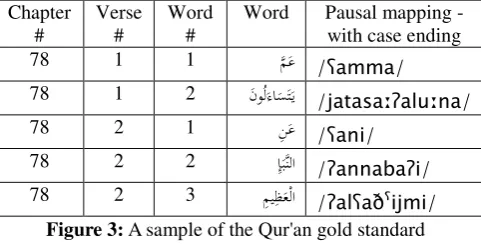
[image:5.595.51.292.426.549.2]A gold standard for evaluating the Arabic > IPA mapping algorithm was especially constructed. The gold standard consists of about 1000 words from the Qur'an, chapters 78 to 85. For each word in the gold standard, the IPA transcription was manually generated. Figure 3 shows a sample of the gold standard for evaluation. Evaluation of the output of the Arabic > IPA mapping algorithm showed an accuracy of 100%, in indication of what we had aspired for.
Figure 3: A sample of the Qur'an gold standard
6.2
Generation and verification of the IPA
transcriptions of the Qur'an
The second method for evaluating the Boundary Annotated Qur’an (version 2.0) was to manually check and verify the automatically-generated IPA transcriptions of all words in the BAQ corpus. The BAQ corpus consists of 77,430 words and 17,606 word types. To reduce the time and effort of manual verification of the IPA transcription, word types were verified rather than words. A frequency list of the Qur'an was generated first, and then the IPA transcription for each word type of the BAQ corpus was verified by linguists who are specialized in both tajwῑd and phonetics. This evaluation method is suitable for verifying the IPA transcriptions of the BAQ corpus words in their pausal forms while preserving case endings in the transcription. A sample of the frequency list for the first 50 word types is in Appendix II.
After manual verification of the Qur'an frequency list, we computed the accuracy of the Arabic>IPA transcription algorithm using the verified frequency list of the Qur'an. Only 91 errors in transcription were found in the Qur'an frequency list. These are 91 word types from a total of 17,606 word types in the list. Therefore, the accuracy of the automatic Arabic > IPA transcription algorithm is 99.48%. The 91 word type errors occur 347 times in the BAQ corpus which contains 77,430 words. Therefore, the computed accuracy of the automatic Arabic > IPA transcription algorithm is 99.55%.
On the other hand, contextual transcription of the BAQ corpus words is concerned with transcribing the words in context. They are transcribed so as to represent co-articulatory effects in continuous speech but with a definite pause at the end of each sentence. For example, the two sentences/verses in figure 3 " ِﺈَﺒﻨﻟا ِﻦَﻋ ﴾١﴿ َنﻮُﻟَءﺎَﺴَﺘَـﻳ ﻢَﻋ
﴿ ِﻢﻴِﻈَﻌْﻟا ٢
﴾ " "About what are they asking one another? (1) About the great news - (2) " are transcribed contextually into /ȥamma jatasaəȤaluən (1) ȥani nnabaȤi
lȥaðɭijm (2)/. Verification of the contextual transcription tier of the BAQ corpus is done by checking these transcriptions sentence by sentence. The Quranic verses in the BAQ corpus are divided into sentences and pauses are defined as either major or minor. This information, which is already provided, makes our task simpler and more accurate.
78 1 1 1 ﻢَﻋ ﻢَﻋ P - ȥamma ȥamma Eam~a
78 1 1 2 َنﻮُﻟَءٓ◌ﺎَﺴَﺘَـﻳ َنﻮُﻟَءﺎَﺴَﺘَـﻳ V || jatasaəȤaluəna jatasaəȤaluən yatasaA'aluwna لﺄﺳ
78 2 1 1 ِﻦَﻋ ِﻦَﻋ P - ȥani ȥani Eani
78 2 1 2 ِﺈَﺒﻨﻟٱ ِﺈَﺒﻨﻟا N - ȤannabaȤi nnabaȤi Aln~aba<i ﺄﺒﻧ
78 2 1 3 ِﻢﻴِﻈَﻌْﻟٱ ِﻢﻴِﻈَﻌْﻟا N || Ȥalȥaðɭijmi lȥaðɭijm AloEaZiymi ﻢﻈﻋ
78 3 1 1 ىِﺬﻟٱ يِﺬﻟا N - Ȥallaðiə Ȥallaðiə Al~a*iy
78 3 1 2 ْﻢُﻫ ْﻢُﻫ N - hum Hum humo
78 3 1 3 ِﻪﻴِﻓ ِﻪﻴِﻓ P - fiəhi fiəhi fiyhi
78 3 1 4 َنﻮُﻔِﻠَﺘُْﳐ َنﻮُﻔِﻠَﺘُْﳐ N || muxtalifuəna muxtalifuən muxotalifuwna ﻒﻠﺧ
78 4 1 1 ﻼَﻛ ﻼَﻛ P - kallaə kallaə kal~aA
78 4 1 2 َنﻮُﻤَﻠْﻌَـﻴَﺳ َنﻮُﻤَﻠْﻌَـﻴَﺳ V || sajaȥlamuəna sajaȥlamuən sayaEolamuwna ﻢﻠﻋ
Figure 4: shows a sample of the multi-tiered BAQ dataset version 2.0. Chapter
#
Verse #
Word #
Word Pausal mapping - with case ending
78 1 1 ﻢَﻋ /ȥamma/
78 1 2 َنﻮُﻟَءﺎَﺴَﺘَـﻳ /jatasaəȤaluəna/
78 2 1 ِﻦَﻋ /ȥani/
78 2 2 ِﺈَﺒﻨﻟا /ȤannabaȤi/
7.
The multi-tiered
Boundary Annotated
Qur’an
dataset: version 2.0
The Boundary-Annotated Qur’an dataset: version 1.0 contains 13 tiers, including: 2 tiers for the Arabic word, 2 tiers for part-of-speech, 2 tiers for boundary types, etc. Version 2.0 adds another 4 tiers for the BAQ dataset. These tiers are: (i) an IPA pausal transcription of the corpus words with case ending, (ii) an IPA contextual transcription tier, (iii) transliteration tier using Tim Buckwalter transliteration scheme4, and (iv) root for each word in the dataset. Figure 4 shows a sample of the multi-tiered BAQ dataset version 2.0.
8.
Conclusions
In this paper, we have extended the development of the Boundary Annotated Qur'an: a dataset for machine learning. Version 1.0 and 2.0 of the BAQ dataset contains multiple annotation tiers in a machine readable format. IPA phonetic transcriptions of the Qur'an are newly added tiers. Pausal phonemic transcriptions with and without case endings were automatically generated and added to the dataset. These transcriptions were then manually verified and corrected to reach 100% accurate dataset. A transliteration tier was added using Tim Buckwalter’s transliteration scheme for MSA Arabic words. This shows the difference between 1-to-1 letter mapping and IPA phonetic transcriptions. Finally, the root of each word in the dataset was added.
9.
References
Al-Ghalayyni. 2005. ةيبرعلاسوردلا عماج "Jami' Al-Duroos Al-Arabia" Saida - Lebanon: Al-Maktaba Al-Asriyiah "ةيرصعلاةبتكملا".
Beckman, M. and Hirschberg, J. 1994. The ToBI annotation conventions. The Ohio State University and AT&T Bell Laboratories, unpublished manuscript. Online. Accessed September 2011.
ftp://ftp.ling.ohio-state.edu/pub/phonetics/TOBI/ToBI/ToBI.6.html.
Brierley, C., Sawalha, M., Heselwood, B. and Atwell, E. (Under review). A Verified Arabic-IPA Mapping for Arabic Transcription Technology Informed by Quranic Recitation, Traditional Arabic Linguistics, and Modern Phonetics. Submitted to the Journal of Semitic Studies.
Brierley, C., Sawalha, M. and Atwell, E. 2014. Tools for Arabic Natural Language Processing: a case study in qalqalah prosody. To appear in Proc. Language Resources and Evaluation Conference (LREC 2014), Reykjavik.
Brierley, C., Sawalha, M., Atwell, E. 2012. “Open-Source Boundary-Annotated Corpus for Arabic Speech and Language Processing.” In Proceedings of Language Resources and Evaluation Conference (LREC), Istanbul, Turkey.
Habash, N., Soudi, A. and Buckwalter, T. 2007. On
4
http://www.qamus.org/transliteration.htm
Arabic Transliteration. In Soudi, A., van den Bosch, A. and Neumann, G. (eds.), Arabic Computational Morphology: Knowledge-based and Empirical Methods.
Harrag, A. and Mohamadi, T. 2010. QSDAS: New Quranic Speech Database for Arabic Speaker Recognition. In The Arabian Journal for Science and Engineering. 35, 2C. 7-19.
Hassan, Z.M. and Heselwood, B. (eds.). 2011. Instrumental Studies in Arabic Phonetics. Amsterdam. John Benjamins Publishing Company.
Ryding, Karin C. 2005. A Reference Grammar of Modern Standard Arabic. Cambridge. Cambridge University Press.
Sawalha et al 2014a. (Forthcoming). IPA transcription technology for Classical and Modern Standard Arabic. Sawalha, M., Brierley, C., and Atwell, E. 2012a.
‘Predicting Phrase Breaks in Classical and Modern Standard Arabic Text.’ In Proceedings of LREC 2012, Istanbul, Turkey.
Sawalha, M., Brierley, C., and Atwell, E. 2012b. “Open-Source Boundary-Annotated Qur’an Corpus for Arabic and Phrase Breaks Prediction in Classical and Modern Standard Arabic Text.” In Journal of Speech Sciences, 2.2.
Sharaf, A.B. 2011. Automatic categorization of Qur'anic chapters. In 7th. International Computing Conference in Arabic (ICCA'11), Riyadh, KSA.
Taylor, L.J. and Knowles, G. 1988. ‘Manual of Information to Accompany the SEC Corpus: The machine readable corpus of spoken English.‟
Accessed: January 2010.
Wells, J.C. 2002. SAMPA for Arabic. Online. Accessed: 25.04.2013. http://www.phon.ucl.ac.uk/home/sampa/arabic.htm
Appendix I: Arabic > IPA mapping
Arabicconsonants
IPA symbol selection
Equivalent sound (if any) in English
ا aə bag
ب b big
ت t tin
ث θ thin
ج ȴ jam
ح ħ breathy ‘h’ as in hollow
or whole
خ x loch
د d dog
ذ ð there
ر r rock
ز z zoo
س s sat
ش ȓ shall
ص sȥ a bit like the ‘so’ sound
in sock
ض dȥ a bit like 'd' sound in
'duck', 'bud', 'nod'
ط tȥ a bit like 't' sound in
'bought', 'bottle'
ظ ðȥ no English equivalent
but voiced th-like
ع ȥ no English equivalent
غ dz like the ‘r’ in the French
word rue
ف f fun
ق q no English equivalent
ك k king
ل l lemon
م m man
ن n next
ه h house
و w will
ي j yellow
ء Ȥ glottal stop as in
Cockney bottle Shaded cell: We are using /x/ for /χ/ for better readability of IPA transcriptions
Arabic short and long
vowels
IPA Equivalent sound (if any) in English
َ◌ a short ‘a’ as in man
ِ◌ i short ‘i’ as in him
ُ◌ u short ‘u’ as in fun
ا aə long ‘a’ as in car
ي iə long ‘i’ sound as in sheep
و uə long ‘u’ sound as in boot
Appendix II: A sample of the Qur'an
frequency list with IPA transcriptions of
pausal form with case ending
word type number
Word type frequency
Word type Word type in IPA
1 1673 ْﻦِﻣ min
2 1185 ِﰲ fiə
3 1010 ﺎَﻣ maə
4 828 ِﻪﻠﻟا Ȥallaəhi
5 812 َﻻ laə
6 810 َﻦﻳِﺬﻟا Ȥallaðiəna
7 733 ُﻪﻠﻟا Ȥallaəhu
8 691 َﻦِﻣ mina
9 670 ﻰَﻠَﻋ ȥalaə
10 662 ﻻِإ Ȥillaə
11 658 َﻻَو walaə
12 646 ﺎَﻣَو wamaə
13 609 نِإ Ȥinna
14 592 َﻪﻠﻟا Ȥallaəha
15 519 ْنَأ Ȥan
16 416 َلﺎَﻗ qaəla
17 405 َﱃِإ Ȥilaə
18 372 ْﻦَﻣ man
19 344 ْنِإ Ȥin
20 337 ُﰒ θumma
21 327 ِﻪِﺑ bihi
22 325 ْﻢَُﳍ lahum
23 323 َنﺎَﻛ kaəna
24 296 ﺎَِﲟ bimaə
25 294 ْﻢُﻜَﻟ lakum
26 280 َﻚِﻟَذ ðaəlika
27 275 ُﻪَﻟ lahu
28 268 يِﺬﻟا Ȥallaðiə
29 265 َﻮُﻫ huwa
30 264 ْوَأ Ȥaw
31 263 ْﻞُﻗ qul
32 253 اﻮُﻨَﻣآ Ȥaəmanuə
33 250 اﻮُﻟﺎَﻗ qaəluə
34 241 ﺎَﻬﻴِﻓ fiəhaə
35 239 ُﻪﻠﻟاَو wallaəhu
36 234 ْﻦَﻣَو waman
37 229 اﻮُﻧﺎَﻛ kaənuə
38 219 ِضْرَْﻷا ȤalȤardɭi
39 195 اَذِإ Ȥiðaə