Sandhya. World Journal of Pharmaceutical and Life Sciences
EFFECTIVENESS OF STRUCTURED TEACHING PROGRAMME ON KNOWLEDGE
REGARDING ALLERGIC RESPIRATORY DISORDERS AND THEIR PREVENTION IN
CHILDREN AMONG MOTHERS
Sandhya P.*
Government College of Nursing, Fort-Bengaluru, Karnataka, India-560002.
Article Received on 18/06/2019 Article Revised on 08/07/2019 Article Accepted on 29/07/2019
INTRODUCTION
Health is the most important aspect of life, Children are vital to nation. Parents provide every advantage possible to the children in their families and to ensure that they are healthy. Under-five children‟s are vulnerable group constitute of 13% of total population of India.
In India, the most common disease affecting children is acute respiratory infection (ARI), which is responsible for about 30-50% of visits to health facilities and for about 20-40% hospital admissions.Outdoor air pollution in developed countries cause excess deaths and increased risk during the times of high pollution.
STATEMENT OF THE PROBLEM
“A study to evaluate the effectiveness of structured teaching programme on knowledge regarding allergic respiratory disorders and their prevention among mothers at selected rural area, Bengaluru”.
OBJECTIVES
1. To assess the knowledge of mothers regarding allergic respiratory disorders and their prevention before and after administering structured teaching programme.
2. To find an association between posttest levels of knowledge of mothers regarding allergic respiratory disorder and their prevention and selected demographic variables variables.
HYPOTHESIS
H1: There will be a significant increase in the mean posttest knowledge scores of mothers.
H2: There will be a significant association between post-test knowledge scores and the selected demographic variables.
ASSUMPTIONS
1.Children are vulnerable and exposed to the allergic resoiratory disorders.
2.Mothers will have some knowledge.
3.Structured teaching programme can increase the knowledge of mothers.
World Journal of Pharmaceutical and Life Sciences
WJPLS
www.wjpls.org
SJIF Impact Factor: 5.088*Corresponding Author: Sandhya P.
Government College of Nursing, Fort-Bengaluru, Karnataka, India-560002.
ABSTRACT
The study was to “Evaluate the effectiveness of structured teaching programme on knowledge regarding allergic respiratory disorders and their prevention in children among mothers at selected rural area,bengaluru”. The study involved Pre-Experimental design, with Random sampling method. Information was collected from 50 mothers of under-five using the structured interview schedule. STP was implemented and the post-test was conducted after 7 days. Findings related to effectiveness of structured teaching programme showed that the overall mean knowledge score in pre-test is 31.5% and in post-test 59.25% with the enhancement of 27.75% and it is significant at 5% level. The study concluded that STP was effective in improving the knowledge mothers of under-fives regarding allergic respiratory disorders and their prevention in children.
KEYWORDS:
1. Knowledge: is the responses of mothers to the items included in the structured questionnaire regarding allergic respiratory disorders and their prevention and expressed in terms of scores.
2. The allergic respiratory disorders: Respiratory disorders caused due to the allergic effect of allergens. 3. Allergens: The effect of substances which are responsible for allergic reaction.
For Ex: Environmental changes, pollen, dust, furry pets, passive smoke, firewood, kerosene, cosmetics and food, etc.
REVIEW OF LITERATURE
The Review of literature was divided into:
1. Assessment of knowledge regarding allergic respiratory disorders.
2. Effects of allergens on children. 3. Preventive measures.
4. Effectiveness of structured teaching programme.
CONCEPTUAL FRAMEWORK
The conceptual framework was based on Imogene King‟s Goal attainment theory.
METHODOLOGY
Research approach: Evaluative approach.
Research design: Pre-experimental i.e., one group pre-test post-test design was adopted for the study. Schematic representation:
Group Randomization Pre test Treatment Post Test
Single R O1 X O2
R-Randomization
O1 - Pretest knowledge scores
X - administration of Stuructured Teaching Programme O2 –Post-test knowledge score
Variables
Independent variable- Structured teaching programme.
Dependent variable- knowledge of mothers. Attribute variables - Age, education, occupation,
type of family, family income, type of house, cooking fuel used, type of diet, number of under-five children, presence of allergic respiratory disorders in the family and history of respiratory problems and source of health information.
Setting of the Study- The study was conducted at selected rural area, Bengaluru.
Population -Mothers of under-fives residing at selected rural area, Bengaluru.
Sample -50 mothers of under-fives.
Sampling Technique-Simple random sampling technique.
Criteria for Selection of Sample Inclusion Criteria
1.Mothers who are present during the study period. 2.Mothers those who arewilling to participate in the study.
3.Mothers who are present at the time of study.
Exclusion Criteria
Mothers who are sick during the study period.
Data collection tool
Structured knowledge questionaire The tool was divided into two parts: i. Demographic performa.
ii. Structured knowledge questionaire. There were 30 items with a maximum total score of 30.
Validity: The tool and the intervention was validated by 14 Experts and 1 Paediatrician.
Reliability of the Tool: Split half method with Spearman‟s Brown Prophecy formula (r=2r/1+r) was
used to measure coefficient of internal consistency. The reliability co-efficient for knowledge questionnaire was found to be 0.932 and validity co-efficient worked to be 0.962 revealing the tool is reliable and feasible.
Data collection procedure: The researcher collected data from the sample pretest which was conducted followed by structured teaching programme. The duration of the STP was 45 minutes and the total time taken for the study was on eand half hour. After 7 days a post test was conducted by using the same structured knowledge scores.
Plan for data analysis: The demographic variables were analyzed by using descriptive statistics(Frequency and percentage). The effectiveness of structured teaching programme was analyzed by inferential statistics(Paired „t‟ test). Association between demographic variables with knowledge scores were analyzed by using chi-square test.
RESULTS
SECTION 1:
Table – 1: Pre-test and post-test mean knowledge on allergic respiratory disorders and their prevention in children.
N=50
Aspects Max.
Score
Respondents Knowledge Paired „t‟ Test
Mean SD Mean (%)
Pre test 30 12.6 4.63 31.5
20.57*
Post test 30 23.7 4.09 59.25
Enhancement 30 11.1 0.5 27.75
* Significant at 5% level, t (0.05,49df ) = 1.96
Table – 2: Aspect wise mean pre-test and post-test knowledge on allergic respiratory disorders and their prevention in children.
N = 50
No. Knowledge Aspects
Respondents Knowledge (%) Paired
„t‟ Test
Pre test Post test Enhancement
Mean SD Mean SD Mean SD
I
General information on anatomy and physiology of respiratory system and ARD
24.4 1.08 49.8 1.17 25.4 0.09 12.7*
II
Information regarding causes, signs and symptoms and their complication of ARD
34.2 1.42 68.8 1.4 34.66 0.02 12*
III
Information regarding prevention of ARD in children.
33.7 2.51 59.61 1.83 25.90 0.67 12.95*
*Significant at 5% level, t (0.05,49df ) = 1.96
SECTION 2:
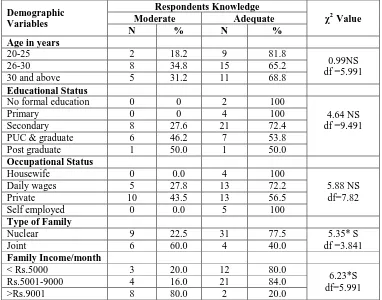
Table –3: Association between sociodemographic variables and knowledge level of respondents on allergic respiratory disorders and their prevention in children.
N=50
Demographic Variables
Respondents Knowledge
χ2
Value
Moderate Adequate
N % N %
Age in years
20-25 2 18.2 9 81.8
0.99NS df =5.991
26-30 8 34.8 15 65.2
30 and above 5 31.2 11 68.8
Educational Status
No formal education 0 0 2 100
4.64 NS df =9.491
Primary 0 0 4 100
Secondary 8 27.6 21 72.4
PUC & graduate 6 46.2 7 53.8
Post graduate 1 50.0 1 50.0
Occupational Status
Housewife 0 0.0 4 100
5.88 NS df=7.82
Daily wages 5 27.8 13 72.2
Private 10 43.5 13 56.5
Self employed 0 0.0 5 100
Type of Family
Nuclear 9 22.5 31 77.5 5.35* S
df =3.841
Joint 6 60.0 4 40.0
Family Income/month
< Rs.5000 3 20.0 12 80.0
6.23*S df=5.991
Rs.5001-9000 4 16.0 21 84.0
NS-Non significant S-Significant
DISCUSSION
The assessment of knowledge among mother of underfives regarding allergic respiratory disorders and their prevention in children, in pre-test 33[66.0%] parents had inadequate knowledge and 17[34.0%] had moderate knowledge, and in the post-test 15[30.0%] had gained moderately adequate knowledge and 35[70.0%] had gained adequate knowledge towards allergic respiratory disorders and their prevention in children. The improvement mean of knowledge was 27.75% and „t‟ value 20.57. It shows that there is a significant improvement in knowledge of mothers of underfives after administration of structured teaching programme.
IMPLICATIONS Nursing Practice
Nursing professionals needs to update their knowledge in regards to allergic respiratory disorders and their
prevention in children and incorporate the knowledge in daily practice and Motivate the mothers to make use of the laws and policies in protecting their children from exposure of allergens.
Nursing Education
Nurse educators should emphasize more on preparing students to impart health information to the public regarding allergic respiratory disorders and their prevention in children.
Nursing Administration
Effectively collaborate the community health agencies with the community leaders so that awareness can be given to the community regarding allergic respiratory disorders and their prevention in children.
Type of House
Pucca 4 22.2 14 77.8
0.82 NS df =5.991,
Kacha 7 35.0 13 65.0
Semi-pucca 4 33.3 8 66.7
Cooking fuel used
Wood 9 28.1 23 71.9
0.14 NS df =5.991
Kerosene 4 33.3 8 66.7
Gas 2 33.3 4 66.7
Diet pattern
Vegetarian 9 52.9 8 47.1 6.45* S
df=3.841
Mixed 6 18.2 27 81.8
Total No of under-five children
One 0 0.0 3 100
1.74 NS df=5.991
Two 7 36.8 12 63.2
Three 8 28.6 20 71.4
Child born less than 2.5Kg
Yes 0 0.0 11 100 6.04 * S
df = 3.841
No 15 38.5 24 61.5
Exclusively breast fed
Yes 9 22.5 31 77.5 5.35*S
df = 3.841
No 6 60.0 4 40.0
Respondent suffering from ARD
Yes 8 21.6 29 78.4 4.75*S
df = 3.841
No 7 53.8 6 46.2
Health problems of respiratory system in under five children
Yes 15 31.2 33 68.8 0.89 NS
df = 3.841
No 0 0.0 2 100
Source of Information
Electronic media 8 27.6 21 72.4
4.64 NS df = 9.491
Print media 6 46.2 7 53.8
Health personnel 0 0.0 2 100.0
Nursing Research
Findings of the present study suggest the educator and administrator should encourage nurses to read, discuss and conduct research to validate effectiveness of structured teaching programme to increase the knowledge about allergic respiratory disorders and their prevention in children and bring about public awareness.
Recommendations
A similar study can be conducted on public to assess knowledge and attitude towards allergic respiratory disorders and their prevention in children.
Manuals, information booklets and self-instruction module can be prepared and distributed in community to create awareness.
Follow up study can be conducted to evaluate the association between knowledge and attitude of mothers of under-five.
CONCLUSION: The study findings analysis shows that there was a significant gain in knowledge regarding allergic respiratory disorders and their prevention in children.
ACKNOWLEDGEMENT
I thank Almighty, the path of light and the ray of hope of
my life for his grace and endless blessings throughout my study.
I would like to extend my deepest gratitude to Guide and
all the Experts who have contributed in the form of
constructive criticism and suggestions to formulate the
tool and participants in Dodballapura PHC area,
Bengaluru Rural District, who participated in this
study.
I express my sincere gratitude to my mother Smt.
C.M.Rathnamma, my father Sri. A. Puttaswamy and my sister Ms. Vindhya.P and my husband Mr
Shashikumara.N.S for their support and encouragement
for my study.
Thanks are also to all of my well-wishers and many
other who have helped me directly and indirectly in the preparation of this thesis.
Place: Bengaluru Sd/- Date: 24-07-2019 Sandhya. P
REFERENCE
1. Dorothy R. Marlow, Barbara A. Redding. Text of Pediatric Nursing. 6th Edition. Elsevier Publication.New Delhi. Page number: 239.
2. Robert Jenningsheinsohn, Robertlynnkabel.Air quality control handbook. Available from: http://www.eng.utoledo.edu/~akumar/IAP1/introduc tion.htm
andhttp://www.paho.org/english/ad/dpc/cd/aiepi1.ht m
3. Rahman K. Second hand smoke: A major public health threat. TFI News letter: World Health Organization. 2009:(2)1.
4. Report on respiratory allergens. 2012. 11
Dec:Available from:
http://www.bangaloremirror.com/article/1/20110306 20110306023016965fa137f79/Min-summer-temp- to-be-13%C2%BAc-Better-take-care-of-your-health.html?pageno=1
5. World Health Organization. WHO Meeting on Prevention and Control of Chronic Respiratory Diseases. Geneva; 2004 June: Switzerland.17-19. Available