Kor, A and Bennett, B (2013) A Hybrid Reasoning Model for “Whole and Part” Cardinal Direction
Rela-tions. Advances in Artificial Intelligence. ISSN 1687-7489 DOI: https://doi.org/10.1155/2013/205261
Link to Leeds Beckett Repository record:
http://eprints.leedsbeckett.ac.uk/709/
Document Version:
Article
Creative Commons: Attribution 3.0
The aim of the Leeds Beckett Repository is to provide open access to our research, as required by
funder policies and permitted by publishers and copyright law.
The Leeds Beckett repository holds a wide range of publications, each of which has been
checked for copyright and the relevant embargo period has been applied by the Research Services
team.
We operate on a standard take-down policy.
If you are the author or publisher of an output
and you would like it removed from the repository, please
contact us
and we will investigate on a
case-by-case basis.
Research Article
A Hybrid Reasoning Model for ‘‘Whole and Part’’ Cardinal
Direction Relations
Ah-Lian Kor
1and Brandon Bennett
21Arts Environment and Technology Faculty, Leeds Metropolitan University, Headingley Campus, Leeds LS6 3QS, UK 2School of Computing, University of Leeds, Leeds LS2 9JT, UK
Correspondence should be addressed to Ah-Lian Kor; [email protected]
Received 8 May 2012; Accepted 24 September 2012
Academic Editor: Ian Mitchell
Copyright © 2013 A.-L. Kor and B. Bennett. This is an open access article distributed under the Creative Commons Attribution License, which permits unrestricted use, distribution, and reproduction in any medium, provided the original work is properly cited.
We have shown how the ninetilesin the projection-based model for cardinal directions can be partitioned into sets based on
horizontal and vertical constraints (calledHorizontal and Vertical Constraints Model) in our previous papers (Kor and Bennett,
2003 and 2010). In order to come up with an expressive hybrid model for direction relations between two-dimensional single-piece regions (without holes), we integrate the well-known RCC-8 model with the above-mentioned model. From this expressive
hybrid model, we derive 8 basic binary relations and 13 feasible as well as jointly exhaustive relations for thex- andy-directions,
respectively. Based on these basic binary relations, we derive two separate8 × 8composition tables for both the expressive and
weak direction relations. We introduce a formula that can be used for the computation of the composition of expressive and weak direction relations between “whole or part” regions. Lastly, we also show how the expressive hybrid model can be used to make several existential inferences that are not possible for existing models.
1. Introduction
Relative positions of regions in large-scale spaces, and partic-ularly in the geographic domain, are often described by rela-tions referring to cardinal direcrela-tions. These relarela-tions specify the direction from one region to another in terms of the familiar compass bearings: north, south, east, and west. The intermediate directions northwest, northeast, southwest, and southeast are also often used. Some models for reasoning with
cardinal directions are the cone-shaped [1, 2],
projection-based models (ibid), and direction matrix [3–5].
Papadias and Theodoridis [6] describe topological and
direction relations between regions using their minimum bounding rectangles (MBRs). However, the language used is not expressive enough to describe direction relations. Additionally, the MBR technique yields erroneous outcome
when involving regions that are not rectangular in shape [4]
Some work has been done on hybrid direction models. Escrig
and Toledo [7] and Clementini et al. [8] integrated qualitative
orientation and distance to obtain positional information.
Isli [9] combined Frank’s [1, 2] cardinal direction relations
model and Freksa’s [10] orientation model to facilitate a more
expressive reasoning mechanism. Sharma and Flewelling
[11] infer spatial relations from integrated topological and
cardinal direction relations. Liu and colleagues [12] have
developed reasoning algorithms which combine RCC-8 [13]
for topological relations (discussed inSection 4) and the
car-dinal direction calculus (CDC [3–5], discussed inSection 2)
for direction relations. Li and colleagues’ work [14, 15]
focuses on the development and evaluation of an efficient reasoning mechanism for RCC-8 and RA (Rectangle Algebra,
and further explanation can be found in [16,17]) which is
employed to solve the satisfiability problem of these two joint constraint networks.
Typically, composition tables are used to infer spatial relations between objects. They have been employed to make
different inferences about cardinal directions relations [3,19–
North
South
East West
N NE NW
E W
S
SW SE
[image:3.600.339.513.72.197.2]Position of an observer
Figure 1: Cone-shaped direction model with 4 or 8 partitions (ibid).
EQ North
South North
South
Ea
st
Ea
st
We
st
We
st
Two separate sets of
half-planes
Two integrated sets of
half-planes NE NW
SE SW
(Frank, 1992 and 1996)
(Frank, 1992 and 1996)
(Ligozat, 1998)
[image:3.600.67.272.73.157.2]Point B
Figure 2: Cardinal directions defined by half-planes.
can lead to tractable computation of inferences [25]. In this
paper, we have developed an expressive hybrid model for direction relations. We will describe the binary relations in
the model and define“whole and part”relations. Based on this
model, we derive two8 × 8composition tables forexpressive
and weakdirection relations. This is followed by introducing a
formula which could be used to compute bothexpressive and
weakdirection relations for“whole and part”regions. Finally,
we will demonstrate how the model could be used to make several types of existential inferences.
2. Cardinal Direction Models
Frank [1, 2] defines cardinal directions as cones which
are related to the angular direction between an observer’s position (in the form of a point) and a destination point. The cone-shaped cardinal direction model could have 4, 8,
or more partitions (look atFigure 1).
Frank defines the four major cardinal directions (north, south, east, and west) as pair-wise opposites and half planes. When the two sets of half planes are combined, it yields four intermediate cardinal directions (northeast, northwest,
southeast, and southwest) which are depicted in Figure 2.
Ligozat [21] applies the model to points in a two-dimensional
space. Thus, the referent object,Point B, will be given the four
major directions. However, the relations between two objects will be denoted by one of the following basic relations: N, S, E, W, NE, NW, SE, SW, or EQ.
Region
NE( )
SE( )
SW( ) S( )
W( )
N( )
E( ) O( )
NW(𝑎
𝑎
𝑎 𝑎
𝑎 𝑎
𝑎 𝑎
𝑎
𝑎 )
Figure 3: Cardinal directions defined by tiles for extended objects
[1,2].
Frank [1,2] extends the half-planes to tiles for regions (as
shown inFigure 3). In this projection-based model, the plane
of an arbitrary single-piece regionais partitioned into nine
tiles, North-West, NW(a); North, N(a); North-East, NE(a); South-West, SW(a); South, S(a); South-East, SE(a); West, W(a); Neutral Zone, O(a); East, E(a). According to Frank, the O tile is considered a neutral zone, because in this tile, the relative cardinal direction between two regions cannot be determined due to their proximity.
Frank compares and contrasts reasoning with the cone-shaped and the projection-based models for cardinal direc-tions. The reasoning capability for both the systems is limited and weak though they do not differ substantially in their reasoning outcomes. In order to create a more expressive
rea-soning model, Isli [26] integrates the Frank’s cone-shaped and
projection-based models to facilitate reasoning about relative position of points of the 2-dimensional space. This hybrid model is well suited for applications of large-scale high-level vision, such as, for example, satellite-like surveillance of a geographic area.
The cardinal direction calculus (CDC) [3–5] is a very
expressive qualitative calculus for directional information of
extended objects. A direction relation matrix (DRM) in (1)
is used to represent direction relations between connected
plane regions. Liu and colleagues [27, 28] have shown that
consistency checking of complete networks of basic CDC constraints is tractable, while reasoning with the CDC in gen-eral is NP hard. However, if some constraints are unspecified, then consistency checking of incomplete networks of basic CDC constraints is intractable.
The cardinal direction of a target object (regionb) to a
referent object (regiona) as shown inFigure 4is described by
recording those tiles covered by the target object. According
to Goyal and Egenhofer [4], a 3 × 3 matrix is employed
to register the intersections between the target object and
the tiles of the referent object (see (1)). The elements in
the direction-relation matrix correspond to the tiles of the
referent object, regiona(inFigure 4).
In (1), the symbol 0 represents empty tile while ¬0
represents nonempty tile. These are used to describe cardinal
directions at a coarse granularity level. InFigure 4, region𝑏
[image:3.600.62.278.195.374.2]Region𝑏
Region
NE( )
SE( )
SW( ) S( )
W( )
N( )
E( ) O( )
NW(𝑎
𝑎
𝑎 𝑎
𝑎 𝑎
𝑎 𝑎
𝑎
[image:4.600.86.255.73.206.2]𝑎 )
Figure 4: Nine tiles with regions𝑎(as the referent object) and𝑏(as
the target object) [4,5].
𝑋max(𝑎)
Horizontal set Vertical set
𝑋min(𝑎)
𝑌min(𝑎
𝑎
)
[image:4.600.70.275.278.426.2]𝑌max(𝑎)
Figure 5: Horizontal and vertical sets oftilesfora.
tiles are considered nonempty while the rest are considered
empty (as shown in (1)).
Goyal and Egenhofer [5] extend the direction relation
matrix, so that it will be more expressive. Instead of using the empty and nonempty notations, it registers how much (in terms of proportion) the target region occupies each tile
(see (2)). The expressive direction relation matrix in (2) has
6 elements of zero and three nonzero elements which sum up to 1.0. If the matrix has only one nonzero element then it
is known as asingle element direction relation matrixwhile
a matrix with more than one nonzero element is called a multielement direction relation matrix(ibid).
Coarse direction relation matrix [4]:
dir𝑅𝑅(𝑎, 𝑏) = (
NW(𝑎) ∩ 𝑏 N(𝑎) ∩ 𝑏 NE(𝑎) ∩ 𝑏 W(𝑎) ∩ 𝑏 O(𝑎) ∩ 𝑏 E(𝑎) ∩ 𝑏 SW(𝑎) ∩ 𝑏 S(𝑎) ∩ 𝑏 SE(𝑎) ∩ 𝑏
) ,
dir𝑅𝑅(𝑎, 𝑏) = (
0 ¬0 ¬0 0 0 ¬0 0 0 0) .
(1)
dir𝑅𝑅(𝑎, 𝑏)
= ((
(
area(NW(𝑎) ∩ 𝑏)
area of𝑏
area(N(𝑎) ∩ 𝑏)
area of𝑏
area(NE(𝑎) ∩ 𝑏)
area of𝑏 area(W(𝑎) ∩ 𝑏)
area of𝑏
area(O(𝑎) ∩ 𝑏)
area of𝑏
area(E(𝑎) ∩ 𝑏)
area of𝑏 area(SW(𝑎) ∩ 𝑏)
area of𝑏
area(S(𝑎) ∩ 𝑏)
area of𝑏
area(SE(𝑎) ∩ 𝑏)
area of𝑏
) )
) ,
dir𝑅𝑅(𝑎, 𝑏) = (
0 0.05 0.45 0 0 0.50 0 0 0 ) .
(2)
3. Horizontal and Vertical Constraints Model
Every region has a minimal bounding box with specific
minimum and maximum𝑥(and𝑦) values. The boundaries
of the minimal bounding box of a region𝑎are depicted in
Figure 5. The set of boundaries of the minimal bounding
box for region𝑎could be represented as{𝑋min(𝑎),𝑋max(𝑎),
𝑌min(𝑎),𝑌max(𝑎)}, and these values will be employed to define
each tile.
The definition of the nine tiles in terms of the boundaries of the minimal bounding box is listed as below. Note, in this paper, all the tiles are regarded as mutually exclusive. Thus neighboring tiles cannot share common boundaries:
(i) N(𝑎) ≡ {⟨𝑥, 𝑦⟩|𝑋min(𝑎)≤ 𝑥<𝑋max(𝑎) ∧ 𝑦≥𝑌max(𝑎)},
(ii) NE(𝑎) ≡ {⟨𝑥, 𝑦⟩|𝑥≥𝑋max(𝑎)∧𝑦≥𝑌max(𝑎)},
(iii) NW(𝑎) ≡ {⟨𝑥, 𝑦⟩|𝑥<𝑋min(𝑎)∧𝑦≥𝑌max(𝑎)},
(iv) S(𝑎) ≡ {⟨𝑥, 𝑦⟩|𝑋min(𝑎)≤𝑥<𝑋max(𝑎)∧𝑦<𝑌min(𝑎)},
(v) SE(𝑎) ≡ {⟨𝑥, 𝑦⟩|𝑥≥𝑋max(𝑎)∧𝑦<𝑌min(𝑎)},
(vi) SW(𝑎) ≡ {⟨𝑥, 𝑦⟩|𝑥<𝑋min(𝑎)∧𝑦<𝑌min(𝑎)},
(vii) E(𝑎) ≡ {⟨𝑥, 𝑦⟩|𝑥≥𝑋max(𝑎)∧𝑌min(𝑎)≤𝑦<𝑌max(𝑎)},
(viii) W(𝑎) ≡ {⟨𝑥, 𝑦⟩|𝑥 < 𝑋min(𝑎)∧𝑌min(𝑎)≤𝑦<𝑌max(𝑎)},
(ix) O(𝑎) ≡ {⟨𝑥, 𝑦⟩ | 𝑋min(𝑎) ≤ 𝑥 < 𝑋max(𝑎)∧𝑌min(𝑎) ≤ 𝑦 <
𝑌max(𝑎)}.
In our previous papers [29, 30], we have shown how
to partition the nine tiles (in Figure 5) into sets based on
horizontal and vertical constraints called the Horizontal
and Vertical Constraints Model. However, in this paper, we shall rename the sets for easy comprehension purposes. The following are the definitions of the partitioned regions.
(i) WeakNorth(a) is the region that covers the tiles
NW(a), N(a), and NE(a). WeakNorth(a)≡NW(a)∪
N(a)∪NE(a).
(ii) Horizontal(a) is the region that covers thetilesW(a),
O(a), and E(a). Horizontal(a)≡W(a)∪O(a)∪E(a).
(iii) WeakSouth(a) is the region that covers the tiles
SW(a), S(a), and SE(a). WeakSouth(a) ≡ SW(a) ∪
(iv) WeakWest(a) is the region that covers thetilesSW(a),
W(a), and NW(a). WeakWest(a)≡SW(a)∪W(a)∪
NW(a).
(v) Vertical(a) is the region that covers thetilesS(a), O(a),
and N(a). Vertical(a)≡S(a)∪O(a)∪N(a).
(vi) WeakEast(a) is the region that covers thetilesSE(a),
E(a), and NE(a). WeakEast(a) ≡ SE(a) ∪ E(a) ∪
NE(a).
4. RCC Model
RCC stands for region connection calculus [13, 18, 31].
It is a first-order theory employed for qualitative spatial representation as well as reasoning and is based on Clarke’s
logic of connection [32,33]. The connection predicate, C(a,
b), which means “region a is connected with region b”, is the only primitive predicate for RCC. This dyadic relation is both
reflexive and symmetric and holds whenever regions𝑎and𝑏
are “connected.” The two main axioms expressing reflexivity
and symmetry [18] are as follows:
∀𝑎[C(𝑎, 𝑎)] (reflexive)
∀𝑎∀𝑏[C(𝑎, 𝑏) →C(𝑏, 𝑎)] (symmetric) . (3)
Based on this primitive, a basic set of dyadic relations are
defined as shown inTable 1.
The relations P, PP, TPP, and NTPP are nonsymmetrical and will have their respective inverses (Pi, PPi, TPPi, and NTPPi). Of all the listed relations, only 8 relations in the
following set{DC, EC, PO, EQ, TPP, NTPP, TPPi, NTPPi}
are provably jointly exhaustive and pairwise disjoint (JEPD— which means any two regions are related by exactly one of
these eight relations [34, 35]). Randell and colleagues [13]
refer this set of relations as RCC-8, and they are depicted in Figure 6.
5. Expressive Hybrid Model
In our expressive hybrid model, we have combined our Horizontal and Vertical Constraints Model[29,30] and
RCC-8 [13].
5.1. Definitions. If there is a referent regiona and another
arbitrary regionb, the possible basic binary relations between
them can be defined as below. In terms of weak relations,
(i)WeakNorth(b,a):b⊆WeakNorth(a), (ii)Horizontal(b,a):b⊆Horizontal(a),
(iii)WeakSouth(b,a):b⊆WeakSouth(a),
(iv)WeakEast(b,a):b⊆WeakEast(a), (v)Vertical(b,a):b⊆Vertical(a), (vi)WeakWest(b,a):b⊆WeakWest(a).
In terms of RCC-8 relations,
(i) DCy(a,b):y-dimension of𝑎is disconnected from
y-dimension ofb,
(ii) EQy(a,b): y-dimension of 𝑎 is identical with
y-dimension ofb,
(iii) POy(a,b): y-dimension of 𝑎 partially overlaps
y-dimension ofb,
(iv) ECy(a,b):y-dimension of𝑎is externally connected to
y-dimension ofb,
(v) TPPy(a,b): y-dimension of 𝑎 is a tangential proper
part ofy-dimension ofb,
(vi) NTPPy(a,b): y-dimension of 𝑎 is a nontangential
proper part ofy-dimension ofb,
(vii) TPPiy(a,b): y-dimension of𝑏is a tangential proper
part ofy-dimension ofa,
(viii) NTPPiy(a,b): y-dimension of 𝑏 is a non-tangential
proper part ofy-dimension ofa,
(ix) DCx(a,b):x-dimension of𝑎is disconnected from
x-dimension ofb,
(x) EQx(a,b): x-dimension of 𝑎 is identical with
x-dimension ofb,
(xi) POx(a,b): x-dimension of 𝑎 partially overlaps
x-dimension ofb,
(xii) ECx(a,b):x-dimension of𝑎is externally connected to
x-dimension ofb,
(xiii) TPPx(a,b): x-dimension of 𝑎is a tangential proper
part ofx-dimension ofb,
(xiv) NTPPx(a,b): x-dimension of 𝑎 is a non-tangential
proper part ofx-dimension ofb,
(xv) TPPix(a,b):x-dimension of𝑏 is a tangential proper
part ofx-dimension ofa,
(xvi) NTPPix(a,b): x-dimension of𝑏 is a non-tangential
proper part ofx-dimension ofa.
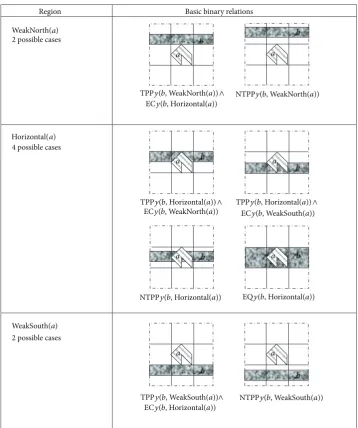
5.2. Basic Binary Relations of the Hybrid Model. In this section, we shall demonstrate how we come up with all possible binary direction relations for the hybrid model. All the possible basic binary relations for each horizontal set are
shown in Figure 7. The notations that will be used in this
section are as follows.
(i) RELy(b,Z)is any basic binary relation between𝑏and
the horizontally partitioned region,𝑍.
(ii) RELx(b,Z)is any basic binary relation between𝑏and
the vertically partitioned region,𝑍.
Based on Figure 7, the total number of possible binary
relations for the hybrid model in the y-direction is [(2 +
4 + 2) + (2 × 4) + (2 × 2) + (4 × 2) + (2 × 4 × 2)]which equals 44 cases. However, due to the single-piece condition, the following rules apply.
Rule 1. ¬(b⊆WeakNorth(a)∧ 𝑏 ⊆WeakSouth(a)).
Rule 2. Assume 𝑈 to be {WeakNorth(a), Horizontal(a),
𝑎 𝑎 𝑎
𝑎
𝑏
𝑎
𝑎
𝑎 𝑎
𝑏
𝑏 𝑏 𝑏
𝑏 𝑏
𝑏
DC(𝑎, 𝑏) EC(𝑎, 𝑏) PO(𝑎, 𝑏) EQ(𝑎, 𝑏)
𝑎disconnected from𝑏 𝑎externally connected to𝑏 𝑎partial overlapping𝑏 𝑎equals𝑏
TTP(𝑎, 𝑏)
𝑎tangential proper
part of𝑏
TTPi(𝑎, 𝑏)
𝑏tangential proper
part of𝑎
NTTP(𝑎, 𝑏)
𝑎nontangential proper
part of𝑏
NTTPi(𝑎, 𝑏)
𝑏nontangential proper
[image:6.600.58.550.361.502.2]part of𝑎
Figure 6: 8 basic JEPD RCC binary relations [13].
Table 1: Spatial relations defined in terms of C(𝑎, 𝑏)[18].
Relations Semantics Definition
DC(𝑎, 𝑏) ais disconnected fromb ¬C(𝑎, 𝑏)
P(𝑎, 𝑏) ais part ofb ∀𝑒[C(𝑒, 𝑎) → C(𝑒, 𝑏)]
PP(𝑎, 𝑏) ais a proper part ofb P(𝑎, 𝑏) ∧ ¬P(𝑏, 𝑎)
EQ(𝑎, 𝑏) ais identical withb P(𝑎, 𝑏) ∧P(𝑏, 𝑎)
O(𝑎, 𝑏) aoverlapsb ∃𝑒[P(𝑒, 𝑎) ∧P(𝑒, 𝑏)]
DR(𝑎, 𝑏) ais discrete fromb ¬O(𝑎, 𝑏)
PO(𝑎, 𝑏) apartially overlapsb O(𝑎, 𝑏) ∧ ¬P(𝑎, 𝑏) ∧ ¬P(𝑏, 𝑎)
EC(𝑎, 𝑏) ais externally connected tob C(𝑎, 𝑏) ∧ ¬O(𝑎, 𝑏)
TPP(𝑎, 𝑏) ais a tangential proper part ofb PP(𝑎, 𝑏) ∧ ∃𝑒[EC(𝑒, 𝑎) ∧EC(𝑒, 𝑏)]
NTPP(𝑎, 𝑏) ais a nontangential proper part ofb PP(𝑎, 𝑏) ∧ ¬ ∃𝑒[EC(𝑒, 𝑎) ∧EC(𝑒, 𝑏)]
If NTPP𝑦(𝑏, 𝑅)where𝑅 ∈ 𝑈then¬(NTPP𝑦(𝑏, 𝑅)∧
REL𝑦(𝑏, 𝑆)),
where𝑆 ∈ 𝑈 − 𝑅, or¬(NTPP𝑦(𝑏, 𝑅)∧REL𝑦(𝑏, 𝑆)∧
REL𝑦(𝑏, 𝑇)),
whereT∈ 𝑈 − 𝑆.
Rule 3. Assume𝑈to be{WeakNorth(a), WeakSouth(a)}.
If (TPP𝑦(𝑏,Horizontal(𝑎))∧EC𝑦(𝑏, 𝑅)), where𝑅 ∈ 𝑈,
then¬(TPP𝑦(𝑏,Horizontal)∧EC𝑦(𝑏, 𝑅)∧REL𝑦(𝑏, 𝑆)),
where𝑆 ∈ 𝑈 − 𝑅.
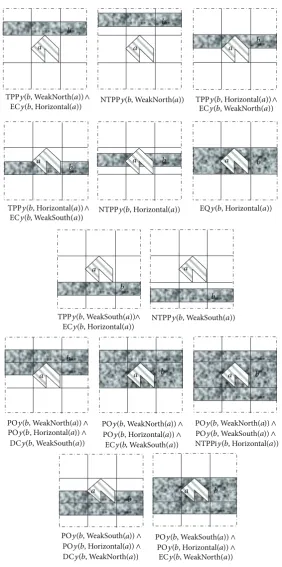
Based on the rules above, the total number of feasible
binary relations for single-piece regions in they-direction is
(44-4-23-4) which equals 13 cases. The thirteen feasible and jointly exhaustive binary relations for the hybrid model are
depicted inFigure 8. This means that, in the hybrid model, the
number of jointly exhaustive binary relations (in both the𝑥
-and𝑦-directions) that hold between two single-piece regions
will be13 × 13. This concurs with the13 × 13basic relations
in theRectangle Algebra Model[16,17].
6. Combined Mereological, Topological, and
Cardinal Direction Relations
Mereology (from the Greek𝜇𝜀𝜌o𝜍, “part”) is the theory of
parthood relations: of the relations of part to whole and the
relations, of part to part within a whole [36]. In this section,
we shall make two distinctions: “whole and part” cardinal directions, as well as “weak and expressive” relations. We shall
rewrite the notations used in our previous paper [29].𝑃R(b,a)
means that only part of the destination extended region,b,
is in tile R(a). The direction relation 𝐴R(b, a) means that
Region Basic binary relations
2 possible cases
4 possible cases
2 possible cases WeakNorth( )
Horizontal( )
WeakSouth( )
𝑎
𝑎
𝑎
𝑎
𝑎
𝑎
𝑎 𝑏
𝑏
𝑎
𝑎 𝑎
𝑎 𝑏
𝑏 𝑏
𝑏 𝑏 𝑏
TPP𝑦(𝑏, WeakNorth(𝑎))∧ NTPP𝑦(𝑏, WeakNorth(𝑎))
EC𝑦(𝑏, Horizontal(𝑎))
TPP𝑦(𝑏, Horizontal(𝑎))∧ TPP𝑦(𝑏, Horizontal(𝑎))∧
EC𝑦(𝑏, WeakNorth(𝑎)) EC𝑦(𝑏, WeakSouth(𝑎))
NTPP𝑦(𝑏, Horizontal(𝑎)) EQ𝑦(𝑏, Horizontal(𝑎))
TPP𝑦(𝑏, WeakSouth(𝑎))∧
EC𝑦(𝑏, Horizontal(𝑎))
[image:7.600.120.479.69.498.2]NTPP𝑦(𝑏, WeakSouth(𝑎))
Figure 7: Possible basic binary relations for each horizontally partitioned region (note: it will be similar for vertically partitioned region).
an example, when𝑏is completely in the South-East tile ofa,
this direction relation can be represented as shown below:
𝐴SE(𝑏, 𝑎) = ¬𝑃N(𝑏, 𝑎) ∧ ¬𝑃NE(𝑏, 𝑎) ∧ ¬𝑃NW(𝑏, 𝑎)
∧ ¬𝑃S(𝑏, 𝑎) ∧ 𝑃SE(𝑏, 𝑎) ∧ ¬𝑃SW(𝑏, 𝑎)
∧ ¬𝑃W(𝑏, 𝑎) ∧ ¬𝑃E(𝑏, 𝑎) ∧ ¬𝑃O(𝑏, 𝑎) .
(4)
The “whole and weak” direction relations are defined in terms of horizontal and vertical sets:
(i)𝐴N(𝑏, 𝑎) ≡WeakNorth(𝑏, 𝑎)∧Vertical(𝑏, 𝑎),
(ii)𝐴NE(𝑏, 𝑎) ≡WeakNorth(𝑏, 𝑎)∧WeakEast(𝑏, 𝑎),
(iii)𝐴NW(𝑏, 𝑎) ≡WeakNorth(𝑏, 𝑎)∧WeakWest(𝑏, 𝑎),
(iv)𝐴S(𝑏, 𝑎) ≡WeakSouth(𝑏, 𝑎)∧Vertical(𝑏, 𝑎),
(v)𝐴SE(𝑏, 𝑎) ≡WeakSouth(𝑏, 𝑎)∧WeakEast(𝑏, 𝑎),
(vi)𝐴SW(𝑏, 𝑎) ≡WeakSouth(𝑏, 𝑎)∧WeakWest(𝑏, 𝑎),
(vii)𝐴E(𝑏, 𝑎) ≡Horizontal(𝑏, 𝑎)∧WeakEast(𝑏, 𝑎),
(viii)𝐴W(𝑏, 𝑎) ≡Horizontal(𝑏, 𝑎)∧WeakWest(𝑏, 𝑎),
(ix)𝐴O(𝑏, 𝑎) ≡Horizontal(𝑏, 𝑎)∧Vertical(𝑏, 𝑎).
The “whole and expressive” direction relations are defined in terms of expressive horizontal and vertical sets. A general form of such direction relation can be represented as follows:
REL𝑦(𝑏,H(𝑎))[𝐴
𝑅(𝑏, 𝑎)]REL𝑥(𝑏,V(𝑎))
≡REL𝑦 (𝑏,H(𝑎)) ∧REL𝑥 (𝑏,V(𝑎)) ,
(5)
where H(a) and V(a) are horizontally and vertically
parti-tioned regions for𝑎, respectively, whereb⊆R(a) and R(a)
, WeakNorth(
TPP𝑦(𝑏, WeakNorth(𝑎
𝑎 𝑎 𝑎
𝑎 𝑎
𝑎
𝑎
𝑎 𝑎
𝑎 𝑎
𝑎
𝑎 ))∧
EC𝑦(𝑏, Horizontal(𝑎)) TPP𝑦(𝑏, Horizontal(𝑎))∧
TPP𝑦(𝑏, Horizontal(𝑎))∧
EC𝑦(𝑏, WeakNorth(𝑎))
EC𝑦(𝑏, WeakSouth(𝑎))
EC𝑦(𝑏, WeakSouth(𝑎))
NTPP𝑦(𝑏, Horizontal(𝑎)) EQ𝑦(𝑏, Horizontal(𝑎))
TPP𝑦(𝑏, WeakSouth(𝑎))∧
EC𝑦(𝑏
𝑏 𝑏
𝑏
𝑏 𝑏
𝑏
𝑏
𝑏
𝑏
𝑏 𝑏
𝑏 𝑏
, Horizontal(𝑎
𝑎
𝑎 𝑎𝑎 𝑎𝑎
))
NTPP𝑦(𝑏 𝑎))
NTPP𝑦(𝑏, WeakSouth(𝑎))
PO𝑦(𝑏, WeakNorth( ))∧
PO𝑦(𝑏, Horizontal( ))∧
DC𝑦(𝑏, WeakSouth(𝑎))
PO𝑦(𝑏, WeakNorth( ))∧
PO𝑦(𝑏, Horizontal( ))∧
PO𝑦(𝑏, WeakNorth( ))∧
PO𝑦(𝑏, WeakSouth( ))∧
NTPPi𝑦(𝑏, Horizontal(𝑎))
PO𝑦(𝑏, WeakSouth( ))∧
PO𝑦(𝑏, Horizontal( ))∧
DC𝑦(𝑏, WeakNorth(𝑎
𝑎 PO𝑦(𝑏, Horizontal( ))𝑎 ∧
𝑎 𝑎
))
PO𝑦(𝑏, WeakSouth( ))∧
[image:8.600.158.441.94.663.2]EC𝑦(𝑏, WeakNorth(𝑎))
Figure 8: Thirteen feasible and jointly exhaustive binary relations in they-direction for the hybrid model (note: this will be similar for
7. Composition Table
Composition is a common inference mechanism for a wide range of relations and has been exploited for automated reasoning. It has been employed for reasoning about temporal
descriptions of events based on intervals [37],
topologi-cal relations [5, 38–42], direction relations [1,24,29,30],
and combined topological relations with cardinal direction
relations [19]. To reiterate, one of the main advantages of
using composition tables is that they can lead to tractable
computation of significant classes of inference [25].
Given the relation between 𝑎 and b and the relation
between𝑏andc, a composition table allows for concluding
the relation between𝑎and𝑐. Bennett [41] defines the concept
of the composition of two binary relations as follows.
Given a theory Θ which is used to define a set 𝛽
of mutually exhaustive and pairwise disjoint dyadic
relations (i.e., a basis set), the composition, Comp(𝑅1,
𝑅2), of two relations𝑅1and𝑅2which are taken from
ß is defined to be the disjunction of all relations𝑅3
in ß, such that, for arbitrary constants𝑎,𝑏, and𝑐, the
formula𝑅1(𝑎, 𝑏)∧𝑅2(𝑏, 𝑐)∧𝑅3(𝑎, 𝑐)is consistent with
Θ.
7.1. Composition of Regions with Parts. In our previous paper
[29], the method for computing the composition of cardinal
direction relations for part regions is not robust enough, because it does not hold for all cases. In order to address this problem, we introduce a formula (obtained through case analyses) for computing the composition of cardinal direction relations. The basis of the formula is to consider
the direction relation between𝑎and each individual part of
𝑏followed by the direction relation between each individual
part of𝑏andc.
Assume that the region covers one or moretilesof region
𝑎while region𝑐covers one or moretilesof𝑏.The direction
relation between𝑎and𝑏is𝑅(𝑏, 𝑎)while the direction relation
between 𝑏 and c is 𝑆(𝑐, 𝑏). The composition of direction
relations could be written as follows:
𝑅(𝑏, 𝑎) ∧ 𝑆(𝑐, 𝑏) . (6)
Firstly, establish the direction relation between𝑎and each
individual part ofb:
𝑅(𝑏, 𝑎) ∧ 𝑆(𝑐, 𝑏)
≡ [𝑅1(𝑏1, 𝑎) ∧ 𝑅2(𝑏2, 𝑎) ⋅ ⋅ ⋅ ∧ 𝑅𝑘(𝑏𝑘, 𝑎)] ∧ [𝑆 (𝑐, 𝑏)] ,
(7)
where1 ≤ 𝑘 ≤ 9.
Consider the direction relation of each individual part of
𝑏and𝑐. Equation (7) becomes
[[𝑅1(𝑏1, 𝑎) ∧ 𝑆11(𝑐1, 𝑏1)] ∨ [𝑅1(𝑏1, 𝑎) ∧ 𝑆12(𝑐2, 𝑏1)] ⋅ ⋅ ⋅ ∨ [𝑅1(𝑏1, 𝑎) ∧ 𝑆1𝑚(𝑐1𝑚, 𝑏1)]]
∧ [[𝑅2(𝑏2, 𝑎) ∧ 𝑆21(𝑐1, 𝑏2)] ∨ [𝑅2(𝑏2, 𝑎) ∧ 𝑆22(𝑐2, 𝑏2)] ⋅ ⋅ ⋅
∨ [𝑅2(𝑏2, 𝑎) ∧ 𝑆2𝑚(𝑐2𝑚, 𝑏2)]]
∧ ⋅ ⋅ ⋅ [[𝑅𝑘(𝑏𝑘, 𝑎) ∧ 𝑆𝑘1(𝑐1, 𝑏𝑘)] ∨ [𝑅𝑘(𝑏𝑘, 𝑎) ∧ 𝑆𝑘2(𝑐2, 𝑏𝑘)] ⋅ ⋅ ⋅ ∨ [𝑅𝑘(𝑏𝑘, 𝑎) ∧ 𝑆𝑘𝑚(𝑐𝑘𝑚, 𝑏𝑘)]] ,
(8)
where1 ≤ 𝑘, 𝑚 ≤ 9.
7.2. Composition of Weak Direction Relations. Firstly, we shall demonstrate how to apply the formula for the composition of weak direction relations followed by more expressive direction relations.
Type 1. 𝐴𝑅(𝑏, 𝑎) ∧ 𝐴𝑅(𝑐, 𝑏).
Find the composition of𝐴O(𝑏, 𝑎) ∧ 𝐴SW(𝑐, 𝑏).
Use (8) with𝑘 = 1and𝑚 = 1:
𝑅1(𝑏1, 𝑎) ∧ 𝑆11(𝑐1, 𝑏1) ≡ 𝐴O(𝑏, 𝑎) ∧ 𝐴SW(𝑐, 𝑏)
≡ [Horizontal(𝑏, 𝑎) ∧Vertical(𝑏, 𝑎)]
∧ [WeakSouth(𝑐, 𝑏) ∧WeakWest(𝑐, 𝑏)]
≡ [Horizontal(𝑏, 𝑎) ∧WeakSouth(𝑐, 𝑏)]
∧ [Vertical(𝑏, 𝑎) ∧WeakWest(𝑐, 𝑏)] .
(9)
The outcome of the composition is
[Horizontal(𝑐, 𝑎) ∨WeakSouth(𝑐, 𝑎)]
∧ [Vertical(𝑐, 𝑎) ∨WeakWest(𝑐, 𝑎)] . (10)
This means that the region c⊆O(a) ∨W(a) ∨S(a)∨
SW(a).
Type 2. 𝐴𝑅(𝑏, 𝑎) ∧ 𝑃𝑅(𝑐, 𝑏).
Find the composition of𝐴E(𝑏, 𝑎) ∧ [𝑃NW(𝑐, 𝑏) ∧ 𝑃N(𝑐, 𝑏)].
Use (8) withk= 1, and1 ≤ 𝑚 ≤ 2:
[[𝑅1(𝑏1, 𝑎) ∧ 𝑆11(𝑐1, 𝑏1)] ∨ [𝑅1(𝑏1, 𝑎) ∧ 𝑆12(𝑐2, 𝑏1)]] ≡ [[𝐴𝐸(𝑏, 𝑎) ∧ 𝐴𝑁𝑊(𝑐1, 𝑏)] ∨ [𝐴𝐸(𝑏, 𝑎) ∧ 𝐴𝑁(𝑐2, 𝑏)]]
≡ [[Horizontal(𝑏, 𝑎) ∧WeakEast(𝑏, 𝑎)]
∧ [WeakNorth(𝑐1, 𝑏) ∧WeakWest(𝑐1, 𝑏)]]
2 2
≡ [[Horizontal(𝑏, 𝑎) ∧WeakNorth(𝑐1, 𝑏)]
∧ [WeakEast(𝑏, 𝑎) ∧WeakWest(𝑐1, 𝑏)]]
∨ [[Horizontal(𝑏, 𝑎) ∧WeakNorth(𝑐2, 𝑏)]
∧ [WeakEast(𝑏, 𝑎) ∧Vertical(𝑐2, 𝑏)]] .
(11)
The outcome of the composition is
[[Horizontal(𝑐1, 𝑎) ∨WeakNorth(𝑐1, 𝑎)]
∧ [WeakEast(𝑐1, 𝑎) ∨Vertical(𝑐1, 𝑎) ∨WeakWest(𝑐1, 𝑎)]]
∨ [[Horizontal(𝑐2, 𝑎) ∨WeakNorth(𝑐2, 𝑎)]
∧ [WeakEast(𝑐2, 𝑎)]] .
(12)
Viewing the fact that𝑐1⊂ 𝑐and𝑐2⊂ 𝑐, the above outcome
can be written as
[[Horizontal(𝑐, 𝑎) ∨WeakNorth(𝑐, 𝑎)]
∧ [WeakEast(𝑐, 𝑎) ∨Vertical(𝑐, 𝑎) ∨WeakWest(𝑐, 𝑎)]] .
(13)
This means that the region 𝑐 ⊆E(a)∨O(a)∨W(a)∨
NE(a)∨N(a)∨NW(a).
Type 3. 𝑃𝑅(𝑏, 𝑎)∧ 𝐴𝑅(𝑐, 𝑏).
Find the composition of[𝑃O(𝑏1, 𝑎)∧𝑃N(𝑏2, 𝑎)]∧𝐴NE(𝑐, 𝑏).
Establish the relationship between𝑐and each individual part
of𝑏. In this case,𝐴NE(𝑐, 𝑏),𝑃NE(𝑐, 𝑏1) and𝑃NE(𝑐, 𝑏2) holds
(this is not necessarily true for all cases).
Use (8) with1 ≤ 𝑘 ≤ 2and𝑚 = 1.
[[𝑃𝑅1(𝑏1, 𝑎)] ∧ [𝑃𝑅11(𝑐1, 𝑏1)]] ∧ [[𝑃𝑅2(𝑏2, 𝑎)] ∧ [𝑃𝑅21(𝑐1, 𝑏2)]] ≡ [[𝑃O(𝑏1, 𝑎)] ∧ [𝑃NE(𝑐, 𝑏)]]
∧ [[𝑃N(𝑏2, 𝑎)] ∧ [𝑃NE(𝑐, 𝑏)]] .
(14)
Therefore, the above composition can be rewritten as
[[𝑃O(𝑏1, 𝑎)] ∧ [𝑃NE(𝑐, 𝑏1)]] ∧ [[𝑃N(𝑏2, 𝑎)] ∧ [𝑃NE(𝑐, 𝑏2)]]
≡ [[Horizontal(𝑏1, 𝑎) ∧Vertical(𝑏1, 𝑎)]
Boundaries of minimal bounding box for region𝑎 𝑎
Boundaries of minimal bounding box for region
𝑏2
𝑏
𝑏 1
[image:10.600.326.530.72.184.2]𝑐
Figure 9: An example.
∧ [WeakNorth(𝑐, 𝑏1) ∧WeakEast(𝑐, 𝑏1)]]
∧ [[WeakNorth(𝑏2, 𝑎) ∧Vertical(𝑏2, 𝑎)]
∧ [WeakNorth(𝑐, 𝑏2) ∧WeakEast(𝑐, 𝑏2)]]
≡ [[Horizontal(𝑏1, 𝑎) ∧WeakNorth(𝑐, 𝑏1)]
∧ [Vertical(𝑏1, 𝑎) ∧WeakEast(𝑐, 𝑏1)]]
∧ [[WeakNorth(𝑏2, 𝑎) ∧WeakNorth(𝑐, 𝑏2)]
∧ [Vertical(𝑏2, 𝑎) ∧WeakEast(𝑐, 𝑏2)]] .
(15)
The outcome of the composition is
[[Horizontal(𝑐, 𝑎) ∨WeakNorth(𝑐, 𝑎)]
∧ [WeakEast(𝑐, 𝑎) ∨Vertical(𝑐, 𝑎)]]
∧ [[NTPP𝑦(𝑐,WeakNorth(𝑎))]
∧ [WeakEast(𝑐, 𝑎) ∨Vertical(𝑐, 𝑎)]]
= [[NTPP𝑦(𝑐,WeakNorth(𝑎))]
∧ [WeakEast(𝑐, 𝑎) ∨Vertical(𝑐, 𝑎)]] .
(16)
This means that the𝑌min(𝑐)of the minimal bounding box
for region𝑐is greater than𝑌max(𝑎)of the minimal bounding
box for region𝑎and𝑐 ⊆NE(𝑎) ∨N(𝑎).
Type 4. 𝑃𝑅(𝑏, 𝑎) ∧ 𝑃𝑅(𝑐, 𝑏). Find the composition of
[𝑃O(𝑏1, 𝑎) ∧ 𝑃NE(𝑏2, 𝑎)] ∧ [𝑃O(𝑐, 𝑏) ∧ 𝑃W(𝑐, 𝑏) ∧ 𝑃SW(𝑐, 𝑏)] .
(17)
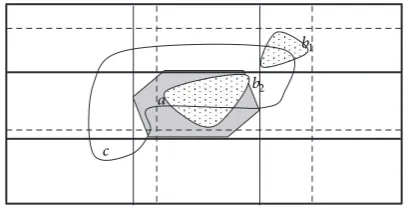
Figure 9has been drawn for this example. Establish the
Use (8) with1 ≤ 𝑘 ≤ 2; the value of𝑚1for𝑏1is1 ≤ 𝑚1≤
4, while the value𝑚2for𝑏2is1 ≤ 𝑚2≤ 7:
[[𝑃𝑅1(𝑏1, 𝑎) ∧ 𝑃𝑅11(𝑐1, 𝑏1)] ∨ [𝑃𝑅1(𝑏1, 𝑎) ∧ 𝑃𝑅12(𝑐2, 𝑏1)] ∨ [𝑃𝑅1(𝑏1, 𝑎) ∧ 𝑃𝑅13(𝑐3, 𝑏1)]
∨ [𝑃𝑅1(𝑏1, 𝑎) ∧ 𝑃𝑅14(𝑐4, 𝑏1)]]
∧ [[𝑃𝑅2(𝑏2, 𝑎) ∧ 𝑃𝑅21(𝑐1, 𝑏2)] ∨ [𝑃𝑅2(𝑏2, 𝑎) ∧ 𝑃𝑅22(𝑐2, 𝑏2)] ∨ [𝑃𝑅2(𝑏2, 𝑎) ∧ 𝑃𝑅25(𝑐5, 𝑏2)] ∨ [𝑃𝑅2(𝑏2, 𝑎) ∧ 𝑃𝑅26(𝑐6, 𝑏2)] ∨ [𝑃𝑅2(𝑏2, 𝑎) ∧ 𝑃𝑅27(𝑐7, 𝑏2)]]
≡ [[𝑃O(𝑏1, 𝑎) ∧ 𝑃S(𝑐1, 𝑏1)] ∨ [𝑃O(𝑏1, 𝑎) ∧ 𝑃SW(𝑐2, 𝑏1)]
∨ [𝑃O(𝑏1, 𝑎) ∧ 𝑃W(𝑐3, 𝑏1)] ∨ [𝑃O(𝑏1, 𝑎) ∧ 𝑃O(𝑐4, 𝑏1)]]
∧ [[𝑃NE(𝑏2, 𝑎) ∧ 𝑃NE(𝑐1, 𝑏2)] ∨ [𝑃NE(𝑏2, 𝑎) ∧ 𝑃N(𝑐2, 𝑏2)] ∨ [𝑃NE(𝑏2, 𝑎) ∧ 𝑃NW(𝑐3, 𝑏2)]
∨ [𝑃NE(𝑏2, 𝑎) ∧ 𝑃E(𝑐4, 𝑏2)] ∨ [𝑃NE(𝑏2, 𝑎) ∧ 𝑃O(𝑐5, 𝑏2)] ∨ [𝑃NE(𝑏2, 𝑎) ∧ 𝑃W(𝑐6, 𝑏2)]
∨ [𝑃NE(𝑏2, 𝑎) ∧ 𝑃SW(𝑐7, 𝑏2)]] .
(18)
In part (1) of the above composition, 𝑐1,𝑐2,𝑐3,𝑐4 ⊂ 𝑐.
To simplify the composition, we consider the combined
horizontal and vertical sets of all the parts of𝑐.Thus, we have
the following:
[WeakNorth(𝑏1, 𝑎) ∧WeakEast(𝑏1, 𝑎)]
∧ [[Horizontal(𝑐, 𝑏1) ∨WeakSouth(𝑐, 𝑏1)]
∧ [Vertical(𝑐, 𝑏1) ∨WeakWest(𝑐, 𝑏1)]]
≡ [[WeakNorth(𝑏1, 𝑎)]
∧ [Horizontal(𝑐, 𝑏1) ∨WeakSouth(𝑐, 𝑏1)]]
∧ [[WeakEast(𝑏1, 𝑎)]
∧ [Vertical(𝑐, 𝑏1) ∨WeakWest(𝑐, 𝑏1)]]
= [WeakNorth(𝑐, 𝑎) ∨Horizontal(𝑐, 𝑎)
∨WeakSouth(𝑐, 𝑎)]
∧ [WeakEast(𝑐, 𝑎) ∨Vertical(𝑐, 𝑎) ∨WeakWest(𝑐, 𝑎)] .
(19)
In part(2)of the above composition,𝑐1,𝑐2,𝑐3,𝑐4,𝑐5,𝑐6,
𝑐7⊂ 𝑐. The simplified version of the composition is as follows:
[Horizontal(𝑏2, 𝑎) ∧Vertical(𝑏2, 𝑎)]
∧ [[WeakNorth(𝑐, 𝑏2) ∨Horizontal(𝑐, 𝑏2)
∨WeakSouth(𝑐, 𝑏2)]
∧ [WeakEast(𝑐, 𝑏2) ∨Vertical(𝑐, 𝑏2)
∨WeakWest(𝑐, 𝑏2)]]
≡ [[Horizontal(𝑏2, 𝑎)]
∧ [WeakNorth(𝑐, 𝑏2) ∨Horizontal(𝑐, 𝑏2)
∨WeakSouth(𝑐, 𝑏2)]]
∧ [[Vertical(𝑏2, 𝑎)]
∧ [WeakEast(𝑐, 𝑏2) ∨Vertical(𝑐, 𝑏2)
∨WeakWest(𝑐, 𝑏2)]]
= [[WeakNorth(𝑐, 𝑎) ∨Horizontal(𝑐, 𝑎)
∨WeakSouth(𝑐, 𝑎)]]
∧ [WeakEast(𝑐, 𝑎) ∨Vertical(𝑐, 𝑎)
∨WeakWest(𝑐, 𝑎)]] .
(20)
The final outcome of the composition is part(1) ∧part
(2)is equivalent to
[WeakNorth(𝑐, 𝑎) ∨Horizontal(𝑐, 𝑎) ∨WeakSouth(𝑐, 𝑎)]
∧ [WeakEast(𝑐, 𝑎) ∨Vertical(𝑐, 𝑎) ∨WeakWest(𝑐, 𝑎)] .
(21)
This means that the regionc⊆Uwhich is the union of all
the 9tilesof regiona. However, based onFigure 9, regionc ̸⊂
SW(a).
7.3. Composition of Expressive Direction Relations. We shall
use the following notations to represent the 13 binary
y-direction relations:
(i) REL1𝑦(𝑏, 𝑎)-NTPP𝑦(𝑏,WeakNorth(𝑎)),
(ii) REL2𝑦(𝑏, 𝑎)-TPP𝑦(𝑏,WeakNorth(𝑎))
∧EC𝑦(𝑏,Horizontal(𝑎)),
(iii) REL3𝑦(𝑏, 𝑎)-TPP𝑦(𝑏,Horizontal(𝑎))
∧EC𝑦(𝑏,WeakNorth(𝑎)),
(iv) REL4𝑦(𝑏, 𝑎)-TPP𝑦(𝑏,Horizontal(𝑎))
∧EC𝑦(𝑏,WeakSouth(𝑎)),
(v) REL5𝑦(𝑏, 𝑎)-NTPP𝑦(𝑏,Horizontal(𝑎)),
(vi) REL6𝑦(𝑏, 𝑎)-EQy(𝑏,Horizontal(𝑎)),
(vii) REL7𝑦(𝑏, 𝑎)-NTPP𝑦(𝑏,WeakSouth(𝑎)),
(viii) REL8𝑦(𝑏, 𝑎)-TPP𝑦(𝑏,WeakSouth(𝑎))
∧PO𝑦(𝑏,Horizontal(𝑎))∧
DC𝑦(𝑏,WeakSouth(𝑎)),
(x) REL10𝑦(𝑏, 𝑎)-PO𝑦(𝑏,WeakNorth(𝑎))
∧PO𝑦(𝑏,Horizontal(𝑎))∧
EC𝑦(𝑏,WeakSouth(𝑎)),
(xi) REL11𝑦(𝑏, 𝑎)-PO𝑦(𝑏,WeakNorth(𝑎))
∧PO𝑦(𝑏,WeakSouth(𝑎))∧
NTPPi𝑦(𝑏,Horizontal(𝑎)),
(xii) REL12𝑦(𝑏, 𝑎)-PO𝑦(𝑏,WeakSouth(𝑎))
∧PO𝑦(𝑏,Horizontal(𝑎))∧
DC𝑦(𝑏,WeakNorth(𝑎)),
(xiii) REL13𝑦(𝑏, 𝑎)-PO𝑦(𝑏,WeakSouth(𝑎))
∧PO𝑦(𝑏,Horizontal(𝑎))∧
EC𝑦(𝑏,WeakNorth(𝑎)).
Similar notations will be used to represent the 13 binary x-direction relations (WeakNorth is replaced by WeakEast, HorizontalwithVertical,andWeakSouthbyWeakWest).
Example 1. Find the composition of the following:
[[REL3𝑦(𝑏1,𝑎)[𝑃
O(𝑏1, 𝑎)]REL3𝑥(𝑏1,𝑎)]
∧ [REL2𝑦(𝑏2,𝑎)[𝑃
NE(𝑏2, 𝑎)]REL2𝑥(𝑏2,𝑎)]]
∧ [REL1𝑦(𝑐,𝑏)[𝐴
N(𝑐, 𝑏)]REL5𝑥(𝑐,𝑏)] .
(22)
Establish the direction relation between 𝑐 and each
individual part of𝑏. Use (8), with1 ≤ 𝑘 ≤ 2and1 ≤ 𝑚1≤ 2,
and1 ≤ 𝑚2≤ 2:
[[𝑃𝑅1(𝑏1, 𝑎)] ∧ [𝑃𝑅11(𝑐1, 𝑏1) ∨ 𝑃𝑅12(𝑐2, 𝑏1)]]
∧ [[𝑃𝑅2(𝑏2, 𝑎)] ∧ [𝑃𝑅21(𝑐1, 𝑏2) ∨ 𝑃𝑅22(𝑐2, 𝑏2)]] . (23)
Use (5), and the above composition can be rewritten in
the following expressive form:
[[REL3𝑦 (𝑏1, 𝑎) ∧REL3𝑥 (𝑏1, 𝑎)]]
∧ [[REL1𝑦 (𝑐1, 𝑏1) ∧REL3𝑥 (𝑐1, 𝑏1)]
∨ [REL1𝑦 (𝑐2, 𝑏1) ∧REL2𝑥 (𝑐2, 𝑏1)]]
∧ [[REL2𝑦 (𝑏2, 𝑎) ∧REL2𝑥 (𝑏2, 𝑎)]]
∧ [[REL1𝑦 (𝑐1, 𝑏2) ∧REL8𝑥 (𝑐1, 𝑏2)]
∨ [REL1𝑦 (𝑐2, 𝑏2) ∧REL4𝑥 (𝑐2, 𝑏2)]]
≡ [REL3𝑦 (𝑏1, 𝑎) ∧ [REL1𝑦 (𝑐1, 𝑏1) ∨REL1𝑦 (𝑐2, 𝑏1)]]
∧ [REL3𝑥 (𝑏1, 𝑎) ∧ [REL3𝑥 (𝑐1, 𝑏1) ∨REL2𝑥 (𝑐2, 𝑏1)]]
∧ [REL2𝑦 (𝑏2, 𝑎) ∧ [REL1𝑦 (𝑐1, 𝑏2) ∨REL1𝑦 (𝑐2, 𝑏2)]]
∧ [REL2𝑥 (𝑏2, 𝑎) ∧ [REL8𝑥 (𝑐1, 𝑏2) ∨REL4𝑥 (𝑐2, 𝑏2)]] . (24)
1 2
outcome of the composition can be written as follows:
REL1𝑦 (𝑐, 𝑎) ∧ [REL2𝑥 (𝑐, 𝑎) ∨REL3𝑥 (𝑐, 𝑎)] ∧REL1𝑦 (𝑐, 𝑎)
∧ [REL2𝑥 (𝑐, 𝑎) ∨REL3𝑥 (𝑐, 𝑎)
∨REL6𝑥 (𝑐, 𝑎) ∨REL13𝑥 (𝑐, 𝑎)]
=REL1𝑦 (𝑐, 𝑎) ∧ [REL2𝑥 (𝑐, 𝑎) ∨REL3𝑥 (𝑐, 𝑎)] . (25)
The outcome of the composition is:
NTPP𝑦 (𝑐,WeakNorth(𝑎))
∧ [TPP𝑥 (𝑐,WeakEast(𝑎)) ∧EC𝑦 (𝑐,Horizontal(𝑎))
∨TPP𝑥 (𝑐,Vertical(𝑎)) ∧EC𝑦 (𝑐,Horizontal(𝑎))] . (26)
Example 2. This example is similar to the fourth example in the previous section of this paper.
Find the composition of
[𝑃O(𝑏1, 𝑎) ∧ 𝑃NE(𝑏2, 𝑎)]
∧ [𝑃O(𝑐, 𝑏) ∧ 𝑃W(𝑐, 𝑏) ∧ 𝑃SW(𝑐, 𝑏)] .
(27)
Establish the direction relation between 𝑐 and each
individual part of𝑏.Use (8), with 1≤k≤2 and 1≤ 𝑚1 ≤
4, and 1≤ 𝑚2≤7.
The composition in expressive form will be as follows.
For part𝑏1,
[[REL2𝑦 (𝑏1, 𝑎) ∧REL2𝑥 (𝑏1, 𝑎)]]
∧ [[REL4𝑦 (𝑐1, 𝑏1) ∧REL4𝑥 (𝑐1, 𝑏1)]
∨ [REL8𝑦 (𝑐2, 𝑏1) ∧REL4𝑥 (𝑐2, 𝑏1)]
∨ [REL4𝑦 (𝑐3, 𝑏1) ∧REL8𝑥 (𝑐3, 𝑏1)]
∨ [REL8𝑦 (𝑐4, 𝑏1) ∧REL8𝑥 (𝑐4, 𝑏1)]] .
(28)
The regions𝑐1,𝑐2,𝑐3,𝑐4⊂ 𝑐; the above composition can be
written as follows:
[REL2𝑦 (𝑏1, 𝑎)
∧ [REL4𝑦 (𝑐, 𝑏1) ∨REL8𝑦 (𝑐, 𝑏1)
∨REL4𝑦 (𝑐, 𝑏1) ∨REL8𝑦 (𝑐, 𝑏1)]]
∧ [REL2𝑥 (𝑏1, 𝑎)
∧ [REL4𝑥 (𝑐, 𝑏1) ∨REL4𝑥 (𝑐, 𝑏1)
∨REL8𝑥 (𝑐, 𝑏1) ∨REL8𝑥 (𝑐, 𝑏1)]]
= [REL2𝑦 (𝑐, 𝑎) ∨REL3𝑦 (𝑐, 𝑎)
∨REL6𝑦 (𝑐, 𝑎) ∨REL13𝑦 (𝑐, 𝑎)]
∧ [REL2𝑥 (𝑐, 𝑎) ∨REL3𝑥 (𝑐, 𝑎)
∨REL6𝑥 (𝑐, 𝑎) ∨REL13𝑥 (𝑐, 𝑎)] .
For part𝑏2
[[REL3𝑦 (𝑏2, 𝑎) ∧REL3𝑥 (𝑏2, 𝑎)]]
∧ [[REL8𝑦 (𝑐1, 𝑏2) ∧REL7𝑥 (𝑐1, 𝑏2)]
∨ [REL6𝑦 (𝑐2, 𝑏2) ∧REL8𝑥 (𝑐2, 𝑏2)]
∨ [REL2𝑦 (𝑐3, 𝑏2) ∧REL8𝑥 (𝑐3, 𝑏2)]
∨ [REL2𝑦 (𝑐4, 𝑏2) ∧REL6𝑥 (𝑐4, 𝑏2)]
∨ [REL3𝑦 (𝑐5, 𝑏2) ∧REL6𝑥 (𝑐5, 𝑏2)]
∨ [REL3𝑦 (𝑐6, 𝑏2) ∧REL2𝑥 (𝑐6, 𝑏2)]
∨ [REL2𝑦 (𝑐7, 𝑏2) ∧REL2𝑥 (𝑐7, 𝑏2)]]
= [[REL2𝑦 (𝑐, 𝑎) ∨REL3𝑦 (𝑐, 𝑎)
∨REL5𝑦 (𝑐, 𝑎) ∨REL12𝑦 (𝑐, 𝑎)]
∧ [REL2𝑥 (𝑐, 𝑎) ∨REL3𝑥 (𝑐, 𝑎)
∨REL4𝑥 (𝑐, 𝑎) ∨REL5𝑥 (𝑐, 𝑎)
∨REL7𝑥 (𝑐, 𝑎) ∨REL8𝑥 (𝑐, 𝑎) ∨REL12𝑥 (𝑐, 𝑎)]] . (29b)
The final outcome of the composition is the composition of
part𝑏1(29a)∧part𝑏2(29b).
ApplyRule 3from the earlier part of the paper, and we
will get the following:
[[REL2𝑦 (𝑐, 𝑎) ∨REL3𝑦 (𝑐, 𝑎)
∨REL6𝑦 (𝑐, 𝑎) ∨REL13𝑦 (𝑐, 𝑎)]
∧ [REL2𝑦 (𝑐, 𝑎) ∨REL3𝑦 (𝑐, 𝑎) ∨REL12𝑦 (𝑐, 𝑎)]
∧ [REL2𝑥 (𝑐, 𝑎) ∨REL3𝑥 (𝑐, 𝑎)
∨REL4𝑥 (𝑐, 𝑎) ∨REL8𝑥 (𝑐, 𝑎) ∨REL12𝑥 (𝑐, 𝑎)]
∧ [REL2𝑥 (𝑐, 𝑎) ∨REL3𝑥 (𝑐, 𝑎)
∨REL6𝑥 (𝑐, 𝑎) ∨REL13𝑥 (𝑐, 𝑎)]] .
(30)
We collapse some of the disjunction of relations:
REL6𝑦 (𝑐, 𝑎) ∨REL13𝑦 (𝑐, 𝑎) =REL13𝑦 (𝑐, 𝑎)
REL4𝑥 (𝑐, 𝑎) ∨REL8𝑥 (𝑐, 𝑎) ∨REL12𝑥 (𝑐, 𝑎) =REL12𝑦 (𝑐, 𝑎)
REL6𝑥 (𝑐, 𝑎) ∨REL13𝑥 (𝑐, 𝑎) =REL13𝑥 (𝑐, 𝑎) . (31)
Equation (30) becomes
[REL2𝑦 (𝑐, 𝑎) ∨REL3𝑦 (𝑐, 𝑎) ∨REL13𝑦 (𝑐, 𝑎)]
∧ [REL2𝑦 (𝑐, 𝑎) ∨REL3𝑦 (𝑐, 𝑎) ∨REL12𝑦 (𝑐, 𝑎)]
∧ [REL2𝑥 (𝑐, 𝑎) ∨REL3𝑥 (𝑐, 𝑎) ∨REL12𝑥 (𝑐, 𝑎)]
∧ [REL2𝑥 (𝑐, 𝑎) ∨REL3𝑥 (𝑐, 𝑎) ∨REL13𝑥 (𝑐, 𝑎)] . (32)
Region𝑐is single piece. Therefore, (32) becomes
[PO𝑦 (𝑐,WeakNorth(𝑎)) ∧PO𝑦 (𝑐,WeakSouth(𝑎))
∧NTPP𝑖𝑦 (𝑐,Horizontal(𝑎))] (33)
∧ [PO𝑥 (𝑐,WeakEast(𝑎)) ∧PO𝑥 (𝑐,WeakWest(𝑎))
∧NTPP𝑖𝑥 (𝑐,Vertical(𝑎))] . (34)
This means that the regionc⊆Uwhich is the union of all the
9tilesof region𝑎. As mentioned earlier, based onFigure 9,
regionc ̸⊂SW(a). Thus, the outcome of the composition for
weak relations (in the previous section) yields the same result as this composition. However, the computation for the latter is more tedious and complex when involving regions with many parts.
8. Existential Inference
The composition table inTable 2 is the result of transitive
inferences made about regions 𝑎 and c, given the hybrid
cardinal direction relations for regions 𝑎 and 𝑏 as well as
regions𝑏and𝑐. In the context of this paper, an existential
inference is the inference made about the spatial relation
between𝑎andb, given the relations between𝑐and𝑎or/and
the given relations between𝑐 and𝑏. We shall demonstrate
how our expressive hybrid cardinal direction model could be used to make several existential inferences which are not possible in existing models.
Example 3(Find𝑅(𝑏, 𝑎)such that𝑐 ⊂WeakNorth(𝑏) and𝑐 ⊂
WeakNorth(𝑎)). To answer this query, we must first specify
the expressive relation between𝑎andc.
There are two possible relations: TPP𝑦(c,WeakNorth(a))
or WeakNorth(c,a).If it is the former then composition is WeakNorth(b,a) ∧ WeakNorth(c,b) which means R(b,a) is WeakNorth(b,a).If it is the latter, there are several combina-tions:
(i) WeakNorth(𝑏, 𝑎)∧Horizontal(𝑐, 𝑏)
(ii) WeakNorth(𝑏, 𝑎)∧WeakSouth(𝑐, 𝑏)
(iii) Horizontal(𝑏, 𝑎)∧WeakNorth(𝑐, 𝑏)
(iv) WeakSouth(𝑏, 𝑎)∧WeakNorth(𝑐, 𝑏).
This means 𝑅(𝑏, 𝑎) are Horizontal(b,a) or WeakSouth
(b,a) when𝑐 ⊂WeakNorth(b) and𝑐 ⊂WeakNorth(a).
Example 4 (Find R(b,a) and S(c,b) such that T(a,c) is
¬[TPP𝑦(c,Horizontal(a)) ∧EC𝑦(c,WeakSouth(a))]). Based
onTable 2, 9 different compositions will yield the following outcome:
TPP𝑦(c,Horizontal(a))∧EC𝑦(c,WeakSouth(a))
The set of possible compositions,Q,is:
{REL1𝑦(𝑏, 𝑎)∧REL7𝑦(𝑐, 𝑏), REL2𝑦(𝑏, 𝑎)∧REL7𝑦(𝑐, 𝑏),
REL3𝑦(𝑏, 𝑎)∧REL7𝑦(𝑐, 𝑏), REL3𝑦(𝑏, 𝑎)∧REL8𝑦(𝑐, 𝑏),
REL5𝑦(𝑏, 𝑎)∧REL7𝑦(𝑐, 𝑏), REL5𝑦(𝑏, 𝑎)∧REL8𝑦(𝑐, 𝑏),
REL6𝑦(𝑏, 𝑎)∧REL4𝑦(𝑐, 𝑏), REL7𝑦(𝑏, 𝑎)∧REL1𝑦(𝑐, 𝑏),
set of all possible ordered pairs of𝑅and𝑆which satisfy the
above query will be𝑈 − 𝑄.
Example 5 (Find R(b,a) and S(c,b) such that T(a,c) is
PO𝑦(c,WeakSouth(a)) ∧ PO𝑦(c,Horizontal(a)) ∧ EC𝑦(c,
WeakNorth(a))). Based onTable 2, we have 4 pairs of𝑅and
𝑆 which satisfy 𝑇. They are: REL1y(b,a) ∧ REL7y(c,b),
REL2y(b,a) ∧ REL8y(c,b), REL7y(b,a) ∧ REL1y(c,b),
REL7𝑦(𝑏, 𝑎)∧REL2𝑦(𝑐, 𝑏).
9. Conclusion
In this paper, we have shown how topological and direction relations can be integrated to produce a more expressive hybrid model for cardinal directions. The composition table
derived from this model could be used to infer bothweak and
expressivedirection relations between regions. We have also introduced and demonstrated how to use a formula to com-pute the composition of weak or expressive relations between “whole and part” regions. We have also demonstrated how the composition table with expressive direction relations could be used to make several difficult existential inferences.
References
[1] A. U. Frank, “Qualitative spatial reasoning with cardinal
direc-tions,”Journal of Visual Languages and Computing, vol. 3, pp.
343–371, 1992.
[2] A. U. Frank, “Qualitative spatial reasoning: cardinal directions
as an example,”International Journal of Geographic Information
Systems, vol. 10, no. 3, pp. 269–290, 1996.
[3] R. K. Goyal,Similarity assessment for cardinal directions between
extended spatial objects [Ph.D. thesis], University of Maine, 2000.
[4] R. Goyal and M. Egenhofer, “Consistent queries over cardinal
directions across different levels of detail,” inProceedings of the
11th International Workshop on Database and Expert Systems Applications, Greenwich, UK, 2000, A. M. Tjoa, R. Wagner, and A. Al-Zobaidie, Eds., pp. 876–880, IEEE Computer Society, September 2000.
[5] R. Goyal and M. Egenhofer, “Similarity of cardinal directions,” inProceedings of the 7th International Symposium on Spatial and Temporal Databases, C. Jensen, M. Schneider, B. Seeger, and V.
Tsotras, Eds., vol. 2121 ofLecture Notes in Computer Science, pp.
36–55, Springer, Berlin, Germany, 2001.
[6] D. Papadias and Y. Theodoridis, “Spatial relations, minimum bounding rectangles, and spatial data structures,” Tech. Rep. KDBSLAB-TR-94-04, University of California, Berkeley, Calif, USA, 1994.
[7] M. T. Escrig and F. Toledo, “A framework based on CLP extended with CHRS for reasoning with qualitative orientation
and positional information,” Journal of Visual Languages &
Computing, vol. 9, no. 1, pp. 81–101, 1998.
[8] E. Clementini, P. Di Felice, and D. Hern´andez, “Qualitative
rep-resentation and positional information,”Artificial Intelligence,
vol. 95, pp. 315–356, 1997.
[9] A. Isli, “Combining cardinal direction relations and relative
relations in QSR,” inProceedings of the 8th International
Sym-posium on Artificial Intelligence and Mathematics (AI&M), Fort Lauderdale, Fla, USA, January 2004.
spatial reasoning,” inProceedings of GIS—From Space to
Ter-ritory: Theories and Methods of Spatio-Temporal Reasoning, A. U. Frank, I. Campari, and U. Formentini, Eds., Springer, Berlin, Germany, 1992.
[11] J. Sharma and D. Flewelling, “Inferences from combined
knowl-edge about topology and directions,” inProceedings of the 4th
International Symposium on Advances in Spatial Databses, pp. 271–291, Portland, Me, USA, 1995.
[12] W. M. Liu, S. J. Li, and J. Renz, “Combining RCC-8 with qualitative direction calculi: algorithms and complexity,” in Proceedings of the 21st International Joint Conference on Artificial Intelligence (IJCAI’09), pp. 854–859, Pasadena, Calif, USA, July 2009.
[13] D. Randell, Z. Cui, and A. G. Cohn, “A spatial logic based on
regions and connection,” inProceedings of the 3rd International
Conference on Knowledge Representation and Reasoning, 1992. [14] S. J. Li, “Combining topological and directional information
for spatial reasoning,” inProceedings of the 20th International
Joint Conference on Artifical Intelligence (IJCAI’07), pp. 435– 440, 2007.
[15] S. J. Li and A. G. Cohn, “Reasoning with topological and
directional spatial information,”Computational Intelligence, vol.
28, no. 4, pp. 579–616, 2012.
[16] P. Balbiani, J. Condotta, and L. F. A. del Cerro, “A Model for
rea-soning about bidimensional temporal relations,” inProceedings
of the 6th International Conference on Knowledge Representation and Reasoning, 1998.
[17] P. Balbiani, J. Condotta, and L. F. del Cerro, “A new tractable
subclass of the rectangle algebra,” inProceedings of the 16th
Inter-national Joint Conference on Artifical Intelligence (IJCAI’99), vol. 1, pp. 442–447, 1999.
[18] A. G. Cohn, B. Bennett, J. Gooday, and N. M. Gotts, “Qualitative spatial representation and reasoning with the region connection
calculus,”GeoInformatica, vol. 1, no. 3, pp. 275–316, 1997.
[19] J. Sharma,Integrated spatial reasoning in geographic
informa-tion systems: combining topology and direcinforma-tion [Ph.D.
the-sis], University of Maine, 1993,http://www.library.umaine.edu/
theses/pdf/Sharma.pdf.
[20] D. Papadias, M. J. Egenhofer, and J. Sharma, “Hierarchical
reasoning about direction relations,” in Proceedings of the
4th ACM workshop on Advances on Advances in Geographic Information Systems (GIS’96), ACM-GIS, Rockville, Md, USA, November 1996.
[21] G. Ligozat, “Reasoning about cardinal directions,”Journal of
Visual Languages and Computing, vol. 9, pp. 23–44, 1998.
[22] M. T. Escrig and F. Toledo, Qualitative Spatial Reasoning:
Theory and Practice: Application to Robot Navigation, IOS Press, Amsterdam, The Netherlands, 1998.
[23] S. Skiadopoulos and M. Koubarakis, “Composing cardinal
direction relations,” inProceedings of the SSTD-01, Redondo
Beach, Calif, USA, July 2001.
[24] S. Skiadopoulos and M. Koubarakis, “Composing cardinal
direction relations,”Artificial Intelligence, vol. 152, no. 2, pp. 143–
171, 2004.
[25] B. Bennett, A. Isli, and A. G. Cohn, “When does a composition table provide a complete and tractable proof procedure for a
relational constraint language?” inProceedings of the IJCAI-97
[26] A. Isli, “Integrating existing cone-shaped and projection-based cardinal direction relations and a TCSP-like decidable general-isation,” CoRR cs.AI/0311051, 2003.
[27] W. M. Liu, X. T. Zhang, S. J. Li, and M. S. Ying, “Reasoning
about cardinal directions between extended objects,”Artificial
Intelligence, vol. 174, pp. 951–983, 2011.
[28] W. M. Liu and S. J. Li, “Reasoning about cardinal directions
between extended objects: the NP-hardness result,”Artificial
Intelligence, vol. 175, no. 18, pp. 2155–2169, 2011.
[29] A.L. Kor and B. Bennett, “Composition for cardinal directions
by decomposing horizontal and vertical constraints,” in
Pro-ceedings of the AAAI 2003 Spring Symposium, D. Dicheva and D. Dochev, Eds., Stanford University, Stanford, Calif, USA, March 2003.
[30] A. L. Kor and B. Bennett, “Reasoning mechanism for cardinal
direction relations,” inAIMSA 2010, D. Dicheva and D. Dochev,
Eds., vol. 6304 ofLecture Notes in Artificial Intelligence (LNAI),
pp. 32–41, Springer, 2010.
[31] A. G. Cohn, B. Bennett, J. Gooday, and N. Gotts, “Representing and reasoning with qualitative spatial relations about regions,” inTemporal and Spatial Reasoning, O. Stock, Ed., Kluwer, New York, NY, USA, 1997.
[32] B. L. Clarke, “Calculus of individuals based on connection,” Notre Dame Journal of Formal Logic, vol. 23, no. 3, pp. 204–218, 1981.
[33] B. L. Clarke, “Individuals and points,”Notre Dame Journal of
Formal Logic, vol. 26, no. 1, pp. 61–75, 1985.
[34] B. Bennett, A. Isli, and A. G. Cohn, “A system handling RCC-8 queries on 2D regions representable in the closure algebra of
half-planes ?” inProceedings of the 11th International Conference
on Industrial and Engineering Applications of Artificial Intelli-gence and Expert Systems (IEA/AIE’98), pp. 281–290, Springer, 1998.
[35] F. Wolter and M. Zakharyaschev, “Spatio-temporal
repre-sentation and reasoning based on RCC-8,” in Proceedings
of the 7th Conference on Principles of Knowledge Repre-sentation and Reasoning (KR’00), 2000, http://citeseerx.ist. psu.edu/viewdoc/summary?doi=10.1.1.33.4558.
[36] A. C. Varchi, “Parts, wholes, and part-whole relations: the
prospects of mereotopology,”Data And Knowledge Engineering,
vol. 20, pp. 259–286, 1996.
[37] J. F. Allen, “Maintaining knowledge about temporal intervals,” Communications of the ACM, vol. 26, no. 11, pp. 832–843, 1983. [38] M. Egenhofer, “Reasoning about binary topological relations,”
inProceedings of the 2nd Symposium on Large Spatial Databases (SSD’91), O. Gunther and H. J. Schek, Eds., vol. 525, pp. 143–160, Lecture Notes in Computer Science, Zurich, Switzerland, 1991. [39] M. Egenhofer, “Deriving the composition of binary topological
relations,”Journal of Visual Languages and Computing, vol. 5,
no. 2, pp. 133–149, 1994.
[40] Z. Cui, A. G. Cohn, and D. A. Randell, “Qualitative simulation
absed on logical formalism of space and time,” inProceedings of
the AAAI’92, pp. 679–684, AAAI Press, Menlo Park, Calif, USA, 1992.
[41] B. Bennett, “Some observations and puzzles about composing
spatial and temporal relations,” inProceedings of the 11th
Euro-pean Conference on Artificial Intelligence, Workshop on Spatial and Temporal Reasoning (ECAI), Amsterdam, The Netherlands, August 1994.
[42] G. Ligozat, “Simple models for simple calculi,” inCOSIT’99,
C. Freksa and D. M. Mark, Eds., vol. 1661 ofLecture Notes in
Submit your manuscripts at
http://www.hindawi.com
International Journal of
Computer Games
Technology
Hindawi Publishing Corporationhttp://www.hindawi.com Volume 2014
Hindawi Publishing Corporation
http://www.hindawi.com Volume 2014
Distributed
Sensor Networks
International Journal of
Advances in
Fuzzy
Systems
Hindawi Publishing Corporation
http://www.hindawi.com Volume 2014
International Journal of
Reconfigurable Computing
Hindawi Publishing Corporation
http://www.hindawi.com Volume 2014
Hindawi Publishing Corporation
http://www.hindawi.com Volume 2014
Applied
Computational
Intelligence and Soft
Computing
Advances in
Artificial
Intelligence
Hindawi Publishing Corporation
http://www.hindawi.com Volume 2014
Advances in Software Engineering
Hindawi Publishing Corporation
http://www.hindawi.com Volume 2014
Hindawi Publishing Corporation
http://www.hindawi.com Volume 2014 Electrical and Computer Engineering
Journal of Journal of
Computer Networks and Communications
Hindawi Publishing Corporation
http://www.hindawi.com Volume 2014
Hindawi Publishing Corporation
http://www.hindawi.com Volume 2014
International Journal of
Biomedical Imaging
Hindawi Publishing Corporation
http://www.hindawi.com Volume 2014
Artificial
Neural Systems
Advances inHindawi Publishing Corporation
http://www.hindawi.com Volume 2014
Robotics
Journal ofHindawi Publishing Corporation
http://www.hindawi.com Volume 2014
Computational Intelligence & Neuroscience
Hindawi Publishing Corporation
http://www.hindawi.com Volume 2014
Hindawi Publishing Corporation
http://www.hindawi.com Volume 2014
Modelling & Simulation in Engineering Hindawi Publishing Corporation
http://www.hindawi.com Volume 2014
The Scientific
World Journal
Hindawi Publishing Corporationhttp://www.hindawi.com Volume 2014
Hindawi Publishing Corporation
http://www.hindawi.com Volume 2014
Human-Computer Interaction
Advances in
Computer EngineeringAdvances in
Hindawi Publishing Corporation
![Figure 3: Cardinal directions defined by tiles for extended objects[1, 2].](https://thumb-us.123doks.com/thumbv2/123dok_us/36574.1005577/3.600.339.513.72.197/figure-cardinal-directions-defined-tiles-extended-objects.webp)
![Figure 4: Nine tiles with regionsthe target object) [4, 5].](https://thumb-us.123doks.com/thumbv2/123dok_us/36574.1005577/4.600.86.255.73.206/figure-tiles-regionsthe-target-object.webp)
![Figure 6: 8 basic JEPD RCC binary relations [13].(](https://thumb-us.123doks.com/thumbv2/123dok_us/36574.1005577/6.600.58.550.361.502/figure-basic-jepd-rcc-binary-relations.webp)