INTERNATIONAL RESEARCH JOURNAL OF MANAGEMENT AND COMMERCE VOLUME-1, ISSUE-5 (August 2014) ISSN: (2348-9766)
A Monthly Double-Blind Peer Reviewed Refereed Open Access International e-Journal - Included in the International Serial Directories.
International Research Journal of Management and Commerce (IRJMC) Website: www.aarf.asia. Email: [email protected] , [email protected]
Page 1
A STUDY ON THE EVOLVEMENT OF THE CAPITAL
STRUCTURE THEORIES
Liew Teo Piaw Lewis,
Centre of Graduate Studies, Universiti Malaysia Sarawak, Malaysia.
Dr. Mohamad Jais,
Faculty of Economics and Business, Universiti Malaysia Sarawak,Malaysia.
ABSTRACT
This study intends to review the theories of capital structure and empirical findings on capital
structure. Despite several decades of intensive research with vast empirical literature in this field,
there is still a lack of consensus in answering the question about firms’ capital structure, especially
when the study is carried out across the countries. This reveals the explanatory power of
environmental factors on capital structure decision. Hence, it is of interest to study how the capital
structure theories have evolved and to advocate for the development of new approaches that benefits
from the organizational-environmental fit and also the synergy of various capital structure theories.
KEYWORDS - Market Timing Theory, Pecking Order Theory, Trade-off Theory
1. INTRODUCTION
INTERNATIONAL RESEARCH JOURNAL OF MANAGEMENT AND COMMERCE VOLUME-1, ISSUE-5 (August 2014) ISSN: (2348-9766)
A Monthly Double-Blind Peer Reviewed Refereed Open Access International e-Journal - Included in the International Serial Directories.
International Research Journal of Management and Commerce (IRJMC) Website: www.aarf.asia. Email: [email protected] , [email protected]
Page 2
date, three theories dominate the capital structure studies: Trade-off Theory, Pecking Order Theory and Market Timing Theory.
2. TRADE-OFF THEORY
The Trade-off Theory assumes that there is an advantage for firms to finance through debt but they do need to consider costs associated with debts. Hence, firms trade off the benefits of debt and equity financing and find an optimal capital structure that will minimize the cost of capital and maximize the firm value. The optimal capital structure is driven by three main components: (i) tax advantage (Miller, 1977; Myers, 2001), (ii) costs of financial distress (bankruptcy costs) (Myers, 1977) and (iii) agency costs (Jensen and Meckling, 1976). Thus, an optimal capital structure may be reached by establishing equilibrium between advantages (tax advantages) and disadvantages (bankruptcy costs and agency cost) of each form of financing. As the benefits and costs of debts and equity may evolve over time, this theory has later been developed into dynamic version. In reality, the decisions are often dynamic and firms usually readjust their optimal capital structure over time when events cause a firm to deviate from the optimal level. These adjustments to firm-specific optimal debt levels are costly and there must be time lags involved (Myers, 1984). Myers further concludes that more emphasis should be put on understanding what adjustment costs are, why they are so vital and how should managers respond to them.
Subsequently, Fischer et al. (1989) propose the dynamic version of Trade-off Theory in which they argue that due to information asymmetries and market imperfections, the firms’ capital structures at a particular time may not always meet the target leverage ratios and thus the firm allows its debt ratio to drift away from their targets for a time after accounting the costs and the benefits of the use of debt and equity. And if the actual leverage ratio deviates from the optimal one, the firm will adapt its financing behavior in a way that brings the leverage ratio back to the optimal level. Thus, the difference between the static and dynamic trade-off model is that the firms readjust their optimal leverage over time instead of an optimal leverage point and the firm will face adjustments costs and time lags to close the gaps from the optimal level.
INTERNATIONAL RESEARCH JOURNAL OF MANAGEMENT AND COMMERCE VOLUME-1, ISSUE-5 (August 2014) ISSN: (2348-9766)
A Monthly Double-Blind Peer Reviewed Refereed Open Access International e-Journal - Included in the International Serial Directories.
International Research Journal of Management and Commerce (IRJMC) Website: www.aarf.asia. Email: [email protected] , [email protected]
Page 3
dynamic model, the financing decision typically depends on the financing margin that the firm envisages in the next period. Some firms expect to pay out funds while others expect to raise funds. In order to raise funds, they may issue debt or equity. In each case, what is expected to be optimal in the next period will help to identify the relevant comparison for the firm in the current period. Goldstein et al. (2001) observe that a firm with low leverage today has the subsequent option to increase leverage. Under their assumptions, the option to increase leverage in the future serves to reduce the otherwise optimal level of leverage today.
In sum, the dynamic trade-off theory of capital structure has argued that every firm has target leverage and there is always a difference between the observed and target leverage due to the presence of market imperfections and adjustment costs. Hence it provides more comprehensive picture than the static form about the mechanism of the capital structure decision over time.
3. PECKING ORDER THEORY
The Pecking Order Theory was proposed by Myers (1984) which assumes that capital structure is arranged by a hierarchy of preferences after accounting the existence of information asymmetry between managers and outside investors. As the costs of internal financing are lower than the costs of external financing, firms prefer retained earnings as their main source of financing, then debt and finally external equity financing. Myers (1984) and Myers and Majluf (1984) assert that managers possess more information about the firms’ prospects, risks and values than do outside investors. Due to asymmetric information where the quality of the available investment opportunities cannot be conveyed credibly to potential investors, the investors may not be able to distinguish between good and bad projects. This will lead to a mispricing of a firm’s equity in the marketplace or so called the problem of adverse selection (Myers, 2001). The cost of adverse selection arises when a firm’s stocks are priced undervalue by the investors, causing a loss of wealth for existing shareholders. Thus, in order to protect present shareholders, firms will not issue equity even though it may involve forgoing an investment opportunity with positive net present values. This will lead to another cost of underinvestment.
INTERNATIONAL RESEARCH JOURNAL OF MANAGEMENT AND COMMERCE VOLUME-1, ISSUE-5 (August 2014) ISSN: (2348-9766)
A Monthly Double-Blind Peer Reviewed Refereed Open Access International e-Journal - Included in the International Serial Directories.
International Research Journal of Management and Commerce (IRJMC) Website: www.aarf.asia. Email: [email protected] , [email protected]
Page 4
prefer internal resources since they expect a price discount by the investors when new equities are issued (Fama and French, 2002). Therefore, Myers and Majluf (1984) argue that raising funds through debt instruments, especially the less risky ones, helps firms mitigate the inefficiencies in their investment decisions that are caused by the information asymmetry.
There are other reasons why firms consider external resource as a better way compared to stock issuing. Ross (1977) and Leland and Pyle (1977) assert that firm’s capital structure choice is used as a means to signal to outside investors the information held by insiders. According to Ross, profitability (as a proxy of quality performance) and leverage are positively related and hence, investors interpret larger level of leverage as a signal of the firm’s current stable income, high future cash flows and managers’ confidence about the performance of their own firm. The Pecking Order hypothesis, however, can also be generated by other imperfections like tax, agency, or behavioral considerations. Fazzary et al. (1988) have listed the main sources of costs hierarchy which induce firms to follow the Pecking Order Theory. Besides the information costs, they include transaction costs and agency costs in the list. These elements provide an explanation as to why firms prefer internal funds as the cheapest source of financing over the external ones.
Due to the presence of transaction costs, the costs of raising funds vary accordingly. There are two major components of transactions costs (Oliner and Rudebusch, 1989; 1992): the compensation for the dealer placing the issue, and other expenses such as legal, accounting and printing costs, registration fees and taxes. The cost of raising funds internally is the lowest since retained earnings incur no flotation costs and require no additional disclosure financial information about the firms’ investment opportunities and their potential profits that managers don’t want to be made public. Meanwhile the cost of new equity is the highest. Thus, the desire to avoid transaction costs may be viewed as a reason that attribute to the Pecking Order behavior (Fama and French, 2004). The type of funds that will be preferred depends on the costs of the issue, with top ranking from retained earnings, then debt and lastly new equity.
INTERNATIONAL RESEARCH JOURNAL OF MANAGEMENT AND COMMERCE VOLUME-1, ISSUE-5 (August 2014) ISSN: (2348-9766)
A Monthly Double-Blind Peer Reviewed Refereed Open Access International e-Journal - Included in the International Serial Directories.
International Research Journal of Management and Commerce (IRJMC) Website: www.aarf.asia. Email: [email protected] , [email protected]
Page 5
costs of raising funds externally and consequently shifting firms towards internally generate funds as a cheapest source of financing, following what is known as the Pecking Order Theory.
To conclude, contrary to the MM propositions without taxes, the value of the firm could decrease if the firm does not prioritize its financing sources from internal financing to debt and lastly to equity. The Pecking Order Theory also contradicts the Trade Off Theory. While the Trade Off Theory assumes a target level of debt for every firm, the Pecking Order Theory does not pursue a target ratio of debt to equity. Rather, each firm chooses its ratio based on its own financing needs. At first, firms source fund to finance their projects from retained earnings. This should lower the percentage of debt in the capital structure because profitable, internally funded project raise both the book value and the market value of equity. When additional cash are needed, firms may source from debt, clearly raising the debt level. However, at some point, when the debt capacity of the firms is exhausted, firms may give way to equity issuance. Thus the amount of leverage is not predefined as stated by the trade off theory, but is determined by the projects availability.
4. MARKET TIMING THEORY
The Market Timing Theory was proposed by Baker and Wurgler (2002). This theory states that the current capital structure is the cumulative outcome of past attempts to time the equity market. Market timing implies that firms issue new shares when it is perceived to be overvalued and that firms repurchase own shares when it is considered to be undervalued. The intention is to exploit the temporary fluctuations in the cost of equity relative to other forms of capital. Under normal market conditions, firms follow the standard pecking order with internal financing preferred to external financing, and equity issued only as a last resort. When external equity is less expensive than debt, however, firms prefer external equity if they seek external financing.
The basic idea is that managers look at current conditions in both debt and equity markets. If they need financing, they use whichever market currently looks more favorable. If neither market looks favorable, they may defer issuances. Alternatively, if current conditions look unusually favorable, funds may be raised even if the firm has no need for funds currently. If managers are trying to exploit too extreme expectations, net equity issues will be positively related to market-to-book. If there is no optimal capital structure, managers do not need to reverse these decisions when the firm appears to be correctly valued and the cost of equity appears to be normal, leaving temporary fluctuations in market-to-book to have permanent effects on leverage.
INTERNATIONAL RESEARCH JOURNAL OF MANAGEMENT AND COMMERCE VOLUME-1, ISSUE-5 (August 2014) ISSN: (2348-9766)
A Monthly Double-Blind Peer Reviewed Refereed Open Access International e-Journal - Included in the International Serial Directories.
International Research Journal of Management and Commerce (IRJMC) Website: www.aarf.asia. Email: [email protected] , [email protected]
Page 6
substantially more equity than companies that go public in cold markets. However, the long-run effects of market timing appear to be limited. Rather, firms’ capital structure policies in the long term appear to be largely consistent with the existence of target leverage. Huang and Ritter (2009) on the hand find empirical evidence of a longer lasting market-timing effect on capital structure. They show that companies make use of equity issue when the cost of equity is low and in periods when the cost of equity is high, companies follow the pecking-order theory by issuing leverage when making use of external financing.
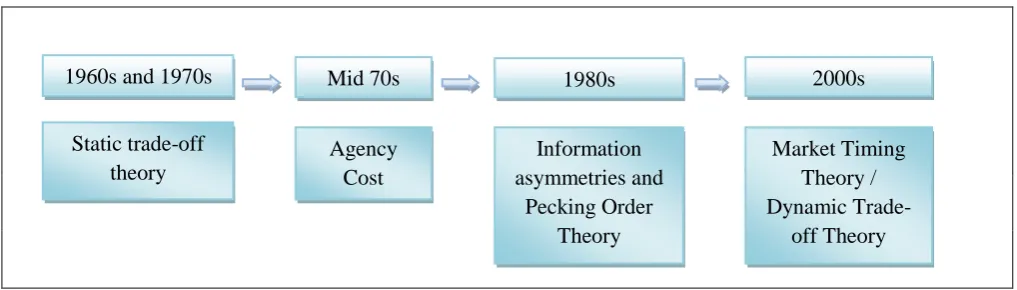
[image:6.595.51.560.273.418.2]To conclude, various capital structure theories have emerged over the years (Figure 3.2) with each subject to respective endogenous and exogenous variables.
Figure 1: Time line of the evolvement and emergence of capital structure theories.
5. A SURVEY ON THE EMPIRICAL FINDINGS
In the early years, firms in United States were the primary source of study and the coverage was only extended to Europe and Japan in mid of 1980s (Kester, 1986). It was then until the mid of 1990’s that the studies start to focus on using international samples to test the capital structure models. One of the earliest papers in international capital structure (Rajan and Zingales, 1995) examines whether the determinants of capital structure differ across firms in G7 countries over the period from 1987 to 1991. They find that the same factors that explain leverage levels for US firms (size, growth, profitability, and importance of tangible assets) also explain the leverage for G7 firms. However, while national capital structure is fairly similar across these countries, some differences remain and they suggest that this requires a further study of the relevant institutional contexts that affect the capital structure.
By analyzing leverage data from France, Germany, Japan, the United Kingdom and the United States during 1991 to 1992, Wald (1999) documents similar results as in Rajan and Zingales (1995). Specifically, Wald reports that differences in tax policies and agency problem (bankruptcy costs, information asymmetries and shareholder/creditor conflicts) explain the leverage differences across
2000s 1980s
Mid 70s 1960s and 1970s
Information asymmetries and
Pecking Order Theory Agency
Cost
Market Timing Theory / Dynamic
Trade-off Theory Static trade-off
INTERNATIONAL RESEARCH JOURNAL OF MANAGEMENT AND COMMERCE VOLUME-1, ISSUE-5 (August 2014) ISSN: (2348-9766)
A Monthly Double-Blind Peer Reviewed Refereed Open Access International e-Journal - Included in the International Serial Directories.
International Research Journal of Management and Commerce (IRJMC) Website: www.aarf.asia. Email: [email protected] , [email protected]
Page 7
countries. In support to the existence of country specific determinants, Booth et al. (2001) find that although capital structure decisions in ten developing countries are affected by the same variables as in developed countries, there are persistent differences in the way leverage is affected by country-specific factors such as GDP growth and capital market development. They conclude that more research needs to be done to understand the impact of institutional factors on firms’ capital structure choices as country factor may be related to different institutional features.
In another study of 30 OECD countries, Song and Philippatos (2004) report that most cross-sectional variation in international capital structure is caused by the heterogeneity of firm-specific, industry-specific and country-specific determinants. At the same time, Bancel and Mitto (2004) examine whether European and U.S. managers’ views on capital structure are driven by similar factors via a survey conducted in 2001-2002. Their study focuses on the cross-countries comparison of managerial views on determinants of capital structure in a sample of 16 European countries: Austria, Belgium, Greece, Denmark, Finland, Ireland, Italy, France, Germany, Netherlands, Norway, Portugal, Spain, Switzerland, Sweden, and the U.K. They also examine the role of legal institutions in explaining the financing policies of firms across countries and report that it is possible that factors underlying debt or equity policies may be influenced differently by various institutions. This study also indicated that even among developed economies like the U.S. and European countries, the financing policies and managers’ behavior are influenced by the institutional environment.
The importance of country-specific factors in determining capital structure choice of firms is also acknowledged by Fan et al. (2003) who analyze a larger sample of 39 countries. They find a significant impact of a few additional country-specific factors such as the degree of development in the banking sector and equity and bond markets. Delcoure (2007) in her study that investigates the determinants of capital structure in emerging Central and Eastern European (CEE) countries show that some of the traditional capital structure theories are portable to companies in CEE countries but no single theory is capable to explain the whole capital structure decision. She further pointed out that the country level factors like the differences and financial constraints of banking systems, disparity in legal systems governing firms’ operations, shareholders’ right and bondholders’ protection, sophistication of stock and bond markets, and corporate governance measures have significant impact on firms’ capital structure.
INTERNATIONAL RESEARCH JOURNAL OF MANAGEMENT AND COMMERCE VOLUME-1, ISSUE-5 (August 2014) ISSN: (2348-9766)
A Monthly Double-Blind Peer Reviewed Refereed Open Access International e-Journal - Included in the International Serial Directories.
International Research Journal of Management and Commerce (IRJMC) Website: www.aarf.asia. Email: [email protected] , [email protected]
Page 8
environment and more stable and healthier economic conditions, firms are likely to adopt higher debt and the effects of the firm level determinants on leverage are also reinforced. Antoniou et al. (2008) who study capital market oriented economies (the U.K. and the U.S.) and bank oriented economies (France, Germany, and Japan) also demonstrate that the capital structure of a firm is heavily dependent upon the economic environment and its institutional setting. They further point out that the country’s legal and financial traditions are influential towards the degree and effectiveness of the determinants of capital structure.
In a more recent study, Kayo & Kimura (2011) investigate the relative importance of the levels of period, firm, industry and country on the firm’s leverage using data from 40 countries from 1997 to 2007. Their findings indicate the significant roles of all the levels with the levels of firm and time being the most relevant when explaining the variances of leverage. This shows that no one can ignore the importance of external environments (the level of industry and country) as both have the power to influence internal firm characteristics including capital structure.
To provide further insights into the practice of capital structure, the empirical works on capital structure have been extended from developed to developing countries and from listed firms to the unlisted firms. Giannetti (2003) argues that the failure to find a significant impact of country specific variables may be due to the bias induced in many studies by including only large listed companies. She thus analyzes a large sample of unlisted firms from eight European countries and finds a significant influence on the leverage of individual firms of a few institutional variables such as creditor’s protection, stock market development and legal enforcement. Similarly, Hall et al. (2004) analyze a large sample of unlisted firms from eight European countries. They observe cross country variation in the determinants of capital structure and suggest that this variation could be due to different country specific variables.
INTERNATIONAL RESEARCH JOURNAL OF MANAGEMENT AND COMMERCE VOLUME-1, ISSUE-5 (August 2014) ISSN: (2348-9766)
A Monthly Double-Blind Peer Reviewed Refereed Open Access International e-Journal - Included in the International Serial Directories.
International Research Journal of Management and Commerce (IRJMC) Website: www.aarf.asia. Email: [email protected] , [email protected]
Page 9
puzzling questions are left either partially or completely unanswered in the area of international capital structure.
Hence, contemporary research focus on the combination of the characteristics of the firms as well as to their institutional environment in analyzing the capital structure decision, especially in today’s dynamic environment where no one can remain inertia but to keep adapting to the changes in order to safeguard the comprehensive competitiveness. There is no universal optimal capital structure around the world as it is determined not only by the firm specific factors but the environment in which the firm is operating in. This is to say that under different environment, firm has to react accordingly to achieve the optimal capital structure. Therefore, in recent years, the literature has paid special attention to the influence of the legal and institutional environment on corporate finance. Many scholars have used empirical data from various countries to show that different economic environment and institutional context are accounted to the differences in capital structure of various countries. In addition, for the same country, different times of the macro environment and different types of system oriented also cause the differences in the firm’s capital structure.
Institution is a series of essential political, social and legal rules based on the activity of human beings. Rajan and Zingales (1995) is the first to propose the importance of institutional factors in capital structure decision. Even though they do not thoroughly investigate the effect of institutional differences in capital structure determination of the G-7 countries, they pinpoint that the difference in capital structure determination among countries may exist partly due to differences in the tax code, bankruptcy laws, the state of development of bond markets and patterns of ownership. Hence, they suggest the needs to study the relation between institutional characteristics and capital structure determination.
INTERNATIONAL RESEARCH JOURNAL OF MANAGEMENT AND COMMERCE VOLUME-1, ISSUE-5 (August 2014) ISSN: (2348-9766)
A Monthly Double-Blind Peer Reviewed Refereed Open Access International e-Journal - Included in the International Serial Directories.
International Research Journal of Management and Commerce (IRJMC) Website: www.aarf.asia. Email: [email protected] , [email protected]
Page 10
the Common Law countries and in the Scandinavian Civil Law countries than in the others. Hence, the legal system plays a key role for the availability of external financing in a country.
It has no doubt that these findings have led the scholars to turn their attention to a new strand of study in capital structure: to test the effect of the differences between institutions across countries. More evidences are presented to indicate that the institutional differences are as important as firm characteristics in determining the firm’s capital structure since last decade. Demirguc-Kunt and Maksimovic (1999) and Fan et al. (2003) analyzed the institutional background of financing mainly from the perspective of effectiveness of legal institution. They show that in countries where legal systems score high on an efficiency index, a greater proportion of firms use long-term external financing. Bancel and Mittoo (2004) argue that the Common Law system provides a better quality for the investors' and creditors' protection than Civil Law systems, and among the Civil Law systems, the French system provides the least protection. They further assert that legal structures with little investor and creditor protection aggravate information asymmetries and contracting costs. Thus, countries belong to the French system are expected to induce severe information asymmetries. Cheng and Shiu (2007) find similar results and reveal that investors’ protection plays an essential role in the determinants of capital structure across countries. They postulate that firms in countries with better-protected creditors’ rights have higher leverage, while those in countries with better shareholders’ protection use more equity funds. This finding implies that the quality of investors’ protection influences funding supply and thus profoundly impacts capital structure with a positive relationship between creditors’ protection and capital structure and a negative relationship between shareholders’ protection and leverage. It also means that good investors’ protection can lower the cost of capital.
INTERNATIONAL RESEARCH JOURNAL OF MANAGEMENT AND COMMERCE VOLUME-1, ISSUE-5 (August 2014) ISSN: (2348-9766)
A Monthly Double-Blind Peer Reviewed Refereed Open Access International e-Journal - Included in the International Serial Directories.
International Research Journal of Management and Commerce (IRJMC) Website: www.aarf.asia. Email: [email protected] , [email protected]
Page 11
significantly higher degree of information asymmetry, use more short term debt in their capital structure and have higher cost of equity as compare to those in Common Law countries.
To date, more and more environmental factors affecting the capital structure decision are proposed and identified, such as the development of the financial sector, the relative importance of the stock market versus the banking sector, the economic development like the GDP growth, inflation, tax levels, and institutional governance quality like corruption. In fact, the legal and institutional setting creates a net of relations between firms and financial institutions (Demirguc-Kunt and Maksimovic, 1999). In this strand of study, financial systems have traditionally been classified into two main groups: market-based versus bank based, depending on the orientation or importance of financial intermediaries. It is reported that Civil Law countries tend to have undeveloped financial markets and have a tendency to be bank-based system in general, whereas Common Law countries tend to be more market based systems with developed financial markets. Since then, another classification scheme has arisen. Instead of grounding on the legal origins of each country, this new criterion is based on the importance of markets and financial intermediaries.
Morck et al. (2000) assert that countries with less developed financial systems and poorer investors’ protection tend to have higher cost of raising equity and lower cost of financial distress. This is due to the lower transparency and illiquid capital markets besides lower protection to the creditors’ rights. As a result, firms tend to rely more on internally generated funds or borrowing from the banking system to meet their financing needs. The effects of the legal framework and the sophistication of financial market on the capital structure decision are further sited as the empirical works coverage is widened to more countries. Giannetti (2003) also finds that financial development is significant determinant of leverage in Western European firms. Using a sample of firms from developing Asian and South American countries, Schmukler and Vesperoni (2006) propose the significant relationship between leverage and financial liberalization.
INTERNATIONAL RESEARCH JOURNAL OF MANAGEMENT AND COMMERCE VOLUME-1, ISSUE-5 (August 2014) ISSN: (2348-9766)
A Monthly Double-Blind Peer Reviewed Refereed Open Access International e-Journal - Included in the International Serial Directories.
International Research Journal of Management and Commerce (IRJMC) Website: www.aarf.asia. Email: [email protected] , [email protected]
Page 12
financing over equity financing. They also postulate that if both elements of the financial sector develop simultaneously, the long run debt equity ratio, while rising, will converge to a stable value.
Fan et al. (2003) suggest more institutional factors as critical determinants of capital structure in a study using data from 39 developed and developing countries. They affirm that a country’s legal and tax system, level of corruption and the availability of information intermediaries explain a significant portion of the cross-country variation in leverage. They further indicate that firms in Common Law countries have less leverage and use more long term debt. Delcoure (2007) further add to the literature by looking at the difference in banking system development, disparity in legal system governing firms’ operations, shareholder’s and bondholder’s rights protection, sophistication of equity and bond markets and corporate governance as the factors that influence firms’ leverage decisions.
Gonzalez and Gonzalez (2008) confirm the effect of bank market concentration on capital structure in 39 countries by indicating that firm leverage increases with higher bank concentration and stronger protection of creditor’s rights. Their results imply that greater bank concentration substitutes for creditor’s protection and asset tangibility to reduce the agency cost of debt between shareholders and debt holders. De Jong et al. (2008) further extend the study to cover 42 countries and find that apart from institutional setting like bond market development and creditor’s right protection which significantly explains the variation in capital structure across the countries, the macroeconomic states like the GDP growth rate is also significant in explaining the capital structure decision. What is more interesting is that they show considerable explanatory power of country specific variables beyond firm specific factors by indicating the significant indirect effects of the country factors on firm specific determinants. For example, they show that in countries with a better law enforcement system and a healthier macroeconomic environment, the effects of some firm level determinants such as growth opportunities, profitability and liquidity are also reinforced. Another noteworthy study is the research by Alves and Ferreira (2011) who use a large panel of firms from 31 countries, all with different legal systems and different levels of investor protection. Their findings suggest that the stronger the shareholder rights, the fewer the asymmetric problems and hence there is a negative impact of the shareholder rights on leverage.
INTERNATIONAL RESEARCH JOURNAL OF MANAGEMENT AND COMMERCE VOLUME-1, ISSUE-5 (August 2014) ISSN: (2348-9766)
A Monthly Double-Blind Peer Reviewed Refereed Open Access International e-Journal - Included in the International Serial Directories.
International Research Journal of Management and Commerce (IRJMC) Website: www.aarf.asia. Email: [email protected] , [email protected]
Page 13
default and the loss incurred during default, both of which also depend on the current state of the economy. Furthermore, agency problems are not static by nature, and may be influenced by changing macroeconomic conditions. Hence, capital structure decisions including the adjustment process also varies over time and across firms as macroeconomic condition changes.
Indeed, in today dynamic economy, macroeconomic environment does not only exert a direct impact on firms’ capital structure decision, but also distorts the firms’ characteristics that may influence the capital structure decisions. For example, the firms’ growth opportunities may vary with macroeconomic condition as there are more future investment and growth opportunities available at economic trough than at economic peak. This implies that firms have to determine their capital structure in response to the change in growth opportunities arising from the fluctuations of macroeconomic condition. The connection among macroeconomic condition, firm level factors and capital structure suggests that capital structure will be related to macroeconomic condition.
In the literature, an earlier study on this subject by Korajczyk and Levy (2003) derives target capital structure as a function of the macroeconomic states and firm specific characteristics. They divide their samples into two: financially constrained and financially unconstrained firms in order to test the effects of financial constraints and macroeconomic conditions on capital structure decisions. Their results show that capital structure choices vary with macroeconomic conditions and that the debt ratios of financially unconstrained firms are counter-cyclical while the constrained firms are pro-cyclical. Hackbarth et al. (2006) further added to the literature by presenting a contingency model to analyze credit risk and capital structure. They show that macroeconomic conditions have significant effect on both target capital structure and capital structure adjustment process.
Levy and Hennessy (2007) develop a general equilibrium model for corporate financing over the business cycles. In consistent with Korajczyk and Levy (2003), they find a counter-cyclical variation in leverage for less constrained firms. Their simulation also shows that firms finance less debt due to the increases in managerial wealth and in risk sharing during expansion than contraction. Recently, Cook and Tang (2010) assert that firms adjust their leverage toward target faster in good macroeconomic states relative to bad states; Tang and Yan (2010) also notice that credit spreads decrease in GDP growth rate but increase in GDP growth volatility. However, they find that a major portion of credit spreads is accounted for firm level characteristics, while macroeconomic factors are responsible for a relatively smaller portion.
INTERNATIONAL RESEARCH JOURNAL OF MANAGEMENT AND COMMERCE VOLUME-1, ISSUE-5 (August 2014) ISSN: (2348-9766)
A Monthly Double-Blind Peer Reviewed Refereed Open Access International e-Journal - Included in the International Serial Directories.
International Research Journal of Management and Commerce (IRJMC) Website: www.aarf.asia. Email: [email protected] , [email protected]
Page 14
markets to foreign investors has been a key structural change in emerging economies. When the financial integration proceeds to higher levels, it expands firms’ financing resources and hence may result in a change in capital structure. In addition, one could expect a decline in the cost of capital when the firms have become investible for foreign investors and experience a positive stock price revaluation. In view of the above arguments, firms can adjust their capital structure more easily as a result of expanded financing resources and reduced cost of debt and equity capital from financial integration.
Many papers have documented the impact of financial integration at the country level. Mitton (2006) is among the earlier study to look into the effect of financial integration. He shows that firm-specific openness to foreign equity investors leads to lower leverage. Schmukler and Vesperoni (2006) further evidence that firms increase their long-term debt and extend their debt maturity by accessing international equity and bond markets. Agca et al. (2007) show that credit market integration results in higher leverage but shorter debt maturity in developing countries while Giannetti and Ongena (2009) find that foreign bank lending stimulates the use of financial debt in Eastern European firms.
The most recent study by Lucey and Zhang (2011) shows that higher level of credit market integration results in higher leverage. In contrast, higher level of equity market integration leads to lower leverage. They demonstrate that financial integration imposes impact on the capital structure of emerging markets by affecting factors related to corporate financing. More importantly, different firm and institutional characteristics can lead to different significance and magnitude of these effects. For instance, they evidence that firms are able to borrow more funds in countries with more efficient legal systems during integration process. This unveils the necessity to investigate the determinants of capital structure grounded on Contingency Theory as firms tailor the design of their financing mix to the sources of environmental uncertainties faced. Hence, there is no universal set of strategies which is optimal for all firms. Instead, different strategies should be designed for different environmental contexts.
6. CONCLUSION
To conclude, despite decades of empirical tests, there is still no consensus on which factors are reliably important, especially when the study is carried out across the countries. Myers (2001) postulates that “each factor could be dominant for some firms or in some circumstances, yet
unimportant elsewhere”. This indicates that the capital structure decision may heavily depend on its
INTERNATIONAL RESEARCH JOURNAL OF MANAGEMENT AND COMMERCE VOLUME-1, ISSUE-5 (August 2014) ISSN: (2348-9766)
A Monthly Double-Blind Peer Reviewed Refereed Open Access International e-Journal - Included in the International Serial Directories.
International Research Journal of Management and Commerce (IRJMC) Website: www.aarf.asia. Email: [email protected] , [email protected]
Page 15
benefits from the organizational-environmental fit and also the synergy of various capital structure theories. This is in line with Fama and French (2005), Barclay and Smith (2005) and Byoun (2008) who propose that capital structure theories should be adopted as complementary rather than mutually exclusive in identifying the factors that affect the capital structure decision. Hence, a possible solution to these dilemmas is the adoption of a contingency approach which suggests that there is no universal set of capital structure strategies which is optimal for all firms but different strategies should be planned to fit with the environment, contingent upon various internal and external constraints. This is because no companies are completely similar, and hence, every company engages in its own set of unique environmental contingencies that result in different levels of environmental uncertainties. REFERENCES
1. Agarwal, S. & Mohtadi, H. (2004). Financial Markets and The Financing Choice of Firms: Evidence from Developing Countries. Global Finance Journal, 15: 57-70.
2. Agca, S., De Nicolo, G. & Detragiache, E. (2007). Financial Reforms, Financial Openness and Corporate Borrowing: International Evidence. Working paper 07/186, IMF.
3. Alti, A. (2006). How Persistent Is The Impact of Market Timing on Capital Structure. Journal of Finance, 61:1681-1710.
4. Alves, P.F.P. & Ferreira, M.A. (2011). Capital Structure and Law Around The World. Jounal of Multinational Financial Management, 21(3):119-150.
5. Antoniou, A., Guney, Y., & Paudyal, K. (2008). The Determinants of Capital Structure: Capital Market-Oriented Versus Bank-Oriented Institutions. Journal of Financial and Quantitative Analysis, 43(1):59-92.
6. Baker, M. & Wurgler, J. (2002). Market Timing and Capital Structure. Journal of Finance, 62:1-32.
7. Bancel, F. & Mittoo, U.R. (2004). Cross-country Determinants of Capital Structure Choice: A survey of European Firms. Financial Management, 33(4):103-133.
8. Barclay, M.J. & Smith, C.W.S.Jr. (2005). The Capital Structure Puzzle: The Evidence Revisited. Journal of Applied Corporate Finance, 17:8-17.
9. Beck, T., Demirguc-Kunt, A. & Maksimovic, V. (2004). Financial and Legal Constraints to Firm Growth: Does Size Matter? Journal of Finance, 60:137-177.
10. Cheng, S. & Shiu, C. (2007). Investor Protection and Capital Structure: International Evidence. Journal of Multinational Financial Management, 17:30-44.
INTERNATIONAL RESEARCH JOURNAL OF MANAGEMENT AND COMMERCE VOLUME-1, ISSUE-5 (August 2014) ISSN: (2348-9766)
A Monthly Double-Blind Peer Reviewed Refereed Open Access International e-Journal - Included in the International Serial Directories.
International Research Journal of Management and Commerce (IRJMC) Website: www.aarf.asia. Email: [email protected] , [email protected]
Page 16
12. Cook, D.O. & Tang, T. (2010). Macroeconomic Conditions and Capital Structure Adjustment Speed. Journal of Corporate Finance, 16:73-87.
13. Cotei, C., Farhat, J & Benjamin A.A. (2011). Testing Trade-off and Pecking Order Models of Capital Structure: Does Legal System Matter? Managerial Finance, 37(8):715-735.
14. De Jong, A., Kabir, R. & Nguyen, T.T. (2008). Capital Structure Around the World: The Roles of Firm and Country Specific Determinants. Journal of Banking and Finance, 32:1954-1969.
15. Delcoure, N. (2007). The Determinants of Capital Structure in Transitional Economies. International Review of Economics and Finance, 16:400-415.
16. Demirguc-Kunt, A. & Maksimovic, V. (1999). Institutions, Financial Markets and Firm Debt Maturity. Journal of Financial Economics, 54:295-336.
17. Fama, E.F. & French, K.R. (2002). Testing Trade-off and Pecking Order Predictions About Dividends and Debt. Review of Financial Studies, 15(1):1-33.
18. Fama, E.F. & French, K. R. (2004). The Capital Asset Pricing Model: Theory and Evidence. Journal of Economic Perspectives, 18:25-40.
19. Fama, E.F. & French, K.R. (2005). Financing Decisions: Who Issues Stock? Journal of Financial Economics, 76:549-582.
20. Fan, J.P.H., Titman, S. & Twite, G.J. (2003). An International Comparison of Capital Structure and Debt Maturity Choices. EFA 2003 Annual Conference Paper No. 769. Available at SSRN: http://ssrn.com/abstract=423483.
21. Fazzari, S., Hubbard, G. & Petersen, B. (1988). Financing Constraints and Corporate Investment. Brookings Papers on Economic Activity I, 141-195.
22. Fischer, E., Heinkel, R. & Zechner, J. (1989). Dynamic Capital Structure Choice: Theory and Tests. Journal of Finance, 44(1):19-40.
23. Frank, M.Z. & Goyal, V.K. (2007). Corporate Leverage: How Much Do Managers Really Matter? University of Minnesota and Hong Kong University of Science and Technology, Working paper. Available at SSRN: http://ssrn.com/abstract=971082
24. Giannetti, M. (2003). Do Better Institutions Mitigate Agency Problems? Evidence from Corporate Finance Choices. Journal of Financial and Quantitative Analysis, 38(1):185-212. 25. Giannetti, M. & Ongena, S. (2009). Financial Integration and Firm Performance: Evidence
from Foreign Bank Entry in Emerging Markets. Review of Finance, 13:181-223.
26. Goldstein, R., Ju, N. & Leland, H. (2001). An Ebit-based Model of Dynamic Capital Structure. Journal of Business, 74:483-512.
INTERNATIONAL RESEARCH JOURNAL OF MANAGEMENT AND COMMERCE VOLUME-1, ISSUE-5 (August 2014) ISSN: (2348-9766)
A Monthly Double-Blind Peer Reviewed Refereed Open Access International e-Journal - Included in the International Serial Directories.
International Research Journal of Management and Commerce (IRJMC) Website: www.aarf.asia. Email: [email protected] , [email protected]
Page 17
28. Hackbarth, D., Miao, J. & Morellec, E. (2006). Capital Structure, Credit Risk, and Macroeconomic Conditions. Journal of Financial Economics, 82:519-50.
29. Hall, G., Hutchinson, P. & Michaelas N. (2004). Determinants of the Capital Structure of European SMEs. Journal of Business Finance and Accounting, 31:711-728.
30. Huang, R. & Ritter, J. (2009). Testing Theories of Capital Structure and Estimating the Speed of Adjustment. Journal of Financial and Quantitative Analysis, 44:237-71.
31. Jensen, M. & Meckling, W. (1976). Theory of the Firm: Managerial Behavior, Agency Costs and Ownership Structure. Journal of Financial Economics, 3(4):305-360.
32. Kayo, K.E. & Kimura, H. (2011). Hierarchical Determinants of Capital Structure. Journal of Banking & Finance, 35:358-371.
33. Kester, C.W. (1986). Capital and Ownership Structure: A Comparison of United States and Japanese Manufacturing Corporations. Financial Management, 15:5-16.
34. Korajczyk, R. & Levy, A. (2003). Capital Structure Choice: Macroeconomic Conditions and Financial Constraints. Journal of Financial Economics, 68:75-109.
35. La Porta, R., Lopez de Silanes, F., Shleifer, A. & Vishny, R. (1997). Legal Determinants of External Finance. Journal of Finance, 52(3):1131-1150.
36. La Porta, R., Lopez de Silanes, F., Shleifer, A. & Vishny, R. (1998). Law and Finance. Journal of Political Economy, 106:1113-1155.
37. La Porta, R., Lopez de Silanes, F., Shleifer, A. & Vishny, R. (2000). Investor Protection and Corporate Governance. Journal of Financial Economics, 58:3-27.
38. Leland, H.E. & Pyle D.H. (1977). Informational Asymmetries, Financial Structure and Financial Intermediation. Journal of Finance, 32:371-388.
39. Levy, A. & Hennessy, C. (2007). Why Does Capital Structure Choice Vary with Macroeconomic Conditions? Journal of Monetary Economics, 54:1545-1564.
40. Lopez-Iturriaga, F. & Rodriguez-Sanz, J. (2008). Capital Structure and Institutional Setting: A Decompositional and International Analysis. Applied Economics, 40(14):1851-1864.
41. Lucey, B.M. & Zhang, Q. (2011). Financial Integration and Emerging Markets Capital Structure. Journal of Banking & Finance, 35:1228-1238.
42. Miller, M.H. (1977). Debt and Taxes. Journal of Finance, 32:261-275.
43. Myers, S.C. (1977). Determinants of Corporate Borrowing. Journal of Financial Economics, 5(5):147-175.
44. Myers, S. C. (1984). The Capital Structure Puzzle. Journal of Finance, 39:575-592.
INTERNATIONAL RESEARCH JOURNAL OF MANAGEMENT AND COMMERCE VOLUME-1, ISSUE-5 (August 2014) ISSN: (2348-9766)
A Monthly Double-Blind Peer Reviewed Refereed Open Access International e-Journal - Included in the International Serial Directories.
International Research Journal of Management and Commerce (IRJMC) Website: www.aarf.asia. Email: [email protected] , [email protected]
Page 18
46. Myers, S. & Majluf, N.S. (1984). Corporate Financing and Investment Decisions When Firms Have Information that Investors Do Not Have. Journal of Financial Economics,13(2):187-221.
47. Oliner, S. & Rudebusch, G. (1989). Internal Finance and Investment: Testing the Role of Asymmetric Information and Agency Costs. Board of Governors of the Federal Reserve System, Working Paper Series No.101.
48. Oliner, S. & Rudebusch, G. (1992). Sources of the Financing Hierarchy for Business Investment. Review of Economics and Statistics, 74(2):643-654.
49. Rajan, R. & Zingales, L. (1995). What Do We Know About Capital Structure? Some Evidence from International Data. Journal of Finance, 50:1421-1460.
50. Ross, S.A. (1977). The Determination of Financial Structure: The Incentive-Signalling Approach. The Bell Journal of Economics, 8:23-40.
51. Schmukler, S.L. & Vesperoni, E. (2006). Financial Globalization and Debt Maturity in Emerging Economies. Journal of Development Economics, 79:183-207.
52. Song, J. & Philippatos, G. (2004). Have We Resolved Some Critical Issues Related to International Capital Structure? Empirical Evidence from the 30 OECD Countries. Working Paper, University of Tennessee.
53. Tang, D.Y. & Yan, H. (2010). Market Conditions, Default Risk and Credit Spreads. Journal of Banking & Finance, 34: 743–753.