GE-INTERNATIONAL JOURNAL OF ENGINEERING RESEARCH
VOLUME- 3, ISSUE- 5 (May 2015) IF-4.007 ISSN: (2321-1717)
A Monthly Double-Blind Peer Reviewed Refereed Open Access International e-Journal - Included in the International Serial Directories.
GE- International Journal of Engineering Research (GE-IJER) Website: www.aarf.asia. Email: [email protected] , [email protected]
Page 18
ARTIFICIAL BEE COLONY – DIFFERENTIAL EVOLUTION
(ABC-DE) ALGORITHM FOR CNC TURNING PROCESS OPTIMIZATION
R.S.S. PRASANTH1, K. HANS RAJ2
1, 2
Faculty of Engineering, Dayalbagh Educational Institute, India
ABSTRACT
Optimization of any machining process is a highly challenging task per se, because it
essentially involves prediction of optimal cutting parameters and operating constrains that
are complex and very nonlinear in nature and affect the total production time which in turn
affects production cost and quality of the work piece. Artificial Bee Colony (ABC) algorithm
is a nature inspired algorithm (NIA) for process optimization, which mimics the intelligent
foraging behavior of honey bees. This paper proposes to improve the rate of convergence of
ABC algorithm by integrating Differential Evolution (DE) operators with ABC technique to
develop ABCDE algorithm for the optimization of CNC turning process model to minimize
the production time by predicting the optimal the process parameters such as cutting speed,
feed rate for different depth of cuts, while satisfying the process constraints such as cutting
force, cutting power, chip tool interface temperature, and surface roughness. The
performance of ABCDE on process optimization is ascertained by comparing its results with
Real Coded Genetic Algorithm integrated with Laplace Crossover and Power Mutation
operator (RCGA-LXPM), Differential Evolution (DE), and ABC algorithms in terms of
standard performance metrics. The results suggest that ABC-DE algorithm outperforms
RCGA - LXPM, DE and ABC algorithms.
KEYWORDS - NATURE INSPIRED ALGORITHMS, SWARM INTELLIGENCE, ARTIFICIAL BEE COLONY, DIFFERENTIAL EVOLUTION, CNC TURNING.
1.0INTRODUCTION
GE-INTERNATIONAL JOURNAL OF ENGINEERING RESEARCH
VOLUME -3, ISSUE -5 (May 2015) IF-4.007 ISSN: (2321-1717)
A Monthly Double-Blind Peer Reviewed Refereed Open Access International e-Journal - Included in the International Serial Directories.
GE- International Journal of Engineering Research (GE-IJER) Website: www.aarf.asia. Email: [email protected] , [email protected]
Page 19 maintain the dimensional accuracy, surface integrity, surface roughness and metal removal rate while adhering to operating ranges of machine tool and not violating dynamic machining constraints. For the past few decades we have been witnessing a rapid up-gradation of conventional machine tools to computer controlled machine tools, in manufacturing sector. But the economics of computer controlled machine tools essentially depends upon minimizing the production cost by increasing the production rate by reducing the production time. Therefore, to derive best performance from a CNC turning machine it is imperative to optimize its process by determining the optimal cutting parameters. For precision manufacturing, traditional parameter selection which relies on handbooks and operator expertise is inappropriate, as such approach to estimate optimal process parameters is limited to a specific machining environment. And also, conventional techniques of process variable selection more often fails to produce repeatable results and neglect the economics of machining in dynamic manufacturing environment. And thus there is a definite need of robust optimization techniques that can give us optimal or near optimal ranges of process variables in dynamically changing machining environments. Mathematical optimization techniques although are useful to certain extent but they are not robust as they depend on initial solution, get stuck in sub optima, are problem specific and computationally difficult in case of multi variable and multi object problems and thus they are not suitable for dynamic process settings [1, 2].
GE-INTERNATIONAL JOURNAL OF ENGINEERING RESEARCH
VOLUME -3, ISSUE -5 (May 2015) IF-4.007 ISSN: (2321-1717)
A Monthly Double-Blind Peer Reviewed Refereed Open Access International e-Journal - Included in the International Serial Directories.
GE- International Journal of Engineering Research (GE-IJER) Website: www.aarf.asia. Email: [email protected] , [email protected]
Page 20 Swarm intelligence is as defined by Bonabeau, as ― … any attempt to design algorithms or distributed problem solving devices inspired by the collective behavior of social insect colonies and other animal societies …‖ [5]. One among such recent swarm intelligence inspired algorithms is Artificial Bee Colony (ABC) algorithm [5] which is increasingly inviting the attention of many researchers due to its computational efficiency over Genetic Algorithms (GAs), Differential Evolution (DE) and PSO [6-8].
GE-INTERNATIONAL JOURNAL OF ENGINEERING RESEARCH
VOLUME -3, ISSUE -5 (May 2015) IF-4.007 ISSN: (2321-1717)
A Monthly Double-Blind Peer Reviewed Refereed Open Access International e-Journal - Included in the International Serial Directories.
GE- International Journal of Engineering Research (GE-IJER) Website: www.aarf.asia. Email: [email protected] , [email protected]
Page 21 LXPM and DE are compared to each other, then it is observed that LXPM performed better than DE.
According to a recent review, although ABC and its improved versions are finding wider applicability, ABC still suffers from inherent limitation such as slow convergence in local minimum [19]. Some studies reported [20, 21] cascading Differential Evolution (DE) algorithm and replacement of neighborhood operator of ABC with mutation operator of DE for improved results, but such attempts chip away the utility of crossover operator of DE which facilitates uniform distribution of population. Therefore, this paper attempts to integrate mutation and crossover operators of DE into ABC algorithm so as to improve the quality of the solution and rate of convergence of ABC algorithm for such constrained CNC turning process optimization problem in order to determine the optimal cutting parameters such as cutting speed, and feed rate for different depth of cuts while obeying the constraints of cutting force, cutting power, temperature and surface roughness within the specified boundaries of process variables. This is paper is further organized as follows. In section two, the empirical model for optimization of CNC turning process is presented followed by description of ABC and DE algorithms. The integration of DE operators into ABC algorithm to form Artificial Bee Colony – Differential Evolution (ABC-DE) algorithm is presented in section three. The results are compared and analyzed on standard performance metrics such as best, standard deviation, number of fitness evaluations, in section four. In section five, conclusions are drawn accordingly which are followed by references.
2.0EMPIRICALMODELOFCNCTURNINGPROCESS
The empirical model of CNC turning process is to minimize the production time which is the sum of machining time, tool changing time, quick return time and work piece handling time. The model is adopted form [22, 23], that considers cutting parameters such as cutting speed, feed rate and depth of cut besides four constraints i.e., cutting force, cutting power, surface roughness, and temperature.
Tu = tm + tcs (tm /T) + tr+th …. (1)
Where cutting time (per pass)
tm = ПDL / 1000V f …. (2)
GE-INTERNATIONAL JOURNAL OF ENGINEERING RESEARCH
VOLUME -3, ISSUE -5 (May 2015) IF-4.007 ISSN: (2321-1717)
A Monthly Double-Blind Peer Reviewed Refereed Open Access International e-Journal - Included in the International Serial Directories.
GE- International Journal of Engineering Research (GE-IJER) Website: www.aarf.asia. Email: [email protected] , [email protected]
Page 22
V f a1doc a2Ta3 = K …..(3) Subject to:
(i) Boundary conditions:
Vmin ≤ V ≥ Vmax …..(4)
fmin ≤ f ≥ fmax …..(5)
docmin ≤ doc ≥ docmax …..(6)
(ii) Constraints:
Four practical constraints such as cutting force, cutting power, chip-tool temperature and surface roughness are considered in this model.
F = 844 V -0.010133 f 0.725 doc 0.75 ≤ Fmax …. (7)
P = 0.0373 V 0.91 f 0.78 doc 0.75 ≤ Pmax …. (8)
θ = 74.96 V 0.4
f 0.2 doc 0.105 ≤ θ max …. (9)
R = 14.785 V -1.52 f 1.004 doc 0.25 ≤ Rmax …. (10)
Nomenclature and values
Symbol Description Value
D Diameter of the work piece (mm) 152
L Length of the work piece (mm) 203
Vmin Minimum cutting speed (m/min) 30
Vmax Maximum cutting speed (m/min) 200
fmin Minimum feed rate (mm/rev) 0.254
fmax Maximum feed rate (mm/rev) 0.762
R Surface roughness (µm)
Rmax Maximum surface roughness of rough and finish cut (µm) 50
Pmax Maximum power of the machine (KW) 5
GE-INTERNATIONAL JOURNAL OF ENGINEERING RESEARCH
VOLUME -3, ISSUE -5 (May 2015) IF-4.007 ISSN: (2321-1717)
A Monthly Double-Blind Peer Reviewed Refereed Open Access International e-Journal - Included in the International Serial Directories.
GE- International Journal of Engineering Research (GE-IJER) Website: www.aarf.asia. Email: [email protected] , [email protected]
Page 23
Θmax Maximum temperature of tool work piece interface (0C) 550
docmin Minimum depth of cut (mm) 2.0
docmax Maximum of depth of cut (mm) 5.0
T Tool life (min)
tm Machining time (min)
tcs Tool change time (min/edge) 0.5
th Loading and unloading time (min/pass) 1.5
tr Quick return time (min/pass) 0.13
Tu Total production time (min)
C0 Operating cost (RS/piece) 3.5
Ct Tool cost per cutting edge (RS/edge) 17.5
CT Total production cost (RS/edge)
a1,a2, a3, K Constants used in tool life equation
0.29; 0.35; 0.25; 193.3
3.0ARTIFICIALBEECOLONY(ABC)ALGORITHM
GE-INTERNATIONAL JOURNAL OF ENGINEERING RESEARCH
VOLUME -3, ISSUE -5 (May 2015) IF-4.007 ISSN: (2321-1717)
A Monthly Double-Blind Peer Reviewed Refereed Open Access International e-Journal - Included in the International Serial Directories.
GE- International Journal of Engineering Research (GE-IJER) Website: www.aarf.asia. Email: [email protected] , [email protected]
Page 24 source. In the employee bee phase, the employee bee searches for the better neighborhood food sources. Once the neighborhood food source is located, the employee bee applies the greedy selection strategy to find the best of its known two food sources and shares acquired information with the onlooker bees waiting at the hive, by dancing on the dancing area. The onlooker bee gathers the information from the dancing pattern, tempo and the duration of the employee bee and adopts the employee bee food source probabilistically. Once the onlooker bee chooses its food source, the onlooker bee agents further searches for its neighborhood solution and applies the greedy selection strategy to find the best its two food sources. The food sources, that were not improved, even after a predefined number of trials, will be rendered to scouts for random search. All the three phases are repeated until a termination condition (number of cycles or the CPU time) is satisfied.
The pseudo-code of artificial bee colony algorithm [15] is presented below:
1. Initialize the Colony Size (CS), Number of Food Sources/Solutions (SN), Number of dimensions to each solution (D), Modification Rate(MR), SPP(Scout Production Period-limit)
2. Initialize the population of solutions xi,j where i= 1 .. SN and j= 1 .. D
3. Evaluate the population 4. cycle = 1
5. REPEAT
6. Produce a new solution vi for each employed bee by using (1) Vij = Xij +∅ij(Xij – Xkj),
if Rj < MR, otherwise Xij …… (11)
[∅ij - is a random number in the range [−1, 1]. k ∈ {1, 2 ... SN} (SN: Number of
solutions in a colony) is randomly chosen index. Although k is determined randomly, it has to be different from i. Rj is a randomly chosen real number in the range [0, 1]
and j ∈ {1, 2 ... D} (D: Number of dimensions in a problem). MR, modification rate, is a control parameter.]
7. Apply greedy selection process for the employed bees between the vi and xi
8. Calculate the probability values Pi using (2) for the solutions xi
GE-INTERNATIONAL JOURNAL OF ENGINEERING RESEARCH
VOLUME -3, ISSUE -5 (May 2015) IF-4.007 ISSN: (2321-1717)
A Monthly Double-Blind Peer Reviewed Refereed Open Access International e-Journal - Included in the International Serial Directories.
GE- International Journal of Engineering Research (GE-IJER) Website: www.aarf.asia. Email: [email protected] , [email protected]
Page 25 9. For each onlooker bee, produce a new solution vi by using (1) in the neighborhood of
the solution selected depending on Pi and evaluate it.
10. Apply greedy selection process for the onlooker bees between the vi and xi
11.If Scout Production Period (SPP) is completed, determine the abandoned solutions by using ―limit‖ parameter for the scout, if it exists, replace it with a new randomly produced solution using (3)
Xji = Xjmin + rand (Xjmax - Xjmin) ……(13)
12.Memorize the best solution achieved so far 13.cycle = cycle +1
14.UNTIL ( Max Cycle Number or Max CPU time)
3.10 Differential Evolution Algorithm
Differential Evolution (DE) algorithm [24] is another popular numerical optimization algorithm that is similar to GA, as it uses mutation, crossover, and selection operators. However DE is different from GA, as it largely depends on its mutation operator, while GA is based on crossover operator. In DE, mutation operator provides good search mechanism that produces difference of randomly selected pairs of solutions in the population and provides diversity, while a crossover operator maintains the uniform distribution of population. The selection process ensures that the fitness value of the population always improves or remains unchanged but does not get deteriorate. The key steps of DE [24] algorithm is:
Initialize Evaluate Repeat
o Mutate o Crossover o Evaluate o Select
Until requirements are met
Mutation: A mutant solution vector i is produced by equation
i = xr1+F (xr2- xr3) …... (14).
GE-INTERNATIONAL JOURNAL OF ENGINEERING RESEARCH
VOLUME -3, ISSUE -5 (May 2015) IF-4.007 ISSN: (2321-1717)
A Monthly Double-Blind Peer Reviewed Refereed Open Access International e-Journal - Included in the International Serial Directories.
GE- International Journal of Engineering Research (GE-IJER) Website: www.aarf.asia. Email: [email protected] , [email protected]
Page 26 randomly chosen and must satisfy the condition xr1, xr2, xr3 | r1 ≠ r2 ≠ r3 ≠ I, where I is the
index of the current solution.
Crossover: The parent vector is mixed with mutant vector to produce a trail vector using
yji = ji if Rj ≤ CR, otherwise xji . … (15).
CR is a crossover constant which controls the recombination and varies between [0, 1]. And
Rj is a random number between [0, 1].
Selection: All solutions of the population have equal chance of being selected as parents irrespective of their fitness value. The child produced after the mutation and crossover operations is evaluated. And then, the performance of the child vector and its parent vector is compared and the better one will be stored. If the parent is still better, it is retained in the population [24].
3.20 Artificial Bee Colony – Differential Evolution (ABC-DE) algorithm
GE-INTERNATIONAL JOURNAL OF ENGINEERING RESEARCH
VOLUME -3, ISSUE -5 (May 2015) IF-4.007 ISSN: (2321-1717)
A Monthly Double-Blind Peer Reviewed Refereed Open Access International e-Journal - Included in the International Serial Directories.
GE- International Journal of Engineering Research (GE-IJER) Website: www.aarf.asia. Email: [email protected] , [email protected]
Page 27 which is greater than zero, while the ABC algorithm uses a random number in the range [−1,
1], therefore they are intrinsically different. Therefore, in order to improve the quality of the solution and the convergence rate of ABC algorithm it is proposed hybridize ABC algorithm by embedding a mutation and crossover operators of DE algorithm in onlooker bee phase. And thus is this paper we present ABC algorithm’s integration with DE’s mutation and crossover operators in its onlooker phase, since onlooker phase represent global search. The hybrid ABC algorithm called, ABC-DE algorithm features the following modifications to the original ABC algorithm, keeping all its other steps unaffected.
1. In step 9, for each onlooker bee produce new solutions vi using differential
mutation operator and crossover operators, i.e., using equations (4) and (5), in the neighborhood of the solutions selected depending on pi and evaluate it.
2. The scaling factor F, employed in mutation operator of DE which is a constant and greater than 0 (F>0) has been changed to vary in the range of [0, 1] and thus making the algorithm self adaptive.
3.21 Handling of constraints
Constraint handling is the huge concern in solving the constrained manufacturing optimization problems, as the choice of the constraint handling technique has a definite impact on efficiency of any stochastic search technique. Among many constraint handling mechanisms [28], because of its simplicity and effectiveness Deb’s feasibility rules [29] are adopted for handling constraints in the current optimization problem. In this method tournament selection is used, that is two solutions are compared against each other, according to the following order of preference of feasible solution.
If both solutions are feasible, the one with better objective function value wins.
If one solution is feasible and the other unfeasible, the feasible one wins.
GE-INTERNATIONAL JOURNAL OF ENGINEERING RESEARCH
VOLUME -3, ISSUE -5 (May 2015) IF-4.007 ISSN: (2321-1717)
A Monthly Double-Blind Peer Reviewed Refereed Open Access International e-Journal - Included in the International Serial Directories.
GE- International Journal of Engineering Research (GE-IJER) Website: www.aarf.asia. Email: [email protected] , [email protected]
Page 28 3.30 Working of ABC-DE algorithm
Step 0: Set the control parameters such as colony size (CS), number of food sources (SN), number of dimension of the optimization problem (D), maximum limit of scout production period (Limit), modification rate (MR), maximum cycle number (MCN) for which the algorithm would repeat its process, and crossover rate (CR).
Step 1: Initialize required number random solutions as equal to the size of CS for all the number of variables that are equal to the size of D.
Step 2: Now generate random original solutions by evaluating the fitness function for all the randomly initialized solution variables in the previous step and store it. Step 3: Now initialize MCN counter to 1.
Step 4: Now generate a random number raging [0, 1] and compare it with a control parameter MR, if the random number is less than the MR then, by employing the neighborhood operator of ABC algorithm generate neighborhood sources equal to the size of SN and store the neighborhood solutions, which are employee bees.
Step 5: Now check for boundary violations of solution variables and if there are any repair them accordingly using a repair algorithm
Step 6: Now evaluate the fitness of the neighborhood solution variables
Step 7: Now check for any constraint violations and if there are any such violations apply Deb’s constraint handling rules, and store the best feasible solution. Step 8: Now apply a greedy selection process between the randomly generated
original solutions and their neighborhood solutions generated in the previous step using neighborhood operator of ABC algorithm, and best value is stored. Step 9: Now compute the probability of a particular solution that may selected for the
GE-INTERNATIONAL JOURNAL OF ENGINEERING RESEARCH
VOLUME -3, ISSUE -5 (May 2015) IF-4.007 ISSN: (2321-1717)
A Monthly Double-Blind Peer Reviewed Refereed Open Access International e-Journal - Included in the International Serial Directories.
GE- International Journal of Engineering Research (GE-IJER) Website: www.aarf.asia. Email: [email protected] , [email protected]
Page 29 Step 10: Now at this stage of onlooker bee phase process, generate new solution for
each onlooker bee by employing the mutation and crossover operators of DE. Step 11: Now check for boundary violations of solution variables and if there are any
repair them accordingly using a repair algorithm
Step 12: Now evaluate the fitness of the neighborhood solution variables
Step 13: Now check for any constraint violations and if there are any such violations apply Deb’s constraint handling rules, and store the best feasible solution. Step 14: And now activate greedy selection process between the randomly generated
original solutions and the solutions that are produced by employing the DE operators in the previous step.
Step 15: Now at this stage check whether there are any redundant solutions that have not improved after certain number of cycles, i.e., the scout production period Limit is exhausted. Now produce new random solutions using the neighborhood operator of ABC algorithm’s scout bee phase.
Step 16: Now memorize the best solutions achieved so far and continue the process by incrementing the cycle number until the requirements are met.
3.31 Parameters of algorithm
ABC and ABC-DE algorithms are implemented in MATLAB 7.0, and tested on a Laptop machine equipped with Intel Centrino Duo processor, 512 MB RAM, and 150 GB HDD. The following control parameters are adopted for this study.
Parameters of algorithms
Parameter ABC ABC-DE
Colony size (CS) 40 40
Number of food sources (SN) 20 20
Modification rate (MR) 0.9 0.9
GE-INTERNATIONAL JOURNAL OF ENGINEERING RESEARCH
VOLUME -3, ISSUE -5 (May 2015) IF-4.007 ISSN: (2321-1717)
A Monthly Double-Blind Peer Reviewed Refereed Open Access International e-Journal - Included in the International Serial Directories.
GE- International Journal of Engineering Research (GE-IJER) Website: www.aarf.asia. Email: [email protected] , [email protected]
Page 30 Crossover rate (CR) - 0.5
Scaling Factor (F) - [0-1]
Maximum cycle number (MCN) 500 500
Number of independent runs 100 100
4.0 RESULTS
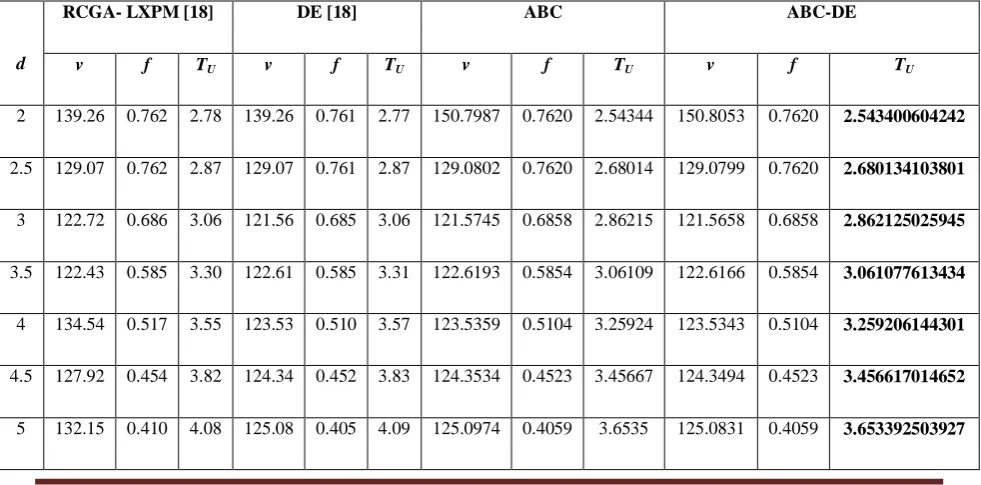
[image:13.595.53.544.513.755.2]Optimal cutting parameters such as feed rate, cutting speed for different depth of cut values and the corresponding total production time, obtained using ABC and ABC-DE are compared with RCGA-LXPM, and DE, in Table 1. The results indicate that ABC and ABC-DE algorithms outperformed RCGA-LXPM and ABC-DE. It is further observed that, ABC-ABC-DE has performed highly competitive to ABC, and in fact at fifth digit level ABC-DE has reduced the total production time which indicates its increased potential in finding quality solution in precision manufacturing environment.
Table no 1. Comparison of optimal parameters predicted by RCGA-LXPM, DE, ABC and ABC-DE for minimum production time
d
RCGA- LXPM [18] DE [18] ABC ABC-DE
v f TU v f TU v f TU v f TU
2 139.26 0.762 2.78 139.26 0.761 2.77 150.7987 0.7620 2.54344 150.8053 0.7620 2.543400604242
2.5 129.07 0.762 2.87 129.07 0.761 2.87 129.0802 0.7620 2.68014 129.0799 0.7620 2.680134103801
3 122.72 0.686 3.06 121.56 0.685 3.06 121.5745 0.6858 2.86215 121.5658 0.6858 2.862125025945
3.5 122.43 0.585 3.30 122.61 0.585 3.31 122.6193 0.5854 3.06109 122.6166 0.5854 3.061077613434
4 134.54 0.517 3.55 123.53 0.510 3.57 123.5359 0.5104 3.25924 123.5343 0.5104 3.259206144301
4.5 127.92 0.454 3.82 124.34 0.452 3.83 124.3534 0.4523 3.45667 124.3494 0.4523 3.456617014652
GE-INTERNATIONAL JOURNAL OF ENGINEERING RESEARCH
VOLUME -3, ISSUE -5 (May 2015) IF-4.007 ISSN: (2321-1717)
A Monthly Double-Blind Peer Reviewed Refereed Open Access International e-Journal - Included in the International Serial Directories.
GE- International Journal of Engineering Research (GE-IJER) Website: www.aarf.asia. Email: [email protected] , [email protected]
Page 31 Where, d is Depth of cut in mm; v is Cutting speed in m/min; f isFeed rate in mm/rev; TU is
Total production time in min
GE-INTERNATIONAL JOURNAL OF ENGINEERING RESEARCH
VOLUME -3, ISSUE -5 (May 2015) IF-4.007 ISSN: (2321-1717)
A Monthly Double-Blind Peer Reviewed Refereed Open Access International e-Journal - Included in the International Serial Directories.
GE- International Journal of Engineering Research (GE-IJER) Website: www.aarf.asia. Email: [email protected] , [email protected]
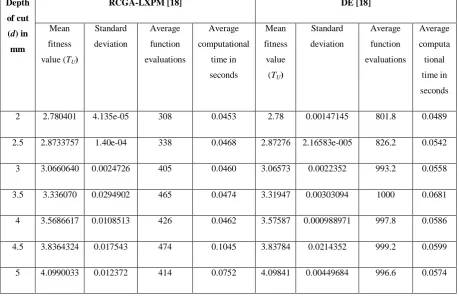
[image:15.595.69.529.140.436.2]Page 32 Table no 2. Comparison of standard performance metrics of RCGA-LXPM and DE on CNC
turning process optimization
Depth
of cut
(d) in
mm
RCGA-LXPM [18] DE [18]
Mean
fitness
value (TU)
Standard deviation Average function evaluations Average computational time in seconds Mean fitness value
(TU)
Standard deviation Average function evaluations Average computa tional time in seconds
2 2.780401 4.135e-05 308 0.0453 2.78 0.00147145 801.8 0.0489
2.5 2.8733757 1.40e-04 338 0.0468 2.87276 2.16583e-005 826.2 0.0542
3 3.0660640 0.0024726 405 0.0460 3.06573 0.0022352 993.2 0.0558
3.5 3.336070 0.0294902 465 0.0474 3.31947 0.00303094 1000 0.0681
4 3.5686617 0.0108513 426 0.0462 3.57587 0.000988971 997.8 0.0586
4.5 3.8364324 0.017543 474 0.1045 3.83784 0.0214352 999.2 0.0599
5 4.0990033 0.012372 414 0.0752 4.09841 0.00449684 996.6 0.0574
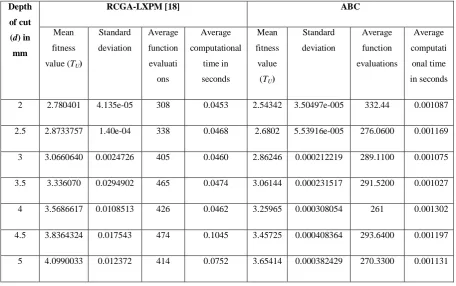
As we may observe from the table no. 2 that RCGA-LXPM’s performance is better than DE [18]. Table no.1 and 2 suggest that RCGA-LXPM has not only achieved competitive results in terms of its fitness value with respect to DE but also the convergence rate is also improved. In order to ascertain the performance of ABC algorithm on CNC turning process optimization problem and improve the quality of the solution we have first applied ABC algorithm and the results are presented in table given below.
GE-INTERNATIONAL JOURNAL OF ENGINEERING RESEARCH
VOLUME -3, ISSUE -5 (May 2015) IF-4.007 ISSN: (2321-1717)
A Monthly Double-Blind Peer Reviewed Refereed Open Access International e-Journal - Included in the International Serial Directories.
GE- International Journal of Engineering Research (GE-IJER) Website: www.aarf.asia. Email: [email protected] , [email protected]
[image:16.595.70.527.136.422.2]Page 33 Table no 3. Comparison of standard performance metrics of RCGA-LXPM and ABC on
CNC turning process optimization
Depth
of cut
(d) in
mm
RCGA-LXPM [18] ABC
Mean
fitness
value (TU)
Standard deviation Average function evaluati ons Average computational time in seconds Mean fitness value
(TU)
Standard deviation Average function evaluations Average computati onal time in seconds
2 2.780401 4.135e-05 308 0.0453 2.54342 3.50497e-005 332.44 0.001087
2.5 2.8733757 1.40e-04 338 0.0468 2.6802 5.53916e-005 276.0600 0.001169
3 3.0660640 0.0024726 405 0.0460 2.86246 0.000212219 289.1100 0.001075
3.5 3.336070 0.0294902 465 0.0474 3.06144 0.000231517 291.5200 0.001027
4 3.5686617 0.0108513 426 0.0462 3.25965 0.000308054 261 0.001302
4.5 3.8364324 0.017543 474 0.1045 3.45725 0.000408364 293.6400 0.001197
5 4.0990033 0.012372 414 0.0752 3.65414 0.000382429 270.3300 0.001131
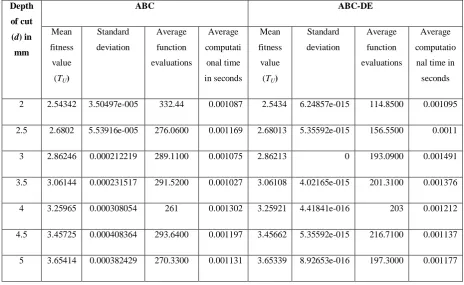
The proposed new hybrid algorithm named ABC-DE’s performance is ascertained by evaluating it on standard performance metrics and compared with ABC in table no. 4. It is observed that ABC-DE has outperformed ABC algorithm in terms of standard metrics such as standard deviation, number of fitness evaluations besides maintaining and producing the very competitive and quality of the solution in every case. These findings suggest that ABC-DE is more stable, faster, and reliable and can produce highly comparable quality solutions with respect to RCGA-LXPM, DE and ABC.
GE-INTERNATIONAL JOURNAL OF ENGINEERING RESEARCH
VOLUME -3, ISSUE -5 (May 2015) IF-4.007 ISSN: (2321-1717)
A Monthly Double-Blind Peer Reviewed Refereed Open Access International e-Journal - Included in the International Serial Directories.
GE- International Journal of Engineering Research (GE-IJER) Website: www.aarf.asia. Email: [email protected] , [email protected]
[image:17.595.65.530.116.401.2]Page 34 Table no 4. Comparison ABC and ABC-DE on CNC turning process optimization
Depth
of cut
(d) in
mm
ABC ABC-DE
Mean
fitness
value
(TU)
Standard deviation Average function evaluations Average computati onal time in seconds Mean fitness value
(TU)
Standard deviation Average function evaluations Average computatio
nal time in
seconds
2 2.54342 3.50497e-005 332.44 0.001087 2.5434 6.24857e-015 114.8500 0.001095
2.5 2.6802 5.53916e-005 276.0600 0.001169 2.68013 5.35592e-015 156.5500 0.0011
3 2.86246 0.000212219 289.1100 0.001075 2.86213 0 193.0900 0.001491
3.5 3.06144 0.000231517 291.5200 0.001027 3.06108 4.02165e-015 201.3100 0.001376
4 3.25965 0.000308054 261 0.001302 3.25921 4.41841e-016 203 0.001212
4.5 3.45725 0.000408364 293.6400 0.001197 3.45662 5.35592e-015 216.7100 0.001137
5 3.65414 0.000382429 270.3300 0.001131 3.65339 8.92653e-016 197.3000 0.001177
Table no. 5 Comparison of ABC-DE algorithm with different traditional and nontraditional optimization methods for CNC turning process optimization [23]
Depth
of cut
(d) in
mm
ABC-DE
fitness
value (TU)
ABC
fitness
value
(TU)
RCGA-LXPM
fitness
value
(TU)
DE
fitness
value
(TU)
PSO
fitness
value
(TU)
SA
fitness
value
(TU)
GA
fitness
value
(TU)
NMS
fitness
value
(TU)
BSP
fitness
value
(TU)
2.0 2.5434006 2.54344 2.78 2.77 2.78 2.85 2.85 2.87 2.84
2.5 2.6801341 2.68014 2.87 2.87 2.87 2.93 3.12 2.97 2.93
3.0 2.86212503 2.86215 3.06 3.06 3.04 3.15 3.13 3.15 3.11
3.5 3.06107761 3.06109 3.3 3.31 3.29 3.34 3.46 3.44 3.34
4.0 3.25920614 3.25924 3.55 3.57 3.55 3.59 3.51 3.69 3.59
4.5 3.45661701 3.45667 3.82 3.83 3.82 3.85 3.96 3.88 3.84
[image:17.595.94.516.478.753.2]GE-INTERNATIONAL JOURNAL OF ENGINEERING RESEARCH
VOLUME -3, ISSUE -5 (May 2015) IF-4.007 ISSN: (2321-1717)
A Monthly Double-Blind Peer Reviewed Refereed Open Access International e-Journal - Included in the International Serial Directories.
GE- International Journal of Engineering Research (GE-IJER) Website: www.aarf.asia. Email: [email protected] , [email protected]
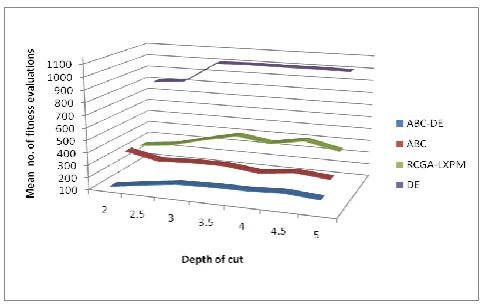
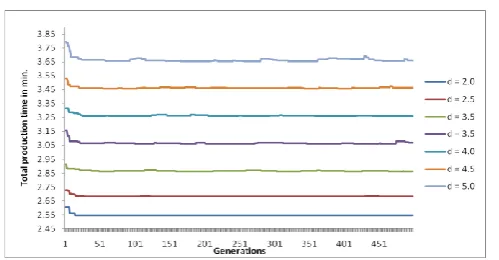
[image:18.595.177.419.339.493.2]Page 35 Further, an attempt has been made to pictorially present the effectiveness of the ABC-DE algorithm over its counterparts such as ABC, RCGA-LXPM and DE, by plotting graphs that represent key standard performance metrics, such as number of fitness evaluations required to converge to optimal value, the repeatability or stability of the algorithm for 100 different runs by plotting the standard deviation form the mean fitness, and the convergence behavior of the proposed algorithm during process of finding the best value for different depth cuts. Figure no. 1, depicts the how fast ABC-DE converges against other nature inspired algorithms such as ABC, RCGA-LXPM and DE. Figure no. 2 displays the robustness and stability of the ABC-DE algorithm when compared with ABC, RCGA-LXPM and DE. In figure no.3 convergence behaviour of ABC-DE algorithm for different depth of cut values is presented.
[image:18.595.174.421.555.685.2]Figure no. 1 Comparision of ABC-DE algorithm interms of its convergence aginast ABC. RCGA-LXPM and DE algorithms
GE-INTERNATIONAL JOURNAL OF ENGINEERING RESEARCH
VOLUME -3, ISSUE -5 (May 2015) IF-4.007 ISSN: (2321-1717)
A Monthly Double-Blind Peer Reviewed Refereed Open Access International e-Journal - Included in the International Serial Directories.
GE- International Journal of Engineering Research (GE-IJER) Website: www.aarf.asia. Email: [email protected] , [email protected]
[image:19.595.175.425.80.210.2]Page 36 Figure no. 3 Convergence behaviour of ABC-DEalgorithm for different depth of cut values
5.0CONCLUSIONS
Artificial bee colony - differential evolution (ABC-DE) algorithm is implemented in MATLAB 7.0., and applied on CNC turning process optimization problem to predict optimal cutting parameters such as cutting speed, feed rate for different depth of cut values and estimate minimum total production time. The performance of ABC-DE algorithm on the aforesaid optimization problem is evaluated on standard performance metrics such as mean fitness value, standard deviation and number of fitness evaluation to ascertain its ability to find quality solution, stability and rate of convergence. The results suggest that ABC-DE algorithm, not only achieved improved results in terms of quality solutions but also in terms of its speed, convergence behavior, and stability, when compared to other nature inspired algorithms such as ABC, RCGA-LXPM and DE algorithms. The results indicate the potential and suitability of the ABC-DE algorithm for precession oriented intelligent manufacturing systems.
6.0 ACKNOWLEDGEMENTS
Authors gratefully acknowledge the inspiration and guidance of Most Revered Prof. P. S. Satsangi, the Chairman, Advisory Committee on Education, Dayalbagh, Agra, India.
REFERENCES
GE-INTERNATIONAL JOURNAL OF ENGINEERING RESEARCH
VOLUME -3, ISSUE -5 (May 2015) IF-4.007 ISSN: (2321-1717)
A Monthly Double-Blind Peer Reviewed Refereed Open Access International e-Journal - Included in the International Serial Directories.
GE- International Journal of Engineering Research (GE-IJER) Website: www.aarf.asia. Email: [email protected] , [email protected]
Page 37 2. R V Rao, P J Pawar, Grinding process parameter optimization using non-traditional
optimization algorithms, Proc Inst Mech Eng Part B-J Eng Manuf, 224(B6), 2010, 887–898.
3. S Deb, US Dixit, Intelligent machining: computational methods and optimization.In: Davim JP (ed) Machining: fundamentals and recent advances. (Springer, London, 2008)
4. J Kennedy, R Eberhart, Particle swarm optimization. In: Proceedings of the IEEE International Conference on Neural Networks (ICNN’95), Perth, Australia, 1995.
5. E Bonabeau, M Dorigo, G Théraulaz , Swarm intelligence: from natural to artificial systems. (Oxford University Press; 1999)
6. D Karaboga, An idea based on honey bee swarm for numerical optimization. Technical report TR06, (Erciyes University, Engineering Faculty, Computer Engineering Department, 2005) 21
7. D Karaboga, B Basturk, A powerful and efficient algorithm for numerical function optimization: Artificial bee colony (abc) algorithm, Journal of Global Optimization,
39(3), 2007, 459–471.
8. Karaboga, D., & Basturk, B, On the performance of artificial bee colony (abc) algorithm, Applied Soft Computing, 8(1), 2008, 687– 697.
9. T Srikanth, V Kamala, Experimental determination of optimal speeds for alloy steels in plane turning, Proceedings of the 9th Biennial ASME, 2008.
10.T Srikanth, V Kamala, A Real Coded Genetic Algorithm for Optimization of Cutting Parameters in Turning, International Journal of Computer Science and Network Security (IJCSNS), 8(6), 2008, 189-193.
11.R S S Prasanth,K Hans Raj, Application of Differential evolution algorithm for optimizing orthogonal cutting, Proceedings of International Conference on Systemics, Cybernetics and Informatics, ICSCI-2011, Hyderabad, 2011, 122-126.
GE-INTERNATIONAL JOURNAL OF ENGINEERING RESEARCH
VOLUME -3, ISSUE -5 (May 2015) IF-4.007 ISSN: (2321-1717)
A Monthly Double-Blind Peer Reviewed Refereed Open Access International e-Journal - Included in the International Serial Directories.
GE- International Journal of Engineering Research (GE-IJER) Website: www.aarf.asia. Email: [email protected] , [email protected]
Page 38 13.R S S Prasanth,K Hans Raj, Estimation of optimal cutting parameters of plane
turning using quantum inspired evolutionary algorithm, International Journal of Modern Engineering Research (IJMER), 2(1), 2012, 304 –312 .
14.Ali Rıza Yıldız, A novel particle swarm optimization approach for product design and manufacturing, Int J Adv Manuf Technol, 40, 2009, 617–628.
15.V JanakiramanV. R Saravanan, Concurrent optimization of machining process parameters and tolerance allocation, Int J Adv Manuf Technol, 51, 2010, 357–369.
16.Antonio Costa, Giovanni Celano, Sergio Fichera, Optimization of multi-pass turning economies through a hybrid particle swarm optimization technique, Int J Adv Manuf Technol, 53, 2011, 421–433.
17.Shutong XIE, Yinbiao GUO, Intelligent Selection of Machining Parameters in Multi-pass Turnings Using a GA-based Approach, Journal of Computational Information Systems, 7(5), 2011, 1714-1721.
18.Chauhan Pinkey, Kusum Deep, Millie Pant, Optimization of CNC turning process using real coded genetic algorithm and differential evolution, Transaction on Evolutionary algorithm and Continuous Optimization, 2011. ISSN: 2229-8711.
19.D Karaboga, B Aka., A comparative study of artificial bee colony algorithm, Applied Mathematics and Computation, 214, 108–132, (2009).
20.Ajith Abraham, Ravi Kumar Jatoth, A. Rajasekhar, Hybrid Differential Artificial Bee Colony Algorithm, Journal of Computational and Theoretical Nanoscience, (9), 2012, 1–9.
21.Bin Wu, Cun hua Qian, Differential Artificial Bee Colony Algorithm for Global Numerical Optimization, Journal of Computers, 6(5), 2011.
22.Deep K., Thakur M., A new mutation operator for real coded genetic algorithms, Appl. Math. Comput., 193, 2007, 21-230.
23.Deep K., Bansal J.C., Performance Analysis of Turning Process via Particle Swarm Optimization, Studies in Computational Intelligence, 129, 2008, 453-460 (2008)
GE-INTERNATIONAL JOURNAL OF ENGINEERING RESEARCH
VOLUME -3, ISSUE -5 (May 2015) IF-4.007 ISSN: (2321-1717)
A Monthly Double-Blind Peer Reviewed Refereed Open Access International e-Journal - Included in the International Serial Directories.
GE- International Journal of Engineering Research (GE-IJER) Website: www.aarf.asia. Email: [email protected] , [email protected]
Page 39 25.Bahriye Akay, Dervis Karaboga, Artificial bee colony algorithm for large-scale
problems, and engineering design optimization, J Intell Manuf, 2010. DOI 10.1007/s10845-010-0393-4
26.Swagatam Das, Ponnuthurai Nagaratnam Suganthan, Differential Evolution: A survey of the state of the art, IEEE Transactions on Evolutionary Computation, 15 (1), No. 1, 2011, 4-31.
27.C Grosan, A. Abraham, Hybrid Evolutionary Algorithms: Methodologies,
Architectures, and Reviews‖, Studies in Computational Intelligence (SCI), 75, 2007, 1-17.
28.Efrén Mezura-Montesa, Carlos A. Coello Coello: Constraint - handling in nature inspired numerical optimization: past present and future, Swarm and Evolutionary Computation, 1, 2011, 173-194.