Optimization of Process Parameters on Laser Beam Cutting Machining
Nilesh P Pandya
1Sagar Ramavat
2Vikrant Mahajan
31
P.G. Student (Advance Manufacturing System)
2Head of Department
3Assistant Professor
1,2,3
Department of Mechanical Engineering
1,2,3
SSIU, Gujarat, India
Abstract— Laser cutting of medium density fibreboard
(MDF) is a complicated process and the selection of the process parameters combinations is essential to get the highest quality of the cut section. This paper presents laser cutting of MDF based on design of experiments (DOE). CO2 laser was used to cut three thicknesses 4, 6 and 9 mm of MDF panels. In this process 4mm thickness to be cut. The process factors investigated are: laser power, cutting speed. In this work, cutting quality was evaluated by measuring, kerf width, surface Roughness. The analysis of variance (ANOVA) was carried out for study the effect of process parameters on process performance. In addition mathematical models have also been developed for response parameter. Properties of the machined surface have been examined by surface roughness tester. For the different values of the two input parameters developed L9 orthogonal array by taguchi method. The surface roughness of MDF material is measure with the surface roughness tester SJ-410 to measure accurate value of roughness. To measure kerf width of digital vernier calliper used. The effect of each factor on the quality measures was determined and special graphs were drawn for this purpose. The optimal cutting combinations were presented in favours of high quality process output and in favours of low cutting cost.
Key words: Laser Beam Machining (LBM), Surface Roughness (SR), Kerf Width, Taguchi’s Orthogonal Array, Laser Power, Cutting Speed, Analysis of Variance (ANOVA)
I. INTRODUCTION
MDF is an engineered product characterized with great structural integrity, higher dimensional stability and greater flexibility in terms of shaping. MDF panels are suitable for many interior construction and industrial applications. The degree of surface roughness of the MDF panel plays an important role since any surface irregularities may show through thin overlays would reduce the final quality of the panel.
II. WORKING PRINCIPLE OF LBM
[image:1.595.310.550.140.303.2]Laser Beam Machining (LBM) is a form of machining process in which laser beam is used for the machining of metallic and non-metallic materials. In this process, a laser Beam of high energy is made to strike on the work piece; the thermal energy of the laser gets transferred to the surface of the w/p (work piece). The heat so produced at the surface heats, melts and vaporizes the materials from the w/p. Light amplification by stimulated emission of radiation is called LASER.
Fig 2.1 working of LBM
It works on the principle that when a high energy laser beam strikes the surface of the work piece. The heat energy contained by the laser beam gets transferred to the surface of the w/p. This heat energy absorbed by the surface heat melts and vaporizes the material from the w/p. In this way the machining of material takes place by the use of laser beam.
III. LITERATURE REVIEW
Mr. Amitkumar and prof. Pravin“Investigation of effect of LBM process parameters On performance characteristic Of SS (ss 304)” investigates the influence of laser beam machining process parameters input like laser power cutting speed and assist gas pressure and output parameters like surface roughness and kerf width It is concluded that the Assist gas pressure and Laser power plays a significant role in governing low SR and low Kerf width. The confirmation experiments were conducted using the optimum combinations of the machining parameters obtained from Taguchi analysis. As a result, optimization of the performance characteristics of the LBM such as SR and Kerf width are improved together by using the method proposed by this study. [1]
Hitoshi Ozaki, Yosuke Koike, Hiroshi Kawakami, and Jippei Suzuki, “Cutting properties of stainless steel by using laser cutting without assist gas” Investigates process parameters of stainless steel laser cutting without assistant gas, Input parameters are Laser power ,Cut length, Shielding gas, Cutting speed, Output parameter is kerf width, The following conclusions can be drawn. (1) Increase in the laser power led to increase of the critical cutting speed. With the laser power of 2.0kW, the critical cutting speed was 100mm/s. (2) the cross-sectional shapes of kerf were almost the same though the laser power or the cutting speed was varied. The kerf taper was below 0.06mm in all cutting conditions. (3) When the heat input was increased, the kerf width and the removed area of kerf were also increased. (4) When the cutting speed was high, the dross-free cutting was achieved. The thin recast layer, about 10μm, was observed on the cut surface. (5) When the laser power was decreased or the cutting speed was increased, the rate of pressure rise in the chamber during cutting process was decreased. [3]
Adrian PETRU, Aurel LUNGULEASA, “Wood processes by laser tools” This paper is a study about laser using in the wood industry. The paper is a synthesis about scientific literature and papers from this domain. Input parameters are Speed, Power, and Laser type. Output parameter is Surface roughness. Woodworking by laser is a domain unexploited at the maximum in this moment and it has some aspects unknown. Because the relatively costs of production are high, especially for lasers pumping, they are very little used in the wood industry. The woodworking by lasers creates new prospects in terms of phenomena research that occur during and after wood processing. Wood surfaces treatments by laser can be controlled in small details. It is possible to study wood burning mechanisms (especially chemical wood degradation). Also it is possible to isolate insoluble wood components. [4]
Nukman Yusoff, Saiful Rizal Ismail, Azuddin Mamat and Aznijar Ahmad-Yazid, “Malaysian wood co2 – laser cutting parameters and cut quality” Laser has been used to cut most non-metallic materials very efficiently and successfully because these materials are highly absorptive by the CO2 laser wavelength of 10.6_m. Laser cutting process has been found to be reliable in loads of applications, with several advantages over other mechanical means in producing successful cut of even thermally sensitive materials such as wood. Input parameters are Speed, Power, and Laser type. Output parameters are Material removal rate and kerf width. It is concluded that: (1)Selection of cutting parameters for laser cutting of wood is governed by material’s moisture and air content, work piece thickness and density (2) For material thickness of 10mm for all wood samples, it is not possible to achieve a successful cut using laser power of 100 watt at 1.2m min_1 cutting speed (3) Due to exothermic reaction, cutting with compressed air exhibits severe burns and charring, larger kerf width and over cuts, and higher portions of material loss (4) The use of nitrogen is proven to be reliable in reducing material loss and over burning due to the compensation of heat accumulation. Nitrogen offers cooler and inert environment to the cutting process (5) Closer dimensional accuracy and acceptable surface finish in laser cutting of wood are able to be obtained when nitrogen is used in
assisting the cutting process as compared to the use of compressed air instead. [5]
H. A. Eltawahni, N. S. Rossini, M. Dassisti, K. Alrashed, T. Aldaham, K. Y. Benyounis “Evaluation and optimization of laser cutting parameters for plywood materials” This article reports experiments on the laser plywood-cutting performance of a CW 1.5 kW CO2 Rofin laser, based on design of experiments (DOE). Input parameters are Air pressure Cutting speed Laser power. Output parameters are Upper kerf, Lower kerf, Ratio. The following conclusion can be drawn from this investigation, 1- The effects of all investigated factors have been set up and every factor has a potential effect on the responses with different level. 2- The focal point position has the major role in influencing the average upper kerf width and the latter decreases as the focal position increases. Moreover, the upper kerf decreases as the cutting speed and air pressure increase, and it increases as the laser power increases. 3- The laser power and cutting speed have the main effect on the average lower kerf width and the latter decreases as the cutting speed increases while it increases as the laser power increases. Moreover, the lower kerf increases as the focal position increases. 4- The focal point position and the laser power have the principal role in affecting the ratio. It decreases as the focal point position and laser power increase, however, the laser power becomes less significant as the thick of the plywood specimen decreases. As regards the cutting speed, the ratio has a particular trend: it increases as the cutting speed increases up to around 3750 mm/min, and then it starts to decreases. 5- Economical cut sections and high quality could be carried out following the tabulated optimal cost setting shown above, but with increase in the predicted ratio of 98.96 %, 80.40 % and 78.97 % for 3, 6 and 9 mm plywood respectively. 6- A ratio as close as possible to 1 could be obtained following the tabulated optimal quality setting shown above, but with increase in the processing operating cost of 53.39 %, 56.17 % and 100.63 % for 3, 6 and 9 mm plywood respectively.[6]
Madić Miloš and Radovanović Miroslav, “Application of taguchi method for optimization of Laser cutting” in this paper a brief overview of the Taguchi method with the key concepts and tools used in the method are given. Input parameters are Laser cutting parameter Work piece parameter; Output parameters are Surface Roughness, Kerf width, Tapper etc. Following are the major observations from the literature: (1) Application of the Taguchi method in laser cutting is aimed at finding a "robust" solution i.e. identification of laser cutting conditions that are Insensitive to parameter variations and noise. (2) In most cases, the Taguchi method has been employed for multi-objective optimization of pulsed Nd: YAG laser oxygen cutting of various materials, mainly aluminium and its alloys. Very few works are reported on usage of the Taguchi method in CO2 laser cutting for single and multi-objective optimization. (3)The most of the performance characteristics considered are related to machined geometry (kerf width, taper and kerf deviation) and surface quality characteristics (surface roughness). The application of the Taguchi method for optimization of metallurgical characteristics (heat affected zone, burr inclusion) and productivity performance characteristics (material removal rate) is limited. The Taguchi based optimization of other important performance characteristics such as specific cutting speed, productivity, processing time, costs is to be considered. (4) For identification of near optimal solutions in the case of multi-objective optimization, the Taguchi method has been combined with different techniques, in most cases with grey relational analysis, weighted sum method, principal component analysis and fuzzy logic. (5)The Taguchi method limits the search for the optimal parameter settings only to discrete parameter values used in the experiment matrix. As a model free optimization technique, the Taguchi method does not process any further interpolation and extrapolation. To overcome this shortcoming, the Taguchi method and response surface methodology are integrated together to incorporate the advantages of both simultaneously. No literature so far shows a hybrid approach, i.e. integration of the Taguchi method and artificial neural networks for optimization of process variables and more work is required to be done in this area. (6) A possibility of using a novel approach to multi-objective process optimization, based on the Taguchi method and artificial intelligence proposed by Šibalija and Majstorović [21] is a research area of interest. [8]
Chithirai Pon Selvan M, Nethri Rammohan and Sachidananda HK. “Laser Beam Machining HAZ and cut quality Comparative study “This paper presents a review on the conclusions of the various research papers available on laser beam machining on the various properties that affect the quality of the process such as heat affected zone formed in the work-piece. Input parameters are Power, Cutting speed . Output parameters are HAZ Cutting quality, Surface Roughness. It concludes that LBM is a machining process that can be used to machine almost any known material ranging from soft materials to DTM (difficult to machine) materials. Complex shapes can be machined. LBM process has a very high MRR compared to other non-conventional machining processes such as EDM. Though MRR is very high, the material is removed at the cost surface quality. The surface quality is less due to the formation of spatters and
burrs which is unavoidable in the process of LBM. However, the spatter formation and HAZ can be reduced by increasing the cutting speed and by adopted gas assisted LBM. Decreasing the laser power also significantly reduces the HAZ. The kerf width characteristic depends on the input parameters as well. Decreasing the power and increasing the feed rate, decreases the kerf width and the HAZ. As the cutting speed increases, the surface roughness decreases and quality improves when the other operating parameters kept constant. [9]
Black *, S.A.J. Livingstone, K.L. Chua. “Laser beam machining (LBM) database for the cutting of ceramic tile” This paper covers the cutting of commercially-available ceramic tiles using a CO2 laser cutting machine, with the object of producing a laser beam machining (LBM) database that contains the essential parameter information for their successful processing. Input parameters are Laser power, Assist gas Pressure. Output parameters are Surface Roughness, Dross adherence. [10]
IV. OBJECTIVES
To Study the effect of input variable parameters on performance parameters.
To get the optimum input & output parameter for selected CO2 laser & work piece material.
To study about the SR and KERF WIDTH in LBM & its optimization.
V. EXPERIMENTAL SETUP
A. Machine Specification
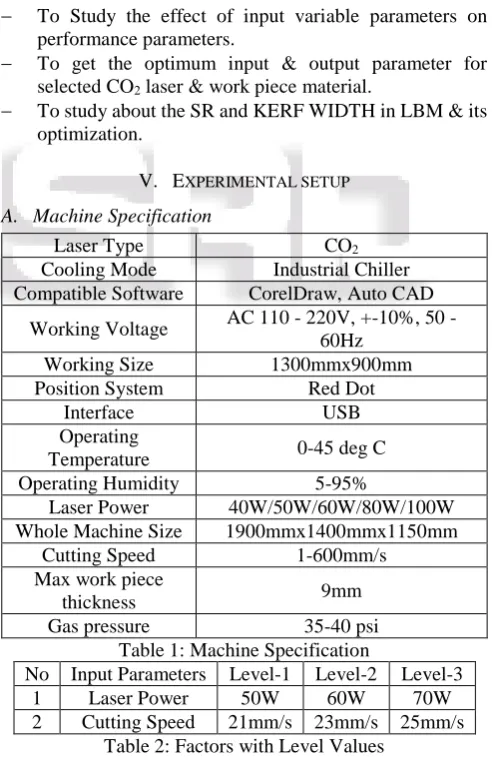
Laser Type CO2
Cooling Mode Industrial Chiller
Compatible Software CorelDraw, Auto CAD
Working Voltage AC 110 - 220V, +-10%, 50 - 60Hz
Working Size 1300mmx900mm
Position System Red Dot
Interface USB
Operating
Temperature 0-45 deg C
Operating Humidity 5-95%
Laser Power 40W/50W/60W/80W/100W
Whole Machine Size 1900mmx1400mmx1150mm
Cutting Speed 1-600mm/s
Max work piece
thickness 9mm
[image:3.595.306.553.312.699.2]Gas pressure 35-40 psi
Table 1: Machine Specification
No Input Parameters Level-1 Level-2 Level-3
1 Laser Power 50W 60W 70W
2 Cutting Speed 21mm/s 23mm/s 25mm/s Table 2: Factors with Level Values
B. Experimental Design by Taguchi Method
Sr No. Laser Power Cutting Speed
1 50 21
2 50 23
4 60 21
5 60 23
6 60 25
7 70 21
8 70 23
9 70 25
Table 3: L9 orthogonal array
VI. EXPERIMENTAL RESULTS
Laser beam cutting machining of MDF materials which is given below in figure,
Fig 6.1 Laser cut MDF material
A. Output parameter: - surface roughness
Surface roughness for laser beam machining is important parameter. In this process different value of laser power and cutting speed for surface roughness. Surface roughness is measured with surface roughness tester which is given in table below.
No. Laser
Power(W)
Cutting Speed(mm/s)
Surface Roughness(µm)
1 50 21 6.249
2 50 23 4.420
3 50 25 3.554
4 60 21 5.576
5 60 23 4.250
6 60 25 3.487
7 70 21 4.758
8 70 23 3.723
9 70 25 2.955
Table 4: Experimental value for surface roughness
B. Output parameter:- Kerf Width
No. Laser
Power(W)
Cutting Speed(mm/s)
Kerf Width(Mm)
1 50 21 0.125
2 50 23 0.094
3 50 25 0.055
4 60 21 0.180
5 60 23 0.140
6 60 25 0.090
7 70 21 0.185
8 70 23 0.145
9 70 25 0.095
Table 5: Experimental value for kerf width
In laser beam cutting the kerf width of laser cut material is dependence on laser power and cutting speed. There are 9 experiments taken and their different value which is given below in table.
VII. RESULT ANALYSES
A. ANOVA FOR SURFACE ROUGHNESS
Research work shown, nine (9) experiment runs are taken on work piece for design of experiment 3-level of each factor are used.
Source DF Adj
SS Adj MS
F-Value
P-Value Regression 2 8.5260 4.26299 53.44 0.000
Laser
power 1 1.2946 1.29456 16.23 0.007
Cutting
speed 1 7.2314 7.23143 90.64 0.000
Error 6 0.4787 0.07978
Total 8 9.0047
Table 6: Analysis Of Variance for Surface Roughness
S R-sq R-sq(adj) R-sq(pred)
0.282451 94.68% 92.91% 86.55%
Table 7: Model Summary
B. Regression Equation:-
SURFACE ROUGHNESS = 19.74
- 0.0464 LASER POWER - 0.5489 CUTTING SPEED
Fig 7.1 Main Effects Plot For Surface Roughness From above given figure shown that the main effective plot for surface roughness for two different parameter. If laser power increases the value of surface roughness decreases and other parameter cutting speed increases the value of surface roughness also decreases.
C. ANOVA FOR KERF WIDTH
Research work shown, nine (9) experiment runs are taken on work piece for design of experiment 3-level of each factor are used.
Source DF Adj SS Adj MS
F-Value P-Value Regression 2 0.014217 0.007108 43.05 0.000
Laser
power 1 0.003800 0.003800 23.01 0.003 Cutting
speed 1 0.010417 0.010417 63.09 0.000 Error 6 0.000991 0.000165
Total 8 0.015208
Table 8: Analysis Of Variance for Kerf Width
S R-sq R-sq(adj) R-sq(pred)
0.0128499 93.49% 91.31% 85.40%
D. Regression Equation:-
[image:5.595.45.288.106.291.2]KERF WIDTH = 0.4514 + 0.002517 LASER POWER - 0.02083 CUTTING SPEED
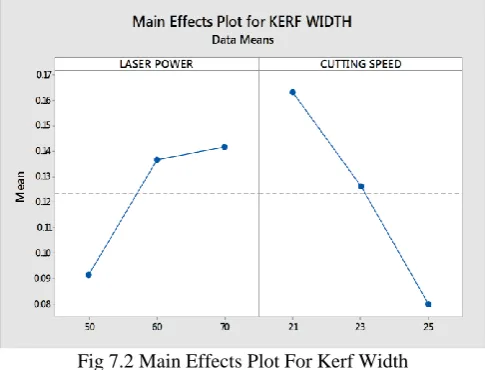
Fig 7.2 Main Effects Plot For Kerf Width
Main effective plot for kerf width which shown in fig 7.2 the different value of two parameter laser power and cutting speed the different value gives different kerf width value. If the parameter laser power increases the value of kerf width is increases and after increases the cutting speed the value of kerf width decreases which is shown.
VIII. OPTIMIZATION VALUE
Optimization value of input parameter like laser power and cutting speed for different output like surface roughness and kerf width which is shown. For most appropriate (minimize) value for surface roughness and kerf width.
Sr. No.
Laser power(W)
Cutting speed (mm/s)
Surface roughness
(μm)
Kerf width (mm)
1 60 21mm/s 5.576 0.180
Table 10: Optimization Value
IX. CONCLUSIONS
1. Effect of process parameters on surface roughness:- For laser power as the value increases the surface roughness value is decreases and now for the cutting speed value increases the value of surface roughness decreases.
2. Effect of process parameters on kerf width:-
As following the past result the value of laser power increased the value of kerf width also increase for the cutting speed increased the value of kerf width decreases.
REFERENCES
[1] Mr. Amitkumar and prof. Pravin. “Investigation of Effect of Laser Beam Machining (LBM) Process Parameters on Performance Characteristics of Stainless Steel (SS 304)” International Journal of Engineering Research and Technology. ISSN 0974-3154 Volume 10, Number 1 (2017).
[2] V.Senthilkumar1, N.Periyasamy2, A.Manigandan3, “Parametric investigation of process parameters for laser cutting process” International Journal of Innovative Research in Science, Engineering and Technology (An
ISO 3297: 2007 Certified Organization)Vol. 4, Issue 5, May 2015.
[3] Hitoshi Ozaki, Yosuke Koike, Hiroshi Kawakami, and Jippei Suzuki, “Cutting properties of stainless steel by using laser cutting without assist gas”. Graduate School of Engineering, Mie University, 1577 Kurima-machiya, Tsu, Mie 514-8507.
[4] Adrian PETRU, Aurel LUNGULEASA, “Wood
processes by laser tools”. INTERNATIONAL CONFERENCE of SCIENTIFIC PAPER AFASES 2014Brasov, 22-24 May 2014.
[5] Nukman Yusoff, Saiful Rizal Ismail, Azuddin Mamat and Aznijar Ahmad-Yazid, “Malaysian wood co2 –laser cutting parameters and cut quality”. American Journal of Applied Sciences 5 (8): 990-996, 2008 ISSN 1546-9239 [6] H. A. Eltawahni, N. S. Rossini, M. Dassisti, K. Alrashed, T. Aldaham, K. Y. Benyounis “Evaluation and optimization of laser cutting parameters for plywood materials”
a- Mechanical Eng. Dept., University of Benghazi, P. O. Box 1308, Benghazi-Libya.
b- Mechanical and Management Engineering Department, Politecnico di Bari, Viale Japigia 182, 70126 Bari-Italy.
c- College of Technology at Al-Riyadh, Mech. Eng. Dept., P.O.Box 7650, ZIP Code 31472, Saudi Arabia.
d- Department of Industrial Engineering and Manufacturing systems, University of Benghazi, P. O. Box 1308, Benghazi-Libya.
e- School of Mech. & Manu. Eng., Dublin City University, Dublin 9, Ireland.
[7] V.Senthilkumar, M. Bharath, K.Dhanapal, M.Dhinesh Kumaran, R.Gobinath. “Analysis and optimization of laser machining parameters”. International Journal of Innovative Research in Science, Engineering and Technology (An ISO 3297: 2007 Certified Organization) Vol. 5, Special Issue 8, May 2016
[8] Madić Miloš and Radovanović Miroslav, “Application of taguchi method for optimization of Laser cutting”. 1University of Niš, Faculty of Mechanical Engineering
in Niš, a [email protected], b
[9] Chithirai Pon Selvan M, Nethri Rammohan and Sachidananda HK. “Laser Beam Machining”: A Literature Review on Heat affected Zones, Cut Quality and Comparative Study. European Journal of Advances in Engineering and Technology, 2015, 2(10): 70-76, ISSN: 2394 - 658X
[10]Black *, S.A.J. Livingstone, K.L. Chua, “laser beam machining (LBM) database for the cutting of ceramic tile”, Journal of Materials Processing Technology 84 (1998) 47–55, Department of Mechanical and Chemical Engineering, Heriot-Watt Uni6ersity, Riccarton,