415
AN INTEGRATED THEORETICAL FRAMEWORK FOR
CLOUD COMPUTING ADOPTION BY UNIVERSITIES
TECHNOLOGY TRANSFER OFFICEs (TTOs)
1MAHSA BARADARAN ROHANI, 2AB. RAZAK CHE HUSSIN
1
Universiti Teknologi Malaysia, Faculty of Computing, Department of Information System
2
Universiti Teknologi Malaysia, Faculty of Computing, Department of Information System
E-mail: [email protected], [email protected]
ABSTRACT
Cloud Computing (CC) as a new phenomenon technology has become a significant term in the world of information systems (IS). Adopting new technologies and developing new systems as new strategies help organizations to gain competitive advantage and become more efficient and productive. As cloud-based solutions have many advantages for organizations it is valuable for them to understand the determinants of cloud computing adoption. Organizations including Technology-Transfer-Offices (TTOs) need to improve their business methods by adopting CC. Despite the advantages of Cloud Computing, only a few studies have examined CC adoption in the IS field and in particular there is no study in the context of TTO. This paper aims to fill this gap by analyzing the determinants of CC adoption by Malaysian TTOs. Many factors influence CC adoption. The aim of this paper is to identify the factors and barriers which influence the adoption of CC by TTOs. To assess the determinants of CC adoption by TTOs, researcher proposed an integrated theoretical framework based on two theories of adoption: the Diffusion of Innovations (DOI) theory and Technology-Organization-Environment (TOE).
Keywords:Cloud Computing, Adoption, Technology Transfer Office (TTO), Diffusion of Innovations
(DOI), Technology-Organization-Environment (TOE)
1. INTRODUCTION
In recent years, Information Technology (IT) is globally regarded as an essential tool that can improve business competitiveness and provide enormous advantages for organizations. Adopting new technologies and developing new systems as new IT strategies help organizations to gain competitive advantage and become more efficient and productive. Therefore, due to severe market competition and obviously changing business environment, organizations remain motivated to adopt new IT and to rapidly reorient their IT strategies including Cloud Computing to improve their business operations (Pan and Jang, 2008; Sultan, 2010; Low et al., 2011). Cloud Computing provides many advantages for all organizations, including TTOs. Despite the advantages of Cloud Computing, study on CC adoption seems to be one of the less examined research in the IS field (Wu et al., 2011) and particularly there is no study in the context of TTO. Therefore TTOs same as other organizations need to consider both the benefits and risks of CC to make better decision to adoption. Consequently, Technology Transfer Offices of Malaysian universities have been
selected for this study as they are lagging behind Cloud Computing adoption.
1.1. Cloud Computing
Cloud Computing has become a critical player in the world of information technology (Sultan, 2010; Low et al., 2011, Buyya et al., 2009). According to (Saedi & Iahad, 2013) the term Cloud Computing (CC) “can be explained in two parts: First, using a web browser on the internet to dynamically allocate or de allocate the access of the remote computing resources based on the users’ demands (Naone, 2007) and the second part refers to paying for the real use of the computing resources and facilities” (Hoover & Martin 2008; Kim et al. 2009).
Cloud Computing includes three different types of services: Software as a Service (SaaS), platform as a Service (PaaS), and Infrastructure as a Service (IaaS) Goscinski and Brock, 2010, Low et al., 2011, Wu, 2011). In SaaS, customers rent software applications from cloud service providers via the internet (Sultan, 2010) instead of installing them on their own
computer (Salesforce.com, Customer Resource
416 and executed (Salesforce.com, Microsoft Azure, and Google App Engine). The last category, which is the delivery of computer infrastructure as a service (IaaS), offers computing power and storage space. In this category clients pay on a per-use basis and services are presented by Amazon.com AWS, IBM Blue Cloud, SUN Network.com, Rackspace, and GoGrid.
Therefore Cloud Computing is defined as the ability of businesses and individual users to access applications from anywhere in the world on demand (Low et al., 2011; Misra & Mondal, 2010; Sultan, 2010).
According to NIST (National Institute of Standards and Technology) there are 4 types of deployment models of cloud computing (Mell & Grance, 2009; Das et al. 2011; Marston et al., 2011). The first is Private Cloud, where “the cloud infrastructure is operated solely for an organization. It may be managed by the organization or a third party and may exist on premise or off premise”. The second is Community Cloud where “the cloud infrastructure is shared by several organizations and supports a specific community that has shared concerns. It may be managed by the organizations or a third party and may exist on premise or off premise”. The third is Public Cloud. This is when “the cloud infrastructure is made available to the general public or a large industry group and is owned by an organization selling cloud services”. And finally Hybrid Cloud, which is a combination of two or more types of cloud computing as previously described. (Khajeh-Hosseini et al., 2010)
1.2. Technology Transfer Office
Universities are definitely an important source of new knowledge in the area of science and technology. It is very important to identify mechanisms by which the results of university researchers can be transferred into industry (Yazdani et al., 2011; Siegel et al., 2005). In this process, a Technology Transfer Office (TTO) has the important role (Siegel et al., 2003). Many
universities established technology transfer
offices to manage and protect their intellectual property (Siegel et al., 2003). TTO were established at most universities with the mission of supporting and helping professors, students and administration to develop and commercialize their inventions Apple, 2008; Yazdani et al., 2011).
TTO should present a link between university researchers and entrepreneurship, or in one word,
economy. However in both developed and developing countries there is still a gap between university and industry (Siegel et al., 2007). TTOs are important players of each market and they significantly contribute to each economy’s GDP. Although TTOs are not powerful enough to influence the economy individually, overall they have a great impact. Therefore proposing new strategies and technologies that help TTOs become more efficient and effective also have a positive impact on the economy’s growth as a whole (Siegel et al., 2004; Sharif et al., 2008) One strategy that helps organizations including TTOs to gain competitive advantage among competitors is investing in ICT (Siegel et al., 2007; Yazdani et al., 2011; Sharif et al., 2008).
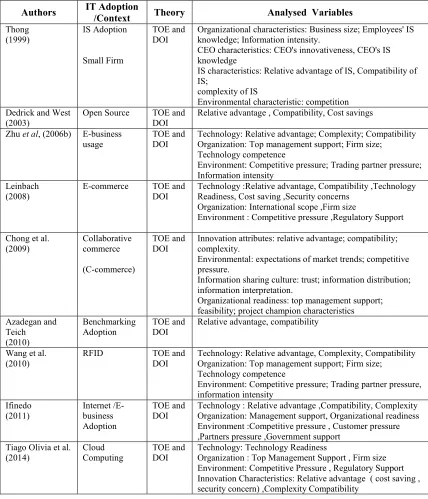
Table 1: Previous Research Combined TOE and DOI
2. BACKGROUND OF STUDY
2.1. Cloud Computing Adoption
Cloud Computing is defined by the National Institute of Standards and Technology (NIST) as “a model for enabling convenient, on-demand network access to a shared pool of configurable computing
resources (e.g., networks, servers, storage,
applications, and services) that can be rapidly provisioned and released with minimal management effort or service provider interaction” (Khajeh-Hosseini et al., 2010). Cloud computing is a kind of computing application service that is like e-mail, office software, and enterprise resource planning (ERP) and uses ubiquitous resources that can be shared by the business employee or trading partners. Thus, a user on the internet can communicate with many servers at the same time, and these servers exchange information among themselves (Hayes, 2008). Moreover, telecommunication and network technology have been progressing fast; Cloud computing services can provide the user seamless, convenient, and qualified technological support that can develop the enormous potential demand (Buyya et al., 2009; Pyke, 2009). Thus, cloud computing
provides the opportunity of flexibility and
417 and become more efficient, productive and innovative by allowing firms to focus on their
core business. Cloud offers efficient
communication, and improves collaboration which leads to work efficiency and coordination among organizations and enhances the ability to respond more quickly to changing market needs (Armbruat et al., 2010; Marston et al., 2011; Olivia et al., 2014). Therefore acceptance and usage of any beneficial technology such as CC by TTOs have a positive influence on the economy as a whole. Cloud Computing can provide several advantages for all organizations (Saya et al., 2010), both strategic and operational. Despite the
advantages of Cloud Computing for
organizations, only a few studies have examined the CC adoption in the IS field (Wu et al., 2011) and in particular there is no study in the TTO context. Moreover the cloud computing adoption rate is not growing as fast as expected (Banerjee, 2009). According to (Saya et al., 2010) most of the previous literature focused on Cloud computing’s architecture (Rochwerger et al., 2009), potential applications (Liu & Orban 2008), and Cloud Computing costs and benefits (Assuncao et al., 2009). Besides developing a theoretical framework few have examined cloud computing adoption. While Cloud Computing provides many advantages to all enterprises it seems that the adoption of CC is still in early stages of diffusion (Saya et al., 2010; Khajeh-Hosseini et al. 2010; Saedi & Ihad, 2013) hence study on CC adoption is very important and useful. As a result it is important to identify the factors influencing the decision to adopt cloud computing.
2.2. Theories of Adoption
Many different theories and models have been proposed to study the process of adopting new technologies. Review of literature on Information Technology (IT) adoption shows that there are several studies at the individual level. There are many theories and models used for IT adoption at the individual level such as Technology Acceptance Model (TAM) (Davis, 1986; Davis, 1989; Davis et al., 1989), Theory of Planned Behavior (TPB) (Ajzen, 1985; Ajzen, 1991), TAM 2 (Venkatesh & Davis, 2000), Unified Theory of Acceptance and Use of Technology (UTAUT) (Venkatesh et al., 2003). However, there are fewer studies at the organization level. This article mainly focused on well-known and most relevant theories for this study, Diffusion of
Innovation (DOI),
Technology-Organization-Environment (TOE).
2.2.1.Diffusion of Innovation (DOI)
Diffusion of Innovation Theory (DOI) is a theory developed by Everett Rogers (1962). DOI is a theory of how, why, and at what rate new ideas and technology spread through cultures (Rogers, 2003).
DOI is mostly based on the innovation’s
characteristics and the perceptions of the users about the technology (Olivia, 2014). Rogers (1983) defined diffusion of innovation as “the process in which an innovation is communicated through certain channels over time within a particular social system”. Rogers (2003) identified five important attributes of innovation that influence the decision whether to adopt or reject a particular innovation. These five attributes are valid for both individual and organizational adoption of technology. Rogers suggested the characteristics which influence the adoption of innovation as relative advantage,
compatibility, complexity, observability, and
trialability. Relative advantage is the degree to which an innovation can bring benefits to an organization. Compatibility refers to the degree to which an innovation is consistent with existing business processes, practices and value systems. Complexity considers the degree to which an innovation is difficult to use. Observability is the degree to which the results of an innovation are visible to others and trialability is the degree to which an innovation may be experimented with on a limited basis (Rogers, 2003).
2.2.2.Technology-organization-environment
framework
TOE framework was developed by Tornatzky and Fleischer (1990) to analyze the adoption of technological innovation by firms and organizations. According to TOE framework there are three context
groups: technological, organizational and
environmental which influence the adoption an innovation at firm level (DePietro et al., 1990; Melville & Ramirez 2008; Low et al., 2011).
The technological context refers to the
technologies available to an organization and the current state of technology in the organization.
Technological context also refers to the
418 resources, and the amount of slack resources available internally. The environmental context refers to organization’s environment (DePietro et al., 1990, Low et al., 2011) such as industry, competitors, regulations, and relationships with the government. These are external factors that
present constraints and opportunities for
technological innovations (DePietro et al., 1990).
The majority of these theories explains and predicts the adoption decision based on factors that are related to the technology itself (such as the characteristics of the technology, or users’ perception about the technology). However, technology-related constructs are not the only
factors that influence the adoption of
technologies. There are other factors (such as environmental and organizational factors) that influence the decision to adopt an innovation. These factors, specifically environmental factors, are not taken into account in DOI. Technology- Organization-Environment (TOE) is another theoretical framework that overcomes this drawback. This framework not only uses technological aspects of the diffusion process, but
also non-technological aspects such as
environmental and organizational factors. Table 1 shows previous research that combined two theories in different context of IT adoption.
3. RESEARCH METHODOLOGY
The main aim of this research is to identify factors which influence the adoption of cloud computing by TTOs. This study proposed an integrated theoretical framework based on two theories including the DOI and TOE framework. An in-depth literature review was conducted by researcher to determine and identify factors and
barriers which influence CC adoption.
Quantitative method will be used in this research. Questionnaires will be used to collect data from case studies. After that a pilot study will be conducted to confirm the structure and content of the survey before conducting the main study; therefore, researcher will use a pilot study among TTOs in order to improve the variables. Online survey and paper based survey will be used for the collection of quantitative data. Intended data will be collected from Technology Transfer Offices of five public Malaysian research universities. Online questionnaires will be set up using Google Survey, and this online survey will be sent via e-mail to the TTOs managers. To analyze data Smart PLS software will be used.
4. RESEARCH FRAMEWORK AND
HYPOTHESIS
In this study, an integrated theoretical framework for cloud computing adoption at technology transfer offices based on DOI and TOE that are used widely in IT adoption studies (Chong et al., 2009, Olivia et al., 2014) has been proposed. These two theoretical frameworks complement each other. DOI is mostly focused on characteristics of the technology and does not recognize environmental factors while TOE is a
multiple perspective framework including
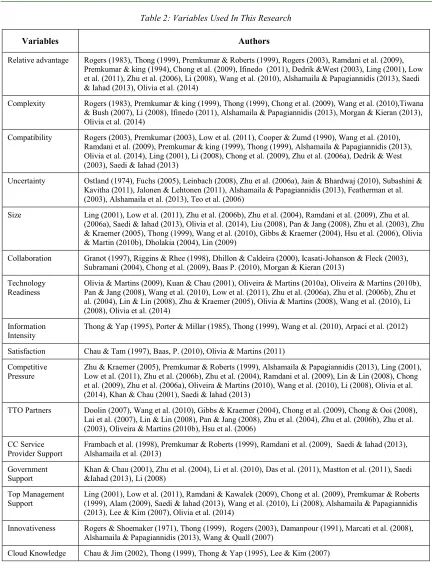
environmental context influence the decision to adopt an innovation. When using the TOE framework in comparison with other adoption and diffusion theories it is much more relevant to arrange every determinant of CC adoption into three categories: technological, organizational, and environmental contexts. Moreover, the TOE theory is a very useful analytical tool to explain the adoption of innovation by firms (DePietro et al., 1990). Table 2 shows the list of variables included in this study.
Table 2: Variables used in this research
4.1. Research Theoretical Framework
Figure 1 demonstrates the initial integrated theoretical framework for adoption of cloud computing by TTOs. Research framework is founded based on two theories, TOE and DOI. In order to develop this integrated framework, factors of and barriers to CC adoption are categorized into four groups: Technology, Organization, Environment and Human characteristics.
419
4.2. Research Hypothesis
In this section of the research, each construct is explained in more detail. The related hypothesis for each construct is then presented.
T.1 Relative Advantage: Rogers (2003)
defined relative advantage as “the degree to which an innovation is perceived as providing better and greater benefit for firms”. In this study relative advantage is defined as “the degree to which TTO managers perceive cloud computing as being better than other computing paradigms”. Many previous studies in innovation adoption process identified that relative advantage is a significant determinant (Wang et al., 2010; Low et al., 2011; Olivia et al., 2014) therefore it is important to study the concept of relative advantage in the context of cloud computing.
According to (Saedi & Ihad, 2013), CC
provides enormous advantages for all
organizations. An advantageous technology is one that enables an organization to perform tasks quicker, easier and more efficiently. In addition, it can improve the quality, productivity and performance of the organization (Low et al., 2011; Armbrust et al., 2010; Hayes, 2008). For these reasons, relative advantage has a positive influence on adoption of cloud computing by TTOs; therefore in the context of cloud computing the below hypothesis is formulated:
HT1: Relative advantage will be positively correlated to the adoption of cloud computing
T.2 Complexity: Rogers (2003) defined
complexity as “the degree to which an innovation is perceived as relatively difficult to understand and use”, which is a definition which applies to Cloud Computing. According to (Buyya et al., 2009) organizations may doubt and have no confidence regarding the use of cloud computing because it is a relatively new technology for them. It may take time for users to understand and implement the new system. Thus, complexity of an innovation can act as a barrier to implementation of new technology; complexity factor is usually negatively affected (Premkumar et al., 1994). Therefore, researcher hypothesizes that in the context of cloud computing the level of complexity of the system has a negative influence on adoption of cloud computing:
HT2: Complexity will be negatively correlated to the adoption of cloud computing
T.3 Compatibility: Based on (Rogers, 1983)
compatibility refers to “the degree to which innovation fits with the potential adopter’s existing values, previous practices and current needs”. Compatibility has been considered as a significant factor for innovation adoption (Cooper and Zmud, 1990; Wang et al., 2010). In this study compatibility is defined as “the degree to which cloud computing is perceived as consistent with the existing values, work styles, past experience, and requirements of the
TTOs”. When technology is recognized as
compatible with work application systems,
organizations are likely to consider the adoption of new technology. When technology is viewed as significantly incompatible, major adjustments in processes that involve considerable learning are required. Thus, the following hypothesis is proposed:
HT3: Compatibility will be positively correlated to the adoption of cloud computing
T.4 Uncertainty: Uncertainty refers to the extent
to which the results of using an innovation are insecure (Ostlund, 1974; Fuchs, 2005). Rogers considers uncertainty as a significant barrier for innovation adoption (Rogers, 2003). In the context of cloud computing, security, privacy and lock-in are typical concerns that organizations may have (Aziz, 2010; Alshamaila & Papagiannidis, 2013). Therefore, uncertainty of the innovation can act as a barrier for cloud computing adoption. In this research uncertainty refers to insecurity. Recognition of concerns in cloud computing can be a possible hindrance to TTOs adopting cloud computing until uncertainties are resolved.
HT4: Level of uncertainty of the cloud computing will be negatively correlated to the adoption of cloud computing
O.1 TTO’s Size: Size of the organization is one of
420 innovation technology development (Low et al., 2011).
HO1: TTO’s size will be positively correlated with the adoption of cloud computing. TTOs with larger size are more likely to adopt cloud computing.
O.2 Collaboration: The degree of
inter-organization collaboration includes contacts, interactions, relationships, joint programs and written agreements between trading partners (Granot, 1997) having equal aims in terms of product or service delivery, quality, productivity, and customer satisfaction (Chong et al., 2009). For organizations such as TTOs, having good
communication pathways and improving
collaboration among TTO partners is crucial to achieving their business goals. Thus for TTOs increasing and improving collaboration among TTO and partners is very significant. This claim can be supported by Subramani’s (2004) study which found that the use of IT or internet-based technologies is a significant determinant leading to closer trading partner relationships. Morgan and Kieran (2013) in their study of Cloud Computing adoption revealed that one of the organizational factors influencing CC adoption is the desire to improve collaboration. They mentioned that adoption of cloud computing has resulted in more collaboration among partners. Consequently, if TTOs are willing to have more communication and collaboration with their partners they are more likely to adopt Cloud Computing in their business. These considerations lead to the following hypothesis:
HO2: Desire to improve collaboration for TTOs will be positively correlated with the adoption of cloud computing.
O.3 Technology Readiness: The technological
readiness of organizations refers to technological infrastructure and IT human resources, which influence the adoption of technology (Kuan & Chau, 2001; Zhu et al., 2006; To & Ngai, 2006; Pan & Jang, 2008; Oliveira & Martins, 2010; Wang et al., 2010; Low et al., 2011). Technological infrastructure refers to installed network technologies and enterprise systems which provide a platform on which the cloud computing applications can be built. IT human resources provide the knowledge and skills to
implement cloud-computing-related IT
applications (Wang et al., 2010). Cloud computing services can become part of value
chain activities only if firms have the required infrastructure and technical competence. Therefore, firms that have technological readiness are more prepared for the adoption of cloud computing. These considerations lead to the following hypothesis:
HO3: Technology readiness will be positively correlated with the adoption of cloud computing.
O.4 Information Intensity: Thong (1999) defined
information intensity as “the degree to which information is present in the product or service of a business”. Business or firms in different sectors have different information intensity. Moreover; those in more information intensive sectors are more likely to adopt IS (Porter & Millar, 1985). In this research information intensity is described as the firm’s reliance on accessing accurate, up-to-date, relevant and reliable information whenever they need it. Based on the definition companies whose business depends on information are more likely to adopt cloud computing. The following hypothesis is related to this construct:
HO4: Information intensity will be positively correlated to the adoption of cloud computing
O.5 Satisfaction: defined as “the degree of
satisfaction level with existing systems (Chau & Tam, 1997). The level of satisfaction with existing systems plays a significant role as far as motivation to change is concerned. It means that organizations that have high level of satisfaction with their current systems are not willing to adopt new technology (Chau & Tam, 1997). Organizational innovation proceeds in phases in which problems are first identified and then solutions are compared and evaluated (Rogers, 1983; Tornatzky & Fleischer, 1990). A low satisfaction level with existing systems, generally referred to as performance gap, will provide the impetus to find new ways to improve performance (Rogers, 1983). Based on this argument, the following hypothesis is suggested:
HO5: Satisfaction with existing systems will be negatively correlated to the adoption of Cloud Computing
E.1 Competitive Pressure: Competitive pressure
421 computing, as one of the new computing paradigms, is one way to achieve competitive advantage. In the context of this study researcher believes that TTOs that operate in more competitive environment are more likely to adopt cloud computing. The following hypothesis is suggested:
HE1: Competitive pressure will be positively correlated to the adoption of Cloud Computing
E.2 TTO Partners: Some empirical studies
have identified that trading partners are an important determinant for IT adoption and use (Chong & Ooi, 2008; Lai et al., 2007; Lin & Lin, 2008; Pan & Jang, 2008; Zhu et al., 2004). Partners may be a facilitator for innovation adoption (Wang et al., 2010; Gibbs & Kraemer 2004). Many organizations rely on trading partners for their IT design and implementation tasks (Pan & Jang, 2008). Trading partner power or recommendation also have a positive effect on IT adoption decisions; this power can be either convincing or compulsory (Chong and Ooi (2008) and Oliveira and Martins (2010)). Moreover when firms face strong competition, they tend to implement changes more aggressively. Hence, in the context of this research, in order to have good communication between university and industry and to facilitate the technology transfer process, TTO partners positively influence on the adoption of cloud computing.
HE2: TTO Partners will be positively correlated to the adoption of cloud computing.
E.3 Cloud Computing Service Provider
Support: Marketing activities that suppliers
execute can significantly influence TTOs’ adoption decisions. This may affect the diffusion process of a particular innovation. Previous researches such as Hultink et al. (1997), Frambach et al. (1998), Woodside & Biemans (2005), Alshamaila & Papagiannidis (2013), have attempted to show a link between supplier marketing efforts and the firm’s adoption decision. In many studies these are known as “external factors” defined as “the perceived importance of support offered by cloud computing service providers”. In this research, support includes marketing, training, customer service and technical support provided by cloud providers. Hence researcher thinks higher levels of marketing effort and support provided by cloud computing service providers increases the chance
of cloud computing adoption by TTOs; therefore, the following hypothesis is proposed:
HE3: Higher level of support from cloud providers will be positively correlated to the adoption of cloud computing by TTOs
E.4 Government Support: Government support
is another environmental factor that can influence Cloud Computing adoption. Government support is defined as “the different types of helps given by the government.” (Khan & Chau, 2001 ; Zhu et al., 2004 ; Li et al., 2010; Das et al., 2011; ; Saedi & Iahad, 2013; Li, 2008). It refers to the support given by the authorities in order to promote the increase of IS innovations in firms. The perception that firms have of the existing laws and regulations can be determinant in this process. Thus, governments could encourage TTOs to adopt Cloud Computing by creating rules, support and promotion to protect businesses in the use of this system. For this research, the following hypothesis is proposed:
HE4: Government support will be positively correlated to the adoption of cloud computing.
H.1 Top Management Support: Top
management support is a significant factor in the adoption of new technologies and has been found to be positively related to adoption (Premkumar & Roberts, 1999). Top management can provide vision, support, and a commitment to create a positive environment for innovation (Lee & Kim, 2007). Top management support and their attitudes towards change can be effective in the adoption of innovation (Premkumar & Michael, 1995; Eder & Igbaria, 2001; Daylami et al., 2005). Moreover, top management can send signals to different parts of the organization about the importance of the new technology (Thong, 1999; Wang et al., 2010; Low et al., 2011). Consequently, top management support is considered to have an impact on the decision to adopt cloud computing (Thong, 1999; Daylami et al., 2005; Wilson et al., 2008).
HH1: Top management support will be positively correlated to the adoption of cloud computing
H.2 Innovativeness: Thong and Yap (1995)
422 process information, take decisions and solve problems”. Managers or decision makers who prefer to perform the tasks differently are more innovative; and hence they usually adopt new technologies (Alshamaila & Papagiannidis, 2013). Therefore it is hypothesized that TTOs managers or decision makers who are more innovative are more likely to adopt cloud computing.
HH2: Innovativeness is positively correlated to the adoption of cloud computing
H.3 Cloud Knowledge: As indicated in
Diffusion of Innovation theory, that organizations have enough knowledge about an innovation for both decision maker and employees is the first step in adoption process. According to Thong (1999) CEO’s knowledge of information system (IS) has a positive impact on the adoption of information systems. In this context the researcher believes that TTOs whose decision makers or
managers are knowledgeable about cloud
computing are more likely to adopt it. Similar to decision maker’s cloud knowledge, employees’ knowledge about cloud computing is also significant in the adoption of information systems. In addition, TTO whose employees have more knowledge about innovation offer less resistance towards the adoption of new technologies. There is also empirical evidence that shows the positive relationship between employees’ IS knowledge and the decision to adopt IS (Thong, 1999). In the context of cloud computing, the following hypothesis has been proposed:
HH3: Having knowledge about cloud computing is positively correlated to the decision to adopt cloud computing
Cloud Computing Adoption: Cloud
computing adoption is the only dependent variable in this research. Measuring the adoption of cloud computing is done by creating items to measure the intention to use and adopt cloud computing by the TTOs.
5. DISCUSSION AND CONCLUSION
Literature review shows there has been no previous study to analyze the factors influencing the adoption of cloud computing in the context of TTOs. This study proposed an integrated theoretical framework based on the DOI theory and TOE framework. This research identifies four contexts: Human characteristics, technological, organizational and environmental which are essential elements for adoption of Cloud
Computing. This research can be a starting point for future developments on the determinants that facilitate or inhibit the adoption of Cloud Computing by TTOs. This study can serve as a foundation for TTOs’ decision makers considering whether to adopt cloud computing in their TTOs or not. The study is a resource for organizations and researchers that may use the conclusions of this study to extend their knowledge in this area and eventually develop other externalities. Researcher expects proposed theoretical framework could be grounded and a starting point for future research on the adoption of Cloud Computing.
Cloud computing is a new computing paradigm which is advantageous for organizations. Services offered by cloud service providers help TTOs to perform their tasks quicker, easier and more efficiently .To promote cloud computing adoption, it is important to clarify the factors which influence CC adoption. This study was aimed to understand the process of cloud computing adoption and to identify factors that affect the adoption of Cloud Computing. According to (Saya et al. 2010) it is crucial for CC service providers to determine how to influence organizations’ adoption decision, and also to understand how to convince them to migrate to the cloud based solutions. Therefore based on the research objectives, this study offers an integrated framework for Cloud Computing adoption that can be useful for both TTOs and Cloud Computing service providers. (Benlian & Hess, 2011) believe that CC service providers must be considered as factors that influence adoption decisions and then prioritizing or downplaying them when offering CC services to organizations at different stages of their technology adoption lifecycle.
6. LIMITATIONS AND FUTURE RESEARCH
423
REFERENCES:
[1] Alam, S. S. “Adoption of internet in
Malaysian SMEs” Journal of Small Business
and Enterprise Development, 16, 2009, 240-255.
[2] Ajzen, I. “From intentions to actions: A
theory of planned behavior”, Berlin,
Springer, 1985
[3] Ajzen, I. “The Theory of Planned Behavior”,
Organizational Behavior and Human Decision Processes, 50,2, 1991, pp. 179-211.
[4] Armbrust M., Fox, A., Griffith, R., Joseph,
A. D., Katz, R., Konwinsky, A. “A view of
cloud computing”. Communication of the
ACM, 2010, 50-58.
[5] Assuncao, M. D., Costanzo, A., and Buyya,
R. “Evaluating the cost-benefit of using cloud computing to extend the capacity of clusters.” Paper presented at the 18th ACM International Symposium on High Performance Distributed Computing, Garching, Germany, 2009
[6] Apple, K. S. “Evaluating university
technology transfer offices.” Public policy in an entrepreneurial economy, 2008, 139-157.
[7] Alshamaila, Y. & Papagiannidis, S. “Cloud
computing adoption bySMEs in the north
east of England.” A multi-perspective
framework. Journal of Enterprise Information Management Information. JEIM 26,3, 2013
[8] Arpaci, I., Yardimci, Y., Ozkan, S.,
Turetken,O., “Organizational Adoption of
Mobile Communication Technologies.”
European, Mediterranean & Middle Eastern Conference on Information Systems. June 7-8, Munich, Germany, 2012
[9] Azadegan, A. & Teich, J. “Effective
benchmarking of innovation adoptions: A theoretical framework for e-procurement
technologies.” Benchmarking: An
International Journal, 17, 2010, 472- 490
[10]Aziz, N. “French higher education in the
cloud.” Grenoble Ecole de Management,
2010
[11]Baas, P., “Task-Technology Fit in the
Workplace: affecting employee satisfaction and productivity”, 2010
[12]Banerjee, P., “An intelligent IT infrastructure
for the future”, Proceedings of 15th
International Symposium on High-performance Computer Architecture, HPCA, Raleigh, NC, USA, 2009
[13]Benlian, A., and Hess, T. “Opportunities and
risks of software-as-a-service: Findings from a
survey of it executives.” Decision Support
Systems, 52 (1), 2011, 232-246.
[14]Buyya, R., Yeo, C.S., Venugopa, S., Broberg, J.
and Brandic, I., “Cloud computing and emerging it platforms: vision, hype, and reality for
delivering computing as the 5th utility”, Future
Generation Computer Systems, Vol. 25, 2009, pp. 599-616.
[15]Chau, P.Y.K. and Tam, K.Y., “Factors affecting
the adoption of open systems: an exploratory study”, MIS Quarterly, Vol. 21, 1997, pp. 1-24.
[16]Chau, P.Y.K. and Hu, P.J.-H., “Investigating
healthcare professionals’ decisions to accept telemedicine technology: an empirical test of
competing theories”, Information and
Management, 39(4), 2002, pp. 297-311.
[17]Chong, A.Y.L. and Ooi, K.B., “Adoption of
interorganizational system standards in supply chains: an empirical analysis of RosettaNet
standards”, Industrial Management & Data
Systems, Vol. 198, 2008, pp. 529-47.
[18]Chong, A., Ooi, K., Lin, B. and Raman, M.,
“Factors affecting the adoption level of
c-commerce: an empirical study”, Journal of
Computer Information Systems, Vol. 50 No. 2, 2009
[19]Cooper, R.B. and Zmud, R.W., “Information
technology implementation research: a
technological diffusion approach”, Management Science, Vol. 36, 1990, pp. 123-39.
[20]Damanpour, F., “Organizational innovation: a
meta-analysis of effects of determinants and
moderators”, The Academy of Management
Journal, Vol. 34 No. 3, 1991, pp. 555-590.
[21]Das, R. K., Patnaik, S., & Misro, A. K.,
“Adoption of cloud computing in e-governance” Berlin/Heidelberg, Germany: Springer, 2011
[22]Davis, F., “Perceived usefulness, perceived ease
of use, and user acceptance of information
technology”, Management Information Systems
Quarterly, 13(3), 1989, pp. 319-340.
[23]Davis, F., Richard, P.B. and Paul, R.W., “User
acceptance of computer technology: a
comparison of two theoretical models”,
Management Science 35(8), 1989, pp. 982-1003.
[24]Daylami, N., Ryan, T., Olfman, L. and Shayo,
C., “System sciences”, HICSS ‘05, Proceedings
of the 38th Annual Hawaii International Conference, Island of Hawaii, 3-6 January, 2005
[25]Dedrick, J. and West, J., “Proceedings on the
Workshop on Standard Making”, A Critical
424
[26]Depietro, R., Wiarda, E., & Fleischer, M.,
“The context for change: Organization, technology, and environment. In L. G. Tornatzky, & M. Fleischer (Eds.)”, Processes of technological innovation. Lex¬ington, MA: Lexington Books, 1990
[27]Dhillon, G. and Caldeira, M., “Interpreting
the adoption and use of EDI in the Portuguese clothing and textile industry”, Information Management &Computer Security, Vol. 8 No. 4, 2000, pp. 184-8.
[28]Dholakia, R.R. and Kshetri, N., “Factors
impacting the adoption of the internet among
SMEs”, Small Business Economics, Vol. 23,
2004, pp. 311-22.
[29]Doolin, B., & Troshani, I., “Organizational
adoption of XBRL”, Electronic Markets, 17,
2007, pp199–209
[30]Featherman, M., Pavlou, P. and Samuel, B.,
“Predicting e-services adoption: a perceived
risk facets perspective”, International
Journal of Human-Computer Studies 59, 2003, pp. 451-474.
[31]Frambach, R., Barkema, H., Nooteboom, B.
and Wedel, M., “Adoption of a service innovation in the business market: an empirical test of supply-side variables”, Journal of Business Research, Vol. 41 No. 2, 1998, pp. 161-174.
[32]Fuchs, S., “Organizational Adoption Models
for Early ASP Technology Stages”, Adoption and Diffusion of Application Service Providing (ASP) in the Electric Utility Sector. WU Vienna University of Economics and Business, 2005
[33]Granot, H., “Emergency inter-organizational
relationships”, Disaster Prevention and
Management: An International Journal, Vol. 6 No. 5, 1997, pp. 305-10.
[34]Goscinski, A., and Brock, M., “Toward
dynamic and attribute based publication,
discovery and selection for cloud
computing”, Future Generation Computer
Systems, 26 (7), 2010, pp.947-970.
[35]Gibbs, J. and Kraemer, K., “A cross-country
investigation of the determinants of scope of e-commerce use: an institutional approach”, Electronic Markets, Vol. 14 No. 2, 2004, pp. 124-137.
[36]Hayes, B., “Cloud computing”,
Communications of the ACM, Vol. 51, 2008, pp. 9-11.
[37]Hultink, E., Griffin, A., Hart, S. and Robben,
H., “Industrial new product launch strategies and product development performance”,
Journal of Product Innovation Management, Vol. 14 No. 4, 1997, pp. 243-257.
[38]Hoover, J. N., and Martin, R., “Demystifying the
cloud”, InformationWeek Research & Reports,
2008, pp.30-37.
[39]Ifinedo, P., “An empirical analysis of factors
influencing Internet/E-Business technologies
adoption by SMEs in Canada”, International
Journal of Information Technology & Decision, 2011a
[40]Icasati-Johanson, B. and Fleck, S.J., “Impact of
ebusiness supply chain technology on inter-organizational relationships: stories from the
front line”, Proceedings for the 16th Bled
Ecommerce Conference: Etransformation, Bled, 2003
[41]Jain, L., and Bhardwaj, S., “Enterprise cloud
computing: Key considerations for adoption”, International Journal of Engineering and Information Technology, 2 (2), 2010, pp.113-117.
[42]Khajeh-Hosseini, A., Greenwood, D., Smith, J.
W., and Sommerville, I., “The cloud adoption toolkit: Addressing the challenges of cloud
adoption in enterprise”, Retrieved from
http://arxiv.org/, 2010
[43]Kim, W., Kim, S. D., Lee, E., and Lee, S.,
“Adoption issues for cloud computing”, Paper
presented at the Proceedings of the 11th
International Conference on Information Integration and Web-based Applications, Services, Kuala Lumpur, Malaysia, 2009
[44]Kuan, K. K. Y., & Chau, P. Y. K., “A
perception-based model for EDI adoption in
small businesses using a technology–
organization–environment framework”,
Information and Management, 38, 2001, pp. 507 521.
[45]Lai, V.S., “Critical factors of ISDN
implementation: An exploratory study”,
Information and Management, 33(2), 1997a, pp. 87-97.
[46]Lee, S. and Kim, K., “Factors affecting the
implementation success of internet-based
information systems”, Computers in Human
Behavior, Vol. 23, 2007, pp. 1853-80.
[47]Leinbach, T. R., “Global E-Commerce: Impacts
of National Environment and Policy”, edited by Kenneth L. Kraemer, Jason Dedrick, Nigel P.
Melville, and Kevin Zhu. Cambridge:
Cambridge University Press. The Information Society, 24, 2008, pp.123-125.
[48]Li, J., Wang, Y.-F., Zhang, Z.-M., & Chu, C.-H.,
425
framework”, Program for the IEEE
International Conference on RFID-Technology and Applications. Guangzhou, China, 2010
[49]Li, Y.H., “An empirical investigation on the
determinants of e-procurement adoption in
Chinese manufacturing enterprises”,
International Conference on Management Science & Engineering (15th), California, USA, Vols I and II, Conference Proceedings, 2008, pp 32-37.
[50]Lin, H.F. and Lin, S.M., “Determinants of
e-business diffusion: A test of the technology
diffusion perspective”, Technovation, Vol.
28, No. 3, 2008, pp.135-145.
[51]Liu, H., and Orban, D., “Gridbatch: Cloud
computing for large-scale data-intensive batch applications”, Paper presented at the 8th IEEE International Symposium on Cluster Computing and the Grid, Lyon, France, 2008
[52]Liu, M., “Determinants of e-commerce
development: An empirical study by firms in
Shaanxi, China”, 4th International
Conference on Wireless Communications, Networking and Mobile Computing, Dalian, China, October, Vols 1-31, 2008, pp.9177-9180.
[53]LING, C. Y., “Model of factors influences on
electronic commerce adoption and diffusion
in small & medium sized enterprises”, ECIS
Doctoral Consortium, 2001
[54]Low, C., Chen, Y., and Wu, M.,
“Understanding the determinants of cloud
computing adoption”, Industrial
Management & Data Systems, 111 (7), 2011, pp.1006-1023.
[55]Marston, S., Li, Z., Bandyopadhyay, S.,
Zhang, J., and Ghalsasi, A., “Cloud
computing -the business perspective”,
Decision Support Systems, 51 (1), 2011, pp.176-189.
[56]Marcati, A., Guido, G. and Peluso, A., “The
role of SME entrepreneurs’ innovativeness
and personality in the adoption of
innovations”, Research Policy, Vol. 37 No. 9, 2008, pp. 1579-1590.
[57]Mell, P. and Grance, T., “The NIST
definition of cloud computing”, available at: www.newinnovationsguide.com/NIST_Clou d_Definition.pdf (accessed April 5, 2013), 2010
[58]Melville, N., and Ramirez, R., “Information
technology innovation diffusion: An
information requirements paradigm”,
Information Systems Journal, 18 (3), 2008, pp.247-273.
[59]Misra, S. C., and Mondal, A., “Identification of a
company’s suitability for the adoption of cloud computing and modelling its corresponding
return on investment”, Mathematical and
Computer Modelling, 53 (3-4), 2011, pp.504-521.
[60]Morgan & Kieran, “Factors affecting the
adoption of cloud computing: An exploratory
study”, European conference on information
systems, 2013
[61]Naone, E., “Computer in the cloud”, Technology
Review, 2007
[62]Oliveira, T. & Martins, M. F. “Literature Review
of Information Technology Adoption Models at Firm Level”. The Electronic Journal Information Systems Evaluation, 14, 2011, pp.110-121.
[63]Oliveira, T. and Martins, M.F., “Understanding
e-business adoption across industries in
European countries”, Industrial Management &
Data Systems, Vol. 110, 2010, pp. 1337-54.
[64]Oliveira, T., & Martins, M., “A comparison of
web site adoption in small and large Portuguese
firms”, ICE-B 2008: Proceedings of the
international conference on e-business, 2009, pp. 370-377
[65]Oliveira, T., & Martins, M., “Determinants of
information technology adoption in Portugal”, ICE-B 2009: Proceedings of the international conference on e-business, 2009 pp. 264-270
[66]Oliveira, T., & Martins, M. F., “Literature
Review of Information Technology Adoption Models at Firm”, 2011
[67]Oliveira,T. and Thomas,M. and Espadanal, M.,
“Assessing the determinants of cloud computing adoption: An analysis of the manufacturing and
services sectors”. Journal of Information &
Management, 51, 2014, pp.497–510
[68]Ostlund, L., “Perceived Innovation Attributes as
Predictors of Innovativeness”. The Journal of
Consumer Research, 1(2), 1974
[69]Poter, M., & Millar, V., “How information gives
you competitive advantage”. Harvard Business
Review, 1985
[70]Pan, M.J. and Jang, W.Y., “Determinants of the
adoption of enterprise resource planning within
the technology organization-environment
framework: Taiwan’s communications industry”, Journal of Computer Information Systems, Vol. 48, 2008, pp. 94-102.
[71]Premkumar, G. and King, W.R., “Organizational
characteristics and information systems
426 Systems Research, Vol. 5 No. 2, 1994, pp. 75-109.
[72]Premkumar, G. and Roberts, M., “Adoption
of new information technologies in rural small businesses”, Omega, Vol. 27 No. 4, 1999, pp. 467-484.
[73]Premkumar, P., “Meta-analysis of research
on information technology implementation in
small business”, Journal of Organizational
Computing and Electronic Commerce, Vol. 13 No. 2, 2003, pp. 91-121.
[74]Pyke, J., “Now is the time to take the cloud seriously”, White Paper, 2009
[75]Ramdani, B., Kawalek, P. and Lorenzo, O.,
“Predicting SMEs’ adoption of enterprise
systems”, Journal of Enterprise Information
Management, Vol. 22 No. 1, 2009, pp. 10-24.
[76]Ramdani, B. & Kawalek, P., “Predicting
SMEs’ adoption enterprise systems”. Journal of Enterprise Information Management, 22, 2009, pp. 10-24.
[77]Riggins, F.J. and Rhee, H.S., “Toward a
unified view of electronic commerce”, Communications of the ACM, Vol. 40 No. 10, 1998, pp. 88-95.
[78]Rochwerger, B., Breitgand, D., Levy, E.,
Galis, A., Nagin, K., Llorente, I. Galan, F., “The reservoir model and architecture for
open federated cloud computing”. IBM
Journal of Research and Development, 53 (4), 2009, pp. 1-17.
[79]Rogers, E. M., “Diffusion of innovations”.
New York, NY: Free Press, 1962, 2003
[80]Rogers, E.M. and Shoemaker, F.F.,
“Communication of innovations: a cross-cultural approach”. Free Press. 1971
[81]Saedi, Amin and Iahad, Noorminshah A.,
“Future Research on Cloud Computing Adoption by Small and Medium-Sized Enterprises: A Critical Analysis of Relevant Theories”, 2013
[82]Saedi, Amin and Iahad, Noorminshah A.,
“An Integrated Theoretical Framework for Cloud Computing Adoption by Small and Medium-Sized Enterprises", PACIS 2013
[83]Saya, S., Pee, L. G., and Kankanhalli, A.,
“The impact of instutational influences on perceived technological characteristics and real options in cloud computing adoption”.
Paper presented at the ICIS 2010
Proceedings, St. Louis, 2010
[84]Sharif, N., & Baark, E.’ “Mobilizing
technology transfer from university to industry: The experience of Hong Kong
universities”. Journal of Technology
Management in China, 3(1), 2008, pp.47-65.
[85]Siegel, D. S., & Phan, P. H., “Analyzing the
effectiveness of university technology transfer: implications for entrepreneurship education”. Advances in the Study of Entrepreneurship, Innovation & Economic Growth, 16, 2005, 1-38.
[86]Siegel, D. S., Veugelers, R., & Wright, M.,
“Technology transfer offices and
commercialization of university intellectual property: performance and policy implications”. Oxford Review of Economic Policy, 23(4), 2007, pp.640-660.
[87]Siegel, D. S., Waldman, D. A., Atwater, L. E., &
Link, A. N., “Commercial knowledge transfers from universities to firms: improving the
effectiveness of university–industry
collaboration”. The Journal of High Technology
Management Research, 14(1), 2003, pp.111-133.
[88]Siegel, D. S., Waldman, D. A., Atwater, L. E., &
Link, A. N., “Toward a model of the effective
transfer of scientific knowledge from
academicians to practitioners: qualitative
evidence from the commercialization of
university technologies”. Journal of Engineering and Technology Management, 21(1), 2004, pp.115-142.
[89]Subashini, S., and Kavitha, V., “A survey on
security issues in service delivery models of
cloud computing”. Journal of Network and
Computer Applications, 34 (1), 2011, pp.1-11.
[90]Subramani, M., “How do suppliers benefit from
IT use in supply chain relationships”, MIS
Quarterly, Vol. 28 No. 1, 2004, pp. 45-74.
[91]Sultan, N., “Cloud computing for education: A
new dawn”, International Journal of Information Management, 30 (2), 2010, pp.109-116.
[92]Teo, T., Ranganathan, C., & Dhaliwal, J., “Key
dimensions of inhibitors for the deployment of
web-based business-to-business electronic
commerce”. IEEE Transactions on Engineering
Management, 53(3), 2006, pp.395-411.
[93]Thong, J., “An integrated model of information
systems adoption in small businesses”, Journal
of Management Information Systems, 15(4), 1999, pp. 187-214.
[94]Thong, J. and Yap, C., “CEO Characteristics,
Organizational Characteristics and Information Technology Adoption in Small Businesses”, Omega, 23(4), 1995, pp. 429-442.
[95]Throng, D., “How Cloud Computing Enhances
Competitive Advantages: A Research Model for
Small Businesses”. The Business Review, 2010,
427
[96]Tiwana, A. and Bush, A., “A comparison of
transaction cost, agency, and knowledge based predictors of IT outsourcing decisions: a US-Japan cross-cultural field study”, Journal of Management Information Systems, Vol. 24 No. 1, 2007, pp. 259-300.
[97]To, M.L. and Ngai, E.W.T., “Predicting the
organizational adoption of B2C e-commerce:
an empirical study”, Industrial Management
& Data Systems, Vol. 106, 2006, pp. 1133-47.
[98]Tornatzky, L.G. and Fleischer, M., “The
Processes of Technological Innovation”, Lexington Books, 1990, Lexington, MA.
[99]Tuncay, E., “Effective use of cloud
computing in educational institutions”,
Proscenia Social and Behavioral Sciences, Vol. 2, 2010, pp. 938-42.
[100] Venkatesh, V. and Davis, F., “A
Theoretical Extension of the Technology Acceptance Model: Four Longitudinal Field
Studies”, Management Science, 46(2), 2000,
pp. 186-204.
[101] Venkatesh, V., Morris, M. G., Davis, G.
B., & Davis, F. D., “User acceptance of information technology: Toward a unified
view”. Management Information Systems
Quarterly, 27, 2003, pp.425–478.
[102] Wang, W. Y. C., Heng, M. S. H., and
Chau, P. Y. K., “The adoption behavior of information technology industry in increasing
business-to-business integration
sophistication”. Information Systems Journal, 20 (1), 2010, pp.5-24.
[103] Woodside, A.G. and Biemans, W.G.,
“Modeling innovation, manufacturing,
diffusion and adoption/rejection processes”, Journal of Business & Industrial Marketing, 20(7), 2005, pp. 380-393.
[104] Wilson, H., Daniel, E. and Davies, I.A.,
“The diffusion of e-commerce in UK SMEs”, Journal of Marketing Management, Vol. 24 No 5-6, 2008, pp. 489-516.
[105] Wu, W.-W., “Mining significant factors
affecting the adoption of saas using the rough
set approach”. Journal of Systems and
Software, 84 (3), 2011, pp.435-441.
[106] Wu, W.-W., Lan, L. W., and Lee, Y.-T.
“Exploring decisive factors affecting an organization's saas adoption: A case study”. International Journal of Information Management, 2011, pp.1-8.
[107] Yazdani, K., Rashvanlouei, K., & Ismail,
K., “Ranking of technology transfer barriers in developing countries; case study of Iran's
biotechnology industry”. Paper presented at the
Industrial Engineering and Engineering Management (IEEM), 2011
[108] Zhu, K., & Kraemer, K., “Post-adoption
variations in usage and value of e-business by or generations: Cross-country evidence from the
retail industry”. Information Systems Research,
16, 2005, pp.61–84
[109] Zhu, K., Kraemer, K. L., & Xu, S., “The
process of innovation assimilation by firms in different countries: A technology diffusion
perspective”. Management Science, 52, 2006,
pp.1557–1576.
[110] Zhu, K., Kraemer, K. L., Xu, S., & Dedrick,
J., “Information technology payoff in e-business environments: an international perspective on value creation of e-business in the financial
services industry”. Journal of Management
Information Systems, 21, 2004, pp.17–54.
[111] Zhu, K., Kraemer, K., and Xu, S.,
[image:14.612.90.518.130.629.2]
428
Table 1: Previous Research Combined TOE and DOI
Authors IT Adoption
/Context Theory Analysed Variables
Thong (1999)
IS Adoption
Small Firm
TOE and DOI
Organizational characteristics: Business size; Employees' IS knowledge; Information intensity.
CEO characteristics: CEO's innovativeness, CEO's IS knowledge
IS characteristics: Relative advantage of IS, Compatibility of IS;
complexity of IS
Environmental characteristic: competition Dedrick and West
(2003)
Open Source TOE and DOI
Relative advantage , Compatibility, Cost savings
Zhu et al, (2006b)
E-business usage
TOE and DOI
Technology: Relative advantage; Complexity; Compatibility Organization: Top management support; Firm size;
Technology competence
Environment: Competitive pressure; Trading partner pressure; Information intensity
Leinbach (2008)
E-commerce TOE and DOI
Technology :Relative advantage, Compatibility ,Technology Readiness, Cost saving ,Security concerns
Organization: International scope ,Firm size
Environment : Competitive pressure ,Regulatory Support
Chong et al. (2009)
Collaborative commerce
(C-commerce)
TOE and DOI
Innovation attributes: relative advantage; compatibility; complexity.
Environmental: expectations of market trends; competitive pressure.
Information sharing culture: trust; information distribution; information interpretation.
Organizational readiness: top management support; feasibility; project champion characteristics Azadegan and
Teich (2010)
Benchmarking Adoption
TOE and DOI
Relative advantage, compatibility
Wang et al. (2010)
RFID TOE and DOI
Technology: Relative advantage, Complexity, Compatibility Organization: Top management support; Firm size; Technology competence
Environment: Competitive pressure; Trading partner pressure, information intensity
Ifinedo (2011)
Internet /E-business Adoption
TOE and DOI
Technology : Relative advantage ,Compatibility, Complexity Organization: Management support, Organizational readiness Environment :Competitive pressure , Customer pressure ,Partners pressure ,Government support
Tiago Olivia et al. (2014)
Cloud Computing
TOE and DOI
Technology: Technology Readiness
[image:15.612.88.520.87.653.2]
429
Table 2: Variables Used In This Research
Variables Authors
Relative advantage Rogers (1983), Thong (1999), Premkumar & Roberts (1999), Rogers (2003), Ramdani et al. (2009), Premkumar & king (1994), Chong et al. (2009), Ifinedo (2011), Dedrik &West (2003), Ling (2001), Low et al. (2011), Zhu et al. (2006), Li (2008), Wang et al. (2010), Alshamaila & Papagiannidis (2013), Saedi & Iahad (2013), Olivia et al. (2014)
Complexity Rogers (1983), Premkumar & king (1999), Thong (1999), Chong et al. (2009), Wang et al. (2010),Tiwana & Bush (2007), Li (2008), Ifinedo (2011), Alshamaila & Papagiannidis (2013), Morgan & Kieran (2013), Olivia et al. (2014)
Compatibility Rogers (2003), Premkumar (2003), Low et al. (2011), Cooper & Zumd (1990), Wang et al. (2010), Ramdani et al. (2009), Premkumar & king (1999), Thong (1999), Alshamaila & Papagiannidis (2013), Olivia et al. (2014), Ling (2001), Li (2008), Chong et al. (2009), Zhu et al. (2006a), Dedrik & West (2003), Saedi & Iahad (2013)
Uncertainty Ostland (1974), Fuchs (2005), Leinbach (2008), Zhu et al. (2006a), Jain & Bhardwaj (2010), Subashini & Kavitha (2011), Jalonen & Lehtonen (2011), Alshamaila & Papagiannidis (2013), Featherman et al. (2003), Alshamaila et al. (2013), Teo et al. (2006)
Size Ling (2001), Low et al. (2011), Zhu et al. (2006b), Zhu et al. (2004), Ramdani et al. (2009), Zhu et al. (2006a), Saedi & Iahad (2013), Olivia et al. (2014), Liu (2008), Pan & Jang (2008), Zhu et al. (2003), Zhu & Kraemer (2005), Thong (1999), Wang et al. (2010), Gibbs & Kraemer (2004), Hsu et al. (2006), Olivia & Martin (2010b), Dholakia (2004), Lin (2009)
Collaboration Granot (1997), Riggins & Rhee (1998), Dhillon & Caldeira (2000), Icasati-Johanson & Fleck (2003), Subramani (2004), Chong et al. (2009), Baas P. (2010), Morgan & Kieran (2013)
Technology Readiness
Olivia & Martins (2009), Kuan & Chau (2001), Oliveira & Martins (2010a), Oliveira & Martins (2010b), Pan & Jang (2008), Wang et al. (2010), Low et al. (2011), Zhu et al. (2006a), Zhu et al. (2006b), Zhu et al. (2004), Lin & Lin (2008), Zhu & Kraemer (2005), Olivia & Martins (2008), Wang et al. (2010), Li (2008), Olivia et al. (2014)
Information Intensity
Thong & Yap (1995), Porter & Millar (1985), Thong (1999), Wang et al. (2010), Arpaci et al. (2012)
Satisfaction Chau & Tam (1997), Baas, P. (2010), Olivia & Martins (2011)
Competitive Pressure
Zhu & Kraemer (2005), Premkumar & Roberts (1999), Alshamaila & Papagiannidis (2013), Ling (2001), Low et al. (2011), Zhu et al. (2006b), Zhu et al. (2004), Ramdani et al. (2009), Lin & Lin (2008), Chong et al. (2009), Zhu et al. (2006a), Oliveira & Martins (2010), Wang et al. (2010), Li (2008), Olivia et al. (2014), Khan & Chau (2001), Saedi & Iahad (2013)
TTO Partners Doolin (2007), Wang et al. (2010), Gibbs & Kraemer (2004), Chong et al. (2009), Chong & Ooi (2008), Lai et al. (2007), Lin & Lin (2008), Pan & Jang (2008), Zhu et al. (2004), Zhu et al. (2006b), Zhu et al. (2003), Oliveira & Martins (2010b), Hsu et al. (2006)
CC Service Provider Support
Frambach et al. (1998), Premkumar & Roberts (1999), Ramdani et al. (2009), Saedi & Iahad (2013), Alshamaila et al. (2013)
Government Support
Khan & Chau (2001), Zhu et al. (2004), Li et al. (2010), Das et al. (2011), Mastton et al. (2011), Saedi &Iahad (2013), Li (2008)
Top Management Support
Ling (2001), Low et al. (2011), Ramdani & Kawalek (2009), Chong et al. (2009), Premkumar & Roberts (1999), Alam (2009), Saedi & Iahad (2013), Wang et al. (2010), Li (2008), Alshamaila & Papagiannidis (2013), Lee & Kim (2007), Olivia et al. (2014)
Innovativeness Rogers & Shoemaker (1971), Thong (1999), Rogers (2003), Damanpour (1991), Marcati et al. (2008), Alshamaila & Papagiannidis (2013), Wang & Quall (2007)
430