ISSN: 1992-8645 www.jatit.org E-ISSN: 1817-3195
RANK BASED DOCUMENT CLUSTERING AND
SUMMARIZATION APPROACH IN THE
DISTRIBUTED P2P NETWORK
1 A.SRINIVASA RAO, 2D r . C h . D I V A K A R , 3Dr.A.GOVARDHAN
1 Research Scholar,Dept of CSE JNTUK Kakinada, A.P ,India.
2
Principal, Pydah college of engineering and technology, Visakhapatnam,AP,India.
3 Professor and Director, School of Information Technology, JNTUH,Hyderabad,Telangana state.
ABSTRACT
Quick and high quality document clustering techniques play a vital role in text mining applications by grouping large text documents into meaningful clusters and enhancing the clustering accuracy using dimensionality reduction or query expansion. Detecting meaningful clusters and summaries in Distributed p2p network applies single document summarization techniques and peer relationships for detecting meaningful clusters and summaries. Traditional cluster based summarization methods usually suffer with the computation speed, compression, peer selection and sentence clustering in order to generate high quality summaries. Traditional document clustering and summarization methods assume node adjacency and neighborhood information to build clusters and summaries. Since the multilevel overlay p2p networks have suffered with node adjacency and duplicate information, it was difficult to generate optimal clusters and summaries within the peers. Proposed approach provides better solution to generate optimal document clustering using probabilistic k- representative clustering algorithm and forms efficient summaries using phrase rank based summarization. Experimental results give better performance in terms of execution time, entropy and cluster quality are concerned.
Keywords: Document clustering, Summarization, Phrase ranking,P2P networks.
1. INTRODUCTION
Document classification and clustering have been assessed as a document retrieval and visualization approach [3]. Document summarization and clustering techniques attempt to cluster documents
simultaneously based upon their common
characteristics; the documents that are significant to a certain concept will optimistically assign in a unique cluster [4]. For new guests or users, an efficient categorical or nominal index of the whole forum as well as an online searching service will assist them to look for their user specific cluster sentences. For the skilled members in p2p networks, an automatic peer document clustering will assist them to assess and determine high quality
documents more efficiently and easier.The goal and
purpose of the work is to enhance a document summarizing using clustering methods to group the web documents in an online distributed networks. Such a summarization result has definitely boosted up the knowledge relationship in the distributed p2p network. Any clustering procedure depends on 4 principles:
(1) Data illustration model, (2) Document similarity measure, (3) Cluster development system, and
(4) Clustering method that develops the
clusters/summaries using the boosting model and the phrase similarity.
The majority of the document clustering techniques that are in use today are centered on the feature vector spaces[1, 2], which are broadly used to train document model for text clustering and classification. Each featured vector space specifies documents as a characteristic vector of the terms that occur in all the document collection set. Each document feature vector includes word/ phrase frequencies of the words appearing in that sentence
or document.Document Similarity between
ISSN: 1992-8645 www.jatit.org E-ISSN: 1817-3195
Document summary presents the user with topic of the original documents is often called a document summary. A summary that can be read in place of the document is called an informative summary. An informative summary will include facts that are indicated in the input document or set of sentences, while an indicative summary may provide capabilities such as writing style, length etc. However, clustering can be executed to many kinds of data, the focus of this literature is on clustering p2p documents [4] which is a sub-field of text-mining. Document clustering deals with the unsupervised learning of a document selection in valuable groups based on their textual content,
typically for the determination of topic
identification; i.e. documents in one cluster belongs
to a particular topic, while different clusters
symbolize different topics or sentences. Unlike
document classification – which is a supervised method that expects prior information about document groups to train a classification, document segmentation is an unsupervised learning technique that does not depend upon prior identification of topics.
The main usage, we take into consideration here is the guidance of a p2p based virtual node extended supercomputer for equivalent calculations in the parallel synchronous process [8] . The bulk synchronous parallel process provides the outline view of the practical arrangement and the connection capabilities of the network hardware (e. g., a cluster of workstations,a parallel computer or a set of nodes connected by the wireless network). A bulk synchronous parallel system comprises of a set of bulk procedures and a series of super-steps with
bounded time periods of a level synchronization. Inside a super-step each procedure operates internal calculations and transmits information to other external procedures; soon after it signifies, by calling the sync procedure, that it is set for the block synchronization.
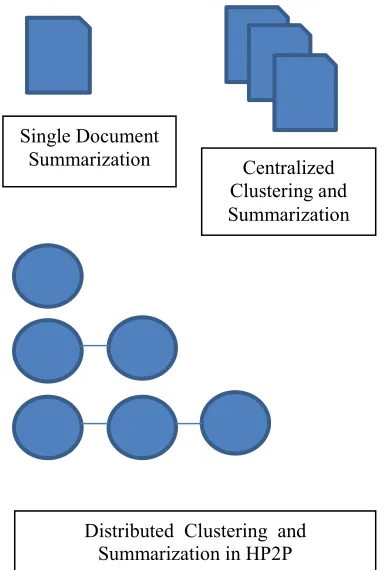
A distributed type of this method is also used in the hierarchical distributed clustering method to generate summaries for the consistently distributed clusters [5]. Figure 1, demonstrates the different levels at which summarization of document clusters can be performed.
• Key-phrase extraction can be carried out to a
single document for tagging the
document/sentence; this is generally used in metadata (e.g. Description, title, keywords) that can be correlated with the document.
• A consolidated document based clustering can be labeled and summarized using key feature phrase extraction.
• Extended document clusters or classifications in a flat p2p network can be optimally summarized.
[image:2.612.311.505.366.651.2]
Figure 1. Single Document Summarization Process
Document Cluster summaries can be interchanged between peers to assist cooperative clustering. • Distributed clustering in a hierarchical network can be summarized level by level using specified threshold. Cluster phrase summaries can be
Single Document
Summarization Centralized
Clustering and Summarization
Distributed Clustering and Summarization
ISSN: 1992-8645 www.jatit.org E-ISSN: 1817-3195
operated at different heights of the hierarchy, thus featuring different types of summaries ranging from general to broad level.
2. RELATED WORK
Various documents clustering techniques have been
implemented in literature [1]. Hierarchical
clustering techniques are generally viewed as more reliable than other types of techniques [6]. The cause is that it is a bottom up procedure which primarily implies that each document is a cluster and thus merges the best similar clusters in an iterative procedure. The total number of iterations relies upon k, the number of required clusters. Due
to its quadratic computational complexity,
hierarchical clustering techniques are un-practical for large collection of documents. A number of techniques that attempt parallelism in hierarchical clustering techniques have been introduced in research[5-10]. A similar hierarchical clustering method is introduced in [3] which is applied as the clustering sub-routine for a parallel buckshot method. Instructive statistics are utilized to decrease the illustration of cluster centroids and thus decrease communication expense.
The random cluster centroid based technique is the most well-known summarization technique used to find the inter and intra document relationships in the large corpus. MEAD is a clustering technique based on the cluster-centroid approach for the multidocument summarization process. It is based on a phrase or sentence extraction. For each phrase or sentence in the documents, MEAD system calculates three characteristics and uses a cluster linear combination of the sentences and phrases. The three characteristics used are centroid score , overlap with the first sentence /phrase and positioned . For single document or group of phrase clusters it calculates the centroid based topic categories using tf-IDF type data.
The summarization approaches can be categorized into two types: unsupervised approaches, based upon the characteristics and heuristics resulting from the document text or sentence and supervised approaches, that depend upon machine learning
techniques trained on preexisting summary
documents, and. Supervised summarization
approaches[12,13,14] handle the summarization activity as a two-class classification drawback at the phrase extraction stage, where the phrases and summary sentences are positive analytical samples while the phrases and non-summary sentences are
negative analytical samples. It scores sentence clusters and phrases by merging sentence scores against text centroid , and tf-idf title overlap and text position value. The sentence is restricted by a user specified threshold and unused cluster sentences by checking cosine/Euclidean similarity towards earlier ones [11].
After symbolizing each sentence text by a vector of characteristics, the identification function can be trained in two different techniques[15]. The first is in a discriminating way with well known
techniques such as SVM [14]. In [12],
mathematical regression model,the use of genetic algorithm ,probabilistic neural network, Gaussian mixture model and back propagation system for text summarization process have been inspected. This approach is a trainable Summarizer, which considers several characteristics, including positive
keyword,sentence relative length, sentence
position,sentence inclusion of named entities, sentence centrality,negative keyword, sentence resemblance to the title, sentence inclusion of numerical data, the bushy part of the sentence and combined similarity for each sentence to make summaries. As per Lefever et. al. [08], the challenging feature of this task is that it is in general not known previously specifically how many clusters to generate , thus the use of a Fuzzy Ants clustering method that does not depend on prior information of the number of clusters that need to be found in the documents. An analysis of benchmark data sets from SemEval's WePS2 or WePS1 competitions, shows that the resulting approach is successful with the agglomerative clustering method. Gorke et al. [17] implemented a procedure for grouping static or dynamic graphs. They use the minimum cut-trees to determine optimal clusters and present a technique to refine this data-structure when the graph nodes are updated. But, tree processing is an expensive operation and processing the initial tree is a global. Proposed tree has a high runtime and depends only on the size of the graph.
3.PROPOSED MODEL
Let
N
p be the distributed peer to peer networkwith p nodes or peers. In any distributed p2p network, each peer can communicate with any other peer to exchange information like document
sharing ,document clustering or document
ISSN: 1992-8645 www.jatit.org E-ISSN: 1817-3195
…………
………...
………
Node P1
Set of Documents
Dp1
Document Preprocessing
TermProb PhraseProb
SentProb
Overlay Clusteirng Algorithm Using K representative Peers
Cluster1 Cluster2 Clusterk
Node P2
Set of Documents
Dp2
Document Preprocessing
TermProb PhraseProb
SentProb
Node Pn
Set of Documents
Dpn
Document Preprocessing
TermProb PhraseProb
SentProb
Weighted Graph Based Document Summarization
[image:4.612.103.530.66.670.2]Clustered Document Summaries
ISSN: 1992-8645 www.jatit.org E-ISSN: 1817-3195
3.1 Assumptions of the proposed model
The main aim of this work has been to optimize the graph methods for the improvement of the
effectiveness of document clustering, by
challenging some assumptions that implicitly characterize its application. Such assumptions relate to the static manner in which document clustering is typically performed, and include the static application of document clustering prior to querying, and the static calculation of inter-document p2p nodes. It does not require any previous knowledge, the approach extracts all required information from the domain.
3.2 Proposed Model
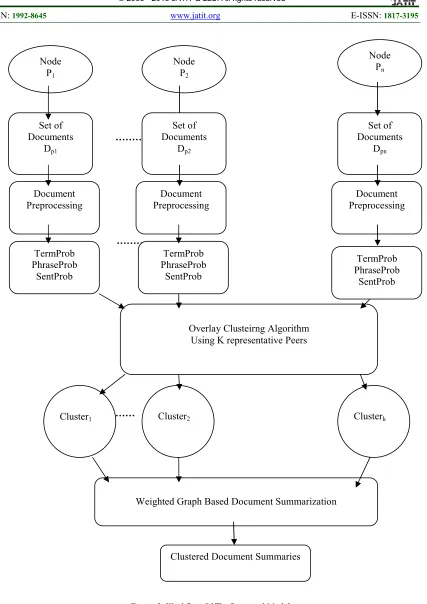
Each p2p network is partitioned into k overlays. Each overlay has a subset of nodes or peers to communicate with each other. In this approach, the global collection of documents is represented as D with n number of documents. Global document set D is partitioned into k overlay nodes. Proposed p2p document clustering and summarization process is described in figure 2 as shown above. In this approach, each overlay has set of peers or nodes associated with documents. In each node of the overlay network, set of documents are preprocessed to remove stopwords. After document
pre-processing, document term probability,
document phrase probability, document sentence probability are calculated to find the relevant clusters . Using the probabilistic document clustering algorithm, documents in the multiple overlay peers are grouped into k-representative clusters. After clustering operation is performed, all clustered documents with the peers are summarized to get final summaries.
3.2.1 Overlay probabilistic Document Clustering Algorithm:
Input:
O : set of overlays in the p2p network. Oj : jth overlay in the p2p network.
Pi,j : jth peer or node in ith overlay.
Dip : set of documents in ith overlay in pth peer Procedure:
Step 1: Initialize the p2p multiple overlay network. For each Oi ,Oj
∈
O such that Oi ,Oj≠ ∅
and
O
i∩
O
j→ ∅
∀
i j
,
Step 2: Count number of documents in each overlay O.
Step 3: Select one random representative peer in each of the overlay.
Step 4: Let Dip is the document in the ith overlay of
pth peer.
For each node or peer pi in Oj
Do
For each document Dip in node or peer
Do
Tokenize(Dpi); // extract tokens, phrases and
sentences ExtractTokens(); ExtractPhrases(); ExtractSentences(); Done
Done Step 5:
Calculate the Probabilistic Correlation Similarity between the peer and the representative peer of each overlay as
Let dj and dri are the documents in the ith peer and
representative peer of kth overlay.
, ,
α β γ
be the document term correlation coefficient,phrase correlation coefficient and sentence correlation coefficient.λ
: cluster impact factor //user selected thresholdε
: Nodes coverage factor.For each overlay Ok
Do
For each peer Pi
Do
Document term correlation coefficient
α
can becalculated as
//
d
ipr
representative of the document of the pth peer in ith overlay.
For each term t in
d
jr
of Pi
Do
Execute equation (1)
Add to Corr(Pi,t,
d
jr
,
α
t)Done
Document Phrase correlation coefficient
β
can becalculated as
For each Phrase
ph
ind
jr
of Pi
Do
Execute equation (2)
Add to Corr(Pi,
ph
,d
jr
,
β
ph) DoneDocument Sentence correlation coefficient
γ
canbe calculated as
For each Sentence
s
ind
jr
of Pi
ISSN: 1992-8645 www.jatit.org E-ISSN: 1817-3195
Execute equation (3)
Add to Corr(Pi,
s
,d
jr
,
γ
s)Done
The rank of the document can be givens as
1
,r, ( ) / 1.5 * (max { , , } max { , , }
i i i
σ = α+β+γ α β γ + + α β γ
j
P d
r
If ,r,
i
σ
jP d
r >
λ
or,r,
i
σ
jP d
r > (
λ ε
−
)Then
AddCluster
C (P , ,
,r,)
i
ri i
r
σ
j
P d
r // r representative
clusters in each overlay End if
Done
Select new representative peer using sum of the documents rank of the peers from the initial representative peer. ,r, 1 1
max{
}
i i d k i jr
σ
= ==
∑∑
j P P d r ExtractTokens() For each token t in DipDo
Find the probability of t in Dip as
Prob(t,Dip)=
| ( ,
n t
D
ip)
∩
n t
( ,
D
jp) | / | ( ,
n t
D
o)
o
D
: Documents in the other peer of the currentoverlay
jp
D
: Documents in the jth document of pth peer ofthe current overlay
ip
D
: Document in the current peer of pth peer ofthe current overlay Done
ExtractPhrases()
For each Phrase ph in Dip
Do
Find the probability of ph in Dip as
Prob(ph,Dip)=
| (ph,
n
D
ip)
∩
n
(ph,
D
jp) | / | (ph,
n
D
o)
ExtractSentences()
For each Sentences in Dip
Do
Find the probability of s in Dip as
Prob(s,Dip)=
| (s,
n
D
ip)
∩
n
(s,
D
jp) | / | (s,
n
D
o)
D
o : Documents in the other peer of the currentoverlay
jp
D
: Documents in the jth document of pth peer ofthe current overlay
ip
D
: Document in the current peer of pth peer ofthe current overlay Done
| | | | | |
1 1 1
{| | Prob( , ) * Prob( , ) Prob( , ) * Prob( , )}
r
j r ir j r r
i i i
t t t t
= = =
−
∑
j∑
j∑
d d d
j j j
d d d d d
r r r
r r r r r
t
α
=
_______________________________________________________________ ----(1)| | | |
2 2
0 0
(| | Prob( , ) ) (| | Prob( , ) )
r
j r r r
i i
t t
= =
−
∑
j∑
d d
j j
d d d d
r r
r r r r
| | | | | |
1 1 1
{| | Prob( , ) * Prob( , ) Prob( , ) * Prob( , )}
r
j r ir j r r
i i i
ph ph ph ph
= = =
−
∑
∑
∑
j j
d d d
j j j
d d d d d
r r r
r r r r r
ph
β
=
_____________________________________________________________ -- (2)| | | |
2 2
0 0
(| | Prob( , ) ) (| | Prob( , ) )
r
j r r r
i i
ph ph
= =
−
∑
j∑
d d
j j
d d d d
r r
r r r r
| | | | | |
1 1 1
{| | Prob( , ) * Prob( , ) Prob( , ) * Prob( , )}
r
j r ir j r r
i i i
s s s s
= = =
−
∑
j∑
j∑
d d d
j j j
d d d d d
r r r
r r r r r
s
ISSN: 1992-8645 www.jatit.org E-ISSN: 1817-3195
| | | |
2 2
0 0
(| | Prob( , ) ) (| | Prob( , ) )
r
j r r r
i i
s s
= =
−
∑
j∑
d d
j j
d d d d
r r
r r r r
3.2.2 Graph Based Document Summarization Algorithm
Input :
Let Gk be the cumulative graph upto k documents.
Summ: Set of Document Summaries.
C: Set of Cluster Documents in all the overlays.
Cip : Set of Subclusters in ith overlay of pth peer.
C ,i
σ
jdr : j
th
document score of ith cluster.
C ,i ,β
σ
jdr : Phrase score of j
th
document score of ith
cluster.
C ,i
D
j
d
r : jth document of ith cluster.
θ
: Candidate set factor //user defined value.Procedure:
For each peer or node
p
k in cluster iDo
For each document in cluster i of
p
kcount
=0;If C ,
0
i
σ
>
jdr and
count
<
θ
Then
CS=addCandidate( C ,
i
D
j
d
r ,
C ,i
σ
jd
r );
end if done done
For each document C ,
i
D
j
dr in candidate set CS.
For each Phrase
ph
m in C ,i
D
j
dr // m phrases
Do
Terms[]=splitwords(
ph
m);1
v
=Terms[0];// initialize first term in vertexIf
v
1 is not in Graph GAdd
v
1 to Graph G.Endif
For each term Terms[id] // id=2,3….len(terms) Do
[id]
id
v
=
Terms
1
[id 1]
id
v
−=
Terms
−
1 C , ,
(
,
,
)
i
id id id
e
=
v
−v
σ
αj
d
r
If
v
id∉
GThen
Add
v
idto GEnd if
If
e
id∈
G thenFor each cluster i
Get all document phrases
ph
s from the cluster iwhich has score greater than
e
idAdd a document phrase to Summ(
ph
s);Done Else
Add edge
e
idto GraphEnd for End for
4. EXPERIMENTAL RESULTS
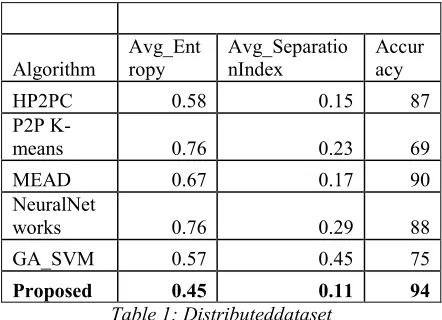
Experimental results are performed on different datasets like 20NewsGroup, Reuters RC,Yahoo . Each data set has different types of categories along with documents.
Algorithm
Avg_Ent ropy
Avg_Separatio nIndex
Accur acy
HP2PC 0.58 0.15 87
P2P
K-means 0.76 0.23 69
MEAD 0.67 0.17 90
NeuralNet
works 0.76 0.29 88
GA_SVM 0.57 0.45 75
[image:7.612.87.534.63.751.2]Proposed 0.45 0.11 94
Table 1: Distributeddataset
[image:7.612.307.528.435.595.2]ISSN: 1992-8645 www.jatit.org E-ISSN: 1817-3195
Figure 3 : Avg Separation Index Vs Average Entropy Of N- Peers
Algorithm
5 PEER-Accura cy
20 PEER-Accura cy
30-PEER Accura cy
40-PEER Accura cy
HP2PC 87 84 87 83
P2P
K-means 69 79 78 74
MEAD 90 84 82 88
NeuralNetw
orks 88 76 72 79
GA_SVM 75 78 74 72
Proposed 92 89 88 90
Table 2: Summarization Accuracy In P2P Network
Table 2: Describes the overall clustering and summarization accuracy in the p2p network overlay. Proposed algorithm accuracy was compared with traditional robust approaches.
Figure 4 : 5 Peer Vs 20 Peer Accuracy Comparison In the fig 4., p2p network with 5 peer and 20 peer are compared with traditional and proposed models. In the 5 peer networks, the proposed approach has high accuracy compared to existing methods. In the 20 peer network, proposed system runs in 89% accuracy.
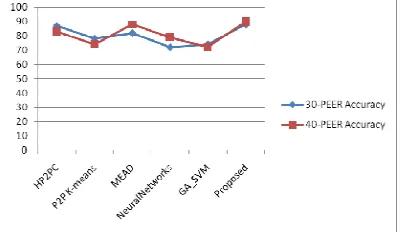
Figure 5 : 30 Peer Vs 40 Peer Accuracy Comparison
In the fig 5., p2p network with 30 peer and 40 peer are compared with traditional and proposed models. In the 30 peer networks, the proposed approach has high accuracy compared to existing methods. In the 40 peer network, proposed system runs in 90% accuracy.
Algorit hm
5 PEER-RunTime( ms)
20 PEER-RunTime( ms)
30-PEER RunTime( ms)
HP2PC 3.45 17 22.67
P2P
K-means 5.34 18.98 26.66
MEAD 3.76 16.87 24.76
Neural Networ
ks 6.56 23.45 34.66
GA_SV
M 6.34 24.86 44.66
Propos
ed 2.65 16.78 22.45
Table 3: 5,20,30 Peers Summarization Runtime
[image:8.612.85.528.74.629.2]Table 3 describes the execution time of the summarization and clustering approaches in 5,20,30 peers overlay network.
[image:8.612.319.520.570.686.2]ISSN: 1992-8645 www.jatit.org E-ISSN: 1817-3195
5. CONCLUSION
In this paper, a distributed p2p network was used to perform clustering based summarization process. Each overlay has dynamic overlays associated with
peer nodes. Proposed clustering based
summarization system works well on dynamic p2p networks Traditional cluster based summarization methods usually suffer with the computation speed, compression, peer selection and sentence clustering in order to generate high quality summaries. Traditional document clustering and summarization methods assume node adjacency and neighborhood information to build clusters and summaries. Proposed approach provides better solution to cluster different overlay networks by using probabilistic k representative clustering algorithm and forms efficient summaries using phrase rank
based document summarization process.
Experimental results give better performance in terms of execution time, entropy, similarity index are concerned.
REFERENCES
[1] M. J. McGill. And G. Salton ,” Introduction to Modern Information Retrieval”. Tata McGraw-Hill computer science series , 1983, New York. [2] A. Wong, C. Yang and G. Salton,”A vector space
model for automatic indexing”. ACM
Communications , 18(11):613–620, Nov1975. [3] M. Littman and P. O. R. Allen, “An interface for
navigating clustered document sets returned by queries”. ACM Conference on Organizational Computing-Systems, 1993.
[4] O. Etzioni. And O. Zamir, ” A dynamic clustering interface to Web search results”. Computer Networks , 1999.
[5] M. Kamel and K. Hammouda,” Distributed collaborative web document clustering using
cluster key-phrase summaries”. 2007.
Information Fusion, Special Issue on Web Information Fusion, In Press.
[6] S. Sahni and S. Ranka, " Clustering methods on a
Hypercube-Multicomputer", IEEE
Transactions on Parallel and Distributed Computing, Vol. 2, No. 2, pp.129-137,2006. [7] " Parallel algorithms for hierarchical clustering
and applications to split decomposition and parity graph based recognition", Journal of Algorithms , E. Dahlhaus (2000), Vol. 36,pp. 205– 240.
[8] E. Jensen, S. Betzel, R. Cathey, O. Frieder & D. Grossman (2007), " Exploiting parallelism to
support scalable hierarchical clustering",
Society for Information-Science and
Technology, Vol. 58, No. 8, pp. 127-1221. [9] M. Kamel and K. Hammouda , "Collaborative
Document Clustering methods" , In
proceedings of 2006 SIAM Conference on Data Mining (SDM06), pp. 453-463, Bethesda. [10] S. Rajesekanan, "Efficient Parallel
Hierarchical-Clustering Methods", IEEE Transactions on Parallel and Distributed Systems, No. 6, Vol. 16, pp. 49-502.
[11] E. Hovy, D. Radev and K. McKeown,
“Introduction to the special issue on
summarization, Computational Linguistics”, Vol. 28, No. 4, 2002.
[12] F. Ren and M. A. Fattah, “GA, MR, FFNN, PNN based models for automatic
text-summarization”, Computer Speech and
Language.
[13] S. Ye, M.-Y. Kan, T.-S. Chua, and L. Qiu,
“Document concept-lattice for text
understanding and summarization”, Vol. 43, Information Processing and Management, 2007, pp. 1643–1662.
[14] H-R. Ke, , I-H. Meng, J-Y. Yeh, W-P. Yang
“Text summarization using a trainable
summarizer and latent semantic analysis,” Information Processing and Management, pp. 75–95, Vol. 41, No. 1, 2005.
[15] D. ShenH. Li, Q. Yang, J.-T.Sun, “Document summarization using conditional random-fields”, (IJCAI’07), Hyderabad, India, pp. 862– 287, January 6–12, 2007.