228
APPLYING INTELLIGENT MOTION AND LOCATION
MONITORING SYSTEM FOR THE ELDERLY
1
S. KHAWANDI, 2B. DAYA, 3F. KHALIL 1
Assistant Prof., Lebanese University, Lebanon 2
Prof., Lebanese University, Lebanon 3
Eng., Lebanese University, Lebanon
E-mail: [email protected]
ABSTRACT
One of three adults 65 years or older falls every year. As medical science advances, people can live with better health and alone up to a very advanced age. Therefore, to let elderly people live in their own homes leading their normal life and at the same time taking care of them requires new kinds of systems. In this paper, we propose a multi-sensor monitoring system for the fall detection in home environments. The proposed system extracts motion and location data from the webcam, and heart rate from the heart rate sensor.The extracted parameters are the face and body speeds, center of mass, aspect ratio and heart rate. These parameters will be fed to a neural network classifier in order to classify the fall event in two classes: fall and not fall. Reliable recognition rate of experimental results underlines satisfactory performance of our system.
Keywords: Neural Network; fall detection; heart rate; webcam.
1 INTRODUCTION
Human society is experiencing tremendous demographic changes in aging since the turn of the 20th century. Thus with the population growing older and increasing number of people living alone, supportive home environments able to automatically monitor human activities are likely to widespread due to their promising ability of helping elderly people. Due to aging population, chronic diseases and their management costs are also on the rise. Another important issue is that elderly people are becoming more independent. As medical science advances, people can live with better health and alone up to a very advanced age. Therefore, to let elderly people live in their own homes leading their normal life, while, at the same time taking care of them requires new kinds of systems.
Intelligent vision-based surveillance systems are receiving a great deal of interest especially in the fields of personal security and assistance. These systems are built in order to accomplish several tasks from detection of human presence to recognition of their activities. In the past few decades, vision-based surveillance has been extensively applied on industrial inspection, traffic
control, security systems, and medical and scientific research.
229 an alarm is triggered immediately upon the detection of a fall.
In this paper, we review some existing vision-based fall detection systems (section II), then we introduce our proposed system (section III) as a combination between two different commercial devices: a webcam and a heart rate sensor. Data extracted from the two sub-systems will be processed by the neural network in order to detect the fall. The experimental results are presented in section IV and finally the conclusion in section V.
2 RELATEDAPPROACHES
Information Technology combined with recent advances in networking, mobile communications, and wireless medical sensor technologies offers great potential to support healthcare professionals and to deliver remote healthcare services, hence, providing the opportunities to improve efficiency and quality and better access to care at the point of need. Existing fall detection approaches can be categorized into three different classes to build a hierarchy of fall detection methods. Fall detection methods can be divided roughly into three categories:
1.1 Wearable Sensors
Wearable Sensors (such as accelerometers or help buttons): These autonomous sensors are usually attached under the armpit, around the wrist, behind the ear’s lobe, at the waist or even on the chest. A barometric pressure sensor was introduced by Bianchi [6], as a surrogate measure for altitude to improve upon existing accelerometer-based fall event detection techniques. The acceleration and air pressure data are recorded using a wearable device attached to the subject's waist and analyzed offline. A heuristically trained decision tree classifier is used to label suspected falls. Estudillo-Valderrama [7] analyzed results related to a fall detection system through data acquisition from multiple biomedical sensors then processed the data with a personal server. A wearable airbag was incorporated by Tamura [8] for fall detection by triggering airbag inflation when acceleration and angular velocity thresholds are exceeded. Chen [9] created a wireless, low-power sensor network by utilizing small, noninvasive, low power motes (sensor nodes). Wang [10] applied reference velocities and developed a system that uses an accelerometer placed on the head. However the problem of such detectors is that older people often forget to wear them, indeed their efficiency relies on the person’s ability and willingness to wear
them, moreover in the case of a help button, it can be useless if the person is unconscious or immobilized.
2.1 Environmental Sensors
Environmental sensors based devices attempt to fuse audio data and event sensing through vibration data. Zhuang [11] proposed an approach the audio signal from a single far-field microphone. A Gaussian mixture model (GMM) super vector is created to model each fall as a noise segment. The pair wise difference between audio segments is measured using the Euclidean distance. A completely passive and unobtrusive system was introduced by Alwan [12] that developed the working principle and the design of a floor vibration-based fall detector. Detection of human falls is estimated by monitoring the floor vibration patterns. The principle is based on the vibration signature of the floor. The concept of floor vibrations with sound sensing is unique in its own way [13]. Pattern recognition is applied to differentiate between falls and other events. Toreyet [14] fused the multitude of sound, vibration and passive infrared (PIR) sensors inside an intelligent environment equipped with the above fusion elements. Wavelet based feature extraction is performed on data received from raw sensor outputs.
Most ambient device based approaches use pressure sensors for subject detection and tracking. The pressure sensor is based on the principle of sensing high pressure of the subject due to the subject's weight for detection and tracking. It is a cost effective and less intrusive for the implementation of surveillance systems. However, it has a big disadvantage of sensing pressure of everything in and around the subject and generating false alarms in the case of fall detection, which leads to a low detection accuracy.
2.2 Computer Vision Systems
230 From tracking data, McKenna [16] automatically obtained spatial context models by using the combination of Bayesian Gaussian mixture estimation and minimum description length model for the selection of Gaussian mixture components through semantic regions (zones) of interest. Tao [17] developed a detection system using background subtraction with an addition of foreground extraction, extracting the aspect ratio (height over width) as one of the features for analysis, and an event-inference module which uses data parsing on image sequences.
Foroughi [18] applied an approximated ellipse around the human body for shape change. Projection histograms after segmentation are evaluated and any temporal changes of the head position are noted. Miaou [19] captured images using an Omni-camera called MapCam for fall detection. The personal information of each individual, such as weight, height and electronic health history, is also considered in the image processing task. Rougier [20] proposed a classification method for fall detection by analyzing human shape deformation. Segmentation is performed to extract the silhouette and additionally edge points inside the silhouette are extracted using a canny edge detector for matching two consecutive human shapes using shape context. Dedeoglu[21] detect falls using image sensors by analyzing the bounding box representing the person in a single image. This can fail if the camera is not placed sideways because of occluding objects. Ozcan et al.[22] developed a fall detection system using a wearable embedded smart camera mounted on the waist of the elderly. The camera does not record the elderly’s motion pictures but the environment’s around him. With Visual fall detection, what appears to be a fall might not be a fall. Most of existing systems are unable to distinguish between a real fall incident and an event when the person is lying or sitting down abruptly.
3 PROPOSED SYSTEM
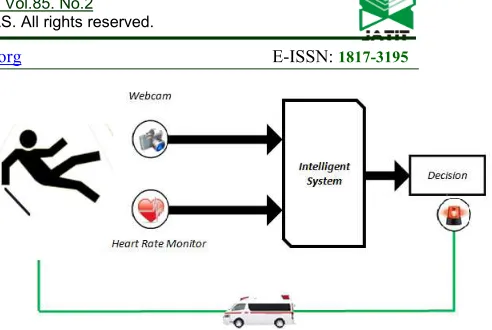
[image:3.612.314.560.51.216.2]This paper proposes a multi-sensor fall-detector system (Fig. 1) as a combination between two different commercial devices: a webcam and a heart rate sensor. Data extracted from the two sub-systems will be processed by the neural network in order to detect the fall. Once the fall is detected, an emergency alert will be activated automatically and sent to care holders through an internet-based home gateway
Figure 1. Overview of the proposed system.
3.1 Webcam System
It is obvious that we need several webcams to cover the entire monitored zone and the switch between the webcams will be based on the face presence. In this paper, we present the webcam system as limited to one webcam, as it will be similar when having multiple webcams.
The webcam system is based on image processing in real time; this system detects the body and face of a person in a given area, collects data such as the aspect ratio, center of Mass, face and body of the person, then sends the extracted data to be processed by the classifier. The system starts by removing the background. After the silhouette is acquired, the next step is the skin color detection, which is an effective way often used to define a set of areas likely to contain a face or hands; then, the system detects the face. Then, features extraction is involved (speed of a person’s movement, aspect ratio, and fall angle).
3.1.1 Background Subtraction
Background subtraction (Fig. 2) is a particularly popular method to detect moving regions in an image by differentiating between the current image and a reference background image in a pixel-by pixel way
Figure 2. Background Subtraction.
3.1.2 Skin-color and HSV detection
[image:3.612.326.553.585.684.2]231 an effective technique for determining whether an image contains a face or hands. In this technique, the appropriate threshold values are defined for all the pixels in a color space (Fig. 3). Different color spaces are used to represent skin color pixels: RGB, RGB standard, HSV (or HSI), YCrCb, and HSV. After the detection of skin-color pixels, image filtering (erosion and dilation) is carried out.
Figure 3. Image after skin color detection.
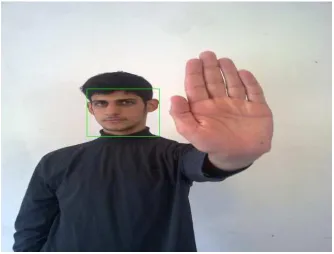
3.1.3 Face Detection- Approximated Ellipse After identifying the skin areas, it is necessary to distinguish the face. For this, the shape of the detected object is compared with an ellipse. This correlation technique is very effective and efficient. Based on the comparison with an ellipse, we may have more than one image, such as the hand. In order to solve this issue, each image will be converted into a binary image (black and white); then, the white contour will be replaced by black. In this state, the object representing the hand goes black but the object representing the face becomes black except the eyes and mouth. After this transformation, we compute the white surface in each picture, and the object having the greater white surface is the one of the face, and in this case, it is detected. After calculating the white surface in each image, we found that the white surface in the face is greater than that in the hand; that is why this intelligent system detects the face (Fig. 4).
Figure 4. Image after skin color detection.
3.1.4 Data Extraction
One major point in the recognition system is the features extraction, i.e., the transition from the
initial data space to a feature space that will make the recognition problem more tractable. So, we analyze the shape changes of the detected face and body in the video sequence.
• Center of Mass
The Center of Mass “COM” (Fig. 5) is defined as the height between the center of mass of the person and the floor.
[image:4.612.122.286.200.270.2]
Figure 5. Bounding box and poses of human object.
Usually, the COM is between 15cm and 100cm. Therefore, two outstanding ranges may be taken into consideration:
• COM > 50: this is the normal case scenario. The person is standing, and the center of mass is far from the ground, thus chances that the subject has fallen are weak.
• COM<50: In this case, the center of mass is close to the ground. The subject could be sleeping or sitting, or they could be lying down due to a fall; therefore, a decision needs to be made in order to decide whether we have a falling situation or not.
• Aspect Ratio
The aspect ratio of a person is a simple yet effective feature for differentiating a normal standing pose from other abnormal poses (Fig. 5). The aspect ratio of the human body changes during a fall. When a person falls, the height and width of his bounding box change drastically (height/width). The range is from 0.15 to 6 (it can vary depending on the dimensions of the subject or on the scaling camera to image coefficients).
• Face Speed
The planar speed of movement is calculated using the following formula:
Planar speed = distance/time (pixel/s);
o Distance: between the same face in
consecutive frames (pixel);
o Time: processing time between two
[image:4.612.120.287.541.668.2]232 The range is from 90 to 700 pixels (it can vary depending on the quality of the pictures)
• Body Speed
Let's suppose that our subject is moving his face; in this case the face speed will rise, yet no fall has occurred. Thus, in order to improve the reliability of our system, we will take into consideration the speed of the body. A fall could not occur unless both Face and Body speed are medium or high. The body speed is calculated using the same formulas of the face speed.
3.2 Heart Rate System
[image:5.612.99.299.451.494.2]A heart rate monitor is a personal monitoring device, which allows a subject to measure his or her heart rate in real time or record his or her heart rate for later study. Early models consisted of a monitoring box with a set of electrode leads, which attached to the chest. This paper does not include the design of a heart rate monitor, but we will use an existing heart rate monitor. A Wi-Fi heart rate belt (HRM-2823) (Fig. 6) could be connected to a computer or Wi-Fi operator mobile; this monitor has professional software providing online data exchange model that allows the heart rate belt keeps connecting with the PC and transmits data to PC in real time. The idea is to have a “non-image”-related parameter involved in the fall detection in order to minimize the false alarms.
Figure 6. Heart rate monitor.
3.3 Neural Network System
Throughout the years, the computational changes have brought growth to new technologies. Such is the case of artificial neural networks, that over the years, they have given various solutions to the industry. Designing and implementing intelligent systems has become a crucial factor for the innovation and development of better products for society. There are several types of neural networks according to their architectures. In our work, we used multilayer networks MLP and cascade-forward network. For each network, we applied three different learning algorithms: "Levenberg-Marquardtbackpropagation" (trainlm), "gradient descentmomentum" (traingdx), "resilientbackpropagation" (trainrp). For the input
data, the following sets of parameters are used for falling recognition:
•Face Speed: The face speed is calculated using the formula: Planar speed = distance/time (pixel/s);
•Body Speed: The body speed is calculated using the formula: Planar speed = distance/time (pixel/s);
•Aspect ratio: The aspect ratio of a person is a simple yet effective feature for differentiating normal standing poses from other abnormal poses. The aspect ratio of the human body changes during a fall. When a person falls, the height and width of his bounding box changes drastically (height/width).
•Center of Mass: The Center of Mass “COM” is the height between the center of mass of the person and the floor.
•Heart rate: Measures the number of heart beats per second (bpm).
3.3.1 Multilayer Networks MLP
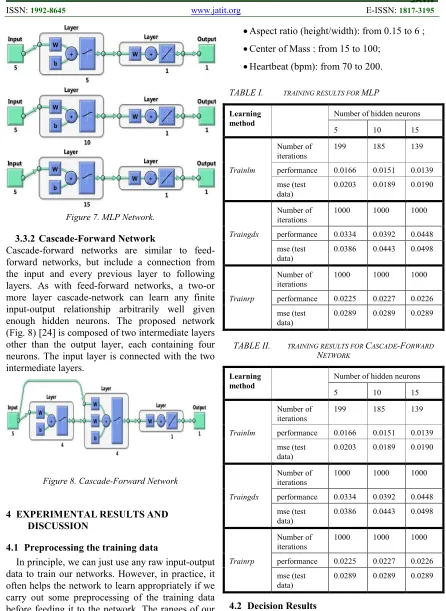
Multilayer perceptrons (MLPs) represent the most prominent and well researched class of ANNs in classification, implementing a feedforward, supervised paradigm. MLPs consist of several layers of nodes, interconnected through weighted acyclic arcs from each preceding layer to the following, without lateral or feedback connections. Each node calculates a transformed weighted linear combination of its inputs of the form, with the vector of output activations from the preceding layer, the transposed column vector of weights, and a bounded non-decreasing non-linear function, such as the linear threshold or the sigmoid, with one of the weights acting as a trainable bias connected to a constant input.
233 Figure 7. MLP Network.
3.3.2 Cascade-Forward Network
[image:6.612.84.530.69.680.2]Cascade-forward networks are similar to feed-forward networks, but include a connection from the input and every previous layer to following layers. As with feed-forward networks, a two-or more layer cascade-network can learn any finite input-output relationship arbitrarily well given enough hidden neurons. The proposed network (Fig. 8) [24] is composed of two intermediate layers other than the output layer, each containing four neurons. The input layer is connected with the two intermediate layers.
Figure 8. Cascade-Forward Network
4 EXPERIMENTALRESULTSAND
DISCUSSION
4.1 Preprocessing the training data
In principle, we can just use any raw input-output data to train our networks. However, in practice, it often helps the network to learn appropriately if we carry out some preprocessing of the training data before feeding it to the network. The ranges of our input are:
•Body Speed (pixel/s): from 0 to 800;
•Face Speed (pixel/s): from 0 to 800;
•Aspect ratio (height/width): from 0.15 to 6 ;
•Center of Mass : from 15 to 100;
•Heartbeat (bpm): from 70 to 200.
TABLE I. TRAINING RESULTS FOR MLP
Learning method
Number of hidden neurons
5 10 15
Trainlm
Number of iterations
199 185 139
performance 0.0166 0.0151 0.0139
mse (test data)
0.0203 0.0189 0.0190
Traingdx
Number of iterations
1000 1000 1000
performance 0.0334 0.0392 0.0448
mse (test data)
0.0386 0.0443 0.0498
Trainrp
Number of iterations
1000 1000 1000
performance 0.0225 0.0227 0.0226
mse (test data)
0.0289 0.0289 0.0289
TABLE II. TRAINING RESULTS FOR CASCADE-FORWARD NETWORK
Learning method
Number of hidden neurons
5 10 15
Trainlm
Number of iterations
199 185 139
performance 0.0166 0.0151 0.0139
mse (test data)
0.0203 0.0189 0.0190
Traingdx
Number of iterations
1000 1000 1000
performance 0.0334 0.0392 0.0448
mse (test data)
0.0386 0.0443 0.0498
Trainrp
Number of iterations
1000 1000 1000
performance 0.0225 0.0227 0.0226
mse (test data)
0.0289 0.0289 0.0289
4.2 Decision Results
234 then after comparing the output with the threshold, we can make a decision:
If the output is greater than the threshold, then there is a fall, otherwise no fall.
The threshold is carefully chosen to be an optimal threshold in order to minimize the error. For this, a program was developed to pass over all the possible threshold values (between 0 and 1) and select the threshold having the smallest error value.
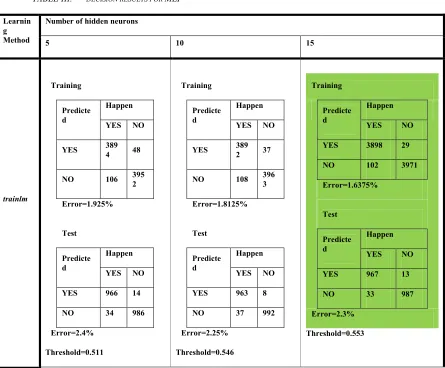
The results are shown in the tables below:
TABLE III. DECISION RESULTS FOR MLP
Learnin g Method
Number of hidden neurons
5 10 15
trainlm
Training
Predicte d
Happen
YES NO
YES 389
4 48
NO 106 395
2
Error=1.925%
Test
Predicte d
Happen
YES NO
YES 966 14
NO 34 986
Error=2.4%
Threshold=0.511
Training
Predicte d
Happen
YES NO
YES 389
2 37
NO 108 396
3
Error=1.8125%
Test
Predicte d
Happen
YES NO
YES 963 8
NO 37 992
Error=2.25%
Threshold=0.546
Training
Predicte d
Happen
YES NO
YES 3898 29
NO 102 3971
Error=1.6375%
Test
Predicte d
Happen
YES NO
YES 967 13
NO 33 987
Error=2.3%
[image:7.612.87.532.239.607.2]235
Traind x
Training
Predicte d
Happen
YES NO
YES 379
6 111
NO 204 388
9
Error=3.9375%
Test
Predicte d
Happen
YES NO
YES 927 22
NO 73 978
Error=4.75%
Threshold=0.508
Training
Predicte d
Happen
YES NO
YES 378
7 132
NO 213 386
8
Error=4.3125%
Test
Predicte d
Happen
YES NO
YES 929 34
NO 71 966
Error=5.25%
Threshold=0.479
Training
Predicted
Happen
YES NO
YES 3747 110
NO 253 3890
Error=4.5375%
Test
Predicted
Happen
YES NO
YES 914 26
NO 86 974
Error=5.6%
Threshold=0.513
Trainr p
Training
Predicte d
Happen
YES NO
YES 385
7 92
NO 143 390
8
Error=2.9375%
Test
Predicte d
Happen
YES NO
YES 947 26
NO 53 974
Error=3.95%
Threshold=0.453
Training
Predicte d
Happen
YES NO
YES 386
1 94
NO 139 390
6
Error=2.9125%
Test
Predicte d
Happen
YES NO
YES 948 26
NO 52 974
Error=3.9%
Threshold=0.434
Training
Predicted Happen
YES NO
YES 3863 96
NO 137 3904
Error=2.9125%
Test
Predicted Happen
YES NO
YES 949 26
NO 51 974
Error=3.85%
236 TABLE IV. decision results for Cascade-Forward
Network
Learning Method Results
Trainlm
threshold =0.442
Training Test
Predicted Happen Predicted Happen
YES NO YES NO
YES 3931 45 YES 976 19
NO 69 3955 NO 24 981
Error=1.425% Error =2.15%
Traingdx
threshold =0.506
Training Test
Predicted Happen Predicted Happen
YES NO YES NO
YES 3802 94 YES 934 23
NO 198 3906 NO 66 977
Error =3.65% Error =4.45%
Trainrp
threshold =0.532
Training Test
Predicted Happen Predicted Happen
YES NO YES NO
YES 3845 67 YES 944 20
NO 155 3933 NO 56 1055
237 As it is shown in green in the tables 3 and 4 above, the "Cascade-Forward Network" system is the most efficient decision system when using the learning algorithm "Levenberg-Marquardt back propagation" (trainlm) and a threshold equal to 0.526.
5 CONCLUSIONS AND FUTURE WORK
Fall-related injuries have been among the five most common causes of death amongst the elderly population. Falls represent 38% of all home accidents and cause 70% of deaths in the 75+ age group. Early detection of a fall is an important step in avoiding any serious injuries. An automatic fall detection system can help to address this problem by reducing the time between the fall and arrival of required assistance. Healthcare video surveillance systems are a new and promising solution to improve the quality of life and care for the elderly, by preserving their autonomy and generating the safety and comfort needed in their daily lives. This corresponds to the hopes of the elderly themselves, their families, the caregivers, and the governments. The positive receptivity for video surveillance systems suggests that this technology has a bright future for healthcare and will advantageously complement other approaches (e.g., fixed or wearable sensors, safer home modifications, etc.) by overcoming many of their limitations. Better performances and results can be obtained by implementing neural network architecture when different methods of acquiring data are combined (wearable devices + webcam images). The results showed that we can detect a fall by combining five different parameters: aspect ratio, center of mass, body speed, face speed and heartbeat.
Best results were obtained by implementing a "cascade-forward neural network." The presented work is based on an existing work [1] and may be extended and enhanced, in a later phase, to include other intelligent systems with other parameters that could help to address this problem by reducing the risk of false alarms and improving the time between the fall and the alarm.
REFERENCES
[1] S. Khawandi, B. Daya and P. Chauvet, "Applying Neural Network Architecture in a Multi-Sensor Monitoring System for the Elderly", the Sixth International Conference on Advanced Engineering Computing and
Applications in Sciences, ADVCOMP, Barcelona, Spain, 23-28 September, 2012. [2] N. Noury, T. Hervé, V. Rialle, G. Virone, and
E. Mercier, “Monitoring behavior in home using a smart fall sensor and position sensors,” in IEEE-EMBS. Microtechnologies in Medicine & Biology, October, Lyon-France, 2000, pp. 607–610.
[3] N. Noury, A. Fleury, P. Rumeau, A. K. Bourke, G. O. Laighin, V. Rialle, and J. E. Lundy, “Fall Detection - Principles and Methods,” 29th Annual Int. Conf. of the IEEE Engineering in Medicine and Biology Society, Lion (France), August 2007, pp. 1663–1666.
[4] A. Yamaguchi, “Monitoring behavior in home using positioning sensors” Int. Conf. IEEE-EMBS, Hong-Kong, 1998; 1977-79.
[5] M. J. Mathie, A. C. F. Coster, N. H. Lovell and B. G. Celler, Accelerometry: Providing an Integrated, Practical Method for Long term, Ambulatory Monitoring of Human Movement, Journal for Physiological Measurement (IOPScience), Vol. 25, 2004.
[6] F. Bianchi, S. J. Redmond, M. R. Narayanan, S. Cerutti and N. H. Lovell, Barometric Pressure and Triaxial Accelerometry Based Falls Event Detection, IEEE Transactions on Neural Systems and Rehabilitation Engineering, Vol. 18, pp. 619-627, 2010. [7] M.A. Estudillo-Valderrama, L.M. Roa, J.
Reina-Tosina and D. Naranjo-Hernandez, Design and Implementation of a Distributed Fall Detection System - Personal Server, IEEE Transactions on Information Technology in Biomedicine, Vol. 13, pp. 874-881, 2009. [8] T. Tamura, T. Yoshimura, M. Sekine, M.
Uchida and O. Tanaka, A Wearable Airbag to Prevent Fall Injuries, IEEE Transactions on Information Technology in Biomedicine, Vol.13, pp. 910-914, 2009.
[9] J. Chen, K. Kwong, D. Chang, J. Luk, and R. Bajcsy, Wearable Sensors for Reliable Fall Detection, 27th IEEE Annual Conference of Engineering in Medicine and Biology (EMBS), pp. 3551-3554, 2005.
238 [11]X. Zhuang, J. Huang, G. Potamianos and M.
Hasegawa-Johnson, Acoustic Fall Detection Using Gaussian Mixture Models and GMM Super-Vectors, IEEE International Conference on Acoustics, Speech and Signal Processing (ICASSP), pp.69-72, 2009.
[12]M. Alwan , P. J. Rajendran, S. Kell, D. Mack , S. Dalal, M. Wolfe, and R. Felder, A Smart and Passive Floor-Vibration Based Fall Detector for Elderly, IEEE International Conference on Information & Communication Technologies (ICITA), pp. 1003-1007, 2006.
[13]Y. Zigel, D. Litvak and I. Gannot; A Method for Automatic Fall Detection of Elderly People Using Floor Vibrations and Sound Proof of Concept on Human Mimicking Doll Falls, IEEE Transactions on Biomedical Engineering, Vol. 56, pp. 2858-2867, 2009.
[14]B. U. Toreyin, E. B. Soyer, I. Onaran, and A. E. Cetin, Falling Person Detection Using Multi-sensor Signal Processing, 15th IEEE Signal Processing and Communications Applications Conference, SIU & EURASIP Journal on Advances in Signal Processing, vol. 8, 2007 & 2008.
[15]R. Cucchiara, A. Prati, and R. Vezzani, “A multi-camera vision system for fall detection and alarm generation,” Expert Syst. J., vol. 24(5), 2007, pp. 334-345.
[16]C. H. Nait and S. J. McKenna, “Activity summarisation and fall detection in a supportive home environment,” Int. Conf. on Pattern Recognition (ICPR), 2004.
[17]J. Tao, M. Turjo, M. F. Wong, M. Wang and Y. P. Tan: Fall Incidents Detection for Intelligent Video Surveillance, Fifth IEEE International Conference on Information, Communications and Signal Processing, pp. 1590-1594, 2005.
[18]H. Foroughi, B. S. Aski, and H. Pourreza, Intelligent Video Surveillance for Monitoring Fall Detection of Elderly in Home Environments, 11th IEEE International Conference on Computer and Information Technology (ICCIT), pp. 219-224, 2008. [19]S. G. Miaou, P. H. Sung and C. Y. Huang, A
Customized Human Fall Detection System Using Omni-Camera Images and Personal Information, 1st Trans-Disciplinary Conference on Distributed Diagnosis and Home Healthcare (D2H2), pp. 39-42, 2006.
[20]C Rougier, J Meunier, A St-Arnaud, and J Rousseau, Robust Video Surveillance for Fall Detection Based on Human Shape Deformation, IEEE Transactions on Circuits and Systems for Video Technology (CSVT), Vol. 21, pp. 611-622, 2011.
[21]B. To reyin, Y. Dedeoglu, and A. C¸etin. Hmm based falling person detection using both audio and video. In IEEE International Workshop on Human-Computer Interaction, Beijing, China, 2005.
[22]Ozcan, K.; Mahabalagiri, A.; Casares, M.; Velipasalar, S. Automatic fall detection and activity classification by a wearable embedded smart camera. IEEE J. Emerg. Sel. Top. Circuits Syst. 2013, 3, 125–136.
[23]G. Miller, P. Todd, and S. Hedge, " Designing neur al networks using genetic algorithms," Proceedings of the International Confe rence on Genetic Algorithms 1989.