Journal of Theoretical and Applied Information Technology
31st March 2013. Vol. 49 No.3 © 2005 - 2013 JATIT & LLS. All rights reserved.
ISSN: 1992-8645 www.jatit.org E-ISSN: 1817-3195
APPLICATION STUDY ON FUZZY EVALUATION SYSTEM
OF WATER CONSERVANCY TALENTS BASED ON AHP
HONG WU1
1
Principal's Office, Hohai University, Nanjing 211100, China E-mail: [email protected]
ABSTRACT
Analyzing the existing problems of the comprehensive quality of the water resource assessment, the authors put forward fuzzy comprehensive evaluation method and System. Depending on the materials, the article sets up the evaluation index system by decomposing and refining the water resource quality evaluation of the content, and then studys comprehensive evaluation model of water conservancy talents on the basis of AHP. Finally, the article uses the sample data to do the actual evaluation, which has validated the practical and scientific of the study.
Keywords: Water Conservancy Talents; Fuzzy Evaluation;AHP
1. INTRODUCTION
In recent years, China has formulated National long-term Education Reform and Development (2010-2020) Plan, National long-term Talent Development Plan (2010-2020) and just released National educational development of the 12th Five-Year Plan, bringing the country's top-level design for talents training, which raised such educational philosophy to the will of the country. Especially the Talent Development Plan emphasized greatly on vigorously developing the much-needed expertise in key areas of economic and social development, which underlined plans of strengthening the overall planning and classified guidance of professional talents, the development around key areas, and carrying out the talent demand forecast. Yet it is considered to be an effective way about job performance assessment that building a scientific evaluation system. Regardless of forecast and planning on the talent demand, regardless of training talents and employment, and regardless of configuration and management of talents, the work is inseparable from the monitoring and assessing by the evaluation system. Setting talents of water conservancy field as study object is deemed to be a preliminary exploration to overall plan the development of the professional talents.
Due to late start of the work in the country, the work shows simplistic and subjective in the field of water conservancy talents evaluation and the evaluation indicators exist to be sidedness or lack of scientific. Thus we introduced a set of index system applying to water conservancy talents evaluation, which is designed to be scientific, objective,
comprehensive and a combination of quantitative and qualitative. The index system aims to the initial screening of talents for water conservancy department, which is a fundamental but essential work for the study on management in water conservancy.
The Fuzzy Comprehensive Evaluation method is introduced to do a comprehensive judgment towards specific objects for some purpose by considering various factors in fuzzy environment [1]. The significant characteristics of the method contain three parts: Primarily, the method does not directly dependent on a particular indicator, which on the one hand, ameliorates the efficiency of evaluation; On the other hand, enhances the comparability between talents. It supports us easier to find talents’ defect and helps improving talents. Secondly, establishing a Fuzzy Comprehensive Evaluation model gives a consolidated assessment, which transforms the emotional evaluation into rational results. It makes a great sense to strengthen democratization and scientificalness in such decision-making on water conservancy management.
For the issue of talent evaluation, scholars in China have launched a large number of studies and put forward many constructive ideas. Xiao Mingzheng and Li Leng of Beijing University, authors of Recommendations on the Improvement of
Our Talent Evaluation, stressed the need for the
introduction of advanced talent evaluation method. Qiu Junping of Wuhan University, authors of
Personnel Evaluation System Based on
Psychological Measurement, advanced the opinion
comprehensive standard and index system. But actually in China there is a trend of slow that construction and development of evaluation system for professional talents are. The trend gives prominence to establishing a scientific talent evaluation system which meets demand of talents training and development. In 2005, Liu Tao, the author of Research and Implementation of the
Talent Evaluation System Based on Expert Systems,
introduced the talent evaluation system based on human resources expertise and mathematical model. Later in 2006, Zhang Xufen, the author of Research and Implementation of the Talent Evaluation
System Based on Performance Management Model,
introduced the system based on performance management model. These prototype systems above mostly are C/S structured, which need to be improved in applicability and interactivity.
In summary, the main idea we build the talent evaluation system by introducing the fuzzy comprehensive evaluation method is to provide a scientific method that experts can assess water conservancy talents online, which brings efficiency and promotes the work of talents screening and training.
2. SYSTEM OF FUZZY COMPREHENSIVE
EVALUATION
1) Establish the Index System
(1) Four Levels of the Index System
Taking into account the diversity of water conservancy talents, we establish the index system according to specific conditions about talents in different functions. All indexes are considered to be in accordance with principles of completeness, feasibility and scientificalness [2]. Completeness is a requirement for a comprehensive and objective index system which contains a variety of information; Feasibility is that these indexes are easy to understand or operate; Scientificalness is that each index should be an independent provider which reflects the law of water conservancy work and the actual condition of water conservancy talents.
Based on the above principles four levels of the index system are introduced below:
A. Level of Knowledge. Level of knowledge
covers three indexes: education level, seniority and knowledge structure. Education level refers to one’s educational background; Seniority is from one’s work experience or sophistication; Knowledge structure reflects amount of knowledge and the
ability to apply his/her knowledge, information and technology to interdisciplinary issues comprehensively.
B. Mental Models. Mental models consists
of five indexes: Ideological and moral quality, professional quality, personality traits, work style and teamwork. Ideological and moral quality on the basis of the views shaped about worldview, outlook on life, values and morality, which measures the sense of mission and social responsibility; Professional quality is the quality of dedication and sacrifice, which measures whether one can strive to do his/her job and whether one’s words or actions are in line with the requirements of professional ethics norms; Personality traits and work style reflect the characteristics; Teamwork judges the sense of cooperation.
C. Basic Qualities. Basic qualities chiefly
reflect the level of communication ability, which covers four indexes including presentation skills, writing skills, communication skills and health conditions. Presentation skills is the ability to completely express his/her ideas or views orally; Writing skills is the ability to correctly express and exchange information vividly; Communication skills is the ability to communicate with others in social life and work practices. These indexes above reflect observational, cognitive and responsive abilities to objective things, which also measures social resilience.
D. Ability Structure. Ability structure is at the core of the high-level personnel evaluation system, which covers seven indexes including learning ability, adaptability, organizational ability, coordination ability, innovation ability, decision-making ability and practical ability. Learning ability is the ability to access, share, and create knowledge; Adaptability is the ability to act according to circumstances; Organizational ability and coordination ability reflects abilities to together resources and reasonable arrangements; Innovation ability and decision-making ability reflects abilities not to rigidly adhere to the existing view, abilities of innovative awareness, and abilities of decision-making capacity; Practical ability is the ability to apply the theory to analysis, research and solve real-world problems. These seven indexes dynamic measures the level of the overall quality and the strength of the competitive of the high-level personnel.
(2) Determine index weights
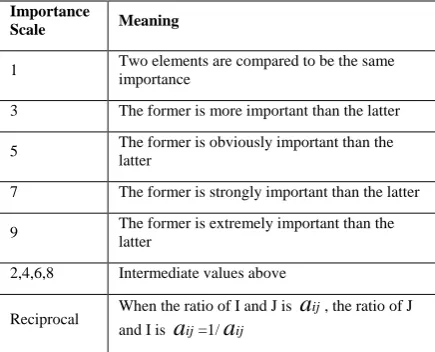
methods and in order to comprehensively reflect the effect of policy decisions determined by decision-makers, we introduced the AHP method. The AHP method aims at decomposition, which divides a complicated issue into several components grouped by relations of domination, forming an orderly hierarchical structure. Afterwards the work is to invite experts, scholars or pundits determining the Saaty Scale through comparing the relative importance of two components by two, see Table 1. After compounding the data in the orderly hierarchical structure, finally we get the total ordered by the degree of importance of each decision factor relative to target layer [3].
Table 1 The Relative Importance of Saaty Scale Table
2) Design the Fuzzy Comprehensive Evaluation Model
(1) Establish the Fuzzy Set
The index system of evaluating water conservancy talents is designed to consist of three different levels, where the index set of level k is
k
Z
=
{Z
k1,Z
k2 ,Z
k3,….,Z
km } and itsweight is
a
k=
{a
k1,a
k2,a
k3,…,a
km },where
a
ki (i
=
1,2,3,…,m) represents thepercentage of
Z
ki inZ
k , and 1M ki i
a =
∑
=
1. Thus referring above we get the index of sub-layers of each component.Determine the comment set.
W
=
{W
1,W
2, 3W
,…,W
L }, whereW
j(j
=
1,2,3,…,
L
) shows all levels of comments from high to low. On this study we takeL
=
5, whereW
1,2
W
,W
3,W
4,W
5 represent comments of A,B,C,D,E, namely V=(
W
1,W
2,W
3,
W
4,W
5).(2) Determine the Evaluation Matrix
Fuzzy Evaluation Matrix from
Z
k toW
:11 12 1
21 22 2
1 2
l
l k
n n nl
r r r
r r r
R
r r r
=
,
where[4]
r
ij=
(i
=
1,2,3,…,n;j
=
1,2,3,…,
L
)represents membership degrees of indexes of sub-component (which isZ
ki) to thecomment of level
j
(which isW
j).How to get the value of
r
ij : Statisticalprocessing and finishing the points (the comments made by experts and so on), to the index
Z
ki weget
W
i1 numbers of comments ofW
1, andW
i2numbers of comments of
W
2 , ….., andW
iLnumbers of comments of
W
L. So wheni
=
1,2,…,
n
, here comesr
ij=
1
ij N
ij j
W
W =
∑
(
j
=
1,2,3,…,
n
).Compute the Fuzzy Evaluation Matrix. Firstly, do Fuzzy Matrix computation to the Evaluation
Matrix
R
k of sub-componentsZ
ki and get themembership degree vector of main-components
Z
kto comments set
W
. The vector is markedB
k,where
B
k=A
k*
R
k=
(b
k1,b
k2,…,b
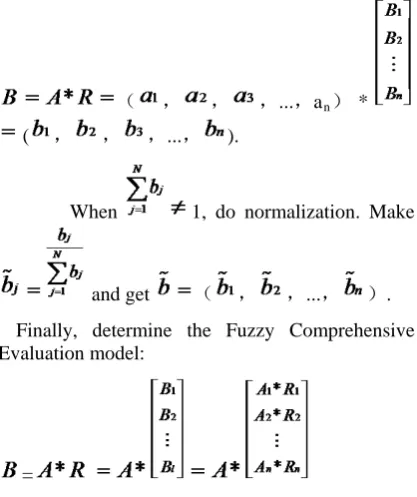
kL)[5]:
1 11 12 1
2 21 22 2
1 2
l
l
k k k kl
B b b b
B b b b
R
B b b b
= =
Secondly, do Fuzzy Matrix computation to the R and get the vector
B
which is the membershipdegree vector of
Z
toW
.Importance
Scale Meaning
1 Two elements are compared to be the same importance
3 The former is more important than the latter
5 The former is obviously important than the
latter
7 The former is strongly important than the latter
9 The former is extremely important than the
latter
2,4,6,8 Intermediate values above
( , , ,...,an) *
( , , ,..., ).
When 1, do normalization. Make
and get ( , ,..., ).
Finally, determine the Fuzzy Comprehensive Evaluation model:
=
According to the characteristics of water conservancy comprehensive evaluation, our case study is based on weighted mean model, M (● ,
+). We set comments of each level ( 1
,2,..., ) a weight value which reflects
the relative importance. The final result –the weighted composite score- is the weighted mean of
in . ranges from 0 to 100, which is a positive correlation between the score and the quality of talents.
3. SYSTEM ARCHITECTURE AND
FUNCTION DESIGN
[image:4.612.91.300.95.344.2]1) System Technical Architecture Design
Figure 1 Technical Architecture of Evaluation System
As shown in Figure 1, the evaluation system is based on Java Web MVC Architecture. Using Browser for inputting the information which belongs to specific talents in water conservancy (or select one from database), users are required to give the Evaluation Set. After that by using HTML together with JavaScript, Browser will send a message in which includes related parameters to
Web Server. Browser also plays a role as a message receiver, which is to say that the Browser receives the computed results -the Weighted Composite Score- from background.
Web Server provides interface. Servlet on Control layer responds to requests from client. The Model layer inside with JavaBean module is designed for communicating with database where the information is stored for future use (or loading one from database). Once Fuzzy Comprehensive Evaluation Model armed with the Evaluation Set, on routine the system will compute and then output the result returned by JSP on View layer - which is called Evaluation Findings.
Since it is transparent for users on foreground that how function modules organize on background, by GUI what users need to do is simplified into just inputting essential information with the Evaluation Set remotely on the screen where after computing users will get the Weighted Composite Score and the conclusion.
[image:4.612.314.528.362.513.2]2) Structural Design of System Functions
Figure 2 Three Modules of The System
See Figure 2, the system consists of three modules: Talents Information Management, Water Conservancy Talents Evaluation and Evaluation Index System Management. Talents Information Management module implements the management on water conservancy talents on which users can entry, query or modify the information for other’s use.
At the core of the system is Water Conservancy Talents Evaluation module. After selecting one to be evaluated from database, users work to acquire original Evaluation Set in Saaty scale that refers to the Evaluation Index System built before. This module will sequentially compute the Subdomains Fuzzy Matrix, all levels of Fuzzy Evaluation Vector and finally the Weighted Composite Score. Users give the conclusion according to the Score.
[image:5.612.312.525.162.559.2]See Figure 3 for the whole workflow of the system.
Figure 3 whole workflow of the system
4. CASE STUDY ON ASSESSMENT OF
WATER EXPERTS
To verify the objectivity and practicality of the Evaluation System of water conservancy talents based on Fuzzy Comprehensive Model, we use the case of evaluating design professionals of Guizhou Province Water Resources and Hydropower Survey and Design Institute for Water Resources and Hydropower through dialogue with them.
1) Setting Evaluation Index System
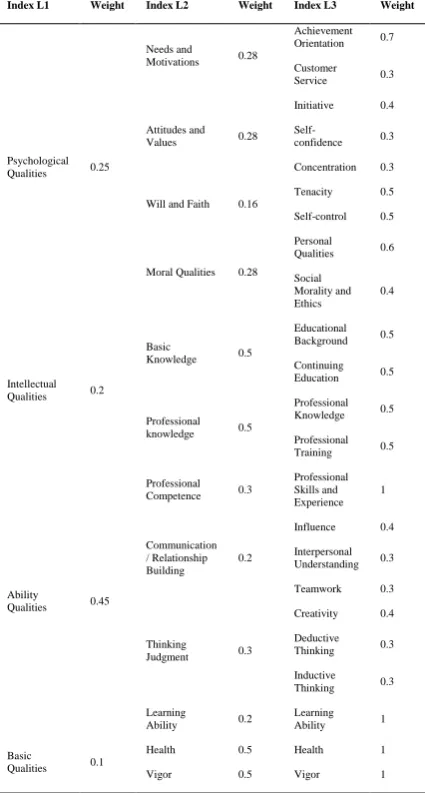
According to the method above, we work to build the Fuzzy Comprehensive Model corresponding to the talent characteristics there, which is shown in Table 2:
Subdomains weight coefficient vector: X (0.25, 0.2, 0.45, 0.1), X1 (0.28, 0.28, 0.16,
0.28), X2 (0.5, 0.5), X3 (0.3, 0.2, 0.3, 0.2), X4
(0.5, 0.5), X11 (0.7, 0.3), X12 (0.4, 0.3, 0.3),
X13 (0.5, 0.5), X14 (0.6, 0.4), X21 (0.5, 0.5),
X22 (0.5, 0.5), X31 (1), X32 (0.4, 0.3, 0.3),
X33 (0.4, 0.3, 0.3), X34 (1), X41 (1),
X42 (1).
Table 2 The Index Weights of Water Conservancy Professionals
Index L1 Weight Index L2 Weight Index L3 Weight
Psychological Qualities 0.25
Needs and Motivations 0.28
Achievement Orientation 0.7
Customer Service 0.3
Attitudes and
Values 0.28
Initiative 0.4
Self-confidence 0.3 Concentration 0.3
Will and Faith 0.16
Tenacity 0.5 Self-control 0.5
Moral Qualities 0.28
Personal Qualities 0.6
Social Morality and Ethics
0.4
Intellectual Qualities 0.2
Basic
Knowledge 0.5
Educational Background 0.5 Continuing Education 0.5
Professional knowledge 0.5
Professional Knowledge 0.5 Professional Training 0.5
Ability
Qualities 0.45
Professional Competence 0.3
Professional Skills and Experience
1
Communication / Relationship Building
0.2
Influence 0.4 Interpersonal Understanding 0.3 Teamwork 0.3
Thinking Judgment 0.3
Creativity 0.4 Deductive Thinking 0.3 Inductive Thinking 0.3 Learning
Ability 0.2
Learning
Ability 1
Basic
Qualities 0.1
Health 0.5 Health 1
Vigor 0.5 Vigor 1
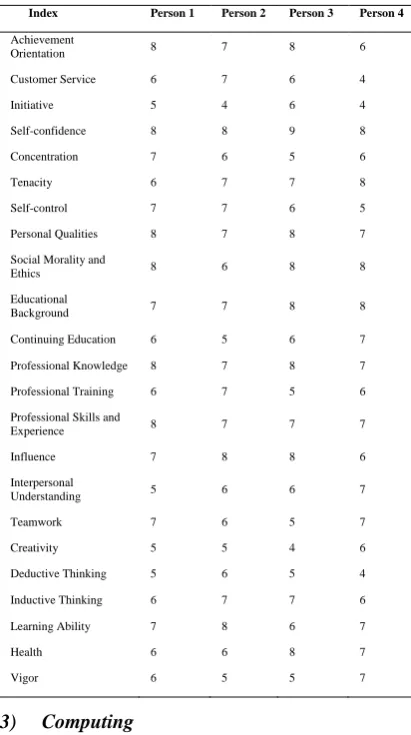
2) Determining Evaluation Set
[image:5.612.137.255.229.456.2]Table 3 Water Conservancy Professional Score Table
Index Person 1 Person 2 Person 3 Person 4
Achievement
Orientation 8 7 8 6
Customer Service 6 7 6 4
Initiative 5 4 6 4
Self-confidence 8 8 9 8
Concentration 7 6 5 6
Tenacity 6 7 7 8
Self-control 7 7 6 5
Personal Qualities 8 7 8 7
Social Morality and
Ethics 8 6 8 8
Educational
Background 7 7 8 8
Continuing Education 6 5 6 7
Professional Knowledge 8 7 8 7
Professional Training 6 7 5 6
Professional Skills and
Experience 8 7 7 7
Influence 7 8 8 6
Interpersonal
Understanding 5 6 6 7
Teamwork 7 6 5 7
Creativity 5 5 4 6
Deductive Thinking 5 6 5 4
Inductive Thinking 6 7 7 6
Learning Ability 7 8 6 7
Health 6 6 8 7
Vigor 6 5 5 7
3) Computing
A. Compute the Subdomains Fuzzy Matrix of all levels and do normalization:
11 11
7 6 8 5 0.27 0.23 0.3 0.2
6 6 6 3 0.29 0.29 0.29 0.13
A = →A =
[ ] [ ]
42 6 4 5 6 42 0.29 0.18 0.24 0.29
A = →A =
B. Compute the Fuzzy Evaluation Vector in Level 3, where M=(∧ , ∨) and
Y
=
X
*
A
As
Y
11=
X
11*
A
11=
( 0.6 , 0.4 )* 0.27 0.23 0.3 0.2 0.29 0.29 0.29 0.13
= (0.278,0.254,0.296
,0.172)
C. Compute the Fuzzy Evaluation Vector in Level 2, Use
Y
11,Y
12 ,Y
13 ,Y
14 fornormalizing into
Y
1, andY
2,Y
3,Y
4.D. Compute the Fuzzy Evaluation Vector in Level 1, Use
Y
1 ,Y
2 ,Y
3 ,Y
4 fornormalizing into
Y
, thusY
=(0.2,0.2,0.5,0.1)*
1
2
3
4
Y Y Y Y
=(0.27151,0.23606,0.26245,
0.22999).
Normalize
Y
.Y
=(0.27151,0.23606, 0.26245,0.22999)。.Do Standardization. Set 100 Points of Ability Qualities, 48 Points of Psychological Qualities, 32 Points of Intellectual Qualities and 20 Points of Basic Qualities.
Finally we get the Score:
0.27151
*
48+0.23606*
32+0.26245*
100+0.229 99*
20=51.43088Thus the Weighted Composite Score is 51.43088 Points.
Compare the Points with the actual performance of this water conservancy talent. The evaluation results are basically accurate.
4) System Assessment
The evaluation system of water conservancy talents is designed to serve the informatization. Compared with the traditional talent evaluation mode, it implements two major breakthroughs of the method and technology:
In the method, the system introduces Fuzzy Comprehensive Evaluation Method, which is widely-used currently. Based on the theory of fuzzy mathematics, it can transform qualitative evaluation into quantitative evaluation effectively and can solve the non-deterministic problems directly, especially which is difficult to quantify.
knowledge level, mental models, basic quality, ability structure; Secondly, using AHP, we continue to divide each qualitative evaluation into evaluation indexes of different levels, combine each index weights we given and obtain an intuitive quantitative score; Finally, we calculate the weighted composite score with quantitative score. This is a transformation that changes qualitative Analysis into quantitative evaluation.
Applied to water conservancy talents evaluation, not only can the method improve evaluation efficiency and increase the comparability of talents through multi-index evaluation, but also discover talents’ defects easily and is of great help in the improvement of talents. More importantly, it can improve the talents evaluation system, which makes contributions to democratization and scientificalness of decisions on strengthening water conservancy management.
Technically, the system adopts MVC software design architecture constituted by three core modules: Logic layer, presentation layer and control layer. In the MVC architecture, each layer completes each task and they can work together through transmitting message. Using MVC structure, we can flexibly separate these processes of input, computation and output in the system, which implements intuitiveness on using, security on running, simplicity on maintaining.
In addition, according to the actual situation, the system brings scientific, objective, operational water conservancy talents comprehensive evaluation index system, which is combined qualitative and quantitative and is in accordance with China's basic national conditions of the present stage, aiming to the initial screening of talents for water conservancy department and making an important foundation for water conservancy management.
5. CONCLUSION
With the development of water conservancy and environmental complication, what have been increasingly stressed on water conservancy talent evaluation should be assisted by highly-qualified experts with professional ethics as well as scientific spirit in reasonable structure; Furthermore what have been recognized as the only way of promoting water conservation work to the continuous development is establishing a mature evaluation index system which ought to be scientific, objective, comprehensive, also a combination of
quantitative and qualitative and be in line with the present stage of China’s basic national conditions.
To verify the objectivity and practicality of the evaluation system based on Fuzzy Comprehensive Model, we launch the case study of evaluating design professionals of Guizhou Province Water Resources and Hydropower Survey and Design Institute for Water Resources and Hydropower using assessment data there. After comparing the evaluation findings with staff’s actual performance along with various factors, we find a basic reflection from paper score to practical comprehensive quality, which gives the conclusion that the evaluation system is a fine application for initial screening water conservancy talents.
In short, hence the research on evaluation index system is still in the development stage, there are urgent needs in further exploring the selection, screening and evaluation methods of indexes, which is, in other words, that when we reveal the law of development for water conservancy talents evaluation, what we need to do is combining basic national conditions to research and finding a better way of assessing water conservancy talents that must be objective, comprehensive and fair.
REFERENCES
[1] Jinying Sun, Yong Wu, Youzhi Hao, Zhen Dai, Fuzzy Comprehensive Evaluation Model and Influence Factors Analysis on Comprehensive Performance of Green Buildings, Renewable
Energy Resources and a Greener Future, Vol.
34, pp.125-131, 2006
[2] Klein, Gary, Jiang James J. Sobol, Marion G.A New View of IS Personnel Performance Evaluation, Communications of the ACM, Vol.44, pp. 95-101, 2001
[3] Gong, Yaping Law, Kenneth S, Chang, Song, Human Resources Management and Firm Performance: The Differential Role of Managerial Affective and Continuance Commitment, Journal of Applied Psychology, Vol.94, pp. 263-275, 2009
[4] Gaziel Haim. Principals of Performance Assessment, Educational Management Administration & Leadership, Vol.36, pp. 337-351, 2008
[5] Capaldo, Guido, Zollo. Applying fuzzy logic to Personnel assessment: a case study, Giusepp Omega, Vol. 29, pp. 95-103, 2001