Journal of Theoretical and Applied Information Technology 31st December 2013. Vol. 58 No.3
© 2005 - 2013 JATIT & LLS. All rights reserved.
ISSN: 1992-8645 www.jatit.org E-ISSN: 1817-3195
650
STUDENT MODELING IN ADAPTIVE EDUCATIONAL
CHAT ROOM
1MUNA HANINI, 2RADWAN TAHBOUB, 3NEDAL A.M JABARI
1Palestine Polytechnic University, Informatics 2
Palestine Polytechnic University, CE/CS Department
3Palestine Technical Colleges/Arroub, Computer Department
E-mail: [email protected], [email protected] ,3 [email protected]
ABSTRACT
This paper introduced a viable method for modeling student in adaptive educational chat room. This is a complementary solution to the discussion rooms that have been discussed in the virtual classroom AVCM. Adopted this model to study the behavior of the student during the chat session and find an assessment of knowledge depending on it. That's where the period of time spent by students during the chat session is an important element of assessment, which also includes peer evaluation among students as well as the main component is analyzing the text of the discussion among the students and search for a set of specific expressions to determine the level of benefit presented by each student to another. At the end of the chat session each student will be modeled using the entries of the set < Ts, P, M, S> where S is the student model = ((3M+2Ts+P))/6.
Keywords: Model, AVCM, Mining, Chat, Discussion.
1. INTRODUCTION
Adaptivity is the highest level of intelligent online learning. The adaptivity means reflecting the user own characteristics to the behavior of the system [1, 2]. The user characteristics, preferences, abilities and cognitive style are all aspects can tune the system behavior. In adaptive educational systems adaptation could have different components including adaptive lectures presentation, adaptive assessment tools, and finally adaptive one to one discussion tool.
In recent learning systems, technology strongly involved in the pedagogical process, especially in the virtual classroom, virtual classroom contains mainly two components, first is the lectures presentations, and second is the student evaluation techniques. Most learning systems manage these two processes in traditional way. Both lectures presentation and evaluation process are introduced in the same way for all students. Personal differences among students especially student preferable way of study are not considered in these systems.
In [3] it discussed the framework model for adaptive virtual class model based on student modeling and course sequencing (AVCM), this model is shown in Figure 1. AVCM which will be discussed in the background is an integrated model for adaptive virtual classroom model based onthree main components: Adaptive presentation, adaptive assessment and adaptive discussion tool. In [4] we
discussed the adaptive discussion tool and the methodology that uses in its behavior.
In AVCM a new model of adaptive chat tool is supposed to be integrated with adaptive educational systems. Adaptive chat tool help the students to select their best peers in discussion by marking the students in the chat window with different colors to differentiate among them. Our problem is to model the student within this chat tool in order to reflect the knowledge level acquired with the chat session into the overall student profile. The educational process within the chat tool consists of peer to peer discussion session about one and only one concept. This concept should be first studied within the virtual classroom presentations and also having the adaptive test which give the student a score for this concept. This score is only one input for the student model about this concept. We have other inputs using three approaches:
1. Peer evaluation. 2. Chat context analysis 3. Time spent in the chat.
Our mission is to build a student model approach for the educational chat tool which can be used to update the student profile and reflect the new entries on the adaptive system.
Journal of Theoretical and Applied Information Technology 31st December 2013. Vol. 58 No.3
© 2005 - 2013 JATIT & LLS. All rights reserved.
ISSN: 1992-8645 www.jatit.org E-ISSN: 1817-3195
652
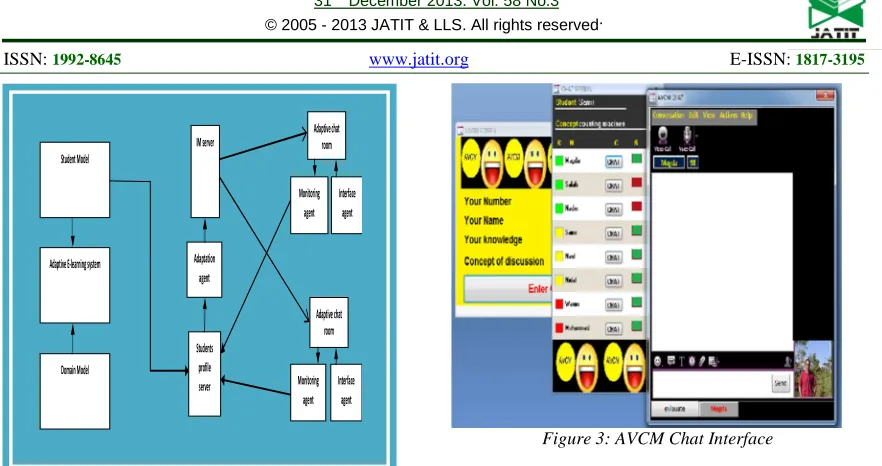
Figure 2: Architecture of the AVCM Adaptive Chat Room
As any Adaptive, educational system User and Domain Model are required to organize and store the data about the course content and student characteristics and knowledge. During the course the students learn concepts provided by the Domain Model. The students will have a score as a result of multiple choice exams. This score, which is stored in the student profile, will be used to adapt the interface of the chat room. The problems of chat tools are mainly three problems. In order to solve these problems we need to have the following facilities in the educational chat tool:
1. Adaptive chat interface as described in AVCM chat.
2. Having evaluation methodology to model the student in the chat room.
[image:3.612.89.530.52.285.2]These requirements need that we rely on several methodologies related to chat and text mining. Many researchers studied these concepts and added value to the chat and text mining. Investing these concepts in our research will fill the requirements mentioned above. AVCM chat tool interface is shown in Figure 3.
Figure 3: AVCM Chat Interface
2.2 Text Mining and Analysis
In peer to peer chat process, both parties
write number of messages. These messages usually related to one or more concept. In our case we are looking for methodology to analyze the text entered in the chat room to evaluate its relation with the current of discussion. Chat posts usually classified as being a part of conversation or free topic chat, as being about a particular topic [7], collaborative task –oriented, academic seminar or presentation chat, practice chat and evaluation chat. We are setting on collaborative – task oriented chat and evaluation chat. We are interested in the second type because we are looking for estimating the degree of the relation of the chat posts and the current educational concept.
Our adjective is to extract the maximum amount of conversation related to the current concept, therefore we find ourselves need to remove many items in the chat context which is not related directly to the chat concept. In this case data mining concept will be applied to get the minimum and most important data related to the concept, which means that all chat items mentioned above should be searched and removed from the chat mining, and leave only the text related directly to the concept. Currently, we have number of chat monitoring systems mainly divided into two categories [8]: network based and client based. In our model network or client based is the best solution since we need the analysis to be centralized and confidential. As shown in Table 1 we can see a comparison of instant messaging monitoring capabilities.
Chat analysis in most systems aims to filter the vast amount of text and provide the minimum required data. Most monitoring systems follow the following functions [4]: log browsing, message retrieval, Domain Model
Adaptive E-learning system Student Model
Adaptive chat room
Adaptive chat room
Interface agent Monitoring
agent
Interface agent Monitoring
agent Students
profile server IM server
653 content search and simple statistical reporting. In our research we need to use the last three while we are not going to use log browsing. When we are talking about chat in education we mean some specific kind of chat used for educational purpose only.
Table 1: IM Monitoring Capabilities
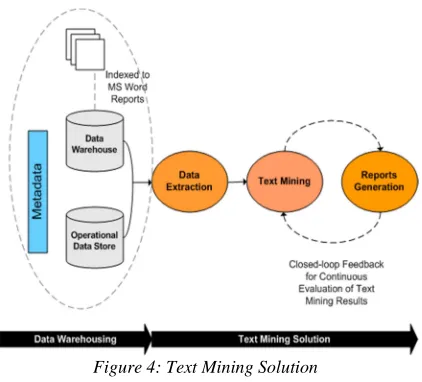
Figure 4 shows the general methodology used for data mining and analysis of text mining solutions. Descriptive metadata is a data about the data content which can be implemented using data warehouse and data store. From these techniques the data extracted will be used for text mining which is the process of deriving high-quality information from text. High-quality information is typically derived through the devising of patterns and trends through means such as statistical pattern learning. Text mining usually involves the process of structuring the input text (usually parsing, along with the addition of some derived linguistic features and the removal of others, and subsequent insertion into a database), deriving patterns within the structured data, and finally evaluation and interpretation of the output. 'High-quality' in text mining usually refers to some combination of relevance, novelty and interestingness. Typical text mining tasks include text categorization, text clustering, concept/entity extraction, production of granular taxonomies, sentiment analysis, document summarization and entity relation modeling (i.e., learning relations between named entities).
Text analysis involves information retrieval, lexical analysis to study word frequency distributions, pattern recognition, tagging/annotation, information extraction, data mining techniques including link and association analysis, visualization, and predictive analytics. The overarching goal is, essentially, to turn text
into data for analysis, via application of natural language processing (NLP) and analytical methods.
[image:4.612.315.526.228.419.2]A typical application is to scan a set of documents written in a natural language and either model the document set for predictive classification purposes or populate a database or search index with the information extracted[8]. Reports extracted from text mining are the key factor whichwe arelooking for to create our final report about the chat text analysis and having an evaluation for the two peers in the chat session.
Figure 4: Text Mining Solution
In chat posts we face many chat characteristics which we should take in consideration when we analyze it [3]:
1. Chat text and its component
2. Chat initializes which are abbreviations and acronyms used in chat which are used to express some words instead of spoken language.
3. Emoticon usage: Some symbols used to express emotions.
4. Abbreviated speech: Misused of words are more common in chat room.
5. Mentions: Sounds like buzz and poke.
6. Using of different language.
2.3 Dynamic Online Peer Evaluation
Journal of Theoretical and Applied Information Technology 31st December 2013. Vol. 58 No.3
© 2005 - 2013 JATIT & LLS. All rights reserved.
ISSN: 1992-8645 www.jatit.org E-ISSN: 1817-3195
654 for both peers to evaluate each others, after filling the questionnaire it will be analyzed and passed to the Student Model to extract the increment in the students’ knowledge and store it in the student profile.
The peer evaluation is not more than ordinary questionnaire with multiple choice answers and the students give their own opinion freely. Several techniques and methodology used for online questionnaire or moreover for online survey because our peer evaluation methodology will match the same methodology used for such survey. In [9] online survey is described with multiple choice answers where respondents select one or more options.
Online survey which represents the base for our online peer evaluation tend to focus in one more on “Quantitative” data collection [10] so it is preferable to consider the following points when we design the peer evaluation form.
1. Review the basic objectives of the evaluation. What are we trying to discover? What actions do we want to take as a result of the evaluation? 2. Visualize all of the relevant information items we would like to have. What will the output report look like? What charts and graphs will be prepared? What information do we need to be assured that action is warranted?
3. Rank each topic in items 1 and 2 according to the value of the topic. List the most important topics first. Revisit items 1 and 2 again to make sure the objectives, topics and information we need are appropriate.
4. How easy or difficult is it for the respondent to provide information on each topic? If it is difficult, is there another way to obtain the information by asking other questions.
3. STUDENT MODELING IN ADAPTIVE EDUCATIONAL CHAT ROOM
The interface design as shown in Figure 3 shows that the main components of the educational chat room are:
1. Current student. 2. Concept name. 3. Session number. 4. Session time counter. 5. Peer evaluation function.
Current student represents the student currently in chat session and should be modeled, concept name related directly to the domain model which represents the course concepts sequencing, this concept which is being under discussion and the
evaluation should be for it. Session number is a counter which counts the sessions the student already attended in discussion; session time counter is a counter which calculated the session duration for the current session and finally the peer evaluation function which open the pop up form to be filed by the student to evaluate his peer. All these functions including the chat text mining will represent the full student modeling in the adaptive chat tool.
3.1Chat Text Mining In AVCM Chat Form
As shown in Figure 4, text mining in the chat will analyze the text written by the student and extract a result from this chat. The result will reflect the degree of the relation between the concept of the discussion with the text of discussion. When we are looking for data mining in the chat we will have the following situations and conditions:
1. The discussion topic usage in the chat. 2. Number of keywords used in chat. 3. Number of overall words used in the chat. 4. Number of question terms used in chat session (What, Why, How???).
5. Number of thanks words in the chat session (Thanks, good, excellent, understand, clear). 6. Number of rejection terms used in chat session (Sorry, not clear, not good, not understand). All these points will be extracted using chat text mining for the two peers and analyzed to extract the final evaluation of the student in linguistic term ( Excellent , ….. , bad) .
In reference to Figure 4 text mining in the chat will follow the following procedures:
1. Convert the text in the chat between two peers into text file.
2. Looking for and remove all words not related directly to the chat concept. These words should be stored in a table to simplify the search process. These words may include but not limited :
a. Pronouns.
b. Have, do and am verbs.
c. In, on, outside, inside, between, among, into, to, of, or, etc.
d. Other language words.
655
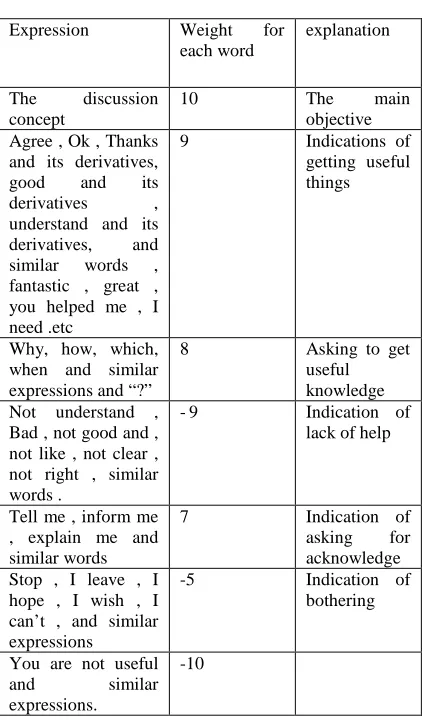
Table 2: Supposed Weights of the Chat Text Expressions
Expression Weight for
each word
explanation
The discussion
concept
10 The main
objective Agree , Ok , Thanks
and its derivatives,
good and its
derivatives ,
understand and its
derivatives, and
similar words ,
fantastic , great , you helped me , I need .etc
9 Indications of
getting useful things
Why, how, which, when and similar expressions and “?”
8 Asking to get
useful knowledge Not understand ,
Bad , not good and , not like , not clear , not right , similar words .
-9 Indication of
lack of help
Tell me , inform me , explain me and similar words
7 Indication of
asking for
acknowledge Stop , I leave , I
hope , I wish , I can’t , and similar expressions
-5 Indication of
bothering
You are not useful
and similar
expressions.
-10
As we are discussing expressions and their meanings we introduced some examples about these expressions in table 2. It is necessary to have complete expression meanings frompsychologist to be more accurate about the text evaluation in the chat text.
4. Counting the weight and extracting the final result.
In Figure 5 the full model after adding the new procedures related to the text evaluation is described.
Figure 5: The Chat Evaluation Model
Figure 5 resumes the model procedures which can be described as the following
:
1- The two peers start their session with counter= 0 and required chat session is T. 2- The total time spent by each student is t1
and t2. The time spent evaluation for the first student is:
Ts = (t1/T)*100% (1) and the time spent evaluation for the second student is:
Ts=(t2/T)*100% (2) 3- When the two peers finish their session,
they should click the peer evaluation form. The pop up form contains a questionnaire about the benefits, serious and the ability of sharing the knowledge. This section should have score of 100.
4- Last procedure of student modeling in chat session is chat text evaluation. This section concerns in extracting the words and expressions which reflects the value of the chat. The steps for this procedure as the following:
a. The chat text stored in indexed files or database for future use which is called data warehousing.
b. From this database the text should be extracted and converted into text file. c. Once the text is a text file, we need to have short text without all words and expressions which are considered not related directly as discussed before. d. Once we have the short text, we start to search the text for specific words as shown in Table2. Scores will calculated for each expression and final score will be obtained.
Journal of Theoretical and Applied Information Technology 31st December 2013. Vol. 58 No.3
© 2005 - 2013 JATIT & LLS. All rights reserved.
ISSN: 1992-8645 www.jatit.org E-ISSN: 1817-3195
656 course test. The student modeling in chat session set is < Ts, P, M>. The student evaluation score will be
S = (3M+2Ts+P ) / 6 (3)
We consider that the chat text is the most important factor which reflects the chat session value, time spent reflects the serious of the students , while the peer evaluation has the lowest value since it is personal view.
3.2 Example
Suppose that two students have already finished their chat session and the following data was given:
1- First student completed the session time which is 30 minutes while the second student spent only 23 minutes.
2- First student evaluated the second student as 60% while the second student evaluated the first student by 85%.
3- After finishing the chat text mining we got the following results :
a. First student: 77%. b. Second student: 44%.
The set of the first student will be
< Ts, P, M> = < 100, 85, 77>. The student score is (231+200+85)/6= 86
The set of the second student will be
< Ts, P, M> = < 77, 60, 44>. The student score is (132+154+60)/6= 57.6.
4. CONCLUSION AND RECOMMENDATIONS
Student modeling in adaptive e-learning systems is an important factor in determining the system behavior because the modeling output will describe thestudent characteristics and knowledge level. Adaptive chat session is one of the e-learning adaptive components and used as a tool for learning. It is necessary to evaluate the student by evaluation the student activities within this chat to update the student new characteristics. Three entries are important factor to model the student within the chat session represented through the set < Ts, P, M>. When we can have a value for these three entries we can estimate the student new knowledge level acquired during the chat session. The modeling doesn’t concentrate directly on exam questions but on student behavior which doesn’t give accurate value but estimated value. It is recommended strongly to use Fuzzy Logic or
Bayesian Network to have more accurate estimation for the student model in the chat session.
5. FUTURE WORKS
The future works will be concentrated on getting more accurate data by using fuzzy logic in chat student modeling.
REFERENCES
[1] Sasakura , Yamasaki , "A framework for adaptive e-learning systems in higher learning with information visualization ", IEEE ,2007 .
[2] De Bra, P., Ad Aerts, Berden, B., De Lange, B., Rousseau, B., Santic, T., Smits, D., Stash, N.,"AHA! The Adaptive Hypermedia Architecture" Department of Computer Science Eindhoven University of Technology, 2003.
[3] Jabari, N.A.M., Hariadi, M. & Purnomo, M. H. “Intelligent Adaptive Presentation and E-testing System based on User Modeling and Course sequencing in Virtual Classroom”. IJCA 50 (9): 0975-8887. 2012.
[4] Jabari, N.A.M., Hariadi, M. & Purnomo, M. H , “Agent Based Adaptive Educational Chat Tool Model”. JATIT, 2013 .
[5] Liu , Tang , Ma ," A rule–based Approach for student modeling " , IEEE , 2008 , p 526-530 .
[6] Dafne Gonzalez ,”TEACHING AND LEARNING THROUGH CHAT:A TAXONOMY OF EDUCATIONAL CHAT FOR EFL/ESL” iatefl , 2004 .
[7] Kuan C. Chen ,” Text Mining e-Complaints Data From e-Auction Store With Implications For Internet Marketing Research “Journal of Business & Economics Research , USA , 2009
[8] Siu Cheung Hui , Yulan He ,Haichao Dong ,”Text Mining for Chat Message Analysis” ,NTU , 2007
[9] Avan Wadia , Diana Parkinson ,”Consulting How to design and use free online surveys to collect feedback on your services” . Monitoring and evaluation consulting , 2010.