ENHANCED ROAD SECURITY USING EDGE DETECTION
AND INFRARED IMAGERY
1MITHILA HARISH, 2ABHISHEK GUDIPALLI, 3RAMASHRI TIRUMALA
1,2 School of Electrical Engineering, VIT University, Vellore – 632014, India.
3
Department of Electronics and Communication Engineering,
Sri Venkateswara University College of Engineering, Tirupati – 517501, India
E-mail: [email protected], [email protected], [email protected]
ABSTRACT
Edges are prominent features in images and their detection plays main role in computer vision and image processing. Identifying and Detecting the edges are a low level task in a variety of applications such as shape recognition, image compression, enhancement and restoration. The technique laid out aims to develop enhanced techniques for road safety. Road safety is a major issue and many lives are lost due to inadequate safety measures, including poor lighting conditions, road conditions,etc. The methods laid out aim to provide enhanced safety that can be further used in enhancing road safety with the potential to avoid accidents. These are performed using various criteria involving concepts of edge detection, infrared imaging and real time imaging. In addition to this, it also analyses other safety techniques and algorithms that have been previously developed in this line of research. One of the methods laid out caters to the problems colour blind people have, specifically in distinguishing between the green light in traffic signals
and street lights.
Keywords: Infrared, Edge Detection, Log, Power Law Transform, Real Time Imaging
1. INTRODUCTION
The fundamental image pre-processing tool un many image processing applications is image enhancement. The important applications such as biomedical, remote sensing, autonomous navigation, etc. Requires digital images with good contrast and visual detail. Enhancement methods finds use to modify an image to show visual information contained in image in a better
manner [1]. According to Weber’s contrast law,
the minimum change required for human visual system to perceive contrast, however this applicable only for a properly illuminated area. The human visual system uses objective evaluation measure for selection of parameters, such as edges which improves results, while reducing time required for enhancement process [1],[2].
Image fusion is an ever growing field. Various new techniques for image processing have been discovered in recent times. There are many problems regarding the current state of road safety. One problem is that colour blind people have some difficulty in distinguishing
between traffic signals and streetlights [1]. This paper proposes an edge algorithm, specifically using canny filter, to try to solve the above mentioned problem.
Another problem encountered in roads occurs in many cases due to bad lighting and weather. For instance, on a rainy night, it is very difficult for drivers to observe the vicinity properly. This leads to many accidents. This paper proposes the use of infrared cameras, which are helpful in cases of poor lighting [3] [4] [5].Applying edge detection, in this case the canny filter, to this captured image further helps the driver as at a glance objects will appear clearer.
original was fused with the edge detected image which yielded better results.
2. DIFFERENT IMAGING METHODS
2.1 Infrared imaging
Infrared (IR) light is electromagnetic radiation with a wavelength longer than that of visible light, measured from By the nominal edge of visible red light at 0.74μm, and
extending conventionally to 300μm [6]. The
wavelengths correspond to a Infrared have range of approximately 1 to 400 THz of frequency and includes most of the thermal radiation emitted by objects near room temperature. Infrared imaging is widely used for military and civilian purposes. In military applications it finds useful in target acquisition, surveillance, night vision, homing and tracking. Non-military uses include thermal efficiency analysis, environmental monitoring, industrial facility inspections, remote temperature sensing, short-ranged wireless communication, spectroscopy, and weather forecasting [2],[3]. Humans radiate chiefly at wavelengths around 12 μm at normal body temperature. The atomic level infrared energy elicits vibration modes in a molecule through a change in the dipole moment, making it a useful frequency range for study of these energy states for molecules of the proper symmetry. Infrared spectroscopy examines absorption and transmission of photons in the infrared energy range, based on their frequency and intensity [2], [3].
The following is an infrared image of a cat. This is converted to grayscale, and is further edge detected using canny edge detection techniques as shown in figures 1, 2 & 3. This will help in the cases of bad lighting and weather, for instance driving in the night in the midst of heavy rains. The image is converted to gray scale for simplicity in the computing and processing stages. Gray scale images process the property of ease of manipulation which this technique exploits.
Figure 1: Infrared image
Figure 2: Grayscale image
Figure 3: Edge detected image
2.2 Real time imaging
Real time imaging can be of tremendous use and can be used. A major and important cause for traffic accidents is largely due to a low level of vigilance. [3] describes a real-time prototype computer vision system where the driver vigilance is monitored. A remotely located CCD camera and a specially designed hardware system are included.
allows, in the detection of, generic obstacles as well as lane position in a structured environment
and proposes techniques for the same.
2.2.1 Differentiating Between Traffic Light and Streetlight
[image:3.612.135.243.297.400.2]There is a problem in differentiating between traffic lights and streetlights for a colour blind people. The following are pictures of a streetlight and traffic light, respectively, and edge detection is performed on the images. As can be observed from the results, there is a clear difference which will help in better navigation of roads. The below figures 4 & 6 show the images of Street light and traffic signal of real time images captured through camera and the figures 5 & 7 shows the edge detected image obtained through Canny edge detection technique.
Figure 4: Street light image
Figure 5: Edge Detected Street light image Figure 6: Traffic signal image
Figure 7: Edge detected Traffic signal image
3. PROPOSED ALGORITHM
The proposed algorithm can be explained in five steps
Step 1: Acquire the real time image and convert it into grayscale image.
Step 2: Enhance the quality of image using Power law transform.
Step 3: A 3x3 Laplacian mask is convolved with enhanced image.
Step 4: Apply Laplacian of Gaussian (LoG) edge detection operator to the enhanced image
Step 5: Apply image fusion between enhanced image and edge detected image to obtain final image.
4 EXPERIMENTAL RESULTS
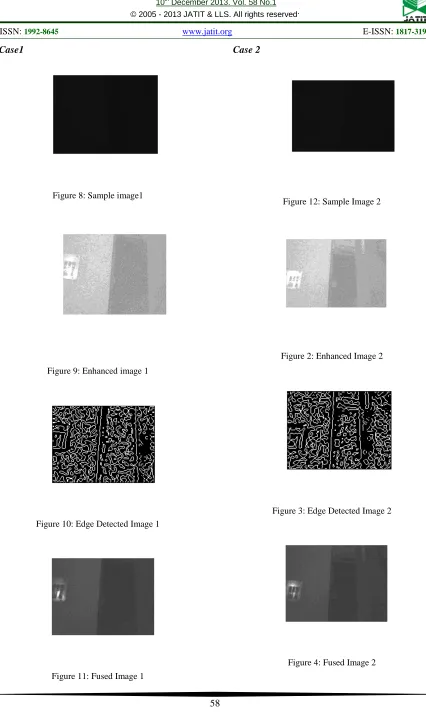
The proposed algorithm has been applied to the sample real time images which are obtained in darkness. The quality of the images is
very poor and having low brightness. The
proposed algorithm clearly analyses the image
Case1
Figure 8: Sample image1
[image:4.612.91.517.50.765.2]Figure 9: Enhanced image 1
Figure 10: Edge Detected Image 1
Figure 11: Fused Image 1
Case 2
Figure 12: Sample Image 2
Figure 2: Enhanced Image 2
Figure 3: Edge Detected Image 2
5 CONCLUSION
The proposed approach has a potential for various applications to detect edges and enhancing images used extensively for military and civilian purposes. From the analysis, the following findings were obtained. Edge detection of traffic lights and streetlights are useful for the colour blind people who cannot distinguish between them. Implementing such a strategy would be helpful. Infrared imaging is useful in cases of bad lighting and poor weather conditions such as rain, storms and the like. Implementation of the same would lead to less dependency on headlights and streetlights, and would be particularly useful in terrains with poor lighting facilities. Real Time imaging is useful and can be used in continuous monitoring of obstacles. This would help greatly in better driving. Real time scanning is useful. A 1D edge detector can be used to highlight potential edges, and then can be weighted by a Gaussian centered on the predicted edge location. A more sophisticated method is developed- an image detection method based on background differencing and edge detection techniques is developed which separates the objects from their backgrounds and works well under various lighting and weather conditions. Implementation of the above would lead to better road safety and reduction in the number of accidents.
REFERENCES
[1] R C Gonzalez,R E Woods, “Digital Image
Processing”, (Second Edition)[M].New
York: Prentice Hall, 2003.
[2] C L Novak, S A Shafer, “Color edge
detection”, Proc of DARPA Image
Understanding Workshop[C].pp:35 -37, 1987.
[3] Pierre Buyssens, Marinette Revenu and
Olivier Lepetit, “Fusion of IR and Visible light Modalities for Face Recognition” Proc of IEEE 3rd International Conference on-
Biometrics: Theory, Applications, and
Systems, 2009. BTAS '09 during 28-30 September, 2009
[4] Prabath Gunawardane, Tom Malzbender,
Ramin Samadani, Alan McReynolds, Dan
Gelb, James Davis, “Invisible Light: Using Infrared For Video Conference Relighting’,
17th IEEE International Conference on
Image Processing (ICIP), 2010 during 26-29 September, 2010
[5] Gun A.Lee, Mark Billinghurst and Gerard
Jounghyun Kim, “Occlusion based
Interaction Methods for Tangible Augmented Reality Environments” Proceedings of the
2004 ACM SIGGRAPH International
conference on Virtual Reality continuum and its applications in industry.Pages 419-426
[6] Thi Thi Zin, Takahashi, H.,Hama, H.,
“Robust Person Detection using Far Infrared Camera for Image Fusion”, Second
International Conference on Innovative
Computing, Information and Control,
ICICIC '07, 2007.
[7] S K Naik, C A Murthy, “Standardization of Edge magnitude in color images”, IEEE Transactions on Image Processing, 15(9): 2588-2595, 2006.
[8] Dong Wang and Jingzhou Zhang “Infrared Image edge detection algorithm based on Sobel and ant colony algorithm”, 2011
International conference on multimedia
technology, pp.4944 – 4947.
[9] Morley G. Whillans, MD “Colour-blind drivers perception of traffic signals”, The
Canadian Medical Association Journal,
Volume 128, May 15, 1983
[10] Xiaoli Yang, Zhenpeng Zhao and Youn K
Kim, “A Real Time Traffic Light
Recognition System”, International Journal
of Information Acquisition, Volume 05,
Issue 02, June 2008
[11] Nancy Truong, William Agassounon,
“Utilizing Biomimetic Image Processing To Rapidly Detect Rollover Threats”, DTIC Document, November 2006
[12] Qiang Ji, Xiaojie Yang, “Real-Time Eye, Gaze, and Face Pose Tracking for Monitoring Driver Vigilance”, Volume 8, Issue 5, October 2002, Elsevier Science Ltd.
[13] Massimo Bertozzi, Alberto Broggi,
“GOLD: A Parallel Real-Time Stereo
Vision System for Generic Obstacle and
Lane Detection”, IEEE Transactions on
Image Processing, January 1998- Volume 7, Issue:1, Pages 62-81
[14] N.J. Ferrier, S.M.Rowe, A. Blake “Real-
Time Traffic Monitoring”, Proceedings of
The Second IEEE Workshop on
Applications of Computer Vision, 1994, 5- 7 Dec 1994
[15] M. Fathya, M.Y. Siyal, “An image detection
technique based on morphological edge
detection and background differencing for
real-time traffic analysis”, Elsevier Pattern