Motion Estimation with
Quadtree Splines
Richard Szeliski and Heung-Yeung Shum
Digital Equipment Corporation Cambridge Research Lab
Digital Equipment Corporation has four research facilities: the Systems Research Center and the Western Research Laboratory, both in Palo Alto, California; the Paris Research Laboratory, in Paris; and the Cambridge Research Laboratory, in Cambridge, Massachusetts.
The Cambridge laboratory became operational in 1988 and is located at One Kendall Square, near MIT. CRL engages in computing research to extend the state of the computing art in areas likely to be important to Digital and its customers in future years. CRL’s main focus is applications technology; that is, the creation of knowledge and tools useful for the preparation of important classes of applications.
CRL Technical Reports can be ordered by electronic mail. To receive instructions, send a mes-sage to one of the following addresses, with the word help in the Subject line:
On Digital’s EASYnet: CRL::TECHREPORTS On the Internet: [email protected]
This work may not be copied or reproduced for any commercial purpose. Permission to copy without payment is granted for non-profit educational and research purposes provided all such copies include a notice that such copy-ing is by permission of the Cambridge Research Lab of Digital Equipment Corporation, an acknowledgment of the authors to the work, and all applicable portions of the copyright notice.
The Digital logo is a trademark of Digital Equipment Corporation.
Cambridge Research Laboratory One Kendall Square
Cambridge, Massachusetts 02139
Motion Estimation with
Quadtree Splines
Richard Szeliski and Heung-Yeung Shum
1Digital Equipment Corporation Cambridge Research Lab
CRL 95/1 March, 1995
Abstract
This paper presents a motion estimation algorithm based on a new multiresolution
representa-tion, the quadtree spline. This representation describes the motion field as a collection of smoothly
connected patches of varying size, where the patch size is automatically adapted to the complex-ity of the underlying motion. The topology of the patches is determined by a quadtree data
struc-ture, and both split and merge techniques are developed for estimating this spatial subdivision. The
quadtree spline is implemented using another novel representation, the adaptive hierarchical
ba-sis spline, and combines the advantages of adaptively-sized correlation windows with the speedups
obtained with hierarchical basis preconditioners. Results are presented on some standard motion
sequences.
Keywords: motion analysis, multiframe image analysis, hierarchical image registration, optical
flow, splines, quadtree splines, adaptive subdivision.
c Digital Equipment Corporation 1995. All rights reserved.
1
Contents i
Contents
1 Introduction
: : : : : : : : : : : : : : : : : : : : : : : : : : : : : : : : : : : : : : :
12 Previous work
: : : : : : : : : : : : : : : : : : : : : : : : : : : : : : : : : : : : : :
23 General problem formulation
: : : : : : : : : : : : : : : : : : : : : : : : : : : : :
44 Spline-based flow estimation
: : : : : : : : : : : : : : : : : : : : : : : : : : : : : :
64.1 Function minimization
: : : : : : : : : : : : : : : : : : : : : : : : : : : : : : :
75 Hierarchical basis splines
: : : : : : : : : : : : : : : : : : : : : : : : : : : : : : :
106 Quadtree (adaptive resolution) splines
: : : : : : : : : : : : : : : : : : : : : : : :
146.1 Subdivision strategy
: : : : : : : : : : : : : : : : : : : : : : : : : : : : : : : :
167 A Bayesian interpretation
: : : : : : : : : : : : : : : : : : : : : : : : : : : : : : :
188 Experimental results
: : : : : : : : : : : : : : : : : : : : : : : : : : : : : : : : : :
209 Extensions
: : : : : : : : : : : : : : : : : : : : : : : : : : : : : : : : : : : : : : : :
22ii LIST OF TABLES
List of Figures
1 Displacement spline: the spline control verticesf(^
u
j^
v
j)gare shown as circles ()
and the pixel displacementsf(
u
iv
i)gare shown as pluses (+).
: : : : : : : : : :
62 Example of general flow computation: (a) input image, (b)–(d) flow estimates for
m
=64,16, and4.: : : : : : : : : : : : : : : : : : : : : : : : : : : : : : : : :
93 Multiresolution pyramid
: : : : : : : : : : : : : : : : : : : : : : : : : : : : : :
11 4 Hierarchical basis preconditioned conjugate gradient algorithm: : : : : : : : : :
135 Square 2 sample image and convergence plot
: : : : : : : : : : : : : : : : : : :
136 Quadtree associated with spline function, and potential cracks in quadtree spline
:
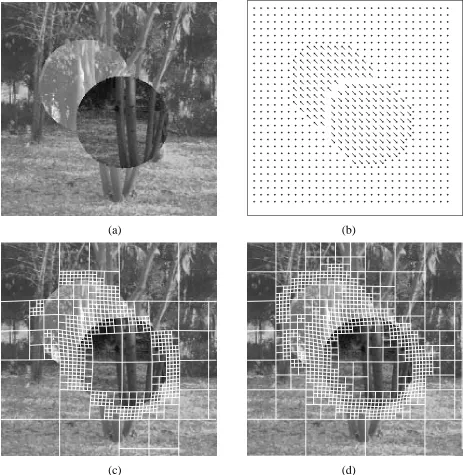
15 7 Quadtree spline motion estimation (Two Discs (SRI Trees) sequence): (a) inputimage, (b) true flow, (c) split technique, (d) merge technique.
: : : : : : : : : : :
178 Flow errorku;u k and residual normal flowku N i
kfor Two Discs (SRI Trees)
sequence. Note how most of the errors are concentrated near the motion
disconti-nuities and especially the disoccluded region in the center.
: : : : : : : : : : : :
219 Hamburg Taxi sequence: estimated quadtree and estimated flow, merging
s
= 8patches in a 3-level pyramid.
: : : : : : : : : : : : : : : : : : : : : : : : : : : :
2110 Flower Garden sequence: estimated quadtree and estimated flow, merging
s
=4patches in a 4-level pyramid.
: : : : : : : : : : : : : : : : : : : : : : : : : : : :
2211 Michael Otte’s sequence: estimated quadtree and estimated flow, merging
s
= 8patches in a 4-level pyramid.
: : : : : : : : : : : : : : : : : : : : : : : : : : : :
23List of Tables
1 Introduction 1
1
Introduction
One of the fundamental tradeoffs in designing motion estimation and stereo matching algorithms is selecting the size of the windows or filters to be used in comparing portions of corresponding
im-ages. Using larger windows leads to better noise immunity through averaging and can also
disam-biguate potential matches in areas of weak texture or potential aperture problems. However, larger windows fail where they straddle motion or depth discontinuities, or in general where the motion
or disparity varies significantly within the window.
Many techniques have been devised to deal with this problem, e.g., using adaptively-sized win-dows in stereo matching. In this paper, we present a technique for recursively subdividing an image
into square patches of varying size and then matching these patches to subsequent frames in a way
which preserves inter-patch motion continuity. Our technique is an extension of the spline-based
image registration technique presented in [Szeliski and Coughlan, 1994], and thus has the same
advantages when compared to correlation-based approaches, i.e., lower computational cost and the
ability to handle large image deformations.
As a first step, we show how using hierarchical basis splines instead of regular splines can lead to faster convergence and qualitatively perform a smoothing function similar to
regulariza-tion. Then, we show how selectively setting certain nodes in the hierarchical basis to zero leads
to an adaptive hierarchical basis. We can use this idea to build a spline defined over a quadtree domain, i.e., a quadtree spline. To determine the size of the patches in our adaptive basis, i.e., the
shape of the quadtree, we develop both split and merge techniques based on the residual errors in the current optical flow estimates.
While this paper deals primarily with motion estimation (also known as image registration or
optical flow computation), the techniques developed here can equally well be applied to stereo
match-ing. In our framework, we view stereo as a special case of motion estimation where the epipolar
geometry (corresponding lines) are known, thus reducing a two-dimensional search space at each
pixel to a one-dimensional space. Our techniques can also be used as part of a direct method which
simultaneously solves for projective depth and camera motion [Szeliski and Coughlan, 1994]. The adaptive hierarchical basis splines developed in this paper are equivalent to adaptively
sub-dividing global parametric motion regions while maintaining continuity between adjacent patches.
We can therefore implement a continuum of motion models ranging from a single global (e.g.,
2 2 Previous work
algorithm as a parallel feature tracker for very long motion sequences where image deformations
may be significant [Szeliski et al., 1995].
The motion estimation algorithms developed in this paper can be used in a number of applica-tions. Examples include motion compensation for video compression, the extraction of 3D scene
geometry and camera motion, robot navigation, and the registration of multiple images, e.g., for
medical applications. Feature tracking algorithms based on our techniques can be used in human interface applications such as gaze tracking or expression detection, in addition to classical robotics
applications.
The remainder of the paper is structured as follows. Section 2 presents a review of relevant pvious work. Section 3 gives the general problem formulations for image registration. Section 4
re-views the spline-based motion estimation algorithm. Section 5 shows how hierarchical basis func-tions can be used to accelerate and regularize spline-based flow estimation. Section 6 presents our
novel quadtree splines and discusses how their shape can be estimated using both split and merge
techniques. Section 7 discusses the relationship of adaptive hierarchical basis splines to multiscale Markov Random Fields. Section 8 presents experimental results based on some commonly used
motion test sequences. We close with a comparison of our approach to previous algorithms and a
discussion of future work.
2
Previous work
Motion estimation has long been one of the most actively studied areas of computer vision and image processing [Aggarwal and Nandhakumar, 1988; Brown, 1992]. Motion estimation
algo-rithms include optical flow (general motion) estimators, global parametric motion estimators,
con-strained motion estimators (direct methods), stereo and multiframe stereo, hierarchical (coarse-to-fine) methods, feature trackers, and feature-based registration techniques. We will use this rough
taxonomy to briefly review previous work, while recognizing that these algorithms overlap and that
many algorithms use ideas from several of these categories.
The general motion estimation problem is often called optical flow recovery [Horn and Schunck,
1981]. This involves estimating an independent displacement vector for each pixel in an image.
Approaches to this problem include gradient-based approaches based on the brightness constraint
2 Previous work 3
and Bergen, 1985; Heeger, 1987; Fleet and Jepson, 1990; Weber and Malik, 1993], and
regulariza-tion [Horn and Schunck, 1981; Hildreth, 1986; Poggio et al., 1985]. Nagel [1987], Anandan [1989], and Otte and Nagel [1994] provide comparisons and derive relations between different techniques,
while Barron et al. [1994] provide some numerical comparisons.
Global motion estimators [Lucas, 1984; Bergen et al., 1992] use a simple flow field model
pa-rameterized by a small number of unknown variables. Examples of global motion models include
affine and quadratic flow fields. In the taxonomy of Bergen et al. [1992], these fields are called parametric motion models, since they can be used locally as well (e.g., affine flow can be estimated
at every pixel). The spline-based flow fields we describe in the next section can be viewed as local
parametric models, since the flow within each spline patch is defined by a small number of control
vertices.
Global methods are most useful when the scene has a particularly simple form, e.g., when the
scene is planar. These methods can be extended to more complex scenes, however, by using a col-lection of global motion models. For example, each pixel can be associated with one of several
global motion hypotheses, resulting in a layered motion model [Wang and Adelson, 1993; Jepson
and Black, 1993; Etoh and Shirai, 1993; Bober and Kittler, 1993]. Alternatively, a single image can
be recursively subdivided into smaller parametric motion patches based on estimates of the current
residual error in the flow estimate [M¨uller et al., 1994]. Our approach is similar to this latter work,
except that it preserves inter-patch motion continuity, and uses both split and merge techniques.
Stereo matching [Barnard and Fischler, 1982; Quam, 1984; Dhond and Aggarwal, 1989] is
traditionally considered as a separate sub-discipline within computer vision (and, of course, pho-togrammetry), but there are strong connections between it and motion estimation. Stereo can be
viewed as a simplified version of constrained motion estimation where the epipolar geometry is
given, so that each flow vector is constrained to lie along a known line. While stereo is traditionally
performed on pairs of images, more recent algorithms use sequences of images (multiframe stereo or motion stereo) [Bolles et al., 1987; Matthies et al., 1989; Okutomi and Kanade, 1993]. The idea
of using adaptive window sizes in stereo [Okutomi and Kanade, 1992; Okutomi and Kanade, 1994]
is similar in spirit to the idea used in this paper, although their algorithm has a much higher com-putational complexity.
Hierarchical (coarse-to-fine) matching algorithms have a long history of use both in stereo
4 3 General problem formulation
smaller, lower-resolution images and then use these to initialize higher-resolution estimates. Their
advantages include both increased computation efficiency and the ability to find better solutions by escaping from local minima.
The algorithm presented in this paper is also related to patch-based feature trackers [Lucas and
Kanade, 1981; Rehg and Witkin, 1991; Tomasi and Kanade, 1992]. It differs from these previous approaches in that we use patches of varying size, we completely tile the image with patches, and
we have no motion discontinuities across patch boundaries. Our motion estimator can be used as
a parallel, adaptive feature tracker by selecting spline control vertices with low uncertainty in both motion components [Szeliski et al., 1995].
3
General problem formulation
The general motion estimation problem can be formulated as follows. We are given a sequence of
images
I
t(
xy
)which we assume were formed by locally displacing a reference imageI
(xy
)withhorizontal and vertical displacement fields1
u
t(
xy
)andv
t(
xy
), i.e.,I
t (x
+u
t
y
+v
t
)=
I
(xy
):
(1)Each individual image is assumed to be corrupted with uniform white Gaussian noise. We also
ignore possible occlusions (“foldovers”) in the warped images.
Given such a sequence of images, we wish to simultaneously recover the displacement fields
(
u
tv
t)and the reference image
I
(xy
). The maximum likelihood solution to this problem is wellknown and consists of minimizing the squared error
X
t Z Z
I
t (x
+u
t
y
+v
t
);
I
(xy
)]2
dxdy:
(2)
In practice, we are usually given a set of discretely sampled images, so we replace the above inte-grals with summations over the set of pixelsf(
x
i
y
i )g.If the displacement fields
u
tandv
tat different times are independent of each other and therefer-ence intensity image
I
(xy
)is assumed to be known, the above minimization problem decomposesinto a set of independent minimizations, one for each frame. For now, we will assume that this is
the case, and only study the two frame problem, which can be rewritten as
E
(fu
iv
ig)= X
i
I
1 (x
i +
u
i
y
i +v
i );
I
0 (
x
i
y
i )]2
:
(3)
1
3 General problem formulation 5
This equation is called the sum of squared differences (SSD) formula [Anandan, 1989]. Expanding
I
1in a first order Taylor series expansion in (u
i
v
i)yields the the image brightness constraint [Horn
and Schunck, 1981]
E
(fu
iv
ig) X
i
I
+I
xu
i+
I
yv
i] 2
where
I
=I
1;
I
0 andr
I
1=(
I
xI
y)is the intensity gradient.
The squared pixel error function (3) is by no means the only possible optimization criterion. For
example, it can be generalized to account for photometric variation (global brightness and contrast
changes), using
E
0 (fu
i
v
i g)= X iI
1 (x
i +u
i
y
i +v
i );
cI
0 (
x
i
y
i )+b
]2
where
b
andc
are the (per-frame) brightness and contrast correction terms. Both of these parameters can be estimated concurrently with the flow field at little additional cost. Their inclusion is mostuseful in situations where the photometry can change between successive views (e.g., when the
images are not acquired concurrently).
Another way to generalize the criterion is to replace the squaring function with a non-quadratic
penalty function, which results in a robust motion estimator which can reject outlier measurements [Black and Anandan, 1993; Bober and Kittler, 1993; Black and Rangarajan, 1994]. Another
possi-bility is to weight each squared error term with a factor proportional to
1
2 I + 2 ujr
I
j 2where
2 Iand
2 uare the variances of the image and derivative noise, which can compensate for noise
in the image derivative computation [Simoncelli et al., 1991]. To further increase noise immunity,
the intensity images used in (3) can be replaced by filtered images [Burt and Adelson, 1983]. The above minimization problem typically has many local minima. Several techniques are
com-monly used to find a more globally optimal estimate. For example, the SSD algorithm performs the
summation at each pixel over an
m
m
window (typically55) [Anandan, 1989]. More recentvariations use adaptive windows [Okutomi and Kanade, 1992] and multiple frames [Okutomi and
Kanade, 1993]. Regularization-based algorithms add smoothness constraints on the
u
andv
fieldsto obtain good solutions [Horn and Schunck, 1981; Hildreth, 1986; Poggio et al., 1985]. Finally,
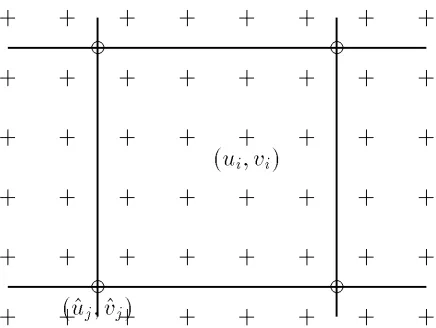
6 4 Spline-based flow estimation + + + + + + + + + + + + + + + + + + + + + + + + + + + + + + + + + + + + + + + + + + + + + + + + e e e e (^
u
j ^v
j ) (u
iv
i [image:12.612.196.414.100.264.2])
Figure 1: Displacement spline: the spline control verticesf(^
u
j^
v
j)gare shown as circles () and
the pixel displacementsf(
u
iv
i)gare shown as pluses (+).
The choice of representation for the(
uv
)field also strongly influences the performance of themotion estimation algorithm. The most commonly made choice is to assign an independent
esti-mate at each pixel(
u
iv
i), but global motion descriptors are also possible [Lucas, 1984; Bergen et
al., 1992; Szeliski and Coughlan, 1994]. One can observe, however, that motion estimates at
indi-vidual pixels are never truly independent. Both local correlation windows (as in SSD) and global
smoothness constraints aggregate information from neighboring pixels. The resulting displacement
estimates are therefore highly correlated. While it is possible to analyze the correlations induced by overlapping windows [Matthies et al., 1989] and regularization [Szeliski, 1989], the procedures
are cumbersome and rarely used. For these reasons, we have chosen in our work to represent the motion field as a spline, which is a representation which falls in between per-pixel motion estimates
and purely global motion estimates.
4
Spline-based flow estimation
Our approach is to represent the displacements fields
u
(xy
)andv
(xy
)as two-dimensional splinescontrolled by a smaller number of displacement estimates
u
^ j and^
v
j which lie on a coarser splinecontrol grid (Figure 1). The value for the displacement at a pixel
i
can be written asu
(x
iy
i)= X
^
u
jB
j (x
i
y
i) or
u
i= X
^
4.1 Function minimization 7
where the
B
j(
xy
)are called the basis functions and are only non-zero over a small interval(fi-nite support). We call the
w
ij =B
j (
x
i
y
i)weights to emphasize that the(
u
iv
i)are known linear
combinations of the(^
u
j^
v
j ).2
In our current implementation, the basis functions are spatially shifted versions of each other,
i.e.,
B
j(
xy
) =B
(x
;x
^ jy
;
y
^ j). We have studied five different interpolation functions: (1)
block, (2) linear on squares, (3) linear on triangles, (4) bilinear, and (5) biquadratic [Szeliski and
Coughlan, 1994]. In practice, we most often use the bilinear bases. We also impose the condition
that the spline control grid is a regular subsampling of the pixel grid,
x
^ j =mx
i, ^y
j =my
i, so that
each set of
m
m
pixels corresponds to a single spline patch.4.1
Function minimization
To recover the local spline-based flow parameters, we need to minimize the cost function (3) with
respect to thef^
u
j^
v
jg. We do this using a variant of the Levenberg-Marquardt iterative non-linear
minimization technique [Press et al., 1992]. First, we compute the gradient of
E
in (3) with respect to each of the parametersu
^j and ^
v
j,g
u j
@E
@
u
^j =2
X
i
e
iG
x iw
ijg
v j@E
@
v
^j =2
X
i
e
iG
y iw
ij
(5)where
e
i =I
1 (x
i +u
i
y
i +v
i );
I
0 (
x
i
y
i) (6)
is the intensity error at pixel
i
,(
G
x iG
y i
)=r
I
1(
x
i+
u
iy
i+
v
i) (7)
is the intensity gradient of
I
1at the displaced position for pixeli
, and thew
ij are the sampled valuesof the spline basis function (4). Algorithmically, we compute the above gradients by first forming
the displacement vector for each pixel(
u
iv
i)using (4), then computing the resampled intensity
and gradient values of
I
1at (x
0 i
y
0 i
)=(
x
i+
u
iy
i+
v
i), computing
e
i, and finally incrementing the
g
u jand
g
v jvalues of all control vertices affecting that pixel [Szeliski and Coughlan, 1994].
2
8 4 Spline-based flow estimation
For the Levenberg-Marquardt algorithm, we also require the approximate Hessian matrix A
where the second-derivative terms are left out. The matrixAcontains entries of the form
a
uu jk = 2 X i@e
i@
u
^ j@e
i@
u
^ k=2 X
i
w
ijw
ik (G
x i ) 2a
uv jk =a
v u jk = 2 X i@e
i@
u
^ j@e
i@
^v
k=2 X
i
w
ijw
ikG
x iG
y
i (8)
a
v v jk= 2 X
i
@e
i@
v
^ j@e
i@
v
^ k=2 X
i
w
ijw
ik (G
y i )
2
:
The entries ofAcan be computed at the same time as the energy gradients.
The Levenberg-Marquardt algorithm proceeds by computing an increment uto the current
displacement estimateuwhich satisfies
(A+
I)u =;g (9)whereuis the vector of concatenated displacement estimates f^
u
j^
v
jg,gis the vector of
concate-nated energy gradientsf
g
u jg
v j
g, and
is a stabilization factor which varies over time [Press et al.,1992]. To solve this large, sparse system of linear equations, we use preconditioned gradient de-scent
u=;
B ;1g=;
g~ (10)whereB= ^
A+
I, and ^A =block diag(A)is the set of22block diagonal matrices defined in
(9) with
j
=k
, andg~ =B ;1gis called the preconditioned residual vector. 3
An optimal value for
can be computed at each iteration by minimizingE
(d) 2d T
Ad;2
d Tg
i.e., by setting
=(dg )=
(d TAd), whered= ~
gis the direction vector for the current step. See
[Szeliski and Coughlan, 1994] for more details on our algorithm implementation.
To handle larger displacements, we run our algorithm in a coarse-to-fine (hierarchical)
fash-ion. A Gaussian image pyramid is first computed using an iterated 3-point filter [Burt and Adelson, 1983]. We then run the algorithm on one of the smaller pyramid levels, and use the resulting flow
estimates to initialize the next finer level (using bilinear interpolation and doubling the displacement
magnitudes).
3
4.1 Function minimization 9
(a) (b)
(c) (d)
Figure 2: Example of general flow computation: (a) input image, (b)–(d) flow estimates for
m
=64,10 5 Hierarchical basis splines
Figure 2 shows an example of the flow estimates produced by our technique. The input image
is256240 pixels, and the flow is displayed on a3028 grid. We show the results of using a
3 level pyramid, 9 iterations at each level, and with three different patch sizes,
m
= 64,m
=16,and
m
= 4. As we can see, using patches that are too large result in flow estimates which are toosmooth, while using patches that are too small result in noisy estimates. (This latter problem could potentially be fixed by adding regularization, but at the cost of increased iterations.) To overcome
this problem, we need a technique which automatically selects the best patch size in each region of
the image. This is the idea we will develop in the next two sections.
5
Hierarchical basis splines
Regularized problems often require many iterations to propagate information from regions with
high certainty (textures or edges) to regions with little information (uniform intensities). Several
techniques have been developed to overcome this problem. Coarse-to-fine techniques [Quam, 1984; Anandan, 1989] can help, but often don’t converge as quickly to the optimal solution as
multi-grid techniques [Terzopoulos, 1986]. Conjugate gradient descent can also be used, especially for
non-linear problems such as shape-from-shading [Simchony et al., 1989]. Perhaps the most ef-fective technique is a combination of conjugate gradient descent with hierarchical basis functions
[Yserentant, 1986], which has been applied both to interpolation problems in stereo matching [Szeliski,
1990] and to shape-from-shading [Szeliski, 1991].
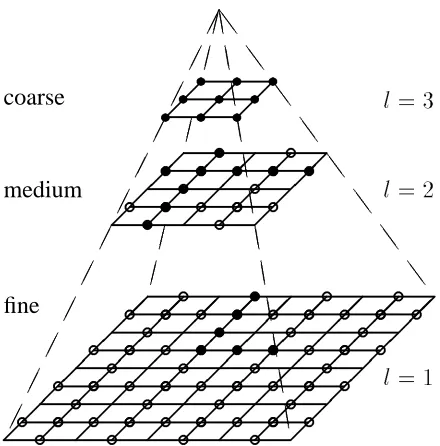
Hierarchical basis functions are based on using a pyramidal representation for the data [Burt and
Adelson, 1983], where the number of nodes in the pyramid is equal to the original number of nodes at the finest level (Figure 3). To convert from the hierarchical basis representation to the usual
fine-level representation (which is called the nodal basis representation [Yserentant, 1986]), we start at
the coarsest (smallest) level of the pyramid and interpolate the values at this level, thus doubling the resolution. These interpolated values are then added to the hierarchical representation values
at the next lower level, and the process is repeated until the nodal representation is obtained.4
This
process can be written algorithmically as
procedure
S
for
l
=L
;1down to14
5 Hierarchical basis splines 11 ; ; ; ; ; ; ; ; ; ; ; ; ; ; ; ; ; ; ; ; ; ; ; ; ; ; ; ; ; ; ; ; ; ; ; ; ; ; ; ; ; ; ; ; ; ; ; ; ; ; ; ; ; ; ; ; ; ; ; ; ; ; ; ; ; ; ; ; ; ; ; ; ; ; ; ; ; ; ; ; ; ; ; ; ; ; ; ; ; ; ; ; ; ; ; ; ; ; E E E E E E E E E E E E E E E E E E E E E E E E S S S S S S S S S S S S S S S S fine medium coarse
l
=1l
=2l
=3c c c c c c c c c c c c c c c c c c c c c c c c c c c c c c c c c c c c
c c c c c c c c c c c c c c c c c c
c c c c c c c c c c c c c c c c c c
s s
s s
s s s c c c c c c c c c c
c c c c c c c c c c
s s
s s
s
[image:17.612.195.415.104.327.2]s s s s s s s s s s s s s s
Figure 3: Multiresolution pyramid
The multiple resolution levels are a schematic representation of the hierarchical basis spline. The
circles indicate the nodes in the hierarchical basis. Filled circles () are free variables in the quadtree
spline (Section 6), while open circles () must be zero (see Figure 6).
for
j
2M l ul j
=u^ l j + P k 2Nj ~
w
jk ^ u l+1 kend
S
.In this procedure, each node is assigned to one of the level collectionsM
l (the circles in Figure
3). Each node also has a number of “parent nodes”N
j on the next coarser level that contribute to
its value during the interpolation process. The
w
~jk are the weighting functions that depend on the
particular choice of interpolation function. For the examples shown in this paper, we use bilinear interpolation, since previous experiments suggest that this is a reasonable choice for the interpolator
[Szeliski, 1990].
We can write the above process algebraically as
u =Su~ =S 1 S 2
:::
S L;1 ~12 5 Hierarchical basis splines with (S l ) jk = 8 > > > < > > > :
1 if
j
=k
~w
jk ifj
2Mland
k
2Nj 0 otherwise
and~
uis the hierarchical basis representation. Using a hierarchical basis representation for the flow
field is equivalent to usingSS T
as a preconditioner, i.e.,~g = SS T
g[Axelsson and Barker, 1984;
Szeliski, 1990]. The transformationSS T
can be used as a preconditioner because the influence of
hierarchical bases at coarser levels (which are obtained from theS T
operation) are propagated to the nodal basis at the fine level through theSoperation. To evaluateS
T
, i.e., to convert from the
nodal basis representation to the hierarchical basis representation, we use the procedure
procedure
S
Tfor
l
=1toL
;1for
k
2M l+1 ^ u l+1 k =u l+1 k + P j:k 2N j ~w
jk ^ u l jend
S
T.
When combining hierarchical basis preconditioning with the block diagonal preconditioning in (10), we have several choices. We can apply the block diagonal preconditioning first,g~=SS
T B
;1 g,
or second,~g = B ;1
SS T
g, or we can interleave the two preconditionersg~ = SB ;1
S T
g, org~ = ^ B ;T SS T ^
Bg, where ^ B =B
1
2. The latter two operations correspond to well-defined
precondition-ers (i.e., optimization under a change of basis), while the first two are easier to implement. In our
current work, we use the first form, i.e., we apply block preconditioning first, and then use sweep up and then down the hierarchical basis pyramid to smooth the residual. In future work, we plan to
develop optimal combinations of block diagonal and hierarchical basis preconditioning.
To summarize our algorithm (Figure 4), we keep both the hierarchical and nodal representations, and map between the two as required. For accumulating the distances and gradients required in
(9), we compute the image flows and the derivatives with respect to the parameters in the nodal
basis. We then use the hierarchical basis to smooth the residual vector gbefore selecting a new
conjugate direction and computing the optimal step size. Using this technique not only makes the
convergence faster but also propagates local corrections over the whole domain, which tends to
smooth the resulting flow significantly.
5 Hierarchical basis splines 13
0
:
0= 0
d ;1=0 1
:
gn
= ;r
E
(u) 2:
y g~n = SZS T B ;1 g n 3
:
n= g~ n g n
=
~ g n;1 g n;1 4:
dn = ~ g n ;
n d n;1 5:
n = d n g n=
d T n Ad n 6:
un+1 = u n +
n d n 7:
incrementn
, loop to1:
y S =mapping from hierarchical to nodal basis, B =blo ckdiag(A)
[image:19.612.164.447.125.331.2]Z =0/1 matrix for quadtree spline basis (Section 6).
Figure 4: Hierarchical basis preconditioned conjugate gradient algorithm
0.1 1 10 100
0 5 10 15 20 25 30
RMS flow error
iteration
Square 2 convergence (gradient descent)
"L = 1, l = 1000" "L = 3, l = 0" "L = 3, l = 100" "L = 3, l = 1000" "H = 3, l = 0" "H = 3, l = 1000"
(a) (b)
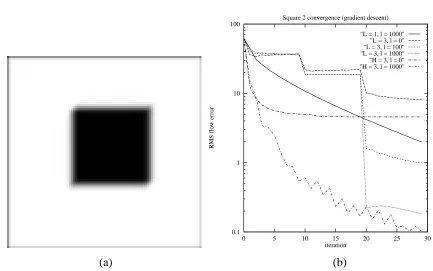
(a) input image, (b) convergence plot (error vs. iteration number)
[image:19.612.83.516.365.636.2]14 6 Quadtree (adaptive resolution) splines
Figure 5a shows one image in the sequence, while Figure 5b shows the convergence rates for regular
gradient descent (
L
=1), coarse-to-fine estimation (L
=3), and preconditioning with hierarchicalbasis functions (
H
=3), with different amounts of regularization ( 1= 0
1001000). As we cansee from these results, adding more regularization results in a more accurate solution (this is because
the true flow is a single constant value), using coarse to fine is quicker than single-level relaxation, and hierarchical basis preconditioning is faster than coarse-to-fine relaxation. It is interesting to
note that using hierarchical basis functions even without regularization quickly smooths out the
solution and outperforms coarse-to-fine without regularization.
6
Quadtree (adaptive resolution) splines
While hierarchical basis splines can help accelerate an estimation algorithm or even to add extra smoothness to the solution, they do not in themselves solve the problem of having adaptively-sized
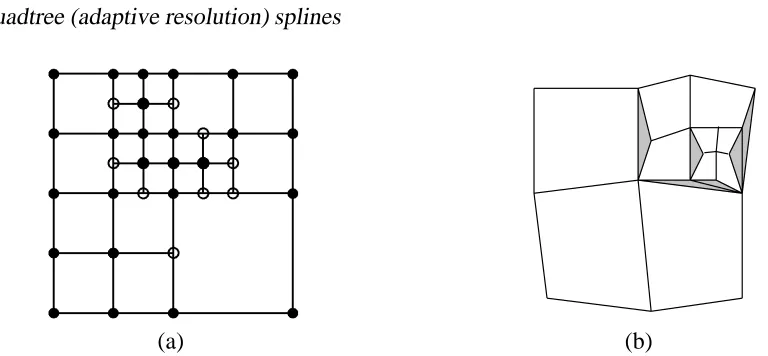
patches. For this, we will use the idea of quadtree splines, i.e., splines defined on a quadtree domain. A quadtree is a 2-D representation built by recursively subdividing rectangles into four pieces
(Fig-ure 6) [Samet, 1989]. The basic concept of a quadtree spline is to define a continuous function over
a quadtree domain by interpolating numeric values at the corners of each spline leaf cell (square). However, because cells are non-uniformly subdivided, cracks or first-order discontinuities in the
in-terpolated function will arise (Figure 6b) unless a crack-filling strategy is used [Samet, 1989]. The
simplest strategy is to simply replace the values at the nodes along a crack edge (the white circles in Figure 6) with the average values of its two parent nodes along the edge. This is the strategy we
used in developing octree splines for the representation of multi-resolution distance maps in 3-D
pose estimation problems [Lavall´ee et al., 1991].
When the problem is one of iteratively estimating the values on the nodes in the quadtree spline, enforcing the crack-filling rule becomes more complicated. A useful strategy, which we developed
for estimating 3-D displacement fields in elastic medical image registration [Szeliski and Lavall´ee,
1994], is to use a hierarchical basis and to selectively zero out nodes in this basis. Observe that if in Figures 3 and 6a we set the values of the open circles () to zero in the hierarchical basis and then
re-compute the nodal basis usingS, the resulting spline has the desired continuity, i.e., nodes along
longer edges are the averages of their parents.
6 Quadtree (adaptive resolution) splines 15 t t t t t t t t t t t t t t d t t
t t d
t t t t t
d t t t t d d d t d dt dt dt d d dt d
[image:21.612.102.486.72.250.2](a) (b)
Figure 6: Quadtree associated with spline function, and potential cracks in quadtree spline (a) the nodes with filled circles () are free variables in the associated hierarchical basis, whereas
the open circles () (and also the nodes not drawn) must be zero (in the nodal basis, these nodes
are interpolated from their ancestors); (b) potential cracks in a simpler quadtree spline are shown
as shaded areas.
simply requiring a selective zeroing step between theS T
andSoperations (algebraically, we write
~
g=SZS T
g, whereZis a diagonal matrix with 1’s and 0’s on the diagonal—see Figure 4). 5
Second, it generalizes to splines of arbitrary order, e.g., we can build a
C
1quadtree spline based on quadratic
B-splines using adaptive hierarchical basis functions. However, for higher-order splines, even more
nodes have to be zeroed in order to ensure that finer level splines do not affect nearby coarser (un-divided) cells. Third, as we will discuss in the next section, the adaptive hierarchical basis idea is
even more general than the quadtree spline, and corresponds to a specific kind of multi-resolution
prior model.
The quadtree spline as described here ensures that the function within any leaf cell (square
do-main) has a simple form (single polynomial description, no spurious ripples). An alternative way
of interpreting the quadtree in Figure 6a is that it specifies the minimum degree of complexity in each cell, i.e., that each square is guaranteed to have its full degrees of freedom (e.g., all 4 corners
have independent values in the bilinear case). In this latter interpretation, the open circles in the
hierarchical basis are not zeroed, and only the circles actually not drawn in Figure 6a are zeroed. In this approach, large squares can have arbitrarily-detailed ripples inside their domain resulting
5
Whenever theZmatrix changes, we also have to re-compute the quadtree spline usingu SZS ;1
u. TheS ;1
procedure is similar toS T
, but nowu^ j
^ u j
;w~ jk
16 6 Quadtree (adaptive resolution) splines
from fine-level basis functions near the square’s boundaries. To date, we have not investigated this
alternative possibility.
6.1
Subdivision strategy
The quadtree spline provides a convenient way to use adaptively-sized patches for motion
estima-tion, while maintaining inter-patch continuity. The question remains how to actually determine the
topology of the patches, i.e., which patches get subdivided and which ones remain large. Ideally, we would like each patch to cover a region of the image within which the parametric motion model
is valid. In a real-world situation, this may correspond to planar surface patches undergoing rigid motion with a small amount of perspective distortion (bilinear flow is then very close to projective
flow). However, usually we are not a priori given the required segmentation of the image. Instead,
we must deduce such a segmentation based on the adequacy of the flow model within each patch.
The fundamental tool we will use here is the concept of residual flow [Irani et al., 1992], recently used by M¨uller et al. [1994] to subdivide affine motion patches (which they call tiles). The residual
flow is the per-pixel estimate of flow required to register the two images in addition to the flow
currently being modeled by the parametric motion model. At a single pixel, only the normal flow can be estimated,
u N i
= (
e
i
G
x ie
i
G
y i ) k(G
x i
G
y i
)k+
(12)
where the intensity error
e
i and the gradient rI
1
= (
G
x iG
y i
)are given in (6–7). This measure
is different from that used in [Irani et al., 1992; M¨uller et al., 1994], who sum the numerator and denominator in (12) over a small neighborhood around each pixel.
To decide whether to split a spline patch into four smaller patches, we sum the magnitude of
the residual normal flowku N i
k over all the pixels in the patch and compare it to a threshold u.
6
Patches where the motion model is adequate should fall below this threshold, while patches which have multiple motions should be above. Starting with the whole image, we subdivide recursively
until either the p-norm residual falls below an acceptable value or the smallest patch size considered (typically 4-8 pixels wide) is reached.
Figures 7a–c show an example of a quadtree spline motion estimate produced with this
split-ting technique for a simple synthetic example in which two central disks are independently moving
6
Actually, we use ap;norm,( P
ku N i
k p
) 1=p
6.1 Subdivision strategy 17
(a) (b)
[image:23.612.74.537.136.611.2](c) (d)
Figure 7: Quadtree spline motion estimation (Two Discs (SRI Trees) sequence): (a) input image,
18 7 A Bayesian interpretation
against a textured background. The quadtree boundaries are warped to show the extent of the
esti-mated image motion (up and left for the top disc, down and right for the bottom disc). Note how the subdivision occurs mostly at the object boundaries, as would be expected. The most visible error
(near the upper right edge of the lower disc) occurs in an area of little image contrast and where the
motion is mostly parallel to the region contour.
An alternative to the iterative splitting strategy is to start with small patches and to then merge
adjacent patches with compatible motion estimates into larger patches (within the constraints of allowable quadtree topologies). To test if a larger patch has consistent flow, we compare the four
values along the edge of the patch and the value at the center with the average values interpolated
from the four corner cells (look at the lower left quadrant of Figure 6a to visualize this). The relative difference between the estimated and interpolated values,
d
= k^u j
;u j
k q
k^u j
k 2
+ku j
k 2
<
dwhere u
j is the interpolated value, must be below a threshold d (typically 0.25-0.5) for all five
nodes before the four constituent patches are allowed to be merged into a larger patch. Notice
that the quantityu^ j
;u
j is exactly the value of the hierarchical basis function at a node (at least
for bilinear splines), so we are in effect converting small hierarchical basis values close to be
ex-actly zero (this has a Bayesian interpretation, as we will discuss in the next section). Note also that this consistency criterion may fail in regions of little texture where the flow estimates are initially
unreliable, unless regularization is applied to make these flow fields more smooth.
Figure 7d shows an example of a quadtree spline motion estimate produced with this merging
technique. The results are qualitatively quite similar to the results obtained with the split technique.
7
A Bayesian interpretation
The connection between energy-based or regularized low-level vision problems and Bayesian esti-mation formulations is well known [Kimeldorf and Wahba, 1970; Marroquin et al., 1987; Szeliski,
1989]. In a nutshell, it can be shown that the energy or cost function being minimized can be
con-verted into a probability distribution over the unknowns using a Gibbs or Boltzmann distribution,
7 A Bayesian interpretation 19
(typically the squared error terms between the measurements and their predicted values) and a prior
model (which usually corresponds to the stabilizer or smoothing term), i.e.,
E(u)=E d
(u
d)+E p(u) ,
p
(u)/e
;E(u)=
e
;Ed
(ud)
e
;E p(u)
/
p
(ud)p
(u) (13)It then becomes straightforward to make use of robust statistical models by simply modifying the
appropriate energy terms [Black and Anandan, 1993; Black and Rangarajan, 1994].
The basic spline-based flow model introduced in [Szeliski and Coughlan, 1994] is already a valid prior model, since it restricts the family of functions to the smooth set of tensor-product splines.
In most cases, a small amount of intensity variation inside each spline patch is sufficient to ensure
that a unique, well-behaved solution exists. However, just to be on the safe side, it is easy to add a small amount of regularization with quadratic penalty terms on theu^
j’s and their finite differences.
Hierarchical basis splines, as well as other multilevel representations such as overcomplete
pyra-mids can be viewed as multiresolution priors [Szeliski and Terzopoulos, 1989]. There are two ba-sic approaches to specifying such a prior. The first, which we use in our current work, is to simply
view the hierarchical basis as a preconditioner, and to define the prior model over the usual nodal basis [Szeliski, 1990]. The alternative is to define the prior model directly on the hierarchical
ba-sis, usually assuming that each basis element is statistically independent from the others (i.e., that
the covariance matrix is diagonal) [Szeliski and Terzopoulos, 1989; Pentland, 1994]. An extreme example of this is the scale-recursive multiscale Markov Random Fields introduced in [Chin et al.,
1993], whose special structure makes it possible to recover the field in a single sweep through the
pyramid. Unfortunately, their technique is based on a piecewise-constant model of flow, which re-sults in recovered fields that have excessive “blockiness” [Luettgen et al., 1994].
Within this framework, adaptive hierarchical basis splines can be viewed as having a more
com-plex multiresolution prior where each hierarchical node has a non-zero prior probability of being exactly zero. The split and merge algorithms can be viewed as simple heuristic techniques designed
to recover the underlying motion field and to decide which nodes are actually zero. More
sophisti-cated techniques to solve this problem would include simulated annealing [Marroquin et al., 1987]
and mean-field annealing [Geiger and Girosi, 1991].
Quadtree splines have an even more complicated prior model, since the existence of zeros at
certain levels in the pyramid implies zeros at lower levels as well as zeros at some neighboring
20 8 Experimental results
Technique PixelError Dev.Std. Avg. Ang.Error Dev.Std. Density
regular spline (
s
=16) 0:
95 1:
71 12:
4118
:
95100%
regular spline (
s
=8) 0:
89 1:
64 11:
7817
:
75100%
regular spline (
s
=4) 0:
95 1:
68 14:
8117
:
80100%
quadtree spline (merge,
s
=4) 0:
85 1:
58 11:
0416
:
66100%
quadtree spline (split,
s
=4) 0:
95 1:
63 14:
4118
:
11 [image:26.612.110.497.108.232.2]100%
Table 1: Summary of Two Discs (SRI Trees) results
8
Experimental results
To investigate the performance of our quadtree spline-based motion estimator, we use the
synthet-ically generated Two Discs (SRI Trees) sequence shown in Figure 7, for which we know the true motion (Figure 7b). The results of our spline-based motion estimator for various choices of
win-dow size
s
, as well as the results with both the split and merge techniques, are shown in Table 1. The experiments show that the optimal fixed window size iss
=8, and that both split and mergetechniques provide slightly better results. The relatively small difference is error between the
vari-ous techniques is due to most of the error being concentrated in the regions where occlusions occur (Figure 8). Adding an occlusion detection process to our algorithm should help reduce the errors
in these regions.
We also tested our algorithm on some of the standard motion sequences used in other recent motion estimation papers [Barron et al., 1994; Wang and Adelson, 1993; Otte and Nagel, 1994].
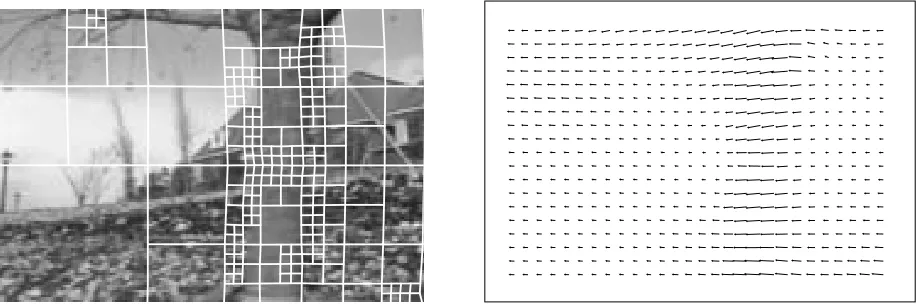
The results on the Hamburg Taxi sequence are shown in Figure 9, where the independent motion
of the three moving cars can be clearly distinguished. Notice that the algorithm was also able to pick out the small region of the moving pedestrian near the upper left corner.
The result on the Flower Garden sequence are shown in Figure 10. Here, the trunk of the tree
is clearly segmented from the rest of the scene. The top of the flower garden, on the other hand, is not clearly segmented from the house and sky, since it appears that the
C
0continuous motion field
represented by the splines is an adequate description.7
The final sequence which we studied is the table of marble blocks acquired by Michael Otte
7
8 Experimental results 21
Figure 8: Flow errorku;u kand residual normal flowku N i
kfor Two Discs (SRI Trees) sequence.
Note how most of the errors are concentrated near the motion discontinuities and especially the disoccluded region in the center.
Figure 9: Hamburg Taxi sequence: estimated quadtree and estimated flow, merging
s
=8patches [image:27.612.79.536.449.621.2]22 9 Extensions
Figure 10: Flower Garden sequence: estimated quadtree and estimated flow, merging
s
= 4patches in a 4-level pyramid.
[Otte and Nagel, 1994]. In this scene, the camera is moving forward and left while all of the blocks
are stationary, except for the short central block, which is independently moving to the left. The quadtree segmentation of the motion field has separated out the tall block in the foreground and the
independently moving block, but has not separated the other blocks from the table or the checkered
background. Changing the thresholds on the merge algorithm could be used to achieve a greater segmentation, but this does not appear to be necessary to adequately model the motion field.
9
Extensions
We are currently extending the algorithm described in this paper in a number of directions, which
include better multiframe flow estimation, parallel feature tracking, and local search.
When given more than two frames, we must assume a model of motion coherency across frames to take advantage of the additional information available. The simplest assumption is that of linear
flow, i.e., that displacements between successive images and a base image are known scalar
multi-ples of each other,u t
=
s
tu 1.
8
Flow estimation can then be formulated by summing the intensity differences between the base frame and all other frames [Szeliski and Coughlan, 1994], which is
similar to the sum of sum of squared-distance (SSSD) algorithm of [Okutomi and Kanade, 1993]. We have found that in practice this works well, although it is often necessary to bootstrap the motion
8
In the most common case, e.g., for spatio-temporal filtering, a uniform temporal sampling (s t
=t) is assumed, but
9 Extensions 23
Figure 11: Michael Otte’s sequence: estimated quadtree and estimated flow, merging
s
= 8patches in a 4-level pyramid.
estimate by first computing motion estimates with fewer frames (this is because gradient descent
gets trapped in local minima when the inter-frame displacements become large).
When the motion is not linear, i.e., we have a non-zero acceleration, we cannot perform a single batch optimization. Instead, we can compute a separate flow field between each pair of images,
using the previous flow as an initial guess. Alternatively, we can compute the motion between a base
image and each successive image, using a linear predictoru t
= u t;1
+(u t;1
;u t;2
). This latter
approach is useful if we are trying to track feature points without the problem of drift (accumulated
error) which can occur if we just use inter-frame flows.
The linearly predicted multiframe motion estimator forms the basis of our parallel extended
im-age sequence feature tracker [Szeliski et al., 1995]. To separate locations in the imim-age where
fea-tures are being tracked reliably from uninformative or confusing regions, we use a combination of the local Hessian estimate (9) and the local intensity error within each spline patch. This is similar
to Shi and Tomasi’s tracker [Shi and Tomasi, 1994], except that we use bilinear patches stitched
together by the spline motion model, which yields better stability than isolated affine patches.
24 10 Discussion and Conclusions
after inter-level transfers in the coarse to fine algorithm, or after splitting in the quadtree spline
es-timator, we search around the current(
uv
)estimate by trying a discrete set of nearby(uv
)values(as in SSD algorithms [Anandan, 1989]). However, because we must maintain spline continuity,
we cannot make the selection of best motion estimate for each patch independently. Instead, we
average the motion estimates of neighboring patches to determine the motion of each spline con-trol vertex.
In future work, we plan to extend our algorithm to handle occlusions in order to improve the
accuracy of the flow estimates. The first part, which is simpler to implement, is to simply detect
foldovers, i.e., when one region occludes another due to faster motion, and to disable error
con-tributions from the occluded background. The second part would be to add an explicit occlusion
model, which is not as straightforward because our splines are currently
C
0continuous. In other
work, we would also like to study the suitability of our method as a robust way to bootstrap layered motion models. We also plan to test our technique on standard stereo problems.
10
Discussion and Conclusions
The quadtree-spline motion algorithm we have developed provides a novel way of computing an ac-curate motion estimate while performing an initial segmentation of the motion field. Our approach
optimizes the same stability versus detail tradeoff as adaptively-sized correlation windows, with-out incurring the large computational cost of overlapping windows and trial-and-error window size
adjustment. Compared to the recursively split affine patch tracker of [M¨uller et al., 1994], our
tech-nique provides a higher level of continuity in the motion field, which leads to more accurate motion estimates.
The general framework of quadtree splines and hierarchical basis functions is equally applicable
to other computer vision problems such as surface interpolation, as well as computer graphics and
numerical relaxation problems. It has already been applied successfully to the elastic registration of 3D medical images [Szeliski and Lavall´ee, 1994], and we plan to extend our approach to other
applications.
References
10 Discussion and Conclusions 25
the perception of motion. Journal of the Optical Society of America, A 2(2):284–299,
Febru-ary 1985.
[Aggarwal and Nandhakumar, 1988] J. K. Aggarwal and N. Nandhakumar. On the computation
of motion from sequences of images—a review. Proceedings of the IEEE, 76(8):917–935,
August 1988.
[Anandan, 1989] P. Anandan. A computational framework and an algorithm for the measurement of visual motion. International Journal of Computer Vision, 2(3):283–310, January 1989.
[Axelsson and Barker, 1984] O. Axelsson and V. A. Barker. Finite Element Solution of Boundary
Value Problems: Theory and Computation. Academic Press, Inc., Orlando, Florida, 1984.
[Barnard and Fischler, 1982] S. T. Barnard and M. A. Fischler. Computational stereo. Computing
Surveys, 14(4):553–572, December 1982.
[Barron et al., 1994] J. L. Barron, D. J. Fleet, and S. S. Beauchemin. Performance of optical flow
techniques. International Journal of Computer Vision, 12(1):43–77, January 1994.
[Bergen et al., 1992] J. R. Bergen, P. Anandan, K. J. Hanna, and R. Hingorani. Hierarchi-cal model-based motion estimation. In Second European Conference on Computer Vision
(ECCV’92), pages 237–252, Springer-Verlag, Santa Margherita Liguere, Italy, May 1992.
[Black and Anandan, 1993] M. J. Black and P. Anandan. A framework for the robust estimation of
optic flow. In Fourth International Conference on Computer Vision (ICCV’93), pages 231– 236, IEEE Computer Society Press, Berlin, Germany, May 1993.
[Black and Rangarajan, 1994] M. J. Black and A. Rangarajan. The outlier process: Unifying line
processes and robust statistics. In IEEE Computer Society Conference on Computer Vision
and Pattern Recognition (CVPR’94), pages 15–22, IEEE Computer Society, Seattle,
Wash-ington, June 1994.
[Bober and Kittler, 1993] M. Bober and J. Kittler. Estimation of complex multimodal motion: An
approach based on robust statistics and hough transform. In British Machine Vision
Confer-ence, pages 239–248, BMVA Press, 1993.
[Bolles et al., 1987] R. C. Bolles, H. H. Baker, and D. H. Marimont. Epipolar-plane image
anal-ysis: An approach to determining structure from motion. International Journal of Computer
Vision, 1:7–55, 1987.
26 10 Discussion and Conclusions
[Burt and Adelson, 1983] P. J. Burt and E. H. Adelson. The Laplacian pyramid as a compact image
code. IEEE Transactions on Communications, COM-31(4):532–540, April 1983.
[Chin et al., 1993] T. M. Chin, M. R. Luettgen, W. C. Karl, and A. S. Willsky. An estimation-theoretic perspective on image processing and the calculation of optic flow. In Advances in
Image Sequence Processing, Kluwer, March 1993.
[Dhond and Aggarwal, 1989] U. R. Dhond and J. K. Aggarwal. Structure from stereo—a re-view. IEEE Transactions on Systems, Man, and Cybernetics, 19(6):1489–1510,
Novem-ber/December 1989.
[Enkelmann, 1988] W. Enkelmann. Investigations of multigrid algorithms for estimation of optical
flow fields in image sequences. Computer Vision, Graphics, and Image Processing, :150–177,
1988.
[Etoh and Shirai, 1993] M. Etoh and Y. Shirai. Segmentation and 2D motion estimation by region
fragments. In Fourth International Conference on Computer Vision (ICCV’93), pages 192–
199, IEEE Computer Society Press, Berlin, Germany, May 1993.
[Fleet and Jepson, 1990] D. Fleet and A. Jepson. Computation of component image velocity from
local phase information. International Journal of Computer Vision, 5:77–104, 1990.
[Geiger and Girosi, 1991] D. Geiger and F. Girosi. Mean field theory for surface
reconstruc-tion. IEEE Transactions on Pattern Analysis and Machine Intelligence, PAMI-13(5):401–
412, May 1991.
[Heeger, 1987] D. J. Heeger. Optical flow from spatiotemporal filters. In First International
Con-ference on Computer Vision (ICCV’87), pages 181–190, IEEE Computer Society Press,
Lon-don, England, June 1987.
[Hildreth, 1986] E. C. Hildreth. Computing the velocity field along contours. In N. I. Badler
and J. K. Tsotsos, editors, Motion: Representation and Perception, pages 121–127, North-Holland, New York, New York, 1986.
[Horn and Schunck, 1981] B. K. P. Horn and B. G. Schunck. Determining optical flow. Artificial
Intelligence, 17:185–203, 1981.
[Irani et al., 1992] M. Irani, B. Rousso, and S. Peleg. Detecting and tracking multiple moving
objects using temporal integration. In Second European Conference on Computer Vision
10 Discussion and Conclusions 27
[Jepson and Black, 1993] A. Jepson and M. J. Black. Mixture models for optical flow
computa-tion. In IEEE Computer Society Conference on Computer Vision and Pattern Recognition
(CVPR’93), pages 760–761, New York, New York, June 1993.
[Kimeldorf and Wahba, 1970] G. Kimeldorf and G. Wahba. A correspondence between Bayesian
estimation on stochastic processes and smoothing by splines. The Annals of Mathematical
Statistics, 41(2):495–502, 1970.
[Lavall´ee et al., 1991] S. Lavall´ee, R. Szeliski, and L. Brunie. Matching 3-d smooth surfaces with
their 2-d projections using 3-d distance maps. In SPIE Vol. 1570 Geometric Methods in
Com-puter Vision, pages 322–336, Society of Photo-Optical Instrumentation Engineers, San Diego,
July 1991.
[Lucas, 1984] B. D. Lucas. Generalized Image Matching by the Method of Differences. PhD
the-sis, Carnegie Mellon University, July 1984.
[Lucas and Kanade, 1981] B. D. Lucas and T. Kanade. An iterative image registration technique
with an application in stereo vision. In Seventh International Joint Conference on Artificial
Intelligence (IJCAI-81), pages 674–679, Vancouver, 1981.
[Luettgen et al., 1994] M. R. Luettgen, W. C. Karl, and A. S. Willsky. Efficient multiscale regu-larization with applications to the computation of optical flow. IEEE Transactions on Image
Processing, 3(1):41–64, January 1994.
[Mallat, 1989] S. G. Mallat. A theory for multiresolution signal decomposition: the wavelet
representation. IEEE Transactions on Pattern Analysis and Machine Intelligence,
PAMI-11(7):674–693, July 1989.
[Marroquin et al., 1987] J. Marroquin, S. Mitter, and T. Poggio. Probabilistic solution of ill-posed problems in computational vision. Journal of the American Statistical Association,
82(397):76–89, March 1987.
[Matthies et al., 1989] L. H. Matthies, R. Szeliski, and T. Kanade. Kalman filter-based algorithms for estimating depth from image sequences. International Journal of Computer Vision, 3:209–
236, 1989.
[M¨uller et al., 1994] J. R. M¨uller, P. Anandan, and J. R. Bergen. Adaptive-complexity registration
of images. In IEEE Computer Society Conference on Computer Vision and Pattern
28 10 Discussion and Conclusions
[Nagel, 1987] H.-H. Nagel. On the estimation of optical flow: Relations between different
ap-proaches and some new results. Artificial Intelligence, 33:299–324, 1987.
[Okutomi and Kanade, 1992] M. Okutomi and T. Kanade. A locally adaptive window for signal
matching. International Journal of Computer Vision, 7(2):143–162, April 1992.
[Okutomi and Kanade, 1993] M. Okutomi and T. Kanade. A multiple baseline stereo. IEEE
Transactions on Pattern Analysis and Machine Intelligence, 15(4):353–363, April 1993.
[Okutomi and Kanade, 1994] M. Okutomi and T. Kanade. A stereo matching algorithm with an
adaptive window: Theory and experiment. IEEE Transactions on Pattern Analysis and
Ma-chine Intelligence, 16(9):920–932, September 1994.
[Otte and Nagel, 1994] M. Otte and H.-H. Nagel. Optical flow estimation: advances and compar-isons. In Third European Conference on Computer Vision (ECCV’94), pages 51–60,
Springer-Verlag, Stockholm, Sweden, May 1994.
[Pentland, 1994] A. P. Pentland. Interpolation using wavelet bases. IEEE Transactions on Pattern
Analysis and Machine Intelligence, 16(4):410–414, April 1994.
[Poggio et al., 1985] T. Poggio, V. Torre, and C. Koch. Computational vision and regularization
theory. Nature, 317(6035):314–319, 26 September 1985.
[Press et al., 1992] W. H. Press, B. P. Flannery, S. A. Teukolsky, and W. T. Vetterling.
Numeri-cal Recipes in C: The Art of Scientific Computing. Cambridge University Press, Cambridge,
England, second edition, 1992.
[Quam, 1984] L. H. Quam. Hierarchical warp stereo. In Image Understanding Workshop, pages 149–155, Science Applications International Corporation, New Orleans, Louisiana,
De-cember 1984.
[Rehg and Witkin, 1991] J. Rehg and A. Witkin. Visual tracking with deformation models. In
IEEE International Conference on Robotics and Automation, pages 844–850, IEEE Computer
Society Press, Sacramento, California, April 1991.
[Samet, 1989] H. Samet. The Design and Analysis of Spatial Data Structures. Addison-Wesley, Reading, Massachusetts, 1989.
[Shi and Tomasi, 1994] J. Shi and C. Tomasi. Good features to track. In IEEE Computer Society
Conference on Computer Vision and Pattern Recognition (CVPR’94), pages 593–600, IEEE
10 Discussion and Conclusions 29
[Simchony et al., 1989] T. Simchony, R. Chellappa, and Z. Lichtenstein. Pyramid implementation
of optimal-step conjugate-search algorithms for some low-level vision problems. IEEE
Trans-actions on Systems, Man, and Cybernetics, SMC-19(6):1408–1425, November/December
1989.
[Simoncelli et al., 1991] E. P. Simoncelli, E. H. Adelson, and D. J. Heeger. Probability
distribu-tions of optic flow. In IEEE Computer Society Conference on Computer Vision and Pattern
Recognition (CVPR’91), pages 310–315, IEEE Computer Society Press, Maui, Hawaii, June
1991.
[Singh, 1990] A. Singh. An estimation-theoretic framework for image-flow computation. In Third
International Conference on Computer Vision (ICCV’90), pages 168–177, IEEE Computer
Society Press, Osaka, Japan, December 1990.
[Szeliski, 1989] R. Szeliski. Bayesian Modeling of Uncertainty in Low-Level Vision. Kluwer
Aca-demic Publishers, Boston, Massachusetts, 1989.
[Szeliski, 1990] R. Szeliski. Fast surface interpolation using hierarchical basis functions. IEEE
Transactions on Pattern Analysis and Machine Intelligence, 12(6):513–528, June 1990.
[Szeliski, 1991] R. Szeliski. Fast shape from shading. CVGIP: Image Understanding, 53(2):129–
153, March 1991.
[Szeliski and Coughlan, 1994] R. Szeliski and J. Coughlan. Hierarchical spline-based image
reg-istration. In IEEE Computer Society Conference on Computer Vision and Pattern Recognition
(CVPR’94), pages 194–201, IEEE Computer Society, Seattle, Washington, June 1994.
[Szeliski and Lavall´ee, 1994] R. Szeliski and S. Lavall´ee. Matching 3-D anatomical surfaces with non-rigid deformations using octree-splines. In IEEE Workshop on Biomedical Image
Anal-ysis, pages 144–153, IEEE Computer Society, Seattle, Washington, June 1994.
[Szeliski and Terzopoulos, 1989] R. Szeliski and D. Terzopoulos. Parallel multigrid algorithms
and computer vision applications. In Fourth Copper Mountain Conference on Multigrid
Methods, pages 383–398, Society for Industrial and Applied Mathematics, Copper Mountain,
Colorado, April 1989.
[Szeliski et al., 1995] R. Szeliski, S. B. Kang, and H.-Y. Shum. A Parallel Feature Tracker for
Ex-tended Image Sequences. Technical Report 95/2, Digital Equipment Corporation, Cambridge
Research Lab, April 1995.
30 10 Discussion and Conclusions
Transactions on Pattern Analysis and Machine Intelligence, PAMI-8(2):129–139, March
1986.
[Tomasi and Kanade, 1992] C. Tomasi and T. Kanade. Shape and motion from image streams
under orthography: A factorization method. International Journal of Computer Vision,
9(2):137–154, November 1992.
[Wang and Adelson, 1993] J. Y. A. Wang and E. H. Adelson. Layered representation for motion
analysis. In IEEE Computer Society Conference on Computer Vision and Pattern Recognition
(CVPR’93), pages 361–366, New York, New York, June 1993.
[Weber and Malik, 1993] J. Weber and J. Malik. Robust computation of optical flow in a
multi-scale differential framework. In Fourth International Conference on Computer Vision
(ICCV’93), pages 12–20, IEEE Computer Society Press, Berlin, Germany, May 1993.
[Witkin et al., 1987] A. Witkin, D. Terzopoulos, and M. Kass. Signal matching through scale
space. International Journal of Computer Vision, 1:133–144, 1987.
[Yserentant, 1986] H. Yserentant. On the multi-level splitting of finite element spaces. Nu-merische Mathematik, 49:379–412, 1986.
Acknowledgements
We would like to thank John Wang and Michael Otte for providing us with the motion sequences