ALGHORITHME ADVANCED HYBRID ROUTING
PROTOCOL FOR WIRELESS SENSOR NETWORKS
CHAHIDI BADR ,FIHRI MOHAMMED, EZZATI ABDELLAH
LAVETE Laboratory, Faculty of Sciences and Technical Settat Morocco
E-mail: [email protected] , [email protected] , [email protected]
ABSTRACT
Sensor networks offer several services; especially in the area of monitoring, such as environmental and medical observation. Routing protocols open an avenue of research, especially in the delivery of the information between network nodes.
Increase the life of a sensor network is a major challenge in the research subject, particularly with devices characterized by batteries as energy sources and storage devices and calculates limited, making the process complicated routing, since we must take account of these constraints in the development of a new protocol. Our work item on the reduction of energy and it is minimizing traffic, HRP and a new protocol that handles all this is affecting both the Mac layer and the network layer. The results obtained in the simulation protocol and effective in this level (energy) compared to other protocols of the same type.
In this article we treated the mechanisms that ensure quality of service, at the energy consumption, are more we will try to explain how our protocol at the network layer.
Keywords:Network Clustering, Routing Protocol, HRP, Ad Hoc Network, Mobility
1. INTRODUCTION
Routing is a mechanism that enables the routing of data from a source to a destination. This mechanism becomes complex in a dynamic and evolving over time.
Indeed, we must take into account the minimization of network load, ensuring optimal routing and providing support for multipoint communication when developing a new protocol.
Sensor networks have become increasingly used in different fields whether surveillance, military or health, thanks to their easy implementations compared to conventional networks.
These sensors are characterized by low memory and processor with an energy constraint, which is a major challenge in this research and taking into account first of all communications.
The implementation of one or more QoS mechanisms is a major challenge, especially in a highly dynamic environment, it is necessary
because more traffic can flow through the network some on a strong constraint.
The energy relationship / QoS is interesting because the first is the consumption of energy and the second is the satisfaction of constraints traffic.
It is for this purpose, we proposed a hybrid adaptive routing algorithm that we named HRP-advanced. It touches the MAC layer and the network layer. On comparing the results obtained with this protocol to those of other protocols of the same type, we have seen gains in terms of energy where the life of the network.
A. Characteristics sensors networks
Among the characteristics of a sensor network can be distinguished:
Energy limited
Lack of infrastructure
Sensor networks are characterized by an absence of pre-existing infrastructure or centralized administration. Each node acts as a router. It is responsible for establishing and maintaining network connectivity in a continuous manner.
Constraints on bandwidth
One of the characteristics of sensor networks is the sharing of communications medium, where the bandwidth reserved for a host will be relatively modest.
B. The routing in sensor networks
As already mentioned routing allows routing data from a source to a destination, the problem is made to find the right path in the network under a certain criteria such as latency, or consumption of energy.
This will be difficult in an environment characterized by a large number of devices (sensors), frequent topology change and computing capacity, backup and limited energy.
Where in the design of a routing protocol must take on account the following issues:
- Fault tolerance and reliability: routing protocols in sensor networks must adapt to topology changes especially with devices characterized by a limited energy source. The network must be capable of detecting the failure of a node and to organ builder, to reconfigure.
- Optimization of network load on minimizing the number of sending and receiving packets. This will give as a result a minimum energy consumption and long lifetime of the network. The power source should be intelligently divided beyond the capture, calculation and communication phases as needed.
Modèle de consommation d’énergie dans les
réseaux de capteurs.
In a sensor energy is consumed at the reception, transmission and processing of data [4].
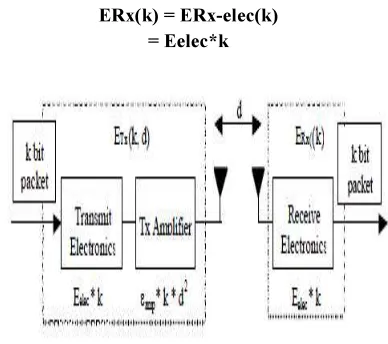
Communication is the most important step in terms of energy consumption. To send a message of k bits over a distance of d meters, the transmitter uses:
ETx(k,d) = ETx-elec(k)+ ETx-amp(k,d) = Eelec*k+eamp*k*d2
and to receive this message, the radio expends: ERx(k) = ERx-elec(k)
[image:2.595.312.506.225.397.2]= Eelec*k
Figure 1. The Radio Energy Dissipation Model
Operation
Energy dissipated
transmit or receive
circuitry
Eelec
= 50 nJ/bit
Transmit
Amplifier if
dmaxtoBS ≥d0
єmp=0.0013pJ/bit/m4
Table I. Radio characteristics
- Self organizing network: routing Protocol must be adaptive to dynamic changes in location of nodes. The routing algorithms should be able to choose the pats and short distances to the transfer of information.
[image:2.595.305.509.438.540.2]C. Routing algorithms in wireless sensor
networks
Routing algorithms are divided into three families: algorithms central, hierarchical and geographical routing.
- The central data routing [1, 2] is the simplest model in which each node in the network transmits to the base station.
- The location-based protocols in this type of routing [1, 2, 5, 8], the sensor nodes are addressed according to their locations. The distance between neighboring nodes can be estimated on the basis of incoming signal strengths. Relative coordinates of neighboring nodes can be obtained by exchanging such information between neighbors. Alternatively, hire nodes may be available directly by contacting a satellite using GPS (Global Positioning System).
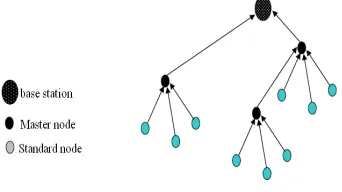
- The hierarchical routing [6, 7, 3] is considered the most favorable approach in terms of energy efficiency. It is based on the concept (standard node - master node) where the standard nodes carry their messages to their master, which then forwards the entire network via other master nodes to the base station (sink).
Figure2: Hierarchical Routing Algorithm
D.
Representation of an Ad hoc network
[image:3.595.106.277.505.601.2]We can represent a network by a graph, directed or undirected, and that depends on the re-linking, G = (X (t), U (t)) with X (t) denotes the set of nodes in a time t, and U (t) represents the set of edges (links) at time t.
Figure 3: Representation Of An Ad Hoc Network
2. RELATED WORKS
A. Problematic
Usually the routing is routing packets from a source to a destination is of course choosing the best paths, and this is keeping network performance.
As we have already seen, a sensor network that is characterized by a lack of infrastructure is making the task of routing data complex in contrast to a conventional telecommunications network. Self organization is one of the strengths of this type of network, but it increases the routing complexity, especially with devices powered by limited energy sources (battery). So, to ensure connectivity in an environment that is characterized by the mobility of these nodes and the lack of infrastructure, it is necessary that all nodes participate in routing.
The sensors allow the routing protocol to discover the links to reach other nodes in the network. But with a large number of nodes (large), the process becomes complex.
B. Motivation
The proactive routing requires a large memory capacity at the end of storing information about the links between the nodes, while the reactive application deadlines for the maintenance of roads. This type of routing is also inefficient, since be a flood in the establishment of the link. The objective of our protocol and combined the best properties of both approach the end of solving problems.
proactive routing, and nodes beyond the routing can be a way reagent.
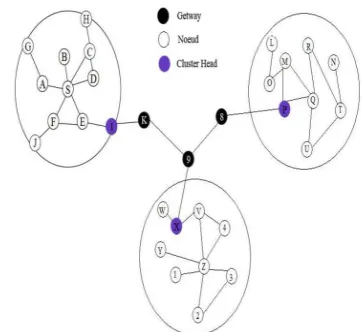
C. Topology Hybrid Routing Protocol (HRP) Hybrid routing protocol, as its name implies, is based on the concept of zones protocol is a protocol based on the concept zones; each zone contains a large number of nodes (sensors). So we can define two levels:
- Node level shows how nodes are connected within an area
- Level Gateway is the connection between areas through the Gateway.
These two levels cause two different types of links.
- Link inter-nodes represent the links between nodes in the same area. - Link inter-area shows the links that connect through the Gateway area.
[image:4.595.97.279.413.579.2]The network is decomposed as shown in Figure:
Figure 4: Example Routing Zone
D. Description
The proposed algorithm consists of three phases:
• Partitioning the network, construction areas and choice of a node distribution.
• Establishment of lists interzones predecessors. • Selection of cluster-head and the development of intra-zone routing table.
These three phases are determined using the HELLO message that gives more information on the environment. This message is exchanged periodically between the various sensors,
ZID
DEG NID NVID DIS
GTWY
Figure 5: Structure Of The HELLO Message
ZID: Identifier of the area. NID: Node ID.
NVID: id neighbor node visited.
DIS: distance between two nodes (source node and neighbor node).
GTWY: This field is set to 1 if the source is a Gateway
Each node sends a message to discover its neighbours. The response occurs after the choice of the node distribution and this is based on the DEG. The one that has the greatest degree is chosen to be the sensor broadcast. If multiple nodes have the same degree, the choice will be made in a manner that is random between nodes.
Distributed algorithm: Construction of the
---
Rating:
Dis : Is the distance between two nodes
Deg : designates the number of neighbors
---
After initialization of the network and the construction of the intra-zone routing table, we still build the inter-zone table that is to say the connection and the link between the gateway and cluster-head.Each gateway sends a HELLO message to its neighbors and to the nodes closest for the selection of cluster-head.
E. Advanced Hybrid Routing Protocole
HRP operates in two phases: (1) Cluster Head choice and (2 establishment of roads (selection predecessor) Cluster Head is the closest Gatway node, the most visible between the nodes and has a high energy density. costing starts with ADV message issued by the Head cluster containing a zero cost. All other nodes initialize their cost to an infinite value. When ADV node receives a message, it checks whether the received value added to the link cost is smaller than the local value. In this case, the node updates its local value and sends a new message ADV as suit.de this way the table is established predecessors, there's other criteria participate in the selection as the distances and the energy of the node that will be chosen.
F. Simulation
3. DESCRIPTION OF THE SIMULATION
The network is size of 100 * 100 m2, the distribution of nodes in the network that fact according areas, the maximum number of nodes is 100.
The nodes send their packets to Getways, which will transmit them to the base station.
It is assumed that the nodes know the area of belonging, where they can communicate with neighboring nodes and determine the distance, and that according to the algorithm computes the shortest path to the Getways.
4. SIMULATION ENVIRONMENT
We assume that all nodes on a fixed position during the simulation. Our simulation model uses the same parameters listed and summarized in the table below:
Parameter Values
Grating surface 100 x 100 m² Location of the BS (50, 60)
number of Getways 3
number of nodes 100
Energy model
In our simulation we use the model of energy consumption W. Heinzelman [4], the energy parameters are shown in the table below.
Parameter Values
E0ca: initial battery power 1 joule Eamp: amplification factor 0.0013e-12
joules/bit/m4
5. RESULTS
Based on the results obtained during the simulation, we observe that the energy consumption increases with the increase of the number of node.
The first figure shows a comparison between our protocol (HRP) and the ZRP with five sources. For the 2nd Figure is also a comparison between the two protocols, but this time with 20 sources 50.
One Source Node In Five
Twenty Source Node In Fifty
6. CONCLUSION
In this article, we tried to detail the operation of our protocol that is intended to increase the lifetime of the network and it is minimizing energy consumption.
HRP is a hybrid that the currency area network protocol. The difference between our protocol and ZRP and HRP in there (the notion of Base Station and Getways, where if a node wants to communicate with another that belongs to another area it must pass through Getways.
According to the results found in the simulation, our protocol showed a great performance compared to ZRP which represents the reference protocols Hybrid.
REFRENCES:
[1] F. Akyildiz, Weilian Su, Sankarasubramaniam, E. Cayirci, “ A survey on sensor networks”, IEEE Communications, Aug 2002.
[2] C. Schurgers and M.B. Srivastava, “Energy efficient routing in wireless sensor networks”, MILCOM Proceedings on Communications for Network-Centric Operations, 2001
[3] S. Bandyopadhyay, E. Coyle, ” An Energy Efficient Hierarchical Clustering Algorithm for Wireless Sensor Networks", Proceedings of IEEE INFOCOM, Vol. 3, pp. 1713-1723. 2003
[4] W. Heinzelman, A. Chandrakasan, H. Balakrishnan, "Energy-Efficien Communication Protocol for Wireless Micro sensor Networks", In proc of the Hawaii International Conférence
on Systems Science, vol. 8, pp. 8020, January 2000.
[5] Callaway, Edgar H., ‘Wireless Sensor Networks: Architectures and Protocols’, Auerbach Publications (2003).
[6] M. Joa-Ng, ―Zone-Based Two-Level Link State Routing for Mobile Ad Hoc Networks,‖ IEEE, 1999, pp. 0733-8716
[7] T. Camp, J. Boleng, and V. Davies. A survey of Mobility models for ad hoc network research. WCMC’02, 2002.