MULTICAST ENABLED VERTICAL HANDOVER
TECHNIQUE FOR HETEROGENEOUS WIRELESS
NETWORKS
1A.PRITHIVIRAJ, 2K.KRISHNAMOORTHY, 3K.JAYA BHARATHY 1
Assistant Professor, Department of CSE, Sona College of Technology, Salem, India 2
Head of the Department, Department of CSE, Sudharsan College of Engineering, Pudhukottai, India 3
PG Scholar, Department of CSE, Sona College of Technology, Salem, India
E-mail: [email protected] , [email protected] , [email protected]
ABSTRACT
In the subsequent generation of wireless networks, mobile nodes can move across heterogeneous networks and gets the best connectivity using multiple access interfaces. The network based protocol like Proxy Mobile IPv6 (PMIPv6) gives better performance when compared with the host based protocols since the serving network in PMIPv6 manages the mobility management on behalf of the mobile node (MN). The wireless Internet services are commonly accessible, when mobile nodes able to use different Internet services without any limitation. Though, if a mobile node uses different wireless networks, much limitation occurs, when they move a network different from each other. Many parameters such as packet loss, handover latency and delay affects the overall handover performance during the vertical handover process. However, there are many existing techniques to conquer, but still, it’s a challenging task. This paper enhances the functionality of PMIPv6 by introducing a multicast enabled handoff technique to improve the performance during handover with minimum delay by eliminating the false handover initiation and provide seamless handover among heterogeneous wireless networks. The obtained simulation results show a reduction in packet loss and handover latency which improves the handover performance. It also addresses the out of sequence packet problem.
Keywords: PMIPv6, Heterogeneous networks, Multicast manager, Packet loss, Handover Latency.
1. INTRODUCTION
The fast growth of mobile wireless communications over the most recent years has generated many wireless networks [2] [12]. These networks will be incorporated to identify network user access in all-IP design. Different wireless technologies such as WLAN, Wi-Fi and UMTS are interconnected to offer internet access to mobile users anywhere anytime. In order to meet seamless connectivity, two protocols have been proposed. Host based mobility management and Network based mobility management protocols, in which MIPv6, HMIPv6 and FMIPv6 are host based protocols where PMIPv6 is a network based protocol [3].
Mobile IPv6 (MIPv6) [3] [17] [14] has three functional entities such as a mobile node (MN), the correspondent node (CN) and the home agent (HA). A mobile node is an IPv6 node which changes its point of attachment and gets its new address when it reaches a new location. Correspondent node is a node that communicates with a mobile node. Home Agent is a router that is
responsible for capturing the packets and forwards them to the current location of the mobile node. When the MN is in home network, all packets from CN are intended to MN’s Home -of-Address (HoA). If the MN enters into a foreign network, it obtains a Care-of-Address (CoA) using stateful or stateless address configuration. Then MN registers its CoA with the HA in the home network. MIPv6 suffers from high delays and triangular routing problem, because home agent always intercepts a packet from the correspondent node. The higher latency problem occurs when the distance between MN and HA increases.
Care-of-Addresses: the Regional Care-of-Address and the On-Link Care-of-Address. When the MN moves across segments, the MAP changes its point and a new MAP is required for registration, so that Regional Care -of-Address and On-Link Care-of-Address are needed to reconfigure. A Regional Care-of-Address is obtained from the new MAP and a new connection is established between the MAP and the MN. Due to the configuration of two new addresses, more signaling and processing is needed to achieve.
Fast Handover for Mobile IPv6 (FMIPv6) [17] [20] is another extension of MIPv6, used to reduce the handover delay and service disruption. The Idea of FMIPv6 is to quickly detect the movement of MN and able to send its packets as soon as possible. When MN obtains IP connectivity on the new subnet that usually depends on the movement detection latency and new Care-of-Address configuration latency. In FMIPv6 Fast Binding Update (FBU) and Fast Binding Acknowledgement (FBACK) messages are used. When the MN leaves its point of attachment, the previous access router is not processed. Hence fast binding update message is lost. FMIPv6 is less advantageous in Predictive mode when compared to Reactive mode.
Proxy Mobile IPv6 [5] [8] [20] is a network based protocol to maintain all the mobility related signaling without the mobile node (MN) involvement. Being a network based protocol it includes many features such as Deployment, Performance and Controllability. In Deployment, the Mobile Node does not require any modification and it allows the service provider to permit the services to many users as possible. In Performance, MN is not required to participate in any of the mobility-related signaling, so that extra tunneling overhead and the number of messages exchanged are reduced on behalf of the Mobile Node (MN). In controllability, it controls the network in terms of traffic and QoS. The functional entities involved in PMIPv6 are as Local Mobility Anchor (LMA) and Mobile Access Gateway (MAG). The LMA acts as the home agent (HA) of the MN and also manages the mobility location of MN [16]. The MAG is to detect the mobile node’s (MN) movements by initiating the binding registration message with LMA [13]. In PMIPv6, the MN does not have an IPv6 protocol stack, because all the mobility related signaling is handled by Mobile Access Gateway (MAG) [19].
1.1 Handover
When a mobile node changes from one network to another network or from one base station to another base station, it is termed as Handover [14] [13].It is used to forward the mobile node service from active network to a new one and to select the appropriate network [6]. Horizontal handover (HHO) and Vertical handover (VHO) are two types of handover [9].In Horizontal handover, the mobile node shifts between the same network domains (Wi-Fi to Wi-Fi) whereas in Vertical handover, the mobile node shifts between different network domains(Wi-Fi to WiMax).
In heterogeneous wireless network environment, the vertical handover [10] process will be benefited from different network characteristics such as network coverage, available bandwidth, cost etc. but cannot be compared directly. A handover decision method is needed to choose the appropriate time to initiate the handover towards the suitable network and also to satisfy both network and user requirements by determining access network to connect at any point of time [4].
[image:2.595.345.497.389.559.2]
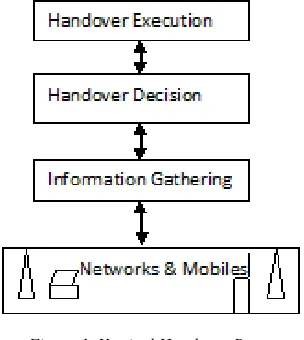
Figure 1. Vertical Handover Process
Three main steps involved in vertical handover process [7] are information gathering, handover decision and handover execution phase is shown in Figure 1.
2. RELATED WORK
Handover is one of critical issues in wireless networks since it is required to maintain uninterrupted services during Mobile Node’s movement from one location to another. In this section, we evaluate a few related works based on the detection of network condition and handover mechanism. In vertical handover, handover decision algorithms have to face the following challenges such as signal strength comparison-based handover decision algorithm.
2.1 Fast Handover with MIH Support in PMIPv6
[image:3.595.90.287.374.529.2]Hyung Heon Kim et.al, proposed [1] a fast handover with MIH support in PMIPv6 to make the handover of mobile nodes between heterogeneous networks with minimal latency time. It does seamless handover by forwarding the data packets without the loss of packets and also addressed the out of sequence packet problem.
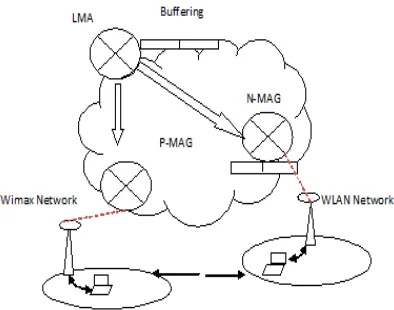
Figure 2.Architecture design of fast handover with MIH support in PMIPv6
Here they considered the handover process between IEEE 802.16 (WiMax) and IEEE 802.11 (WLAN), which is shown in Figure 2.
The steps involved and Message Signaling flow is shown in Figure 3 and is as follows,
• The mobile node in IEEE 802.16 (WiMax) triggers LINK_GOING_DOWN event needed to prepare for handover process.
• Before the handover process, the mobile node obtains a selected beacon message of N-APs (IEEE 802.11 WLAN) whose signal is strong. Based on the higher probability of AP signal strength, the next handover could be targeted. • Then mobile node sends the profile
information and MAC address of N-AP with base station ID (MOB_HO_IND message) to
P-AP. P-AP receives and sends MOB_HO_IND to P-MAG.
Figure 3.Message Signaling Flow
• Then P-MAG sends MIH_HI messages to LMA. After that LMA starts buffering the data packets forwarded to the mobile node until the binding update procedure between LMA and N-MAG gets over. Concurrently, LMA sends MIH_HP message to N-MAG. • The proxy binding update process is
performed by LMA with N-MAG immediately, where the proxy binding update procedure is equal to general proxy binding update which is defined in RFC 5213. • Then LMA flushes buffered data packets to
N-MAG and N-MAG buffers those packets. • Finally N-MAG sends buffered data packets
to the mobile node after the completion of L2 handover between N-MAG and the mobile node.
This method reduces the packet loss and handover latency time by using Beacon message to get AP’s information in future before the handover happens, but signaling overhead and network cost increases during the handover process and only few parameters are considered for selecting a best available network..
2.2 Agent Based Technique
collected and it reduces the handover latency and packet loss. The three agent behaviors used here are information gathering, decision making and selecting a network. In network monitoring, the MN and the Access point collect all the necessary information such as RSS, distance, load, and velocity of MN etc. Based on the available information, the agent will work. The algorithm processes involved in network monitoring and decision making are described below.
2.21 Network Monitoring
1: Scanning for the new networks
2: Measure the Received Signal Strength (RSS) Levels 3: if RSScur ≤ Tmin then 4: allow decision process 5: else
6: if RSSnew ≥ Tmax then
7: insert new network to Database (DB) 8: else
9: discard the network 10: end if 11: end if
2.22 Decision Making
1: if RSScur ≤ Tmin then 2: Imperative Handover using
Pr[mUi = ANj] = 1/n 3: end if
4: if RSScur ≥ Tmax then 5: continue connected in network 6: end if
7: if Tmin < RSScur < Tmax then 8: measure user preferences (if any) 9: if AppP riority = High &&
Bandwidthcur = High && Costcur = Low then
10: continue connected to the current network with the networkscanning process 11: else
12: if Bandwidthcur = Low_Costcur = High then
13: permit network selection process 14: if AppP riority = Low &&
Bandwidthcur =High && Costcur = Low then
15: continue connected in network 16: else
17: permit network selection process 18: end if
19: end if 20: end if 21: end if
2.23 Network Selection
Network selection process plays a major role to select the best network, and yet an important process before the handover execution phase. Information that are processed in network monitoring phase and decision making phase are given as the input data to the network selection process, where the information that are processed can be related to: a set of measurements reflecting the availability, quality of the signal and other parameters (technology used, number of mobile nodes attached) and set of user preferences in which bandwidth and cost are prioritized.
Figure 4. Network Selection process Network selection process consist of the following steps as described in the Figure 4.
This method reduces the handover latency and packet loss by using agent database such as information gathering, decision making and network selection, but the processing delay will increase when the number of available networks in the agent database increases.
3. PROPOSED MULTICAST ENABLED
HANDOVER TECHNIQUE
3.1 Overview
In this paper, we proposed a mechanism by multicasting the data packets to both pMDD and nMDD instead of setting up the tunnel between pMDD and nMDD , which wastes the resources of bandwidth.
Accounting and Authorization of MN before entering into the network.
[image:5.595.89.286.135.312.2]
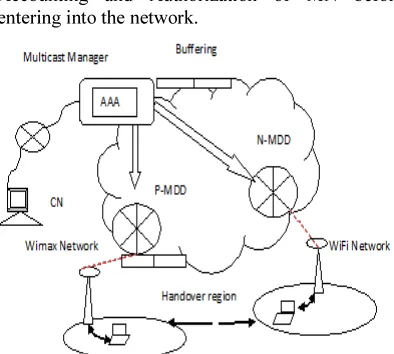
Figure 5. Multicast Enabled Handover Technique
Multicasting Manager acts as a server between the WiMax and Wi-Fi networks. All the necessary information about the MN’s and MDD’s are stored in the Multicast Manager.AAA server in Multicast Manager checks the MN whether it is authorized or not based on the information available before entering into the network are shown in Figure 5.
In IP, multicasting enables the user to send data packets to more than one device simultaneously, but in broadcasting all the devices receive data packets whether they require data packets or not. Multicasting avoids the unnecessary data transmission in networks and aids to keep the bandwidth resources, because it can send data packets to multiple devices simultaneously [18]. It has more advantages when compared to unicasting. Unicasting enables us to send packets to multiple devices simultaneously, but a connection must be established with every device before the transmission. It needs to maintain a list of unicast addresses so that the bandwidth and network resources are wasted which leads to excess time.
False Handover Initiation [17] occurs during the handover process in heterogeneous wireless networks. If handover initiation is false, it results in an unsuccessful handover. The current handover initiation process becomes false if one of the following scenarios occurs.
Scenario1: The MN indicates that RSS from the pBS is greater than current BS, since the MN switch back to the cell covered by the pBS.
Scenario 2: The RSS from the pBS is still weaker than current BS and the MN indicates that the RSS from another BS becomes greater than the nBS, hence the MN varies its moving direction to the BS unlike from the nBS.
Due to this packet loss and out of sequence packet problem which occurs frequently, the Multicast Manager transmits the packets of data to both pMDD and nMDD using multicasting. Here the handover process is performed between two domains WiMax to Wi-Fi and the data from the correspondent node, transmitted to the network by multicast manager.
3.2 Proposed Algorithm
3.2.1 Information Gathering
During the information gathering phase [10], the system checks periodically for a suitable network to which mobile nodes can handover. An Information gathering phase only starts, when the active network cannot be able to handle the connections because of signal weakness or the QoS is below the threshold value of the network. The main Criteria considered for information gathering phase are Received Signal Strength (RSS), Network coverage, Bandwidth and Security. RSS from the mobile node is closely related to the network coverage. Based on this information, comes to know that whether a network is available for the given mobile nodes or not. Bandwidth is an important criterion for networks which affects the QoS. Security is also one of the important criteria in wireless networks. Here for the security purpose, we used Authentication, Authorization and Accounting server, which check the MN whether it is authorized or not before entering into the network and also uses the Host Identity Protocol (HIP), which is an establishment of key and parameter negotiation protocol. Its main purpose is to authenticate node messages based on node identities and establishing security associations (SAs) for the Encapsulating Security Payload (ESP) transport format. It also supports to decouple the transport layer from the inter-networking layer by using public/private key pairs such as Host Identities (HI), instead of IP addresses.
3.2.2 Handover Decision
network which maximizes the functionality that is satisfied by both the user and the networks. It also minimizes the degradations that are occurred during higher load and congestion state and maximizes the utilization of users.
3.2.3 Handover Execution
Handover Execution is the last phase in the handover process, where the messages switch between two networks to redirect the connection from one network to another. Handover is executed based on preplanning and implementation issues by considering the strategies such as Network controlled handover, Mobile controlled handover, Mobile Assisted handover and Network assisted handover.
[image:6.595.93.294.427.717.2]Network controlled handover is initiated and managed by the network for balancing the load and traffic. Mobile controlled handover is initiated and managed by the mobile nodes to measure the signal and to initiate the handover process. Mobile assisted handover is mainly used in wireless networks. The network decides to make handover based on the signal monitoring by the mobile node. Network assisted handover is mainly used when the network collects all the information about the handover process.
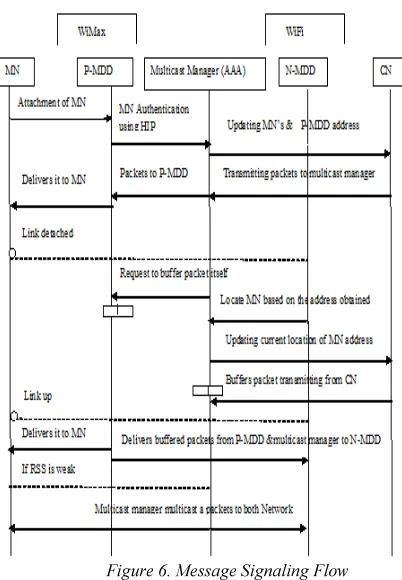
Figure 6. Message Signaling Flow
The message signaling flow for the handover process between WiMax to Wi-Fi network is shown
in Figure 6. The step by step processes involved are,
1. When Mobile node (MN) attaches to P- MDD in WiMax domain, P- MDD sends a request to Multicast manager for authenticating the MN using MN’s id and HNP (Home Network Prefix) option, by using Host identity protocol (HIP).
2. After a Mobile node is authenticated by multicast manager, and sends Acknowledgement to Correspondent node (CN) for updating a MN’s and P-MDD’s current location.
3. The Correspondent node (CN) transmits the data packet to the Multicast manager and then it is forwarded to P-MDD and finally delivered to the MN.
4. During the Link detachment event, a MN finds its attachment with N-MDD in Wi-Fi domain. Multicast manager makes a request P- MDD to buffer the packets by itself using the effective buffering scheme.
5. The N-MDD find its position in Multicast manager by obtaining a MN’s id and P- MDD address, because Multicast manager contains all the information about MDD’s and their configuration mode.
6. Then the Multicast manager requests the Correspondent node (CN) to update the MN’s id and N-MDD’s address, then further the data packets which are transmitted from the Correspondent node (CN) to the Multicast manager are buffered by itself using an effective buffering scheme.
7. After a Link up event, the connection is set up between MN and N- MDD; the packets buffered in the P- MDD are delivered to the N-MDD through the Multicast manager. And finally packets are delivered to the mobile node (MN).
8. When the Received Signal Strength is weak after the handover process, which leads to False Handover Initiation. To overcome this situation, the Multicast manager multicasts the data packets to both the P- MDD and the N- MDD. Finally data packets are delivered to the MN based on the current address and its position. Then effective buffer in multicast manager clears its storage and starts buffering the further transmitting data packets.
3.2.4 Effective Buffering Scheme
packets which are anticipated to loss during handover process. Here packets are buffered based on time-stamp. If the lifetime of the packets exceeds the time stamp value it will be discarded.
Hence the proposed mechanism eliminates the wastage of bandwidth resources and tunnel setup processes between pMDD and nMDD. It also avoids the unnecessary data transmission in networks by multicasting the data packets to both the pMDD and nMDD. This mechanism mainly focuses on handover performance related issues among heterogeneous wireless networks and in future security related isssues will be considered. The proposed handover mechanism is not suitable for constantly moving MN’s.
4. SIMULATION AND EXPERIMENTAL
RESULTS
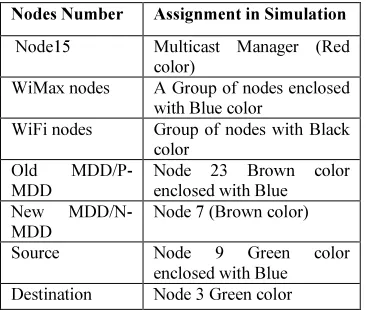
[image:7.595.99.282.540.695.2]Network Simulator (NS2) is an open source event driven simulator specially designed for Computer Networks where the physical activities are translated into events. Events are queued and processed based on their scheduling. NS2 gives support for simulation such as TCP, routing and multicast protocols over wired and wireless networks. Two languages used in NS2 are C++ and Otcl (Object Oriented Tool Command). C++ defines the inside mechanism of the simulation objects and used for detailed protocol implementation where every packet flow has to be processed. The Otcl programs are done by assembling and configuring the objects, and allows fast to write and change the code.
Table 1: Assignment of Nodes in Simulation
Nodes Number Assignment in Simulation
Node15 Multicast Manager (Red color)
WiMax nodes A Group of nodes enclosed with Blue color
WiFi nodes Group of nodes with Black color
Old MDD/P-MDD
Node 23 Brown color enclosed with Blue New
MDD/N-MDD
Node 7 (Brown color)
Source Node 9 Green color
enclosed with Blue Destination Node 3 Green color
Handover Latency computes the maximum interval of time in which the MN does not receive any packet due to handover. To analyze the handover latency, we define that tMN-MDD, tMDD-MM and tP-MDD– N-MDD are the packet
transfer delays between an MN and an MDD, an MDD and a MM respectively. The handover latency of the proposed multicast enabled handover technique is compared with the handover latency of basic handover in PMIPv6. For basic handover in PMIPv6, the average handover latency is given in Equation (1),
= +
+ (1)
The average handover latency for the proposed Multicast enabled handover technique is given in Equation (2),
= +
+ (2)
Link switch delay defines the delay that occurs during layer2 (i.e.) when the mobile node attaches to the network during handover and detaches from the network after the handover process is over and it is shown in Equation (3).
= +
(3)
Router solicitation and router advertisement delay defines the delay that the HNP (Home Network Prefix) are sent to the mobile node from MDD or the delay that occurred during the exchange of RS and RA message and it is shown in Equation (4).
(4)
Authentication delay defines the delay between the MN and the MDD for authenticating the MN in Multicast manager (MM) before entering into the network and it is shown in Equation (5).
(5)
Registration delay is the delay that is occurred during the binding update process, because mobile nodes(MN’s) have to get register its information to the corresponding MDD and it is shown in Equation (6).
Figure7. Packet Transmission from Source to P-MDD
[image:8.595.306.514.462.647.2]Figure 8.Transmission of Packets from P-MDD to N-MDD
Figure 7 and Figure 8 describes the simulation scenario. The domain consists of two networks (Wimax and Wi-Fi), Multicast Manager, Mobile Detecting Device (MDD) and also Mobile Nodes (MNs). The MNs are associated with any one of MDDs according to their position and Received Signal Strength (RSS). Multicast Manager (MM) consists of all the details about MDDs and the MNs associated with them.
Transmission of packets from source to P-MDD and from P-P-MDD to Multicast Manager is shown in Figure 7. After the Link Detachment the mobile nodes moves to the Wi-Fi network where
the transmission of packets from P-MDD to N-MDD is shown in Figure 8 and then the packets are delivered to their Destination.
Figure 9.Performance Analysis of Handover Latency
Figure 9. Shows the comparison of handover latency of Fast Handover with MIH Support in PMIPv6 and Agent based handover Technique and the proposed multicast enabled handover technique. The handover latency of the proposed method is lower than the handover latency of the existing handover method.
Figure 10. Performance Analysis of Packet Loss
Figure 11.Performance Analysis of Out-of-Packet Sequence
Figure 11. Shows the comparison of out of packet sequence problem of Fast Handover with MIH Support in PMIPv6 and Agent based handover Technique and the proposed multicast enabled handover .The out of packet sequence problem of the proposed method is lower than the existing handover method, because proposed method uses an effective buffering scheme in both P-MDD and Multicast manager (MM) in order to reduce the disordering of packet sequence.
5. CONCLUSION
In wireless mobile communication, handover latency is one of the important issues. So we mainly focused on reducing the handover latency of the mobility management. The proposed Multicast Enabled Handover Technique, multicast the packets of data during the handover process from the Multicast manager to the N-MDD and the P-MDD. So that the tunnel establishment between P-MDD and N-MDD can be avoided. This reduces the handover latency, packet loss and out-of-packet sequence problem. The performance of the proposed multicast enabled handover technique is proved to be better than the existing techniques for heterogeneous wireless networks. In future, this technique can be further enhanced with more than two heterogeneous wireless networks in real time to improve the vertical handover performance much better.
REFERENCES
[1] Hyung Heon Kim, Seok Cheon Park and Myung Kyu Yi, “Fast-Handover Mechanism between 802.11 WLAN and 802.16 WiMax with MIH in PMIPv6”, Proceedings of the 4th International Conference on Ubiquitous Information Technologies &Applications
(ICUT’09), pp. 1-6 DOI:
10.1109/ICUT.2009.5405684,2009.
[2] Linoh A. Magagula , H. Anthony Chan, and Olabisi E. Falowo , “Handover Coordinator for Improved Handover Performance in PMIPv6-supported Heterogeneous Wireless Networks”, IEEE Wireless Communications and Networking Conference(WCNC),pp.1-6,DOI:10.1109/WCNC.2010.5506515,2010. [3] Linoh A. Magagula , H. Anthony Chan, and
Olabisi E. Falowo , “Handover Coordination with a Relay-Based Design for Heterogeneous Wireless Networks” ,IEEE 35th Conference on Local Computer Networks(LCN),pp.380-383,DOI:10.1109/LCN.2010.5735748,2010. [4] Shusmita A. Sharna , Mohammad R. Amin
and Manzur Murshed , “An Enhanced-MDP Based Vertical Handoff Algorithm for QoS Support over Heterogeneous Wireless Networks” ,IEEE 10th International Symposium on Network Computing and Applications(NCA),pp.289-293, DOI:10.1109 /NCA.2011.49 ,2011.
[5] Telemaco Melia, Fabio Giust, Riccardo Manfrin and et al., “IEEE 802.21 and Proxy Mobile IPv6: A Network Controlled Mobility Solution”, Future Network &Mobile Summit (FutureNetw),pp.1-8,2011.
[6] K. Radhika and Dr. A. Venugopal Reddy , “Vertical Handoff Decision Algorithm for Heterogeneous Wireless Networks Based on 2-Level Analytic Hierarchy Process” , Annual IEEE India Conference(INDICON),pp.1-6, DOI:10.1109/INDCON.2011.6139384,2011. [7] A. Singhrova and N. Prakash , “Vertical
handoff decision algorithm for improved quality of service in heterogeneous wireless networks” , Communications , IET , Vol.6, Issue:2,pp.211-223,DOI:10.149/Iet-com. 2010 .0820,2012.
,pp.27-31,DOI:10.1109/ComManTel.2013.6482360, 2013.
[9] Sandra Brigit Johnson , Saranya Nath P and T.Velmurugan , “An Optimized Algorithm for Vertical Handoff in Heterogeneous Wireless Networks” , IEEE Conference on Information &CommmunicationTechnologies(ICT),pp.12 061210,DOI:10.1109/CICT.2010.6558284, 2013.
[10] Mariem Zekri, Badii Jouaber and Djamal Zeghlache,” A review on mobility management and vertical handover solutions over heterogeneous wireless networks”, Elsevier (Computer Communications), Vol.35, pp.2055-2068,2012.
[11] Atiq Ahmed, Le¨ıla Merghem-Boulahia and Dominique Ga¨ıti, “Cooperative Agent Based Vertical Handover Scheme for Heterogeneous Networks”, Sixth Advanced International Conference on Telecommunications, 2010. [12] Sassi Maaloul, Mériem Afif and Sami
Tabbane, “A new Vertical Handover Decision based Context Awareness for Ubiquitous Access” ,IEEE The 2nd International Conference on Communications and Information Technology (ICCIT): Communication Networks and Systems, Hammamet ,2012.
[13] Ravi V Angadi and K.C Shet , “QoS Based Handover Technique for Network Based Network Mobility (N-NEMO)” , IJCSNS International Journal of Computer Science and Network Security, Vol.13, Issue.7, July 2013.
[14] A.Maheswari, T.Mithila ,“A New Vertical Handover Mechanism among Heterogeneous Wireless Networks in PMIPv6” , International Journal of Science, Engineering and Technology Research (IJSETR), Vol.3, Issue.3, pp.601-606 ,March 2014.
[15] Hyon-Young Choi , Kwang -Ryoul Kim ,Hyo-Beom Lee and Sung-Gi Min , “ Reactive Smart Buffering Scheme for Seamless Handover in PMIPv6” ,Springer ,pp.568-571,2008.
[16] V.Berlin Henry and D,Sridharan ,“Multicast-Supported Fast Handover For Proxy Mobile Ipv6”,Journal of Computer Science, ©Science Publications,2013.
[17] Mun-Suk Kim, Sukyoung Lee, David Cypher and Nada Golmie , “Performance Analysis Of Fast Handover For Proxy Mobile Ipv6” ,©Elsevier Inc,2012.
[18] Lili Wang, Shuai Gao, Hongke Zhang, Thomas C Schmidt and Jianfeng Guan ,” Mobile multicast source support in PMIPv6 networks” ,EURASIP Journal on Wireless Communications and Networking , DOI:10.1186/1687-1499-2013-152, 2013. [19] Kheya Banerjee, Sheikh Md. Rabiul Islam,
Zulkernine Ibne Tahasin, Rokon Uddin , “An Efficient Handover Scheme for PMIPv6 in IEEE 802.16/WiMAX Network
”
,
International Journal of Electrical & Computer Sciences IJECS-IJENS, Vol.11 ,Issue. 05, pp .8-16, 2011.
[20]Ahmed Rasem, “O-Pmipv6: Optimized