J U N E 1 9 9 1
WRL
Research Report 91/8
Incremental,
Generational
Mostly-Copying
Garbage Collection
in Uncooperative
Environments
The Western Research Laboratory (WRL) is a computer systems research group that was founded by Digital Equipment Corporation in 1982. Our focus is computer science research relevant to the design and application of high performance scientific computers. We test our ideas by designing, building, and using real systems. The systems we build are research prototypes; they are not intended to become products.
There is a second research laboratory located in Palo Alto, the Systems Research Cen-ter (SRC). Other Digital research groups are located in Paris (PRL) and in Cambridge, Massachusetts (CRL).
Our research is directed towards mainstream high-performance computer systems. Our prototypes are intended to foreshadow the future computing environments used by many Digital customers. The long-term goal of WRL is to aid and accelerate the development of high-performance uni- and multi-processors. The research projects within WRL will address various aspects of high-performance computing.
We believe that significant advances in computer systems do not come from any single technological advance. Technologies, both hardware and software, do not all advance at the same pace. System design is the art of composing systems which use each level of technology in an appropriate balance. A major advance in overall system performance will require reexamination of all aspects of the system.
We do work in the design, fabrication and packaging of hardware; language processing and scaling issues in system software design; and the exploration of new applications areas that are opening up with the advent of higher performance systems. Researchers at WRL cooperate closely and move freely among the various levels of system design. This allows us to explore a wide range of tradeoffs to meet system goals.
We publish the results of our work in a variety of journals, conferences, research reports, and technical notes. This document is a research report. Research reports are normally accounts of completed research and may include material from earlier technical notes. We use technical notes for rapid distribution of technical material; usually this represents research in progress.
Research reports and technical notes may be ordered from us. You may mail your order to:
Technical Report Distribution
DEC Western Research Laboratory, WRL-2 250 University Avenue
Palo Alto, California 94301 USA
Reports and notes may also be ordered by electronic mail. Use one of the following addresses:
Digital E-net: DECWRL::WRL-TECHREPORTS
Internet: [email protected]
UUCP: decwrl!wrl-techreports
Incremental, Generational Mostly-Copying
Garbage Collection in
Uncooperative Environments
G. May Yip
June , 1991
Copyright
1991, Digital Equipment Corporation
INCREMENTAL, GENERATIONAL MOSTLY-COPYING
GARBAGE COLLECTION
IN UNCOOPERATIVE ENVIRONMENTS
by
G. May Yip
B.S. Computer Science, MIT (1990) B.S. Electrical Engineering, MIT (1990)
SUBMITTED TO THE DEPARTMENT OF ELECTRICAL
ENGINEERING AND COMPUTER SCIENCE IN PARTIAL
FULFILLMENT OF THE REQUIREMENTS FOR THE
DEGREE OF
MASTER OF SCIENCE IN ELECTRICAL ENGINEERING AND COMPUTER SCIENCE
AT THE
MASSACHUSETTS INSTITUTE OF TECHNOLOGY
May 1991
CopyrightG. May Yip, 1991. All rights reserved. The author hereby grants to MIT permission to reproduce and to
distribute copies of this thesis in whole or in part.
Signature of Author
Department of Electrical Engineering and Computer Science May 10, 1991
Certified by
David K. Gifford Faculty Thesis Advisor
Certified by
Joel F. Bartlett VI-A Company Supervisor
Accepted by
INCREMENTAL, GENERATIONAL MOSTLY-COPYING
GARBAGE COLLECTION
IN UNCOOPERATIVE ENVIRONMENTS
by
G. May Yip
Submitted to the Department of Electrical Engineering and Computer Science on May 10, 1991 in Partial Fulfillment of the Requirements for the Degree of
Master of Science in Electrical Engineering and Computer Science
Abstract
The thesis of this project is that incremental collection can be done feasibly and efficiently in an architecture and compiler independent manner. The design and implementation of an incremental, generational mostly-copying garbage collector for C++ is presented. The collector achieves, simultaneously, real-time performance (from incremental collection), low total garbage collection delay (from generational collection), and the ability to function without hardware and compiler support (from mostly-copying collection).
The incremental collector runs on commercially-available uniprocessors, such as the DECStation 3100, without any special hardware support. It uses UNIX’s user controllable page protection facility (mprotect) to synchronize between the scanner (of the collector) and the mutator (of the application program). Its implementation does not require any modification to the C++ compiler. The maximum garbage collection pause is well within the 100-millisecond limit imposed by real-time applications executing on interactive workstations. Compared to its non-incremental version, the total execution time of the incremental collector is not adversely affected.
Faculty Thesis Advisor: David K. Gifford
Title: Professor of Electrical Engineering and Computer Science VI-A Company Supervisor: Joel F. Bartlett
Dedication
Acknowledgment
My company supervisor, Joel Bartlett, has been very helpful to me during my three VI-A internship assignments at DEC Western Research Laboratory. Bartlett is not just an excellent boss, giving me advice and support whenever I need guidance, but he is also a terrific friend. I have never had a boss who would fix my bike and listen to my complaints about landlord/tenant problems. He is the kind of boss who is not just concerned with work performance, but is also concerned with other aspects of a summer intern’s life. Bartlett debugged early drafts of this thesis and gave me useful feedback which improved the presentation of the final version significantly.
I would like to thank my faculty thesis advisor, David Gifford, who has been an active advisor even though he was at MIT, and I was doing my thesis project some three thousand miles away. He read my e-mail messages carefully and provided me with questions to further investigate. Gifford helped improve the presentation of this thesis. Thank you very much.
Table of Contents
Abstract 2
Dedication 3
Acknowledgment 4
Table of Contents 5
List of Tables 7
List of Figures 8
1. Introduction and Related Work 9
1.1 Mostly-Copying Collection 10
1.2 Generational Collection 12
1.3 Incremental Collection 13
2. Bartlett’s Generational Mostly-Copying Collector 16
2.1 Programming Interface in C++ 16
2.2 Summary of Bartlett’s Collection Algorithm 18
2.2.1 Spaces 19
2.2.2 Allocation 20
2.2.3 Collection 21
3. Incremental, Generational Mostly-Copying Collection 25
3.1 The Big Picture 25
3.2 An Incremental, Generational Mostly-Copying Collector 28
3.2.1 Special Considerations 28
3.2.1.1 Space Numbers 28
3.2.1.2 Heap Size and Heap Page Size 29
3.2.1.3 Allocation 30
3.2.1.4 Miscellaneous Bookkeeping 30
3.2.2 Before GC 31
3.2.3 Start GC 31
3.2.3.1 Protecting Objects 32
3.2.3.2 Forward Region 33
3.2.4 During GC 35
3.2.4.1 Page Fault Trap 35
3.2.4.2 Scanning Objects 35
3.2.4.3 Application Allocation 40
3.2.4.4 Collector Allocation 40
3.2.5 End GC 43
3.2.6 Heap Page State Transitions 43
4. Experimental Results 47
4.1 Hardware and Compiler Independence 47
4.2 Benchmark Measurements 48
4.3 Real-Time Performance 51
4.4 Soundness of Generational Collection 55
5.1 Summary 57
5.2 Future Work 58
Appendix A. Sample C++ program using garbage collection 60
Appendix B. Source code for the Incremental Garbage Collector 62
B.1 Header file for C++ version 1.2 62
B.2 Header file for C++ version 2.0 67
List of Tables
List of Figures
Figure 1-1: Bartlett’s Mostly-Copying Collector 1.1
Figure 1-2: Appel, Ellis and Li’s Incremental Collector 1.3 Figure 2-1: C++ definition for thewordobject class 2.1
Figure 2-2: Scanning objects 2.2.3
Figure 2-3: Scanning objects - II 2.2.3
Figure 2-4: Scanning objects - III 2.2.3
Figure 2-5: Scanning objects - IV 2.2.3
Figure 3-1: Incremental, Generational, Mostly-Copying Collection 3.1
Figure 3-2: Objects and Physical Page Clusters 3.2.3.1
Figure 3-3: Determining physical page cluster 3.2.3.1
Figure 3-4: Scanning object A 3.2.4.2
Figure 3-5: Scanning object A - II 3.2.4.2
Figure 3-6: Scanning object A - III 3.2.4.2
Figure 3-7: Scanning strategy for unstable objects 3.2.4.2
Figure 3-8: Scanning a linked list 3.2.4.4
Figure 3-9: Heap page state table 3.2.6
Figure 3-10: Heap page state transitions diagram 3.2.6
Figure 4-1: Time profile of bipsctrl running with the non-incremental 4.3 collector
Chapter 1
Introduction and Related Work
Garbage collection (GC) refers to the memory allocation and recycling mechanisms for the application program’s data memory area. GC has always been associated with high-level, symbolic-processing languages such as Lisp and Scheme, where the concept of automatic storage management for objects of indefinite extent is embedded in the language. However, in other high-level languages, garbage collection has not gained wide acceptance because the extra bookkeeping needed often imposes a significant performance penalty. Traditional garbage collection schemes, like mark-and-sweep and stop-and-copy, lengthen a program’s total execution time and adversely affect its interactive performance.
Although copying and generational collection algorithms applied to high-level languages are hardly new ideas [Fenichel&Yochelson 69] [Moon 84], garbage collection in C++ seems to be an odd idea on first sight. In C++, contrary to Lisp and Scheme, the storage for objects of indefinite extent must be explicitly managed. But the importance of garbage collection in C++ is increasing, because as programs become more complicated, GC can help alleviate the complexity in storage management. Efficient garbage collection techniques present an attractive alternative to the usual low-level, ad hoc approach to storage management, where object deallocation is explicitly managed. Indeed, advances in garbage collection technology have made possible the advent of efficient collectors that do not rely on special purpose hardware or compiler support.
This thesis work is based on the work done at Digital Equipment Corporation’s Systems Research Center and Digital Equipment Corporation’s Western Research Lab. Appel, Ellis and Li [Appel et al. 88] demonstrate that incremental garbage collection is feasible using standard virtual memory page protections, without a tagged architecture or additional hardware support. To detect pointers to from-space objects, a medium grain synchronization is established between the collector and the mutator at the virtual memory level. Bartlett invented mostly-copying collection, which makes substantial memory compaction possible without having to know the actual set of root pointers at the start of the collection [Bartlett 88]. The result is that a mostly-copying collector can perform in an environment where stack and register allocation disciplines are not known. Additionally, Bartlett has incorporated generational collection into his mostly-copying collector [Bartlett 89], and has shown that his strategy works well in systems running Scheme, C, and C++.
Detlefs has already attempted to combine Appel et al.’s and Bartlett’s ideas into building a concurrent collector for C++ [Detlefs 90]. However, Detlefs’s collector is not generational and not very portable. It requires modifications to be made to the C++ compiler and requires MACH. My thesis is that incremental, generational mostly-copying collection can be done efficiently in a compiler and architecture independent manner, without any modification made to the underlying operating system. By combining and expanding on ideas employed in previous work, I have built such a collector.
1.1 Mostly-Copying Collection
Stack Registers
A
C
D
E B
B’
E’
Current-space Next-space
[image:15.612.148.486.112.321.2]Static Area
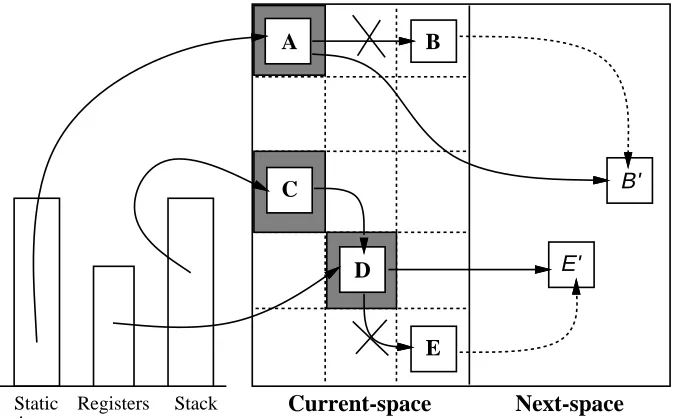
Figure 1-1: Bartlett’s Mostly-Copying Collector
As shown in figure 1-1, Bartlett’s collector is based upon an old-space/new-space approach. The heap is divided uniformly into a number of pages (called heap pages) whose size is independent of the actual physical page size of the underlying paging system. Current-space and next-space are conceptual counterparts of from-space and to-space, respectively, of the classical stop-and-copy collector. Note however, that the spaces here are not necessarily contiguous regions in memory. There is a special space identifier associated with each heap page to indicate the space it is in. In the simplest term, mostly-copying collection proceeds as follows. First, the collector ‘‘guesses’’ which heap pages contain objects that may be referenced from pointers in the processor stack, registers and the application program’s static area. These pages are promoted to the next-space. In the figure, this refers to the pages containing objects A, C and D. Promoting a page means that the special space identifier of the page is flagged such that the page will be retained when the collection is over. The objects that point to A, C and D are called ambiguous roots, because not necessarily all of them are actually real pointers, but they contain the root objects through which all accessible objects can be traced. Because of this uncertainty, ambiguous roots cannot be changed. It is important that the heap pages pointed to by these ambiguous roots be ‘‘locked,’’ so the objects on these pages can be retained.
ambiguous root objects and forwards all objects referenced from these roots into a more compact area in next-space. Scanning refers to the process by which internal pointers (if any) of an object are examined; and forwarding refers to the copying of the objects referenced by these internal pointers into next-space. The forward pointers of the copied objects are updated in the object being scanned. As the figure illustrates, object B is therefore copied into B’, and the old pointer in A which pointed to B is updated to point to B’ instead. The same is also true for object E pointed to by object D. On the other hand, although D is referenced by object C, D is not forwarded because the heap page containing D is already a promoted page. Scanning continues until all promoted and forwarded objects have been scanned. GC is then complete.
In contrast with a conservative mark-and-sweep collector, which also makes ‘‘guesses’’ on stack and register pointers but leaves all retained storage fragmented, the mostly-copying collector is able to compact most of the heap because it has knowledge about the heap structure. By configuring the heap into a set of pages, the collector can preserve pointers in the root set whose values cannot be changed during a collection by simply promoting their corresponding page. It is then possible to compact other objects that are not in the root set.
1.2 Generational Collection
Bartlett has also incorporated generational collection into his mostly-copying collector. Generational collection works on the basis that newly created objects have the highest probability to be destroyed soon, while old objects that have survived collection(s) have a tendency to remain around for a longer time. Such observation is in line with the life times of (i) subroutine local variables, which are created when the subroutine is called and are immediately abandoned as soon as the subroutine exits; and (ii) entries in a large database, which are generally long-living objects.
The mostly-copying algorithm facilitates generational collection as the space identifier of each heap page can be used to approximate the age of the object. In the current version, an even page space identifier represents an ‘‘old’’ page, and an odd one represents a ‘‘young’’ page. According to [Bartlett 89], when running with a generational mostly-copying collector, smaller programs that do not use garbage collection run a bit slower because of the overhead needed to keep track of mutated old objects, but large batch programs such as the Scheme compiler run faster, and interactive programs have shorter pauses during collection. Generational collection is worthwhile whenever the additional time needed to manage the remembered set -- the set of ‘‘old’’ pages that have references to new pages -- can be offset by the reduction in garbage collection time.
1.3 Incremental Collection
Traditionally, incremental collection is implemented on a tagged architecture with special hardware support, e.g. Symbolics Lisp Machines. For conventional incremental stop-and-copy collection, every pointer fetched from memory is examined to see if it points to a from-space object. If so, then just as in the case of a non-incremental collector, the from-space object is copied to to-space and the pointer which points to the object’s old location is updated. This hardware approach implements a fine grain synchronization between the mutator and the collector.
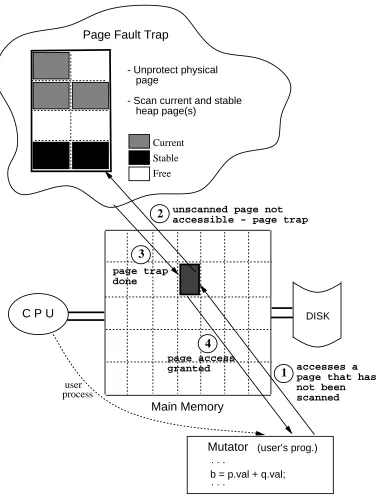
Appel, Ellis and Li have a different approach to incrementalize stop-and-copy collection. Using the standard virtual memory page protection mechanism, a medium grain synchronization is achieved: a virtual page in to-space is not scanned until an object within it is referenced. Their strategy is based upon the following invariants:
•At all times, newly-allocated objects contain to-space pointers only.
•At all times, user application accesses objects via to-space pointers only.
•During collection, scanned objects contain to-space pointers only.
•During collection, unscanned objects contain both from-space and to-space pointers.
C P U
Main Memory Page Trap Thread
Scanner Thread
in to-space continually. Scans unscanned pages
forked kernel
call
forked kernel call
user process
Mutator . . .
. . .
(user’s prog.)
1 2
3
4
accesses a page that has not been unscanned page
page trap done.
not accessible - page trap.
scanned. page access
granted Scans one unscanned page
in to-space on demand.
b = p.val + q.val;
[image:18.612.169.457.108.418.2]DISK
Figure 1-2: Appel, Ellis and Li’s Incremental Collector
therefore must be scanned. Garbage collection is incrementalized by protecting unscanned pages in user mode. With incremental collection, an unscanned page in to-space can then be scanned when the mutator tries to access an object in it, by triggering a pre-established page trap thread running in kernel mode. After the page trap handler has scanned the page, the access mode of that page is adjusted so that execution of the mutator can proceed normally.
Appel et al. used this strategy to build a concurrent, real-time collector on the Firefly multiprocessor workstations. They added two kernel calls and use facilities particular to the
1
Taos operating system. Taos extends Digital Equipment Corporation’s ULTRIX with virtual memory primitives, threads, and cheap synchronization [Thacker&Stewart 87].
Chapter 2
Bartlett’s Generational Mostly-Copying Collector
2.1 Programming Interface in C++
In languages such as Scheme and Lisp, which have their own native garbage collectors in the language system, objects with indeterminate extent are allocated in the heap and are garbage collected. In C++ there is no garbage collection facility native to the language system, and objects with indeterminate lifetime are given storage space by means of a general-purpose memory block allocation facility. Explicit storage management of these objects is necessary.
C++ is an object-oriented superset of C. It allows the application to define new object classes and provides compile time type checking for the classes. For each object class, the application supplies a constructor, a destructor, and creates other class operations. The constructor specifies how new objects are initialized. It is called when a new object is allocated. Class operations are procedures which clients of the object class use to manipulate objects. The destructor is called automatically when the object is going out of scope. Inside the destructor the application can free the memory occupied by the object. With Bartlett’s generational mostly-copying garbage collector added to the C++ system, application programmers can decide which C++ classes are allocated on the garbage collected heap, and which are not. And for the garbage collected classes, the application does not need to provide a destructor.
Bartlett’s collector is added to the language system like any other library because the collector is a self-contained module requiring no cooperation from the compiler. The application calls routines provided by the garbage collector by linking with the collector’s library at compile time. This level of compiler independence allows the collector to be used with different C++ compilers.
struct word {
word* lesser; word* greater; int count;
char symbol[ 1 ]; word( char* chars ); GCCLASS( word ); };
word::word( char* chars ) {
GCALLOCV( word, sizeof( word )+strlen( chars ) ); lesser = NULL;
greater = NULL; count = 1;
strcpy( symbol, chars ); }
[image:21.612.137.485.91.390.2]void word::GCPointers( ) { gcpointer( lesser ); gcpointer( greater ); }
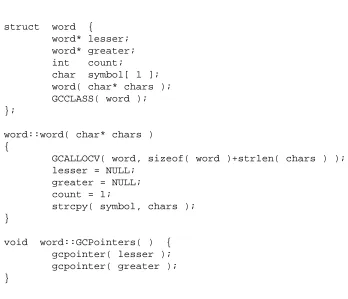
Figure 2-1: C++ definition for thewordobject class
word::GCPointers. When the collector is scanning an object, it must be able to identify internal pointers of the object. In this case, the internal pointers of word are word* lesser andword* greater. In theword::GCPointerscallback, there is a gcpointer statement for each internal pointer. During scanning, the garbage collector has an efficient way to call the GCPointers method of the object being scanned (described in the last paragraph of section 2.2.2, page 20). Then each of the gcpointer statements of the method passes an internal pointer of the object to the collector, so that the object referenced by that internal pointer can be forwarded. If an object class does not contain any internal pointer, theGCPointersmethod is an empty procedure.
Inside the constructor word::word,GCALLOCV is responsible for space allocation. The arguments of GCALLOCV are the class name and the number of bytes the class object occupies, respectively. GCALLOCV is designed for the allocation of variable-size objects; for an object class t whose size is known at compile time, a simpler statement,
C++ supports class inheritance; it is possible that a collectible class is a subclass of a collectible superclass, or a non-collectible subclass has a collectible superclass, and vice versa. To ensure that the pointer-finding method is consistent and able to find all pointers to garbage collected objects, the application programmer must adhere to the following rules:
1. For class C:P {}, C::GCPointers must contain P::GCPointers(). That is, for a class C that is derived from a super class P, the pointer-finding method ofCmust contain the call to P::GCPointers(), which is classP’s pointer-finding method.
2. For class C{X x;}, C::GCPointers must contain x.GCPointers(). That is, for a class Cwhich contains an objectxof the garbage collected class X, C’s pointer-finding method must include the statement x.GCPointers(), which is the call to invoke the pointer-finding method of objectx.
3. For class C{X* x;}, C::GCPointers must contain gcpointer(x). That is, for a class C which contains a pointer x to an object of the garbage collected class X, C’s pointer-finding method must contain the statement gcpointer(x), which informs the garbage collector about the existence of this internal pointer.
If a subclass does not have any internal pointers, then the GCCLASSstatement in the declaration of the subclass can be omitted and the GCPointer callback method is not necessary.
2.2 Summary of Bartlett’s Collection Algorithm
Bartlett’s generational mostly-copying collector is a compacting, conservative collector. The heap is divided into a number of heap pages, each of which is PAGEBYTES bytes in size. PAGEBYTES is an adjustable parameter independent of the hardware page size. The collector conservatively treats all words in the processor stack and registers which could be pointers into the heap as root pointers. Heap pages which are referenced by these ambiguous roots are retained. Their contents are left intact because the ambiguous roots may reference their locations in the future. Other objects in the heap that are not referenced directly by the roots can be compacted, much like the way of a classical stop-and-copy collector.
one collection are ‘‘old.’’ Old objects are stable and not collected. During each collection, stable objects (which constitutes the stable set) that have been mutated to reference young, unstable objects have to be scanned, so that the unstable objects can be forwarded and made stable. The set of stable objects which the collector needs to scan is called the remembered set. For ease of implementation, the remembered set in Bartlett’s collector is equal to the stable set, so no additional bookkeeping is necessary to remember the stable objects which have been mutated. Stable objects are retained at each collection, until the set of stable objects occupy a certain fraction of the heap. Then a total collection is initiated to collect all objects regardless of age.
2.2.1 Spaces
The classical stop-and-copy collector divides the heap into two contiguous regions, from-space and to-space. Objects are allocated in from-space until it is exhausted. Garbage collection is started, and objects that are salvageable are copied to to-space. When collection is over, the two spaces swap roles. Bartlett’s collector divides the heap into two spaces also: current-space and next-space. They are analogous to from-space and to-space, respectively, of the classical algorithm; but Bartlett’s spaces are not contiguous. Rather, each heap page has an associated space identifier to indicate the space it is in. There are two variable that the collector maintains, curr_space and next_space, to denote two important space identifiers. The following explains the partition of the spaces:
•current-space -- space where the application allocates heap pages. Heap pages in current-space have their space identifiers equal tocurr_space.
•next-space -- space where retained heap pages are found during collection. The collector retains heap pages referenced by the ambiguous roots by setting (i.e. promoting) the space identifiers of those pages to be next_space. Heap pages allocated to hold forwarded objects also have their space identifiers equal tonext_space.
Normally curr_spaceandnext_spaceare equal when garbage collection is not going on. Initially,curr_spaceandnext_spaceare set to 3. When garbage collection is initiated,next_space is incremented by 1, to become an even number. When garbage collection ends, curr_spaceis incremented by 2 (i.e. it remains odd), andnext_space is reset to be equal tocurr_space.
during collection always have even identifiers, while heap pages allocated by the application in current-space always have odd identifiers. Generational collection takes advantage of this fact and treats heap pages with even identifiers as the stable set.
2.2.2 Allocation
Allocation in the mostly-copying collector is a two-part process: (i) allocate a free heap page, and then (ii) allocate space from it. A new heap page allocated in step (i) always has its space identifier set to next_space (recall thatcurr_space == next_space when garbage collection in not going on). The variable freewords holds the number of remaining allocatable words in the current free page. If the remaining freewordsnumber of words is insufficient for an allocation request, then the trailing space on the current free page is discarded and left unused. Another heap page is allocated, andfreewords is reset to reflect the status of this new free page.
Each heap page has a type identifier associated with it. When a heap page is allocated to hold objects smaller than one heap page in size, its type identifier is set to OBJECT. To accommodate a large object, more than one heap page has to be allocated. The first of such heap pages is of type OBJECT, while the remaining one(s) are of type CONTINUED. The trailing space (if any) on the last CONTINUED page is not used for another object. It is simply left unused.
2.2.3 Collection
The collector maintains the variable allocatedpages so that it knows how many heap pages have been allocated. Every time the collector enters the allocation routine, it checks the condition:
allocatedpages >= heappages/2 && curr_space == next_space 2
which when true, means that at least half of the heap is already allocated and that collection has not been triggered yet. In this situation the collector enters garbage collection mode and attempts to recycle memory before getting to the allocation routine.
Garbage collection starts with the following assignment:
next_space = curr_space+1;
GC then proceeds with examining the stack, registers and static areas, looking for words which can be interpreted as pointers into current-space heap pages. These words are referred to as the ambiguous root pointers. The current-space heap pages which the ambiguous roots reference are promoted by changing their space identifiers tonext_space. The page type identifier allows large objects to be recognized. When an ambiguous root points into one of the CONTINUED heap pages, all the heap pages which together make up the whole object must be promoted. When such an ambiguous root into an arbitrary CONTINUED page is encountered, it is easy to ‘‘search backward’’ to the beginning of the object by simply checking the type identifier of the page(s) preceding the CONTINUED page until a page of type OBJECT is discovered. After the leading OBJECT page is found, the header word gives the size of the object and the corresponding number of pages are promoted. If an ambiguous root references a stable heap page (one with an even space identifier), no promoting is necessary.
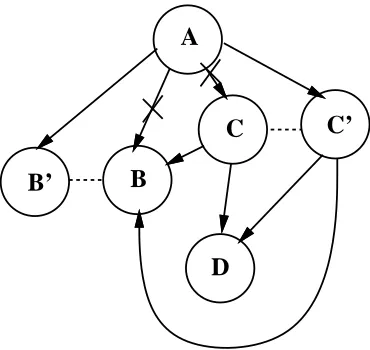
After the stack and registers are searched and promoting is done, the garbage collector sweeps across the set of stable and promoted heap pages and scans the objects inside them. Scanning is done using a breadth-first discipline. Referring to figure 2-2, object A is the first object to be scanned, and it contains pointers referencing objects B and C. Assume that all objects are in current-space before collection begins, and object A is promoted to next-space during collection. Scanning A discovers internal pointers to B and C (via the
GCPointers method), and causes B and C to be forwarded, to B’ and C’ respectively, on another heap page allocated in next-space (see figure 2-3). As B and C are forwarded, their
A
B
C
D
Scanning A causes B and C to be forwarded. Scanning C causes D to be forwarded (assuming that B is already forwarded).
[image:26.612.224.397.114.264.2]The dotted lines show the ‘‘levels’’ of the data structure.
Figure 2-2: Scanning objects
A
B
C
D B’
C’
Scanning A forwards B and C to B’ and C’, respectively.
Figure 2-3: Scanning objects - II
[image:26.612.218.403.422.597.2]A
B
C
D B’
C’
D’
[image:27.612.218.447.112.315.2]Scanning C’ forwards D to D’.
Figure 2-4: Scanning objects - III
A
B’
C’
D’
Figure 2-5: Scanning objects - IV
[image:27.612.219.450.449.605.2]after B and C are copied to B’ and C’. Since B’ and C’ are in next-space, they are considered promoted objects and must be scanned. When B’ is scanned, it does not cause any forwarding because it does not contain any internal pointers. When C’ is scanned, the collector attempts to forward B and D (see figure 2-4). The flag bit in B’s header shows that B has already been forwarded and therefore it is not forwarded again. The internal pointer in C is set to the value of B’s forward pointer found in its header word. Afterwards, object D is forwarded the normal way -- assuming that it has not been already forwarded by another object in the heap. Figure 2-5 shows that as a result of scanning A, objects B, C and D are copied to B’, C’ and D’, respectively, in next-space.
The collector does not attempt to forward objects that span more than one heap page. In the above example, objects B, C and D are assumed to be less than one heap page in size. For larger objects, the collector simply promotes all their heap pages to next-space, thereby saving the effort of having to find contiguous free heap pages to accommodate the large object and copying it.
During scanning, if a reference to a stable object is discovered, nothing needs to be done. Stable objects do not need to be forwarded or promoted because they are retained by the collector. With generational collection, heap pages in the remembered set are scanned also, in the same way that promoted heap pages are scanned.
Garbage collection is over when all the next-space and stable heap pages have been scanned. At this point all live pages have even space identifiers. These even pages constitute the stable set and are retained in the next collection. Heap pages in current-space can be recycled as free pages. Garbage collection is terminated by setting
curr_space = curr_space+2;
next_space = curr_space;
Chapter 3
Incremental, Generational Mostly-Copying Collection
3.1 The Big Picture
The essence of incremental collection is to minimize garbage collection pauses by configuring the collector to scan only a bounded number of ‘‘live’’ objects at a time. After garbage collection is initiated, and after the necessary bookkeeping and setup work for incremental collection is completed, the application program can proceed normally even though garbage collection is not yet finished. While in the non-incremental scheme the application program can suffer a potentially long and detectable pause every time garbage collection takes place; under the incremental scheme the application program is interrupted intermittently to scan objects for a short duration of time. This way garbage collection is incrementalized, because the total work needed for garbage collection is divided into a number of comparable subtasks. The subtasks are spread out over time, each subtask being executed in a smaller time interval.
Incremental collection is synchronized at the granularity of physical pages. Incremental collection for applications running on commercially-available stock processors depends crucially on the virtual memory system’s provision to allow control for virtual memory page protections. At the start of incremental collection, the virtual memory pages on which objects referenced by the roots reside are read/write protected, i.e. they are neither readable nor writable. In the context of the mostly-copying strategy, this means that the physical pages containing one or more promoted heap pages are protected. The application is then allowed to resume as normal, while garbage collection is technically still "going on." When the application attempts to access a protected page, a virtual memory page fault is generated and program control is transferred to a special trap handler, which triggers the garbage collector to do all necessary work in order to make the physical page needed by the application accessible. To avoid the situation where the heap is exhausted by the application allocation before garbage collection is completed, the collector can randomly select a protected physical page to scan each time the application causes a new heap page to be allocated.
C P U
Main Memory
user process
Mutator
. . .
. . .
(user’s prog.)
1 2
3
4
b = p.val + q.val;
DISK
unscanned page not accessible - page trap
accesses a page that has not been scanned page trap
done
page access granted
Page Fault Trap
Free Current Stable
- Unprotect physical page
[image:30.612.136.514.143.640.2]- Scan current and stable heap page(s)
3
faulted virtual page and scanning the promoted heap pages inside it. This is termed ‘‘mostly-copying’’ collection because objects in the promoted heap pages are not moved. They are referenced by the ambiguous roots and therefore their contents cannot be changed. They are allowed to remain intact in the heap. Only objects not directly referenced by the root objects are copied into a more compact area in the heap, and their forward pointers are updated in the root objects appropriately.
When generational collection is added, not only do the promoted heap pages need to be scanned, heap pages in the remembered set have to be scanned also. The remembered set is the set of stable objects which have been mutated since the last time they were scanned. To avoid trapping writes into stable objects, this version of the generational collector in fact treats the entire stable set as the remembered set. Objects become stable once they have survived at least one collection. They have to be scanned because if they have been mutated since the last time they were scanned, they may contain pointers into newly-created (and hence unstable) objects. Similar to the scanning and forwarding strategy described in the previous paragraph, the unstable objects referenced by the stable ones are forwarded (and therefore become stable), and their forward pointers are updated in the stable objects. GC work on the physical page is complete after scanning and forwarding of promoted and stable objects are done. The physical page can be safely accessed by the application now, the trap handler can exit, and the application then resumes from the point where it was interrupted.
This process of faulting on a protected page, unprotecting it, and scanning and forwarding objects inside it repeats until there are no more protected pages left in the heap. Garbage collection is then complete, and the application executes with no interruptions until the next time garbage collection is initiated. Successive generational garbage collections enlarge the set of stable heap pages to be retained in the heap. When more than a certain fraction of the heap is retained after a generational collection is finished, a total collection will be carried out such that all live heap pages, whether they are ‘‘young’’ or ‘‘old,’’ are collected. In addition, the heap can be expanded, if it is discovered that more than a certain fraction of the heap is occupied after a total collection. Figure 3-1 illustrates this scheme for performing an incremental collection on a single-tasking stock processor utilizing a standard virtual memory system.
3For the moment consider only the case in which all the objects in the faulted page lie within the physical
The following section discusses how the incremental version of the generational mostly-copying garbage collector is implemented in more detail. In particular, the state-to-state transitions of the different stages of the collection algorithm are described, along with various special considerations that have to be taken into account in order to optimize performance.
3.2 An Incremental, Generational Mostly-Copying Collector
3.2.1 Special Considerations
To integrate Bartlett’s generational mostly-copying collection algorithm into the incremental framework, a few special considerations have to be taken into account. Section 3.2.1.1 explains why the current-space/next-space partition of the heap in the non-incremental collector must be adjusted to a current-space/previous-space/forward-space partition. Section 3.2.1.2 states a new restriction on the choice of heap size and heap page size. Section 3.2.1.3 discusses the effects of the allocation algorithm on real-time performance. Section 3.2.1.4 describes how the miscellaneous page status information is handled.
3.2.1.1 Space Numbers
The current-space/next-space approach employed by Bartlett’s collector works well in the non-incremental framework because application allocation for a particular value of
•current-space -- space where newly-allocated heap pages are found. The application allocates in the current-space, by setting the space number of the allocated page to becurr_space.
•previous-space -- space where unscanned and (possibly) reclaimable heap pages are found. Heap pages which used to be in current-space before collection begins and which are not promoted after collection has been initiated are entered into previous-space (denoted as prev_space), by asserting that prev_space be equal curr_space at the start of collection, and subsequently advancing the value ofcurr_space.
•forward-space -- space where promoted heap pages and heap pages containing forwarded objects are found. The collector promotes pages into or allocates pages in forward-space by setting the space number of the allocated page to be forw_space.
Collection in progress is indicated by the inequality curr_space !=
forw_space. Current-space and forward-space in the three-space scheme are the same as current-space and next-space, respectively, in the two-space scheme. The addition of previous-space holds (temporarily) the used-to-be current-space objects, and allows application allocation to continue while previous-space objects are being scanned. At the end of collection, the collector will be able to reclaim the previous-space pages by simply changing the value ofprev_spaceto be equal tocurr_space.
3.2.1.2 Heap Size and Heap Page Size
The incremental collector performs GC work on the granularity of a unit of page protection. On the DECStation 3100, a unit of page protection is a physical page. On other machines, this may be different. Since it is undesirable to have the collector protect any part of memory that does not belong to the garbage collected heap, the heap size must be a multiple of the protection unit, meaning that for the DECStation implementation the heap size is rounded to the nearest number of physical pages.
3.2.1.3 Allocation
During each garbage collection pause the collector scans a certain amount of memory and returns control to the application. The less there is to scan at each GC pause, the better the real-time performance is. This is because when there is no object crossing page boundaries at both ends of a physical page, then that physical page can be unprotected and scanned as a unit. But when there is an object crossing either boundary, then instead of unprotecting just one physical page, at least two physical pages will need to be unprotected, and subsequently scanned.
It is important to allocate objects in such a way that will minimize the amount of memory that needs to be scanned each time. The amount of memory to scan is dependent on how the objects are laid out on the physical pages. Scanning must be done in units of a physical page, since a physical page is a page protection unit. To illustrate this point with an extreme example, assume that current-space consists of a set of contiguous physical pages, and there are objects lying across each physical page boundary. Suppose that all the objects are promoted to forward-space at the beginning of collection, and all the physical pages they lie on are protected. When it is necessary to scan any one of these objects, it will be necessary to scan all of the protected physical pages as one unit. Thus, the collector cannot incrementally collect.
3.2.1.4 Miscellaneous Bookkeeping
The incremental collector often checks whether a physical page in the heap is protected. This information is kept in an array indexed by physical page. When a physical page is protected, its corresponding protect map entry is set; and when the page is unprotected, the same entry is cleared. The variable protectedpagesholds the number of physical pages that are still protected, and is maintained to be consistent with the protect map.
In the non-incremental collector, allocatedpages holds the number of ‘‘live’’ heap pages, andstablepagesholds the number of heap pages with even space numbers. For the incremental collector, this no longer works because as mentioned in section 3.2.1.1 we have added the notion of previous-space. Instead, the following variables are used to facilitate accounting:
•forwardedpages-- total number of stable heap pages.
•allocatedpages -- total number of ‘‘live’’ heap pages, i.e. pages that are not free for allocation.
When the heap is first configured, all these variables are initialized to zero. Application allocation causes both currentpagesandallocatedpagesto increment. When collection is initiated, what used to be in current-space is ‘‘demoted’’ to previous-space, and currentpagesis reset to zero. Promoting pages causesforwardedpages to increment. Subsequently application allocation increments currentpages and
allocatedpages, just as before. When the collector allocates a page in forward-space, both forwardedpages and allocatedpages are incremented. When collection is finished, the following assignment happens:
allocatedpages=currentpages + forwardedpages;
which correctly exclude the reclaimed pages in the statistics.
3.2.2 Before GC
When the heap is first configured, all the heap pages are free and are given a space number equal to 1. The current-space marker curr_space is set to 3 initially; and the following condition is true
curr_space==forw_space==prev_space
whenever garbage collection is not taking place. Heap pages are allocated in current-space until one-third of the heap is exhausted. Unlike the non-incremental collector, the incremental collector does not wait until collection is completely done before allowing the application to resume. Therefore collection must start sooner to allow the intermixing of application allocation and collector allocation (for forwarded objects). If incremental collection starts when one-half of the heap is exhausted, and assuming the worst case in which all the previous-space objects have to be forwarded -- half of the heap will be occupied by previous-space objects and the other half by their forwarded copies -- then there will not be enough memory for the application to continue.
3.2.3 Start GC
identified. The heap pages which the ambiguous root pointers reference are ‘‘promoted’’ to forward-space, by setting the space numbers of those pages to be forw_space. For incremental collection to be correct, such that before garbage collection is over all the objects accessible from the roots will be scanned and properly forwarded, the physical pages containing the ambiguous root objects must be protected.
3.2.3.1 Protecting Objects
When there is an ambiguous root pointer in the stack or registers referencing an object in the heap, not only the physical page containing that part of the object being referenced needs to be protected. If the object is big and spans across several physical pages, the entire object has to be protected by protecting all the physical pages that it lies on. It would be incorrect to protect an object only partially, since the application would be able to access the unprotected part, and might therefore access a previous-space pointer.
The collector needs to protect the minimum number of physical pages containing the ambiguous root object such that no object is protected partially. This set of physical pages is called a physical page cluster, and is defined as the set of contiguous physical pages which have to be protected if any one object in any one of the pages is referenced by a root pointer.
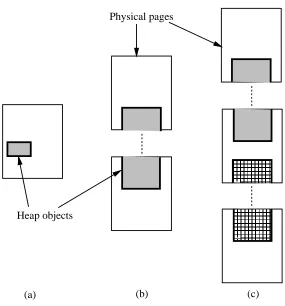
Figure 3-2 illustrates three situations the collector has to consider when protecting root objects. Figure (a) shows the case in which an ambiguous root pointer is pointing at an object in a physical page which does not have any object crossing its page boundary; there is only one physical page in the page cluster. In figure (b) there is one object spanning across more than one physical pages, so the page cluster contains the set of physical pages from the one containing the beginning of the object to the one containing the end. In figure (c) there is more than one object crossing more than one physical page boundary, forming a ‘‘chain’’ of pages which must be protected.
(a) (b) (c)
(a) Objects do not cross physical page boundary, i.e. page cluster has only one page.
(b) Page cluster has one object crossing physical page boundary.
(c) Page cluster has more than one object crossing physical page boundary. Physical pages
[image:37.612.188.473.114.420.2]Heap objects
Figure 3-2: Objects and Physical Page Clusters
4
of the cluster. Figure 3-3 illustrates the idea.
3.2.3.2 Forward Region
One reason for using a copying garbage collector is to compact memory. When objects are copied into forw_space, it is desirable to have them close to each other. Because incremental collection distributes the task of scanning objects over several intervals
4Invalid heap pages outside of the heap are of type OBJECT, so this method of determining page clusters
First heap page after end of cluster is OBJECT
OBJECT heap page
CONTINUED heap page First heap page of cluster is OBJECT
[image:38.612.178.473.123.355.2]A physical page cluster (containing 2 physical pages)
Figure 3-3: Determining physical page cluster
in time, forwarding objects in garbage collection mode occurs intermittently with allocating new objects in application mode. If special care is not taken to treat the two kinds of allocations differently, the resulting heap is likely to be very ‘‘fragmented’’, with a few heap pages of forwarded objects, followed by a few of newly-allocated objects, and so on. To deal with this problem, a ‘‘forward region’’ is reserved at the start of collection, by setting
forw_freepage to be equal to curr_freepage and subsequently advancing curr_freepage to a number of free heap pages beyond the current value. The variable curr_freepage holds the page number of the first free page that will be allocated for an application heap page in current-space; likewise, forw_freepage is the first free page that will be allocated in forward-space. By spacing out curr_freepage and
3.2.4 During GC
3.2.4.1 Page Fault Trap
When the application accesses an object on a protected physical page, the virtual memory system generates a page fault signal. This signal interrupts the application process and causes program control to be transferred to a fault handler. The fault handler finds out the faulting address of the protected page, and figures out the physical page cluster that needs to be unprotected and scanned (see section 3.2.3.1). The handler unprotects the physical page(s) in the page cluster and then calls the garbage collector’s procedure to scan the page cluster. All the physical page(s) in the page cluster are unprotected at the beginning of the scanning, and stay unprotected throughout.
3.2.4.2 Scanning Objects
The basic scanning algorithm for the incremental collector is like that for the non-incremental collector described in section 2.2.3. The page cluster represents a unit of scanning work and is therefore also called the scan region. The scanning procedure looks at all the promoted and stable heap pages in the scan region, and scans the objects by proceeding in a breadth-first manner. However, there are additional concerns in the incremental collector which do not arise in the non-incremental one.
The concerns are primarily due to efficiency requirements imposed by the real-time aspect of the incremental collector. To achieve satisfactory real-time performance, the collector must spend as little time as necessary in scanning the scan region, and return control to the application as quickly as possible. Therefore, the collector should scan all the necessary objects, but not any more than necessary. This criterion directly affects the allocation of forward-space heap pages for the forwarded objects. Because the forwarded objects must be scanned eventually, they will have to be protected. If the forwarded objects were allowed to be allocated in the scan region, then the scanning routine will have to finish scanning these newly-forwarded objects before it can revert control to the application. Additionally, scanning the forwarded objects might in turn cause more to be forwarded into the scan region.
A
B
C
D
[image:40.612.235.415.106.319.2]Physical pages
Figure 3-4: Scanning object A
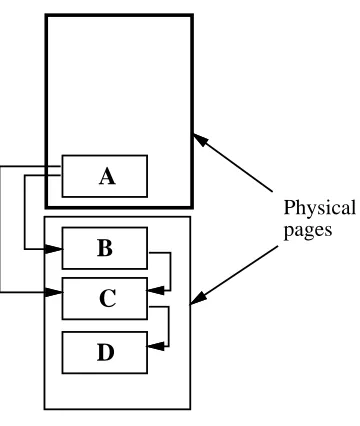
rectangle enclosing A indicates that the physical page containing A is protected and 5
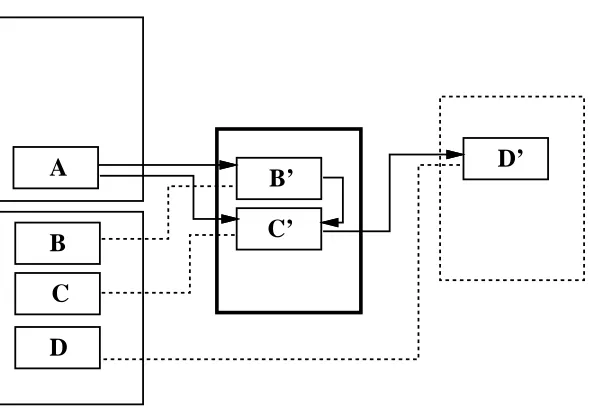
currently causing a virtual memory page fault. Therefore the page cluster has to be unprotected and scanned. Assume again that objects B, C, and D are less than one heap page in size, so that they will have to be copied. Figure 3-5 shows the result of scanning A: the objects B and C that A directly references are forwarded to another physical page (outside the scan region), and their copies B’ and C’ are subsequently protected. The forward pointers of B and C can be found in B’s and C’s header words. A forward pointer indicates the location of the copied object, so that other objects containing reference to the forwarded object can subsequently update the reference with the new location. In addition, A’s internal pointers to B and C are updated to point to the forwarded copies. This completes scanning, and the physical page containing A can be accessible to the application now.
Scanning is triggered again when the physical page containing B’ and C’ causes a page fault. Scanning B’ corrects its internal pointer (which still points to C when the fault is
5Note that although the page containing B, C and D is not protected, by the invariant of the incremental
A
B
C
D
B’
[image:41.612.200.414.102.314.2]C’
Figure 3-5: Scanning object A - II
A
B
C
D
B’
C’
D’
Figure 3-6: Scanning object A - III
[image:41.612.172.467.416.621.2]because it is already forwarded and therefore stable. Stable objects are retained by the collector and their locations do not change. They are also guaranteed to be scanned before collection is over. Scanning C’ is similar to that for scanning A: D is copied into D’, on yet another physical page outside of the current scan region containing B’ and C’. The forward pointer in D’s header is updated to point to D’, and the internal pointer in C’ is updated to point to D’ as well. D’ will be protected after this level of scanning is complete. Since D’ does not have any reference to other objects, scanning D’ later in collection does cause any additional forwarding. (The above describes the basics of the scanning strategy, section 3.2.4.4 will discuss a memory fragmentation problem entailed by this scheme and present a revised design.)
In general, if a stable pointer is discovered when scanning an object, no further work needs to be done. For an internal pointer to an unstable object, there are a few possibilities, as outlined in figure 3-7. In this example, scanning C’ discovers a pointer to D, which is a small object outside of the scan region, so D is forwarded. All (unstable) small objects, whether outside or inside the scan region, are forwarded in the hope of compacting memory.
Promote and protect object
Scan object before exit Forward object Forward object
OUTSIDE scan region
INSIDE scan region
BIG object
[image:42.612.169.462.399.540.2]SMALL object
Figure 3-7: Scanning strategy for unstable objects
scan region is always scanned in order -- the scan pointer makes one pass through the region and scans all objects which need to be scanned -- it can be determined with certainty whether an object in the scan region has had its chance to be scanned by comparing the address of that object with the scanning pointer. If the large object about to be promoted has not been swept by the scanning pointer, then it can be safely assumed that the scanning pointer will get to it later, realize that it has been made a stable object, and will therefore scan it. If on the other hand the object has already been swept by the scanning pointer, then the scanning procedure will have to ‘‘backtrack’’ to scan it properly. Correct operation requires that all the promoted objects in the scan region be scanned before the scanning procedure exits.
Depending upon the operating system the collector runs on, the cost of physical page protection facility may dominate the overhead of incremental collection. For this reason, it is desirable to not only minimize the amount of scanning each time the program pauses for garbage collection, but to minimize the number of memory protection calls. The naive way of implementing the forwarding strategy would be:
1. Unprotect the physical page containing the object to be forwarded, if it is protected.
2. Allocate a heap page in forward-space if necessary.
3. Unprotect the enclosing physical page if it is protected.
4. Copy the object onto the current actively forward heap page.
5. Protect the physical page containing this forward heap page.
6. Protect the physical page containing the forwarded object if it was unprotected in step 1.
3.2.4.3 Application Allocation
With only minor refinement, the incremental collector’s allocation algorithm for newly-created current-space (application) objects follows closely from the one for the non-incremental collector described in section 2.2.2. Regardless of whether there is garbage collection ‘‘going on,’’ the collector finds a free heap page and allocates it in
curr_space. If there is indeed unfinished garbage collection work, then a protected physical page is selected (randomly) to be scanned every time a current-space allocation is requested. This ensures that scanning will catch up with application allocation, so that it is less likely the heap will run out of space before collection is over.
Another refinement is that the incremental allocation algorithm has to be concerned with page clusters. Scanning occurs on the granularity of one page cluster at a time, so the length of a garbage collection pause is directly proportional to the size of the page cluster (the scan region), thus it is important that page clusters are not allowed to grow arbitrarily large, or the purpose of incremental collection will be defeated. Recall in figure 3-2 (c) that a big page cluster spanning several pages is formed when there are objects (larger than one heap page in size) crossing physical page boundaries on consecutive physical pages. To limit the size of page clusters, the current implementation forbids page clusters with more than one object crossing the physical page boundary. By checking the type identifiers of the heap pages at the neighboring physical page boundaries, the allocation procedure verifies that the heap page(s) about to be allocated do not contribute to the creation of a page cluster consisting of more than one object crossing page boundary. It is possible to adjust this restriction to tune performance on different hardware platforms. For instance, if scanning can be carried out faster on a high performance machine, then the restriction on page cluster size could allow more pages and still achieve satisfactory collection pauses.
3.2.4.4 Collector Allocation
Using the allocation strategy discussed so far, A allocates a forward-space page to 6
copy B and C, into B’ and C’, respectively , and when B’ and C’ are scanned, the trailing space on their forw_space heap page is discarded. For a program traversing down a linked list in order, this means that when the elements are forwarded one by one after successive page faults, each element will be made to ‘‘occupy’’ one whole heap page. If each element is much less than one heap page in size, the amount of memory fragmentation is significant.
To avoid fragmentation twoforw_freepage’s are maintained. The idea is to flip-flop between the two ‘‘forward regions’’ referred to by the forw_freepage’s, so that instead of ‘‘spreading out’’ the composite object onto potentially many physical pages, it is separated into two regions. In addition, the original rule saying that ‘‘the forwarded objects are always allocated outside of the scan region’’ becomes the forwarded objects are always allocated outside of the scan region, unless the current forward-space free heap page has enough space remaining for the next forward object to be copied there. Perhaps it is most appropriate to illustrate with an example.
Figure 3-8 shows a linked list of six objects. Assume that each object occupies half a heap page, and that they are all residing on different physical pages. For simplicity assume also that all the physical pages are unoccupied except for the objects shown. The head of the list A is protected, so eventually the whole list structure will be forwarded into a more compact area. When a page fault ocurrs on the physical page containing A, A is scanned which causes B to be forwarded. B is subsequently protected, and the application is allowed to continue. Without the augmented rule, by the time B is scanned, the trailing space after B would have been wasted; but with the augmented rule, scanning B causes C to be copied onto the trailing space after B, and C is scanned immediately afterwards. Scanning C causes D to be forwarded, but this time onto a different physical page. Then D is protected, and the application continues. Eventually D is unprotected and scanned, so that E is copied to the trailing space after D. Like before, E is immediately scanned, which causes F to be forwarded. F is then protected and once again the application is allowed to proceed. Finally, when F is unprotected and scanned, there is no more objects to forward. The ultimate result of the scanning, as shown in the figure, is that the linked structure pointed to by A is compacted onto three heap pages on two physical pages. Because forward-space heap page allocation tries to flip-flop between two physical pages, if the linked structure
A B C D E F
A
E’ D’
C’ B’
F’
Heap pages
[image:46.612.176.471.269.602.2]After scanning, objects B, ..., F are compacted onto two physical pages. Before scanning, all objects are on separate physical pages...
were longer, then the remaining elements would also be compacted on these two physical pages.
3.2.5 End GC
Garbage collection is finished when all the protected physical pages have been unprotected and scanned. Each time a current-space heap page allocation is requested, the collector checks whether protectedpages==0, and if so, garbage collection is terminated. The trailing words left in forw_freepageare discarded; since there will not be any more forward objects to be copied. To mark that collection is over,forw_spaceis set to be equal to curr_space. To reclaim storage, prev_space is set to
curr_space, so that all the heap pages which used to be in previous-space are now free for allocation -- a heap page is allocatable if and only if its space identifier is not stable and is not equal to prev_space or curr_space. The bookkeeping variable
allocatedpages is corrected, and depending on how much of the heap is occupied (by examining the fraction allocatedpages/heappages), a total collection may be started. In that situation, all the stable heap pages are made unstable by assigning them the
curr_spacespace identifier, and a new garbage collection is initiated.
3.2.6 Heap Page State Transitions
This section recapitulates the process of incremental, generational mostly-copying collection using state transitions. Figure 3-9 shows a map of all the different possible states for a heap page. The set of possible states is constructed from the cross product of {space
7
identifier: free, current-space, previous-space, forward-space, or stable} , {page protection: protected, or unprotected}, and {collection status: scanned, or not scanned}. As the figure indicates the cross product generates twenty different combinations, but a number of them do not exist. For instance, only forward-space and stable heap pages are ever scanned, so by definition, there is not any scanned heap page (protected or otherwise) in either current, previous, or free space. The collector never allows the application to access unscanned stable and forward-space heap pages, so unprotected and unscanned forward-space and stable heap pages are not possible. Then there are some states that heap pages arrive in only
7The difference between forward-space and stable heap pages is that the former has its space identifier set to
by coincidence. Since there is more than one heap page in a physical page, heap pages in current, previous, or free spaces can be found on a protected physical page if there happens to be unscanned forward-space or stable heap page on the same physical page. When the protected page is unprotected, the collector scans only the forward-space and stable heap pages. The collector does not operate on the other heap pages. Heap pages arriving in a state by coincidence leaves the state eventually, without active work on the part of the collector.
Adjacent (unscanned) forward/ stable heap pages protected
Unprotected, Scanned
Unprotected, Unscanned
Protected,
Scanned Adjacent (unscanned)forward/stable heap pages protected
Free Current Previous Forward Stable
State exists
State arrived at by coincidence Protected,
[image:48.612.131.517.253.536.2]Unscanned
Figure 3-9: Heap page state table
Free Unprotected, Unscanned
Current Unprotected, Unscanned
Previous Unprotected, Unscanned Stable
Unprotected, Scanned
Stable Protected, Unscanned
Forward Protected, Unscanned
Forward Unprotected, Scanned Start GC
Total GC
End GC
Scanning Scanning
Application Allocation
End GC
Forwarding
Promote Page
prev_space = curr_space; curr_space += 2;
[image:49.612.132.511.202.578.2]Start GC
Chapter 4
Experimental Results
An incremental, generational mostly-copying collector has been built which accomplishes the following objectives:
1. Hardware and compiler independence -- The mostly-copying collection algorithm does not require any specialized hardware or compiler support to identify root objects. The result is a highly portable garbage collector that can be adapted to uncooperative environments.
2. Real-time performance -- The incremental collection strategy distributes the task of scanning objects over time and reduces the length of GC pauses typically suffered by non-incremental collectors drastically. On the DECStation 3100, the maximum GC pause of the incremental collector is well within the 100-millisecond limit imposed by most real-time applications. The average GC pause is merely 4 milliseconds long.
3. Satisfactory total execution time -- With generational collection, total execution time is reduced because repeated copying of long-living stable objects can be avoided. Generational collection is important for the incremental collector because incremental collection inherently requires more heap space, while generational collection lessens the contention for heap space.
Elaboration of these results can be found in the following sections. Section 4.1 states the success and limitation of the first objective. Section 4.2 describes the benchmark programs used and presents the benchmark measurements. Sections 4.3 discusses the accomplishment of the second objective, and section 4.4, the third objective.
4.1 Hardware and Compiler Independence