S T U D Y P R O T O C O L
Open Access
An education intervention to improve
health literacy and decision making about
supporting self-care among older
Australians: a study protocol for a
randomised controlled trial
Caroline A. Smith
1*, Esther Chang
2, Gisselle Gallego
3and Lynda G. Balneaves
4Abstract
Background:Older Australians are high consumers of complementary and alternative medicines (CM). To help
older people to take an active role in their health, we will develop and evaluate a novel educational intervention to support decision self-efficacy, and improve health literacy skills.
Methods:The primary hypothesis is that participants receiving a web/DVD plus booklet intervention compared
with a booklet-only group will demonstrate an increase in decision self-efficacy. This study is a randomised controlled trial. One hundred and sixty-eight people aged 65 years and older will be recruited from community settings comprising retirement villages and community groups, based in Sydney, Australia. Participants will be randomly allocated to either the education intervention delivered by the Internet or a DVD plus booklet versus a control group (booklet only). The primary outcome measure is CM decision self-efficacy. Secondary outcomes are health literacy, knowledge and attitudes, and change in health-seeking behaviour. Participants’views on the ease of using the resources, the length of the modules, the amount of information, and participant understanding of the modules will be assessed. Outcomes will be collected on completion of the intervention at 3 weeks, and at a 2-month follow up from trial entry.
Discussion:This trial has the potential to improve CM health literacy in older Australians. There are no educational resources designed to support decision self-efficacy and improve health literacy amongst older people related to CM. Trial registration:Australian New Zealand Clinical Trials Registry (ANZCTR), ACTRN12616000135415. Registered on 5 February 2016.
Keywords:Complementary medicine, Randomised controlled trial, Health literacy, Australia
Background
More than three million Australians (14% of the popula-tion) are aged over 65 years [1]. Studies indicate seniors take an active role in their health care to improve their health and wellbeing [2], and there is growing evidence that seniors are high users of complementary medicines (CMs). A survey of older Australians found 58% of those aged over
65 years have used at least one of 17 common CM modal-ities in a previous 12-month period, and 65% of these had visited a CM provider [3]. The Australian Longitudinal Study of Aging, an ongoing prospective study of the older population, demonstrated the prevalence of CM utilisation to have increased over time, from 17% in 2000–2001 to 35% in the 2003–2004 period [4]. CM is generally used to treat a wide range of chronic health complaints that be-come increasingly common with age [5], particularly musculo-skeletal conditions and pain [6], and anxiety or de-pression [7]. CM users report significant benefits to both
* Correspondence:[email protected]
1National Institute of Complementary Medicine, Western Sydney University,
Locked Bag 1797, Penrith NSW 2571, Australia
Full list of author information is available at the end of the article
their physical and mental health from CM [8, 9], and that CM is highly valued by encouraging individuals to partici-pate in their health [10].
To be health literate implies having a range of skills and knowledge about health and health care, including the ability to find, understand, interpret, and communicate health information, seek appropriate care, and make crit-ical health decisions [11]. Systematic reviews have con-cluded that low levels of health literacy are associated with poorer treatment outcomes, including poor compliance with medication, increased admissions to emergency de-partments, lower ability to interpret labels and health messages, reduced health status, and increased mortality among the elderly [12]. The ability to obtain reliable health information is important to all populations but par-ticularly older people. Reports indicate an increasing num-ber of older people are seeking information on the Internet [13], yet remain unaware of how to identify qual-ity information to guide their use of this information.
There has been significant discussion in the literature about what constitutes health literacy and how to measure it. The health literacy Ophelia Project undertaken at Deakin University, Australia, identified nine concepts of health lit-eracy [14]. These include having sufficient information to manage health, social support for health, skills to appraise health information, ability to engage with healthcare pro-viders, capacity to navigate the healthcare system, ability to find good health information, and sufficient understanding of health information to know what to do with it.
Complementary medicine may offer a way for older people to cope with their ill health, or to engage in main-taining their health; however, this assumes good health lit-eracy skills. There has been little research examining the decision self-efficacy of CM users and their levels of health literacy. This could be of particular concern due to the use of CM without adequate supervision by a qualified health practitioner, and a higher prevalence of polypharmacy arising from the treatment of complex chronic health con-ditions [15]. Seniors may also be more susceptible to medication sensitivity due to less optimal organ function associated with aging [15–17]. Together, these concerns may increase the risk of potential CM-drug interactions. In the Australian community, the prevalence of serious adverse reactions to CM is relatively low compared to pharmaceutical medications [18]; however, mild reactions are common. A retrospective review of previously col-lected health data identified that 15% of 5052 participants used CM and 5.8% were identified as having a significant risk of an adverse reaction [19]. These risks were linked to garlic and ginkgo biloba and their interactions with drugs affecting blood coagulation, such as aspirin and warfarin, which, represented 95% of the (potential) significant inter-actions identified. Other high-risk natural product and drug combinations identified as potentially dangerous
include ginseng and warfarin, and St John’s wort used along with digoxin.
This risk of interactions is further complicated by lim-ited disclosure of CM use between consumers and their healthcare providers. Non-disclosure rates to healthcare providers among those using CM have been reported to be as high as 71% [18, 20]. There are multiple reasons for non-disclosure including the individual forgetting to mention CM use, disclosure not being seen as relevant, the doctor not asking about CM use, and the doctor not respecting the value of CM [20]. Disclosure and commu-nication about CM is essential for achieving optimal treatment outcomes.
To explore these issues, we recently completed a two-phase, sequential, mixed-method study incorporating quantitative and qualitative methods to examine CM health literacy in a population of older Australians living in retirement villages [21]. We found older Australians using CM were making decisions regarding managing their own health and self-care [21]. Our primary findings suggest this population demonstrate differing competen-cies relating to health literacy. We identified three scales where older adults scored low including navigating the health care system, an ability to find good information, and appraisal of health information. Interpretation of these scales suggests that some participants were unable to understand most health information and were con-fused when they were presented with conflicting infor-mation. We found that these seniors were also unable to access health information when required, they were fre-quently dependent on others to offer information, were unable to advocate on their own behalf, and struggled to find someone who could help them to use the healthcare system to address their health needs.
There are few programmes that have addressed the spe-cific health literacy needs of older people. A pilot health lit-eracy programme that aimed to build health information literacy skills found that following literacy workshops, par-ticipants were empowered to ask questions and reported greater success with finding health information online [22].
Methods/designs
The primary hypothesis is that participants receiving a web/DVD plus booklet intervention compared with a booklet-only group will demonstrate an increase in deci-sion self-efficacy. The secondary hypotheses are that par-ticipants receiving a web/DVD plus booklet intervention compared with a booklet-only group will demonstrate an increase in health literacy, communication skill, and change in health-seeking behaviour.
Study design
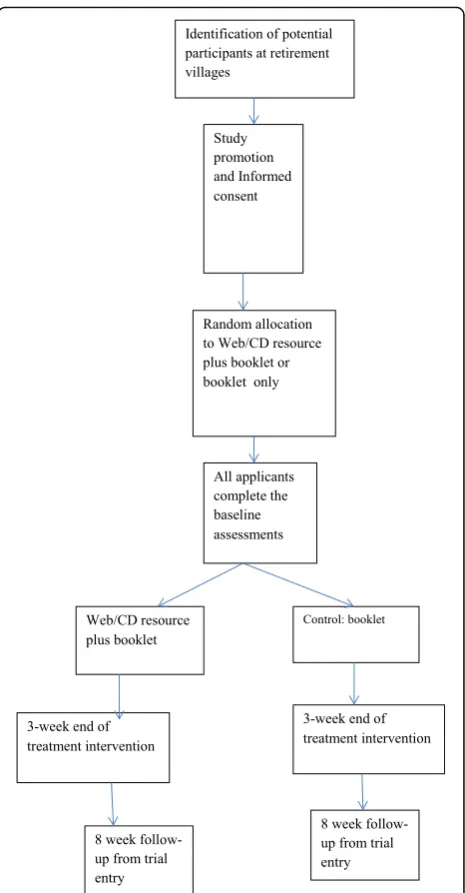
This study (see Fig. 1) is a parallel, randomized, con-trolled trial of a CM education intervention delivered online (using a purpose built website) or DVD plus booklet versus a control group (booklet only) to examine the effect on decision self-efficacy, health literacy, per-ception of risk, and health-seeking behavior, on comple-tion of the intervencomple-tion at 3 weeks, and at 2-month follow up from trial entry. Full details of reporting of the trial protocol items can be found in the“Standard proto-col items: recommendation for interventional trials” (SPIRIT) checklist (please see Additional file 1).
Trial setting
We will recruit participants from a community setting comprising retirement villages and community groups, based in Sydney, Australia. In Australia, a retirement vil-lage is made up of housing for people aged over 55 years who are able to live independently. Many of these vil-lages offer some healthcare services, leisure facilities, and social clubs. The village provides smaller, manage-able housing, supportive of the changing needs of older people. In this setting, we will contact the managers of the retirement villages to describe the study and seek permission to come and promote the study to residents. We will also recruit from various community groups, in-cluding senior citizen clubs, associations and referrals from study participants.
Study population
The study population will comprise men and women aged 65 years and older, with access to the Internet or a DVD player or computer, who will provide informed consent for participation in the study. Exclusion criteria include being unable to communicate in English or liv-ing in a long-term care facility.
Randomisation and blinding
The randomisation sequence was computer generated by an online randomisation service by Sealed Envelope randomisation service, Ltd 2016 (https://www.sealeden-velope.com/), with the codes concealed in sealed, opaque envelopes. Participants will be randomised in a 1:1 ratio, in blocks of eight to either group 1: web/DVD resource
plus booklet, or group 2: control booklet only (see Fig. 1). Participants are not blind to their group allocation; how-ever, the study analyst will be blind during analysis, and the codes will be broken following statistical analysis. The trial co-ordinator was not blind to study group.
Sample size calculation
The sample size was calculated using GPower, and was based on“sample size effect” drawn from published data [23]. It was estimated that a moderate effect size would be obtained (i.e. Cohen D= 0.5) for the primary end-point only, with improved decision self-efficacy between groups at the end of the 3-week intervention. With the alpha value set at 0.05 and power at 0.8 (i.e. 80% chance
[image:3.595.306.539.85.532.2]that the expected effect size would be significant), a minimum sample size of 64 per group, with rounding to 70 per group was estimated. Allowing for 20% attrition, a total sample size of 168 participants was required for this trial (i.e. 84 per group).
Interventions
The educational intervention has been informed by our preliminary research [21]. The delivery of the intervention will comprise a multi-media (web/DVD) intervention, and booklet. The delivery format has been informed by find-ings from the Cochrane systematic review of multimedia educational interventions and offers advantages over the traditional information delivery [24]. A combination of audio with video or graphical presentation can overcome difficulties with low literacy skills [25]. Studies have also shown that learning is improved when material is pre-sented as an audio-visual rather than visual-alone format [26, 27]. A multimedia format also has the advantage that the resources can be used at a pace that suits the user, and at a time and place that is convenient to the individual.
The education intervention comprises five modules, and includes information about CM and other self-care prac-tices, such as exercise. The intellectual content of the inter-vention has been developed from the Complementary Medicine Education and Outcomes (CAMEO) research programme [28], and modified for use in the Australian context. The CAMEO resource comprises a website and booklet and was developed with links to credible and evidence-based information resources (www.cameoprogra-m.org/). The CAMEO resource was developed for patients with cancer; however, for this study the education resources have been adapted for use with older individuals.
Group 1: DVD/web format
The intervention comprises five modules:
1. Module 1 -Complementary medicine - the evidence.
This module provides scientific evidence related to the health benefits of CM, its indications, and details of various evidence-based CM that are widely prac-ticed globally.
2. Module 2 -Finding and evaluating complementary medicine evidence. This module provides an introduction to scientific evidence and how to find research-based studies about CM. It describes data-bases that are available to find research, how to con-duct a search, and how to use the available evidence in making an informed choice about CM.
3. Module 3 -Decision making–complementary medicine.In this module, advice is provided regarding how to bring together the information they have obtained from earlier modules, aligning this with their goals and values, and how to have
discussions with relevant key people to make an informed decision about the use of CM. The universally employed situation, choices, objectives, people, evaluation, and decisions (SCOPED) framework [29] has been incorporated to assist the participant in their decision making.
4. Module 4 -Working with complementary medicine practitioners. This module explains the role of conventional healthcare providers and CM practitioners, and the importance of, and how to disclose CM use with conventional health providers. Guidance is provided regarding the regulatory frame work for CM practitioners in Australia, how to find a professionally accredited CM practitioner and practical tips and questions to ask to guide the selection of a CM practitioner.
5. Module 5 -Monitoring complementary medicine decisions. This module explains the need to monitor one’s health following the use of CM products or therapies. It provides guidance on certain criteria that should be utilised in respect to monitor one’s health and the safety of CM and the procedure (including contact details) of adverse events reporting for CM therapy and services in Australia. There is a final section that includes two case studies of individuals exploring self-care and use of CM that draws on the detailed information pre-sented in the modules.
Participants in the intervention group will be invited to watch the five-module intervention in their home by ei-ther accessing a website using a password, or viewing a DVD player or computer, over a 3-week time period. Each module takes approximately 30 minutes to complete, and completion of two modules per week over 3 weeks is rec-ommended. Users will be able to pace their learning using the navigation menus on the website or DVD. Participants are able to access the intervention as often as they wish. They will also receive a copy of the booklets.
Group 2: control group
Development and piloting of the intervention
The investigators undertook development, proofing and editing of the web materials and booklet, with the assist-ance of web and communication officers at Western Syd-ney University. Following development of the modules and booklet, a pilot study was undertaken for preliminary testing of the educational and assessment tools. Four par-ticipants were presented with the booklet or access to the website to review the booklet or selected web-based mod-ules. Participants were requested to read the allocated re-sources and to complete a short feedback form on the content of the resources, ease of understanding the mater-ial, did they feel overwhelmed by the amount of content, did the images help them to engage with the material, was the font size and layout appropriate, and was the website easy to navigate? The participants were also invited to come together in a focus group context to discuss the re-sources. The group session was led by GG and the inter-view guide included questions about ease of use of the educational materials (i.e. font size, colour, background, instructions), and how long it took participants to complete the modules. For those using the website specific questions were asked about where they accessed the web-site, and what did they use (i.e., tablet, laptop, desktop). Participants were also asked about the ease of understand-ing the concepts presented.
Feedback from the focus groups indicated participants found the information useful and interesting, they enjoyed the interactive, engaging and colourful format of the resources, the modules did not require as much time as expected to complete, and they enjoyed accessing the resources in their own time. The baseline questionnaire was also pilot tested with the focus group and as a result small wording and skip logic changes were undertaken to the instruments.
Procedure for the trial
Following completion of the pilot and minor modifica-tion to the resources, recruitment for the main trial commenced in July 2016. Recruitment will be under-taken at all interested retirement villages. Study promo-tion will involve letter box drops, and promopromo-tional talks by the investigators and the trial co-ordinator. At these visits, following a promotional study presentation, ex-pressions of interests will be gathered and participant in-formation and consent forms made available. A mutually convenient time will be made to obtain informed con-sent and to complete baseline questionnaires.
Following randomisation, the trial co-ordinator will meet with each participant to ensure they are able to ac-cess the website using the password and to navigate the modules, or ensure navigation with the DVD is satisfac-tory. To minimise attrition, all groups will receive a phone call mid-way through the intervention to ensure
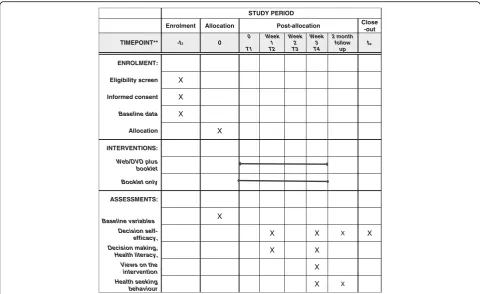
they are continuing to access the resources and address any difficulties. Primary and secondary outcome data will be collected at baseline, at the end of the interven-tion and at two months from trial entry. At trial entry we will collect baseline data on socio-demographic (age, gender, place of birth, education status, employment sta-tus, ethnicity, English skills, Medicare and private health insurance) and health characteristics, health behaviour, and lifestyle including CM use, sources of information, Internet skills, health literacy status, and decision-making (Fig. 2: SPIRIT figure).
Data management
Data capture will be via paper-based questionnaires. Data will be manually entered onto the electronic RED-Cap data management system by the trial co-ordinator. Any issues will be discussed at the weekly research meeting. All entered data will be de-identified.
Primary outcome measure
Decision self-efficacy
The primary outcome is the change on decision self-efficacy at the end of the intervention assessed between groups. The Decision Self-Efficacy scale [30] will be used to assess differences in decision-making skills. The Deci-sion Self-Efficacy scale will measure self-confidence or belief in one’s ability to make decisions, including an ability to participate in shared decision making. This scale comprises 11 items rated along a 5-point scale from“not at all confident” to“very confident”. The psy-chometric properties report an alpha coefficient of 0.92, and the scale has been shown to be correlated with deci-sional conflict scales (DSC) of feeling informed (0.47) and supported (0.45) [32]. Scores on the scale are con-verted to a 0–100 scale. Scores range from 0 (extremely low self-efficacy) to 100 (extremely high self-efficacy).
Secondary outcome measures
[31]. The scale is only administered after the interven-tion has been administered, and the items are summed, scored and converted to a 0–100 scale. Higher scores in-dicate a higher perceived level of preparation for deci-sion making.
The health literacy of participants will be evaluated using a validated and universally employed Health Lit-eracy Questionnaire (HLQ) [14]. The HLQ contains a total 55 questions grouped into nine domains including: (1) feeling understood and supported by healthcare providers; (2) having sufficient information to manage personal health; (3) an ability to actively manage per-sonal health; (4) social support for health; (5) appraisal of health information; (6) ability to actively engage with health care providers; (7) navigating the health care sys-tem; (8) ability to find good health information; and (9) understanding health information well enough to know what to do. Each scale includes four to five items, with participants indicating their response along a Likert-type scale with response options ranging from 1 -“very difficult”to 4 -“very easy”, or along a 5-point scale ran-ging from “strongly agree” to “strongly disagree.” The HLQ has strong psychometric properties, it is grounded in the individual’s lived experience, and is validity driven [14]. Reliability testing was examined using Ray-kov’s procedures rather than Cronbach’s alpha where > 0.80 was sought. This was achieved for eight of the nine
domains; the lowest reliability estimates were achieved for the appraisal of information (0.77). Health literacy scales will be calculated using a scoring algorithm for the HLQ version 1 (dated 2012). The algorithm pro-duces unweighted scale scores for the nine scales of the HLQ, with the final score for each subscale an average score across all items forming the scale. For missing values, this programme uses an algorithm to impute missing values. For scales with four to five items, two missing values can be imputed. For scales with six items, three missing value can be imputed, and if more responses among the scale items were missing, scale score were not computed.
Health-seeking behaviour will be assessed by responses to questions on use of self-care and CM. It will be assessed through a self-reported questionnaire based on questions relating to use of health information sources. Perception of risk will ask questions about the safety of CM. To evaluate the intervention we are seeking partici-pants’ views on the ease of using the resources, the length of the modules, the amount of information and participant understanding of the modules and written information. We will ask participants if they have used the resources outside of the intervention, and if yes, how easy or difficult this was, and did the resources assist with making an informed decision. All data forms will be completed by study participants.
STUDY PERIOD
Enrolment Allocation Post-allocation Close
-out
TIMEPOINT** -t1 0
0
T1 Week
1 T2
Week 2 T3
Week 3 T4
2 month follow
up tx
ENROLMENT:
Eligibility screen X
Informed consent X
Baseline data X
Allocation X
INTERVENTIONS:
Web/DVD plus booklet
Booklet only
ASSESSMENTS:
Baseline variables X
Decision
self-efficacy, X X X X
Decision making,
Health literacy, X X
Views on the
intervention X
Health seeking
behaviour X X
[image:6.595.57.538.87.381.2]Statistical analysis
The trial co-ordinator will co-ordinate all data manage-ment and cleaning prior to analysis. Data on refusal and dropout will be coded and reported according to Con-solidated Standards of Reporting Trials (CONSORT) guidelines [33, 34]. A description of the baseline charac-teristics of study participants will be compiled using de-scriptive statistics, such as mean, standard deviation for continuous variables and categorical variables will be summarised by counts and percentages.
The primary analysis will be conducted using all rando-mised participants. The chi square (X2) test and analysis of variance (ANOVA) will be used to identify the differ-ences between intervention groups for the categorical and continuous variables respectively. Secondary analyses will examine changes within group over time using repeated measures ANOVA and the Sidak test to correct for mul-tiple comparisons [35]. Levels of significance will be re-ported at thep< 0.05 level. All CIs will contribute to data interpretation. All analyses were conducted using SPSS statistical software, version 22. The results from this un-blended trial will be critically evaluated for bias, and this will be considered during interpretation of the results.
Discussion
We have identified a need to support older adults’decision self-efficacy regarding CM. Low levels of health literacy have also been identified among an older population of CM users, who struggle to find good information, and under-stand what it means [21]. This trial seeks to improve deci-sion making by providing information resources to participants to understand why research studies are import-ant, to seek out reliable information and apply new skills to inform their decision self-efficacy. We aim to examine changes in behaviour in the short term and believe these in-formation resources have the potential to reduce the risk of adverse events arising from mis-information.
We expect that this trial will contribute to our under-standing of interventions aimed at supporting decision self-efficacy regarding any self-care behaviour to maintain health and wellbeing, including appropriate use of self-care and CM in older Australians. In addition, by asses-sing the effect of the intervention on decision self-efficacy, health literacy and health-seeking behaviour, and we will gain new insights into the preferred method of delivery of information resources to older Australians. The outcomes from this study will be important given the high rates of non-disclosure to health professions regarding CM use and previously identified areas of low health literacy.
Dissemination
We plan to disseminate findings via an academic journal, we will also write to all study participants and retirement villages with a copy of the results. All reports will follow
the CONSORT guidelines [36] and the extension to non-pharmacological interventions [34]. We will follow the NHMRC codes of conduct for research authorship. The trial protocol will be made freely available. A rea-sonable request for de-identified data set will be consid-ered by the investigators.
Trial status
Recruitment commenced in July 2016. Recruitment was completed in May 2017, and the study was completed in July 2017.
Additional file
Additional file 1:Spirit checklist. (DOC 120 kb)
Abbreviations
CM:Complementary medicine; DSC: Decisional conflict scales; HLQ: Health Literacy Questionnaire
Acknowledgements
We wish to thank Natalie Connor and Natalie McLaughlin for their assistance with web design and editing of materials. Participants for their involvement with the piloting stage, Kylie Barr for her assistance with the development of the DVD, and Afshan Khan for preparation of study materials.
Funding
The trial has been funded by the Illawarra Retirement Trust (IRT). No reference number available.
Availability of data and materials
The data sets analysed during the current study are available from the corresponding author on reasonable request.
Authors’contributions
CS, EC, and GG contributed to the development of the trial intervention. EC provided expertise with the design and testing of health interventions involving older people. GG took the lead with the design of the delivery format of the interventions. LB contributed to the intellectual development of the Complementary Medicine Education and Outcomes (CAMEO) research programme, which developed the educational resource forming the foundation of the intervention. All authors contributed to the editing of the manuscript and have read and approved the final manuscript.
Ethics approval and consent to participate
The study was granted ethical approval by Western Sydney University human ethics committee in October 2015 (H11361). Amendments to the study will be submitted to ethics committee and updated on the trial registry. Subjects gave written consent to participate in the trial.
Consent for publication
Not applicable.
Competing interests
Publisher’s Note
Springer Nature remains neutral with regard to jurisdictional claims in published maps and institutional affiliations.
Author details
1National Institute of Complementary Medicine, Western Sydney University,
Locked Bag 1797, Penrith NSW 2571, Australia.2School of Nursing and
Midwifery, Western Sydney University, Locked Bag 1797, Penrith NSW 2571, Australia.3School of Medicine, The University of Notre Dame, Sydney,
Australia.4College of Nursing, Rady Faculty of Health Sciences, University of
Manitoba, 89 Curry Place, Winnipeg, Manitoba R3T 2N2, Canada.
Received: 27 September 2016 Accepted: 12 September 2017
References
1. Australian Institute of Health and Welfare. Australia’s health 2012. In: Cat no AUS 156. Cat. no. AUS 156 edn. Canberra; 2012.
2. Ding D, Grunseit AC, Chau JY, Vo K, Byles J, Bauman AE. Retirement - a transition to a healthier lifestyle? Evidence from a large Australian study. Am J Prev Med. 2016;51:170–8.
3. Zhang A, Xue CC, Lin V, Story DF. Complementary and alternative medicine use by older Australians. Ann NY Acad Sci. 2007;1114:204–15.
4. Goh LY, Vitry AI, Semple SJ, Esterman A, Luszcz MA. Self medication with over the counter drugs and complementary medications in South Australia’s elderly population. BMC Complement Alt Med. 2009;9:42. 5. Britt HC, Harrison C, Miller GC, Knox SA. Prevalence and patterns of
multimorbidity in Australia. Med J Aust. 2008;189:72–7.
6. Anderson EZ. Complementary therapies and older adults. Topics Geriatr Rehabil. 2009;25:320–8.
7. Yen L, Jowsey T, McRae IS. Consultations with complementary and alternative medicine practitioners by older Australians: results from a national survey. BMC Complement Altern Med. 2013;13:73.
8. Andrew G. Private complementary medicine and older people: service use and user empowerment. Ageing Soc. 2002;22(3):343–68.
9. Williamson AT, Fletcher PC, Dawson KA. Complementary and alternative medicine: use in an older population. J Gerontol Nurs. 2003;29(5):20–8. 10. Cartwright T.“Getting on with life”: The experience of older people using
complementary health care. Soc Sci Med. 2007;64:1692–703. 11. Nutbeam D. Health literacy as a public health goal: a challenge for
contemporary health education and communication strategies into the 21st century. Health Promot Int. 2000;15(3):259–67.
12. Berkman N, Sheridan S, Donahue K, Halpern D, Crotty K. Low health literacy and health outcomes: an updated systematic review. Ann Intern Med. 2011; 155(2):97–107.
13. Tu HT, Cohen GR. Striking jump in consumers seeking health care information. In: Tracking report No 20. Washington DC: Centre for studying Health System Change; 2008.
14. Osbourne R, Batterham R, Elsworth G, Hawkins M, Buchbinder R. The grounded psychometric development and initial validation of the Health Literacy Questionnaire (HLQ). BMC Public Health. 2013;13:658. 15. Atkin PA, Veitch PC, Veitch EM, Ogle SJ. The epidemiology of serious
adverse drug reactions among the elderly. Drugs Aging. 1999;14:141–52. 16. McLean AJ, Le Couteur DG. Aging biology and geriatric clinical
pharmacology. Pharmacol Rev. 2004;56:163–84.
17. Heft MW, Mariotti AJ. Geriatric pharmacology. Dent Clin North Am. 2002;46: 868–85.
18. Braun LA, Tiralongo E, Wilkinson JM, Poole S, Spitzer O, Bailey M, Dooley M. Adverse reactions to complementary medicines: the Australia pharmacy experience. Int J Pharm Pract. 2010;18:242–4.
19. Elmer GW, Lafferty WE, Tyree PT, Lind BK. Potential interactions between complementary/alternative products and conventional medicines in a Medicare population. Ann Pharmacother. 2007;41(10):1617–24.
20. Robinson A, McGrail MR. Disclosure of CAM use to medical practitioners: a review of qualitative and quantitative studies. Complement Ther Med. 2004;12:90–8. 21. Smith CA, Chang E, Brownhill S, Barr K. Complementary medicine health literacy among a population of older Australians. Evid Based Complement Altern Med. 2016;2016:5672050.
22. Aspinall EE, Beschnett A, Ellwoood AF. Health literacy for older adults: using evidence to build a model educational programme. Med Ref Serv Q. 2012; 31(3):302–14.
23. de Achaval S, Fraenkel L, Volk RJ, Cox V, Suarez-Almazor ME. Impact of educational and patient decision aids on decisional conflict associated with total knee arthroplasty. Arthritis Care Res. 2012;64(2):229–37.
24. Ciciriello S, Johnston RV, Osborne RH, Wicks I, de Kroo T, Clerehan R, O'Neill C, Buchbinder R. Multimedia educational interventions for consumers about prescribed and over-the-counter medications. Cochrane Database Sys Rev. 2013(4):Art. No.: CD008416.
25. Wofford JL, Currin D, Michielutte R, Wofford MM. The multimedia computer for low-literacy patient education: a pilot project of cancer risk perceptions. Med Gen Med. 2001;3:23.
26. Kalyuga S, Chandler P, Sweller J. Incorporating learner experience into the design of multimedia instruction. J Educ Psychol. 2000;92:21–36.
27. Moreno R, Mayer RE. Cognitive principals of multimedia learning: the role of modality and contiguity. J Educ Psychol. 1999;91:358–68.
28. Balneaves LG, Truant TL, Verhoef MJ, Ross B, Porcino AJ, Wong M, Brazier AS. The Complementary medicine Education and Outcomes (CAMEO) programme: a foundation for patient and health professional education and decision support programmes. Patient Educ Couns. 2012;89:461–8. 29. Belkora J, Miller M, Crawford B, Coyne K, Stauffer M, Buzaglo J, Blakeney N,
Michaels M, Golant M. Evaluation of the question listing at the cancer support community. Transl Behav Med. 2013;3(2):167–17.
30. O'Connor AM. User manual-Decision self efficacy scale. Ottawa: Ottawa Hospital Research Instiutute; 1995.
31. Bennett C, Graham ID, Kristjansson E, Kearing SA, Clay KF, O'Connor AM. Validation of a preparation for decision making scale. Patient Educ Couns. 2010;78:130–3.
32. O'Connor AM. Validation of a decisional conflict scale. Med Decis Making. 1995;15:25–30.
33. Altman DG, Schulz KF, Moher D, Egger M, Davidoff F, Elbourne D, CONSORT GROUP (Consolidated Standards of Reporting Trials), et al. The revised CONSORT statement for reporting randomized trials: explanation and elaboration. Ann Intern Med. 2001;134:663–94.
34. Boutron I, Moher D, Altman DG, Schulz KF, Ravaud P, et al. Extending the CONSORT statement to randomized trials of nonpharmacological treatment: explanation and elaboration. Ann Intern Med. 2008;148:295–309.
35. Sidak Z. Rectangular confidence regions for the means of multivariate normal distributions. JASA. 1967;62:626–33.
36. Schulz KF, Altman DG, Moher D, for the CONSORT Group. CONSORT 2010 Statement: updated guidelines for reporting parallel group randomized trials. Ann Intern Med. 2010;152:726–32.
• We accept pre-submission inquiries
• Our selector tool helps you to find the most relevant journal
• We provide round the clock customer support
• Convenient online submission
• Thorough peer review
• Inclusion in PubMed and all major indexing services
• Maximum visibility for your research
Submit your manuscript at www.biomedcentral.com/submit