warwick.ac.uk/lib-publications
A Thesis Submitted for the Degree of PhD at the University of Warwick
Permanent WRAP URL:
http://wrap.warwick.ac.uk/106571
Copyright and reuse:
This thesis is made available online and is protected by original copyright.
Please scroll down to view the document itself.
Please refer to the repository record for this item for information to help you to cite it.
Our policy information is available from the repository home page.
TITLE
A STUDY ON OXYHALI DE GLASSESA U TH O R
m.r.s a h a rINSTITUTION
and DATE
University of Warwick1990
Attention is drawn to the fact that the copyright of
this thesis rests with its author.
This copy of the thesis has been supplied on condition
that anyone who consults it is understood to recognise
that its copyright rests with its author and that no
information derived from it may be published without
the author’s prior written consent.
T H E B R IT IS H L IB R A R Y
D O C U M E N T SUPPLY CEN TR E
III I II I J| I *' '
W a n Y o riu M r»Sp» W«th*rtor
20
Unltad Kingdom R E D U C T IO N X
by
M.R.SAHAR
For submission for the
degree of Doctor of Philosophy
University of Uarwick
Department of Physics
This dissertation is submitted to the University of
Warwick in support of ay application for adsission to the
degree of Doctor of Philosophy. It is an account of ay work
carried out in the Department of Physics, University of
Warwick during the period October 1986 to October 1989 and,
except where specifically acknowledged in the text, is a
result of ay own independent research. No part of this
thesis has been subaltted in respect of a degree to this or
any other university.
I would like to record ay thanks to ay supervisor. Dr.
Diane Hoi land, for her continued interest and guidance
throughout the course of this work and for the careful
reading of the aanuscript. Also, of great technical
assistance were H. Mathers, B. Laab and the other aeabers of
the glass ceraaics group, S.York and G. Saith for their aid
with the scanning electron aicroscopy.
My thanks also to the University Technology of Malaysia
and to the Public Services Departaent of Malaysia who
jointly provided financial support.
Finally, ay thanks go to ay wife, Sabariah, for her
encouragement, and for her care and attention to ay
daughters, Sarah and Asaida, throughout the period of this
Abstract
List Of Figures
List Of Tables
List Of Abbreviations
CHAPTER 1 * INTRODUCTION
1 . 1 Introduction 1
1 . 2 Aims Of The Project 4
1.3 Choice Of Systems 5
1.4 Thesis Plan 6
References
CHAPTER 2 : BACKGROUND
2.1 Introduction 9
2.2 IR Transmitting Glasses 11
2.2.1 Oxide Glasses 15
2.2.2 Halide Glasses 16
2.2.3 ChaIcogenide Glasses 18
2.3 Oxyhalide Glasses 18
2.3.1 Oxyhalide Glass Structure 19
2.3.2 Glass Forming Systems 20
2.3.3 OxyhaI ides As IR Transmitting
2.4.2 Chaaical Stability 26
2.4.2.1 Oxide ( Silicates ) Glasses 28
2.4.2.2 Halide Glasses 29
2.4.2.3 Oxyhalide Glasses 30
2.5 Viscosity 3 1
2.5.1 Definition Of Viscosity 31
2.5.2 Methods Of Viscosity Measurement 34
2.5.2.1 Rotating Cylinder Viscoaeter 34
2.5.2.2 Parallel Plate Viscoaeter 35
2.5.2.3 Penetration Viscoaeter 36
2.5.3 Fibre Drawing 3 7
2.6 Crystal Growth Rate 38
2.6.1 Noraal Growth Rate Theory 39
References
CHAPTER 3 : EXPERIMENTAL TECHNIQUES
3.1 Glass Preparation 42
3.2 Theraal Analysis 42
3.3 Crystallisation Studies 43
3.3.1 Heat Treataent 43
3.3.2 XRD Analysis 44
3.3.3 Scanning Eleotron Microscopy 44
3.4. 1 Heat Treataent 46
3.4.2 Electron Microscopy 46
3.4.3 Averaging Method 46
Viscosity Measureaent 49
3.5. Ì Saaple preparation 49
3.5.2 Penetration Viscoaeter 49
Solubility 51
3.6. 1 Saaple Preparation 51
3.6.2 Disti1 led Water 52
3.6.3 lOO * Relative Hualdity 52
3.6.4 Noraal Ataosphere 52
3.6.5 52
3.6.6 Water Peraeation In Glass 53
3.6.7
3.6.7.1 Measureaent Of Chloride
53
Concentration
3.6.7.2 Tests To Identify The Presence 53
Of Cations 54
Zn* • And Pb* * 55
3.6.8 Corrosion Rates 57
3.6.9 IR Analysis 67
4.1 Phase Development 59
4.1.1 Phase Identification 59
4.1.2 Phase Formation As A Function Of
Composition 61
4.2 Hicrostructure 62
4.2.1 Structural Morphology 62
4.2.1 Volume Fraction 63
4.3 Measurement Of Growth Rate 63
4.3.1 Growth Versus Time 63
4.3.2 Growth Rate Versus Temperature 64
4.3.3 Maximum Growth Versus Chlorine
Content. 65
4.3.4 Ta • ■ Versus Chlorine Content 65
4.4 Measurement Of Viscosity 66
4.4.1 Log D Versus Temperature 66
4.4.2 Log n Versua Chlorine Content 66
4.5 Measurement Of Chemical Durability 66
4.5.1 Weight lose / Area Versus Chlorine
content. 66
4.5.2 Corrosion Rate Versus Chlorine
content. 67
4.5.3 Water Permeation Test. 67
4.5.3.1 Penetration Depth Versus Time. 67
4.5.3.2 Penetration Depth Versus
References
CHAPTER 5 : DISCUSSION
5.1 Introduction 69
5.2 Thermal Characteristic 69
5.3 Analytical And Microstructura 1 Study 70
5.4 Crystal Growth Rate 74
5.5 Viscosity 78
5.6 Chemical Durability 60
5.6.1 Effect Of Atmospheric Moisture 80
5.6.2 Effect Of Distilled Water 81
5.6.3 Water Permeation In Glass 82
5.6.4 pH Drift Behaviour 83
5.6.5 Surface Water Content 84
5.6.6 Microscopic Appearance Of Surface 86
5.6.7 Corrosion Mechanisms 88
5.7 EFFECT OF T1C1 AND BiCl, 93
5.7.1 Thermal Properties 93
5.7.2 Crystallisation Studies 94
5.7.3 Growth Rate 95
5.7.4 Viscosity 97
5.7.5 Chemical Durability 98
5.7.5. 1 Effect Of Atsospheric Moisture 98
5.7.5.5 Effect On The Surface Water
Content 1° 2
5.7.5. 6 Effect On Surface Structure 103
5.7.5.7 Effect On Corrosion Mechanism 104
5.8 SILLEN PHASE COMPOSITION 108
References
CHAPTER 6 l CONCLUSION
6 . 1 Introduction 1 0 9
6.2 Thermal Studies 1 0 9
6.3 Crystallisation And Microstructura1 Studies 110
6.4 Growth Rates And Viscosity H I
6.5 Chemical Durability l1 2
References
CHAPTER 7 * FUTURE WORK 1 1 8
Oxychloride glasses in the ternary systei Sb, 0, - PbCI*
- ZnCIt have been prepared. The theraal properties and the
crystallisation behaviour of these glasses have been
investigated by differential scanning calorieetry,
viscoaetry, x - ray diffraction, scanning electron
aicroscopy with energy dispersive x - ray analysis and infra
- red spectroscopy.
Theraal stability gaps, T. - T, up to 149 ° C are
observed. The predoainant crystal phases foraed, depending
on coaposition, are ZnCI, , Sb, 0, and a lead antisony
oxychloride Si I Ian phase whose stoichioaetry varies with
glass coaposition froa PbSb, 0, .»Cl, to PbSb,0,.aCI. Relative
crystal growth rates for the glasses have also been censured
and values up to 0.16 ua sec* are observed. These values
are found to be strongly dependent on the chlorine content
of the glasses as are also the viscosity characteristica.
The cheaical durability of the glasses has also been
studied under various conditions. Initial water dissolution
rates between lO* * to 10** ga oa* * d a y * were observed. The
corrosion rates ware found to be chlorine content dependent
and reaction aechanisas are suggested.
The introduction of a heavy aetal chloride such as BiCIi
or TICI, as a fourth coaponent, was found to increase the
chlorine content without auoh affecting the theraal
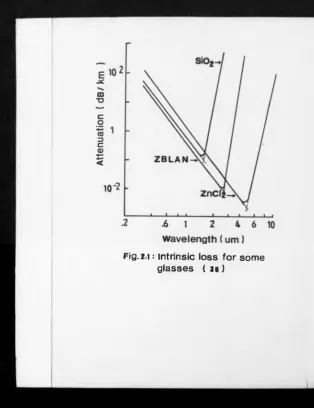
2. 1 Intrinsic loss for s o u glasses. 15
2 . 2 Crystal structure of PbSbOiCl. 21
2.3 Definition of viscosity. 32
2.4 Dependence of growth on
teaperature. 41
3. 1 Saaple preparation for DSC
3.2 Typical DSC curve. 44
3.3 The overall aorphology in the
crystallised glass and the
averaging equation involved. 50
3.4 Essential parts of the penetration
viscoaeter. 50
3.5 Scheaatic diagraa for water
peraeation in glass. 54
4. 1 X - ray diffraction patterns of
glasses. 60
4.2 Ternary diagraas for the
coapositions ( noainal and actual )
of S glasses. 61
4.3 1R spectra with Csl powder
for the crystallised S glasses. 61
4.4(a) SEN aiorograph of crystallised S(
glass. 63
4.4(c) SEM micrograph of crystallised S5
glass. 63
4.4(d) SEM aicrograph of crystallised S.
glass. 63
4.4(a) SEM aicrograph of crystallised ST
glass. 63
4.4(f) SEM aicrograph of crystallised Sa
glass. 63
4.5 The variation of the voluae
fraction of PbSb, 0. Cl. . . . with
ZnCI. and Cl content. 64
4.6(a) Growth of S, for short heat
treatment tlae. 65
4.6(b) Growth of Si for longer heat
treataent tiae. 65
4.7 Growth versus tlae for S». 65
4.8 Growth versus tiae for S.. 65
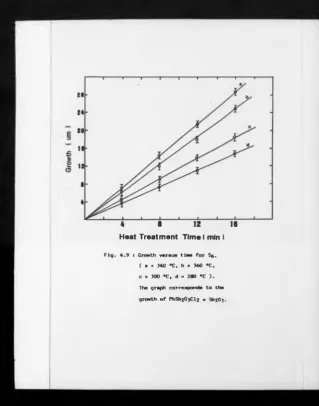
4.9 Growth versus tiae for S.. 65
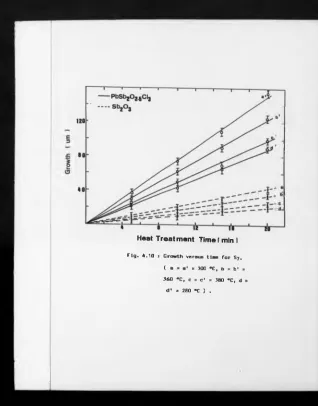
4. 10 Growth versus tiae for S? . 65
4. 11 Growth versus tiae for S.. 65
4. 12 Growth rate - temperature curve for S( . 65
4. 13 Growth rate - teaperature curve for S2 65
4. 14 Growth rate - teaperature curve for S.. 65
4. IB Growth rate - teaperature curve for 8.. 65
chlorine content. gg
4.19 The relation between T.,, ( teaperature
corresponding to aaxiaun growth rate )
and the chlorine content. gg
4.20 Log viscosity versus reciprocal
of absolute teaperature. 0 7
4.21 Log viscosity versus chlorine
content. 5 7
4.22 Weight loss versus chlorine content
for S glasses when exposed to 100 *
RH for 7 days. 5 7
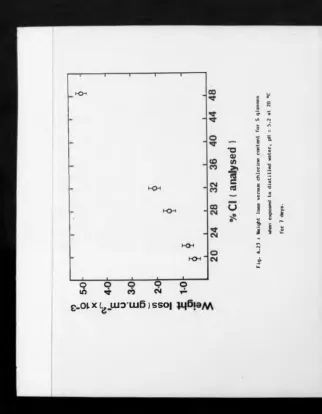
4.23 Weight loss versus chlorine content
for S glasses when exposed to distilled
water for 7 days. 5 7
4.24 Corrosion rate versus tine for S
glasses. gg
4.25 The relation between corrosion rate
and chlorine content. 66
4.20 Penetration depth against tine for S
glasses. 6 5
4.27 The relation between penetration depth
and chlorine content. 69
4.20 The teaporaI variation of solution pH
for S glasses after being laaersed In
sample number. 71
5.2 The relation between 0 t Cl ratio and
sample number- 72
5.3(a) SEH micrograph of St, showing the *
stretching fibre " morphology of
Sb, 0, . 73
5.3(b) SEN micrograph of Si, showing the
" stretching fibre " morphology of
Sb, 0, . 73
5.4 The variation in the percentage of
Pb and Cl content across a crystallised
area of S,. 73
5.5(a) Composition variation across S,. 74
5.5(b) Composition variation across S, . 74
5.6 SEH micrograph of S» , showing the
" star - like " structure. 75
5.7 SEH micrograph of irregular
crystal shapes in Ss glass. 75
5.8 Phase stability regions in Sb,0,
-PbCl, - ZnCI, ternary glasses. 75
5.9 Hicrographs of crystal growth in S,
after heat treatment at 440 • C for
various times. 75
5.10 Hiorographs of crystal growth in S,
after heat treatment at 400 *C for
various tiaes. 75
5.12 Micrographs of crystal growth in Sa
after heat treatment at 320 *C for
various tiaes. 75
5.13 Growth aorphology of A* glass. 79
5.14(a) Growth versus tiae for At glass. 79
5. 14(b) Growth rate - teaperature curve for At . 79
5.15(a) Growth versus tiae for S. glass. 79
5.15(b) Growth rate - teaperature curve for S. 79
5.16(a) Growth versus tiae for St glass. 79
5.16(b) Growth rate - teaperature curve for S> . 79
5.17 Penetration depth versus t1'* for S
glasses. 83
5.18 Diffusion coefficient. D versus
chlorine content. 83
5.19 Corrosion rate of S glasses versus
the concentration of hydrogen and
chloride ions. 85
5.20 IR spectra with CsI of hydrated
layer froa S* after being exposed
to distilled water. 85
5.21 IR spectra with Cal of hydrated
layer froa S. aftar being exposed
glass surface of Ss after being
exposed to distilled water.
5.23 Micrograph of the" washed " corroded
glass surface of S9 after being exposed
to distiI led water.
5.24 X - ray diffraction patterns of the
corroded layers for the glasses S, to Sa .
5.25 Typical crystal deposits on the surface
of St glass after being exposed to
distiI led water.
5.26 X - ray diffraction patterns
of crystallised glasses froa
T series.
5.27 IR spectra with Csl of
crystallised T glasses.
5.28 Micrographs of crystal growth in T,
after heat treataent at 390 *C for
various tiaes.
5.29 Micrographs of crystal growth in Ts
after heat treataent at 360 *C for
5.30 Micrographs of crystal growth in Ta
after heat treataent at 390 #C for
various tiaes.
5.31 Growth versus tlae for T( glass.
5.32 Growth versus tiae for Tf glass.
5.35 Growth versus time for Ta glass. 97
5.36 Growth versus tiae for T* glass. 97
5.37 Growth rate - teaperature curves
for T, and T* glasses. 97
5.38 Growth rate - teaperature curves
for Ts and T* glasses. 97
5.39 Growth rate - teaperature curves
for Tb and T» g lasses. 97
5.40(a) Phase stability region of
Sb,0, - PbC 12 - TIC 1 glasi 98
5.40(b) Phase stability region of
Sb, 0, - PbC la 98
5.41 Log viscosity versus reciprocal of
absolute teaperature for ‘r series
glasses. 98
5.42 Log viscosity versus chlorine content
for T glasses 99
5. 43 Weight loss versus chlorine content
distil led water. 1 0 1
5.44
glasses. 1 0 1
5.45 Penetration depth v e n u e tiee
4.1 Tc, Tg and Tc - Tg values for
Sb,0, - PbCIt - ZnCli glasses. 60
4.2 The noainal and analysed
constituents of S glasses. 61
4.3 The phase occurrence in S series
glasses, identified by XRD and EDX
analysis after heat treatment at To. 62
4.4 The overall eorphology of soae
saaples. 63
4.5 Voluae fractions of phases
calculated using the areal analysis
■ethod. 64
4.6 Weight loss per unit area of
saaples froa S series glasses
when exposed to noraal ataosphere
for 7 days. 6 6
5.1 Calculated lattice paraaeters
and the crystal syitea of soae saaples. 71
5.2 Calculated OiCI ratio of the crystal
phase froa EDX and expected ratio
froa the phase foraation. 72
5.3 The occurrence of phases in the
corroded layer of soae saaples as
identified by X-ray diffraction
presence of cations in the solution
of S series and T series glasses
using Spot tests and Flaae tests. 9i
5.5 Quantitative analysis of soae anions
and cations present in the solution
of S series glasses after 4 days soak
tise. 91
5.6 The noslnal and analysed percentage
of the T glass compositions with
chlorine content. 94
5.7 The Tg, Tc and Tc - Tg values of
T series glasses. 94
5.8 The occurrence of phases identified
by XRD and EDX analysis. 95
5.9 The coaparison of phase occurrence«
crystal aorphology and chlorine
content for T and S glasses. 95
5.10 The maximum growth rates of the
saaples from T glasses with chlorine
content* 97
5.11 Weight loss per unit area of T
glasses when exposed to normal
atmosphere for 7 days. 99
5.12 Weight loss per unit area of T
glasses when exposed in 100 * RH
samples when i n e r s e d in distilled
water for 7 days. 101
5.14 The calculated diffusion coefficient.
D values, of T glasses. 102
5.14(a) Effect of heavy aetal chloride
on diffusion coefficient, D. 102
5.15 The phase occurrence in corrosion
deposits identified by XRD and EDX
analysis. 105
5.16 Quantitative analysis of soae ions
present in solution after 4 days
soak tiae of T glasses. 106
5.17 Structural changes in the Si lien
JCPDS - Joint Committee For Powder Diffraction Standards
DSC - Differential Scanning Calorieetry.
SEN - Scanning Electron Microscopy.
XRD - X - Ray Diffraction.
IR - Infra red
EDX - Energy Dispersive X-ray Analysis.
TEN - Transmission Electron Microscopy.
RH - Relative Hueidity.
UV - Ultra violet
1.1 Introduction
Glass«« are Mostly isotropic, hoso|inaous Materials and thus
highly suited to the transalssion of light, and hence useful
in Making optical fibres. The best glasses are those that
show a high percentage of transMlssion at the required
wavelength. The factors affecting transnission are
scattering and absorption losses, which are classified into
extrinsic and intrinsic. Extrinsic scattering losses are
caused by such iaperfections as bubbles or nlcrocrystaIs,
while extrinsic absorption losses originate froa iipurities
such as OH ions or rare netal ions. Impurities can be
eliainated by purification while defects can be ainlnised by
optimised processing. Thus, only intrinsic losses would
renaln. These are composed of Rayleigh scattering, UV and IR
absorption. Rayleigh scattering is caused by
nicrofIuotuations in the refractive index, while UV
absorption originates from the electronic bandgap
transitions. Both factors decrease with Increased
wavelength. The IR absorption, which is due to aultlphonon
absorption, increases with wavelength and can be related to
the Material properties by the equation v <x ( k/jj )l/a (1)
where v is the vibration frequency, k is the force constant
IR transmission is favoured by glass formers which contain
heavy elements ( high reduced mass ), interacting by weak
force constants ( low field strength and bond strength >. On
the other hand, light masses and strong force constants lead
to high strength, high melting point and low thermal
expansion.
Oxides such as SiOz - based glasses belong to the latter
category which reflect their high thermal stability (2>.
However, their IR transmission is restricted to less than
A.S um, due to Si-0 vibration (3>. Also, the presence of an
OH absorption band is observed around 3 - 4 pm (4). GeO, -
based glasses give better IR transmission, up to 5.7 pm (5),
presumably due to higher reduced mass, but, their
application is not only limited by Ge-0 absorption band (6)
but also by the high solubility of these glasses in water
(7) . TeO, - based glasses also encounter the same problems
(8) . In summary, oxide glasses are only useful in the near
IR to aid IR region ( less than 5 pm >. For longer
wavelengths, other systems have to be developed.
Halides have been considered to have the most appropriate
optical properties ( for optical fibre design ) because of
their low intrinsic loss and thus reasonable IR transmission
characteristic. ZnCla - based glasses often show IR
transmission beyond 10 pa (0) but exploitation is highly
limited by the hygroscopiol ty of the glasses even if the
composition is modified by additional chloride <10>. BeF,
However, this glass was reported to be highly toxic and too
hygroscopic for practical handling and use <12). Zr F.
based glasses are probably the aost proiialng group of new
glasses (13). IR transmission up to 7 urn in the far IR
region (14) and theraal stability up to iOO *C (12) were
observed. The aost lialting factor is their low durability
(15) and the fact that fibre drawing conditions often lead
to devitrification (16). In suaaary, most halide glasses
show considerable IR transaission but their cheaical
durability is low as a consequence of the weak M-X bond ( X
* halide ) (9). This liaits their practical usage.
Because of the probleas encountered both by oxide and halide
glasses, it is of interest to develop other IR transaitting
eater i a Is which will show characteristics interaediate
between these glasses. This led to the developaent of
oxyhalide glasses, originally intended for ultra low loss
optical fibres in the aid to far IR region. Until recently,
the doainant systeas were of the oxychloride glass systeas (
17,18,19 ). These glasses exhibit soae proaising
characteristics especially for longer wavelength usage. They
are stable in air (17), have high IR transaission and wide
glass foraation ranges (18) and should provide a coaproaise
in properties between those of oxide and pure halide glasses
(19).
Thus, oxychloride glassi
transaitting aaterials.
their theraal
>s can be
However,
potential candidates for IR
the lack of inforaation on
stability has restricted
interest in these Materials. It was therefore iaportant that
a systematic study of these systeas be carried out in order
to provide aore inforaatlon.
1.2 Aias Of The Project.
A group of oxychlorides which fora stable glasses and have
wide foraation ranges has been prepared. In order to provide
aore inforaation on theraal and cheaical properties, the
following studies were carried out
:-1. Analytical and aicrostructura1 study.
The aia of this study is to establish the nature of the
phase deve I opaent in the glasses. This is iaportant since
any inforaation on the crystal phase aay be related to the
structural units in the glass and the theraal stability of
the glass. In doing so, the techniques of DSC, XRD, SEN and
IR spectroscopy will be eaployed.
2. The study of the relationship of glass viscosity and
crystal growth behaviour to glass coaposition.
This study will provide inforaation on the theraal behaviour
of the glass which is crucial when it coaes to real
applications, especially fibre drawing. The relation
composition will indicate how thereat behaviour is
controlled by the glass structure. The uncontrolled growth
of crystals is an iaportant contribution to extrinsic
scattering loss behaviour.
3. A study on chemical durability under various conditions.
This is iaportant in that it will show how chemically stable
the glasses are under a variety of application conditions.
Furthermore, the variation of durability with glass
composition will provide an indication of the changes in
glass structure.
4. The effect of heavy halides in the systems.
As heavy eleients will increases the reduced mass ( and, in
theory, shift the phonon edge to longer wavelength I, it is
of particular interest to see their effect on thermal and
chemical characteristics of the glasses.
1.3 Choice Of Systems
To achieve the aims of the project, a series of oxychloride
glass systems were chosen. They are 1
-Binary :
- <i-«> Sb.O, - x ZnClt 0.2 < x < 0.6
Ternary t
- (0.7-x) Sb, 0, - 0.3 PbC1, - x ZnCl, 0.1 < x < 0.5
- (0.7-x) Sb, 0, - 0.3 PbC1, - x TICI 0.05 < x < 0 . 1
- (0.7-x) Sb, 0, - 0.3 PbC1, - x BiCI, 0.05 < x < 0 . 1
Quatenary t
- (0.4-x) Sb, 0, - 0.3 PbCla - 0.3 ZnClla - X TICI
0.05 < x < 0.1
Oxychlorides of these groups were chosen not only to reaedy
the lack of inforaatlon in the literature, but also because
these glasses are transparent up to 8.8 mb and have Tc - Tg
gaps up to 149 *C, ie; potentially good for IR fibres. The
choice of TICI and BiCI, as heavy halide candidates is
siaply because they have slailar chealcal properties to
PbCIt. Hence, any difference In their effect, will partly be
attributable to their higher atoaio nuaber. These halides
will also contribute to the aaount of chlorine in the
systeas. This could be an interesting subject.
1.4 Thesis Plan
The contents of the thesis will be divided Into chapters as
i-Chapter 2 reviews the background of current knowledge
regarding soae of the infra-red transmitting glasses, in
particular halide and oxyhalide glasses. The concept of
glass stability will also be reviewed. This chapter also
surveys ( in general ) several aethods for viscosity
measurement. Finally, this chapter gives an account of the
theory of normal growth rate.
Chapter3 describes the experimental techniques employed in
the research programme. These will include glass
preparation, thermal analysis, SEM and IR analysis. In the
case of crystal growth rates, their calculation using an
averaging method will also be indicated. The Indentation
method for viscosity measurement is described. Finally,
chemical durability studies are outlined.
Chapter A contains all the experimental results obtained
from the investigat ion on thermal behaviour, miorostructuraI
and phase development , and chemical durability
characteristics of the glasses.
Chapter 5 discusses the overall experimental findings, with
emphasis on the correlation between the chlorine content in
the glass with the observed changes in thermal and chemical
behaviour of the glasses. This chapter will also discuss the
effect of introducing heavy metal halides into the glass
&. Kittel, C. ; Intro. To Solid State Physics, John Wiley
and Sons. Inc. 6 * * • ed. (1986).
2. Hazurin, O.V., Strelstsina, M.V. and Shvaiko -
Shvaikorskya, T.P. ; Handbook Of Glass Data, vol 1,
Elsvier, (1983).
3. Donald, l.W. and McMillan, P.W. ; J. Hater. Soi. 13
(1978) 1151-1176.
4. Florence, J.M., Glaze, F.U., and Black, M.H. ; J. Res.
Nat. Bur. Stand. 50 (1947) 703.
5. Cleek, G.U. and Haailton, H.E. ; US Patent 3 119 (1964)
703.
6. Murthy, H.K. and Kirby, E.M. ; Phys. Chea. Glasses, 5
(1964) 144.
7. Murthy, M.K. and Hill, H. ; J. Aaer. Ceraa. Soc. 48
(1965) 109.
8. Ulrich, D.R. ; J. Aaer. Ceraa. Soc. 47 (1964) 595.
9. Lucas, J. ; Halide Glass, in Glass ...Current Issue, ed.
A.F. Wright and J. Dupuy, Martinus Nijhoff Pub. (1985).
10. Savage, J.A. ; Int. Sya. Hal. and Non-Oxide Glass 1,
Caabridge, UK (1982).
11. Sun, K.H. ; US Patent 2 466 507 (1949).
12. Miyashita, T. and Manabe, T, ; IEEE, J. Quant. Elect.
QE-18, lO (1982) 1432.
13. Poulain, H. and Poulain, M. j Mater. Res. Bull. 10
and Manabe, T. î Physics For Fibre Optic, in Advances In
Ceraeics, vol 2, ed. B.Bendow and S.S.Mitra (1981) 74-
82.
15. Simmons, C.J. and Simmons, J.H. ; J.Amer. Ceram. Soc.
69(9) (1986) 661-69.
16. Lau, J ., Nakata, A.H. and Hackenzie, J.D. ; J. Of Non
Cryst. So 1. 70 (1985) 233-242.
17. Dubois, B. , Aomi, H., Videau, J.J, Portier, J . and
Hagenau lier, P. ; Hat. Res. Bull. 19 (1984) 1317.
18. Ahmed, H.H and Holland, D. ; Hâter. Sei. Forum (1987)
19-20.
19. Ahmed, H.H. and Holland, D. î Glass Tech. Vol 28, no3
141.
2.1 Introduction
The ASTM defines a glass as " an inorganic product of fusion
which has been cooled to a rigid condition without
crystallising ” or, a glass is a aaterlal formed by cooling
from normal liquid state which has shown no discontinous
change at any temperature but has become more or less rigid
through a progressive increase in its viscosity. This
describes what could be called the classical formation from
the aeIt.
Glass formation has been observed in a very large number of
inorganic systems. Until recently, glass chemistry has been
largely dominated by oxide systems, the most common being
silicate glasses which are based on SiOz , whilst others
include glasses based on B, Oj , P} O, , GeO> and As, 0, . These
materials provide a very strong tridimensional ( 3D >
covalent network which is needed to fora a glass and are the
so - called " glass - formers". If we consider melts made
from two or more components, the range of oxide glasses is
enormously extended, for example melting any glass - forming
oxide with an alkali metal oxide.
Halide glasses based on BeF, were first Identified by
Goldschmidt (1), while Heyne (2) prepared the
fIuoroberyI I ate glasses. At about the same time, Warren and
structure as vitreous S10a . This work has been continued
intensively by Sun and co - workers (4 - 8). ZnCl, based
glasses were first discovered by Haier (9). The glass
forsing ability of this aaterial has been attributed in part
to its low bond tonicity CIO) and low eelting temperature
<11>. The binary ZnCla glasses containing an alkali halide
component were found to be aore stable than vitreous ZnCla
(12). Foraation of ZrF« based glasses was first reported by
Poulain et. al (13). This compound has been characterised as
a " glass network foraer " to which other coapounds are
added in order to prepare a vitreous material. These include
" network modifiers " such as BaFa (14,15) and interaediate
compounds such as ThF« (16) and HfF, (17,18). Other less
important halide glasses have been reported over the years.
Soae of thea are glasses based on AgCI, Agl and PbBr, (19),
PbCl.-BaCI, (20), TICI (21), SnCla . Pbl. (22) and many
others. Information on these systems is limited and the
glass forming regions are unknown.
Oxyhalide glass systems based on Sba0, were first reported
by Dubois et. al (23). The work was based on the general
formula of ( 1-* ) Sb> 0, - xRX> ( X - F, Cl, Br or I ),
where RXa is a halide chosen from MnFa, MnCla , NnBra, PbCI2,
PbBra , Pbla , SrC!a or BaCla . The report also presented the
glass - foraing limits of each system. Dubois (24) also
reported a structural study of the above systea. A similar
system has been reported by Ahmed and Holland (25). The same
-PbClj glass systea (26). The glass forming tendency of a
oxyhalide system has particularly been studied by Ota and
Soga (27) using the NaPO-, - MnCl, glass composition. Other
oxyhalide glass systea such as PbO - Pb C 1 * (28), Sb* 05
SbCI, / CdC I a (29) have also been prepared. However, it
should be noted that mixtures of ZnCla with Na, SO, or K* SO.
(12) would not form a glass.
Most of the glass systems provide a wide glass - forming
region including the halide and oxyhalide systems. These
glasses may provide characteristics which suit some
applications although a compromise must be made between the
stability and optical transmission of such systems.
2.2 Infra - Red Transmitting Glasses
In 1951, Kapany (30) made the first serious study of the
transmission of images along uncoated and plastic coated
aligned bundles of flexible oxide glass fibres. In fact, he
was the first to apply the term " fibre optics " defining it
as the art of active and passive guidance of light rays in
the spectral regions ( UV, V and IR ) along transparent
fibres over a predetermined path. Of the three regions
mentioned above, the infra red region is of most interest
because of its wide range of applications. The main
application is in communications especially for very long,
- red lenses, new optical - fibre sensors, infra - red laser
components and related laser surgery (32), a very good
prospect for electro - chemical devices (33) and many others
such as windows and domes that protect detection systems
from the environment. Depending on the field of application
other factors such as mechanical properties, thermal and
chemical stability are also matters of great concern.
The most important criteria in the selection of an infrared
fibre material are that it can be formed into a homogeneous
fibre of considerable length and that it will have low
optical loss. The loss mechanisms consist of absorption and
scattering which are classified into intrinsic and extrinsic
factors. The intrinsic losses consist of UV absorption,
Rayleigh scattering and IR absorption .
The UV absorption coefficient ( a , ) may be expressed by the
relation (34)*
a , * A exp ( B / X )
where A and B are constants and X is the wavelength.
The probability of interaction ( ie: increased absorption )
is maximum at short wavelength and decreases as the
wavelength increases. At longer wavelengths ( le: visible or
infrared regions ), the possibility becomes small although
not zero. This absorption is due to electronic transitions
between electron states and is a function of the energy gap
The dependence of Rayleigh scattering on wavelength la
expressed as (34):
«» • ■ C / A 4
where C is a constant which depends on the eaterial. As we
know, glass is not purely hoeogeneous. There exist regions
of higher and lower density, resulting in a sea 11 variation
of refractive index and therefore of light velocity. The
effect is lore significant for shorter wavelengths.
The IR absorption coefficient ( a, ) which is due to
eultlphonon absorption can be described as (34):
a, * D exp ( - E / A >
where D and E are constants. Because of thereal excitation,
atons and eolecules are constantly in notion. As these
notions occur, they define a stationary vibrational systen
with a certain level of energy. For the sinplest node of
vibration of a linear diatonic nolecule consisting of two
point nasses. Hi and H, , the vibrational frequency average (
0 ) according to this nodal is given by the Szigeti relation
( 3 5) :
where the reduced ease ji = ( M, M? / Mi ♦ M* ) and f is the
force constant. This leans that heavier ions and weaker
bonding forces are preferable for the IR absorption to be
located at sufficiently long wavelength.
The combination of these three loss aechanisss leads to
theoretical curves as shown in fig 2.1 (36). The total loss
decreases as the operational transmittance wavelength
increases until a cross - over point is reached where the
total loss again increases, because at longer wavelength the
loss is dominated by the multiphonon absorption .
The V - curve ( fig 2.1 ) is a useful quantitative tool for
assessing infrared optical materials as candidates for
optical fibres. This curve determines the theoretical lowest
limit of attenuation at a certain wavelength. For the low
loss required by telecommunications, the attenuation for an
infrared fibre should approach the lowest limit determined
by this curve.
In this figure, the effect of increasing atomic weight of
the cation and / or anion in promoting extended
transmittance into the infrared is clearly seen. Thus, it is
clear that silicates are only useful in the near infrared
and that it is necessary to resort to heavy metal halide or
oxyhalide materials for the aid and far infrared wavebands.
The extrinsic absorption losses have a noticeable
contributions from Impurities in the glass matrix. Factors
A
tt
e
n
u
a
tio
n
(
d
[image:42.338.7.322.13.422.2]defects, bubbles, local variation in composition and others
are sources of extrinsic scattering losses. However,
normally, optical glasses are in principle free from such
defects and the only losses should come from various
impurities such as hydroxyl ions ( OH* >, transition metal
ions ( Fe**, Cr**, ...) and other complex anions. Each of
these ions nay contribute adsorption bands of different
shapes, intensity and position.
The materials used for infrared transmitting fibres fall
into two categories: crystalline and glass. Crystalline
materials from which fibre can be prepared practically are
limited while glass material is very suitable for the
fabrication of optical fibre although a suitable composition
needs to be selected to form a sufficiently stable glass
without devitrification during the fibre fabrication.
2.2.1 Oxide Glasses
Oxide glasses especially SiO* based or containing Ba 0* ,
P* 0« , V* 0« have been reported extensively (37) especially
for IR optical fibres. However* silica glass has an
intrinsic limit mainly caused by the fundamental Si-0
vibration and absorption bands at shorter wavelength due to
the presence of OH* or due directly to the effect of
additives on the silica network. Work has been done < 38,39
the Si-0 bond by use of additives in the system. Glasses
based on B> 03 and P3 0, exhibit very liaited infra - red
transmission due to their high vibrational frequencies
associated with B-0 and P-0 bonds respectively. Many workers
also have tried using heavy aetal oxide based glasses such
as GeOa , TeO, , Bi,0, , Sb* 03 and others. Work has been done
on GeOa based glass ( 40-41 ) but aost of the glasses still
show proainent hydroxyl absorption. Furthermore, vitreous
Ge03 powder is very soluble in water ( 42). Glasses based on
Te02 have been prepared ( for instance by Ulrich (43) ). All
the glasses transmitted well in the infrared up to 6.3 pa,
but an absorption band was observed at 3.5 pa which reduced
transmission from 80 * to 65 * , and this was attributed to
the presence of water in the glass. Glass forming
coapositions of Sb3 03 -A 13 03 -Ra 0 were examined by Hedden et
al. (44). The glass transmitted to 5.4 ya, with iO %
transmission up to 6 urn. Duabaugh (45) has reported stable
glasses in Bi203 based systems. However, they exhibit
relatively low softening points and were observed to
crystallise if heated below this point.
2.2.2 Halide Glasses
Many workers have successfully prepared halide glass systems
for infra red optical purposes. Generally, there are two
categories of halide glasses. The first consist of fluoride
glasses have been prepared based on a variety of glass
formers such as BeF2 , ZrF« , HfF« and combinations such as
AIFj-BeFj. Many investigations of fIuoroberyI Iate glasses
have been reported (46). These show very good refractive
indices and appear good for use as I-R transmitting fibres.
However, the cost and toxicity of beryllium could limit
practical applications. Also, these glasses are very
sensitive to water. Zirconium fluoride - based glasses were
developed by Poulain et al. (13,47). Studies show that these
glasses exhibit some optical characteristics which are
attractive for optical fibre design (46). Their transmission
range is continous from 0.2 pm in the UV up to 7 pm in IR
region. However, the glass melts cannot be cooled down
slowly, otherwise crystallisation occurs, while on the other
hand, slow cooling is needed to produce homogeneous glass or
large sample size. Additionally, these glasses undergo some
surface attack when exposed to water.
The replacement of ZrF« by HfF« has also been reported (49)
and it shows the same chemical behaviour but is heavier
implying that at a certain wavelength, the absorption
coefficient for HfF« - based glass should be lower than for
ZrF« - based glass. Other fluoride glasses which have been
developed are multicomponent A1F* or ZnFi glasses (50). Most
of them show basic properties similar to fIuorozirconate
Chloride glasses would be alternative candidates for IR
fibres although they are known to be hygroscopic. Only ZnCl>
has been drawn (SI) but its optical loss characteristics
have not been eeasured. Other chloride glasses such as
fluorochloride cadaiun glasses (52) have also been reported.
These glasses show extended IR transmission but are very
hygroscopic and say easily devitrify.
2.2.3 Chalcogenide Glasses
Chalcogenide glasses containing the elements of As, Ge, P
and S, Se and Te are available with stable vitreous states
and wide transmission ranges (53). However, it has not been
possible to reduce optical losses to the level required for
telecommunication. The main problem lies in the removal of
extrinsic impurities and has not yet been solved.
2.3 Oxyhalide Glasses
In recent years, researchers have tried to find
alternatives to the above three types of IR transmitting
glass. Many considerations have been taken into account in
order to achieve a compromise between the oxide glass
properties and the halide glass behaviour. As a result of
this a combination of oxide and halide compositions was aade
As we have aentioned earlier, oxyhalide glasses based on
Sb* 0S were first prepared by Dubois et al. (23) and then
followed by Ahaed and Holland (25,26,29) and Ota et al.
(27). All of the systees show considerable attractive
optical properties. They are transparent froa about 0.43 |ia
up to 6.5 pa. In the systea Sb,0, -PbCl,-ZnCI, <25>, the I-R
edge is at * 8 . 8 pa and decreases slightly to ~ 8.0 pa in Sb,0,-SbCli / CdCl, glasses (26). However, there are broad
bands between 500 ca-‘ and 669 ca-* which are believed to be
due to the Sb-O-Sb stretching vibration (54). This doainates
the absorption edge which may liait practical applications.
2.3.1 Oxyhalide Glass Structure
There is little inforaation available in the literature
about the structure of oxyhalide glasses.
The structure of a crystalline oxychloride, naaely aendlplte
( PbjO,CI, ) has been studied in detail by Gabrielson (55).
He showed that the Pb atoas are both in sixfold and
sevenfold coordination, the coordination sphere being aade
up of both oxygen and chlorine ions. Rao and Rao (28)
studied the structure of PbO-PbCl, glasses using an X-ray
diffraction technique. They found that the structure of the
glasses is doainated by the cheaical tendencies of the ions,
covalent Pb-O-Pb linkages being crucial to the glass
octahedrally coordinated with two oxygens and four chlorines
and such model features account successfully for the
experimental pair distribution functions. The structure of
the Sb, Os-PbCI * glass system has been studied by Dubois et
al. (24). The study was carried out by means of X-ray
diffraction as well as Raman investigation and comparison
was made with Sb or As based glasses. It was found that the
glass was built from the SbO, trigonal pyramid structural
unit when the amount of PbC I* is low and changes to SbO«
square based pyramids when the amount of PbCl, is higher.
In the SbO. structural unit regime, the Pb atoms occupy the
common site of two square based pyramids, one formed by 0
atoms and the other one by Cl atoms which produce the
structure of PbSbO,Cl ( see figure 2.2 ), a so called "
Si lien type " phase. A study of the vitreous Sb, 03
structure by Hasegawa et al. (56) has also suggested that
the Sb? 03 glass contains a structural unit of SbO, pyramids
similar to that of valentinite, one of the crystal form of
Sb, 0, .
2.3.2 Glass forming system
Most of the oxyhalide glasses systems known have a wide
range of glass formation ( 23 - 29) and comprise not only
binary but also ternary and even quaternary systems. Most of
the glasses can be formed by additions of up to 60 mol % of
2.3.3 Oxyhalides as IR transmitting g
To be a good candidate for IR transmitting glass, glass must
show good transparency at longer wavelengths, which leans
that it has low losses due to scattering. As discussed
earlier, lost oxyhalide glass system exhibit considerable
transparency in the IR region. An example of this is a glass
of a composition Sb*0»-PbC1«-ZnCI« which shows transparency
up to 8.8 pm. Others are from the Pb0-Ge0z -CdC1 a system
where the transparency is up to 8.0 urn while a system of
SbaOj-Pbla shows a transparency up to 6.0 urn. The loss due
to absorption is expected to be in between pure halide glass
and oxide glass while the refractive indices are around 1.5.
In conclusion, oxyhalide glasses can be alternatives for IR
transmission. However, other factors such as thermal
stability or chemical durability of the glass should also be
considered.
2.4 Glass stability
Some authors emphasize glass stability based on the
crystallisation rate during cooling or reheating; some refer
to the relaxation process near the glass transition (55) and
some even refer to the chemical durability of the glass.
While it is only by direct observation that glasses can be
to have soee quantitative scale of glass stability. In
practice, many researchers, obtain their glass stability
data by using DSC or by doing some durability test. In
general, the investigations of glass stability can be
divided into two ca
tegoriesi-1. Thermal
2. Chemical
2.4.1 Thermal stability
A glassy state is metastable and tends to transform
continously towards the more stable states. This
transformation process occurs by two processes, namely
structural relaxation and crystallisation. The structural
relaxation process is driven by the considerable strain
frozen-in during glass formation. During the process of
annealing, the material relaxes towards the internal
equilibrium state of the liquid from which it was obtained,
mostly controlled by atomic diffusion ( see eg. ref. 57 >.
The crystallisation process depends on kinetic and
thermodynamic factors and proceeds by two important
processes namely nucleation and growth. DTA ( Differential
Thermal Analysis ) or DSC can provide parameters such as Tg
( Transformation temperature >, T, ( onset of
crystallisation ), crystallisation temperature To ( exotherm
A glass f orslng ability or theraal stability range nay be
evaluated froa the difference between Tc and Tg although
soae glass scientists weight this difference by 1/Tg leading
to the factor Tc - Tg / Tg which is dinensionless.
Another glass stability scale was given by Hruby’s criterion
Hft (58) defined as i
H„ » < Tc - Tg > / ( Tn - Tc >
Basically, this equation gives the sane criteria as Tc - Tg
but it varies aore quickly when the crystallisation peak
shifts. It also takes into account the aelting teaperature,
Ta, although this nay not be significant as it always
correlates with Tg. All these stability scales have been
used successfully by various workers.
Another stability scale which conbines all the paraaeters
Involved is given by Saad et a 1. <59) :
S = ( Tc - Tx )< Tc - Tg ) / Tg
where S is expressed in Kelvins. However, this new criterion
required the saaples to be heated at the sane heating rate
in all cases. Also, the location of the crystallisation peak
Is always involved, and stellar particle sizes should be
used.
So far, at least, there are four known criteria used to
deteraine the theraal stability. Of these four, the first
ie: theraal stability range T * To - Tg or Ts - Tg are aost
frequently used.
The theraal stabilities of silicate and other oxide glasses
are well known. Most of the binary silicate systeas have
values of Tg aore than 400 -C < see eg. ref. 60,61 I and
values of To higher than 550 «C ( see eg. ref. 62,63 ) and
auch higher for pure silica glass (see eg. ref. 64 I. The
values of Tg and Tc of other oxide glasses also indicate
that aost of thea are stable.
The theraal stability ranges of halide glasses are best
known for the heavy halide systeas. Pure ZnCls glass has a
relatively low stability range where T s To -Tg s 70 *C
(65) although this value aay vary, aainly because of the
effect of the difference in water content (66,67). However,
soae reported that binary glasses containing an alkali
halide coaponent such as KCI, KBr or Kl are aore stable than
the vitreous ZnCl, itself with the aixture of ZnCl,-Kl being
the aost stable (12). Other chloride glasses such as B1CI*-
KCI and ThCI, -NaCI-KCI have also been studied (65) but aost
of thea are very hygroscopic. The typical teaperatures for
for ThCl, glasses, Tg = 130 «C and Ta = 290 “C. With such
properties, these glass systeas are not of interest for
exploitation. Evidence of glass foraing ability in fluoride
glasses is very interesting. Included in this class are
glases based on BeF2 , AlFj , ZrF« and a coabination of thea
or with alkali aetal flourides. Of all of thea, the glasses
based on ZrF« are the aost proaising. The various
coabinations give Tc - Tg ranging froa 47 «C < ZrF« -BaF2
systea ) to 80 -C C in ZrF. -BaF* -LaF, -A 1F, glasses ) (65).
But with addition of NaF ( known as ZBLAN glass ), the
values of Tc - Tg are iaproved. Parker et al.(68) reported
the gap up to 93 °C. Others have reported the Tc - Tg value
to be 115 -C (69) and 116 *C (70) and this value is the best
so far reported. Work has also been done to coablne the ZBL
< ZrF«-BaFj-LaF3 ) with chlorides such as ZnCl2 and BiCls
but it was found that the value of To - Tg is about 55 *C
(71), even lower than that of vitreous ZnClt .
In recent years, research on oxyhalide glasses has been
developed progressively. They have been reported to exhibit
glass stability ranges Tc - Tg of as low as 40 aC in
oxybroaide glasses up to 93 «C in the binary systea of
Sb2 03 -PbCl2 glasses (23). With the introduction of ZnCIa as
a third coaponent, the stability range seeas to be auch
iaproved to about Tc - Tg ■ 149 *C (25). Ternary systeas
such as PbO-GeOa-PbCIs glasses have shown reasonable glass
certainly shows that the oxyhalides fron this ternary systea
can fora very stable glasses. The binary oxyhalide systea of
Sb* Oj .HnC11 has also been prepared and has a value of Tg =
326 *C and Tc = 472 aC (23). When the Sb* Os was replaced by
NaPOi, the value of Tg was reported to be aore than 420 aC
(27). Other binary oxyhalides froa the PbO-PbCla glass
aystea have also been reported by Rao et al. (72). The
report showed that the glass was reasonably stable and the
To - Tg value is up to 03 aC. The glasses froa the TeO* -
ZnCI* binary systea have also been prepared (73) but
unfortunately, no theraal properties have been reported.
So, it has been shown that in terns of theraal stability,
oxyhalide glasses can have a stability range which is better
than sone other well known glasses. This indicates that
oxyhalide glasses night be very good prospects for soae
practical applications. But other factors such as cheaical
durability of the glasses oust also be taken into account.
2.4.2 Cheaical Stability
There is no infallible nethod of prediction that one glass
is aore cheaically stable than another except after both
have experienced slnilar experiaental conditions. Scientific
studies of the cheaical durability of glass have been in
process has not yet been achieved. Many attempts have been
■ade to clarify this. Paul (74) for exaaple, tried to
understand the chesical durability of glasses by leans of a
thersodynaslc approach. Others like Scholze (75) use a
phys1co-aatheaaticaI treataent in order to understand the
aechanisas for silicate glasses. Soae workers have also
tried to predict the cheaical durability of glasses froa
their coapositions. Probably, Weberbauer (76) was the first
to do so, followed by llifte and Newton (77) and aany others
subsequently (78,79).
The other way to study cheaical durability is by experiaent.
In general, aost of the tests expose glass to water and lake
soie assessaent of how auch daaage has been produced. The
choice of water as a test substance is reasonable since it
is everywhere, cheap and glass will inevitably be exposed to
it. Noraally, there are three conditions under which glass
will be tested. One is in water itself, secondly under
noraal atiospheric huaidity and finally in soae degrees of
relative huaidity ( RH ). In aost cases, teaperature also
plays a significant role. Other test aethods such as the
powder test (80), diaaing test (81), long exposure test (82)
and aany others are basically slailar to those three basic
conditions aentioned above.
The reaction of glass with water has been studied by
hundreds of workers ( eg. 83 - 85 ). The detailed aechanlsae
Involved in the reaction between glass and water are given
huaidity on weathering of glass was studied in detail by
Walters and Adans (88). In their study, levels of 30% RH up
to 98% RH were eaployed at 50 *C. The authors also did soae
experiaents with cyolio and static conditions of RH and
reported that the cycling condition was found to be less
severe than statio 98% RH.
...4.2.1 Oxide ( silicate ) Glasses
The durability of silica glass was studied by 1 to and
Toaozawa (89). Depending on the applied water pressure, the
result show that silica glass dissolves in water after a few
hours. The durability of binary silica glass was studied in
detail by Dubrovo et al.. The study was conducted in water
(90), in acid solution <9i>, in alkaline solution (92) and
also in salt solution (93). The experiaents were conducted
at teaperatures froa 25 *C up to lOO *C in water and with
varying tiae of exposure. The result show that under all the
conditions, the binary silicate dissolves easily. However,
the durability of silicate glasses can be iaproved by adding
other coaponents such as Alt0> (94) and ZrO» (95). The high
water content of silicate glasses was studied in detail by
Toaozawa et al. (96) in teras of their hygroscopicity. The
results show that the diffusion of water in the glass is
very fast for glasses with high water content.
The cheaical durability of other oxide glasses has also been
(97), GeO, based glasses by Takahashi et al. (98), glasses
based on P, O, by Kanazawa et al. (99) and u n y others. Most
of thea used powders with a particle size range froa 0.1 -
0.5 aa. with different tiae duration and teaperature. In the
case of CaO-PtO. glasses (lOO) the solubility of glass in
basic solvents indicates that the glass is sore stable when
the percentage of CaO is increased.
2.4.2.2 Halide Glasses
Halide glasses and crystalline coapounds are extensively
attacked by water which Beans that, either in water or in
noraal ataosphere, halide glasses are in danger of
corrosion. This is a result of a very poor h-X chemical bond
( X ■ Cl* , Br' , I" ) which is unstable with respect to the
hydrated cation H<H,0)„.
The chealcal durability of f1uorozirconate glasses has been
reported by aany workers. Poulain et al. (47) reported that
the ZrF, -BaF2 -ThF, glass systea is stable in wet ataosphere
up to 350 aC . However they also noted that the glass
surface is attacked by water after a few hours at 20 aC.
Further, it was reported (46) that the dissolution rate of
this glass in boiling water was about 4.7 x 10'* ga c r 1
■In*' ( lei lO* tiae faster than typical silicate glasses ).
The study of reactions of this glass with water was carried
out further in aore detail by Siaaons and Siaaons (iOl). As
fluorozirconate glasses leached rapidly in water, a very
thick hydrated layer being formed on the glass surface which
absorbs a large amount of water.
2.4.2.3 Oxyhalide Glasses
There are few reports of the chemical durability of
oxyhalide glasses in the literature except a few remarks by
Dubois et al .(23). They reported that most oxyhalide
glasses based on Sb*03 are generally resistant to
atmospheric attack except for Sb20, -LiCl and Sb203-KF glass
systems which are attacked after about one month. However,
they also reported that most of these glasses will react
with hot water.
The study of chemical durability of oxyhalides is still in
progress.
As we have mentioned earlier, most silicate glasses and non
silicate oxide glasses, are, in general, chemically stable
although in some applications such as optical fibres , they
are less attractive ( due to absorption losses caused by
scattering ), than many halide glasses such as the
fluorozirconate glass system. On the other hand, many halide
glasses are less chemically durable especially in the water
condition. So, obviously, some compromises should be made
between these two characteristics. Oxyhalide glass might
It is however difficult to make general statements about the
durability of one glass compared with another. Not only do
the results depend on various factors such as temperatures,
glass compositions, solution pH, they are also affected by
relatively small differences in sample preparation,
experimental techniques and apparatus used. It is therefore
quite impossible to propose a standard test for chemical
durabi1ity.
2.5 Viscosity
One of the most important criteria in glass forming is
viscosity. The way in which the viscosity of a glass melt
varies with temperature is very important in determining the
shaping process which leads to a glass article. Further, the
connection between viscosity and other properties of the
glass might lead to a better understanding of glass
structure.
2.5.1 Definition Of Viscosity
The viscosity which is actually referred to, shear viscosity
or coefficient of shear viscosity, is defined as follows:-
Suppose there is a liquid which is confined between two
parallel plates with the upper moving with a velocity v0 and
the lower stationary ( Figure 2.3 >. The distance between
the velocity In the liquid varies linearly with distance
between the plate. In order to maintain this motion, a force
should be applied to the upper plate in the direction of its
notion, to overcome the force of friction within the liquid.
The force per unit area ( known as the shear stress, T > is
proportional to the velocity gradient in the liquid dv/dy.
Thus,
r * 0 . dv/dy
where n is the proportionality constant or viscosity.
However this equation is only valid when v0 is below a
certain value. If v0 is high enough, turbulent flow may
develop. Fortunately, this flow is never encountered in
glass melts because of their high viscosity. The equation is
also only valid for newtonian fluids which is normally true
for glasses above the transformation range. The unit of fl
in the SI system is N s a
*2
or Pa s which in cgs are dyne s cm~ 2 or P < Poise ). This unit has been used extensively inglass literature where the conversion is 1 P = O. 1 Pa s * 1
d Pa s.
With Industrial glasses, the viscosity which is required by
many technological practices is in the range of 102 P to
iO‘ 4■ 8 P. During melting and refining the glass melt, the
viscosity should decrease down to lO2 P, forming requires
viscosities of lO2 P to lO7 P. Annealing of the glass takas
place at viscosities lO*2 P to 10‘4•• P while working with a