http://www.scirp.org/journal/jpee ISSN Online: 2327-5901
ISSN Print: 2327-588X
DOI: 10.4236/jpee.2018.61006 Jan. 31, 2018 70 Journal of Power and Energy Engineering
Heat Transfer Optimization in Air Flat Plate
Solar Collectors Integrated with Baffles
Ramadhani Bakari
Department of Petroleum and Energy Engineering, University of Dodoma, Dodoma, Tanzania
Abstract
This paper presents an experimental analysis for comparisons of conventional flat plate solar collectors and collectors integrated with different numbers of baffles. Heat transfer between absorber plate and drying fluid (air) has been one of the major challenges in the design and operations of the indirect solar dryer systems. In this experiment, efficiency of air flat plate solar collector in-tegrated with 2, 3, 4 and 8 baffles was studied and compared with the ordinary collector. The results showed that integrating solar collector with baffles sig-nificantly increased the efficiency of the system. It was noted that collector with 2, 3, 4 and 8 baffles had a mean efficiency of 29.2%, 31.3%, 33.1% and 33.7% respectively while with no baffles was 28.9%. The analysis showed that when there were less than four baffles in the collector, heat transfer was dominant over pressure drop and hence high efficiency. However, when the number of baffles exceeded four, the effect associated with an increase in pres-sure drop highly observed compared to heat transfer coefficient, thus resulted to insignificant increase in efficiency. Therefore, the optimum number of four baf-fles was commended for the designed model for optimum efficiency.
Keywords
Solar Collector, Solar Dryer, Sun Drying, Collector Efficiency, Heat Transfer
1. Introduction
Open sun drying for the preservation of agricultural, food and many other pro- ducts has been popular in many societies from ancient time [1]. Although the practice is economical, controlling external parameters such as heat input, mois-ture content, temperamois-ture etc. is very challenging [2]. The idea of solar dryer has become the ideal approach to overcome the challenges of open sun drying. The
How to cite this paper: Bakari, R. (2018) Heat Transfer Optimization in Air Flat Plate Solar Collectors Integrated with Baffles. Jour-nal of Power and Energy Engineering, 6, 70-84.
https://doi.org/10.4236/jpee.2018.61006
Received: August 25, 2017 Accepted: January 28, 2018 Published: January 31, 2018
Copyright © 2018 by author and Scientific Research Publishing Inc. This work is licensed under the Creative Commons Attribution International License (CC BY 4.0).
DOI: 10.4236/jpee.2018.61006 71 Journal of Power and Energy Engineering method has become an alternative to the marketing of fresh perishable products which have increased demands from day to day [3]. Solar dryer offers the effec-tive, cheap, and environment-friendly approach of preserving agricultural and food products [4].
It is known that important quality verdict made by consumers on dried food in the market is its visual appearance and sensory quality, which includes: col-our, flavcol-our, taste, texture and aroma [5]. Therefore, the dried food should have the suitable appearance and sensory quality in order to be accepted in the com-petitive market. The challenges of open sun drying such as contamination by in-sects and micro-organisms; damage by animals, mould growth, discolouration, and distraction of vitamin and difficulty in setting uniform and standard of end-products have pushed the researcher to develop different scientific methods of solar energy utilization for crop drying [5][6][7][8]. The use of solar dryer systems in agricultural areas to conserve vegetables, fruits, and other crops has shown to be practical in terms of investment cost, hygienic, improved product quality and an environmentally friendly approach [9].
Indirect Solar Dryer System
DOI: 10.4236/jpee.2018.61006 72 Journal of Power and Energy Engineering
2. Literature Review
The solar collector is a kind of duct heat exchanger that transfers heat energy from incident solar radiation to the fluid passing through it. It absorbs solar ra-diation through glazing, converting it to heat energy and transferring it to a working fluid [20]. The collector comprises of absorber plate in a flat rectangular housing, glass cover on the upper surface and the insulation on other sides to limit the thermal losses. The solar energy absorbed by the plate is transferred to the fluid flowing within the collector channel [21]. To have effective thermal ef-ficiencies of a flat plate solar collector, heat has to be efficiently transferred from the absorber plate to the flowing air. Heat transfer coefficient inside the solar collector is an important parameter that affects the efficiency of the collector [22]. Researchers have recommended various modifications to enhance heat transfer rate in solar collector by incorporating different modifications between absorber plate and glass plate [23].
2.1. Influence of Baffles in Heat Transfer
[image:3.595.270.479.556.694.2]Baffles provide an additional heat transfer surface area and promote air turbu-lence in the collector. The presence of baffles causes the air flow to separate, re-attach and create a reverse flow which increasing the heat washing action. The main concept of integrating collector with baffles is to reduce dead zones and increase heat transfer area.
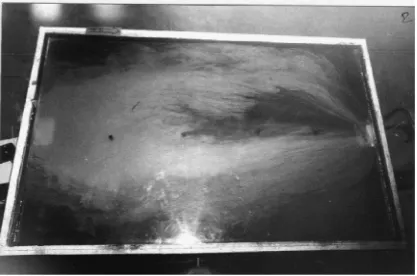
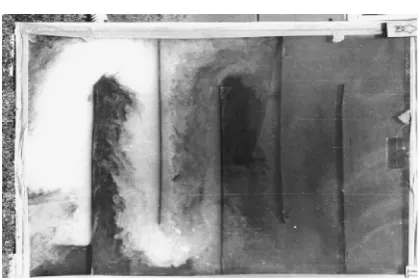
Figure 1 and Figure 2 show visualization model of collectors with and with-out baffles as shown as presented by [24]. Figure 1 illustrates airflows patterns in a collector without baffles, it can be observed that there is straight airflow in the aperture of the absorber from the inlet toward outlet which creates many dead zones. This means that there is no enough retention time between air and ab-sorber to allow the effectiveness of heat transfer. On the other hand, Figure 2 shows the formation of a meandering flow of air in the collector with baffles from the inlet to the outlet. In this case, it is clear that the length of air trajectory is more than double that of the length of the collector, thus increasing the heat transfer and effectively reducing dead zones.
Figure 1. Visualization of the air flow in the collector
DOI: 10.4236/jpee.2018.61006 73 Journal of Power and Energy Engineering
Figure 2. Visualization of air flow in the collector with
baffles.
Important of baffles in solar dryers system was also reported by Pona [25] in his research and recommended the installation of baffles raise the efficiency of the collector by 7% to 12% compared to ordinary collectors (collector without baffles). Similarly, Abene [26] assesses heat transfer in collector by inserting dif-ferent types of air obstacles disposed of in rows across the plate of collector and reported positive improvement of the performance of the drying unit. Further-more, [27] experimentally studied the impact of baffle space and baffle length in the performance of solar collector. It was found that increasing baffle length and decreasing baffle space increases the performance of solar collector. However, the reported studies have shown promising output in enhancing collector heat transfer, the optimum baffle space and length has not been reported. It can be seen that baffles reduce air space channel situated between the insulator and the absorber and increase the friction with the contact surfaces all of which increases pressure drop. Consequently, increased pressure drop increases fixed charge and fan power which leads to increased operating cost. Therefore, designing and in-stallation of baffles should be economically feasible for easy adaptation.
2.2. Efficiency of Flat Plate Solar Collectors
The thermal efficiency of the flat plate solar collector is the ratio of the energy out of the collector to the total incident solar radiation averaged over the same time interval. Mathematically, the efficiency (η) of a collector is expressed by Equation (1) [28][29].
useful energy solar energy available
η = (1)
The outlet energy (useful energy) for a solar thermal collector is the rate of thermal energy leaving the collector, usually described in terms of the rate of energy being added to a heat transfer fluid passing through the receiver or ab-sorber.
(
)
u p o i
Q = ⋅m C ⋅ T −T (2)
[image:4.595.268.478.64.204.2](opti-DOI: 10.4236/jpee.2018.61006 74 Journal of Power and Energy Engineering cal energy captured) can be described by Equation (3).
in
Q = ⋅I A (3)
Accordingly, absorptance and transmittance are multiple effects of optical energy capture and therefore, these factors indicate the percentage of the solar rays penetrating the transparent cover of the collector and the percentage being absorbed.
in
Q = ⋅ ⋅ ⋅α τ I A (4)
The rate of useful energy of the collector can be expressed by using overall heat loss coefficient and the collector temperature as Equation (5).
(
)
useful in loss L C c a
Q =Q −Q = ⋅ ⋅ ⋅ −
α τ
I A U ⋅A ⋅ T −T (5)Since it is difficult to define the collector average temperature in Equation (5), it is convenient to define a quantity that relates the actual useful energy gain of a collector to the useful gain if the whole collector surface were at the fluid inlet temperature [28]. This quantity is known as “the collector heat removal factor (FR)” and is expressed by Equation (6).
(
)
(
)
p o i
R
L i a
m C T T F
A α τ I U T T
⋅ ⋅ − = ⋅ ⋅ ⋅ − ⋅ − (6)
Finally, the equation for the efficiency of flat plate solar collector can be given by “Hottel-Whillier-Bliss equation” [30].
i a
R R L
T T
F F U
I η= ⋅ ⋅ −α τ ⋅ ⋅ −
(7)
If it is assumed that τ and α are constants for a given collector and flow rate, then the collector efficiency is a linear function of the three parameters defining the operating condition: Solar irradiance (I), Fluid inlet temperature (Ti) and collector outlet temperature (To). Thus, the performance of a Flat-Plate Collector can be approximated by experimentally measuring these three parameters, and the efficiency can be calculated by using summarized Equation (8) [31].
p o i
m C T T
A I
η= ⋅ ∗ −
(8)
3. Methodology
Four similar flat plate solar collector models were constructed by using Ptero-
carpus timber which functions as the frame of collector and insulator. The
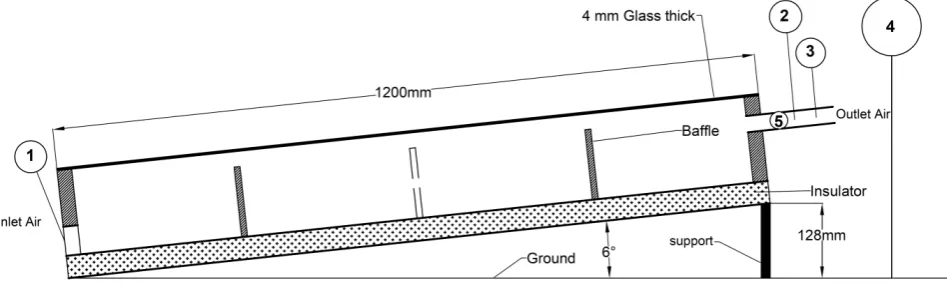
DOI: 10.4236/jpee.2018.61006 75 Journal of Power and Energy Engineering ground toward the north direction to receive maximum solar radiation and to avoid rainy water accumulation inside the collector (Figure 3).
The temperatures in the collector were measured by using multichannel XR5-SE data logger connected with PT940 temperature sensors whilst ambient temperatures were measured by CEM DT-172 temperature and humidity data logger. On the other hand, solar intensity and air flow rate were respectively measured by using PCE-SPM solar radiation meter and Testo-425 Hot Wire Thermo-Anemometer. Table 1 gives the precision of the measuring devices used in this study.
Air flows in the collectors were controlled by extract fans which were attached to the outlet duct. Experiments were conducted daily from 7:00 am before sun-rise to 6:00 pm after sunset. Data were filtered by removing the data with some interruptions such as rainy days and power cuts.
Collector models were integrated with 2, 3, 4, 8 baffles respectively, their effi-ciencies were measured and compared with the collector with no baffles (con-ventional collectors). Baffles were equally spaced over the collector geometry as shown in Figure 4 and Figure 5.
4. Results and Discussion
4.1. Temperature Profiles
Figure 6 is the representation of temperature and solar intensity comparisons
Figure 3. Schematic side view of collector model.
Table 1. Precision of data measuring devices used in this study.
Measuring devices Accuracy
XRe-SE data logger ±0.15˚C from 10˚C to 40˚C; ±0.3˚C from −25 to 85˚C
PCE-SPM solar radiation meter ±10 W/m2 or ±5% (more accuracy in highest value)
CEM DT-172 temperature and humidity data logger Temp ±1˚C and Humid ±2%
[image:6.595.62.536.408.554.2]DOI: 10.4236/jpee.2018.61006 76 Journal of Power and Energy Engineering
Figure 4. Schematic top view of collector with baffles. Length (L) = 1.2 m, length of
baf-fles (w) = 85% width of collector and collector width (W) = 0.6 m.
Figure 5. Collector models with installed baffles: Model-1: ordinary collector, Model-2:
collector with 2 baffles, Model-3: collector with 3 baffles, Model-4: collector with 4 baffles and Model-5: collector with 8 baffles.
Figure 6. Temperature profiles and solar intensity for ordinary collector and collector
with 2, 3 and 4 baffles.
[image:7.595.208.540.223.296.2] [image:7.595.213.539.356.631.2]DOI: 10.4236/jpee.2018.61006 77 Journal of Power and Energy Engineering temperature of 42.7˚C while that with 2, 3 and without baffles gave 42.1˚C, 41.6˚C, and 40.1˚C respectively. On the other hand, the maximum temperature reached in collector with 4 baffles were 52.2˚C while that of the collector with 2, 3 and without baffles were respectively 50˚C, 51˚C, and 48˚C.
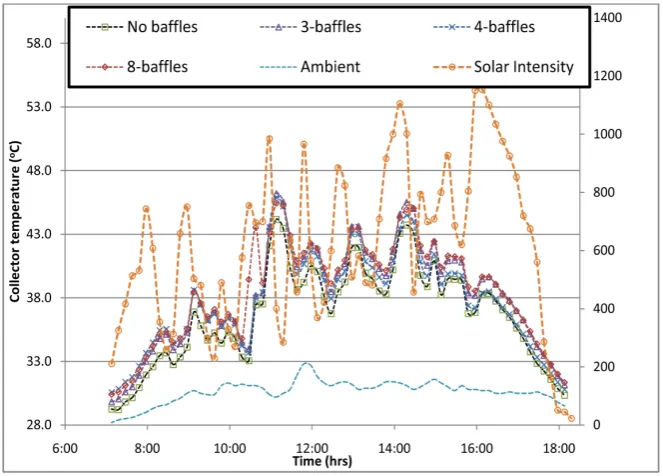
On the other hand, Figure 7 shows variations of temperatures in collectors without baffles and with 3, 4 and 8 baffles. Collector model with 8 baffles showed superiority in outlet temperature compared to other models. The average tem-perature for the collector with 8 baffles was 41.3˚C while that of 3, 4 and without baffles were 39˚C, 40˚C, and 38˚C respectively. The figure showed the high fluc-tuation of temperature which was caused by instability of solar intensity. In this regards, it can be seen that the collector temperature cannot be used as a com-parative parameter in a solar collector with and without baffles due to the varia-tion of solar intensity and air flow due to change in fan efficiency.
During the morning, the sky is normally covered by clouds, which resulted into high fluctuation of solar intensity compared to the afternoon. In some cloudy days, the fluctuations were prolonged along the day as indicated in Fig-ure 7. The average solar intensity in all days of the experiment was 818 W/m2 while the maximum solar intensity recorded was 1425 W/m2.
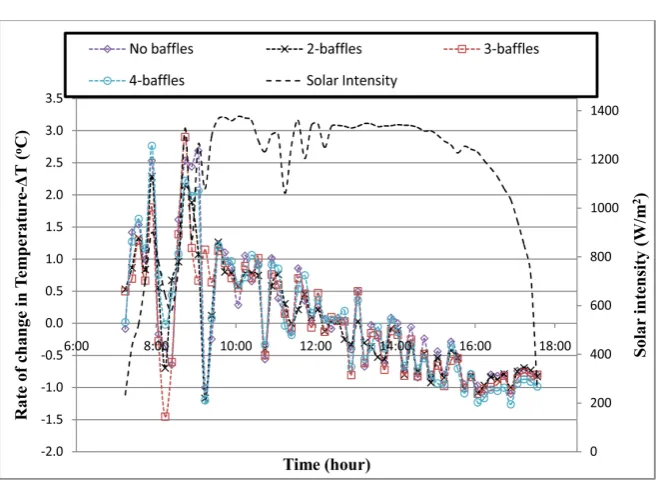
[image:8.595.208.540.458.696.2]The rate of change in temperature at the interval of 10 minutes is shown in Figure 8. There was a high-temperature change from morning to noon, which was caused by instability of solar intensity and low angle (0˚ - 60˚) of insolation to the collector surface. Also, during this time most of the energies absorbed by the collector were used in pre-heating the collector parts. Fluctuation of tem-perature was then reduced from noon due to good insolation angle to the col-lector surface (greater than 60˚), system equilibrium and less effect of fluctuation
Figure 7. Temperature profiles and solar intensity for ordinary collector and collector
DOI: 10.4236/jpee.2018.61006 78 Journal of Power and Energy Engineering
Figure 8. Rate of change in temperature along the day.
of solar intensity.
4.2. Energy Profiles for Collector with Different Number of Baffles
Generally, collected energy varies with the fluctuation of solar intensity and when solar intensity increases, the collector’s energy also increased. Low energy during the morning and sunset were caused by the low solar incidence angle to the collector surface and the fact that during the morning most of the collected heat was used in preheating the system. In addition, fluctuations of energy dur-ing the afternoon were due to poor thermal heat storage behaviour of the ab-sorbing material.4.3. Analysis of Efficiency of Collector with Different Number of
Baffles
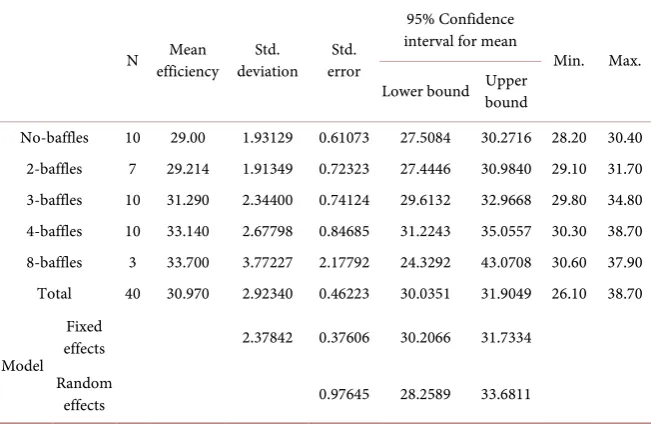
The results of the statistical analysis of variance (ANOVA) for the collector with a different number of baffles (different ratio of baffle space to collector length) which was carried out to study the significance differences between their indi-vidual means are reported in Table 2. Mean efficiencies are 29.2%, 31.3%, 33.1%, 33.7% and 28.9% for collector with 2, 3, 4, 8 and with no baffles respectively. It is clear that collector efficiencies were continued improved with an increase in a number of baffles. The highest thermal efficiency as analysed by SPSS program was 33.7% in collector with 8-baffles while the lowest efficiency was 28.9% for collector without baffles.
4.4. Mean Efficiency Comparisons for Collector with Different
Number of Baffles
DOI: 10.4236/jpee.2018.61006 79 Journal of Power and Energy Engineering
Table 2. Statistical analysis of performance of solar air collector by using SPSS.
N efficiency Mean deviation Std. error Std.
95% Confidence interval for mean
Min. Max. Lower bound Upper bound
No-baffles 10 29.00 1.93129 0.61073 27.5084 30.2716 28.20 30.40 2-baffles 7 29.214 1.91349 0.72323 27.4446 30.9840 29.10 31.70 3-baffles 10 31.290 2.34400 0.74124 29.6132 32.9668 29.80 34.80 4-baffles 10 33.140 2.67798 0.84685 31.2243 35.0557 30.30 38.70 8-baffles 3 33.700 3.77227 2.17792 24.3292 43.0708 30.60 37.90
Total 40 30.970 2.92340 0.46223 30.0351 31.9049 26.10 38.70
Model Fixed
effects 2.37842 0.37606 30.2066 31.7334
Random
effects 0.97645 28.2589 33.6811
baffles number on the efficiency of the collector. The comparisons were done to ascertain if there is a significant difference between collector’s efficiencies.
From Table 3, significance value P < 0.05, thus it can statistically be con-cluded that there was a significant difference between the means of collector ef-ficiency with and without baffles. However, in order to identify which baffle number gave significant difference, a post-hoc test for multiple comparisons was conducted. Table 4 shows the results of Levene’s Test for Equality of Variances (LTEV) which was used to ascertain the method to use in multiple comparison tests.
Since the significance value for Levene test for equity of variance is 0.729 which means (P > 0.5), therefore, equal variance assumed (Tukey HSD) were used for multiple comparisons of means of collector efficiency.
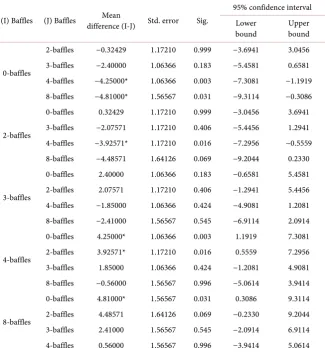
Table 5 shows significant different when comparing collector with 4 and 8 baffles to the collector without baffles, p = 0.003 and p = 0.031 respectively. Likewise, there was a significant difference when comparing collector with 4 and 2 baffles (p = 0.016).
DOI: 10.4236/jpee.2018.61006 80 Journal of Power and Energy Engineering
Table 3. Analysis of variance for collector with different baffles and without baffles.
Sum of squares df Mean square F Sig.
Between groups 135.313 4 33.828 5.980 0.001
Within groups 197.991 35 5.657
[image:11.595.204.539.185.216.2]Total 333.304 39
Table 4. Results for LTEV for collector with and without baffles.
Levene statistic df1 df2 Sig.
[image:11.595.212.538.263.617.2]0.510 4 35 0.729
Table 5. Multiple comparisons test for means efficiency of collector with and without
baffles.
(I) Baffles (J) Baffles difference (I-J) Std. error Mean Sig.
95% confidence interval Lower
bound bound Upper
0-baffles
2-baffles −0.32429 1.17210 0.999 −3.6941 3.0456
3-baffles −2.40000 1.06366 0.183 −5.4581 0.6581
4-baffles −4.25000* 1.06366 0.003 −7.3081 −1.1919
8-baffles −4.81000* 1.56567 0.031 −9.3114 −0.3086
2-baffles
0-baffles 0.32429 1.17210 0.999 −3.0456 3.6941
3-baffles −2.07571 1.17210 0.406 −5.4456 1.2941
4-baffles −3.92571* 1.17210 0.016 −7.2956 −0.5559
8-baffles −4.48571 1.64126 0.069 −9.2044 0.2330
3-baffles
0-baffles 2.40000 1.06366 0.183 −0.6581 5.4581
2-baffles 2.07571 1.17210 0.406 −1.2941 5.4456
4-baffles −1.85000 1.06366 0.424 −4.9081 1.2081
8-baffles −2.41000 1.56567 0.545 −6.9114 2.0914
4-baffles
0-baffles 4.25000* 1.06366 0.003 1.1919 7.3081
2-baffles 3.92571* 1.17210 0.016 0.5559 7.2956
3-baffles 1.85000 1.06366 0.424 −1.2081 4.9081
8-baffles −0.56000 1.56567 0.996 −5.0614 3.9414
8-baffles
0-baffles 4.81000* 1.56567 0.031 0.3086 9.3114
2-baffles 4.48571 1.64126 0.069 −0.2330 9.2044
3-baffles 2.41000 1.56567 0.545 −2.0914 6.9114
4-baffles 0.56000 1.56567 0.996 −3.9414 5.0614
*The mean difference is significant at the 0.05 level.
the collector efficiency.
From this study, a collector with 8 baffles gave the highest efficiency of 33.7%, while that of 4, 3, and 2 and with no baffles were 33.1%, 31.3%, 29.2% and 28.9% respectively.
DOI: 10.4236/jpee.2018.61006 81 Journal of Power and Energy Engineering
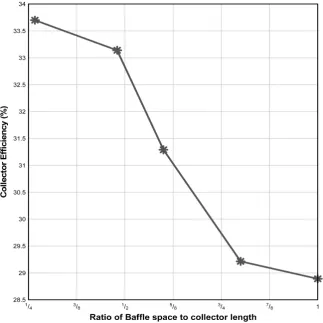
Figure 9. Comparison of ratio of baffle space and collect length to collector efficiency.
the efficiency of the solar collector. It is clear that as the ratios of baffle spacing to collector length was reduced the efficiency of collector were greatly increased, however, when the ratios become small (many baffles), the efficiency was re-duced. This is due to the fact that, in collector without baffles (ratio of 1), there was the direct passage of air in the medium of the collector from the inlet toward outlet which was associated with many dead zones and therefore reducing the effectiveness of the collector.
On the other hand, when there is less number of baffles in the collector, in this case, less than 4, there was a high influence in heat transfer while pressure drop was insignificant. However, when baffles exceed this number, the associated in-crease in pressure drop was becoming higher than the heat transfer coefficient which results into insignificant increase in efficiency.
For the best performance, a number of baffles should be optimized to ensure the increase in collector efficiency is economical in order to avoid a high in-crease in air pumping power.
baf-DOI: 10.4236/jpee.2018.61006 82 Journal of Power and Energy Engineering fles collector was out of range of 7% - 12% [25]. This was due to the fact that, in the collector used by the author in his study, the air was passing inside the tubes which were a good conductor of heat while the models reported in this study air was passing through the collector duct. It was also reported that increase of pressure load because of the close spacing of baffles is not a problem for low air-flow rates and recommended that, the increase in pumping power should not exceed one-tenth of the useful power of the collector.
5. Conclusions
• Thermal efficiency of air flat plate solar collector with different numbers of buffles has been successfully studied and compared to conventional collec-tors.
• Installation of buffles in the air passage gives a promising aproach in tackling the effect of dead zones in the collector and hence improves the overall effi-ciency of the system.
• The optimum number of baffles has to be considered during design to avoid excessive effect in pressure drop which will increase the operation cost.
References
[1] Rabha, D.K., Muthukumar, P. and Somayaji, C. (2017) Energy and Exergy Analyses of the Solar Drying Processes of Ghost Chilli Pepper and Ginger. Renewable Ener-gy, 105, 764-773. https://doi.org/10.1016/j.renene.2017.01.007
[2] Kumar, M., Sansaniwal, S.K. and Khatak, P. (2016) Progress in Solar Dryers for Drying Various Commodities. Renewable and Sustainable Energy Reviews, 55, 346- 360. https://doi.org/10.1016/j.rser.2015.10.158
[3] Bala, B., Mondol, M., Biswas, B., Das Chowdury, B. and Janjai, S. (2003) Solar Dry-ing of Pineapple UsDry-ing Solar Tunnel Drier. Renewable Energy, 28, 183-190.
https://doi.org/10.1016/S0960-1481(02)00034-4
[4] Lingayat, A., Chandramohan, V. and Raju, V. (2017) Design, Development and Performance of Indirect Type Solar Dryer for Banana Drying. Energy Procedia, 109, 409-416. https://doi.org/10.1016/j.egypro.2017.03.041
[5] Akoy, E.A.O.M., Von Hörsten, D. and Luecke, W. (Eds.) (2008) Drying Kinetics and Colour Change of Mango Slices as Affected by Drying Temperature and Time 2008.
[6] Aljuamily, K., Khalifa, A. and Yassen, T. (2007) Testing of the Performance of a Fruit and Vegetable Solar Drying System in Iraq. Desalination, 209, 163-170.
https://doi.org/10.1016/j.desal.2007.04.026
[7] Shahsavar, A. and Ameri, M. (2010) Experimental Investigation and Modeling of a Direct-Coupled PV/T Air Collector. Solar Energy, 84, 1938-1958.
https://doi.org/10.1016/j.solener.2010.07.010
[8] Banout, J., Ehl, P., Havlik, J., Lojka, B., Polesny, Z. and Verner, V. (2011) Design and Performance Evaluation of a Double-Pass Solar Drier for Drying of Red Chilli (Capsicum annum L.). Solar Energy, 85, 506-515.
https://doi.org/10.1016/j.solener.2010.12.017
DOI: 10.4236/jpee.2018.61006 83 Journal of Power and Energy Engineering
https://doi.org/10.1016/j.rser.2008.08.015
[10] Bennamoun, L. and Belhamri, A. (2003) Design and Simulation of a Solar Dryer for Agriculture Products. Journal of Food Engineering, 59, 259-266.
https://doi.org/10.1016/S0260-8774(02)00466-1
[11] Mulokozi, G., Mselle, L., Mgoba, C., Mugyabuso, J. and Ndossi, G. (2000) Improved Solar Drying of Vitamin A-Rich Foods by Women’s Groups in the Singida District of Tanzania. International Center for Research on Women.
[12] Weiss, W. and Buchinger, J. (2009) Solar Drying.
[13] Janjai, S., Srisittipokakun, N. and Bala, B. (2008) Experimental and Modelling Per-formances of a Roof-Integrated Solar Drying System for Drying Herbs and Spices.
Energy, 33, 91-103.https://doi.org/10.1016/j.energy.2007.08.009
[14] Vriens, M. and Van Diesen, G. (2007) Tanzania, the Implementation of an Innova-tion for Sustainable Economic Development in Rural Areas: The Case of Solar Fruit & Vegetable Drying in Rural. Thesis.
[15] Karim, M. (2004) Development of Solar Air Collectors for Drying Applications.
Energy Conversion and Management, 45, 329-344.
https://doi.org/10.1016/S0196-8904(03)00158-4
[16] Akpinar, E.K. and Koçyiğit, F. (2010) Energy and Exergy Analysis of a New Flat- Plate Solar Air Heater Having Different Obstacles on Absorber Plates. Applied Energy, 87, 3438-3450.https://doi.org/10.1016/j.apenergy.2010.05.017
[17] El-khawajah, M.F., Aldabbagh, L.B.Y. and Egelioglu, F. (2011) The Effect of Using Transverse Fins on a Double Pass Flow Solar Air Heater using Wire Mesh as an Absorber. Solar Energy, 85, 1479-1487.
https://doi.org/10.1016/j.solener.2011.04.004
[18] Kabeel, A.E. and El-Agouz, S.A. (2011) Review of Researches and Developments on Solar Stills. Desalination, 276, 1-12.https://doi.org/10.1016/j.desal.2011.03.042
[19] Mbise, E. (2008) Design of an Efficient Box Type Solar Dryer for Fruits and Vegeta-bles. Dares Salaam.
[20] Kalogirou, S.A. (2004) Solar Thermal Collectors and Applications. Progress in Ener- gy and Combustion Science, 30, 231-295.https://doi.org/10.1016/j.pecs.2004.02.001
[21] Zambolin, E. and Del Col, D. (2010) Experimental Analysis of Thermal Perfor-mance of Flat Plate and Evacuated Tube Solar Collectors in Stationary Standard and Daily Conditions. Solar Energy, 84, 1382-1396.
https://doi.org/10.1016/j.solener.2010.04.020
[22] Aldabbagh, L.B.Y., Egelioglu, F. and Ilkan, M. (2010) Single and Double Pass Solar Air Heaters with Wire Mesh as Packing Bed. Energy, 35, 3783-3787.
https://doi.org/10.1016/j.energy.2010.05.028
[23] Velmurugan, P. and Ramesh, P. (2011) Evaluation of Thermal Performance of Wire Mesh Solar Air Heater. Indian Journal of Science and Technology, 4, 12-14. [24] Romdhane, B.S. (2007) The Air Solar Collectors: Comparative Study, Introduction
of Baffles to Favor the Heat Transfer. Solar Energy, 81, 139-149.
https://doi.org/10.1016/j.solener.2006.05.002
[25] Pona, J. (1985) Increasing Thermal Efficiency of Solar Flat Plate Collectors. NASA STI/Recon Technical Report.
[26] Abene, A. (2004) Study of a Solar Air Flat Plate Collector: Use of Obstacles and Ap-plication for the Drying of Grape. Journal of Food Engineering, 65, 15-22.
https://doi.org/10.1016/j.jfoodeng.2003.11.002
DOI: 10.4236/jpee.2018.61006 84 Journal of Power and Energy Engineering
on the Collector Efficiency of Baffled Solar Air Heaters. Energy, 23, 11-16.
https://doi.org/10.1016/S0360-5442(97)00054-6
[28] Struckmann, F. (2008) Analysis of Flat-Plate Solar Collector. Project Report, MVK160 Heat and Mass Transport, Lund.
[29] Luna, D., Jannot, Y. and Nadeau, J.-P. (2010) An Oriented-Design Simplified Model for the Efficiency of a Flat Plate Solar Air Collector. Applied Thermal Engineering, 30, 2808-2814.https://doi.org/10.1016/j.applthermaleng.2010.08.016
[30] Karatasou, S., Santamouris, M. and Geros, V. (2006) On the Calculation of Solar Utilizability for South Oriented Flat Plate Collectors Tilted to an Angle Equal to the Local Latitude. Solar Energy, 80, 1600-1610.
https://doi.org/10.1016/j.solener.2005.12.003
[31] Ekechukwu, O. and Norton, B. (1999) Review of Solar-Energy Drying Systems III: Low Temperature Air-Heating Solar Collectors for Crop Drying Applications. En-ergy Conversion and Management, 40, 657-667.