ISSN Online: 2165-3925 ISSN Print: 2165-3917
DOI: 10.4236/ojapps.2019.97042 Jul. 5, 2019 535 Open Journal of Applied Sciences
New Solutions for Systematic Problems
Involving Complexity through Program MATLAB
Based on Indeterminism for Non-Physicists
Deok-Soo Cha
1,2, Hee-Jong Jun
21Eho Technology Co., Seoul, South Korea 2Soongsil University, Seoul, South Korea
Abstract
Modern science has solved the systematic dynamic problems involving com-plexity such as complex systems by logical solution algebraically such as the old chaos theory derived from algebraic statistics based on determinism. It is very vague and difficult for us. Moreover, modern science treats systems dy-namic problems as logical static problems according to determinism. Howev-er, this study proposes a novel solution for systematic problems, it is accom-plished by systems analysis theory based on a third science (indeterminism) as it is more precise and easier to understand compared to chaos theory. Fur-thermore, it is suitable for non-physicists, because it is supported by comput-er simulations without any mathematical processing. Thus, it can be solved especially regressive systems solution. Therefore, this provided an innovative scientific result to non-physicists for their unsolved systematic problems in modern science.
Keywords
Systematical Solution, Systems Simulator, Systems Analysis Theory, Complexity, Regressive Systematic Solution
1. Introduction
This thesis describes an interdisciplinary scientific study regarding systematic problems involving complexity [1] such as complex systems. However, this is not a regular physical article because this solution is not accomplished by con-ventional physics based on determinism but indeterminism. Please do not mi-sunderstand. (Remark: this study was completed in 2016 [2] [3]). Perhaps de-How to cite this paper: Cha, D.-S. and Jun,
H.-J. (2019) New Solutions for Systematic Problems Involving Complexity through Pro-gram MATLAB Based on Indeterminism for Non-Physicists. Open Journal of Applied Sciences, 9, 535-543.
https://doi.org/10.4236/ojapps.2019.97042
Received: February 27, 2019 Accepted: July 2, 2019 Published: July 5, 2019
Copyright © 2019 by author(s) and Scientific Research Publishing Inc. This work is licensed under the Creative Commons Attribution International License (CC BY 4.0).
DOI: 10.4236/ojapps.2019.97042 536 Open Journal of Applied Sciences terminists will not be pleased with the solution provided herein. There is no problem occurred in it because of no relation with determinists.
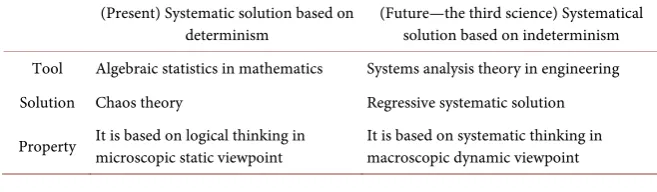
Meanwhile, in modern science, there is a high separating wall created by phy-sicists between determinism and non-determinism [4] [5] like physics and non-physics. In particular, this study was accomplished by other systematic dy-namic solutions based on non-determinism (indeterminism) (see Table 1). It is more precise and easier to apply compared with chaos theory [6] in mathematics based on determinism. Hence, it is similar to a second solution for complexity. Therefore, many non-physicists, including economists, ecologists, and engineers will greatly welcome another solution. Moreover, they have no reason to object to it, as well as, they have no duty to follow determinism. Nevertheless, other physicists do not welcome it because it is different from conventional physics and it is not relevant to determinism. However, there are no problems, if a phy-sicist does not want it, he/she will just continue using their old chaos theory. (Remark: If they are not welcome, it will be published in non-physical journals; we need a rational judgement.)
Generally, modern science has treated all physical problems as logical problems using the chaos theory as derived from algebraic statistics according to determin-ism. Nonlinear dynamic problems involving complexity and nonlinearity in inde-terminism have been solved algebraically by the statistical program SPSS for a long time. Nevertheless, if complexity is a systematic problem but logical problem, it should be solved by systems analysis theory in other science including the com-mercial program MATLAB through mathematical modeling. And, it must be solved in the following sequence: mathematical modeling—computer simula-tion—verification—return. (Remark: Systems cannot be solved algebraically.)
Consequently, this study will prove that complexity is characterized as a sys-tematic problem. It proves that complexity is a solvable problem based on the third science. Complexity is not a difficult problem to non-physicists. To help readers understand, this study provides three cases studies: 1) Adam Smith’s in-visible hand; 2) Logistic curve; 3) Tomas Kuhn’s innovation theory in non-physics.
2. Materials and Methods
2.1. Scientific Background
[image:2.595.208.537.636.732.2]Generally, we can be divided physical phenomena into logical static problems and systematic dynamic problems. For instance, the food chain is a representative
Table 1. Summary of present solution and future solution in third science.
(Present) Systematic solution based on
determinism (Future—the third science) Systematical solution based on indeterminism Tool Algebraic statistics in mathematics Systems analysis theory in engineering Solution Chaos theory Regressive systematic solution
DOI: 10.4236/ojapps.2019.97042 537 Open Journal of Applied Sciences closed loop system with invisible feedback elements. However, a serious problem is that modern science treats systematic problems such as the food chain as a nonlinear dynamic problem and attempts to solve it with regressive solution in statistics such as chaos theory. It seems not a reasonable practice. Instead, this study proposes a novel systematic solution as shown in Table 1 and refers to ap-plication example in Appendix.
Meanwhile, we can classify systematic problems such as food chains, stock markets, and global weather as shown in Figures 1(a)-(c) and it can always solve such feedback systems with systems analysis theory (control theory) [7]. Unfortu-nately, many scientists except control engineers are not familiar with the theory, further, it is a difficult and complex theory. Instead, we must utilize MATLAB [8] to solve the problems without any preliminary knowledge. Thus, non-physicists have no difficulty to solve it.
However, we need to understand the basic concept in the figure. For example, Figure 1(a) is an open loop system and logical problem. Hence, it does not need to be discussed. However, Figure 1(b) and Figure 1(c) are closed loop systems such as food chains or stock markets including other nonlinear systems; these should be solved by dynamic systems analysis theory because they have [an irre-versibility] and cannot be solved inverse between input and output and re not proportional to each other. (Remark: This problem was talked by chemist-physicist Prigogine in his book, The End of Certainty [9]. He said that modern science has not yet solved the irreversibility in determinism.) Accordingly, systematic dy-namic problems that appear in science it must be solved the computer through mathematical modelling.
2.2. Mathematical Process and Simulation
(Modeling): If someone who wants to solve a systematic problem, he/she should build a model system as follows. For instance, given a seller’s positive entropy [10] G(s) and buyer’s negative entropy H(s) in a market, similar to the preda-tor-prey relationship in the food chain in Figure 1(b), the total output entropy converges to equilibrium by self-control based on the law of energy conservation such as the law of supply and demand in Appendix. Similarly, climate change, turbulence in nature, organisms in ecosystems, or any other phenomena with
[image:3.595.70.537.587.688.2](a) (b) (c)
DOI: 10.4236/ojapps.2019.97042 538 Open Journal of Applied Sciences entropy share the same algorithm can be presented as following; output equation y(t) = transfer function F(s) × input equation u(t).
( )
( )
( )
Y s =F s U s× (1)
where [s] is the Laplace operator; G(s) and H(s) are the transfer functions of the system; Y(s) is the output; and U(s) is the input source. If feedback element H(s) = 0, it is an open loop system. If H(s) is not zero, the basic transfer function Eq-uation (2) is the second-order solution of formula as below [7].
( )
( )
( )
2 2 2 2Y s F s
U s s s
ω
βω ω
= =
+ + (2)
where β is the damping factor and ω is the periodical variable. Then, the trans-formed reversible Laplace transform can be given by y(t) [7],
( )
1 B tsin(
)
y t = − ⋅A e− ⋅ W t⋅ +
ϕ
(3)where t is time; A, B, W, and φ are variable constants; and β is the damping fac-tor. Equation (3) is nonlinear as a time series function and is an exponential and periodic function that can never be solved inversely. To build a mathematical model system, the variables in Equation (2) must be determined repeatedly.
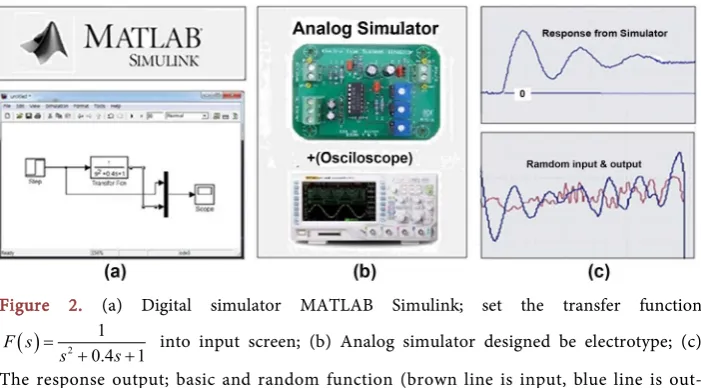
[image:4.595.187.538.517.711.2](Simulation): The computer software MATLAB, as shown in Figure 2(a), is convenient, easy to use, and accurate, similar to the analog simulator in Figure 2(b). Assuming the input sets the systems transfer function, readers can observe the basic response behavior on the monitor, as shown in Figure 2(c). Various behaviors were observed, including initial phenomena, periodic sine curves, de-creasing periodicity, and irregularity. For further details, watch the video clip provided in Ref. [11]. (Remark: Determinists in modern science are asked to deal and analyze systematic problems with microscopic and dynamic characte-ristics in a macroscopic and static viewpoint, but it is not reasonable. Thus, there is no reason for non-physics to follow it.)
Figure 2. (a) Digital simulator MATLAB Simulink; set the transfer function
( )
2 10.4 1
F s
s s
=
+ + into input screen; (b) Analog simulator designed be electrotype; (c)
DOI: 10.4236/ojapps.2019.97042 539 Open Journal of Applied Sciences
3. Results: Application Case Studies
These applications as below cannot be not perfectly solved by logical static solu-tion such as the old chaos theory. However, it can be easily solved by systematic dynamic solution through mathematical modeling and MATLAB, to provide innovative scientific results.
3.1. Adam Smith’s Invisible Hand and Random Walk
Adam Smith’s Invisible Hand [12] is a familiar with economists, likewise, the law of supply and demand in Appendix. If they have a preliminary knowledge regarding systems analytic theory in engineering, they can solve this problem. (Modeling): If the utility of the supplier and demander in a market or preda-tor-prey correlation is a microscopic dynamic problem in real time, moreover, it is a closed-loop feedback system, as shown in Figure 1(b), it will be converged to an equilibrium state automatically. (Simulation): In this case, it was assumed that the transfer function F(s) of the stock market is the same as the one pro-vided above. (Verification): If the stock price information from external fluc-tuates continuously, the output of the daily stock price is random walk [13], there-fore, it is endlessly changed and converges to steady price by self-controlling. In this case, no one can predict the stock price absolutely. Consequently, the invisi-ble hand is not a logical proinvisi-blem but a systematic proinvisi-blem. Accordingly, econ-omists need not follow up determinism and chaos theory, it must be solved by systematic solution based on a third science.
3.2. Logistic Curve in Ecology
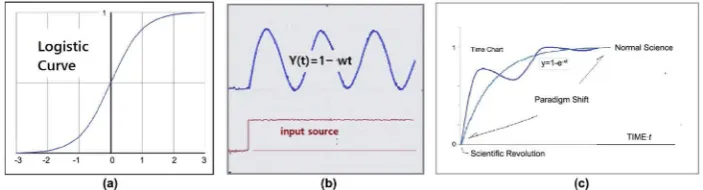
The second case is the established logistic curve [14] in ecology, which was de-vised by the mathematician Verhulst, as shown in Figure 3(a). He asserted that population growth follows a sigmoid curve given by the following equation:
( )
1 xL f x
e
= +
[image:5.595.186.538.592.687.2]which is derived from algebraic statistics based on determinism. (Modeling): This is not a logical problem but a systematic one similar to type (c) in Figure 1. If the feed volume is constant, its correlation can be described by the following transfer function [7],
DOI: 10.4236/ojapps.2019.97042 540 Open Journal of Applied Sciences
( )
( )
( )
2 21
G s F s
G S s
ω ω
= =
+ +
which is derived from Equation (2). (Simulation): we can obtain the basic re-sponse function of is y t
( )
= −1 sinωt (where ω is constant), as shown in Fig-ure 3(b), which has a periodic function within the sine curve. (Verification): Figure 3(a) and Figure 3(b) are equivalent because is y t( )
= −1 sinωt is di-mensionless and we can obtain same sigmoid curve. Hence, this logistic curve theory is not a logical problem but a systematic problem. If the mathematician has known the systematic solution in that time, he can solve this problem per-fectly.3.3. Kuhn’s Innovation Theory
Kuhn’s innovation theory [15] is a famous philosophical principle well-established in modern science. However, it is similar to the heliocentric theory developed in the Middle Ages. The scientific revolution encountered extreme opposition when it was first proposed, but it has led to a paradigm shift, with the theory now widely accepted. Finally, it has arrived at a saturated state as the normal sciences. Therefore, it can be described using the following scheme: [scientific revolution—paradigm shift—normal science]. (Modeling) Here, the correlation can be defined as a time series function as Equation (2) assuming a damping factor of 1 (critical damping state) with an output of [7]
( )
( ) ( )
( ) ( )
1 1 1U s G s Y s
G s H s s s x
= = +
+ +
and an original equation of is y t
( )
= −1 e−xt (where x is constant), as shown in Figure 3(c). This equation is a gradually increases and eventually reaches satu-ration. It is very significant the result for his assertion. It is like invention (inno-vation)—paradigm shift—saturation state (normal science). (Verification): As a practical case, mobile technology developed slowly for 150 years with the fol-lowing sequence: invention—paradigm shift—normal science. Those disagreeing with the result are encouraged to perform their own simulation with MATLAB directly. However, there are several scientific revolutions, including the steam engine, gun powder, fertilizer, semiconductors, internet, and automobiles whose utility slowly increased and converged into a saturated state, and then further into a normal state, as shown in Figure 3(c). Hence, Kuhn’s theory is not a logi-cal problem but a systematic problem. (Remark; if the Kuhn has known the sys-tematic dynamic solution as mentions above, he can successfully solve this problem.)4. Discussion
DOI: 10.4236/ojapps.2019.97042 541 Open Journal of Applied Sciences the systematic problem as a closed loop system as shown in Figure 1(b), which means that they are unfamiliar with systems analysis theory according to deter-minism. This will be serious problem to physicists but non-physicists have no problems. Rather, they welcome it because it is more innovative compared with chaos theory in determinism, hence, they have no reason to object to this ad-vanced solution. Therefore, we must break down the high wall between deter-minism and indeterdeter-minism. Accordingly, the novel solution will contribute to the advancement of science and can explain numerous long-standing problems involving complexity in modern science.
For instance, the famous Lorenz’s butterfly effect [16] including stranger-attractor is a representative systematic problem, if readers understand the solution, he/she can solve it using MATLAB. Likewise, non-physicists can solve long-standing unsolved problems in diverse fields such as macroeconomic problems or food chains in ecology, quantum mechanics in nonlinear dynamics, and AI algorithms in engineering. Biomedical sciences and space industrial sciences can apply this approach to solve related complex problems. In addition, it can be applied to quantum computing as well as soft scientific areas that include advanced mili-tary, political, social, and trading simulations.
5. Conclusion
This study presents a new systematic solution based on indeterminism accom-plished by other scientific principles such as dynamic systems analysis theory based on a third science (indeterminism), for the first time, and with the support of MATLAB. In particular, this study encourages physicists to study novel sys-tematic solutions and apply it to their discipline because it is more precise and easier to use than the old chaos theory. Hence, it represents a second solution for complexity. Complexity is a solvable problem based on this third science. There-fore, our research will significantly contribute to the development of modern science.
Acknowledgements
Authors are grateful to research center in Eho Technical Co. for research.
Conflicts of Interest
The authors declare no conflicts of interest regarding the publication of this pa-per.
References
[1] Casti, J.L. (1995) Complexification. Harper Perennial, New York.
[2] Cha, D. (2016) Complex Systems Are Not Black Boxes But a Solvable Systematical Problem. Journal of Modern Physics, 7, 1540-1545.
https://doi.org/10.4236/jmp.2016.712140
DOI: 10.4236/ojapps.2019.97042 542 Open Journal of Applied Sciences [3] Cha, D. (2015) Establishment of New Solution for Complex Systems. Journal of
Modern Physics, 6, 1927-1934. https://doi.org/10.4236/jmp.2015.613198 http://www.scirp.org/Journal/PaperInformation.aspx?PaperID=60738
[4] Ernest, C. (1956) Determinism and Indeterminism in Modern Physics: Historical and Systematic Studies of the Problem of Causality. Oxford University Press, Ox-ford.
[5] Phillip (2006) Ball Critical Mass: How One Thing Leads to Another Paperback. [6] Kauffman, S. (1996) At Home in the Universe. Oxford University Press, Oxford. [7] Golnaraghi, F. and Kuo, B.C. (1998) Automatic Control Systems. 10th Edition,
McGraw-Hill Education, New York.
[8] MATLAB Simulink. https://www.mathworks.com/matlab/Popper
[9] Prigogine, I. and Stingers, I. (1997) The End of Certainty, 2016. Merriam-Webster, Springfield.
[10] Rifkin, J. and Howard, T. (2013) Entropy: A New World View Seijong Research Center.
[11] Video Clip from YouTube. https://www.youtube.com/watch?v=-EnU4L5uH5o [12] van Ulrich, S. (2004) The Invisible Hand: Economic Thought Yesterday and Today.
Springer, Berlin.
[13] Andrew, W. and Lo, A. (1999) Craig MacKinlay. A Non-Random Walk down Wall Street. Princeton University Press, Princeton.
[14] Wolfram-Mathworld/ Logistic Function.
http://mathworld.wolfram.com/LogisticEquation.html
[15] Kuhn, T.S. (1970) The Structure of Scientific Revolutions. University of Chicago Press, Chicago and London.
https://www.amazon.com/Structure-Scientific-Revolutions-50th-Anniversary/dp/02 26458121/ref=sr_1_1?ie=UTF8&qid=1517912610&sr=8-1&keywords=science+revo lution#reader_0226458121
[16] Lorenz, E.N. (1963) Deterministic Non-Periodic Flow. Journal of the Atmospheric Sciences, 20, 130-141.
DOI: 10.4236/ojapps.2019.97042 543 Open Journal of Applied Sciences
Appendix: Application Example
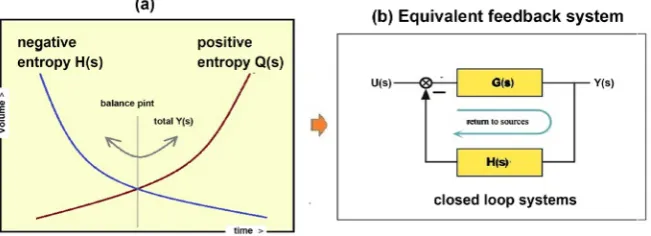
[image:9.595.212.538.271.389.2]To help physicists and non-physicists understanding, this section is provided a representative example as the law of supply and demand. We can replace the graph about economic theory as shown in Figure 4(a) with a block-diagram as shown in Figure 4(b). As matter of a fact, if supplier continues to increase the products Q(s) in the figure, demander decreases to buy gradually and the price decreases. Otherwise, if demander increases to buy and the price increases grad-ually, and then, the market price converges to steady price as shown in Figure 4(a). In this case, the transaction with time delay d is not completed instantane-ous at once. Hence, we can define the microscopic dynamic systematic problems as above as a closed loop feedback system as shown in Figure 4(b). In addition, we can always solve the problems using systems analysis theory in other science.
![Figure 1. Where, [s] is the Laplace operator, the positive entropy is Q(s), the reverse entropy is H(s), and every feedback system’s transfer function is F s( )=G s( )(1G s H s( )( )) illustrated for the cases of (a) is H(s) = 0, (b) is 0 < H(s) < 1, and](https://thumb-us.123doks.com/thumbv2/123dok_us/9029365.399394/3.595.70.537.587.688/figure-laplace-operator-positive-feedback-transfer-function-illustrated.webp)