http://www.scirp.org/journal/ajps ISSN Online: 2158-2750
ISSN Print: 2158-2742
DOI: 10.4236/ajps.2018.92025 Jan. 31, 2018 311 American Journal of Plant Sciences
Molecular Variability and Genetic Structure of
IYMV in Burkina Faso
Moustapha Koala
1,2*, Drissa Sérémé
1,2, Florence Vignols
3, Eric Lacombe
3, Martine Bantgratz
2,3,
Bouma James Neya
1,2, Christophe Brugidou
2,3, Nicolas Barro
4, Oumar Traoré
1,21Laboratoire de Virologie et de Biotechnologie Végétale (LVBV), Institut de l’Environnement et de Recherches Agricoles
(INERA), Ouagadougou, Burkina Faso
2Laboratoire Mixte Internationale (LMI) Patho-Bios, Institut de l’Environnement et de Recherches Agricoles (INERA),
Ouagadougou, Burkina Faso
3UMR IPME (UM, IRD, CIRAD), Institut de Recherche pour le Développement (IRD), Montpellier Cedex, France 4Université Ouaga I Professeur Joseph Ki-Zerbo, Ouagadougou, Burkina Faso
Abstract
Imperata yellow mottle virus (IYMV, Sobemovirus) was first described in 2008 in the south-western region of Burkina Faso (West Africa). The genetic diversity of IYMV was not documented up to day. In this study, the variability of CP of IYMV was evaluated through the molecular characterization of 38 isolates collected in the western part of Burkina Faso. Comparison of se-quences of these new isolates and one IYMV sequence available in GenBank revealed that the average nucleotide diversity was low. The ratio of non- syn-onymous over synsyn-onymous nucleotide substitutions per site was low, indicat-ing a CP diversification under strong purifyindicat-ing selection. Despite of the low nucleotide diversity, phylogenetic analyses revealed segregation of IYMV iso-lates into six major clades. There was no correlation of phylogenetic group-ing of isolates based on geographical location. This is the first study of the ge-netic diversity of IYMV.
Keywords
Imperatayellow mottle virus (IYMV), Coat Protein (CP), Genetic Variability, Phylogenetic Analysis
1. Introduction
The perennial grass Imperata cylindrica (L.) P. Beauv., a common and persistent weed in many food crops such as like cassava, maize, sorghum and rice is consi-How to cite this paper: Koala, M., Sérémé,
D., Vignols, F., Lacombe, E., Bantgratz, M., Neya, B.J., Brugidou, C., Barro, N. and Traoré, O. (2018) Molecular Variability and Genetic Structure of IYMV in Burkina Faso. American Journal of Plant Sciences, 9, 311- 324.
https://doi.org/10.4236/ajps.2018.92025 Received: December 19, 2017
Accepted: January 28, 2018 Published: January 31, 2018
Copyright © 2018 by authors and Scientific Research Publishing Inc. This work is licensed under the Creative Commons Attribution International License (CC BY 4.0).
DOI: 10.4236/ajps.2018.92025 312 American Journal of Plant Sciences dered as traditional and important medicinal plant in several African country such as Uganda, Ghana and Cameroun, where the roots of I. cylindrica have been described as snakebite treatment in Uganda [1]. At Ghana, the properties of management of hypertension have been identified to I. cylindrica leaf extract while in Cameroon the properties of management of typhoid fever have been identified to I. cylindrica [2] [3].
Recently, only one viral disease has been reported that affects I. cylindrica, and was defined as the Imperata yellow mottle virus (IYMV) because of the typ-ical mottled yellowing appearing at the I. cylindrica leaf surface. IYMV was first characterized in I. cylindrica in West Africa in 2008 [4] and classified as a new member of the sobemovirus genus. Like all sobemoviruses, IYMV is readily transmitted mechanically. Up to now, natural infection with IYMV has been observed and demonstrated conclusively in Zea mays and I. cylindrica [4]. Expe-rimentally, the virus has a crop host range including two cereals (Sorghum bico-lor, Pennisetum glaucum) [5] and three wild grasses (Rottboellia exaltata Setaria verticillata, Brachiaria xantholeuca [4] [5]. Contrary to other sobemoviruses, it remains unknown whether insects such as beetles or even the I. cylindrica seeds themselves can serve as vector for IYMV infection.
IYMV is a positive single stranded RNA virus with the particle of 32 nm in diameter. Its genome is 4.447 nucleotide long and comprises five ORFs [6]. ORF1 (45 - 686 nt), which is located at the 5’ end of the genome, encodes a P1-like protein. P1 is involved in the cell-to-cell and systemic movement of the virus [7]. ORF2, has two overlapping ORFs, encodes the putative central poly-proteins. ORF2a (713 - 2509 nt) encodes a serine protease and a viral ge-nome-linked protein (VPg), and ORF2b (2176 - 3768 nt), encodes a RNA de-pendant RNA polymerase (RdRp). ORF4 (3560 - 4381 nt) is translated from the subgenomic RNA at the 3’ end of the genome and encodes the coat protein. Re-cently, the presence of a fifth ORF (ORFx), conserved was reported in all sobe-movirus [6]. Such putative fifth ORF is also present in the IYMV genome, and overlaps the 5’ end of the ORF2a in the +2 reading frame (Figure 1).
DOI: 10.4236/ajps.2018.92025 313 American Journal of Plant Sciences
Figure 1. A schematic representation of the genome organization of IYMV; see text for details.
2. Materials and Methods
2.1. Survey and Sample Collection
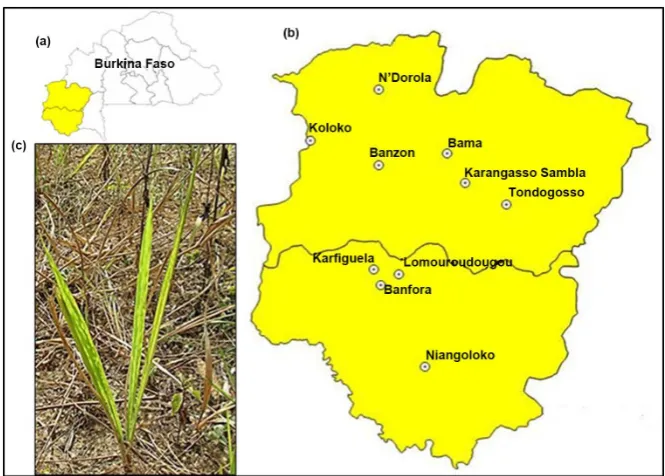
Imperata cylindrica leaves showing viral symptoms of Imperata yellow mottle virus infection were collected in 10 different locations belonging to the high bas-sins region (Bama, Banzon, N’Dorola, Koloko, Tondogosso, Karangasso Sambla) and cascades regions (Banfora, Karfiguela, Lomouroudougou and Niangoloko) of Burkina Faso (West Africa), as indicated in Figure 2. One virus sample iso-lated from an individual I. cylindrica plant was considered as one isolate. In-fected I. cylindrica plants were either used for extraction of total RNA or stored at 80˚C for future use.
2.2. RNA Extraction, RT-PCR Amplifications and Sequencing
Total RNA was extracted from frozen infected Imperata cylindrica leaves using the RNeasy Plant Mini Kit (Qiagen), according to manufacturer’s instructions. Slight modifications were made on the protocol to optimize the quality and quantity of the total RNA. The quality of RNA extraction was compared by measurement of RNA concentration.
Reverse-transcription (RT) was performed using the primers IYMV-R4438-4454 while Polymerase Chain Reaction (PCR) was performed using IYMV-F3483-3502 and IYMV-R4385-4394 described by Koala et al., 2017. All steps and conditions, including, RT and PCR followed the protocol of koala 2017 [5]. All PCR prod-ucts of the correct size were purified from 1% agarose gels using GENECLEAN turbo Protocols columns before being sent to Genewiz (Essex, UK) for sequencing.
2.3. Recombination and Genetic Diversity Analysis
The sequences contigs obtained in this study were assembled using the Seqman II program in the DNASTAR 10.0 (DNAStar Inc., Madison, USA). The 38 se-quences were then compared and analyzed with the available GenBank accession NC-011536 sequence (Table 1). Multiple nucleotide sequence alignments were performed by using CLUSTAL W with default parameter [11].
Alignments were also adjusted manually to guarantee correct reading frames. Noncoding sequences were removed before alignment.
DOI: 10.4236/ajps.2018.92025 314 American Journal of Plant Sciences
Figure 2. Geographical location of IYMV sample collection sites and symptoms on in-fected Imperata cylindrica in its natural habitat. (a) A Map of Burkina Faso showing the south-Western (in yellow) where sampling was done; (b) Precise rural provinces within the two South-Western regions where IYMV was detected and collected; (c) Typical mot-tle yellowing of Imperata cylindrica leaves guiding plant harvests.
Thus, possible recombination events were analysis using the models RDP, GENECONV, Bootscan, MaxChi Chimaera, SiScan and 3Seq implemented in the software package Recombination Detection Program (RDP, version 4.85) [12]-[18]. The default detection thresholds were used. Only events supported by three kinds of methods were retained.
Pairwise genetic distances among nucleotide and amino acid sequences were calculated using the Kimura’s two parameters [19] and using the Jones Taylor Thornton (JTT) model implemented in MEGA v.6.0 [20]. To evaluate variation in selection pressure, during CP evolution, the direction and degree of selective constraints operating in a coding region were assessed by the ratio between nuc-leotide diversities at nonsynonymous and synonymous positions (dNS/dS).
The extent of IYMV variation among these sequences was evaluated using the index π by DnaSp version 5.0. With a sliding window of 100 nt and a step size of 25 nt. The parameter π is the mean number of nucleotide differences per site between two sequences to measure the nucleotide diversity.The value assigned to the nucleotide was that of the window midpoint.
2.4. Construction of Phylogenetic Trees
DOI: 10.4236/ajps.2018.92025 315 American Journal of Plant Sciences
Table 1. IYMV Isolates identified in different sub regions of South-Western Burkina Faso (BF). The unique IYMV sequence identified prior to this analysis [4] is given as the refe-rent accession NC-011536.
Origin Year Isolate GenBank (Acc. No) Reference
N’Dorola 2016 IYMV1-BF MF043148 This study
N’Dorola 2016 IYMV2-BF MF043149 This study
Lomouroudougou 2016 IYMV3-BF MF043150 This study Lomouroudougou 2016 IYMV4-BF MF043151 This study
Banfora 2016 IYMV5-BF MF043152 This study
Karfiguela 2016 IYMV6-BF MF043153 This study
Niangoloko 2016 IYMV7-BF MF043154 This study
Lomouroudougou 2016 IYMV8-BF MF043155 This study
Banfora 2016 IYMV9-BF MF043156 This study
Tondogosso 2016 IYMV10-BF MF043157 This study
Koloko 2016 IYMV11-BF MF043158 This study
Karfiguela 2016 IYMV12-BF MF043159 This study
Lomouroudougou 2016 IYMV13-BF MF043160 This study
Tondogosso 2016 IYMV14-BF MF043161 This study
Karfiguela 2016 IYMV15-BF MF043162 This study
Bama 2016 IYMV16-BF MF043163 This study
Banfora 2016 IYMV17-BF MF043164 This study
Koloko 2016 IYMV18-BF MF043165 This study
Tondogosso 2016 IYMV19-BF MF043166 This study
Tondogosso 2016 IYMV20-BF MF043167 This study
Tondogosso 2016 IYMV21-BF MF043168 This study
Tondogosso 2016 IYMV22-BF MF043169 This study
Karfiguela 2016 IYMV23-BF MF043170 This study
Banzon 2016 IYMV24-BF MF043171 This study
N’Dorola 2016 IYMV25-BF MF043172 This study
Tondogosso 2016 IYMV26-BF MF043173 This study
Niangoloko 2016 IYMV27-BF MF043174 This study
Karangasso Sambla 2016 IYMV28-BF MF043175 This study
Banfora 2016 IYMV29-BF MF043176 This study
N’Dorola 2015 IYMV30-BF MF043177 This study
N’Dorola 2014 IYMV31-BF MF043178 This study
Banzon 2015 IYMV32-BF MF043179 This study
Banfora 2013 IYMV33-BF MF043180 This study
Bama 2014 IYMV34-BF MF043181 This study
Banfora 2014 IYMV35-BF MF043182 This study
N’Dorola 2014 IYMV36-BF MF043183 This study
Bama 2014 IYMV37-BF MF043184 This study
Banfora 2014 IYMV38-BF MF043185 This study
DOI: 10.4236/ajps.2018.92025 316 American Journal of Plant Sciences accession number: AJ279901.1) of Rice yellow mottle virus (RYMV) was used as outgroup for phylogenetic analysis. Robustness of phylogenetic relationships was assessed by 1000 bootstrap replications.
3. Results
3.1. Imperata cylindrica Harvest Campaigns Identify Up to 38
IYMV Isolates in South Western Burkina Faso
Within the frame of a 3-year harvest campaign in distinct areas of South-Western Burkina Faso (Figure 2), a total of 38 samples of I. cylindrica leaves were ana-lyzed for Imperata yellow mottle virus detection.
As expected, RT-PCR on total RNAs from infected plant materials resulted in the amplification of DNA fragments of about 1000 bp for all sample listed in Table 1. PCR amplifications representative of different plants are shown (Figure 3).
3.2. Recombination Analysis
In total, four Potential Recombinant Events (PREs) named PRE_iymv34-BF, PRE_NC-011536, PRE_iymv2-BF and PRE_iymv9-BF were detected by at least one of the models (Figure 4). PRE_iymv34-BF have been the result of recombi-nation of the major NC-011536 with an iymv38-BF minor parent. PRE_NC- 011536 have been the result of recombination of the major parent iymv29-BF with an iymv2-BF minor parent. PRE_iymv2-BF shows the recombination be-tween iymv29-BF as the major parent and Unknown (iymv25-BF) as the minor parent. These PREs (iymv34-BF, NC-011536, iymv2-BF) were detected by MaxChi methods with average P-value 2760 × 10−5, 1068 × 10−2 and 4298 × 10−2
respectively. PRE_iymv34-BF also have been the result of recombination be-tween iymv37-BF as the major parent and iymv38BF as the minor parent in the Chimaera and SiScan methods with average P-value 1393 × 10−2, 1393 × 10−3,
[image:6.595.233.519.567.658.2]respectively. Finally, PRE_iymv9-BF show the recombination between iymv38- BF as the major parent and Unknown (NC-011536) as the minor parent. This recombination event was detected by Chimaera method with average P-value > 1.0.
DOI: 10.4236/ajps.2018.92025 317 American Journal of Plant Sciences
Figure 4. Description of potential recombination events. PRE_iymv34-BF, PRE_NC-011536, PRE_iymv2-BF and PRE_iymv9-BF are the Potential Recombinant Events (PREs). See text for details of major and minor parents.
These four potential recombinants were detected by one or two methods of RDP program with a low degree of confidence. In addition, one of the parental isolates was often unknown. Based on the criteria of recombination selection, these Potential Recombination events were not accepted. No evidence for poten-tial recombination events was found among the other isolates using RPD4.
3.3. Sequence Analysis
The average of genetic diversity among the 39 listed in Table 1 was 4.6% for nt, with the peak (7.6%) of nucleotide substitutions per site between sequences present at the 5’ half N-terminal protein coding region (Figure 5). The average number of nucleotide substitutions per synonymous sites was high (πs = 0.164),
yet 18 times higher than the number of nonsynonymous diversity (πa = 0.009), i.e. a ω ratio (πa/πs) of 0.07. The maximum of the nonsynonymous and
syn-onymous diversity between two any sequences was 2.1% and 25%, respectively. As ω < 1, this suggests that the CP sequences are under high purifying selective constraints. The p-value of the Z test was highly significant (P < 0.001) and con-firmed that, diversification in the CP gene of the BF isolates was found under a strong purifying selection. Using Fisher’s codon based exact test included in MEGA v.6.0 there was no evidence for positive selection (data not shown) [20].
Total number of nucleotide sites of the 39 IYMV sequences was 822 nt en-coding 273 amino acids. The 273 aa residues were dominated by hydrophobic amino acids.
Analyses of the polymorphic sites among sequences of the Burkina Faso iso-lates revealed 136 variable sites for nucleotide and 24 for amino acid sequences. Indeed, 13% and 10% of amino acids changes resulted of mutations at 1st and 2nd nt positions of codons, respectively. We also noted that conserved amino acid sequence of CP of IYMV exhibit several common features of sobemovirus-es. The N-terminal region is rich in basic amino acids and contains an arginine
PRE_iymv34-BF
iymv38-BF
NC-011536
PRE_NC-011536
iymv2-BF
iymv29-BF
PRE_iymv2-BF
iymv29-BF
Unknown (iymv25-BF)
PRE_iymv34-BF
iymv38-BF
iymv37-BF
PRE_iymv9-BF
iymv38-BF
Unknown (NC-011536)
PRE_iymv34-BF
iymv38-BF
iymv37-BF
RDP
GENECOV
BOOTSCAN
MAXCHI
CHIMAERA
SISCAN
DOI: 10.4236/ajps.2018.92025 318 American Journal of Plant Sciences
Figure 5. Distribution of IYMV genetic variation estimated by nucleotide diversity (π). The sliding window was 100 sites wide with slide set at 25 site intervals.
rich region predicted to encode a nuclear localization signal and essential for encapsidation. According the two common features of bipartite signal, the two first basic amino acids an arginine and lysine was detected in majority of iso-lates, in part, and the consensus bipartite targeting motif
RKSKKMT13QAAAVKNQQL23APSRR was detected at position 721.
In Addition, basic amino acids (arginine, lysine, proline, and glutamine) lo-cated in N-terminal region (16) and responsible for coat protein contacts with the RNA were observed in clade 1. Its amino acids were also observed in clade 2 to 6 except proline which were replaced by threonine and lysine at position 13 and 23 respectively. Amino acid predicted to be involved in Ca2+ binding (two
residues of aspartic acid [D139, D142], one of valine [V197] and one of aspara-gine [N252]) were conserved in all isolates [4].
3.4. Phylogenetic Analysis
A total 39 CP gene sequence were analyzed. The phylogenetic relationships among the sequences were constructed using maximum-likehood methods (Figure 6). The 39 CP nt sequences revealed segregation of the isolates under study into six clades.
Clade I was composed of (5) isolates from Tondogosso, (1) from Bama, (1) from Banfora and (1) from Banzon. Clade II included of (1) isolate from Karan-gasso Sambla, (1) isolate from Koloko, (1) from N’Dorola and (1) from Tondo-gosso. Clade III included (3) isolates from Banfora, (1) isolate from N’Dorola, (1) isolates from Koloko. Clade IV included (2) isolates from Bama, (2) isolates from karfiguela, (2) from Lomouroudougou and (1) isolate from Niangoloko. Clade V included (2) isolates from N’Dorola, (2) isolates from Banzon, (2) iso-lates from Lomouroudougou, (1) isolate from Banfora and (1) isolate from Kar-figuela. Clade VI included (3) isolates from Banfora, (1) isolate from Banzon, (1)
0 0.01 0.02 0.03 0.04 0.05 0.06 0.07 0.08 0.09
0 100 200 300 400 500 600 700 800 900
N
u
cl
eo
ti
d
e d
iv
ersi
ty
DOI: 10.4236/ajps.2018.92025 319 American Journal of Plant Sciences
Figure 6. Phylogenetic analysis of 39 IYMV isolates from Western region of Burkina Faso based on the CP gene. The isolate CP_BF1 of RYMV from Burkina Faso was used as an out Clade. Number below branches are bootstrap percentages Scale bar indicates a genetic distance of 0.1.
isolate from N’Dorola and (1) isolate from Karfiguela.However, the Clade I and Clade II are only poorly supported (33% and 26% bootstrap values respectively, (Figure 6).
4. Discussion
DOI: 10.4236/ajps.2018.92025 320 American Journal of Plant Sciences geographic origin indicates that isolates collected in the same locality belong to two different clades, whereas isolates from distant areas clustered in the same clade. Similarly, at amino acids level, two isolates collected from distant areas belong in the same clade. These results suggest lack of correlation between ge-netic diversity and geographic distribution of IYMV isolates. Similar results were also reported for Tobacco mild green mosaic virus (TMGMV) and Citrus triste-za virus (CTV) that infected perennial crops such as Nicotiama glauna and citrus species respectively [8] [23] [24]. The fact that Imperata cylindrica is a perennial grass, a nonfood and designated as a noxious weed in agricultural and nonagri-cultural fields the West Africa prevent the exchange of Imperata cylindrica propagation material. The spread via rhizomes is main mechanism of spread of Imperata cylindrica although some research indicated a spread by seed dispersal
[25]. Therefore, Imperata cylindrica cannot spread to very long distance. The
heterogeneous sequences between isolates of IYMV could be explained by the great potential of genetic variation in Imperata cylindrica reported recently [26]. Indeed, perennial grass survive a long time in nature, adapting to different envi-ronmental conditions and consequently sometimes involves the development of new ecotypes. This is also true for viruses that infect perennial plants to main-tain themselves and adapt to new environmental conditions [26]. Indeed, during the adaptation to the new conditions the multiplication of viruses is accompa-nied by various mutations due to the lack of repair process associated with their RNA dependent RNA polymerase [21]. In addition, it have been reported that the purifying selection often results in amino acid changes with functional or structural modifications such as genome protection, cell-to-cell movement, transmission between plants, interactions with the host and/or vector, etc. [22].
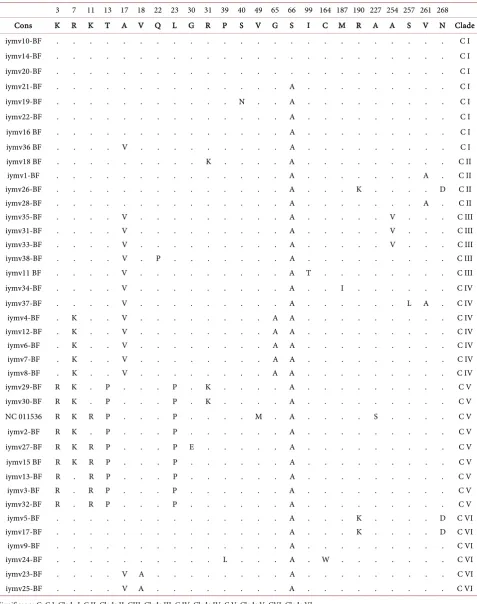
IYMV CPs sequences are under high purifying selective constraints, the structuration of phylogenetic clades revealed in our analysis that the structure in six clades were associated with amino acid changes, particularly the R-domain region of coat protein (1 - 66) (Table 2). These amino acid substitutions are consequent as shown by the strong changes of amino acid physicochemical properties: (P) 13 (T), (P) 28 (L) (P is hydrophilic, T and L are hydrophobic but T is a polar); (G) 65 (A) (G and A are hydrophobic but G is polar uncharged); (A) 66 (S) (A is and S are polar and hydrophobic); (N) 268 (D) (N and D are hydrophilic but N is polar).
Among these amino acid substitutions in the R-domain region, we noticed particularly two amino acid changes with threonine instead proline and leucine instead proline at the position 13 and position 18 respectively. It is well estab-lished that the exceptional conformational rigidity of proline affects the second-ary structure of protein suggesting strong change for the N-terminus coat pro-tein properties [27].
DOI: 10.4236/ajps.2018.92025 321 American Journal of Plant Sciences
Table 2. Multiple alignment of CP amino acid sequences of IYMV Burkina Faso isolates from different localities. Consensus se-quence obtained with CLUSTAL W algorithm is shown above the alignment as a consensus/majority. The amino acids identical to the consensus are indicated by points within the alignment.
3 7 11 13 17 18 22 23 30 31 39 40 49 65 66 99 164 187 190 227 254 257 261 268 Cons K R K T A V Q L G R P S V G S I C M R A A S V N Clade iymv10-BF . . . . . . . C I iymv14-BF . . . C I iymv20-BF . . . C I iymv21-BF . . . A . . . C I iymv19-BF . . . N . . A . . . C I iymv22-BF . . . A . . . C I iymv16 BF . . . A . . . C I iymv36 BF . . . . V . . . A . . . C I iymv18 BF . . . K . . . . A . . . C II iymv1-BF . . . A . . . A . C II iymv26-BF . . . A . . . K . . . . D C II iymv28-BF . . . A . . . A . C II iymv35-BF . . . . V . . . A . . . V . . . C III iymv31-BF . . . . V . . . A . . . V . . . C III iymv33-BF . . . . V . . . A . . . V . . . C III iymv38-BF . . . . V . P . . . A . . . C III iymv11 BF . . . . V . . . A T . . . C III iymv34-BF . . . . V . . . A . . I . . . C IV iymv37-BF . . . . V . . . A . . . L A . C IV iymv4-BF . K . . V . . . A A . . . C IV iymv12-BF . K . . V . . . A A . . . C IV iymv6-BF . K . . V . . . A A . . . C IV iymv7-BF . K . . V . . . A A . . . C IV iymv8-BF . K . . V . . . A A . . . C IV iymv29-BF R K . P . . . P . K . . . . A . . . C V iymv30-BF R K . P . . . P . K . . . . A . . . C V NC 011536 R K R P . . . P . . . . M . A . . . . S . . . . C V iymv2-BF R K . P . . . P . . . A . . . C V iymv27-BF R K R P . . . P E . . . A . . . C V iymv15 BF R K R P . . . P . . . A . . . C V iymv13-BF R . R P . . . P . . . A . . . C V iymv3-BF R . R P . . . P . . . A . . . C V iymv32-BF R . R P . . . P . . . A . . . C V iymv5-BF . . . A . . . K . . . . D C VI iymv17-BF . . . A . . . K . . . . D C VI iymv9-BF . . . A . . . C VI iymv24-BF . . . L . . . A . W . . . C VI iymv23-BF . . . . V A . . . A . . . C VI iymv25-BF . . . . V A . . . A . . . C VI
DOI: 10.4236/ajps.2018.92025 322 American Journal of Plant Sciences Several authors have shown that the bipartite targeting sequence plays an es-sential role in addressing the CP protein to the nucleus [28]. However, although the basic residues R and K have similar properties we cannot say whether all substitutions at different positions in the bipartite targeting sequence have structural consequences on RNA encapsidation, stability of viral particles or other unknown properties of CP during the biological cycle of IYMV. It remains to be determined if these amino acids substitutions involve biologically distinct strains.
5. Conclusion
This is the first study of the genetic diversity of IYMV in Burkina Faso and we think that will allow contributing to a better understanding of IYMV evolution and epidemiology in Burkina Faso. In addition, the diagnosis using the specific primers will make of useful tool for population structure studies of IYMV in Burkina Faso. Although, its results are a prerequisite for further management of imperata yellow mottle disease, it would be interesting to study the genetic di-versity in the neighboring countries such as in Mali and Benin (Data not shown) where the presence of IYMV has been suspected. As the global diversity of IYMV is low, it would be interesting to obtain the complete sequence of other proteins in a number of other viral protein from the different isolates represent-ative of the 6 clades. In this context, will be particularly interesting to sequence the P1 protein as it has been demonstrated for Rice yellow mottle virus [29] that P1 displayed the highest diversity in the RYMV genome, and the VPg protein has is the major determinant for resistance breaking in RYMV [30].
Acknowledgements
Financial supports for this study were provided in part by the Mixed Interna-tional Laboratory LMI Patho-Bios (www.pathobios.com), by the PROVEG pro-gram (Proveg: a network on plant protection through Propro-gram to support net-work based research in Africa, PARRAF http://proveg.org/accueil) and by the International Foundation for Science (IFS) through fellowship N˚ C/5358-1 to Moustapha KOALA. M.K was also the recipient of a financial support by the project n˚1102004 funded by the International Agropolis Foundation for his education & training in molecular cloning at IRD Institute, France. We thank Nils Poulicard for helpful discussions.
References
[1] Ntume, R. and Anywar, G. (2015) Ethnopharmacological Survey of Medicinal Plants Used in the Treatment of Snakebites in Central Uganda. Current Life Siences, 1, 6-14.
[2] Tsobou, R., Mapongmetsem, P.M. and Van Damme, P. (2013) Medicinal Plants Used against Typhoid Fever in Bamboutos Division, Western Cameroon. Ethnobo-tany Research & Applications, 11, 163-174.
DOI: 10.4236/ajps.2018.92025 323 American Journal of Plant Sciences Ethanolic Extract of Imperata Cylindrica Leaves in Animal Models. Journal of Me-dicinal Plants Research, 4, 1486-1491.
[4] Sérémé, D., Lacombe, S., Konaté, M., Pinel-Galzi, A., Traoré, V.S.E., Hébrard, E., Traoré, O., Brugidou, C., Fargette, D. and Konaté, G. (2008) Biological and Mole-cular Characterization of a Putative New Sobemovirus Infecting Imperata Cylindri-ca and Maize in Africa. Archives of Virology, 153, 1813-1820.
https://doi.org/10.1007/s00705-008-0190-y
[5] Koala, M., Traoré, V.S.E., Sérémé, D., Neya, B.J., Brugidou, C., Barro, N. and Traoré, O. (2017) Imperata Yellow Mottle Virus an Emerging Threat to Maize, Sorghum and Pearl Millet in Burkina Faso. Agricultural Sciences, 8, 397-408.
https://doi.org/10.4236/as.2017.85030
[6] Ling, R., Pate, A.E., Carr, J.P. and Firth, A.E. (2013) An Essential Fifth Coding ORF in the Sobemoviruses. Virology, 446, 397-408.
https://doi.org/10.1016/j.virol.2013.05.033
[7] Bonneau, C., Brugidou, C., Chen, L., Beachy, R.N. and Fauquet, C. (1998) Expres-sion of the Rice Yellow Mottle Virus P1 Protein in Vitro and in Vivo and Its In-volvement in Virus Spread. Virology, 244, 79-86.
https://doi.org/10.1006/viro.1998.9100
[8] Vigne, E., Bergdoll, M., Guyader, S. and Fuchs, M. (2004) Population Structure and Genetic Variability within Isolates of Grapevine Fanleaf Virus from a Naturally In-fected Vineyard in France: Evidence for Mixed Infection and Recombination. Jour-nal of General Virology, 85, 2435-2445. https://doi.org/10.1099/vir.0.79904-0
[9] Cuevas, J.M., Delaunay, A., Rupar, M., Jacquot, E. and Elena, S.F. (2012) Molecular Evolution and Phylogeography of Potato Virus Y Based on the CP Gene. Journal of General Virology, 93, 2496-2501. https://doi.org/10.1099/vir.0.044347-0
[10] Neeraj, V., Mahinghara, B.K., Ram, R. and Zaidi, A.A. (2006) Coat Protein Se-quence Shows That Cucumber Mosaic Virus Isolate from Geraniums (Pelargonium spp.) Belongs to Subgroup II. Journal of Biosciences, 31, 47-54.
https://doi.org/10.1007/BF02705234
[11] Thompson, J.D., Higgins, D.G. and Gibson, T.J. (1994) CLUSTAL W: Improving the Sensitivity of Progressive Multiple Sequence Alignment through Sequence Weighting, Position-Specific Gap Penalties and Weight Matrix Choice. Nucleic Ac-ids Research, 22, 4673-4680.https://doi.org/10.1093/nar/22.22.4673
[12] Martin, D.P., Murrell, B., Golden, M., Khoosal, A. and Muhire, B. (2015) RDP4: Detection and Analysis of Recombination Patterns in Virus Genomes. Virus Evolu-tion, 1, vev003.
[13] Martin, D. (2000) RDP: Detection of Recombination amongst Aligned Sequences. Bioinformatics, 16, 562-563.https://doi.org/10.1093/bioinformatics/16.6.562
[14] Padidam, M., Sawyer, S. and Fauquet, C.M. (1999) Possible Emergence of New Ge-miniviruses by Frequent Recombination. Virology, 265, 218-225.
https://doi.org/10.1006/viro.1999.0056
[15] Martin, D.P., Posada, D., Candall, K.A. and Williamson, C. (2005) A Modified Bootscan Algorithm for Automated Identification of Recombinant Sequences and Recombination Breakpoints. AIDS Research and Human Retroviruses, 21, 98-102. [16] Smith, J.M. (1992) Analyzing the Mosaic Structure of Genes. Journal of Molecular
Evolution, 34, 126-129.https://doi.org/10.1007/BF00182389
DOI: 10.4236/ajps.2018.92025 324 American Journal of Plant Sciences [18] Gibbs, M.J., Armstrong, J.S. and Gibbs, A.J. (2000) Sister-Scanning: A Monte Carlo
Procedure for Assessing Signals in Recombinant Sequences. Bioinformatics, 16, 573-582.https://doi.org/10.1093/bioinformatics/16.7.573
[19] Kimura, M. (1980) A Simple Method for Estimating Evolutionary Rates of Base Substitutions through Comparative Studies of Nucleotide Sequences. Journal of Molecular Evolution, 16, 111-120.https://doi.org/10.1007/BF01731581
[20] Koichiro, T., Glen, S., Daniel, P., Alan, F. and Sudhir, K. (2013) MEGA6: Molecular Evolutionary Genetics Analysis Version 6.0. Molecular Biology and Evolution, 30, 2725-2729.https://doi.org/10.1093/molbev/mst197
[21] Garcia-Arenal, F., Fraile, A. and Malpica, J.M. (2001) Variability and Genetic Structure of Plant Virus Populations. Annual Review of Phytopathology, 39, 157-186. https://doi.org/10.1146/annurev.phyto.39.1.157
[22] Varanda, C.M.R., Nolasco, G., Clara, M.I. and Félix, M.R. (2013) Genetic Diversity of the Coat Protein of Olive Latent Virus 1 Isolates. Archives of Virology, 13, 1953-1957.
[23] Rubio, L., Ayllon, M.A., Kong, P., Fernandez, A., Polek, M., Guerri, J., Moreno, P. and Falk, B.W. (2001) Genetic Variation of Citrus Tristeza Virus Isolates from Cal-ifornia and Spain: Evidence for Mixed Infections and Recombination. Journal of virology, 75, 8054-8062.https://doi.org/10.1128/JVI.75.17.8054-8062.2001
[24] Fraile, A., Malpica, J.M., Aranda, M.A., Rodriguez-Cerezo, E. and Garcia-Arenal, F. (1996) Genetic Diversity in Tobacco Mild Green Mosaic Tobamovirus Infecting the Wild Plant Nicotianaglauca. Virology, 223, 148-155.
https://doi.org/10.1006/viro.1996.0463
[25] Yager, L.Y., Miller, D.L. and Jones, J. (2011) Woody Shrubs as a Barrier to Invasion by Cogongrass (Imperatacylindrica). Invasive Plant Science and Management, 4, 207-211.https://doi.org/10.1614/IPSM-D-10-00052.1
[26] Chiang, Y.C., Tsai, C.C., Hsu, T.W. and Chou, C.H. (2012) Characterization of 21 Microsatellite Markers from Cogongrass, Imperata cylindrica (Poaceae), a Weed Species Distributed Worldwide. American Journal of Botany, 99, e428-e430. https://doi.org/10.3732/ajb.1200152
[27] Sõmera, M., Sarmiento, C. and Truve, E. (2015) Overview on Sobemoviruses and a Proposal for the Creation of the Family Sobemoviridae. Viruses, 7, 3076-3115. https://doi.org/10.3390/v7062761
[28] Dingwall, C. and Laskey, R.A. (1991) Nuclear Targeting Sequences—A Consensus? Trends Biochemical Sciences, 16, 478-481.
https://doi.org/10.1016/0968-0004(91)90184-W
[29] Sérémé, D., Séverine, L., Konaté, M., Bangratz, M., Pinel-Galzi, A., Fargette, D., Traoré, A.S., Konaté, G. and Brugidou, C. (2014) Sites under Positive Selection Modulate the RNA Silencing Suppressor Activity of Rice Yellow Mottle Virus Movement Protein P1. Journal of General Virology, 95, 213-218.
https://doi.org/10.1099/vir.0.057026-0