Local and global dynamics of expectations in the Dutch niche
development trajectory of micro-Combined Heat & Power boilers
Ralf Speek
3
Local and global dynamics of expectations in the Dutch niche
development trajectory of micro-Combined Heat & Power boilers
Ralf Speek
AUGUST 2012
Part one
Master Thesis
Philosophy of Science, Technology, and Society
Department of Science, Technology, and Policy Studies (STƏPS)
Graduation committee:
Dr. K.E. Konrad Department of Science, Technology, and Policy Studies (STƏPS), University of Twente
5
Summary
Expectations and promises are important in the development trajectory of new technologies and this is especially true for radical technologies that are able to cause widespread change in the socio-technical fields it is connected to. A typical feature of these technologies is that they are not yet able to compete with existing technologies due to high prices and reduced functionalities. In order for these technologies to get the change to develop, they need to be protected against market mechanisms in protected environments, so-called niches.
Special kinds of expectations that are important in the development trajectory of a technology are expectations that are shared by a number of actors in the niche, the global niche expectations. These global niche expectations are carried over a number of different projects and as the niche progresses while these expectations exist, the global niche expectations become more and more stable.
In this master thesis I have tried to show which elements influence the global niche expectations in the development trajectory of Stirling micro-Combined Heat and Power boiler. I have also tried to clarify which elements have impacted the global niche expectations. Early Strategic Niche
Management literature focuses solely on internal niche processes and I have tried to show that also external niche processes should be included in the analysis. The research question of my thesis is:
Which internal and external niche elements influence the global niche expectations in the
development trajectory of the Stirling micro-Combined Heat and Power boiler in The Netherlands?
On the basis of 10 interviews conducted between 2010 and 2012, visited congresses, and literature research I have first sketched in chapter 4 an overview of the Dutch Stirling micro-CHP boiler-field. After describing the field, in chapter 5 I have presented which global niche expectations exist in the Dutch Stirling micro-CHP boiler niche while in chapter 6 I have described which elements have an impact on these global niche expectations.
6
Acknowledgements
When I started this thesis project at the end of 2009 I imagined that it would take me approximately 8 to 9 months to complete my thesis. It has taken me 2 years more than I expected due to
unforeseen circumstances. When I failed to make my ten years deadline, I decided that I should put the thesis project on hold to work fulltime for a while in order to save some money. I re-started the thesis project in the spring of 2011 and after finishing my interviews in the summer, it took me nearly a year to write the thesis that is now in front of you. All of this time my supervisor Kornelia Konrad was extremely patient with me and for this patience I am extremely grateful. Time after time, she gave me good advice on how to proceed when I was stuck and although it probably was not easy for her, she refused to show me her door. I owe much to her, so I thank you from the bottom of my heart. I would also like to thank Fokko Jan Dijksterhuis who was first my tutor and later the second supervisor of this master thesis project.
Next I would like to my mom and dad, who kept supporting me even when times were not so happy. Without them, I would certainly not have been able to finish my thesis project. I know it must have been rough for them at times, worrying about their son. So, besides for myself, I am so happy for them that this project has come to an end. Stop worrying mom, it is finished!
I also have to mention my brother Joost and my sister-in-law Fenneken. Thank you so much for welcoming me in your home and pushing me the final leg of this project. I think if it wasn’t for you guys, I still wouldn’t have finished. Tim, my little nephew, also played his part. Seeing his smile at seven in the morning made all the difference in the word to get the day going. Thank you little man!
I would also like to say thank you to Bianca for playing the part of my psychologist at times as well as helping me with my thesis. Thank you Shao-Xi and Louke for taking a look at my proposals and thesis. Thank you to all of the Vens, you guys rock! Thank you Harry, Louke, Jan Willem, Billy, RentoRento and Tanja, Sanne, Ilona, Oey, Wilbert, Jasper and Esther, Vincent, Lotta, and all the other people that have contributed to my thesis project and spend time with me the last couple of years.
Enjoy reading my thesis.
Ralf Speek
7
Table of contents
8
Chapter 5 – Expectations in the Stirling micro-CHP boiler niche _____________________ 44
5.1 Landscape expectations ___________________________________________________ 44 5.2 Regime expectations _____________________________________________________ 45 5.3 Global niche expectations _________________________________________________ 455.3.1 Generating heat and electricity with Stirling micro-CHP boilers is more efficient than generating heat with a condensing gas boiler and electricity in a conventional power plant. ___________ 45 5.3.2 Stirling micro-CHP boiler is the direct successor of the condensing gas boiler in existing buildings.
___________________________________________________________________________ 46 5.3.3 Stirling micro-CHP boiler is able to compete on price with the condensing gas boiler ________ 48 5.3.4 The German market is a more interesting market for the Stirling micro-CHP boiler than the Dutch
market _____________________________________________________________________ 49 5.3 Micro level expectations __________________________________________________ 50 5.4 Changed expectations ____________________________________________________ 51
Chapter 6 – Internal and external niche factors __________________________________ 54
6.1 Outcomes of local projects _________________________________________________ 54 6.1.1 The noise problem_____________________________________________________________ 54 6.1.2 Weight problems ______________________________________________________________ 56 6.1.3 Reliability problems ____________________________________________________________ 58 6.1.4 Purchase price and payback time _________________________________________________ 59 6.1.5 Usability _____________________________________________________________________ 60 6.1.6 Positive outcomes of the local tests projects ________________________________________ 62 6.2 Influence of developments of competing and complementing technologies on the global niche expectations about Stirling micro-CHP boilers. __________________________________ 639
Chapter 1 – Introduction
The emergence of new technologies is often accompanied by a lot of uncertainty for the actors involved. This is the case for those that are engaged in the creation of this new technology, as well as for the actors that are possibly influenced by this new technology. Uncertainty about the future of new technologies is closely linked to expectations and promises that are articulated about these technologies since these processes sketch a picture of a possible future world in which the new technologies will operate.
The type of technology also plays an important role in the perceived uncertainty. The more radical a technology is, the more uncertainty it will create. This is because radical innovations are able to cause wide-ranging changes to the structures of production and consumption. Because of this uncertainty, knowledge of the future is desired but since robust knowledge is impossible to acquire, actors have to rely on expectations instead. These new radical technologies are often technically and financially incapable of competing with existing technologies on the market place and these
technologies therefore have to be developed in protected environments, so-called niches. Expectations that are shared in these niches by a wide community can be called global niche expectations and these expectations are carried over a variety of local test projects that together form the backbone of the niche.
The Stirling micro-Combined Heat and Power (micro-CHP) boiler is such a radical innovation that has been developed in the last 10 years. This boiler, besides its normal function to produce heat, has the capacity to generate electricity on a household level. When applied on a large scale, this innovation has the potential to for example have a large impact on the way energy is produced and distributed. The Netherlands has been a particularly interesting future market for this technology since the penetration of the claimed precursor of the micro-CHP boiler, the condensing gas boiler, is very high and the replacement market for these boilers is 350.000-400.000 boilers per year. The boiler has been positioned in the field of the de-central energy generating innovations together with for example technologies like solar-pv, windturbines, and heatpumps.
10 1.1 Research question
I will execute an analysis of the dynamic of expectations surrounding the development of a new technology. The research question that I will try to answer is the following:
Which elements influence the expectations in the development trajectory of the Stirling micro-Combined Heat and Power boiler and how do these elements influence the expectations?
In Geels and Raven’s 2006 article ‘Non-linearity and expectations in niche-development trajectories: ups and downs in Dutch biogas development (1973-2003)’ it is shown that in contrast to earlier analysis of niche development trajectories, not only internal niche processes should be included in the analysis of these trajectories, but also external niche developments should be included in these analyses. In my thesis, I will show that while early studies into the development of radical
technologies highlight that outcomes of local test projects have an impact on expectations (Van Lente, 1993; Kemp et al., 1998; Hoogma, 2000), external circumstances also play an important role for the expectations that relate to general aspects of the radical technology of Stirling micro-CHP boilers in the Netherlands.
1.2 Outline thesis
Before engaging in any form of research activity, I have to specify what I mean by my core concepts. In chapter 2, I will first focus my attention on the theoretical background of these concepts starting with a deliberation ofliterature about niches in which I will also make clear what I mean with global niche level and global niche expectation. Next, I will pay attention to the dynamics of expectations; I will show that expectations are embedded in a network of expectations and that these expectations can not only be influenced by activities, but also by other expectations. In chapter 3, I will present the methodology that I will use in order to answer the rest of my research questions. In chapter 4, I will describe the Stirling micro-CHP technology and the niche in which it develops and I will give a description of the actors involved in the niche. In chapter 5, I will present the expectations that are identified by the interviewees as being shared in the niche by multiple actor groups. In chapter 6, I will identify which elements in and around the developing niche have an influence on the
11
Chapter 2 – Theory
This chapter is about what has been written about the subject of my thesis, which is the dynamics of expectations in an environment that is protected from market influences, a niche. I will shed more light on these dynamics in the micro-CHP field in the Netherlands and I will approach this by looking at what elements have an impact on the niche expectations that carry the niche, the so-called global niche expectations.
In the first section I will begin by introducing an insight from the niche literature in which a conceptual (analytic) distinction is made between a local niche level and a global niche level. I will use this distinction in order to conceptualize global niche expectation. Next, I will discuss literature that has focused on developments of technologies in niches and that has identified expectations as one of the three major processes in the development of new technologies (Geels & Raven, 2006). After introducing the niche literature, I will turn my attention to insights from the sociology of expectations. With these insights, I can show the dynamics in expectations that surround a
developing technology. In the final part, I will combine various insights into a conceptual framework that I will use to answer my research question.
2.1 Niche literature
New technologies encounter problems when they have to compete with technologies that are currently embedded in the society, the reason for this is that they often do not form a reasonable alternative to these embedded technologies due to their relative high price and/or poor
performance. When these technologies are able to change the entire system an actor is involved in, they bring a lot of uncertainty with them. When these technologies want to get the chance to develop they somehow need to be protected against selection mechanisms that are active in the open market place (Kemp et al., 1998). A protecting environment, or a niche, for a technology to develop in does not appear out of thin air and active work is needed in order to create and maintain such a space (Raven et al., 2008; Geels & Deuten, 2006). Promises and expectations are very
important in forming the initial network from where the development of the technology can be launched. Such an initial promise can be used to find the first allies and to put down the diverse roles of (future) participants. Also agreements can be made about mutual obligations and a first agenda can be formed after which the first contours of a new niche appear. Once the development in niches results in robust technologies with better price/performance ratio, they can try to enter the
mainstream markets (Geels & Raven, 2007).
In such a protected environment these technologies get the chance to develop slowly because of projects in which the technology improves its functional side. Next to these purely functional improvements, these projects also form testbeds for various user practices, regulatory structures, among others. Various elements are aligned in these test projects in order to make them ripe to enter the market.
2.1.1 Strategic niche management
12
develop in shielded environments in which they are protected from the selection criteria of the free market (Kemp, et al., 1998). The goal of this method is predominantly to develop policy advice for the creation of a successful climate for the development of new technologies with the ultimate goal that these technologies will successfully penetrate the current socio-technical system. However the analytical core can also be used to show which processes are active during the development of such new technologies and to illuminate which role these processes play (Geels & Raven, 2006).
Within the SNM approach, different projects play an important role in the phase between research and development and the moment the technology enters the open market place. These projects provide interactions between the various actors; they allow user groups, policy makers, and special-interest groups to give feedback to the technology developers like researchers, firms, and engineers. These projects are central in three processes that are identified (Kemp et al, 1998) as playing an important part in the successful development of new technologies. The first is the building of new social networks, which is of importance to create a constituency behind the technology. Projects serve as a way to create space for interactions between relevant actors in order to provide for sufficient resources like knowledge, money, and people. Next to the building of networks, learning processes are important in the development of new technologies. Learning about the needs, problems and possibilities with respect to technical aspects and design specifications, market and user preferences, cultural and symbolic meanings, infrastructural necessities, regulation and policy issues, societal and environmental effects, etc., is important in order to overcome barriers to the introduction and use of a new technology (Kemp et al, 1998). The third process that is identified as playing a central role in the SNM approach is the idea that the articulation of expectations and visions is crucial for the development of the niche. This is because they give direction to the learning processes and development activities, they generate attention for the developments, and they legitimate further protection of the niche.
As Geels and Raven (2006) have convincinglyargued, the three niche internal processes cannot be analysed completely separated, they are interlinked and their interaction is a major contributor to how innovation journeys take place. However, to conduct a full scale analysis of all these processes within the niche of micro-CHP falls outside the scope of this thesis project. Instead I will focus my attention on the dynamics of expectations surrounding the niche. These processes however cannot be, as I just claimed, analysed in isolation. Learning processes and the process of network building will be taken into account as they are of importance in the process of stabilisation and destabilisation of expectations, but they are not the focal point of this research project.
2.1.2 Local niche level versus Global niche level
13
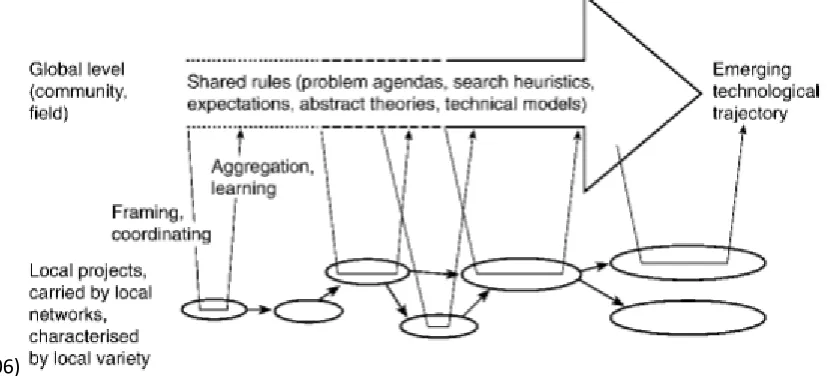
Later SNM-literature broadened the scope from single projects to an emerging community (Geels & Raven, 2006). This was done when Van Mierlo (2002) and Raven (2005) added the crucial insight that it was necessary to make a distinction between local socio-technical projects and a more global niche level in which an emerging community appeared that shared certain cognitive, formal, and normative rules. The development of a technology in a niche could from then on be conceptualized as
[image:13.595.73.326.229.344.2]developing on two levels simultaneously. A string of local projects gradually adds up to form an emerging community at the global niche level. Figure 2a presents a simple conceptualization of the two niche levels while figure 2b present a conceptualization of a technical trajectory carried by local projects.
Figure 2a - Local projects and global niche-level (Geels & Raven,
2006)
Figure 2b - Conceptualization of technical trajectory carried by local projects (Geels & Raven, 2006)
Both global level and local level have an impact on each other. Initially the local projects are
individually testing expectations and promises created especially for these projects. The outcomes of these experiments can have a direct impact on the next project that is being executed by actors in local networks but it also can have an impact on the slowly emerging community on the global niche level. This second kind of impact comes in the form of learning processes that can stabilize or destabilize rules that exist at the global niche level.
[image:13.595.86.500.385.573.2]14
destabilize the rules or introduce new ones. Learning processes play an essential part in this process of stabilizing and destabilizing.
Conceptualisation of niche trajectory
With the distinction between a local and global niche level, the developments of the niche could from then on be conceptualised as taking place simultaneously on two levels. The result of this was that the development of a new technology could be conceptualised as being an aggregation process of local projects that all (one way or another) contributed to the emerging field. Geels and Raven (2006) have conceptualised this process in the following manner: developments start in one or a small number of projects that are carried by a local network of actors. These actors are directly involved in the local projects and they are guided by cognitive rules that are present at the global level. These cognitive rules, and expectations are one of these, are in the beginning of the niche development very broad, unstable, and diffuse. Local projects are used to test and create these diffuse ideas and in the begin phase of the development they do not form a unity and therefore every project is guided by different rules and every project in the beginning is searching for different solutions. On the local level, for every project expectations are articulated that originated at the global level and these guide the local search process. The results of these local projects are being used to change previous expectations and to convince more actors to join the network in order to expand and strengthen it. When the outcomes of the local projects and the learning processes that are generated from it are compared and accumulated, cognitive rules on the global level, including expectations, are slowly becoming more articulated, more specific, and more stable.
The most important point of section 2.1.2 is that global niche expectations can be perceived as cognitive rules that are carried over various local projects. Within the niche development they can be influenced by local project outcomes. As the niche progresses, the global niche expectations may become more and more specific and stable.
2.1.3 Multi-Level Perspective
As claimed by supporters of the SNM approach, the local project outcomes potentially have an impact on the niche dynamics. This is however only the side of the story from inside the niche. The question is whether there are also further elements that can have an impact on the global niche expectations, and which potential elements can be identified.
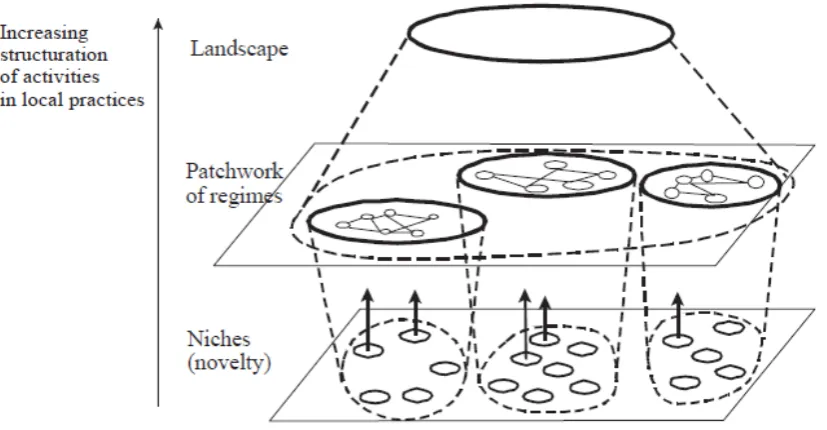
15
Figure 2c - Multiple levels as a nested hierarchy (Geels. 2002)
In the framework used in the multilevel perspective the activities of people are important as well as the rules which provide context for these activities. People act on the basis of rules (and as stated above, expectations are part of the cognitive rules), but they also are able to learn from their actions and change the rules. The three levels provide various levels of structuration and stability for
activities (Geels, 2005). On the niche-level rules are vague and they do not provide a strong coordination for the activities of the actors involved. An example is that there are various diffuse promises and expectations about the potential use of the technologies and various ideas about the best direction of research. On the regime-level the activities in local practices is much more
structurered and stable. The rules are much stronger on this level and these thus have a much stronger coordination effect on the activities. Social conventions and community rules are not easy to change, it is possible but it takes a lot of effort. On the landscape-level the structuration and stability of the local activities is the strongest. Rules like widely shared cultural beliefs, symbols and values are hard to change.
Expectation dynamics in the Multi-Level Perspective
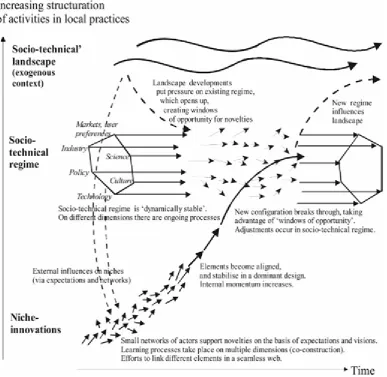
The MLP understands the emergence and diffusion of new technologies as being a dynamic process in which an interaction occurs on various levels. The main point for my thesis is that the
developments on the regime level and on the landscape level also govern the processes in the niche. Changes on the landscape level can for example put pressure on the regime which can spur
16
This pressure provides an opportunity for incremental innovations to develop, for example more efficient power plants, but also for new promising radical technologies to develop in niches, like for example micro-CHP boilers. For the incremental innovations the rules on the various dimensions of the socio-technical need not to be changed much, there is an ongoing process of constant
adjustment of these rules. For radical technologies this is very different, these technologies need windows of opportunities in order to break through in the existing regimes because the rules that govern the niche development deviate from the rules of the socio-technical regime and thus this first needs to be aligned before a breakthrough can be reached.
[image:16.595.89.477.360.737.2]MLP scholars argue that broader regime and landscape developments influence the niche via expectations and networks. This means that the perceptions of the niche actors and the size of support networks are impacted by these niche external influences (Geels and Schot, 2006). Since in early stages of developments the advantages of a new technology are not evident, actors often make promises and raise expectations about new technologies in order to get the new technology on a developing agenda (Geels, 2002). Landscape developments and regime problems are often used as legitimizations of these promises and expectations. These developments and problems are not only current and past problems but they can also be envisioned expected future developments and problems.
17
As stated above, promises and expectations are particularly strong when they are connected to societal problems for which existing technologies cannot provide the solution. Hoogma (2005) identifies three other important characteristics for the strength of the expectations which are the robustness, quality, and specificity. The more an expectation is shared, the more robust it is. Quality of expectation can be shown by demonstrating the advantages, getting expert support, getting endorsement from important actors, and testing expectations in experiments. Finally the clearer it is which steps have to be taken in the development of the technology to reach the expectations, the more specific the expectation is. In my thesis I will pay close attention to these three characteristics.
2.1.4 Developments in competing technologies
[image:17.595.89.500.362.547.2]Expectations for new projects are based on internal technical considerations and experiences from previous projects. But these expectations also take into account the wider world, e.g. regulations, market dynamics and competing technical trajectories. Product champions, when searching resources for new projects, sketch ‘diffuse scenarios’ about future worlds in which the innovation would work (Rip and Kemp 1998). So the formulation of (new) expectations in niche A is influenced by experiences in niche B. If experiences in niche B are negative, it becomes easier to formulate positive visions for niche A, and attract people and funding (Figure 12).
Figure 2e - Co-evolution mechanisms between competing niche trajectories (Rip and Kemp, 1998)
Van Lente and Bakker argue that technologies will compete in early phases of their development with alternatives on the basis of expectations and promises of future progress (2010). Because of this competition these promises will be carefully maintained.
2.2 Sociology of expectations
18
activities. Next to this the articulation of expectations is important in the generation of attention for the developments and for legitimating further protection of the niche. The ‘sociology of
expectations’ takes a wider approach as they include a variety of approaches to expectation and the dynamics of expectation although the locus of the expectations studies lies in the science and technology studies (STS). They approach the topic from a variety of angles but the studies all emphasize the dynamics of expectations as a basic and important feature of modern science and technology (Borup et al., 2006). In order to understand the complexity of expectations, what role they can play in innovation journeys and in how they can be influenced, I will now turn to a number of insights of the sociology of expectations literature.
2.2.1 Van Lente’s ‘promise and requirements’-cycle
In this section I will draw heavily on insights of Harro Van Lente who made important insights into the role of expectations in technological development trajectories. He stated that the development of a technology is a social process and he studied the role of expectations in this process by looking at shared expectations in the form of statements. For him these expectations are the ones that play a role in interactions, while private expectations only become effective ‘to the degree’ that they are linked to shared expectations (Van Lente, 1993). ‘Expectation statements are not in the head of actors, but are at the disposal of the audience’. An expectation does not have to be ‘real’ for the person that communicates the expectation. In sociological sense they are ‘real’ as soon as they have consequences for actions, when they are picked up by other actors. In other words, when a person states an expectations, it is not of importance whether the person really beliefs the expectation. Once it’s ‘out there’ and sociologically and it does some work, whether positively or negatively, towards the fulfillment of the expectations, the expectation will be ‘real’.
I will first present the original insight of Van Lente in which he identifies a cycle of promises and requirements in the development phase of a technology. Promises about the technology are
19
Figure 2f -Promise-requirement conversion-model (Van Lente, 1993)
2.2.2 Levels of expectations
Van Lente (1993) distinguished three types of expectations that are working on a different level and with a different function. The search process on the micro level is informed by expectations, these expectations on the micro-level Van Lente calls search-expectations. These show directions towards success, like what the requirements are, which methods and materials to use, and it indicates standards of evaluation. These are thus the expectations that are present in local test projects in which the technology is tested. On a higher level expectations exist that protect the search process. They indicate eventual successful outcomes of the project and by doing so they create space for the niche to develop further. These are broader in scope and are called niche-expectations. Niche-expectations provide reasons for actors to invest in this technology. These Niche-expectations are used by actors to protect the activities in the niche. They are used to generate attention by focusing on the future benefits of the technology for potential adopters. Even broader of scope are the scenario-expectations. These back up the niche-expectations and justify them. They provide further support for why there would be opportunities. Function is the difference between niche-expectations and scenario-expectations. Both are broad of scope but the niche-expectation explains why THIS project deserves support, while the scenario-expectations indicate that projects LIKE THIS ONE are worth the effort. This means that the scenario expectations are broad general expectations that justify why for example technology is worthwhile to invest resources in (Van Lente, 1993).
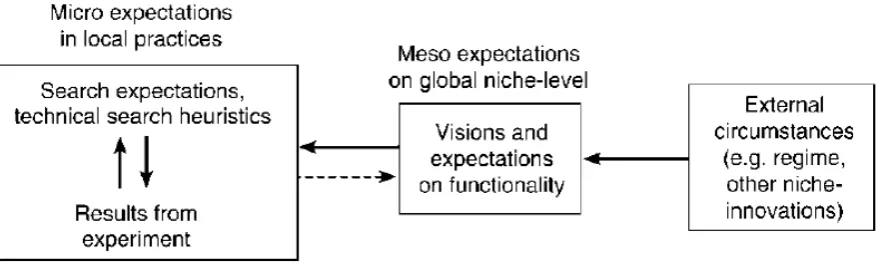
The three identified levels of expectations are comparable to other typologies used in STS literature on expectations. Ruef and Markard (2010) show that most authors distinguish between at least two levels of expectation: (i) specific micro expectations about improvements of the artifacts, and (ii) more generic meso expectations about the functionality of the technology. A third type of
20
The main point of Van Lente’s insight for my thesis is that expectations in innovations trajectories do not occur as single entities but that they are embedded in a network of expectations that possibly have an influence on each other. Specific expectations about a technical possibility, of for example a particular material used in the Stirling engine of a micro-CHP boiler, relate to the more general functional promise of these Stirling micro-CHP boilers. These functional expectations on their turn relate to the even more general expectations about for example the expectation of the need for new alternative ways to produce and consume energy.
2.2.3 Dynamics of expectations
Various authors (among others; Konrad; van Lente; Rip; Borup; Brown) have convincingly argued that expectations dynamics have an impact on the behaviour of organizations. Since expectations are important for the development trajectory of innovations, actors deliberately contribute to the formation of collective expectations (Konrad et al., 2012). Van Lente and Rip (1998) for example showed that product champions try to mobilize public funding by communicating positive outlooks for the innovation while Musiolik and Markard (2011) showed that in order to improve the positive image of a technology actors strategically set up networks. Large numbers of actors thus interact and exchange expectations with the result that collective, shared expectations emerge. Actors contribute to the formation of collective, shared expectations by discourse activities in the form of press
releases, conference presentations, publications, interviews, etc, or by innovation activities (Konrad, 2006).
Vertical dynamics of expectations
The typology of placing expectations on a micro, meso, and macro level is dangerous when this conceptualisation is seen this as a static framework. Rather the network of expectations operates as a dynamic environment, in which the expectations on the various levels are constantly changing, influencing activities, networks, other expectations, etcetera. Expectations mediate between various scales or levels of organization (vertical co-ordination (Borup et al., 2006)). A number of authors showed this vertical form of coordination. Konrad (2006) for example investigated the interplay between expectations on the level of an innovation field and on the micro-level of technological projects. An important insight was that technological projects are the places where technology dynamics and expectation dynamics are linked. She illustrates a dynamic between social or collective expectations and, more locally, specific expectations within ICT innovation communities. Geels and Raven (2006) analyzed the ups and downs in the development trajectory of biogas technology in which they address the interplay between local projects and a global niche level.
21
Horizontal dynamics of expectations
Besides the vertical linking of the micro, meso, and macro level of expectations, the linkage of expectations on the same co+nceptual level is also an important dynamic in the network of expectations surrounding a developing technology. This form of linking can be called horizontal linking and examples of this are competing and complementing niche expectations. Konrad and Budde (2009) conceptualize this by drawing an analogy with the Multi-Level Perspective and placing expectations on the niche, regime, and landscape level, and argue that expectations between as well as expectations on the same level have an impact on each other. They use the example of fuel cell-developments but the same can be applied to the micro-CHP boiler cell-developments. Raven and Geels (2006) also highlight the expectations of competing technologies as an important external niche development.
Expectations can play an important role in the coordination of different actor communities and groups (horizontal co-ordination). These expectations about a technology and the future uncertainty that the technology can generate vary between the various groups in a technological community (Borup et. al, 2006). As the meaning of the technology varies among groups (Bijker, 1995), this interpretative flexibility causes different actor groups to react differently to the technology development. Brown and Michael (2003) point out that this different reaction to the development often is caused from the lack of access to the full information on which the expectations are based which results in uncertainty. Bakker et. al, (2011) make a distinction between the reaction of enactors and selectors to the technology. Enactors are creators (or enactors) of the technology and they need to make clear why their technology is promising while communicating why competing technologies are less well equipped to fulfill the same function. They often fight for funding and other forms of support. Selectors on the other hand are actors that select the technologies according to their criteria. The variation and the selection of the technologies are connected though
expectations in, what Bakker et al. call arenas of expectations. In these arenas, the enactors and selectors fight their battles.
Konrad et al. (2012) also show different responses of different actor groups in the field of fuel cells. In their article they take a closer look at how actors changed their strategies and activities to both hype and disappointment. So-called hype-disappointment cycles can often be observed when looking at the development of new technologies. New technologies receive attention when expectations about the promise of the new technologies are widely accepted. The tone of the promises and expectations become more and more enthusiastic and the new technology often receives increasing attention from the media. Because the expectations are so hyped and cannot be met, a
disappointment phase often follows whereby the attention and expectations cool down suddenly (Van Lente, 1993; Brown, 2003). Konrad et al. (2012) identified three factors that had an impact on organizations sensitivity to expectations dynamics. The first is the strategic embedding of a new technology. This means that the stronger the development activities fit with the more general strategy of a firm, the more it is likely that the firm will continue to invest resources in the development of the technology even when facing disappointments. The second variable is the dependency on other actors or dependency on external legitimacy. The more this is the case, for example with stock-exchanged listed organizations compared to firms led by an owner-manager, the more sensitive they are for disappointments. The third variable they identify is the type of
22
differently to hype and disappointment. Research institutes for example reacted much more slowly than industry actors did.
2.2.4 Conclusion
[image:22.595.78.523.239.371.2]The point of previous section is that the global niche expectations in the Stirling micro-CHP boiler niche relate to expectations on the regime and landscape level as well as to expectations in niches connected to the micro-CHP boiler niche, these can be competing niches but also complementing niches. The expectations are vertically linked to the regime and landscape level and the local niche level, and they are horizontally linked to the competing and complementing technologies. Geels and Raven (2006) have visualized these relations in the following figure.
Figure 2g - Relationships between levels of expectations (Raven, 2005)
In their 2006 study they conclude that for the developments in the Dutch biogas innovation journey, the internal niche interactions are not sufficient to explain the change in meso expectations on the global niche level. For a complete picture, external circumstances need to be included in the analysis. In my thesis I will try to replicate the findings about the internal niche interactions for the Dutch Stirling micro-CHP boiler development journey and look what role external circumstances play in the development of expectations on the global niche-level. To do so I will look at the developments on the regime and landscape level as well as on competing and complementing niche developments.
Before presenting my method section, I will rephrase the central question that I want to answer in my thesis. The new central research question is as follows:
Which internal and external niche elements influence the global niche expectations in the
development trajectory of the Stirling micro-Combined Heat and Power boiler in The Netherlands?
The research question can be split-up in three sub-questions:
i. Which global niche expectations can be identified in the Stirling micro-CHP boiler niche? ii. Which internal niche factors influence the global niche expectations in the
Stirling micro-CHP boiler niche? And how do they influence the global niche expectations? iii. Which external niche factors influence the global niche expectations in the
23
Chapter 3 – Methodology
3.1 Data gathering
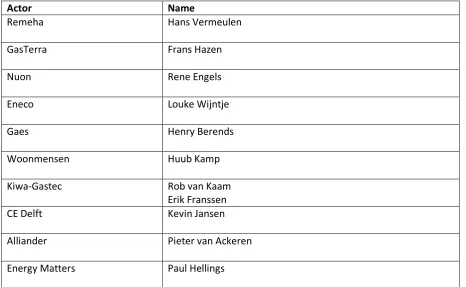
In order to find an answer to the sub-questions the core method of inquiry were 10 semi-structured interviews (see Appendix A) with diverse actors in the field. Before selecting which actors to
interview, an actor-map was construed (see figure 4g) in which the actors were categorized by their function in the niche. The interviewees were chosen in a way that all the major actor groups were represented in the sample. Choosing a variety of actors also makes it possible to investigate the sensitivity of various types of actors to hype-and-disappointments in the field. The boiler
manufacturers and the energy companies can be considered to be enactors while the installation, network, and housing companies can be considered selectors. Most interviewees were chosen after an exploration of the field and the rest were chosen after they were mentioned as being important in the first interviews, the so-called snowball method. Also important was the fact that Nuon, Alliander, Remeha, GasTerra, and Woonmensen were all involved in a local project called Smart City
Apeldoorn. By choosing these actors, the effect of this local project could be examined for various actor groups.
Table 3a shows the overview of the interviewed actors. Next to these semi-structured interviews, I held informal discussions, which lasted around half an hour, with three actors which provided me with context of the field. These three actors were a PHD-student in the field of micro-CHP, Jan Willem Zweerink, an employee of Agentschap.nl, Ben Paulussen, an employee of a governmental agency responsible for subsidies, and the chairman of the foundation ‘Slim met gas’ Jeroen Wouts.
Actor Name
Remeha Hans Vermeulen
GasTerra Frans Hazen
Nuon Rene Engels
Eneco Louke Wijntje
Gaes Henry Berends
Woonmensen Huub Kamp
Kiwa-Gastec Rob van Kaam
Erik Franssen
CE Delft Kevin Jansen
Alliander Pieter van Ackeren
[image:23.595.64.531.432.719.2]Energy Matters Paul Hellings
24
All interviews except the interview with Eneco were done face-to-face, the interview with Eneco as an exception was a phone interview. I was allowed to tape all of the interviews except the interview with Nuon. The reason for this interviewee to refuse to be taped was that Remeha had demanded confidentiality from all the actors involved about the outcomes of the test projects. This was the reason that the interviewee was not comfortable for me to tape our conversation. Other
interviewees that also signed this clause simply did not provide me with detailed information about the projects, these mainly included questions about strategies and outcomes of local projects.
As a number of interviewees indicated that they would like to stay anonymous I have chosen to anonymized all the names of the interviewees. Real names, functions, and dates of interviews are presented in Appendix C, which is included in a separate document. Also in this document, full transcriptions of the interviews can be found, as well as descriptions of the local test projects in Appendix D.
As a way to control the data gathered in the interviews I used secondary sources like websites, conference presentations, and vision documents. These data sources gave me a good overview of the quality of the data from the interviews. The nature of global niche expectations, they are shared and articulated, allowed me to find out a number of the expectations mentioned in the interviews in these sources. Some if these findings also formed a base for interview questions.
3.2 Analysis
The interviews were all transcribed and entered into the program Atlas.ti. This program was used to code the transcribed interviews so that an analysis of the interviews could be performed. I used the results of the literary study as a basis for my coding. Each element identified by the literature as having a possible impact on the global niche expectations formed a code. Next to this the global niche expectations themselves of course also formed a code. Starting from this base I coded my interviews and with the results a map could be drawn in which the elements influencing the global niche expectations could be identified.
I used the program Atlas.ti to crosscheck the results of the interviews by entering the data found in websites, vision documents, conference papers/presentations, etc. in the program and coding it in the same way as the primary data. The results of these secondary data analyses were now compared to the primary data in order to identify interesting similarities and anomalies. After coding the interviews, I checked and compared the results with the data found in the study of the field in order to see whether there were elements found that were different from the ones I expected to find.
An example of my analysis is the usage of the code ‘Global niche expectations’. When all the
25
Chapter 4 – The niche of micro-CHP boilers
The concept of combined heat and power (CHP), or the co-generation of heat and electricity, is known for a long time now. The usage of excess heat from power plants for heating purposes in the last decades has been used successfully numerous times in the industry. Micro-combined heat and power (micro-CHP) is the term for the small scale generation of electricity which applications can predominantly be found in households in the form of a boiler that uses its excess heat to generate a small amount of electricity. In this chapter I will first explain how this process of co-generation of heat and electricity takes place and which alternative methods exist for this co-generation on domestic scale. Next I will present which actors are involved in the micro-CHP boiler niche.
4.1 Micro-CHP concept
Micro-combined heat and power (micro-CHP) is the term for the domestic small scale generation of heat and electricity. At the moment the traditional method of generating electricity and heat is to generate electricity in a big power plant and generate heat in a boiler at home. In the past year a technology was introduced on the Dutch market that could replace this method, a micro-CHP boiler. It is a technology that allows users to generate heat and electricity on a domestic scale. It is a new generation condensing gas boiler (a boiler that uses condensing techniques to increase heat efficiency) that besides heat also generates electricity which can directly be used by the user or delivered back to the electricity grid. In the latter case the users thus become a producer on the electricity market.
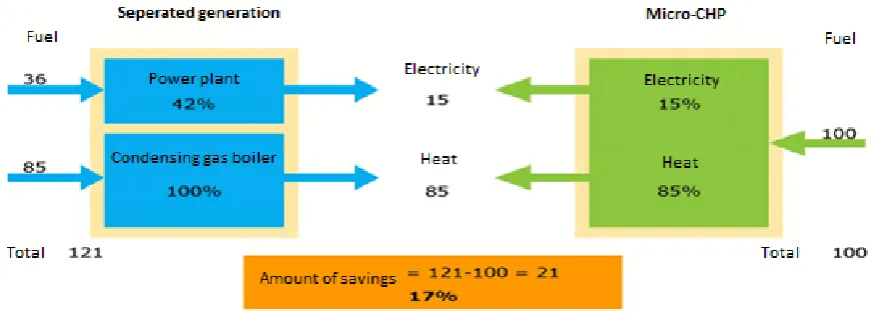
[image:25.595.83.523.471.629.2]By generating heat and electricity in a micro-CHP boiler, a lot of energy van be saved that would otherwise get lost by heat dumping in the air and rivers or by transport losses. An example of this principle is shown in figure 4a.
Figure 4a - Example of the potential amount of energy saved
26
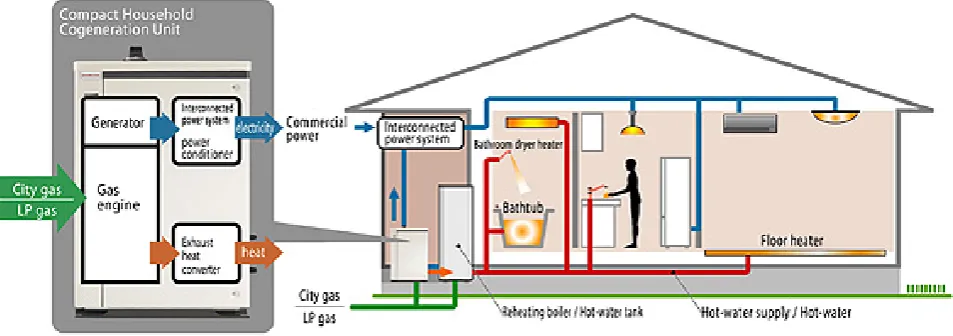
Figure 4b - Example of a solo micro-CHP boiler with an added reheating boiler for hot water supply
As I will show later, there are a number of alternative ways to co-generate heat and electricity on a domestic scale but for now it enough to know that the first generation micro-CHP boiler are heat driven systems that run on natural gas and are connected to the electricity grid. This connection to the grid is necessary since the system only delivers electricity when heat is needed in the household; for the other moments that electricity is needed, back-up electricity is provided by the grid. This connection to the grid also makes it possible to export the surplus of electricity back to the grid.
4.1.1 Various types of micro-CHP technologies
Micro-CHP is the umbrella term for a number of technologies that generate heat and electricity on a household level. Various alternative solutions to co-generate heat and electricity have been and are being developed; the figure 4c below gives an overview of these alternative solutions. The difference between the various technologies is the way in which electricity is produced from the various fuels. Three groups of technology are distinguished:
- External combustion (heat is transferred to another medium)
27
Figure 4c - Overview of various micro-CHP technologies (Werkgroep Decentrale Gastoepassingen, Smart Power Foundation, and Werkgroep micro-wkk Cogen Nederland, 2010)
Although all these technologies can potentially be used in micro-CHP units, the most competing technologies are the micro-CHP boilers based on the Stirling engine, the internal combustion gas engine (ICE) and the fuel cell. Research and development activities in the Netherlands have focused mostly on the development of the Stirling engine and on a much smaller scale on units driven by fuel cells. The Stirling engine based micro-CHP unit is the first technology that has entered the Dutch market. The micro-CHP units based on the Stirling engine have a high heat/power ratio, which means that it has a low electrical efficiency and a relatively high heat production for a particular capacity, with the result that they are best suited for houses that have a high heat demand. Fuel cell based micro-CHP units have a significantly higher electrical efficiency and they are therefore more suited for houses with a lower heat demand such as smaller houses and well isolated houses. As newly build houses are typically well isolated as this is the cheapest way to save energy, this technology seems to be the most promising technology in the longer term. Table 4a shows the result of a consultation among micro-CHP developers about the efficiencies for the three most competitive technologies for
2010 and 2020. Ƞeis the electrical efficiency while Ƞoverall stands for the overall efficiency; the heat
28
Table 4a – Expected efficiencies of the three most competitive micro-CHP technologies (Werkgroep Decentrale Gastoepassingen, Smart Power Foundation, and Werkgroep micro-wkk Cogen Nederland, 2010).
What can also be learned from the previous paragraph is that the fuel cell based micro-CHP boilers have properties that are very good for a future energy system in which micro-CHP boilers play an important role in the generation of electricity. While Stirling based micro-CHP units are driven by heat demand, fuel cell based micro-CHP boilers have such a low heat/power ratio that it is driven by the electricity demand. This set-up makes it an ideal device for a so-called virtual power plant that connects many de-central energy generating technologies to the grid and in which demand and supply is intelligently coordinated in order to create one big ‘virtual power plant’.
In the first orientation of the field diverse parties identified the Stirling based micro-CHP boiler as the technology that has the most potential to be developed into a marketable product and most R&D activities in the Netherlands have focused on the development of this boiler with the result that since last year the boiler is commercially available. As figure 4e shows it is believed that Stirling micro-CHP boilers will dominate the market until at least 2030. I will therefore focus my research activities on the development of this type of micro-CHP boiler. In the next section I will present how a basic Stirling micro-CHP boiler works, which types of Stirling engines there are and what the benefit and disadvantages of each type are.
[image:28.595.91.500.523.716.2]29 4.2 Stirling engine based micro-CHP boiler
The Stirling engine has already been developed in 1816 by sir Robert Stirling as a low-pressure safe alternative for the high-pressure steam engines but it has not been used a lot over the past two centuries since his invention was not needed anymore after the invention of the steel that improved safety of steam engines dramatically. There was a small market for the Stirling engines in places where a reliable energy source of low to medium size was required. Although not very efficient since they ran on lower temperatures, they could be operated by anyone who was capable of managing fires. During the early years of the 20th century the role of the Stirling engine as a reliable motor for domestic use was taken over by electric motor and small internal combustion engines. In the 1940’s the Dutch company Philips decided to build a Stirling engine of 200W to power radios in places where electricity was unavailable. They started production in 1951 but it was soon clear that the production of the small Stirling engines was not cost effective and they stopped the production. They did however continue to develop experimental engines for a variety of applications but were only successful with the development of the 'reversed Stirling engine' cryocooler. However they did patent a number of developments which they licensed to other companies and a lot of these formed the basis for later developments in this field.
As a result of the successful use of large scale co-generation of heat and power, towards the end of the 1990’s a number of parties started seriously to look at the possibilities of building a domestic device that could co-generating heat and power. The technology of the Stirling engine seemed ideal for this purpose and in the early 2000’s three different types of Stirling engine based micro-CHP boilers had been developed that were ready for the first field tests. The first being developed by Whisper Tech Ltd, a New Zealand based company that used Stirling engines in their power generators in ships in which they used seawater to cool the engine. When this turned out to be a success in 1998, in the following year they began to build their engines into a boiler for domestic use. Instead of cooling the engine with seawater, they used the heat of the boiler for domestic purposes. In 2006 Whisper Tech Ltd. was taken over by the Swiss energy company Meridian Energy. The second Stirling engine was developed by STC/Infinia and build in a boiler by Enatec, a collaboration of the Dutch energy company Eneco, the Dutch boiler manufacturer Atag, and the Dutch research institute ECN, and the third being developed by Sunpower, a USA based company, in 2001 bought by British Gas and renamed Microgen, later in 2007 they were bought by a wide partnership of boiler
manufacturers of whom Rehema and Viessmann were the most prominent. The name changed again, this time to Microgen Engine Company (MEC). The three mentioned engines all use a different technology which all have their up and down sides, as I will discuss in a moment but I will first explain the general concept of the Stirling engine.
4.2.1 Stirling engine
A Stirling engine is an external combustion engine that uses an external heat source to expand a working fluid driving a piston engine. In its simplest form the Stirling engine comprises of a cylinder,
30
is moved by the displacer, which is 90 degrees in advance of the working piston. The sinusoidal waveform of the power output results in low vibration and noise levels. Thermal efficiency is
[image:30.595.96.417.182.369.2]enhanced by the regenerator, a heavy matrix of fine wires that acts as a repository for heat extracted from the working gas during the cooling pass to be returned on the heating pass. The system is cooled by water which is thus heated by this process. The piston moves a crank shaft or a linear alternator to generate electricity.
Figure 4f - Example of a kinematic Stirling engine (Harrison, 2002)
4.2.2 Kinematic versus Free-piston
A general benefit of a Stirling engine is that it can achieve a high efficiency, due to the limited number of moving parts it has a relatively low maintenance, and it has the flexibility to use a variety of fuels although in all the Stirling micro-CHP boilers natural gas is at the moment the fuel of choice. In the future however use of biogas or a mix that includes hydrogen gas is possible. However there are also a number of disadvantages of the Stirling technology and one of the most important one is that it uses expensive parts due to the fact that these part need to be heat and pressure proved. An example is that the materials and the assembly of the high temperature heat exchangers make up for 40% of the total costs of the unit. Another disadvantage is that high efficiency numbers of the boiler can only be achieved when the boiler is used for a long time. The efficiency drops dramatically when the engine needs to start-and-stop a lot of times. The activities of the user thus have a large impact on the efficiency.
31
the production cost per unit is relatively low. The free-piston engine on the other hand is very elegant in terms of engineering but in both designs great technical challenges needed to be
overcome and these challenges have postponed the route to the market introduction. Compared to the kinematic engine, the free-piston engine practically has no moving parts and it operates on a higher temperature with the result that the efficiency is higher but also the complexity, and the cost of materials.
4.2.3 Solo versus combi
One characteristic that is important is a differentiation between a solo-boiler and a combi-boiler. The solo-boiler only provides heat for the central heating system. It always needs an added device to generate hot tap water. This most commonly comes in the form of a boiler which is basically a hot water tank which can provide hot water rapidly. The result of this is that a lot of space is needed for the hot water tank. A combi-boiler delivers both domestic hot water and heat for space heating from one unit. The condensing combi-boiler has become the standard boiler for most Dutch households with a penetration of 76% in 2010. When compared a penetration of 15% for the solo boiler one can understand that most efforts are focused to find a replacement for the combi-boiler (de Jong et al., 2006).
The market for condensing combi-boilers has been developed since the early 1980’s and since then it has developed into a strong regime including a strong maintenance and supplier network, a
technology that has been perfected over the years, users that have accepted the technology and are familiar with the way the technology works, and with an industrial quality standard for its efficiency. The replacement market for boilers is very large with around 350.000 and 400.000 boilers a year so the potential market for CHP boilers is very large. Proponents of the introduction of the micro-CHP boiler in the Netherlands have envisioned that this new boiler could be a direct replacement of the old wall mounted combi-boiler since most boilers in the Netherlands are of this type. The result of this vision is that Stirling micro-CHP boilers needed to be developed in a way that they would be a ‘fit’ to the old situation. This meant that they first of all needed to be wall mounted and that they have to be relatively small without the use of a large hot water tank.
The benefit of a solo-boiler with respect to the micro-CHP case is that it can store heat in the hot water tank and that they therefore are more flexible in its operating hours therefore also making it an interesting option to use in a future virtual power plant. A virtual power plant is an electricity grid in which a number of de-central energy generating devices that are able to store energy in buffers are connected to each other. These devices are controlled externally by the demand of energy elsewhere in the grid. A combi Stirling micro-CHP boiler is not suitable for this since there is no buffer in which to store excess heat.
4.3 Actor network
I will first describe which actors are involved in the micro-CHP niche. I will identify and describe the relevant social groups and the actors involved in these groups. I will also describe various relations between actors and actor groups.
32
[image:32.595.75.536.245.598.2]the interviews the stakeholders were asked to describe their present and past position in the micro-CHP field. They were also asked to identify other stakeholders in the field and to elaborate on their roles. With the help of this information and the field research done in advance of the interviews, a categorization of the stakeholders could be made so that each stakeholder could be placed in one of the following categories: Energy suppliers, micro-CHP manufacturers, intermediaries/lobby groups, installers, grid operators, government, consumers, society, and research. Figure 4g shows an actor map (a multi-actor network) in which the various stakeholders are placed into categories. In the next section I will identify on the most interesting actors in each of these categories and elaborate on the role they play in the development of the niche.
Figure 4g: Multi-actor map of micro-CHP field (Adaptation from Feenstra, 2008)
4.3.1 Energy suppliers
When discussing the Dutch energy market I first have to make a division between an electricity segment and a gas segment. In The Netherlands natural gas is by far most important source of heat. More than 90% of all houses and buildings are connected to the natural gas grid and heat is primarily produced by the burning of natural gas. Since the micro-CHP boiler produces heat as well as
33
three big ones. These three all supply electricity as well as gas. These big companies all found their roots in the privatization gulf in the 90’s. Regional energy companies were privatized after which they merged with each other to form big corporations. Of these three, Essent and Nuon have been taken over in 2009 by RWE and Vattenfall respectively.
GasTerra is a gas supplier and trader company owned for 50% by Shell and ExxonMobil (both 25%) and for 50% by the state. It used to be a part of the Dutch gas company Gasunie but in 2005 the company split up with a part that controls the transport of gas, Gasunie Transport Service (GTS), and a part that is in charge of the trade and supply of gas to customers, Gasunie Trade & Supply,
nowadays called GasTerra. In the rest of this thesis I will refer to this actor as GasTerra. Its task as a semi-governmental organization is to trade gas as efficiently as possible. Their goal is to make the most of the available gas reserves in the Netherlands. This is also the main reason why GasTerra has supported the development of the micro-CHP-boiler in the Netherlands, it makes it possible to use the available gas more efficiently than the use of natural gas in the current configuration. Next to this it is much more lucrative to sell natural gas to domestic clients although a lot of the profits made on the gas market return to the Dutch treasury.
In 2006 GasTerra, Essent, Eneco, and Nuon together formed a temporary association ‘Slim met Gas’ (Smart with Gas) with the goal to ‘stimulate the use of efficient and relative clean natural gas technology’. This association had as the primary focus the development of micro-CHP. At the
establishment of the association, they identified a number of possible legal, technical, and economic bottlenecks that would hinder a smooth market introduction and they tried to find a solution for these problems.
When Frans Hazen [GasTerra] approached Eneco in 2005 they already had done a successful field test with 9 units. Before Frans Hazen [GasTerra] approached Eneco they already had tried to start a collaboration with their colleagues of Essent and Nuon but this apparently did not result in a
collaboration. After Frans Hazen [GasTerra] approached Eneco, Eneco received the right contacts and a collaboration was suggested and accepted. In 2007 ‘Slim Met Gas’ was founded which
predominantly supported field tests with Stirling micro-CHP-boilers. Eneco continued with the testing of its ENATEC boiler (although not solely with ENATEC’s) while Essent and Nuon predominantly tested with Remeha’s boiler. Nuon and Essent took a different approach than Eneco, they primarily worked with the use of housing corporations while Eneco worked with single users. The reason for Eneco to use single users was that they would have very motivated users as test subjects while in the tests with Nuon and Essent the users were more or less forced to accept the micro-CHP-boiler.
Interested in micro-CHP development because ….
34
Energy companies are involved in a wide range of activities in the energy system and therefore constantly will need to invest in information about these activities in order to stay informed and to be able to make the right decision at the right times. Knowledge is the most important for the energy companies and networking companies and this is the main reason why they invest in the local test projects. The group is important for the niche since they invest a lot in test-projects in the
development phase of the technological-niche and they have major marketing budgets which can be used to promote the technology in the marketing-niche phase.
4.3.2 Grid controllers
Before 2011 the energy suppliers and grid controllers could be placed in the same category because the grid controllers used to belong to the energy suppliers but due to a ‘split up law’ (that became active 01-01-2011 and was created under EU pressure) the companies had to split up. This was done because since the grid controllers controlled a physically fixated grid, they had the possibility to favor their own energy supplier. By splitting the companies into a supplier and a controller the government tried to create a more open market place.
There is a division between the regional and the national grid controllers. The national grid
[image:34.595.71.255.479.688.2]controllers are 100% state owned. For electricity this controller is called TenneT and it controls the high voltage net (110 kV or higher). For gas this controller is called Gasunie Transport Services (GTS) and its main responsibility is the building and maintenance of the national gas transport system. Next to the national grid there are regional grid controllers that own and maintain the net in a particular region, in the case of electricity this is a low voltage net. There are 8 regional grid controllers for electricity and 11 for gas. The municipalities in The Netherlands decide which grid controller will be active in their municipality but as you can see in the figure 4h, only a few dominate the market. After the split up law the three biggest grid controllers dominate. Enexis was part of Essent, Alliander was part of Nuon, and Stedin was part of Eneco.
Figure 4h; Regional grid controllers
35
Traditionally the network transports electricity from a production site, like a large power plant, to the user. When a large number of micro-CHP-boilers are connected the grid gains a new function and that is to transport energy from the user/producer back to the grid. This new function is also present with the excess amount of power produced in PV-solar panels, or decentralized small wind mills. In order to know whether the grid can still reliably transport power with the same quality, the grid controllers participated in field tests. The problem for the grid controller with micro-CHP is twofold. 1) There is a safety issue. When the grid is down and the micro-CHP units are still pumping energy back into the system, there cannot be any work done on the grid. Therefore the micro-CHP units should have a failsafe for these situations. 2) The second is whether or not the grid can handle the strained that the micro-CHP units will put on the grid. Various tests were done to test this such as the ‘Weiland test’ in 2006 and the ‘Smart City Apeldoorn project’ started in 2009.
4.3.3 Micro-CHP manufacturers
Producers of Stirling micro-CHP boilers can be divided into a group of traditional boiler
manufacturers like Remeha and Viessmann and a group of producers that had no experience in the field of heat boilers like for example Whisper Tech Ltd. Typically the group of traditional boiler manufacturers do not build the engine themselves but they buy it from a dedicated Stirling engine manufacturer. There were two competing free-piston Stirling engine designs, the Microgen-engine and the Infinia-engine, that are build in micro-CHP boilers of various actors. The Microgen-engine was originally developed by the BG group in the U.K. and it is used by a number of boiler
manufactures such as Remeha, Baxi, Viessmann, Vaillant, and KV Navien. The Infinia-engine is built in Japan by the boiler manufacturer Rinnai and used in boilers of Ariston (a brand of the MTS group), Bosch and Rinnai. The main proponent of the new boiler manufacturer, Whisper Tech Ltd., builds its own kinetic Stirling engine.
[image:35.595.150.495.452.718.2]WhisperGen micro CHP boiler Ariston micro-CHP boiler Remeha micro-CHP boiler with Infinia-engine with Microgen-engine
Figure 4i: Three Stirling micro-CHP boilers