V Model of E-Learning Using Gagne Nine Steps of
Education
Hasan Al-Shalabi1, Swidan Andraws2, Adnan I. Alrabea3, A. V. Senthil Kumar4
1
Faculty of Engineering, Al-Hussein Bin Talal University, Ma’an, Jordan; 2Faculty of Engineering and Technology, University of Jordan, Amman, Jordan; 3Faculty of Information Technology, Al Balqa Applied University, Salt, Jordan; 4Hindusthan College of Arts and Science , Bharathiar University, Coimbatore, India.
Email: [email protected], [email protected], [email protected], [email protected]
Received August 31st, 2012; revised September 30th, 2012; accepted October 10th, 2012
ABSTRACT
This paper presents a V model of E-learning using the well-known Gagne nine steps for quality education. Our sug-gested model is based on our experience at the computer engineering departments at Al-Hussein Bin Talal University, the University of Jordan and Albalqa Applied University. We applied the recommendations of the nine steps metho- dology to the E-learning environment. The V model suggested in this paper came up as a result of such application. Although this V model can be subject to some tuning and development in the future it proved to be highly efficient and easy to implement for the teacher and the student.
Keywords: E-Learning; Educational System; Nine Steps; E-Learning V Model; Quality Education
1. Introduction
The educational system is one of the main components of strategic management of governments. Expenditure on education may help foster economic growth, enhance productivity, contribute to people’s personal and social development, and help reduce social inequalities. E- learning was introduced at these universities gradually starting from 2005. At the computer engineering depart-ment at the university of Jordan a E-learning project was launched in 2004. Based on experience it was found that there is a necessity of having a model for the E-learning so that other universities and departments can have a systematic and well defined methodology of adopting E-learning. Despite strained resources, the Ministry of Education developed highly advanced national curricu-lum and many other nations in the region have developed their education system using Jordan as a model. Jordan ranks number one in the Arab World in education. The Jordanian Ministry of Education is now making it man-datory for students to be computer literate and able to apply their studies in computers to their regular studies, most especially the scientific and mathematical courses. Its educational system is of international standards and its secondary education program is accepted in world- class universities.
These terms are used to mean different things in dif-ferent contexts and locations. There are distinctions among these terms, but nowadays they share more in
common than is unique to each. E-learning would be any type of learning done over some digital device. Online learning is using computers and internet to perform the education. Distance learning is by definition far, and may use computers or other electronic methods.
Historically, distance learning involved mailing hard copy of materials to students, who read them, completed assignments, and mailed them back for evaluation. This is now the exception, with most distance learning in-volving the internet and little hard copy. Historically, E-learning was the next step, with the primary focus on self-study courses delivered via CD-ROM and other e-media. Online learning covers a broad spectrum of synchronous and asynchronous delivery modes over the internet.
2. Related Works
came into existence. These are E-learning, online learn-ing and distance learnlearn-ing [4].
Most distance learning today looks much like online learning; however, “hybrid” or “blended” courses/train- ing are also popular [5,6]. These combine aspects of all three, utilizing some on-site sessions, as well as self- study or interactive components (delivered online or via e-storage media) that do not require students to be on-site. Even at traditional colleges and universities, an increas-ing number are offerincreas-ing hybrid- or even online-courses to their local students.
Therefore these are three conceptually distinguishable models of learning, but from practical viewpoint pure distinctions among them have been fading rapidly and may soon disappear completely. In this paper we deal with the concept of E-learning and we will try to suggest a model of E-learning based on the nine steps model of traditional learning system.
A valid question arises: if anybody has access to virtual- ly any piece of information in this world then is there a need for such an educational system and what is its role? The answer is definitely yes, but the new educational system will differ from classical one.
Another question that arises is: Is E-learning going to replace traditional education? The answer to this question is No. E-learning system is a complement or supplement to the traditional system. It is a support to the learning process and facilitates new ways of education which are place and time independent. It provides a learning envi-ronment that integrates a wide range of effective and efficient tools.
Hence the primitive importance of this paper which focuses on finding the steps proposed for the education system.
Several researchers investigated the different aspects of E-Learning. Investigations studied the impact and problems associated with E-Learning in the Middle East region [7-10] and globally. Different researchers dis-cussed the issue studying the use of E-Learning in teach-ing different subjects.
3. Definition, Objectives and Advantages of
E-Learning
E-learning is a form of distance education, and is defined as a way to teach using the mechanisms of modern com- munication like computers, networks, multimedia and Internet portals to deliver information to learners in a fast and cheap way, and to enable us to manage the educa-tional process and setup and measurement and evaluate the performance of learners [11].
The objectives of E-learning can be stated as follows: 1) Using the information technology as a means to enhance the ability of the student to learn and maximize
the utilization of his potentials. 2) Reduce the cost of learning.
3) Develop the personality, the spirit, mind and body of the individual, and upgrade his abilities and skills.
4) Provide a flexible learning environment, and pre-pare qualified and skilled staff to use the strategies and methods of modern teaching.
When comparing to traditional learning we can iden-tify the following advantages of E-learning:
Overcome the constraints of space and time in the educational process.
Provide an opportunity for learners to interact elec-tronically with each other on the one hand and be-tween them and the teacher on the other hand.
Promote a culture of learning and self-training in the community, which improves and develops the capa- city of learners and trainees at the lowest cost and minimum effort.
Raise students’ sense of feeling and equality in the distribution of opportunities in the educational pro- cess and break the barrier of fear and anxiety.
Reduce the administrative burden for courses through the use of electronic means and tools in the delivery of information and duties and assignments to learners and assess their performance.
Use a variety of methods which are more accurate and fair in evaluating the performance of learners.
4. The V Model and Gagne Prototype
Quality learning was investigated by many educators and researchers and several models and systems were worked out. Among the most well-known systems are models and systems suggested by Gagne [12], McCarthy [13] and Keller [14]. We think that Gagne’s model is the most appropriate to be taken as a prototype for E-learning. According to Robert Mills Gagne skills are to be learned at the lowest level and mastered before proceeding. This reminds us of the waterfall development model. At the same time we recognize that learning process is an active interactive process and should be instantaneously adap-tive depending upon the evaluated outcome. This leads to suggest a V model which is focused on the outcome and comparing it with the expected one set at the outset of the delivery. An instructor should use positive reinforcement and repetition, with each new skill building upon previ-ously acquired skills. Gagne identifies the following nine steps of instruction. Gagne’s Nine Levels of Learning are also known as Gagne’s Nine Conditions of Learning, Gagne’s Taxonomy of Learning, and Gagne’s Nine Events of Instruction are:
1) Gain attention: Present stimulus to ensure reception of instruction.
the pupil gain from the instruction?
3) Stimulate recall of prior learning: Ask for recall of existing relevant knowledge.
4) Present the stimulus: Display the content. 5) Provide learning guidance
6) Elicit performance: Learners respond to demon-strate knowledge.
7) Provide feedback: Give informative feedback on the learner’s performance.
8) Assess performance: More performance and more feedback, to reinforce information.
9) Enhance retention and transfer to other contexts.
5. Evaluation of Instruction
1) Have the objectives been met?
2) Is the new program better than the previous one? 3) What additional effects does the new program in-clude?
Evaluation is concerned with the effectiveness of the course or program regarding the student’s performance. Based on the student’s performance, measures are taken of the kind of student capabilities the program is intended to establish.
When objectively analyzing the condition for learning Gagné says: “Since the purpose of instruction is learning, the central focus for rational derivation of instructional techniques is the human learner. Development of ration-ally sound instructional procedures must take into ac-count learner characteristics such as initiate capacities, experimental maturity, and current knowledge states. Such factors become parameters of the design of any
particular program of instruction”.
Gagne’s Nine Levels of Learning model gives trainers and educators a checklist to use before they engage in teaching or training activities. Each step highlights a form of communication that aids the learning process. When each step is completed in turn, learners are much more likely to be engaged and to retain the information or skills that they’re being taught. If you use this ap-proach before any type of training session or presentation, you’ll remember how to structure your session so that your people get the best possible learning experience.
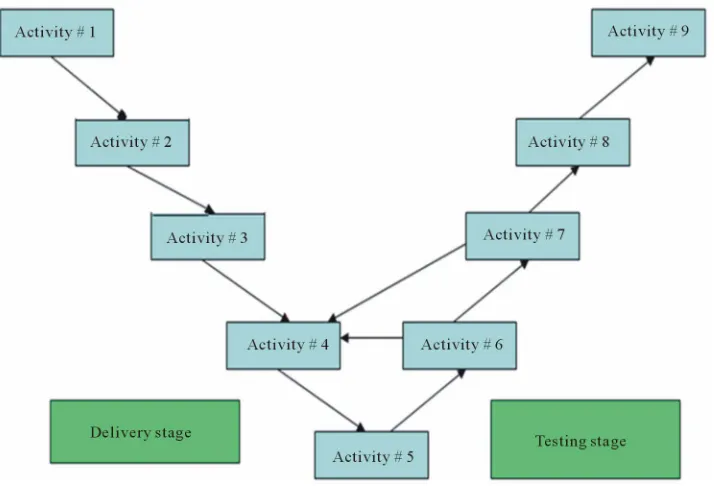
Considerable research was done on models of e- Learning [8-10]. Generally speaking there are three cate-gories of models in E-learning. These are: Academia, business and industry and government [15]. The acade-mia model is the pioneer in the field and we are going to focus on it. Our model represents the activities used in e-learning distributed in two phases and having the shape of a V-letter. That’s why we are calling it the V model. The first phase is the delivery phase while the second phase is the testing phase.
Our model is based on projecting Gagne’s nine steps on the E-learning system.
We represent our model in V-shape and divide it into two main stages: the delivery stage and the testing stage. The model is not linear and involves some level of feed-back.
[image:3.595.121.478.475.718.2]Mapped to Gagne’s nine steps the suggested model can be represented in the following diagram Figure 1.
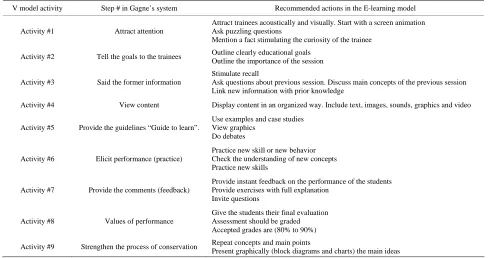
Table 1 shows the correspondence between our sug-gested model and the steps in Gagne’s model.
Table 1. Correspondence between our suggested model and the steps in Gagne’s model.
V model activity Step # in Gagne’s system Recommended actions in the E-learning model
Activity #1 Attract attention
Attract trainees acoustically and visually. Start with a screen animation Ask puzzling questions
Mention a fact stimulating the curiosity of the trainee
Activity #2 Tell the goals to the trainees Outline clearly educational goals Outline the importance of the session
Activity #3 Said the former information
Stimulate recall
Ask questions about previous session. Discuss main concepts of the previous session Link new information with prior knowledge
Activity #4 View content Display content in an organized way. Include text, images, sounds, graphics and video
Activity #5 Provide the guidelines “Guide to learn”.
Use examples and case studies View graphics
Do debates
Activity #6 Elicit performance (practice)
Practice new skill or new behavior Check the understanding of new concepts Practice new skills
Activity #7 Provide the comments (feedback)
Provide instant feedback on the performance of the students Provide exercises with full explanation
Invite questions
Activity #8 Values of performance
Give the students their final evaluation Assessment should be graded Accepted grades are (80% to 90%)
Activity #9 Strengthen the process of conservation Repeat concepts and main points
Present graphically (block diagrams and charts) the main ideas
According to our model the E-learning process is di-vided into nine activities numbered from one to nine in match to the Gagne system. The first column of the table these activities are listed in order. The second column lists the Gagne instruction associated with the given ac-tivity while the third column describes the actions sug-gested in the E-learning system. E-learning systems are increasingly becoming very popular. Nevertheless dif-ferent people in difdif-ferent institutions are using their per-sonal experience and skills in designing and implement-ing their systems. Unfortunately there is no statistical data on the performance and effectiveness of the dif- ferent E-learning systems. One of the aspects of further investigation is to do a comparative analysis of E-learn- ing systems designed and implemented using different models among which our V model is one of the investi- gated models.
6. Conclusion
Based on our experience in E-learning a V model was proposed. Our model was based on Gagne’s nine steps of quality education. Having this model E-learning in Jor-dan can be to certain extent formalized and standardized. Nevertheless a huge margin of freedom is given to the instructor so that his experience and creativity can be exploited to the maximum.
REFERENCES
[1] http://en.wikipedia.org/wiki/Education_in_Jordan
[2] T. H. Kanaan, M. N. Al-Salamat and M. D. Hanania, “Higher Education in Jordan, Access and Equity in Its Financing,” Jordan Center for Policy Research and Dia-logue (JCPRD), March 2009.
[3] F. Martin, J. D. Klein and H. Sullivan, “The Impact of Instructional Elements in Computer-Based Instruction,”
British Journal of Educational Technology, Vol. 38, No.
4, 2007, pp. 623-636.
doi:10.1111/j.1467-8535.2006.00670.x
[4] F. Martin, “Effects of Practice in a Linear and Non-Linear Web-Based Learning Environment,” Educational Tech-
nology & Society, Vol. 11, No. 4, 2008, pp. 81-93.
[5] M. Simonson, S. Smaldino, M. Albright and S. Zvacek, “Teaching and Learning at a Distance,” 3rd Edition, Pearson Education Inc., Upper Saddle River, 2008. [6] J. Serwatka, “Improving Student Performance in Distance
Learning Courses,” The Journal of Technological Hori-
zons in Education, Vol. 29, No. 9, 2002, pp. 46-52.
[7] H. Al-Shalabi and S. Al-Jufout, “Instructor’s Role through Embedded E-Learning at Al-Hussein Bin-Talal Univer- sity. 1st International Conference & Exhibition on E- Learning,” E-Learning Center, University of Bahrain, Ba- hrain, 2006.
[8] H. Al-Shalabi and S. Al-Jufout, “The Electronic Class- room through Embedded E-Learning in Jordan,” Asian
Journal of Distance Education, Vol. 3, No. 2, 2006, pp.
1347-9008.
[9] S. Al-Jufout, H. Al-Shalabi and R. A. Al-Muhaissen, “Embedded E-Learning Technique Evaluation in Jor- dan,” Asian Journal of Distance Education, Vol. 5, No. 3, 2007, pp. 1347-9008.
Higher Education,” The Case of Jordan Proceedings of
the 10th European Conference on E-Learning, England,
10-11 November 2011, pp. 16-22.
[11] Olimpius, “Education Staff Working in E-Learning En-vironments: Skills and Competencies,” 7th International Scientific Conference E-Learning and Software for
Edu-cation, Bucharest, 28-29 April 2011.
[12] http://en.wikipedia.org/wiki/Robert_M._Gagn%C3%A9# cite_note-4#cite_note-4
[13] “Official Site of Bernice McCarthy’s 4MAT System,” www.aboutlearning.com
[14] “Official Site of John Kellers ARCS Model.” www.arcsmodel.com