ISSN Online: 2164-5337 ISSN Print: 2164-5329
DOI: 10.4236/wjcd.2017.79028 Sep. 25, 2017 299 World Journal of Cardiovascular Diseases
Redo Cardiac Surgery: Bleeding Control
A. Seghrouchni
*, M. Bamous, Y. Moutakiallah, F. Nya, N. Atmani, A. Abdou, M. Belkhadir,
S. Bellouize, A. Abetti, R. Mounir, A. Moujahid, A. G. Hatim, M. Drissi, Y. El Bekkali,
A. Boulahya, M. Ait. Houssa
Cardiac Surgery Department, Mohammed V Military Hospital, Mohammed V University, Rabat, Morocco
Abstract
Redo cardiac surgery increases mortality and morbidity. The aim of this study was to determine if aprotinin was superior to tranexamic acid concerning control bleeding loss after redo valve surgery. A retrospective study was con-ducted from January 1994 until December 2014. 221 patients underwent redo cardiac valve surgery and separated into two groups: aprotinin group (n = 85) and tranexamic acid group (n = 136). Univariate tests were applied for data analysis. A total of 221 patients were enrolled in this study. This cohort was separated into two groups: aprotinin group (n = 85) and tranexamic acid group (n = 136). Euroscore in tranexamic acid group was higher: 5.96 ± 3.04 vs. 5.17 ± 2.83 in aprotinin group (p = 0.055). There was no statistical differ-ence in postoperative mortality between the two groups (p = 0.153). No statis-tical differences were reported concerning: total blood loss (p = 0.51), red blood cells transfusion (p = 0.215), reexploration for bleeding (p = 0.537) and postoperative renal failure (p = 0.79). There were statistical differences con-cerning mechanical ventilation time, which is longer in tranexamic acid group (p = 0.008) and the use of inotropic drug support, which is more frequent in the tranexamic acid group (p = 0.001). Our results demonstrated that tra-nexamic acid and aprotinin reduce transfusion requirement and blood loss. Due to financial reason, we chose tranexamic acid in preventing blood loss in redo valve surgery.
Keywords
Cardiac Surgery, Aprotinin, Tranexamic Acid, Cardiopulmonary Bypass
1. Introduction
Redo cardiac surgery increases mortality and morbidity. Excessive perioperative bleeding is a common complication with over 50% of patients receiving blood How to cite this paper: Seghrouchni, A.,
Bamous, M., Moutakiallah, Y., Nya, F., Atmani, N., Abdou, A., Belkhadir, M., Bellouize, S., Abetti, A., Mounir, R., Mou-jahid, A., Hatim, A.G., Drissi, M., El Bekka-li, Y., Boulahya, A. and Houssa, M.A. (2017) Redo Cardiac Surgery: Bleeding Control. World Journal of Cardiovascular Diseases, 7, 299-307.
https://doi.org/10.4236/wjcd.2017.79028
Received: July 24, 2017 Accepted: September 22, 2017 Published: September 25, 2017
Copyright © 2017 by authors and Scientific Research Publishing Inc. This work is licensed under the Creative Commons Attribution International License (CC BY 4.0).
DOI: 10.4236/wjcd.2017.79028 300 World Journal of Cardiovascular Diseases product transfusions [1] [2] [3] [4].
The risk of postoperative morbidity and mortality was increased by periopera-tive transfusion [5]. Thus, postoperaperiopera-tive hemorrhages affect patients’ outcomes, and increase healthcare costs.
Bridges et al. found that re-exploration for control of bleeding after cardiac surgery increased four-fold mortality and sternal infection [6].
In cardiac surgery, bleeding is due to hemostasis changes by exposing blood to CPB circuit and also due to the surgical procedure.
In redo valve surgery, extensive surgical dissection of mediastinal and pleu-ro-pericardial adherences in order to mobilize the entire heart and facilitate the exposure causes diffuse capillary injuries and tissue damage that increase bleeding.
Cardiopulmonary bypass (CPB) adds major insult to the injury and creates ex-cessive activation of the fibrinolytic system that leads to a bleeding tendency [7].
Therefore, different pharmacologic strategies have been recommended to re-duce perioperative blood loss including correction of coagulopathy using tropi-cal agents for example, spraying fibrin sealant over the pericardial surface. But the prophylactic utilization of the intra venous antifibrinolytic agents is the pop-ular approach in preventing blood loss.
In clinical practice, aprotinin, a natural serine protease inhibitor and two ly-sine analogues tranexamic acid (TXA) and aminocaproic acid [8] have been used to reduce blood loss after cardiac surgery. However, there is still confusion and controversy about the best antifibrinolytic agent.
The aim of this study was to determine if aprotinin was superior to tranexam-ic acid concerning control bleeding loss after redo valve surgery.
2. Methods
After institutional ethical committee approval, database of all adult patients (≥18 years) were collected retrospectively. All patients who underwent redo cardiac surgery with cardiopulmonary bypass from January 1994 until December 2014 at our institution were included in the present retrospective observational study.
Categories in this database included patients characteristics, comorbidities, operative data, antifibrinolytic agent given, cardiopulmonary bypass time, cross clamp time, blood products transfused, 24 hours chest tube drainage and post-operative complications.
Anesthesia:
All patients were premedicated with 0.1 mg/kg of diazepam. After the transfer to the operating room the patient was given total intravenous anesthesia. This consists of sufentanil 0.5 mg/kg, midazolam 3 - 5 mg/kg, propofol 1 mg/kg, ven-curonium 0.6 mg/kg. Antibiotic prophylaxis was given intravenously after induc-tion of anesthesia and before skin incision closure, and continued every 6 hours during 24 hours. Cephazolin combined with aminozid were the standard choice.
Cardiopulmonary bypass:
DOI: 10.4236/wjcd.2017.79028 301 World Journal of Cardiovascular Diseases For anticoagulation, we administered heparin 300 iu/kg intravenously until an activated clotting time (ACT) of >400 s was achieved. All CPB procedures were performed with membrane oxygenator, roller pump and under moderate hypo-thermia (32˚ - 34˚).
Continuous blood flow was kept between 2.2 and 3 l/min/m2. Myocardial protection was achieved by cold high potassium crystalloid cardioplegia solution (St Thomas) before 2000, but after this date, we routinely used cold blood car-dioplegia for all patients.
Patients were weaned from CPB when rectal temperature was estimated 36˚C. Before giving protamine, blood from CPB circuit was returned back to patient. Heparin was reversed with protamin sulfate in 1:1 fashion.
Patients were divided into two groups based on the antifibrinolytic agent they were given.
The first group received aprotinin (n = 85). After heparinization, we infused 500,000 kiu before and after protamine administration.
The second group received tranexamic acid (n = 136). When heprinization was done, we injected 15 mg/kg before and after protamine administration.
We evaluated in this study: blood loss were assessed at 6 and 24 hours, he-moglobin level, platelet count and fibrinogen level. Transfusion of blood product was also evaluated.
Adverse events were predefined as follows: low cardiac output syndrome (LOS), postoperative myocardial infarction, renal failure, cerebrovascular event, reexploration due to hemorrhage and reintubation.
30 days mortality was defined as all death during 30 days after surgery. We recorded these operation’s parameters: type of intervention done, urgency of operation, operation time, CPB time, cross clamping time, time of mechanical ventilation, intensive care unit (ICU) stay, postoperative length of stay and use of inotropic drugs.
Exclusion criteria were as follows: allergy to tranexamic acid or aprotinin, preoperative coagulation defects, preoperative renal failure with hemodialysis.
Data analysis:
Statistical analysis was performed using SPSS 19.0 software (SPSS Inc., Chica-go, IL, USA).
Data were represented as mean ± (SD) when the variables were normally dis-tributed or as median with inter-quartile range (IQR) when the variables were not normally distributed.
T-test was used to compare normally distributed data. A non parametric test Mann-Whitney for abnormally distributed variables. A chi-square test X2 or Fisher’s exact test was used to compare ordinal and categorical data respectively.
A p value of less than 0.05 was considered as statistically significant.
3. Results
DOI: 10.4236/wjcd.2017.79028 302 World Journal of Cardiovascular Diseases two groups: aprotinin group (n = 85) and TXA group (n = 136).
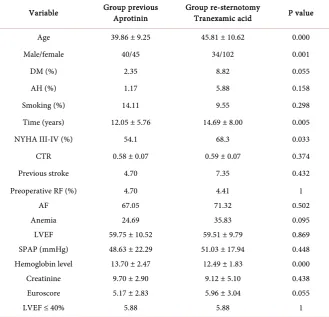
The patient demographic data are outlined in Table 1.
Patients in TXA group were more female (75% vs. 52.9% p = 0.001) and were older (45.81 ± 10.62 years vs. 39.86 ± 9.25 years p = 0.0001) and a higher pro-portion of them were more symptomatic NYHA functional class III-IV: 68.3% vs. 54.1% p = 0.033. That was explained by the delay of surgery. Duration be-tween the first surgical procedure and the reoperation: 14.69 ± 8 years in TXA group vs. 12.05 ± 5.76 in aprotinin group p = 0.005.
Additionally, the TXA group was in higher preoperative risk score.
Euroscore: 5.96 ± 3.04 in TXA group vs. 5.17 ± 2.83 in aprotinin group p = 0.055.
Concerning the rest of demographic data, there were no significant statistical-ly differences between the two groups.
There were no differences in preoperative laboratory parameters between groups.
Preoperative hemoglobin, platelet, fibrinogen, prothrombin time, creatinine levels were similar between groups.
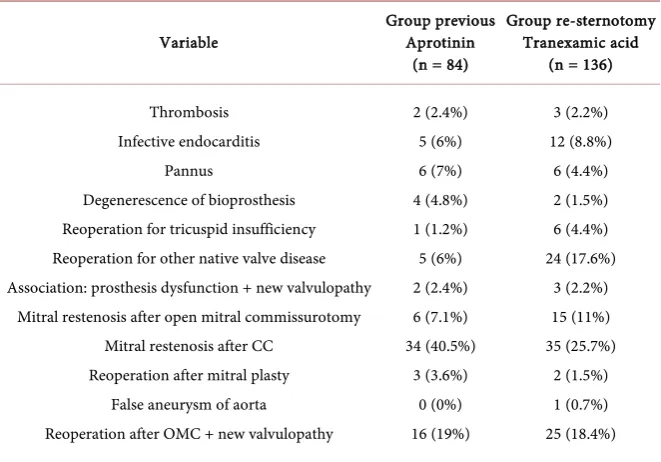
[image:4.595.208.538.374.691.2]Table 2 shows the reasons of reoperation for patients. Although patients
Table 1. Demographics of patients.
Variable Group previous Aprotinin Group re-sternotomy Tranexamic acid P value
Age 39.86 ± 9.25 45.81 ± 10.62 0.000
Male/female 40/45 34/102 0.001
DM (%) 2.35 8.82 0.055
AH (%) 1.17 5.88 0.158
Smoking (%) 14.11 9.55 0.298
Time (years) 12.05 ± 5.76 14.69 ± 8.00 0.005
NYHA III-IV (%) 54.1 68.3 0.033
CTR 0.58 ± 0.07 0.59 ± 0.07 0.374
Previous stroke 4.70 7.35 0.432
Preoperative RF (%) AF Anemia
LVEF SPAP (mmHg) Hemoglobin level
Creatinine Euroscore LVEF ≤ 40%
4.70 67.05 24.69 59.75 ± 10.52 48.63 ± 22.29 13.70 ± 2.47
9.70 ± 2.90 5.17 ± 2.83
5.88
4.41 71.32 35.83 59.51 ± 9.79 51.03 ± 17.94
12.49 ± 1.83 9.12 ± 5.10 5.96 ± 3.04
5.88
1 0.502 0.095 0.869 0.448 0.000 0.438 0.055 1
DOI: 10.4236/wjcd.2017.79028 303 World Journal of Cardiovascular Diseases
Table 2. Cause of reoperation.
Variable Group previous Aprotinin (n = 84)
Group re-sternotomy Tranexamic acid
(n = 136)
Thrombosis Infective endocarditis
Pannus
Degenerescence of bioprosthesis Reoperation for tricuspid insufficiency Reoperation for other native valve disease Association: prosthesis dysfunction + new valvulopathy
Mitral restenosis after open mitral commissurotomy Mitral restenosis after CC
Reoperation after mitral plasty False aneurysm of aorta Reoperation after OMC + new valvulopathy
2 (2.4%) 5 (6%) 6 (7%) 4 (4.8%) 1 (1.2%) 5 (6%) 2 (2.4%) 6 (7.1%) 34 (40.5%)
3 (3.6%) 0 (0%) 16 (19%)
3 (2.2%) 12 (8.8%)
6 (4.4%) 2 (1.5%) 6 (4.4%) 24 (17.6%)
3 (2.2%) 15 (11%) 35 (25.7%)
2 (1.5%) 1 (0.7%) 25 (18.4%)
CC: closed commissurotomy. OMC: open mitral commissurotomy.
treated with aprotinin had slightly more closed mitral commissurotomy than patients treated with TXA (55.3% vs. 41.5% p = 0.05), but this difference was of low clinical importance.
Other causes of redo valve surgery were similar between groups.
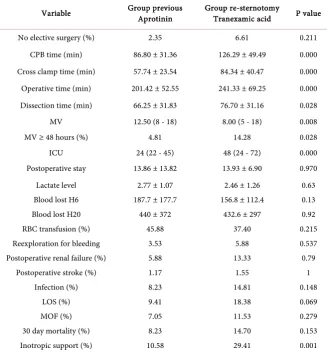
Intraoperatively (Table 3), patients receiving TXA drug had significantly longer CPB time, aortic cross clamp time, duration of surgical procedure, me-chanical ventilation time. ICU stay (p = 0.0001. p = 0.0001. p = 0.0001. p = 0.005 and p = 0.0001) respectively. However, the mean postoperative length of stay was similar between groups: 13.93 ± 6.9 days vs. 13.86 ± 13.82 days (p = 0.97).
The frequency of low cardiac output syndrome was higher in TXA group compared with aprotinin group, but it did not reach statistically significance (18.38% vs. 9.41% p = 0.069). More patients in TXA group were receiving ino-tropic drugs compared to those treated with aprotinin: 29.41% vs. 10.58% (p = 0.001). Postoperative morbidities between patients treated with tranexamic acid and those treated with aprotinin did not found significant differences (myocar-dial infarction, renal failure, infection neurological events).
The incidence of excessive blood loss (>1000 ml/24h) was similar in both groups (aprotinin: 7.05% vs. TXA 7.35% p = 0.935).
At six and 24 hours the volume of blood loss was the same between both groups. Patients treated with aprotinin required more transfusion than patient in the tranexamic group, but it didn’t reach statistical significance (45.88% vs. 37.4% p = 0.215).
The need for re-exploration for bleeding was slightly higher in TXA group but without clinical importance (p = 0.537).
DOI: 10.4236/wjcd.2017.79028 304 World Journal of Cardiovascular Diseases
Table 3. Operative Data.
Variable Group previous Aprotinin Group re-sternotomy Tranexamic acid P value
No elective surgery (%) 2.35 6.61 0.211
CPB time (min) 86.80 ± 31.36 126.29 ± 49.49 0.000 Cross clamp time (min) 57.74 ± 23.54 84.34 ± 40.47 0.000 Operative time (min) 201.42 ± 52.55 241.33 ± 69.25 0.000 Dissection time (min) 66.25 ± 31.83 76.70 ± 31.16 0.028 MV 12.50 (8 - 18) 8.00 (5 - 18) 0.008
MV ≥ 48 hours (%) 4.81 14.28 0.028
ICU 24 (22 - 45) 48 (24 - 72) 0.000
Postoperative stay 13.86 ± 13.82 13.93 ± 6.90 0.970 Lactate level
Blood lost H6 Blood lost H20 RBC transfusion (%) Reexploration for bleeding Postoperative renal failure (%)
Postoperative stroke (%) Infection (%)
LOS (%) MOF (%) 30 day mortality (%) Inotropic support (%)
2.77 ± 1.07 187.7 ± 177.7
440 ± 372 45.88 3.53 5.88 1.17 8.23 9.41 7.05 8.23 10.58
2.46 ± 1.26 156.8 ± 112.4
432.6 ± 297 37.40 5.88 13.33 1.55 14.81 18.38 11.53 14.70 29.41 0.63 0.13 0.92 0.215 0.537 0.79 1 0.148 0.069 0.279 0.153 0.001
CPB: cardiopulmonary bypass. MV: mechanical ventilation. ICU: intensive care unit. RBC: red blood cells. LOS: low output syndrome. MOF: multi organ failure.
hours: 10.39 ± 1.48 vs. 11.08 ± 1.79 (p = 0.004). But the values were similar in both groups at 24 hours: 10.48 ± 1.56 vs. 10.72 ± 1.36 (p = 0.270).
Postoperative platelet counts and fibrinogen level were lower in patient re-ceiving aprotinin than those rere-ceiving tranexamic acid with statistically signific-ance at six and 24 hours (p = 0.009, p = 0.000) respectively.
Lower levels of fibrinogen were also found in aprotinin group at six and 24 hours: p = 0.0001, p = 0.0001 respectively.
Mortality is increased in patients treated with TXA 14.7% vs. 8.23% in pa-tients receiving aprotinin: p = 0.153.
4. Discussion
Significant bleeding, especially during redo valve surgery that needs re-exploration and/or requires blood transfusion, increases morbidity and mortality [6].
DOI: 10.4236/wjcd.2017.79028 305 World Journal of Cardiovascular Diseases In the present study, we compared the efficacy of low dose aprotinin and tra-nexamic acid on postoperative blood loss after redo valve surgery and need for red blood transfusion.
Tranexamic acid (30 mg/kg) associated with low dose aprotinin (500,000 kiu) on control bleeding diathesis and transfusion requirement has been studied in other studies.
In our study, both agents reduce blood loss after redo valve surgery. This finding correlates with recent meta-analysis demonstrating equivalent effects of both drugs [10] [11] [12].
Mengistu et al. [13] showed better platelet function measured by whole blood aggregation in the aprotinin group compared to tranexamic acid. In our study, patients in the aprotinin group experienced lower platelet counts than those re-ceiving tranexamic acid either at six and 24 hours after CPB: p = 0.067 p = 0.009 respectively. This finding suggested that tranexamic acid is better in prevention of platelet dysfunction than aprotinin.
In clinical practice, all agents are effective, however controversy regarding which one should be have the potential clinical superiority. Also they are not without side effects.
Use of antifibrinolytic agents must be governed by an appreciation of their inherent risks and benefits. No drug is completely safe, while patient variability also plays an important role in adverse events.
Some studies have suggested that the risk of death and renal failure is in-creased with the use of aprotinin than with the use of lysine analogues [14] [15] [16] [17]. These adverse events were dramatically observed in Bart study [18] and Bayer withdrawn aprotinin from the world market on May 2008.
The development of postoperative morbidities did not vary significantly be-tween patients receiving low dose aprotinin and those receiving tranexamic acid which is consistent with finding from Van Der Linden’s investigation [19]. Al-though aprotinin group experienced low morbidity and low mortality compared to tranexamic group, it did not reach statistical significance. However, when examining outcomes of patients treated with tranexamic acid, we found signifi-cant longer CPB time, longer ischemic time, prolonged mechanical support, in-creased proportion of LOS, all these factors might play a part in worse outcome.
In recent study, Montes [20] suggests that in the setting of renal disfunction and low output syndrome, an association between tranexamic acid use and oc-currence of postoperative seizures has been demonstrated. In our study, LOS was more prevalent in tranexamic acid group but none had developed convul-sive seizures.
It is known that lysine analogues are substantially cheaper than aprotinin [21]. So there are financial reasons to choose the synthetic lysine analogues, and it is routinely used alone in our patients.
DOI: 10.4236/wjcd.2017.79028 306 World Journal of Cardiovascular Diseases The retrospective nature of this single institution study constituted the main limitation of this paper.
This observational study did not include patients who underwent coronary artery bypass grafting, which may have introduced an additional variance when comparing results between groups. Given the small sample size of our study population, without sufficient statistical power, that makes analysis between groups difficult.
When examining the reason of redo valve surgery, we found that 40.5% of pa-tient receiving low dose aprotinin had previously closed mitral commissurotomy (CMC) and only 26.7% in those receiving tranexamic acid. It is known the pre-vious CMC gives less pleura-pericardic adherences than prepre-vious full sternoto-my. Also, we know that large dissection of adherences in order to mobilize entire heart, increases the risk of bleeding and makes surgical procedure difficult. This parameter might be taken into account when comparing blood loss between groups.
5. Conclusion
Our results showed that tranexamic acid and aprotinin reduce transfusion need and blood loss. Due to financial reason, we chose tranexamic acid in preventing blood loss in redo valve surgery.
References
[1] Ferraris, V.A., Ferraris, S.P., Saha, S.P., et al. (2007) Perioperative Blood Transfu-sion and Blood Conservation in Cardiac Surgery: The Society of Thoracic Surgeons and the Society of Cardiovascular Anesthesiologists Clinical Practice Guideline. The Annals of Thoracic Surgery, 83, S27-S86.
[2] Levy, J.H., Ramsay, J.G. and Guyton, R.A. (2006) Aprotinin in Cardiac Surgery. The New England Journal of Medicine, 354, 1953-1957.
[3] Mehta, R.H., Sheng, S., O’Brien, S.M., Grover, F.L., Gammie, J.S., Ferguson, T.B., et al. (2009) Reoperation for Bleeding in Patients Undergoing Coronary Artery Bypass Surgery: Incidence, Risk Factors, Time Trends and Outcomes. Circulation: Cardi-ovascular Quality and Outcomes, 2, 583-590.
[4] Daly, D.J., Myles, P.S., Smith, J.A., Knight, J.L., Clavisi, O., Bain, D.L., et al. (2007) Anticoagulation, Bleeding and Blood Transfusion Practices in Australasian Cardiac Surgical Practice. Anaesthesia and Intensive Care, 35, 760-768.
[5] Koch, C.G., Li, L., Sessler, D.I., Figueroa, P., Hoeltge, G.A., Mihaljevic, T., et al. (2008) Duration of Red-Cell Storage and Complications after Cardiac Surgery. The New England Journal of Medicine, 358, 1229-1239.
[6] Bridges, C.R. (2007) Valid Comparisons of Antifibrinolytic Agents Used in Cardiac Surgery. Circulation, 115, 2790-2792.
[7] Larmann, J. and Theilmeier, G. (2004) Inflammatory Response to Cardiac Surgery: Cardiopulmonary Bypass versus Non-Cardiopulmonary Bypass Surgery. Best Prac-tice & Research Clinical Anaesthesiology, 18, 425-438.
https://doi.org/10.1016/j.bpa.2003.12.004
DOI: 10.4236/wjcd.2017.79028 307 World Journal of Cardiovascular Diseases
Outcome.Anesthesia & Analgesia, 85, 1258-1267.
[9] Sniecinski, R.M. and Chandler, W.L. (2011) Activation of the Hemostatic System during Cardiopulmonary Bypass. Anesthesia & Analgesia, 113, 1319-1333. [10] Ngaage, D.L. and Bland, J.M. (2010) Lessons from Aprotinin: Is the Routine Use
and Inconsistent Dosing of Tranexamic Acid Prudent? Meta-Analysis of Rando-mized and Large Matched Observational Studies. European Journal of Car-dio-Thoracic Surgery, 37, 1375-1383.
[11] Henry, D.A., Carless, P.A., Moxey, A.J., O’Connell, D., Stokes, B.J., Fergusson, D.A.,
et al. (2011) Anti-Fibrinolytic Use for Minimising Perioperative Allogeneic Blood Transfusion. The Cochrane Database of Systematic Reviews, 16, CD001886. [12] Joseph, L. (2012) Risks of Harms using Antifibrinolytics in Cardiac Surgery:
Syste-matic Review and Network Meta-Analysis of Randomised and Observational Stu-dies. BMJ, 345, e5798.https://doi.org/10.1136/bmj.e5798
[13] Mengistu, A.M., Röhm, K.D., Boldt, J., Mayer, J., Suttner, S.W. and Piper, S.N. (2008) The Influence of Aprotinin and Tranexamic Acid on Platelet Function and Postoperative Blood Loss in Cardiac Surgery. Anesthesia & Analgesia, 107, 391-397. [14] Henry, D.A., Carless, P.A., Moxey, A.J., et al. (2007) Anti-Fibrinolytic Use for Mi-nimising Perioperative Allogeneic Blood Transfusion. The Cochrane Database of Systematic Review, No. 3, CD001886.
[15] Brown, J.R., Birkmeyer, N.J.O. and O’Connor, G.T. (2007) Meta-Analysis Compar-ing the Effectiveness and Adverse Outcomes of Antifibrinolytic Agents in Cardiac Surgery. Circulation, 115, 2801-2813.
[16] Mangano, D.T., Miao, Y., Vuylsteke, A., et al. (2007) Mortality Associated with Aprotinin during 5 Years Following Coronary Artery Bypass Graft Surgery. JAMA, 297, 471-479.
[17] Shaw, A.D., Stafford-Smith, M., White, W.D., et al. (2008) The Effect of Aprotinin on Outcome after Coronary-Artery Bypass Grafting. The New England Journal of Medicine,358, 784-793.
[18] Fergusson, D.A., Hébert, P.C., Mazer, C.D., Fremes, S., MacAdams, C., Murkin, J.M., et al. (2008) A Comparison of Aprotinin and Lysine Analogs in High-Risk Cardiac Surgery. The New England Journal of Medicine,358, 2319-2331.
[19] Van der Linden, P.J., Hardy, J.-F., Daper, A., Trenchant, A. and De Hert, S.G. (2007) Cardiac Surgery with Cardiopulmonary Bypass: Does Aprotinin Affect Out-come? British Journal of Anaesthesia, 99, 646-652.
https://doi.org/10.1093/bja/aem252
[20] Montes, F.R., Pardo, D.F., Carreño, M., Arciniegas, C., Dennis, R.J. and Umaña, J.P. (2012) Risk Factors Associated with Postoperative Seizures in Patients Undergoing Cardiac Surgery Who Received Tranexamic Acid: A Case-Control Study. Annals of Cardiac Anaesthesia, 15, 6-12.https://doi.org/10.4103/0971-9784.91467
Submit or recommend next manuscript to SCIRP and we will provide best service for you:
Accepting pre-submission inquiries through Email, Facebook, LinkedIn, Twitter, etc. A wide selection of journals (inclusive of 9 subjects, more than 200 journals)
Providing 24-hour high-quality service User-friendly online submission system Fair and swift peer-review system
Efficient typesetting and proofreading procedure
Display of the result of downloads and visits, as well as the number of cited articles Maximum dissemination of your research work