Numerical simulation and analysis for indoor air
quality in different ventilation
*
Yang Li
School of Environment and Architecture, University of Shanghai for Science and Technology, Shanghai, China;
Received 23 October 2012; revised 24 November 2012; accepted 1 December 2012
ABSTRACT
Indoor air environment includes indoor thermal environment and air quality, and a reasonable ventilation provides guarantee for a good indoor environment. A numerical study of the indoor environment in different ventilation is presented in this paper. The External Energy Saving Lab of the WenYuan Building was selected for this purpose, and its indoor air quality and thermal performance in the typical summer climate were simulated. For the numerical simulation, the techniques of Fluent Air-pak was adopted to establish the physical and numerical model of lab. A attention is given to the velocity field and the distribution of pollutant concentration, fol- lowed by a discussion of two ventilation modes (displacement ventilation and up-in and up-out ventilation). By comparison, it is found that the Displacement ventilation in improving indoor air quality is obviously superior to the traditional up-in and up-out ventilation.
Keywords: WenYuan Building; Ventilation Modes;
Indoor Air Quality
1. INTRODUCTION
People spend most of their time indoors. Therefore, the quality of indoor environment is directly related to people’s safety, comfort, health, etc. The security as well as people’s physical and mental health should be as the first premise of interior design [1]. Indoor air environ-
ment includes indoor thermal environment and air qual- ity (IAQ), and a reasonable ventilation provides funda- mental guarantee for a good indoor environment. By providing the fresh air for indoor, discharging polluted gas, reducing the concentration of indoor pollutants, ven- tilation can improve indoor thermal comfort. The differ- ent ventilation modes and airflow patterns leads to dif- ferent results of dilution and exclusion of indoor pollut- ants, so as to people’s feelings of air quality [2]. Influ- enced by a variety of objective factors, the distributive rules of the ventilation organization is more difficult to reveal. The traditional approach is by the simulation ex- periments. This method, limited by the restrictive ex- perimental conditions, needs not only a lot of financial but also material resources. In a word, it is difficult to simulate all the characteristics of a complex space’s air flow.
Rencently,significant progress in the field of CFD has been made. With the visual way to demonstrate results, it has been used as an efficient tool to simulate the indoor air flow. Further, it will be the inevitable trend to study- ing the indoor ventilation organization and designing the high-performance air-conditioning room [3]. In the paper, we give an numerical Simulation and analysis of indoor ventilation organization of the External Energy Saving Lab of the WenYuan Building. For the simulaton, the mass conservation equation, energy conservation equa- tion and RNG’s k-ε turbulence models were adopted. According to the comparison among the indoor pollut- ants, concentration field and velocity field distribution in different ventilation modes, a conclusion is drawn. In order to provide a theoretical reference and the scientific basis for the actual ventilation organization and HVAC designs.
*The WenYuan Building of Tongji University built in 1953, was de-signed by Yulin Huang and Ha Xiongwen, teachers of department of architecture for Tongji University. By the reasonable building layout and concise appearance, it has won the award for Outstanding Archi-tectural Design of China ArchiArchi-tectural Society, selected as a member of the Shanghai classic architecture during new China 50 years, it is also known as the first modernist architecture in China. In 2005, it was selected by the fourth batch of Shanghai outstanding historical build-ings list.
2. THE MEANING AND IMPACT
FACTORS ANALYSIS OF INDOOR
AIR ENVIRONMENT
Good indoor air environment should be comfortable for most indoor members. That means high quality fresh, pleasant air for the indoor person to meet human thermal comfort and health needs [3]. According to the ASHRAE standard, thermal comfort is defined as “the satisfactory state of consciousness of thermal environment”. It is four environment factors and two human factors that affect the thermal comfort. Four environment factors include air temperature, relative humidity, the average tempera- ture of the inner surface of indoor maintenance structure and velocity of air flow. Two human factors are the rate of human energy metabolism and clothing thermal resis- tance [4]. The indoor air quality is subject to many fac- tors, and it can be divided into three categories according to the differences in the nature. The first is the physical, including suspended particles, smoke particles, and elec- tromagnetic radiation, etc. The second is chemicals, mainly from the residual components of housing renova- tion, insecticide sprays, the kitchen smoke, etc. Its main ingredient is volatile organic compounds (VOA) (such as formaldehyde, toluene, ethyl acetate) and inorganic compounds (such as ammonia, CO, CO2), etc. The third
category is the biological, like bacteria, fungi, viruses, etc. They often come form carpets, bedding, bedroom humidifier and unsanitary air conditioning equipment, etc. [5].
3. MODEL INTRODUCTION
3.1. The Setting of the Geometric Model
The External Energy Saving Lab of the WenYuan Building used the new type air-conditioning system (in- cluding the Cold radiant panel, Displacement ventilation
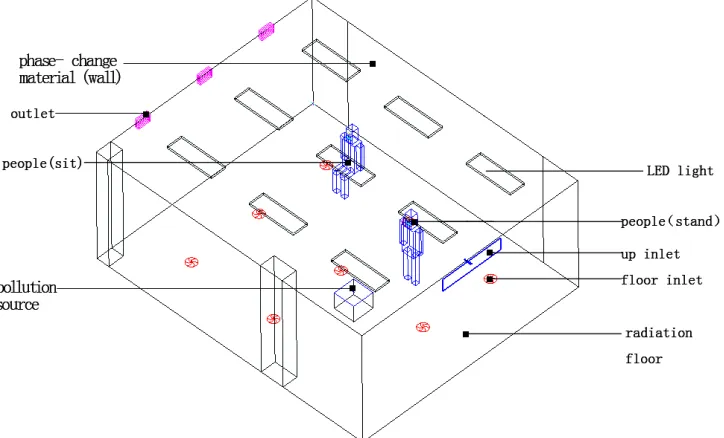
and up-in and up-out ventilation). In this paper, two dif- ferent air-conditioning ventilation modes of Wenyuan Building’s energy-saving laboratory were chose as the object of study. The techniques of CFD is adopted to to simulate and analyse the thermal comfort and indoor air quality in different ventilation modes. Choosing the en- ergy-saving laboratory of Wenyuan Building in the typi- cal condition of summer noon as the Physical model, which shown in Figure 1.
The model parameters are as follows:
1) 8 low-speed floor circular inlets: radius 0.12 m, ve-locity 0.5 m/s, temperature 21˚C;
2) 3 outlets on the east wall: 0.15 m × 0.3 m (geomet- ric dimensions);
3) 1 inlet on the west wall: 0.3 m × 1.5 m (geometric dimensions);
4) 2 Low-E windows faced to the south: 2.75 m × 0.9 m (geometric dimensions);
5) Phase Change Materials window: 2.75 m × 5 m (geometric dimensions);
6) Indoor heat source: a sitting person (producing heat 105 W), a standing person (130 W) and 9 LED lights (each light heat 30 W); Block instead of source: 0.05 m × 0.10.4 m × 1.15 m (geometric dimensions);
7) Room size: X × Y × Z = 6.8 m × 2.75 m × 5.8 m; 8) Source settings: there’s a printer in the lab as the heat source and pollution source, we use block (geomet- ric dimensions: 0.5 m × 0.4 m × 0.5 m) instead of it, and the power of the printer is 100 W;
[image:2.595.119.481.497.716.2]9) Coordinate reference: The starting point coordinate (0, 0, 0), the termination of coordinates (6.8, 2.75, 5.8), respectively corresponding to lower left and upper right corner in the office (Figure 1).
3.2. The Setting of the Boundary Condition
1) Outdoor calculation parameters: Choose the climate condition at 12 o’clock on July 1st in Shanghai, dry bulb temperature 35˚C, wet bulb temperature 28˚C, specific enthalphy 92.56 KJ/Kg, moisture content 0.0278 Kg/kg;
2) Indoor calculation parameters: Dry bulb tempera- ture 25˚C, relative temperature 50%;
3) Exterior wall: The south side is the only exterior wall for this room, used two phase change materials (19˚C and 26˚C). Since we chose the typical climate con- dition of summer noon, the selected state is the stable state of indoor temperature. The simplified calculation can make by setting heat transfer of the phase change material as a constant heat flux boundary conditions, and the heat transfer coefficient is 58 W/m2;
4) Door and window: There are two Low-E glass doors on the south wall (2.75 m × 0.9 m), the heat trans- fer coefficient is 5 W/m2;
5) Inner wall: Since the adjacent rooms are air-condi- tioning rooms, the inner wall can be regarded as adia- batic boundary conditions without difference in tem- perature;
6) Roof and floor: Both the ceiling and raised floor of energy-saving lab are made of copper coil metal radiant panel. There are LED lights on the ceiling and low speed inlet on the floor. For the purpose of simplifying the model, we regarded the whole roof and raised floor as cold radiation, and assumed the cold radiant panel tem- perature is 19˚C. Then we can set the cold radiant panel surface as the steady thermostatic state of boundary con- dition;
7) Outlet: Two different blowing modes are respec- tively set. Displacement ventilation used the floor low- speed and up-flow mode. In the model, and we set the blowing direction along the Y-axis direction, a tempera- ture of 21 degrees and a velocity of 0.5 m/s. In the Up-in and up-out blowing mode, the temperature is set as 21 degreesand the velocity is 1 m/s;
8) Pollution source setting: Printer is the indoor pollu- tion source. Assuming distributing gas of the block’s top surface is VOC benzene, and its emission rate is 0.5 m/s;
9) Vent settings: There are three outlets located over top of east inner wall, and each size is 0.15 m × 0.3 m.
3.3. Numerical Calculation Method
Computational Fluid Dynamics(CFD) is a computer simulation technology began in the early 1930s. It con- tains the fluid dynamics, numerical methods and com- puter graphics [6]. Now it has been widely applicated in the related fields. The basic idea of CFD is to replace the original continuous physical field (such as temperature field, pressure field, velocity field) in time and space to a set, which has a series of variable values of the finite
discrete points, establish the algebraic equations about the relationship between these discrete point field in some ways, then get the approximation of the field vari- able by solving algebraic equations [7]. Compared with the traditional theoretical analysis mode and experiment- tal measurement mode, CFD is superior in adaptability and applications. Nowadays, the widely used CFD soft- wares consist of Fluent, Phoenics, Airpak, etc. Here we choose Airpak as a research tool. Airpak is a professional software which is applied to the HVAC field for engi- neers, architects and designers, it can simulate the air flow, air quality, heat transfer, pollution and comfort of ventilation system accurately. It provides the model of forced convection, natural convection, mixed convection, heat conduction, fluid and solid coupling heat transfer, thermal radiation and turbulence, and computes with the world’s most power CFD solver Fluent. Based on limited volumetric method, it supports the tetrahedron, hexahe- dron and mixed grid [8] as its automatic unstructured, structured mesh generation capacity.
CFD software usually includs three modules: pre- processing, computeanresult and postprocessing [9]. Fluid flow control equation has mass, momentum, energy, and species mass conservation equation, and each control equation can be expressed as follows:
1) The mass conservation equation:
div U 0
t
(1)
2) The momentum conservation equation:
i i j
j
i i j
i j j
u u u t x
u u u x x x
(2)
In the formula: p—static pressure, η—fluid dynamic viscosity, λ—the thermal conductivity of the fluid.
3) The energy conservation equation:
div div h
ph uh vh wh
t x y z
p U grad T S
(3)
In the formula: λ—the thermal conductivity of the fluid, Sh—the inner heat source of fluid, —dissipation function [10], its calculation is as follows:
2 2 2 2 2 2 2 div
u v w u v x y z y x
u w v w
U z x z y
4) к equation:
j j
j
t i i
t
j k j j j i
k k u t x
u u u k
x x x x x
(5)
5) ε equation:
2 1
1
k k
j
t i i
k k j j i
u
t x
u
u u
c
c
In the formula: η1—turbulent viscosity coefficient, c1, c2, c3—constant, σκ, σε—κ, ε turbulent Prandtl number [11]. κ-ε simulation coefficients are as follows: C1ε = 1.44, C2ε = 1.92, C3ε = 1, Cμ = 0.09, σκ = 1.0, σε = 1.3.
4. THE SIMULATION RESULTS
ANALYSIS
2
x x k x x x
4.1. Displacement Ventilation (Low Speed Floor Air Supply) Condition
k
(6)
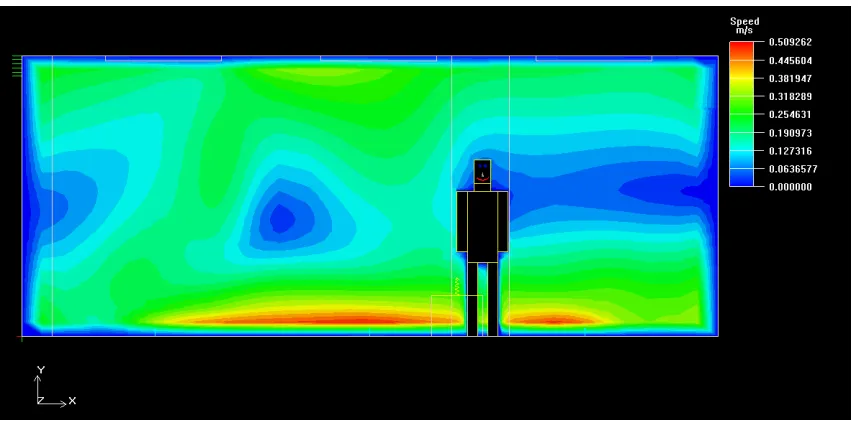
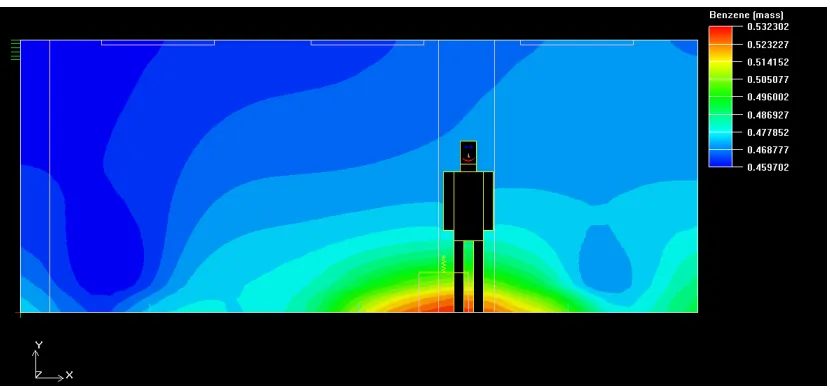
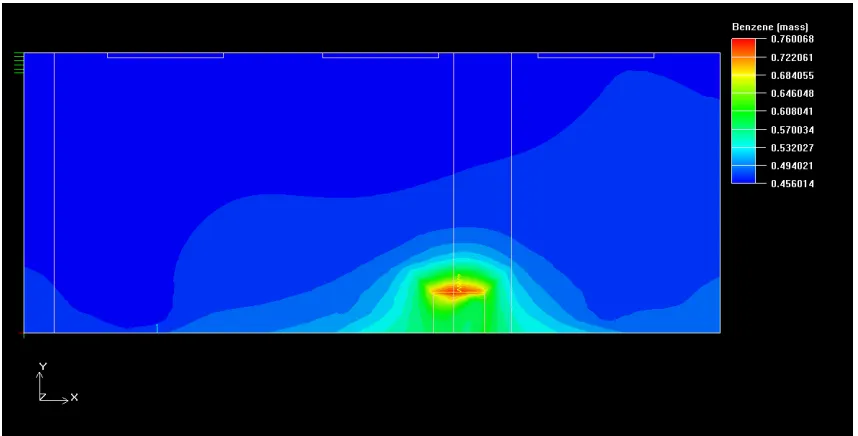
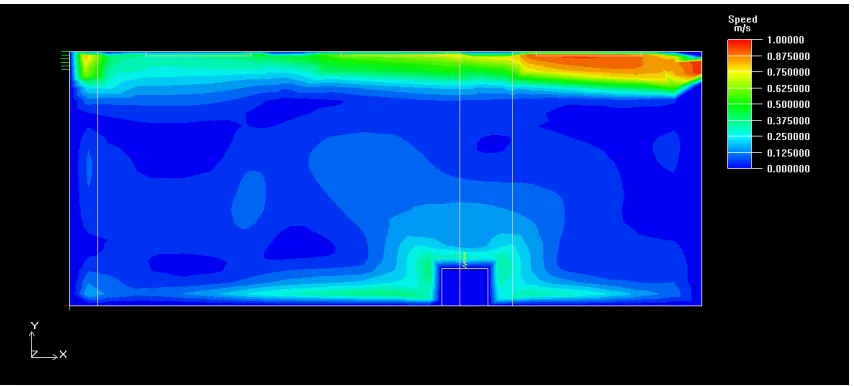
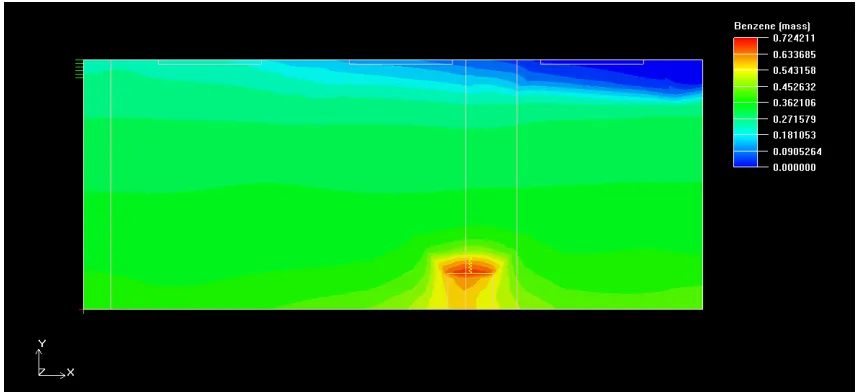
Figures 2 to 8 present the simulating results under the
[image:4.595.85.514.509.721.2]condition of displacement ventilation: The wind velocity vectors, wind velocity nephogram and the pollutants benzene concentration distributions at 2 m, 3 m, 4 m section.
Figure 2. The wind velocity vector at Z = 2 m.
Figure 4. The wind velocity nephogram at Z = 3 m.
Figure 5. The wind velocity nephogram at Z = 4 m.
[image:5.595.91.506.526.722.2]Figure 7. The pollutants benzene concentration distribution at Z = 3 m.
Figure 8. The pollutants benzene concentration distribution at Z = 4 m.
4.2. Up-In and Up-Out Ventilation Mode near the roof (In Figure 9, Vmax = 4.3 m/s; In Figure 10,
Vmax = 0.87 m/s). According to the Vertical comparison
of Figure 6 with Figure 13, the high concentration of
pollutants benzene in displacement ventilation mode is only concentrated in a small area near the pollutant source, and the maximum concentration is only 0.53 g/m³. Most of blue areas, with the pollutant concentration lower than 0.46 g/m³, belong to the slight pollution or no pollution area. But the pollutants benzene diffusion range is quite large in up-in and low-out ventilation mode.
Figures 9 to 15 are under the condition of up-in and
up-out ventilation: The wind velocity vectors, wind ve- locity nephogram and the pollutants benzene concen- tration distributions at Z = 2 m, 3 m, 4 m section. We will compare horizontal results in the same ventilation mode with vertical results in the different ventilation models).
From Figures 2 to 3, we can see that a huge scroll air-
flow is formed at Z = 2 m and the higher wind velocity (V ≈ 0.5 m/s) mainly concentrated near the floor (the entrance to the air). Figures 9 and 10 are the similar
situation, and the wind velocity mainly concentrated
By making a Horizontal contrast of the wind velocity nephograms among Figure 3 (Z = 2 m), Figure 4 (Z = 3
Figure 9. The wind velocity vector at Z = 2 m.
Figure 10. The wind velocity nephogram at Z = 2 m.
[image:7.595.86.513.525.718.2]Figure 12. The wind velocity nephogram at Z = 4 m.
Figure 13. The pollutants benzene concentration distribution at Z = 2 m.
[image:8.595.83.513.523.719.2]Figure 15. The pollutants benzene concentration distribution at Z = 4 m.
sion of the distributions wind velocity nephongram: the maximum velocity is about 0.5 m/s, Medium wind ve- locity in the middle area, and low wind velocity distrib- ute on both sides. By a Horizontal contrast of wind ve- locity nephongram of the room top among Figure 10 (Z
= 2 m), Figure 11 (Z = 3 m) and Figure 12 (Z = 4 m),
the distributions of high wind velocity is basically same. The maximum velocity of the three sections separately are 0.87 m/s, 1.0 m/s and 0.78 m/s. Because of the influ- ence of heat source (printer), the cyan area (medium wind velocity area) trends to be larger. Displacement ventilation mode is more uniform than up-in and up-out mode by the Vertical contrast of the wind velocity dis- tribution.
By the Horizontal contrast of the benzene concentra- tion distributions, the result of Figure 6 (Z = 2 m), Fig- ure 7 (Z = 3 m) and Figure 8 (Z = 4 m) are basically
similar. The high concentration of pollutants benzene only concentrate in a small area near pollution source (The highest concentration of pollutants of three sections are 0.53 g/m³, 0.76 g/m³, and 0.54 g/m³). And the pol- lutants can efficiently discharge to the outdoor. Horizon- tally compare the pollutants benzene concentration dis tributions of Figure 13 (Z = 2 m) with Figure 14 (Z = 3
m) and Figure 15 (Z = 4 m), the pollutants diffusion
areas are similar, but the high concentrations of pollut- ants benzene distribution areas are different. The high concentrations of pollutants benzene distribution areas of
Figure 13 (Z = 2 m) and Figure 15 (Z = 4 m) are located
at the bottom of the room (At the height range of 0 - 1.0 m, the Pollutant concentration concentrated in 0.40 - 0.46 g/m³). In Figure 14 (Z = 3 m), the high concentrations of
pollutants benzene distribution are located near the pollu- tant source (the highest concentration of pollutant is 0.72 g/m³). For the Vertical contrast, displacement ventilation
is better than up-send and up-out ventilation on the as- pect of eliminating the indoor pollutants.
Displacement ventilation mode is much better than up- send and up-out ventilation mode in disposing indoor pollutions, as entrance port and air vents in up-send and up-out ventilation mode are concentrated at the bottom. Although its influence to staff work area is smaller, most of the incident airflow has been drained away from air vents without entering the room at the bottom, which causes the incident airflow can not fully mixed with the indoor airflow, can not make heat exchange and bring in the indoor pollutants, then more and more pollutions are concentrated on the bottom of indoor.As the concentra- tion become higher, it affects people’s physical and mental health, just as we called “Air conditioning dis- ease.
5. CONCLUSION
necessary to promote the healthy and comfort air-condi- tioning system.
6. ACKNOWLEDGEMENTS
This work was financially supported by Shanghai science and tech- nology commission (funding issues No.11230705500) and granted approval by the Patent Administration Department under the State Council of P.R.C. on Two Invention Patent Projects (Patent No.ZL2010 1 0223058.4 and ZL 2007 1 0038310.2).
REFERENCES
[1] Li, Y. (2010) The application of CFD technology in analysis of residential wind environment. Journal of Ur- ban Technology, 12, 67-81.
[2] Feng, Q. (2010) Research of the air-conditioning system with CPCP& DOAS via CFD. Residential Technology, 30,
12.
[3] Lin, Z., Chow, T.T., Fong, K.F, et al. (1999) Validation of CFD model for research into application of displacement ventilation to Hong Kong buildings. In: Zhao, R.Y. and Burnet, J., Eds., ISHVAC, 99: 3rd International Sympo- sium on Heating Ventilation and Air Conditioning, 1-2,
602-613.
[4] Fletcher, C.A.G., Mayer, I.F., Eghlimi, A. and Wee, K.H.A. (2001) CFD as a building services engineering tool. Ar- chitectural Science, 2, 67-81.
[5] Peter, R. and Gao, S.N. (1998) Numerical study of heat transfer from an impinging jet. Heat and Mass Transfer,
40, 671-680.
[6] Jiao, J.J., Gong, G.C. and Shao, C.S. (2008) The numeri-cal simulation of the indoor air environment quality from air flow organization. Heating, Ventilation, and Air Con-ditioning, 19, 270-275.
[7] Long, W.D. (1999) Try to talk about the energy efficiency of buildings in the new ideas. Heating, Ventilation, and Air Conditioning, 29, 32-35.
[8] Tang, G.F., Lv, W.H. and Wang, H.Q. (1989) The nu- merical calculation and model experiment of indoor air- flow. Hunan University Press, Changsha.
[9] Xu, L., Weng, P.F. and Sun, W.M. (2003) The indoor airflow organization and indoor air quality’s numerical analysis of three ventilation modes. Journal of Air Dyna- mics, 21, 311-319.
[10] Yang, Y.R. (2002) Indoor air ventilation efficiency of the three-dimensional numerical analysis. Architecture and Urban Planning of Chongqing University, 3-5.
[11] Tao, W.Q. (1988) Numerical heat transfer. Jiaotong Uni- versity Press, Xi’an, 18-19.
[12] Yuan, L.L. and Liu, B. (2010) The research of indoor air quality under different ventilation modes. Heating, Venti- lation, and Air Conditioning, 40, 1-3.
[13] Ni, B. (2000) Experimental study of displacement venti- lation. Heating, Ventilation, and Air Conditioning, 30,