Proceedings of the 55th Annual Meeting of the Association for Computational Linguistics, pages 1722–1731 Vancouver, Canada, July 30 - August 4, 2017. c2017 Association for Computational Linguistics Proceedings of the 55th Annual Meeting of the Association for Computational Linguistics, pages 1722–1731
Vancouver, Canada, July 30 - August 4, 2017. c2017 Association for Computational Linguistics
CANE: Context-Aware Network Embedding for Relation Modeling
Cunchao Tu1,2∗, Han Liu3∗, Zhiyuan Liu1,2†, Maosong Sun1,2
1Department of Computer Science and Technology, State Key Lab on Intelligent Technology and Systems, National Lab for Information Science and Technology, Tsinghua University, China
2Jiangsu Collaborative Innovation Center for Language Ability, Jiangsu Normal University, China 3Northeastern University, China
Abstract
Network embedding (NE) is playing a critical role in network analysis, due to its ability to represent vertices with ef-ficient low-dimensional embedding vec-tors. However, existing NE models aim to learn a fixed context-free embedding for each vertex and neglect the diverse roles when interacting with other vertices. In this paper, we assume that one vertex usu-ally shows different aspects when interact-ing with different neighbor vertices, and should own different embeddings respec-tively. Therefore, we present Context-Aware Network Embedding (CANE), a novel NE model to address this issue. CANE learns context-aware embeddings for vertices with mutual attention mecha-nism and is expected to model the seman-tic relationships between verseman-tices more precisely. In experiments, we compare our model with existing NE models on three real-world datasets. Experimen-tal results show that CANE achieves sig-nificant improvement than state-of-the-art methods on link prediction and compara-ble performance on vertex classification. The source code and datasets can be ob-tained from https://github.com/ thunlp/CANE.
1 Introduction
Network embedding (NE), i.e., network represen-tation learning (NRL), aims to map vertices of a network into a low-dimensional space according to their structural roles in the network. NE pro-vides an efficient and effective way to represent
∗Indicates equal contribution
†Corresponding Author: Z. Liu ([email protected])
and manage large-scale networks, alleviating the computation and sparsity issues of conventional symbol-based representations. Hence, NE is at-tracting many research interests in recent years (Perozzi et al.,2014;Tang et al.,2015;Grover and Leskovec, 2016), and achieves promising perfor-mance on many network analysis tasks including link prediction, vertex classification, and commu-nity detection.
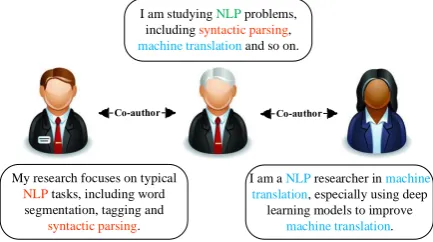
I am studying NLP problems, including syntactic parsing,
machine translation and so on.
My research focuses on typical
NLP tasks, including word segmentation, tagging and
syntactic parsing.
I am a NLP researcher in machine translation, especially using deep
learning models to improve
[image:1.595.308.525.360.481.2]machine translation.
Figure 1: Example of a text-based information network. (Red, blue and green fonts represent con-cerns of the left user, right user and both respec-tively.)
In real-world social networks, it is intuitive that one vertex may demonstrate various aspects when interacting with different neighbor vertices. For example, a researcher usually collaborates with various partners on diverse research topics (as il-lustrated in Fig. 1), a social-media user contacts with various friends sharing distinct interests, and a web page links to multiple pages for different purposes. However, most existing NE methods only arrange one single embedding vector to each vertex, and give rise to the following two invertible issues: (1) These methods cannot flexibly cope with the aspect transition of a vertex when inter-acting with different neighbors. (2) In these mod-els, a vertex tends to force the embeddings of its
neighbors close to each other, which may be not the case all the time. For example, the left user and right user in Fig.1, share less common inter-ests, but are learned to be close to each other since they both link to the middle person. This will ac-cordingly make vertex embeddings indiscrimina-tive.
To address these issues, we aim to propose a Context-Aware Network Embedding (CANE) framework for modeling relationships between vertices precisely. More specifically, we present CANE on information networks, where each ver-tex also contains rich external information such as text, labels or other meta-data, and the significance of context is more critical for NE in this scenario. Without loss of generality, we implement CANE on text-based information networks in this paper, which can easily extend to other types of informa-tion networks.
In conventional NE models, each vertex is rep-resented as a static embedding vector, denoted as
context-free embedding. On the contrary, CANE assigns dynamic embeddings to a vertex according to different neighbors it interacts with, named as
context-aware embedding. Take a vertex u and
its neighbor vertex v for example. The
context-free embedding ofuremains unchanged when
in-teracting with different neighbors. On the con-trary, the context-aware embedding of u is
dy-namic when confronting different neighbors. When u interacting with v, their context
em-beddings concerning each other are derived from their text information,SuandSvrespectively. For
each vertex, we can easily use neural models, such as convolutional neural networks (Blunsom et al.,
2014;Johnson and Zhang,2014;Kim,2014) and recurrent neural networks (Kiros et al.,2015;Tai et al.,2015), to buildcontext-freetext-based em-bedding. In order to realizecontext-aware text-based embeddings, we introduce the selective at-tention scheme and build mutual attention be-tweenuandvinto these neural models. The
mu-tual attention is expected to guide neural models to emphasize those words that are focused by its neighbor vertices and eventually obtain context-aware embeddings.
Both free embeddings and context-aware embeddings of each vertex can be effi-ciently learned together via concatenation using existing NE methods such as DeepWalk ( Per-ozzi et al., 2014), LINE (Tang et al., 2015) and
node2vec (Grover and Leskovec,2016).
We conduct experiments on three real-world datasets of different areas. Experimental results on link prediction reveal the effectiveness of our framework as compared to other state-of-the-art methods. The results suggest that context-aware embeddings are critical for network analysis, in particular for those tasks concerning about com-plicated interactions between vertices such as link prediction. We also explore the performance of our framework via vertex classification and case studies, which again confirms the flexibility and superiority of our models.
2 Related Work
With the rapid growth of large-scale social net-works, network embedding, i.e. network repre-sentation learning has been proposed as a critical technique for network analysis tasks.
In recent years, there have been a large num-ber of NE models proposed to learn efficient ver-tex embeddings (Tang and Liu, 2009;Cao et al.,
2015;Wang et al.,2016;Tu et al.,2016a). For ex-ample, DeepWalk (Perozzi et al.,2014) performs random walks over networks and introduces an ef-ficient word representation learning model, Skip-Gram (Mikolov et al., 2013a), to learn network embeddings. LINE (Tang et al.,2015) optimizes the joint and conditional probabilities of edges in large-scale networks to learn vertex represen-tations. Node2vec (Grover and Leskovec, 2016) modifies the random walk strategy in DeepWalk into biased random walks to explore the network structure more efficiently. Nevertheless, most of these NE models only encode the structural infor-mation into vertex embeddings, without consider-ing heterogeneous information accompanied with vertices in real-world social networks.
of vertices, and propose context-enhanced net-work embedding (CENE) through leveraging both structural and textural information to learn net-work embeddings.
To the best of our knowledge, all existing NE models focus on learning context-free embed-dings, but ignore the diverse roles when a vertex interacts with others. In contrast, we assume that a vertex has different embeddings according to which vertex it interacts with, and propose CANE to learn context-aware vertex embeddings.
3 Problem Formulation
We first give basic notations and definitions in this work. Suppose there is an information network
G = (V, E, T), where V is the set of vertices,
E ⊆V×V are edges between vertices, andT de-notes the text information of vertices. Each edge
eu,v ∈E represents the relationship between two
vertices (u, v), with an associated weight wu,v.
Here, the text information of a specific vertex
v ∈ V is represented as a word sequence Sv =
(w1, w2, . . . , wnv), wherenv = |Sv|. NRL aims to learn a low-dimensional embeddingv∈Rdfor
each vertexv ∈V according to its network
struc-ture and associated information, e.g. text and la-bels. Note that,d |V|is the dimension of rep-resentation space.
Definition 1. Context-free Embeddings: Con-ventional NRL models learn context-free embed-ding for each vertex. It means the embedembed-ding of a vertex is fixed and won’t change with respect to its context information (i.e., another vertex it in-teracts with).
Definition 2. Context-aware Embeddings:
Different from existing NRL models that learn context-free embeddings, CANE learns various embeddings for a vertex according to its differ-ent contexts. Specifically, for an edgeeu,v, CANE
learns context-aware embeddingsv(u)andu(v).
4 The Method
4.1 Overall Framework
To take full use of both network structure and as-sociated text information, we propose two types of embeddings for a vertex v, i.e.,
structure-based embedding vs and text-based embedding vt. Structure-based embedding can capture the
information in the network structure, while text-based embedding can capture the textual mean-ings lying in the associated text information. With
these embeddings, we can simply concatenate them and obtain the vertex embeddings as v =
vs⊕vt, where⊕indicates the concatenation
op-eration. Note that, the text-based embedding vt
can be either context-free or context-aware, which will be introduced detailedly in section 4.4 and 4.5 respectively. Whenvtis context-aware, the
over-all vertex embeddingsvwill be context-aware as
well.
With above definitions, CANE aims to maxi-mize the overall objective of edges as follows:
L=X
e∈E
L(e). (1)
Here, the objective of each edgeL(e) consists of
two parts as follows:
L(e) =Ls(e) +Lt(e), (2)
whereLs(e)denotes the structure-based objective
andLt(e)represents the text-based objective.
In the following part, we give the detailed intro-duction to the two objectives respectively.
4.2 Structure-based Objective
Without loss of generality, we assume the network is directed, as an undirected edge can be consid-ered as two directed edges with opposite directions and equal weights.
Thus, the structure-based objective aims to measure the log-likelihood of a directed edge us-ing the structure-based embeddus-ings as
Ls(e) =wu,vlogp(vs|us). (3)
Following LINE (Tang et al.,2015), we define the conditional probability ofvgenerated byuin
Eq. (3) as
p(vs|us) = exp(u
s·vs) P
z∈V exp(us·zs)
. (4)
4.3 Text-based Objective
Vertices in real-world social networks usually ac-company with associated text information. There-fore, we propose the text-based objective to take advantage of these text information, as well as learn text-based embeddings for vertices.
The text-based objective Lt(e) can be defined
with various measurements. To be compatible withLs(e), we defineLt(e)as follows:
where α, β andγ control the weights of various parts, and
Ltt(e) =wu,vlogp(vt|ut), Lts(e) =wu,vlogp(vt|us), Lst(e) =wu,vlogp(vs|ut).
(6)
The conditional probabilities in Eq. (6) map the two types of vertex embeddings into the same rep-resentation space, but do not enforce them to be identical for the consideration of their own char-acteristics. Similarly, we employ softmax function for calculating the probabilities, as in Eq. (4).
The structure-based embeddings are regarded as parameters, the same as in conventional NE mod-els. But for text-based embeddings, we intend to obtain them from associated text information of vertices. Besides, the text-based embeddings can be obtained either in free ways or context-aware ones. In the following sections, we will give detailed introduction respectively.
4.4 Context-Free Text Embedding
There has been a variety of neural models to obtain text embeddings from a word sequence, such as convolutional neural networks (CNN) (Blunsom et al.,2014;Johnson and Zhang,2014;Kim,2014) and recurrent neural networks (RNN) (Kiros et al.,
2015;Tai et al.,2015).
In this work, we investigate different neural net-works for text modeling, including CNN, Bidi-rectional RNN (Schuster and Paliwal, 1997) and GRU (Cho et al.,2014), and employ the best per-formed CNN, which can capture the local seman-tic dependency among words.
Taking the word sequence of a vertex as input, CNN obtains the text-based embedding through three layers, i.e. looking-up, convolution and pooling.
Looking-up. Given a word sequence S = (w1, w2, . . . , wn), the looking-up layer transforms each word wi ∈ S into its corresponding word
embeddingwi ∈ Rd0 and obtains embedding
se-quence asS = (w1,w2, . . . ,wn). Here,d0 indi-cates the dimension of word embeddings.
Convolution. After looking-up, the convolu-tion layer extracts local features of input embed-ding sequenceS. To be specific, it performs
con-volution operation over a sliding window of length
lusing a convolution matrixC∈Rd×(l×d0) as fol-lows:
xi =C·Si:i+l−1+b, (7)
whereSi:i+l−1denotes the concatenation of word embeddings within the i-th window and b is the
bias vector. Note that, we add zero padding vec-tors (Hu et al.,2014) at the edge of the sentence.
Max-pooling.To obtain the text embeddingvt,
we operate max-pooling and non-linear transfor-mation over{xi0, . . . ,xin}as follows:
ri = tanh(max(xi0, . . . ,xin)), (8)
At last, we encode the text information of a ver-tex with CNN and obtain its ver-text-based embedding
vt= [r
1, . . . , rd]T. Asvtis irrelevant to the other
vertices it interacts with, we name it as context-free text embedding.
4.5 Context-Aware Text Embedding
Text Description
Text Description Convolutional
Unit
Convolutional Unit
u v
P Q
A
tanh(PTAQ)
Row-pooling + softmax
Column-pooling + softmax
ap aq
ut
(v)=P·ap vt(u)=Q·aq
F
[image:4.595.308.526.296.552.2]Edge Text Embedding
Figure 2: An illustration of context-aware text em-bedding.
As stated before, we assume that a specific ver-tex plays different roles when interacting with oth-ers vertices. In other words, each vertex should have its own points of focus about a specific ver-tex, which leads to its context-aware text embed-dings.
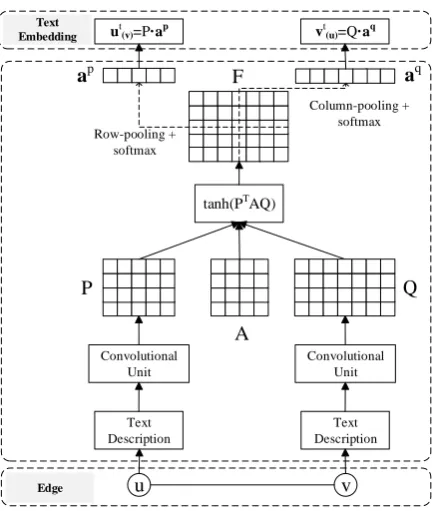
In Fig. 2, we give an illustration of the gen-erating process of context-aware text embedding. Given an edge eu,v with two corresponding text
sequences Su and Sv, we can get the matrices P ∈ Rd×m andQ ∈ Rd×n through convolution
layer. Here,m andnrepresent the lengths ofSu
andSv respectively. By introducing an attentive
matrixA∈Rd×d, we compute the correlation
ma-trixF∈Rm×nas follows:
F= tanh(PTAQ). (9)
Note that, each elementFi,j inF represents the
pair-wise correlation score between two hidden vectors, i.e.,PiandQj.
After that, we conduct pooling operations along rows and columns ofFto generate the importance
vectors, named as row-pooling and column pool-ing respectively. Accordpool-ing to our experiments, mean-pooling performs better than max-pooling. Thus, we employ mean-pooling operation as fol-lows:
gip=mean(Fi,1, . . . ,Fi,n), giq=mean(F1,i, . . . ,Fm,i).
(10)
The importance vectors of P and Q are
ob-tained as gp = [g1p, . . . , gpm]T and gq =
[g1q, . . . , gnq]T.
Next, we employ softmax function to transform importance vectorsgpandgq to attention vectors ap andaq. For instance, thei-th element ofapis
formalized as follows:
api = exp(g
p i) P
j∈[1,m]exp(g
p j)
. (11)
At last, the context-aware text embeddings ofu
andvare computed as
ut(v)=Pap,
v(tu)=Qaq. (12)
Now, given an edge (u, v), we can obtain the
context-aware embeddings of vertices with their structure embeddings and context-aware text em-beddings asu(v)=us⊕ut
(v)andv(u)=vs⊕v(tu).
4.6 Optimization of CANE
According to Eq. (3) and Eq. (6), CANE aims to maximize several conditional probabilities be-tween u ∈ {us,ut(v)} and v ∈ {vs,vt(u)}. It
is intuitive that optimizing the conditional prob-ability using softmax function is computation-ally expensive. Thus, we employ negative sam-pling (Mikolov et al., 2013b) and transform the objective into the following form:
logσ(uT·v)+
k X
i=1
Ez∼P(v)[logσ(−uT·z)], (13)
wherekis the number of negative samples andσ
represents the sigmoid function. P(v) ∝ dv3/4
denotes the distribution of vertices, wheredvis the
out-degree ofv.
Afterward, we employ Adam (Kingma and Ba,
2015) to optimize the transformed objective. Note that, CANE is exactly capable of zero-shot scenar-ios, by generating text embeddings of new vertices with well-trained CNN.
5 Experiments
To investigate the effectiveness of CANE on mod-eling relationships between vertices, we conduct experiments of link prediction on several real-world datasets. Besides, we also employ vertex classification to verify whether context-aware em-beddings of a vertex can compose a high-quality context-free embedding in return.
5.1 Datasets
Datasets Cora HepTh Zhihu #Vertices 2,277 1,038 10,000 #Edges 5,214 1,990 43,894
[image:5.595.334.497.475.527.2]#Labels 7 − −
Table 1: Statistics of Datasets.
We select three real-world network datasets as follows:
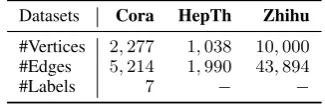
Cora1 is a typical paper citation network
con-structed by (McCallum et al.,2000). After filter-ing out papers without text information, there are
2,277 machine learning papers in this network,
which are divided into7categories.
HepTh2 (High Energy Physics Theory) is
another citation network from arXiv3 released
by (Leskovec et al., 2005). We filter out papers without abstract information and retain1,038
pa-pers at last.
%Training edges 15% 25% 35% 45% 55% 65% 75% 85% 95% MMB 54.7 57.1 59.5 61.9 64.9 67.8 71.1 72.6 75.9 DeepWalk 56.0 63.0 70.2 75.5 80.1 85.2 85.3 87.8 90.3 LINE 55.0 58.6 66.4 73.0 77.6 82.8 85.6 88.4 89.3 node2vec 55.9 62.4 66.1 75.0 78.7 81.6 85.9 87.3 88.2 Naive Combination 72.7 82.0 84.9 87.0 88.7 91.9 92.4 93.9 94.0 TADW 86.6 88.2 90.2 90.8 90.0 93.0 91.0 93.4 92.7 CENE 72.1 86.5 84.6 88.1 89.4 89.2 93.9 95.0 95.9 CANE (text only) 78.0 80.5 83.9 86.3 89.3 91.4 91.8 91.4 93.3 CANE (w/o attention) 85.8 90.5 91.6 93.2 93.9 94.6 95.4 95.1 95.5 CANE 86.8 91.5 92.2 93.9 94.6 94.9 95.6 96.6 97.7
Table 2: AUC values on Cora. (α= 1.0, β= 0.3, γ = 0.3)
Zhihu4 is the largest online Q&A website in
China. Users follow each other and answer ques-tions on this site. We randomly crawl10,000
ac-tive users from Zhihu, and take the descriptions of their concerned topics as text information.
The detailed statistics are listed in Table1.
5.2 Baselines
We employ the following methods as baselines:
Structure-only:
MMB(Airoldi et al.,2008) (Mixed Membership Stochastic Blockmodel) is a conventional graphi-cal model of relational data. It allows each vertex to randomly select a different ”topic” when form-ing an edge.
DeepWalk (Perozzi et al.,2014) performs ran-dom walks over networks and employ Skip-Gram model (Mikolov et al.,2013a) to learn vertex em-beddings.
LINE (Tang et al., 2015) learns vertex embed-dings in large-scale networks using first-order and second-order proximities.
Node2vec (Grover and Leskovec, 2016)
pro-poses a biased random walk algorithm based on DeepWalk to explore neighborhood architecture more efficiently.
Structure and Text:
Naive Combination:We simply concatenate the
best-performed structure-based embeddings with CNN based embeddings to represent the vertices.
TADW (Yang et al.,2015) employs matrix fac-torization to incorporate text features of vertices into network embeddings.
CENE (Sun et al.,2016) leverages both struc-ture and textural information by regarding text content as a special kind of vertices, and optimizes the probabilities of heterogeneous links.
4https://www.zhihu.com/
5.3 Evaluation Metrics and Experiment Settings
For link prediction, we adopt a standard evaluation metric AUC (Hanley and McNeil, 1982), which represents the probability that vertices in a random unobserved link are more similar than those in a random nonexistent link.
For vertex classification, we employ L2-regularized logistic regression (L2R-LR) (Fan et al., 2008) to train classifiers, and evaluate the classification accuracies of various methods.
To be fair, we set the embedding dimension to
200for all methods. In LINE, we set the number
of negative samples to5; we learn the100
dimen-sional first-order and second-order embeddings re-spectively, and concatenate them to form the200
dimensional embeddings. In node2vec, we em-ploy grid search and select the best-performed hyper-parameters for training. We also apply grid search to set the hyper-parametersα, β andγ in
CANE. Besides, we set the number of negative samples k to 1 in CANE to speed up the
train-ing process. To demonstrate the effectiveness of considering attention mechanism and two types of objectives in Eqs. (3) and (6), we design three versions of CANE for evaluation, i.e., CANE with text only, CANE without attention and CANE.
5.4 Link Prediction
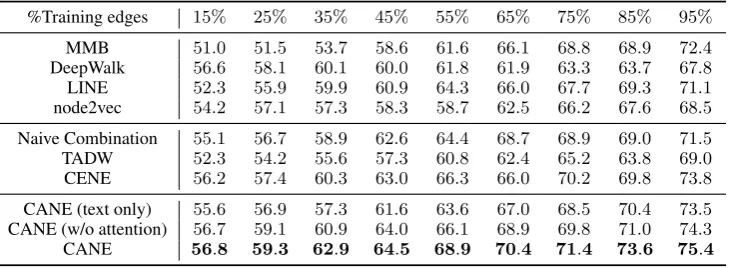
As shown in Table2, Table3and Table4, we eval-uate the AUC values while removing different ra-tios of edges on Cora, HepTh and Zhihu respec-tively. Note that, when we only keep 5% edges
%Training edges 15% 25% 35% 45% 55% 65% 75% 85% 95% MMB 54.6 57.9 57.3 61.6 66.2 68.4 73.6 76.0 80.3 DeepWalk 55.2 66.0 70.0 75.7 81.3 83.3 87.6 88.9 88.0 LINE 53.7 60.4 66.5 73.9 78.5 83.8 87.5 87.7 87.6 node2vec 57.1 63.6 69.9 76.2 84.3 87.3 88.4 89.2 89.2 Naive Combination 78.7 82.1 84.7 88.7 88.7 91.8 92.1 92.0 92.7 TADW 87.0 89.5 91.8 90.8 91.1 92.6 93.5 91.9 91.7 CENE 86.2 84.6 89.8 91.2 92.3 91.8 93.2 92.9 93.2 CANE (text only) 83.8 85.2 87.3 88.9 91.1 91.2 91.8 93.1 93.5 CANE (w/o attention) 84.5 89.3 89.2 91.6 91.1 91.8 92.3 92.5 93.6 CANE 90.0 91.2 92.0 93.0 94.2 94.6 95.4 95.7 96.3
Table 3: AUC values on HepTh. (α= 0.7, β= 0.2, γ= 0.2)
%Training edges 15% 25% 35% 45% 55% 65% 75% 85% 95%
MMB 51.0 51.5 53.7 58.6 61.6 66.1 68.8 68.9 72.4 DeepWalk 56.6 58.1 60.1 60.0 61.8 61.9 63.3 63.7 67.8 LINE 52.3 55.9 59.9 60.9 64.3 66.0 67.7 69.3 71.1 node2vec 54.2 57.1 57.3 58.3 58.7 62.5 66.2 67.6 68.5 Naive Combination 55.1 56.7 58.9 62.6 64.4 68.7 68.9 69.0 71.5 TADW 52.3 54.2 55.6 57.3 60.8 62.4 65.2 63.8 69.0 CENE 56.2 57.4 60.3 63.0 66.3 66.0 70.2 69.8 73.8 CANE (text only) 55.6 56.9 57.3 61.6 63.6 67.0 68.5 70.4 73.5 CANE (w/o attention) 56.7 59.1 60.9 64.0 66.1 68.9 69.8 71.0 74.3 CANE 56.8 59.3 62.9 64.5 68.9 70.4 71.4 73.6 75.4
Table 4: AUC values on Zhihu. (α= 1.0, β= 0.3, γ= 0.3)
(1) Our proposed CANE consistently achieves significant improvement comparing to all the base-lines on all different datasets and different train-ing ratios. It indicates the effectiveness of CANE when applied to link prediction task, and verifies that CANE has the capability of modeling rela-tionships between vertices precisely.
(2) What calls for special attention is that, both CENE and TADW exhibit unstable performance under various training ratios. Specifically, CENE performs poorly under small training ratios, be-cause it reserves much more parameters (e.g., convolution kernels and word embeddings) than TADW, which need more data for training. Differ-ent from CENE, TADW performs much better un-der small training ratios, because DeepWalk based methods can explore the sparse network struc-ture well through random walks even with lim-ited edges. However, it achieves poor performance under large ones, as its simplicity and the limita-tion of bag-of-words assumplimita-tion. On the contrary, CANE has a stable performance in various situa-tions. It demonstrates the flexibility and robust-ness of CANE.
(3) By introducing attention mechanism, the learnt context-aware embeddings obtain
consider-able improvements than the ones without atten-tion. It verifies our assumption that a specific ver-tex should play different roles when interacting with other vertices, and thus benefits the relevant link prediction task.
To summarize, all the above observations demonstrate that CANE can learn high-quality context-aware embeddings, which are conducive to estimating the relationship between vertices precisely. Moreover, the experimental results on link prediction task state the effectiveness and ro-bustness of CANE.
5.5 Vertex Classification
In CANE, we obtain various embeddings of a ver-tex according to the verver-tex it connects to. It’s intu-itive that the obtained context-aware embeddings are naturally applicable to link prediction task. However, network analysis tasks, such as vertex classification and clustering, require a global em-bedding, rather than several context-aware embed-dings for each vertex.
context-aware embeddings as follows:
u= 1
N
X
(u,v)|(v,u)∈E u(v),
where N indicates the number of context-aware
embeddings ofu.
50 60 70 80 90 100
MMB DeepWalk
LINE node2vec
NC
TADW CENE
CANE(text only) CANE(w/0 attention)
CANE
Accuracy (
×
[image:8.595.74.293.157.282.2]100)
Figure 3: Vertex classification results on Cora.
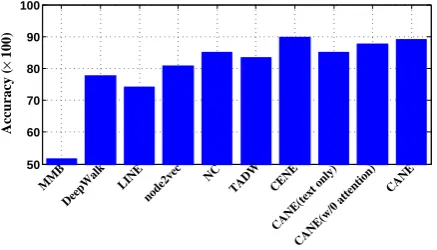
With the generated global embeddings, we con-duct 2-fold cross-validation and report the aver-age accuracy of vertex classification on Cora. As shown in Fig.3, we observe that:
(1) CANE achieves comparable performance with state-of-the-art model CENE. It states that the learnt context-aware embeddings can transform into high-quality context-free embeddings through simple average operation, which can be further employed to other network analysis tasks.
(2) With the introduction of mutual attention mechanism, CANE has an encouraging improve-ment than the one without attention, which is in accordance with the results of link prediction. It denotes that CANE is flexible to various network analysis tasks.
5.6 Case Study
To demonstrate the significance ofmutual atten-tionon selecting meaningful features from text in-formation, we visualize the heat maps of two ver-tex pairs in Fig.4. Note that, every word in this figure accompanies with various background col-ors. The stronger the background color is, the larger the weight of this word is. The weight of each word is calculated according to the attention weights as follows.
For each vertex pair, we can get the attention weight of each convolution window according to Eq. (11). To obtain the weights of words, we as-sign the attention weight to each word in this win-dow, and add the attention weights of a word to-gether as its final weight.
Figure 4: Visualizations of mutual attention.
The proposed attention mechanism makes the relations between vertices explicit and inter-pretable. We select three connected vertices in Cora for example, denoted as A, B and C. From Fig. 4, we observe that, though there exists cita-tion relacita-tions with identical paper A, paper B and C concern about different parts of A. The atten-tion weights over A in edge #1 are assigned to “reinforcement learning”. On the contrary, the weights in edge #2 are assigned to “machine learn-ing’”, “supervised learning algorithms” and “com-plex stochastic models”. Moreover, all these key elements in A can find corresponding words in B and C. It’s intuitive that these key elements give an exact explanation of the citation relations. The discovered significant correlations between vertex pairs reflect the effectiveness of mutual attention mechanism, as well as the capability of CANE for modeling relations precisely.
6 Conclusion and Future Work
time, which aims to learn various context-aware embeddings for a vertex according to the neigh-bors it interacts with. Specifically, we implement CANE on text-based information networks with proposed mutual attention mechanism, and con-duct experiments on several real-world informa-tion networks. Experimental results on link pre-diction demonstrate that CANE is effective for modeling the relationship between vertices. Be-sides, the learnt context-aware embeddings can compose high-quality context-free embeddings.
We will explore the following directions in fu-ture:
(1) We have investigated the effectiveness of CANE on text-based information networks. In fu-ture, we will strive to implement CANE on a wider variety of information networks with multi-modal data, such as labels, images and so on.
(2) CANE encodes latent relations between ver-tices into their context-aware embeddings. Fur-thermore, there usually exist explicit relations in social networks (e.g., families, friends and col-leagues relations between social network users), which are expected to be critical to NE. Thus, we want to explore how to incorporate and predict these explicit relations between vertices in NE. Acknowledgements
This work is supported by the 973 Program (No. 2014CB340501), the National Natural Science Foundation of China (NSFC No. 61572273, 61532010, 61661146007), and Tsinghua Uni-versity Initiative Scientific Research Program (20151080406).
References
Edoardo M Airoldi, David M Blei, Stephen E Fienberg, and Eric P Xing. 2008. Mixed membership stochas-tic blockmodels. JMLR9(Sep):1981–2014.
Phil Blunsom, Edward Grefenstette, and Nal Kalch-brenner. 2014. A convolutional neural network for modelling sentences. InProceedings of ACL. Shaosheng Cao, Wei Lu, and Qiongkai Xu. 2015.
Grarep: Learning graph representations with global structural information. In Proceedings of CIKM. pages 891–900.
Jifan Chen, Qi Zhang, and Xuanjing Huang. 2016. Incorporate group information to enhance network embedding. InProceedings of CIKM.
Kyunghyun Cho, Bart Van Merri¨enboer, Caglar Gul-cehre, Dzmitry Bahdanau, Fethi Bougares, Holger
Schwenk, and Yoshua Bengio. 2014. Learning phrase representations using rnn encoder-decoder for statistical machine translation. In Proceedings
of EMNLP.
Rong-En Fan, Kai-Wei Chang, Cho-Jui Hsieh, Xiang-Rui Wang, and Chih-Jen Lin. 2008. Liblinear: A library for large linear classification.JMLR9:1871– 1874.
Aditya Grover and Jure Leskovec. 2016. Node2vec: Scalable feature learning for networks. In
Proceed-ings of KDD.
James A Hanley and Barbara J McNeil. 1982. The meaning and use of the area under a receiver operat-ing characteristic (roc) curve.Radiology143(1):29– 36.
Baotian Hu, Zhengdong Lu, Hang Li, and Qingcai Chen. 2014. Convolutional neural network architec-tures for matching natural language sentences. In
Proceedings of NIPS. pages 2042–2050.
Rie Johnson and Tong Zhang. 2014. Effective use of word order for text categorization with convolutional neural networks. arXiv preprint
arXiv:1412.1058.
Yoon Kim. 2014. Convolutional neural networks for sentence classification.
Diederik Kingma and Jimmy Ba. 2015. Adam: A method for stochastic optimization. InProceedings
of ICLR.
Ryan Kiros, Yukun Zhu, Ruslan R Salakhutdinov, Richard Zemel, Raquel Urtasun, Antonio Torralba, and Sanja Fidler. 2015. Skip-thought vectors. In
Proceedings of NIPS. pages 3294–3302.
Jure Leskovec, Jon Kleinberg, and Christos Faloutsos. 2005. Graphs over time: densification laws, shrink-ing diameters and possible explanations. In
Pro-ceedings of KDD. pages 177–187.
Andrew McCallum, Kamal Nigam, Jason Rennie, and Kristie Seymore. 2000. Automating the construc-tion of internet portals with machine learning.
In-formation Retrieval Journal3:127–163.
Tomas Mikolov, Kai Chen, Greg Corrado, and Jeffrey Dean. 2013a. Efficient estimation of word represen-tations in vector space. InProceedings of ICIR. Tomas Mikolov, Ilya Sutskever, Kai Chen, Greg S
Cor-rado, and Jeff Dean. 2013b. Distributed representa-tions of words and phrases and their compositional-ity. InProceedings of NIPS. pages 3111–3119.
Bryan Perozzi, Rami Al-Rfou, and Steven Skiena. 2014. Deepwalk: Online learning of social repre-sentations. InProceedings of KDD. pages 701–710. Mike Schuster and Kuldip K Paliwal. 1997. Bidirec-tional recurrent neural networks. IEEE Transactions
Xiaofei Sun, Jiang Guo, Xiao Ding, and Ting Liu. 2016. A general framework for content-enhanced network representation learning. arXiv preprint
arXiv:1610.02906.
Kai Sheng Tai, Richard Socher, and Christopher D Manning. 2015. Improved semantic representations from tree-structured long short-term memory net-works. InProceedings of ACL.
Jian Tang, Meng Qu, Mingzhe Wang, Ming Zhang, Jun Yan, and Qiaozhu Mei. 2015. Line: Large-scale in-formation network embedding. In Proceedings of WWW. pages 1067–1077.
Lei Tang and Huan Liu. 2009. Relational learning via latent social dimensions. In Proceedings of
SIGKDD. pages 817–826.
Cunchao Tu, Hao Wang, Xiangkai Zeng, Zhiyuan Liu, and Maosong Sun. 2016a. Community-enhanced network representation learning for network
analy-sis.arXiv preprint arXiv:1611.06645.
Cunchao Tu, Weicheng Zhang, Zhiyuan Liu, and Maosong Sun. 2016b. Max-margin deepwalk: Dis-criminative learning of network representation. In
Proceedings of IJCAI.
Daixin Wang, Peng Cui, and Wenwu Zhu. 2016. Struc-tural deep network embedding. In Proceedings of
KDD.
Cheng Yang, Zhiyuan Liu, Deli Zhao, Maosong Sun, and Edward Y Chang. 2015. Network representa-tion learning with rich text informarepresenta-tion. In