666 JOURNAL OF RANGE MANAGEMENT 53(6),November 2000
Abstract
A 3-year experiment to evaluate tracked vehicle effects on veg- etation and soil characteristics was established on the Gilbert C.
Grafton South State Military Reservation (CGS) in North Dakota. Study objectives were to evaluate the effects of 3 tracked vehicle use intensity treatments on plant species cover and fre- quency, and soil compaction. The 3 treatments evaluated include heavy use (74 passes), moderate use (37 passes) and no use. The moderate use treatment represents a typical use of 1 battalion unit at CGS with the heavy use treatment classified as 2 battalion units. This land area comprised a 50 by 150 meter block subdi- vided into three, 50 by 50 meter blocks. Each 50 by 50 meter block was subdivided into three, 16.7 by 50 meter blocks with each block treated with 1 of the 3 treatments. Soil bulk density increased (P < 0.05) on the moderate and heavy use treatments in the 0 to 15, 30 to 45, and 45 to 60 cm soil depths. Kentucky blue- grass (Poa pratensis L.) cover (P < 0.05) decreased in 1996 on both the moderate and heavy use treatments but was not (P >
0.05) different among all treatments in 1997. The tracked vehicle use on the heavy and moderate treatments did not change species composition or litter amounts after 2 years; however, bulk densi- ty and bare ground increased on both treatments in 1996 and 1997.
Key Words: Soil dry bulk density, plant community, personnel carrier, Poa pratensis, Bromus inermis
The acreage of army training lands is limited; therefore, care and maintenance of these lands is required to keep them viable for future training. The army’s requirements for training lands have likewise increased, stressing the existing land bases. It is in the army’s best interest to maintain the soils and vegetation on current training lands to sustain a realistic training environment.
Without proper management, lands that receive intense use become devoid of vegetation and do not provide sufficient cover for troops and vehicles.
The National Environmental Policy Act of 1969 (NEPA) and Army Regulation 200–2 require that the Army minimize any sig- nificant short-term and long-term environmental impacts on nat- ural resources (Goran et al. 1983). The army is responsible for maintaining ecological diversity and viability of the lands in its care. Furthermore, rare and endangered species, and the habitat
necessary to maintain those species on army land are protected by the Threatened and Endangered Species Act (U.S. Dept. of Interior 1973).
The study objective was to evaluate the ecological effects of tracked vehicle use on plant species cover and frequency, and soil compaction. The hypothesis was that tracked vehicle use on a Kentucky bluegrass-smooth bromegrass (Poa pratensis-Bromus i n e r m i s) plant community in a transitional grassland would adversely affect soil dry bulk density and plant species composi- tion. The results from this study will allow land managers and installation officials to understand the impacts that tracked vehi- cles have on the land base and adjust their training appropriately.
Materials and Methods
An experiment to evaluate the effects of an M113 full tracked personnel carrier on the vegetation plant community and soil characteristics was established in August 1995 in east-central North Dakota. Three tracked vehicle intensity treatments were evaluated including heavy use (74 passes), moderate use (37 passes), and no use (0 passes).
J. Range Manage.
53:666–670 November 2000
Tracked vehicle effects on vegetation and soil characteristics
CHAD W. PROSSER, KEVIN K. SEDIVEC, AND WILLIAM T. BARKER
Authors are ecologist, USDA, Agricultural Research Service, Northern Plains Agricultural Research Laboratory, Sidney, Mont. 59270, extension rangeland specialist and professor, Animal and Range Sciences Department, North Dakota State University, Fargo, N.D. 58105.
The authors wish to thank Mr. Michael Sweeney for assistance in the soil col- lection and identification. The authors would also like to thank Dr. J.L. Richardson for review of manuscript and providing valuable input in the interpretation of the soil analysis. This research was supported by North Dakota Army National Guard under the supervision of Neal Jacobson.
Manuscript accepted 18 Feb. 2000.
Resumen
Se estableció un experimento de 3 años en la Reservación Militar Estatal Gilbert C. Grafon (CGS) de North Dakota para evaluar los efectos del paso de veháculos militares en la veg- etación y suelo. Los objetivos del estudio fueron evaluar los efec- tos de 3 intensidades de paso de veháculos militares en la cober- tura y frecuencia de especies vegetales y la compactación del suelo. Los 3 tratamientos evaluados fueron: uso alto (74 pasos), uso moderado (37 pasos) y sin uso. El uso moderado representa el uso tápico de una unidad de batallón en el CGS y el tratamien- to de uso alto representa el paso de dos unidades de batallón. El áea experimental fue un bloque de 50 x 150 m dividido en tres bloques, cada bloque de 50 x 50 m se subdividido en 3 bloques de 16.7 x 50 m y en cada uno de estos bloque se aplico uno de los tratamientos. La densidad aparente del suelo a las profundi- dades de 0–15, 30–45 y 45–60 cm aumento (P < 0.05) en los tratamientos de uso moderado y alto. En 1996, la cobertura del zacate “Kentucky bluegrass” (Poa pratensis L.) disminuyó (P <
0 .05) en los tratamientos de uso moderado y alto, pero en 1997 la cobertura de esta especie no difirió entre tratamientos (P >
0.05). Después de 2 años, el uso moderado y alto de veháculos militares no cambio la composición de especies ni la cantidad de mantillo; sin embargo, la densidad aparente y el suelo desnudo aumentó en ambos tratamientos en 1996 y 1997.
The study site was on the Gilbert C.
Grafton South State Military Reservation (CGS) near McHenry, N.D. (47º40'N, 98º40'W). This area is located in an area known as the Transition Grasslands (Küchler 1964, Whitman and Wali 1975, Barker and Whitman 1989). The study site occupied concave footslopes which receive additional runoff from upper slopes. This was evident by the buried soil horizons in the soil profiles. The soil series included Embden, Hecla, and Maddock with soils characterized as
“coarse loamy” or “coarse silty”, mixed Pachic Udic Haploborolls. The vegetative plant community was classified as a Kentucky bluegrass/smooth bromegrass (Poa pratensis/Bromus inermis) vegetative type dominated by Kentucky bluegrass (Poa pratensis L.) and smooth bromegrass (Bromus inermis Leyss. subsp. i n e r m i s) . Other major plants associated with the study site included western snowberry (Symphoricarpos occidentalis H o o k . ) , yarrow (Achillea millefolium L.), white sage (Artemisia ludoviciana Nutt.), yellow sweetclover ( Melilotus officinalis L . ) , heath aster (Aster ericoides L.), and soft goldenrod (Solidago mollis Bartl.).
Average annual precipitation (29-year average) at the McHenry weather station was 47.3 cm per year (NOAA 1995–1997). Annual precipitation was 63.2 cm, 47.5 cm, and 29.4 cm for 1995,
1996, and 1997, respectively. The 29-year average precipitation was 8.7 cm in June, 6.7 cm in July, and 6.9 cm in August.
Precipitation was below the 29-year aver- age for June and above the average for July for all 3 years. Precipitation was below the 29-year average for August with 5.5 cm, 3.1 cm, and 3.5 cm for 1995, 1996, and 1997, respectively. Data were collected in August and September for all 3 years of the study.
Tracked Vehicle Experiment
A M113 personnel carrier tracked vehi- cle was used in the experiment. This tracked vehicle has a flexible track driven by sprockets at the front of the vehicle.
Consequently, the top and bottom rear portions of the track are under tension while the lower forward sections are rela- tively slack, thus, enabling the vehicle to traverse rough terrain. Rubber bushings provide torsional flexibility of the track segments which are 38 cm wide with a central rubber pad 15 cm wide. The M113 is equipped with 5 bogie wheels that are 71 cm on center, 1 drive socket and 1 idle sprocket. The length and width of the track are 305 and 38 cm, respectively. The gross full load weight of an M113 is 11,353 kg, exerting a ground pressure of 54.9 kPa (U.S. Dept. of Army 1990).
The one time application of a M113 per- sonnel carrier was conducted on 2 differ-
ent use treatments on 7 August 1996. The moderate use treatment (37 passes) was derived from the typical use of 1 battalion unit at this military installation. The heavy use treatment (74 passes) was essentially doubling the rate of 1 battalion unit to see if any adverse effects would be observed.
The control was considered a non use treatment (0 passes). A 50 by 150 meter tract of rangeland was selected by con- ducting a reconnaissance of the area in the summer of 1995 to select a typical land- scape utilized by a battalion with tracked vehicles. This 50 by 150 meter tract of land was subdivided into three, 50 by 50 meter blocks of similar soil and vegetation to achieve 3 replicates. Each 50 by 50 meter block was subdivided into three, 16.7 by 50 meter plots with each plot treated with 1 of the 3 treatments using a randomized complete block design repli- cated 3 times.
Six soil cores were extracted from each treatment plot to determine soil dry bulk density as defined by Blake and Hartge (1986). Soil cores were collected from the center of the tracked vehicle lanes using a hydraulic coring machine (Giddings). A 7.5 cm metal core cylinder was fitted with a removable plastic sleeve which protected the sample during transport. The soil cores were taken at ground surface, minimizing compression of soil columns from within 3 dm (J. Richardson personal communica- tion). Although this technique assured M113 personnel carrier.
668 JOURNAL OF RANGE MANAGEMENT 53(6),November 2000 minimal compression of samples at 3 dm,
it is uncertain on the effects of the sub- strate below 3 dm. However, if a compres- sion effect did occur it was equally repre- sented among treatments. (J. Richardson, personal communication). The soil profile at each sampling site was classified and described. Soil cores were taken prior to and after application of the tracked vehicle use treatments in August 1996 allowing for comparisons of soil dry bulk density before and after each treatment. Soil water content was less than field capacity with soils characterized as instantly drained due to particle to particle contact (Wright and Sweeney 1977). Soils had water stable aggregates with excellent macroporosity in terms of soil structure due to high sands and bulk density levels 1 to 1.3 g cm- 3. These were loosely compacted granular soils with high infiltration rates. Seasonal air temperatures were slightly below the long-term averages during this period. Soil cores were collected in August 1997 using the same procedures following a 1-year freeze-thaw cycle.
A 50 m transect was placed on 1 of the 2 tracked vehicle lanes by a randomly selected process for each treatment.
Presence/absence of graminoid species were collected every 2.5 m along the tran- sect using a 0.1 m2 frame, while forb and shrub density was determined using a 0.25 m2frame. The 10-pin point frame was used to determine basal and litter cover as modified by Smith (1959) and described by Mueller-Dombois and Ellenberg (1974). Plant species data were collected in September 1996, four weeks after treat- ment to allow for plant recovery and again in August 1997 to determine effects 1 year after treatment to monitor compositional changes.
The study results are restricted to straight tracks. A single pivot turn has an immediate and obvious impact on vegeta- tion by exposing bare ground, destroying native plants, and allowing primary suc- cession plants to establish. The soils all had less than 5 percent clay content and were “coarse loamy” or “coarse silty”
(Table 1). Although 3 soil series com- prised the study site, no observed differ- ences in soil composition were found between series. Attempts to select for only 1 series were thwarted due to the natural changes in soil profile components, short distances, and ablation till landscapes (M.
Sweeney, personal communication).
Statistical Analysis
A one-way analysis of variance (ANOVA) was used to test for differences in soil dry bulk density among treatments (SPSS 1994). This procedure was used to determine differences using the graminoid presence/absence data, 10-pin point frame data, and forb and shrub composition data.
Where significant differences were detect- ed using a one-way ANOVA, a multiple comparisons test using the Tukey’s proce- dure was carried out (Steel and Torrie 1980) with mean differences considered significant at the P < 0.05 level.
Results and Discussion
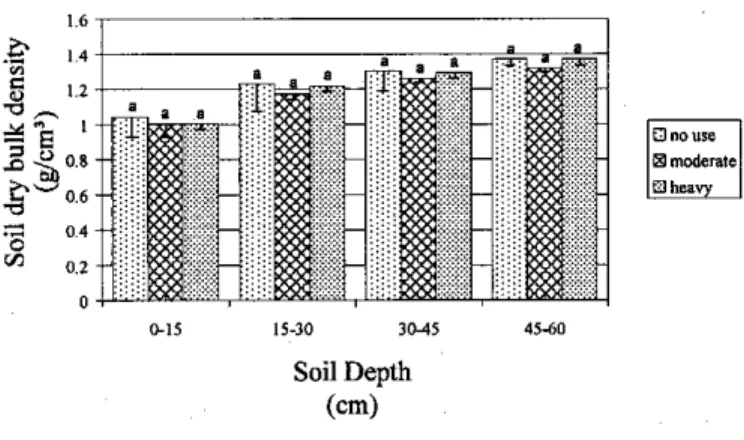
Soil dry bulk densities for each tracked vehicle use treatment (control, moderate,
heavy) were not different prior to treat- ment application in 1996, thus eliminating any site biases between treatments (Fig.
1). Soil dry bulk density did not differ between pre- and post- treatment on the moderate or heavy use treatments in 1996 (Figs. 2 and 3, respectively). However, the moderate and heavy use treatments had a greater soil bulk density at the 0 to 15, 30 to 45, and 45 to 60 cm depths when com- pared to the control following 1 year of treatment (Figs. 2 and 3). Soil dry bulk density increased with depth and tracked vehicle use, independent of number of vehicle passes when compared to the con- trol. The exception was at the 15 to 30 cm depth where no differences were noted in either the moderate or heavy use treatment (Figs. 2 and 3). Similarly, Braunack (1986) and Wolf and Hadas (1984) found most change in soil dry bulk density occurred after pass, with subsequent pass- es having less effect. Braunack (1986) noted the area of disturbance, both in terms of depth and width of ruts, was greater with an increasing number of vehi- cle passes.
Subsoil compaction under heavy axle loads of military vehicles has been report- ed at depths > 50 cm (Gliemeroth 1948, Ericksson 1976, Voorhees et al. 1986).
Fig. 1. Soil dry bulk density (g/cm3) prior to each tracked-vehicle use treatment in 1996.
Within soil depths, treatments with the same letter are not significantly different (P > 0.05).
Table 1. Soil particle size analysis for personnel carrier use treatments.
Treatment Depth Sand Silt Clay
(cm) (%) (%) (%)
Control 0–15 63.7 33.4 2.9
15–30 61.2 35.3 3.5 Moderate 0–15 53.8 42.1 4.1 15–30 51.3 44.8 3.9
Heavy 0–15 59.7 37.9 2.4
15–30 57.5 39.7 2.8
Fig. 2. Soil dry bulk density (g/cm3) on the moderate use treatment in 1996 and 1997. Within soil depths, time periods with the same letter are not significantly different (P > 0.05).
Our data would support their findings with subsoil compaction occurring from 0 to 15 cm and 30 to 60 cm under moderate and heavy use tracked vehicle treatments.
However, no subsoil compaction occurred in the 15–30 cm layer differing from other studies previously reported. These studies reported soil compaction with high clay (>30%) content throughout the profile.
Our study site had < 5% clay content with no over-consolidation or low Ks a t due to high silt and sand content (Table 1). Soils with high sand and silt content do not express similar subsoil compaction char- acteristics as those soils having high clay content based on this study.
Litter cover on the control was 83 and 86 percent in 1996 and 1997, respectively (Fig. 4). Plant cover was 15 and 13% in 1996 and 1997, respectively. The moder- ate use treatment did not show any differ- ences in percent litter composition in 1996 or 1997, or between years compared with the control (Fig. 4). Litter cover was reduced on the heavy use treatment com- pared to the control in 1997. Since the tracked vehicle in this experiment traveled straight lines (which is typical at CGS), litter present at the time of the experiment was not affected to any significant degree during year of application on the moderate use treatment. However, litter cover was reduced on the heavy use treatment 1 year following application.
Effect of tracked vehicle use on bare ground was different from the effects on litter. Total bare ground on the control was 2 and 1% in 1996 and 1997, respectively.
Total bare ground increased to 19 and 18 percent on the moderate and heavy use treatments, respectively, following appli- cation in 1996. Bare ground remained greater on the heavy use treatment com- pared to the control, even 1 year following treatment, increasing to 25 percent on the heavy use treatment in 1997 (Fig. 5).
Wilson (1988) found that Leopard tank use during May and June produced high frequencies of bare ground in native prairie, therefore encouraging invasion of introduced species at rates much higher than if driving occurred after 1 July.
Wilson (1988) suggested that excluding
tank traffic during May and June would decrease damage to the native prairie, reduce opportunities for non-native plant species establishment, and increase the capacity of the vegetation to tolerate traf- fic at other times of the year. Based on Wilson’s (1988) conclusion, this increase in bare ground could lead to an increase in non-native dicot plant species but should be minimal since the treatments occurred in August.
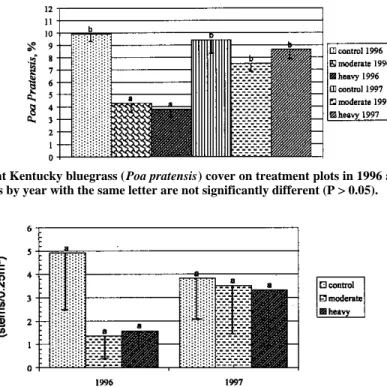
Kentucky bluegrass, classified as an alien species that is naturalized in the United States (Great Plains Flora Association 1986), decreased in basal cover on both tracked vehicle treatments following application in 1996. However, Kentucky bluegrass increased in basal cover by 74 and 126% on the moderate and heavy use treatments, respectively, and was no longer different from the con- trol by 1997 (Fig. 6). Tracked vehicle use, independent of intensity, had a short-term negative impact on Kentucky bluegrass basal cover; however, recovered to pre- treatment levels after 1 year of application.
Unlike Kentucky bluegrass, smooth bromegrass basal cover did not change among treatments or between years in this trial (data not shown). It appears smooth bromegrass recovered the high impact of tracked vehicle usage in the short term better than Kentucky bluegrass. However, a f t e r 1 y e a r o f p o s t t r e a t m e n t , b o t h graminoid species tolerated both levels of tracked vehicle use.
Forb and shrub species showed no nega- tive effects from tracked vehicle use at either intensity level. Total density (stems 0.25m2) of forb and shrub species did not change on either moderate or heavy use treatments between post-treatment levels and the control in 1996 or after 1 year of treatment application (Fig. 7). Since this site, as in most upland rangeland sites in the northern Great Plains Region, was graminoid dominant and forbs and shrubs a minor component (< 5 stems per 0.25 m2 and a confidence interval of 4.9 +\–5.2 ) of Fig. 3. Soil dry bulk density (g/cm3) on the heavy use treatment in 1996 and 1997. Within soil
depths, time periods with the same letter are not significantly different (P > 0.05).
Fig. 4. Percent litter on treatment plots in 1996 and 1997. Treatments by year with the same letter are not significantly different (P > 0.05).
Fig. 5. Percent bare ground on treatment plots in 1996 and 1997. Treatments by year with the same letter are not significantly different (P > 0.05).
670 JOURNAL OF RANGE MANAGEMENT 53(6),November 2000 the plant community, determining effects
on these plant types was non-conclusive.
Conclusion
Soil compaction must be alleviated if compaction has reached the point that root and plant growth and yields are impaired.
Historically, soil freezing and thawing were assumed to eliminate compacted sur- face soil layers in most of the U.S. Corn Belt (Gill 1971) and that no special man- agement was required. However, Voorhees et al. (1986) showed that subsoil com- paction can persist for many years after the initial loading, in spite of annual freezing to the 90 cm depth. This study showed subsoil compaction persisted in the follow- ing year of tracked vehicle application, agreeing with Voorhees et al. (1986). One of the most direct methods for avoiding compaction is the concept of controlled traffic (Taylor 1983, Gerik et al. 1987). A controlled-traffic system restricts wheel traffic to specific lanes or inter rows. As a result, more of the soil area remains uncompacted than when a random or uncontrolled traffic pattern is used.
Our results indicated that 1 year of tracked vehicle use was not detrimental to the vegetation at CGS after 2 years of data collection. Although Kentucky bluegrass cover was reduced in year of tracked vehi- cle application, it showed no long-term
impacts in 1 year following treatment.
Smooth bromegrass and dicot plants were not affected by moderate or heavy lane use of tracked vehicles in this study. There was no effect on litter cover and bare ground using the moderate tracked vehicle use treatment. However, litter cover was reduced and bare ground increased in the subsequent year following the heavy use tracked vehicle treatment. Soil dry bulk densities were significantly increased at the 0 to 15, 30 to 45, and 45 to 60 cm depths even after a freeze-thaw cycle had occurred, but appeared not to affect the vegetation.
Literature Cited
Barker, W.T. and W.C. Whitman. 1989.
Vegetation of the northern Great Plains. N.
Dak. Agr. Exp. Sta. Res. Rep. 111 pp. Fargo, N.D.
Blake, G.R. and K.H. Hartge. 1986. p p . 363–375. Bulk Density. I n: Methods of soil analysis, Part 1. Physical and mineralogical methods. Agron.Monograph No. 9 (2n d Edition), Amer. Soc. of Agron.- Soil Sci.
Soc. of America, Madison, Wisc.
Braunack, M.V. 1986. The residual effects of tracked vehicles on soil surface properties. J.
Terramechan. 23:37–50.
Ericksson, J. 1976. Influence of extremely heavy traffic on clay soil. Grundforbattring.
27:33–51.
Gerik, T.J., J.E. Morrison, Jr., and F.W.
Chichester. 1987. Effects of controlled-traf- fic on soil physical properties and crop root- ing. J. Agron. 79:434–438.
Gill, W.R. 1971. Economic assessment of soil compaction. I n: K.K. Barnes et al. (ed.) Compaction of agricultural soils. Amer. Soc.
Agr. Eng. Monog. ASAE, St. Joseph, Mich.
Gliemeroth, G. 1948. S e l b s t v e r s c h u l d e t e strukturstorungen des bodens unter besonder.
Berucksichtigung des schlepperraddrucks.
Ber. Landtech. II:19–54.
Goran, W. D., L.L. Radke, and W.D.
Severinghaus. 1983. An overview of the ecological effects of tracked vehicles on major U.S. Army installations. U.S. Army Construction Engineering Res. Lab. Tech.
Rept. N-142. Champaign: U.S. Army CERL.
Great Plains Flora Association. 1986. F l o r a of the Great Plains. Univ. Press of Kansas.
1392 pp.
Küchler, A.W. 1964. Potential natural vegeta- tion of the conterminous United States.
Amer. Geog. Soc. Spec. Pub. 36. 116 pp.
Mueller-Dombois, D. and H. Ellenberg.
1974. Aims and methods of vegetation ecolo- gy. John Wiley and Sons, Inc. New York.
NOAA (National Oceanic and Atmospheric Administration). 1995–1997. C l i m a t o l o g i - cal data, North Dakota: Monthly data and annual summaries for 1995–1997. National Climatic Center, Ashville, N.C.
SPSS. 1994. Statistical Procedures for Social Science. Marketing Department. SPSS Inc.
Chicago, Ill.
Steel, R.G.D. and J.H. Torrie. 1980.
Principles and procedures of statistics. (2nd Edition), McGraw-Hill, New York Company. New York. N.Y.
Smith, J.G. 1959. Additional modifications of the point frame. J. Range Manage.
4:204–205.
Taylor, J.H. 1983. Benefits of permanent traf- fic lanes in a controlled traffic crop produc- tion system. Soil Tillage Res. 3:385–395.
U.S. Department of the Army. 1990.
Operators manual for M113A2. USA-CERL Tech. Manual 9–2350–261–10. U.S. Army Tank-Automotive Command, Warren, Mich.
U.S. Department of Interior, Fish and Wildlife Service. 1973. Threatened wildlife of the United States. Resource Publication 114. 289 pp.
Voorhees, W.B., WW. Nelson, and G.W.
Randall. 1986. Extent and persistence of subsoil compaction caused by heavy axle loads. Soil Sci. Soc. Amer. J. 50:428–433.
Whitman, W.C. and W.K. Wali. 1975.
Prairie: A multiple view. Univ. North Dakota Press, Grand Forks, N.D. p. 53–73.
Wilson, S.D. 1988. The effects of military tank traffic on prairie: A management model.
Environ. Manage. 12:397–403.
Wright, R.M . and M. Sweeney. 1977. S o i l Survey of Eddy County. USDA Soil Cons.
Serv., North Dakota Office, Bismarck, N.D.
Wolf, D. and A. Hadas. 1984. Soil compaction effects on cotton emergence. Trans. ASAE 27(3).
Fig. 7. Density (stems/0.25 m2) of forb and shrub species on treatment plots in 1996 and 1997.
Treatments by year with the same letter are not significantly different (P > 0.05).
Fig. 6. Percent Kentucky bluegrass ( Poa pratensis) cover on treatment plots in 1996 and 1997.
Treatments by year with the same letter are not significantly different (P > 0.05).