261
Clinical Concept Extraction for Document-Level Coding
Sarah Wiegreffe1, Edward Choi1∗, Sherry Yan2, Jimeng Sun1, Jacob Eisenstein1
1Georgia Institute of Technology 2Sutter Health
∗
Current Affiliation: Google Inc
[email protected], [email protected], [email protected], [email protected], [email protected]
Abstract
The text of clinical notes can be a valuable source of patient information and clinical as-sessments. Historically, the primary approach for exploiting clinical notes has been informa-tion extracinforma-tion: linking spans of text to con-cepts in a detailed domain ontology. How-ever, recent work has demonstrated the poten-tial of supervised machine learning to extract document-level codes directly from the raw text of clinical notes. We propose to bridge the gap between the two approaches with two novel syntheses: (1) treating extracted con-cepts as features, which are used to supple-ment or replace the text of the note; (2) treating extracted concepts aslabels, which are used to learn a better representation of the text. Un-fortunately, the resulting concepts do not yield performance gains on the document-level clin-ical coding task. We explore possible explana-tions and future research direcexplana-tions.
1 Introduction
Clinical decision support from raw-text notes taken by clinicians about patients has proven to be a valuable alternative to state-of-the-art models built from structured EHRs. Clinical notes contain valu-able information that the structured part of the EHR does not provide, and do not rely on expen-sive and time-consuming human annotation (Torres et al., 2017;American Academy of Professional Coders, 2019). Impressive advances using deep learning have allowed for modeling on the raw text alone (Mullenbach et al.,2018;Rios and Kavuluru,
2018a;Baumel et al.,2018). However, there exist some shortcomings to these approaches: clinical text is noisy, and often contains heavy amounts of abbreviations and acronyms, a challenge for ma-chine reading (Nguyen and Patrick,2016). Addi-tionally, rare words replaced with "UNK" tokens for better generalization may be crucial for predict-ing rare labels.
Clinical concept extraction tools abstract over the noise inherent in surface representations of clinical text by linking raw text to standardized concepts in clinical ontologies. The Apache clin-ical Text Analysis Knowledge Extraction System (cTAKES,Savova et al.,2010) is the most widely-used such tool, with over 1000 citations. Based on rules and non-neural machine learning methods and engineered for almost a decade, cTAKES provides an easily-obtainable source of human-encoded do-main knowledge, although it cannot leverage deep learning to make document-level predictions.
Our goal in this paper is to maximize the predic-tive power of clinical notes by bridging the gap between information extraction and deep learn-ing models. We address the followlearn-ing research questions: how can we best leverage tools such as cTAKES on clinical text? Can we show the value of these tools in linking unstructured data to struc-tured codes in an existing ontology for downstream prediction?
We explore two novel hybrids of these meth-ods: data augmentation (augmenting text with ex-tracted concepts) and multi-task learning (learning to predict the output of cTAKES). Unfortunately, in neither case does cTAKES improve downstream performance on the document-level clinical cod-ing task. We probe this negative result through an extensive series of ablations, and suggest possible explanations, such as the lack of word variation captured through concept assignment.
2 Related Work
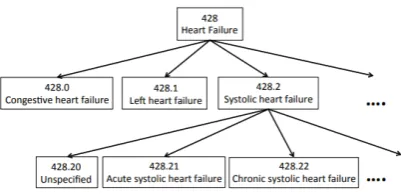
Figure 1: A subtree of the ICD ontology (figure from Singh et al.,2014).
a standardized vocabulary of clinical concepts, each of which is assigned a concept unique iden-tifier (CUI). The Systematized Nomenclature of Medicine- Clinical Terms (SNOMED-CT) ( Don-nelly, 2006) and the International Classification of Diseases (ICD) (National Center for Health Statistics, 1991) build off of the UMLS and pro-vide structure by linking concepts based on their relationships. The SNOMED ontology has over 340,000 active concepts, ranging from fine-grained ("Adenylosuccinate lyase deficiency") to extremely general ("patient"). The ICD ontology is narrower in scope, with around 13,000 diagnosis and pro-cedure codes used for insurance billing. Unlike SNOMED, which has an unconstrained graph struc-ture, ICD9 is organized into a top-down hierarchy of specificity (seeFigure 1).
Clinical Information Extraction Tools There are several tools for extracting structured tion from clinical text. Popular types of informa-tion extracinforma-tion includenamed-entity recognition, identifying words or phrases in the text which align with clinical concepts, andontology mapping, la-belling the identified words and phrases with their respective clinical codes from an existing ontol-ogy.1 Of the tools which perform both of these tasks, the open-source Apache cTAKES is used in over 50% of recent work (Wang et al.,2017), outpacing competitors such as MetaMap (Aronson,
2001) and MedLEE (Friedman,2000).
cTAKES utilizes a rule-based system for per-forming ontology mapping, via a UMLS dictionary lookup on the noun phrases inferred by a part-of-speech tagger. Taking raw text as input, the soft-ware outputs a set of UMLS concepts identified in
1
Ontology mapping also serves as a form of text normal-ization.
2Figure from https://healthnlp.github.io/
examples/.
the text and their positions, with functionality to map them to other ontologies such as SNOMED and ICD9. It is highly scalable, and can be de-ployed locally to avoid compromising identifiable patient data. Figure2shows an example cTAKES annotation on a clinical record.
Clinical Named-Entity Recognition (NER) Recent work has focused on developing tools to replace cTAKES in favor of modern neural architectures such as Bi-LSTM CRFs (Boag et al., 2018; Tao et al., 2018; Xu et al., 2018;
Greenberg et al.,2018), varying in task definition and evaluation. Newer approaches leverage contextualized word embeddings such as ELMo (Zhu et al.,2018;Si et al.,2019). In contrast, we focus on maximizing the power of existing tools such as cTAKES. This approach is more practical in the near-term, because the adoption of new NER systems in the clinical domain is inhibited by the amount of computational power, data, and gold-label annotations needed to build and train such token-level models, as well as considerations for the effectiveness of domain transfer and a necessity to perform annotations locally in order to protect patient data. Newer models do not provide these capabilities.
NER in Text-based Models Prior works use the output of cTAKES as features for disease- and drug-specific tasks, but either concatenate them as shallow features, or substitute them for the text itself (see Wang et al.(2017) for a literature re-view). Weng et al.(2017) incorporate the output of cTAKES into their input feature vectors for the task of predicting the medical subdomain of clini-cal notes. However, they use them as shallow fea-tures in a non-neural setting, and combine cTAKES annotations with the text representations by con-catenating the two into one larger feature vector. In contrast, we propose to learn dense neural con-cept embedding representations, and integrate the concepts in a learnable fashion to guide the rep-resentation learning process, rather than simply concatenating them or using them as a text replace-ment. We additionally focus on a more challenging task setting.
Figure 2: An example of cTAKES annotation output with part-of-speech tags and UMLS CUIs for named entities.2
Automated Clinical Coding The automated clinical coding task is to predict from the raw text of a hospital discharge summary describing a pa-tient encounter all of the possible ICD9 (diagnosis and procedure) codes which a human annotator would assign to the visit. Because these annotators are trained professionals, the ICD codes assigned serve as a natural label set for describing a patient record, and the task can be seen as a proxy for a general patient outcome or treatment prediction task. State-of-the-art methods such as CAML ( Mul-lenbach et al.,2018) treat each label prediction as a separate task, performing many binary classifi-cations over the many-thousand-dimensional label space. The model is described in more detail in the next section.
The label space is very large (tens of thousands of possible codes) and frequency is long-tailed.
Rios and Kavuluru(2018b) find that CAML per-forms weakly on rare labels.
3 Problem Setup
Task Notation A given discharge summary is represented as a matrixX ∈Rde×N.3 The set of
diagnosis and procedure codes assigned to the visit is represented as the one-hot vectory ∈ {0,1}L.
The task can be framed asL=|L|binary classifi-cations: predictyl∈ {0,1}for codelin labelspace
L.
Data We use the publically-available MIMIC-III dataset, a collection of deidentified discharge sum-maries describing patient stays in the Beth Israel Deaconess Medical Center ICU between 2001 and 2012 (Johnson et al.,2016;Pollard and Johnson,
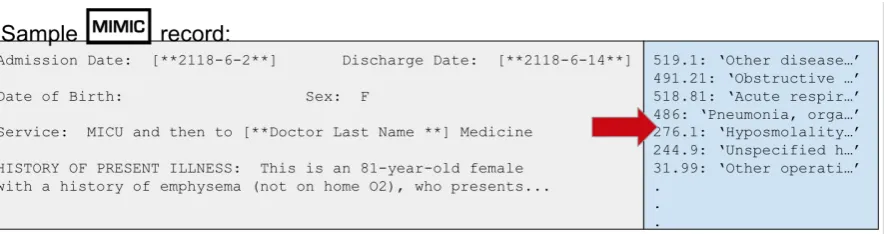
2016). Each discharge summary has been tagged with a set of ICD9 codes. See Figure 3 for an exam-ple of a record, and AppendixAfor a description of the dataset and preprocessing.
Concept Annotation We run cTAKES on the discharge summaries (described in AppendixB).
3We use notation for a single instance throughout.
Results on the extracted concepts are presented in Table1. Note the difference in number of anno-tations provided by using the SNOMED ontology compared to ICD9.4
ICD9
Total concepts extracted 1,005,756 Mean # extracted concepts per document 19.10 Mean % words assigned a concept per document 1.26%
SNOMED
Total concepts extracted 28,090,075 Mean # extracted concepts per document 532.76 Mean % words assigned a concept per document 35.21%
Mean # tokens per document 1513.00
Table 1: Descriptive Statistics on concept extraction for the MIMIC-III corpus.
Base model We evaluate against CAML ( Mul-lenbach et al.,2018), a state-of-the-art text-based model for the clinical coding task. The model lever-ages a convolutional neural network (CNN) with per-label attention to predict the combination of codes to assign to a diven discharge summary. Ap-plying convolution overX results in a convolved input representationH ∈Rdc×N(withdc< de) in
which the column-dimensionalityN is preserved. His then used to predicty, by attentional pooling over the columns.
We include implementation details of all meth-ods, including hyperparameters and training, in AppendixA.
4 Approach 1: Augmentation Model
One limitation of learning-based models is their tendency to lose uncommon words to "UNK" to-kens, or to suffer from poor representation learning for them. We hypothesize that rare words are impor-tant for predicting rare labels, and that text-based
Figure 3: An example clinical discharge summary and associated ICD codes.
models may be improved by augmenting word em-beddings with concept emem-beddings as a means to strengthen representations of rare or unseen words. We additionally hypothesize that linking multiple words to a shared concept via cTAKES annotation will reduce textual noise by grouping word variants to a shared representation in a smaller and more frequently updated parameter space.
4.1 Method
Given a discharge summary containing words
w1, w2, ..., wN ∈ W∗ and an embedding func-tion γ : W → Rde, we construct input
ma-trixX = [xT
1,xT2, ...,xNT] ∈ Rde×N as
column-stacked word embeddings, wherexn=γ(wn).
We additionally assume a code embedding func-tion φ : C → Rde and a set of annotated codes
for a given documentc1, c2, . . . , cN ∈ C∗, where
Cis the full codeset for the ontology used to anno-tate the document, andcnis the code annotated for
word tokenwn, if one exists (elsecn=∅, by abuse
of notation). We construct a representation for each document,D, of the same dimensionality as X, by learning one representation leveraging both the concept and word embedding at each position:
For tokenn,
dn=βwn,cnφ(cn) + (1−βwn,cn)xn, (1)
βwn,cn ∈ [0,1]is a learned parameter specific to
each observed word+concept pair, including UNK tokens.5 Intuitively, if there is a concept associ-ated with indexn, a concept embeddingφ(cn)is generated and alinear combination of the word and concept embedding is learned, using a learned
5
We experimented with models in which this gate was computed element-wise and shared by all word+concept pairs (e.g. by passingxnandφ(cn)through a linear layer or
sim-ple multi-layer perceptron to computedn), but this did not
improve performance.
parameter specific to that word+concept pair.6 We fixβwn,cn=∅ = 0, which reverts to the word
em-bedding when there is no concept assigned. We additionally propose a simpler version of this method,full replace, in which word embeddings are completely replaced with concept embeddings if they exist (i.e. βwn,cn = 1,∀wn, cn 6= ∅). In
this formulation, if a concept spans multiple words, all of those words are represented by the same vec-tor. Conversely, the CAML baseline corresponds to a model in whichβwn,cn = 0,∀wn, cn.
4.2 Evaluation Setup
Metrics In addition to the metrics reported in prior work, we report average precision score (AP), which is a preferred metric to AUC for imbal-anced classes (Saito and Rehmsmeier,2015;Davis and Goadrich,2006). We report both macro- and micro- metrics, with the former being more favor-able toward rare labels by weighting all classes equally. We additionally focus on the
precision-at-k(P@k) metric, representing the fraction of the
khighest-scored predicted labels that are present in the ground truth. Both macro-metrics and P@k
are useful in a computer-assisted coding use-case, where the desired outcome is to correctly identify needle-in-the-haystack labels as opposed to more frequent ones, and to accurately suggest a small subset of codes with the highest confidence as an-notation suggestions (Mullenbach et al.,2018).
Baselines Along with CAML, we evaluate on a
raw codes baseline where the ICD9 annotations generated by cTAKESc1, c2, . . . , cN are used
di-rectly as the document-level predictions. Formally,
6
ˆ
ycn = 1whencn ∈ Landcn 6= ∅, for all nin
integers1toN.
4.3 Results
We present results on the test set inTable 2. Over-all, the concept-augmented models are indistin-guishable from the baseline, and there is no sig-nificant difference between annotation type or re-combination method, although the linear combi-nation method with ICD9 annotations is the best performing and rivals the baseline.
Following the negative results for our initial at-tempt to augment word embeddings with concept embeddings, we tried two alternative strategies:
• We concatenated the ICD9 annotations with two other ontologies: RXNORM and SNOMED. While this led to greater coverage over the text (with slightly more than one third of the tokens in the text receiving correspond-ing concept annotations), it did not improve downstream performance.
• Prior work has demonstrated that leveraging clinical ontological structure can allow mod-els to learn more effective code embeddings in fully structured data models (Singh et al.,
2014; Choi et al., 2017). We applied the methodology ofChoi et al. (2017) on both the ICD9 and SNOMED annotations, but this did not improve performance. For more de-tails, see AppendixD.
4.4 Error Analysis
Error analysis of the word-to-concept mapping pro-duced by cTAKES exposes limitations of our initial hypothesis that cTAKES mitigates word-level vari-ation by assigning multiple distinct word phrases to shared concepts. Figure4demonstrates that the vast majority of the ICD9 concepts in the corpus are assigned to only one distinct word phrase, and the same results are observed for SNOMED concepts. This may explain the virtually indistinguishable performance of the augmentation models from the baseline, because randomly-initialized word and concept embeddings which are observed in strictly identical contexts should theoretically converge to the same representation.7
*These metrics were computed by randomly selectingk
elements from those predicted, since there are no sorted prob-abilities associated with this baseline. For the same reasons we cannot report AUC or AP metrics.
7Simulations of the augmentation method under a con-trived setting with more concept annotations per note as well
Figure 4: A histogram showing the distribution of ICD9 concepts inC grouped according to the number of unique word phrases in the MIMIC-III corpus asso-ciated with each. We observe the same trend when plot-ting SNOMED annotations.
The raw codes baseline performs poorly, which aligns with the observation that cTAKES codes as-signed to a discharge summary often do not have appropriate or proportional levels of specificity (for example, the top-level ICD9 code ’428 Heart Fail-ure’ may be assigned by cTAKES, but the gold-label code is ’428.21 Acute Systolic Heart Failure’). This may also contribute to the negative result of the proposed model.
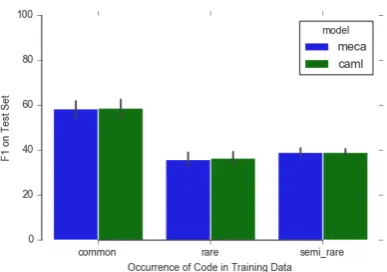
Figure6(included in the Appendix) illustrates prediction performance as a function of code fre-quency in the training set, showing that the pro-posed model does not improve upon the baseline for rare or semi-rare codes.8
4.5 Ablations
We separate and analyze the two distinct compo-nents of cTAKES’ annotation ability for further analysis: 1) how well cTAKES recognizes the lo-cation of concepts in the text (NER), and 2) how accurately cTAKES maps the recognized positions to the correct clinical concepts (ontology mapping). Annotation sparsity (NER) and/or cTAKES map-ping error may lend the raw text on its own equally useful, as observed in Table2. We investigate these hypotheses here. We evaluate performance of abla-tions relative to the augmentation model and base-line to determine whether each component
individ-as more unique word phrindivid-ases mapping to a single concept demonstrate solid performance increases over the baseline. This provides supporting evidence that the findings presented in this section may be the cause of the negative result rather than our proposed architecture.
[image:5.595.321.515.63.198.2]AUC AP F1 R@k P@k
Model Macro Micro Macro Micro Macro Micro 8 15 8 15
Baseline (Mullenbach et al.,2018) 0.8892 0.9846 0.2492 0.5426 0.0796 0.5421 0.3731 0.5251 0.7120 0.5616 Baseline (raw codes) n/a∗ n/a∗ n/a∗ n/a∗ 0.0189 0.0877 0.0534∗ 0.0640∗ 0.1132∗ 0.0747∗
Augmentation with ICD9
full replace 0.8846 0.9838 0.2242 0.5329 0.0691 0.5363 0.3688 0.5189 0.7048 0.5564 linear combination 0.8914 0.9849 0.2467 0.5427 0.0763 0.5419 0.3732 0.5267 0.7121 0.5634 Augmentation with SNOMED
full replace 0.8744 0.9830 0.2221 0.5271 0.0724 0.5326 0.3675 0.5177 0.7022 0.5547 linear combination 0.8781 0.9835 0.2238 0.533 0.0692 0.5357 0.3687 0.5194 0.7042 0.5563
Table 2: Test set results using the augmentation methods.
ually adds value. The ablations are:
1. Dummy ConceptsWe replace all word embed-dings annotated by cTAKES with 0-vectors, and only use remaining embeddings for pre-diction. If this alternative shows similar per-formance to the baseline, then we conclude that the positions in the text annotated by cTAKES (NER) are not valuable for predic-tion performance.
2. Concepts OnlyWe test the complement by re-placing all word embeddingsnot annotated by cTAKES with a 0-vector. In contrast to Dummy Concepts, strong performance of this approach relative to the baseline will allow us to conclude that the positions in the text anno-tated by cTAKES are valuable for prediction performance.
3. Concepts Only, Concept EmbeddingsWe re-place all word embeddings not annotated by cTAKES with a 0-vector, and then replace all remaining word embeddings with their con-cept embedding. If this model performs better than Concepts Only, it will demonstrate the strength of cTAKES’ ontology mapping com-ponent.
Note that Dummy Concepts and Concepts Only are the decomposition of the baseline CAML. Sim-ilarly, Dummy Concepts and Concepts Only, Con-cept Embeddings are the decomposition of the full-replace augmentation model presented in Section
4.
Results Results are presented in Tables 3 and
4. Results are consistent with previous experi-ments in that augmentation with concept anno-tations does not improve performance. For both ontologies, neither the Dummy Concepts nor the Concepts Only models outperform the full-text
models (in which both token representations are used). However, there are some interesting findings. Using SNOMED annotations, performance of the Concepts Only model is significantly higher than Dummy Concepts and very close to full-text model performance. This finding is strengthened by con-sidering the concept coverage discussed in Table
1: the Concepts Only model achieves comparable performance receiving only about 35% (1% in the ICD9 setting) of the input tokens which the full-text baseline receives, and the Dummy Concepts Model receives about 65% (99% in the ICD9 set-ting). Thus, a significant proportion of downstream prediction performance can be attributed a small portion of the text which is recognized by cTAKES in both the SNOMED and ICD9 settings, indicating the strength of cTAKES’ NER component.
5 Approach 2: Multi-task Learning
We present an alternative application of cTAKES as a form of distant supervision. Our approach is inspired by recent successes in multi-task learning for NLP which demonstrate that cheaply-obtained labels framed as an auxiliary task can improve per-formance on downstream tasks (Swayamdipta et al.,
2018;Ruder,2017;Zhang and Weiss,2016). We propose to predict clinical information extraction system annotations as an auxiliary task, and share lower-level representations with the clinical coding task through a jointly-trained model architecture. We hypothesize that domain-knowledge embed-ded in cTAKES will guide the shared layers of the model architecture towards a more optimal repre-sentation for the clinical coding task.
Token Representation AUC AP F1 R@k P@k Model Concept Match No Match Macro Micro Macro Micro Macro Micro 8 15 8 15
Baseline (Mullenbach et al.,2018) Word Word 0.8892 0.9846 0.2492 0.5426 0.0796 0.5421 0.3731 0.5251 0.7120 0.5616
[image:7.595.72.528.63.128.2]Dummy Concepts 0 Word 0.8876 0.9839 0.2119 0.5236 0.0732 0.5261 0.3634 0.5141 0.6943 0.5506 Concepts Only Word 0 0.7549 0.9626 0.0538 0.2487 0.0080 0.1961 0.2063 0.2880 0.4196 0.3197 Concepts Only, Concept Embeddings Concept 0 0.7534 0.9620 0.0552 0.2464 0.0086 0.1972 0.2058 0.2855 0.4200 0.3166 Augmentation Model (full replace) Concept Word 0.8846 0.9838 0.2242 0.5329 0.0691 0.5363 0.3688 0.5189 0.7048 0.5564
Table 3: Test set results of ablation experiments on the MIMIC-III dataset, using ICD9 concept annotations.
Token Representation AUC AP F1 R@k P@k Model Concept Match No Match Macro Micro Macro Micro Macro Micro 8 15 8 15
Baseline (Mullenbach et al.,2018) Word Word 0.8892 0.9846 0.2492 0.5426 0.0796 0.5421 0.3731 0.5251 0.7120 0.5616
[image:7.595.315.521.278.443.2]Dummy Concepts 0 Word 0.8472 0.9780 0.1461 0.4375 0.0413 0.4426 0.3202 0.4439 0.6234 0.4804 Concepts Only Word 0 0.8736 0.9817 0.2059 0.4518 0.0515 0.4295 0.3278 0.4583 0.6300 0.4903 Concepts Only, Concept Embeddings Concept 0 0.8739 0.9813 0.2019 0.4451 0.0519 0.4258 0.3247 0.4538 0.6254 0.4851 Augmentation Model (full replace) Concept Word 0.8744 0.9830 0.2221 0.5271 0.0724 0.5326 0.3675 0.5177 0.7022 0.5547
Table 4: Test set results of ablation experiments on the MIMIC-III dataset, using SNOMED concept annotations.
5.1 Method
We annotate the set of non-null ground-truth codes output by cTAKES for documentiin the training data as {(ai,1, ci,1),(ai,2, ci,2), . . . ,(ai,M, ci,M)},
where each anchorai,mindicates the span of tokens
in the text for which conceptci,mis annotated, and
ci,m6=∅.
The loss term of the model is augmented to in-clude the multi-class cross-entropy of predicting the correct code for all annotated spans in the train-ing batch:
L=
I
X
i=1
BCE(yi,yˆi)
+λ
PI
i=1 PMi
m=1−logp(ci,m|ai,m) PI
i=1Mi
whereBCE(yi,yˆi)is the standard (binary
cross-entropy) loss from the baseline for the clinical coding task, p(ci,m | ai,m) is the probability
as-signed by the auxiliary model to the true cTAKES-annotated concept given word spanai,mas input,λ
is the hyperparameter to tradeoff between the two objectives, andI is the number of instances in the batch.
Because we use the auxiliary task as a “scaf-fold” (Swayamdipta et al.,2018) for transferring domain knowledge encoded in cTAKES’ rules into the learned representations for the clinical coding task, we must only run cTAKES and compute a for-ward pass through the auxiliary module at training time. At test-time, we evaluate only on the clini-cal coding task, so the time complexity of model inference remains the same as the baseline, an ad-vantage of this architecture.
H H
Convolution
× N dc
de
Patient
has hairy cell
melanoma
ŷ ŷ
XX …
dc
Max along 3 embeddings
zzT
ĉ
Predict Predict
× 1 de × N
de
Max along 3 embeddings
zzT Predictĉ × 1
dc (CAML)
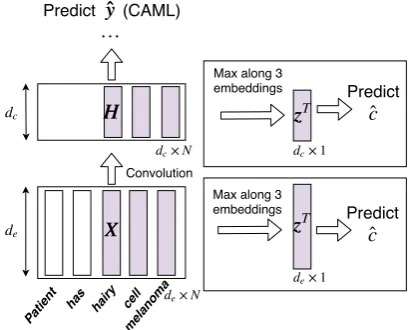
Figure 5: The proposed architecture (for prediction on a single document,i, and auxiliary supervision on a sin-gle annotation,m). The bottom box illustrates the pre-convolution model, and the top box post-pre-convolution. The architecture on the left is the baseline.
We model p(ci,m |ai,m)via a multi-layer
per-ceptron with a Softmax output layer to obtain a distribution over the codeset,C. We additionally experiment with a linear layer variant to combat overfitting on the auxiliary task by reducing the ca-pacity of this module. The input to this module is a single vector,zi,m∈Rde, constructed by selecting
the maximum value oversword embeddings for each dimension, wheresis the length of the input span.9 To facilitate information transfer between the clinical coding and auxiliary task, we experi-ment with tying both the randomly-initialized em-bedding layer,X, and a higher-level layer of the
9While this is simple representation, we find that multi-word concept annotations are rather rare, in which casezi,m
AUC AP F1 R@k P@k Shared Features Auxiliary Model Macro Micro Macro Micro Macro Micro 8 15 8 15
Baseline (Mullenbach et al.,2018) n/a 0.8892 0.9846 0.2492 0.5426 0.0796 0.5421 0.3731 0.5251 0.7120 0.5616 Pre-convolution MLP 0.8874 0.9839 0.2365 0.5390 0.0734 0.5376 0.3724 0.5235 0.7102 0.5597 Pre-convolution Linear Layer 0.8834 0.9838 0.2398 0.5412 0.0766 0.5414 0.3731 0.5265 0.7113 0.5633
[image:8.595.67.529.62.135.2]Post-convolution MLP 0.7252 0.9619 0.0578 0.3002 0.0159 0.2966 0.2449 0.3417 0.4879 0.3748 Post-convolution Linear Layer 0.7562 0.9655 0.0606 0.3035 0.0123 0.2934 0.2461 0.3392 0.4900 0.3700
Table 5: Test set performance on the ICD9 coding task forλ= 1and using ICD9 annotations.
Tagging Accuracy Shared Features Auxiliary Model After one epoch After last epoch
Pre-convolution MLP 0.9343 0.9398 Pre-convolution Linear Layer 0.8940 0.9400
Post-convolution MLP 0.9102 0.9335 Post-convolution Linear Layer 0.7524 0.9341
Table 6: Dev set performance on the auxiliary task for
λ = 1and using ICD9 annotations. Relatively high task performance is achieved even after one epoch with a simple model.
network (e.g. the outputs of the document-level convolution layerHdescribed in Section3). See Figure5for the model architecture.
5.2 Experiment and Results
Results are presented in Table 5and Table 6for ICD9 annotations. Overall, the cTAKES span-prediction task does more to hurt than help perfor-mance on the main task. Tying the model weights at a higher layer (post-convolution as opposed to pre-convolution) results in worse performance, even though the model fits the auxiliary task well. This indicates either that the model may not have enough capacity to adequately fit both tasks, or that the cTAKES prediction task as formulated may actu-ally misguide the clinical coding task slightly in parameter search space.10
We additionally remark that increasing the weight of the auxiliary task generally lowers per-formance on the clinical coding task, and tuningλ
on the dev set does not result in more optimal per-formance (we include results withλ= 1here; see
Table 9in the Appendix). Notably, for even very small values ofλ, we achieve very high validation accuracy on the auxiliary task. This performance does not change with larger weightings, indicating that the auxiliary task may not be difficult enough to result in effective knowledge transfer.11
10We found similar results using SNOMED annotations. 11
While the models in Sections4did not introduce new hyperparameters to the baseline architecture, hyperparameters for this architecture were selected by human intuition. Room for future work includes more extensive tuning (see Table8in AppendixA).
6 Conclusion
Integrating existing clinical information extraction tools with deep learning models is an important direction for bridging the gap between rule-based and learning-based methods. We have provided an analysis of the quality of the widely-used clinical concept annotator cTAKES when integrated into a state-of-the-art text-based prediction model. In two settings, we have shown that cTAKES does not improve performance over raw text alone on the clinical coding task. We additionally demonstrate through error analysis and ablation studies that the amount of word variation captured and the differen-tiation between the named-entity recognition and ontology-mapping tasks may affect cTAKES’ ef-fectiveness.
While automated coding is one application area, the models presented here could easily be ex-tended to other downstream prediction tasks such as patient diagnosis and treatment outcome predic-tion. Future work will include evaluating newly-developed clinical NER tools with similar func-tionalities to cTAKES in our framework, which can potentially serve as a means to evaluate the effectiveness of newer systems vis-à-vis cTAKES.
Acknowledgments We thank the Research, De-velopment, and Dissemination group at Sutter Health as well as members of the Georgia Tech Computational Linguistics Lab for helpful discus-sions. Figure 3 was provided by James Mullen-bach.
References
American Academy of Professional Coders. 2019. What is medical coding?
Alan R Aronson. 2001. Effective mapping of biomed-ical text to the umls metathesaurus: the metamap program. In Proceedings of the AMIA Symposium, page 17. American Medical Informatics Associa-tion.
learning to align and translate. arXiv preprint arXiv:1409.0473.
Tal Baumel, Jimena Nassour-Kassis, Raphael Co-hen, Michael Elhadad, and Noémie Elhadad. 2018. Multi-label classification of patient notes a case study on icd code assignment. InProceedings of the 2018 AAAI Joint Workshop on Health Intelligence.
Willie Boag and Hassan Kané. 2017. Awe-cm vec-tors: Augmenting word embeddings with a clinical metathesaurus. arXiv preprint arXiv:1712.01460.
Willie Boag, Elena Sergeeva, Saurabh Kulshreshtha, Peter Szolovits, Anna Rumshisky, and Tristan Nau-mann. 2018. Cliner 2.0: Accessible and accu-rate clinical concept extraction. arXiv preprint arXiv:1803.02245.
Edward Choi, Mohammad Taha Bahadori, Le Song, Walter F Stewart, and Jimeng Sun. 2017. Gram: graph-based attention model for healthcare represen-tation learning. In Proceedings of the 23rd ACM SIGKDD International Conference on Knowledge Discovery and Data Mining, pages 787–795. ACM.
Jesse Davis and Mark Goadrich. 2006. The relation-ship between precision-recall and roc curves. In Pro-ceedings of the 23rd international conference on Ma-chine learning, pages 233–240. ACM.
Kevin Donnelly. 2006. Snomed-ct: The advanced ter-minology and coding system for ehealth. Studies in health technology and informatics, 121:279.
Carol Friedman. 2000. A broad-coverage natural lan-guage processing system. In Proceedings of the AMIA Symposium, page 270. American Medical In-formatics Association.
Nathan Greenberg, Trapit Bansal, Patrick Verga, and Andrew McCallum. 2018. Marginal likelihood train-ing of bilstm-crf for biomedical named entity recog-nition from disjoint label sets. InProceedings of the 2018 Conference on Empirical Methods in Natural Language Processing, pages 2824–2829.
Alistair EW Johnson, Tom J Pollard, Lu Shen,
H Lehman Li-wei, Mengling Feng,
Moham-mad Ghassemi, Benjamin Moody, Peter Szolovits, Leo Anthony Celi, and Roger G Mark. 2016. Mimic-iii, a freely accessible critical care database. Scien-tific data, 3:160035.
Donald AB Lindberg, Betsy L Humphreys, and Alexa T McCray. 1993. The unified medical lan-guage system. Methods of information in medicine, 32(04):281–291.
James Mullenbach, Sarah Wiegreffe, Jon Duke, Jimeng Sun, and Jacob Eisenstein. 2018. Explainable pre-diction of medical codes from clinical text. In Pro-ceedings of the 2018 Conference of the North Amer-ican Chapter of the Association for Computational Linguistics: Human Language Technologies, vol-ume 1.
National Center for Health Statistics. 1991. The In-ternational Classification of Diseases: 9th Revision, Clinical Modification: ICD-9-CM.
Hoang Nguyen and Jon Patrick. 2016. Text mining in clinical domain: Dealing with noise. In Proceed-ings of the 22nd ACM SIGKDD international con-ference on knowledge discovery and data mining, pages 549–558. ACM.
T.J. Pollard and A.E.W. Johnson. 2016. The MIMIC-III clinical database.
Anthony Rios and Ramakanth Kavuluru. 2018a. Emr coding with semi-parametric multi-head matching networks. InProceedings of the 2018 Conference of the North American Chapter of the Association for Computational Linguistics: Human Language Tech-nologies, volume 1, pages 2081–2091.
Anthony Rios and Ramakanth Kavuluru. 2018b. Few-shot and zero-Few-shot multi-label learning for structured label spaces. InProceedings of the 2018 Conference on Empirical Methods in Natural Language Process-ing, pages 3132–3142.
Sebastian Ruder. 2017. An overview of multi-task learning in deep neural networks. arXiv preprint arXiv:1706.05098.
Takaya Saito and Marc Rehmsmeier. 2015. The precision-recall plot is more informative than the roc plot when evaluating binary classifiers on imbal-anced datasets.PloS one, 10(3):e0118432.
Guergana K Savova, James J Masanz, Philip V Ogren, Jiaping Zheng, Sunghwan Sohn, Karin C Kipper-Schuler, and Christopher G Chute. 2010. Mayo clin-ical text analysis and knowledge extraction system (ctakes): architecture, component evaluation and ap-plications. Journal of the American Medical Infor-matics Association, 17(5):507–513.
Yuqi Si, Jingqi Wang, Hua Xu, and Kirk Roberts. 2019. Enhancing clinical concept extraction with contex-tual embedding. arXiv preprint arXiv:1902.08691.
Anima Singh, Girish Nadkarni, John Guttag, and Er-win Bottinger. 2014. Leveraging hierarchy in med-ical codes for predictive modeling. InProceedings of the 5th ACM conference on Bioinformatics, Com-putational Biology, and Health Informatics, pages 96–103. ACM.
Swabha Swayamdipta, Sam Thomson, Kenton Lee, Luke Zettlemoyer, Chris Dyer, and Noah A. Smith. 2018. Syntactic scaffolds for semantic structures. CoRR, abs/1808.10485.
Jacqueline M Torres, John Lawlor, Jeffrey D Colvin, Marion R Sills, Jessica L Bettenhausen, Am-ber Davidson, Gretchen J Cutler, Matt Hall, and Laura M Gottlieb. 2017. Icd social codes. Medical care, 55(9):810–816.
Yanshan Wang, Liwei Wang, Majid Rastegar-Mojarad, Sungrim Moon, Feichen Shen, Naveed Afzal, Sijia Liu, Yuqun Zeng, Saeed Mehrabi, Sunghwan Sohn, et al. 2017. Clinical information extraction appli-cations: a literature review. Journal of biomedical informatics.
Wei-Hung Weng, Kavishwar B Wagholikar, Alexa T McCray, Peter Szolovits, and Henry C Chueh. 2017. Medical subdomain classification of clinical notes using a machine learning-based natural language processing approach. BMC medical informatics and decision making, 17(1):155.
Kai Xu, Zhanfan Zhou, Tao Gong, Tianyong Hao, and Wenyin Liu. 2018. Sblc: a hybrid model for disease named entity recognition based on se-mantic bidirectional lstms and conditional random fields. BMC medical informatics and decision mak-ing, 18(5):114.
Yuan Zhang and David Weiss. 2016.
Stack-propagation: Improved representation learning for syntax.arXiv preprint arXiv:1603.06598.
A Experimental Details
Data Following Mullenbach et al. (2018), we use the same train/test/validation splits for the MIMIC-III dataset, and concatenate all supplemen-tal text for a patient discharge summary into one record. We use the authors’ provided data pro-cessing pipeline12 to preprocess the corpus. The vocubulary includes all words occurring in at least 3 training documents. See Table7for descriptive statistics of the dataset.
We construct a concept vocabulary for embed-ding initialization following the same specification as the word vocabulary: any concept which does not occur in at least 3 training documents is re-placed with an UNK token. Details on the size of the vocabulary can be found in Table8.
# training documents 47,723
# test documents 3,372
# dev documents 1,631
[image:11.595.306.527.102.232.2]Mean # tokens per document 1,513.0 Mean # labels per document 16.09 Total # labels (L) 8,921
Table 7: Dataset Descriptive Statistics.
Training We train with the same specifications asMullenbach et al.(2018) unless otherwise spec-ified, with dropout performed after concept aug-mentation for the models in Sections4, and early stopping with a patience of 10 epochs on the pre-cision at 8 metric, for a maximum of 200 epochs (note that in the multi-task learning models the stop-ping criterion is only a function of performance on the clinical coding task). Unlike previous work, we reduce the batch size to 12 in order to allow each batch to fit on a single GPU, and we do not use pretrained embeddings as we find this improves performance. All models are trained on a single NVIDIA Titan X GPU with 12,189 MiB of RAM. We port the optimal hyperparameters reported in
Mullenbach et al.(2018) to our experiments. With more extensive hyperparameter tuning, we may ex-pect to see a potential increase in the performance of our models over the baseline. See Table8for hyperparameters and other details specific to our proposed model architectures. All neural models
12https://github.com/jamesmullenbach/
caml-mimic/blob/master/notebooks/ dataproc_mimic_III.ipynb
are implemented using PyTorch13, and built on the open-source implementation of CAML.14
Parameter Value
Vocabulary Size 51,917 SNOMED Concept Vocabulary (C) Size 20,775 ICD9 Concept Vocabulary (C) Size 1,529 Embedding Size (de) 100
Post-convolution Embedding Size (dc) 50
[image:11.595.74.291.302.394.2]Dropout Probability 0.2 Learning Rate 0.0001 Attention Mechanism Hidden State Size 20 Attention Mechanism Activation Function ReLU Auxiliary hidden layer size 700 Auxiliary activation function ReLU
Table 8: Model details.
B Concept Extraction
We build a custom dictionary from the UMLS Metathesaurus that includes mappings from UMLS CUIs to SNOMED-CT and ICD9-CM concepts. We run the cTAKES annotator in advance of train-ing for all 3 dataset splits ustrain-ing the resulttrain-ing dic-tionary, allowing us to obtain annotations for each note in the dataset, and the positions of the anno-tations in the raw text. Note that for the multi-task learning experiments (Section5), we only re-quire annotations for training data. Annotating the MIMIC-III datafiles using these specifications takes between 4 and 5 hours for 3,000 discharge summaries on a single CPU, and can be parallelized for efficiency.
C Attention for Overlapping Concepts
We implement an attention mechanism (Bahdanau et al.,2014) to compute a single concept embed-ding φ(Cn) ∈ Rde when Cn = {c1, c2, . . . , cJ} represents a set of concepts annotated at position
ninstead of a single concept. Intuitively, we want to more heavily weight those concepts in the set which have the most similarity to the surrounding text. We define a context vector for positionnas:
vn= [xn−2,xn−1,xn+1,xn+2]∈R4de
The context is defined as the concatenated word embeddings surrounding positionn. We use a con-text size ofn+/−2, where2is a hyperparameter. We choose to use a smaller value for computational efficiency.
13
https://github.com/pytorch/pytorch
14https://github.com/jamesmullenbach/
λ AUC AP F1 R@k P@k Auxiliary Tagging Accuracy
Macro Micro Macro Micro Macro Micro 8 15 8 15 After one epoch After last epoch
0.001 0.9002 0.9848 0.3129 0.5470 0.0704 0.5511 0.3902 0.5447 0.7164 0.5631 0.8888 0.9398 0.01 0.8954 0.9842 0.2885 0.5352 0.0636 0.5425 0.3843 0.5328 0.7088 0.5528 0.8938 0.9401
0.1 0.9000 0.9846 0.3145 0.5465 0.0689 0.5471 0.3909 0.5426 0.7183 0.5617 0.8940 0.9400 0.5 0.8934 0.9840 0.2892 0.5362 0.0624 0.5386 0.3844 0.5361 0.7089 0.5546 0.8941 0.9400 1 0.8975 0.9840 0.3087 0.5460 0.0668 0.5477 0.3886 0.5439 0.7169 0.5624 0.8940 0.9400 10 0.8979 0.9842 0.3122 0.5484 0.0678 0.5474 0.3908 0.5457 0.7182 0.5644 0.8940 0.9400 50 0.8939 0.9837 0.2982 0.5410 0.0638 0.5427 0.3855 0.5391 0.7111 0.5592 0.8940 0.9401
100 0.8913 0.9835 0.2943 0.5383 0.0632 0.5407 0.3849 0.5374 0.7096 0.5577 0.8940 0.9401
[image:12.595.75.526.63.180.2]1000 0.8851 0.9827 0.2750 0.5260 0.0564 0.5309 0.3803 0.5290 0.7016 0.5491 0.8940 0.9401
Table 9: The effect of tuningλon dev set performance on the ICD9 coding task, for the pre-convolution model with a linear auxiliary layer and ICD9 annotations. We selectλ= 1for reporting test results; there isn’t a clear value which produces strictly better performance.
We concatenate the word-context vector and each concept embeddingcj inCnas[vn, φ(cj)]∈
R5de, and pass it through a multi-layer perceptron
to compute a similarity score:f :R5de →R1. An
attention score for eachcj is computed as:
αj = PJexp(f(vn, φ(cj)) k=1exp(f(vn, φ(ck))
This represents the relevance of the concept to the surrounding word-context, normalized by the other concepts in the set. A final concept embed-dingφ(Cn) ∈Rde is computed as a linear
combi-nation of the concept vectors, weighted by their attention scores:
φ(Cn) = J
X
j=1
αj·φ(cj)
D Leveraging Ontological Graph
Structure
Following the methodology ofChoi et al.(2017), we experiment with learning higher-quality concept representations using the hierarchical structure of the ICD9 ontology. We replace concept embedding
φ(cn)with a learned linear combination of itself and its parent concepts’ embeddings (seeFigure 1). For child concepts which are observed infrequently or have poor representations, prior work has shown that a trained model will learn to weight the par-ent embeddings more heavily in the linear com-bination. Because the parent concepts represent more general concepts, they have most often been observed more frequently in the training set and have stronger representations. This also allows for learned representations which capture relationships between concepts. We refer the reader toChoi et al.
(2017) for details.
[image:12.595.314.508.410.546.2]