Supramolecular Iridium(III) Assemblies
Diego Rota Martira
and Eli Zysman-Colmana
*
a
Organic Semiconductor Centre, EaStCHEM School of Chemistry, University of St
Andrews, St Andrews, Fife, KY16 9ST, UK, Fax: +44-1334 463808; Tel: +44-1334 463826; E-mail: [email protected];
URL: http://www.zysman-colman.com
Abstract. Iridium(III) complexes exhibit remarkable photophysical properties such as high photoluminescence quantum yields, wide color tunability and high chemical stability. They
have featured prominently in diverse applications such as sensing, bio-imaging, photoredox
catalysis, solar fuels and solid-state lighting. In the vast majority of these reports the iridium
complex is mononuclear in nature. The use of iridium complexes as components of
self-assembled systems has garnered increasing attention and this review aims to comprehensively
document the advances made in this area. Special emphasis will be devoted to describing the photophysical properties and applications of such photo-active supramolecular materials. Soft materials such as soft salts, liquid crystals, gels, colloids incorporating iridium are described as are hydrogen bonding- and π-π staking-directed assemblies, coordination-driven self-assembled materials such as coordination polymers and metal organic frameworks, macrocycles, capsules and cages. Finally, guest Ir(III) complexes encapsulated within the cavities of cage-type structures are presented.
Contents
1. Introduction 2. Soft Materials
2.4 Colloidal structures
2.5 Hydrogen bonding- and p-p-directing supramolecular networks 3. Coordination-driven self-assembly
3.1 Coordination polymers, metal-organic frameworks and discrete structures 3.2 Macrocycles, capsules and cages
4. Encapsulation of Ir(III) chromophores 5. Conclusions
Acknowledgments References
1. Introduction
The term molecular self-assembly applies to pathways that produce a final product directly
and spontaneously when the correct components are mixed under appropriate conditions.[1]
Self-assembly plays an integral role in the structure and function of biological systems[2-4]
and it is implicated in a variety of functional materials.[5] In Nature self-assembly is generally
based on numerous hydrogen bounding, electrostatic, van der Waals, and other weak inter- and
intra-molecular interaction working synergistically to assemble, for example, secondary and
tertiary structures of proteins, which then provide well-defined local environments to mediate
biochemical transformations.[6] Similarly, in natural photosynthesis organisms optimize solar
energy conversion through the self-organized assembly of photofunctional chromophores.[7,
8] Over the last two decades, molecular self-assembly has played a key role in the construction
of a variety of elegant and intricate synthetic nanostructures, including molecular crystals and
liquid crystals,[9, 10] colloids[11] and micelles,[12] gels,[13, 14] polymers[15, 16] and
nanoscale structures of high symmetry, such as 3D-frameworks,[17] metal-organic polygons
and polyhedra.[18, 19] As the properties of these materials highly depend both on the nature
of their components and the interactions between them, the explicit manipulation of the
building blocks and the non-covalent forces that hold the constituents together has promoted
technologies. For example, liquid crystals have found application as anisotropic organic
semiconductors in organic field effect transistors (OFETs), Organic Light-Emitting Diodes
(OLEDs) and Organic Photovoltaic devices (OPVs).[9, 10, 20] Due to their large surface area
and biocompatibility, colloids and micelles are very important for water purification, cleansing
action of soap and food formulation.[21, 22] Hydrogels and polymers are key components in
materials for medicine, food science and cosmetics.[23-25] Nanostructured materials such as
molecular crystals, frameworks or 3D-polyhedral structures exhibit interesting optical,
magnetic and catalytic properties, which have been rapidly exploited in diverse applications
such as in catalysis, magnetic devices and gas purification.[26-28]
In recent years, there has been an increasing interest in the construction of photoactive
supramolecular assemblies through the incorporation of luminescent building blocks.[29-32]
This immediately generates possibilities for assembling in very close proximity a high
concentration of chromophoric units through non-covalent interactions, thereby achieving
photophysical properties that are difficult to obtain in conventional molecular materials.
Besides modulating the optoelectronic properties of the emissive compounds as a function of
the assembly, their organization into ordered structures can also radically change the physical
properties of the bulk materials.[33] As a result, nanomaterials that exhibit both fascinating
physical and photoactive properties have been one of the main areas of interest in
supramolecular chemistry in recent years.[29, 34, 35]
Cyclometalated iridium(III) complexes exhibit efficient phosphorescence, unprecedented
facile emission color tunability across the visible spectrum, and high chemical and thermal
stability.[36-40] They have thus found use in myriad applications such as in sensing,[41, 42]
devices.[47, 48] The use of iridium complexes as luminescent components for self-assembly
has also become increasingly popular. This review article provides an exhaustive summary on
the development of photoactive self-assembled materials based on iridium(III) complexes,
giving special emphasis to their photophysical properties, and highlighting their applications.
Depending on the nature of the ligands, iridium(III) complexes can be cationic, neutral and
anionic. The vast majority of cationic iridium(III) complexes possess the general motif
[Ir(C^N)2(N^N)]+, where C^N is a cyclometalating ligand such as 2-phenylpyridinato (ppy)
and N^N is a neutral ancillary ligand such as 2,2’-bipyridine (bpy). Homoleptic neutral iridium
complexes possess the general formula [Ir(C^N)3] and are frequently studied as their facial
geometric isomer. Heteroleptic neutral complexes generally possess the structural motif
[Ir(C^N)2(X)], where X is an anionic bidentate ligand such as acetylacetonates, oxazolines or
thiazolines whereas, negatively charged cyclometalated iridium(III) complexes typically
possess the composition [Ir(C^N)2(Y)2]-, where Y is typically an anionic monodentate ligand
such as CN-, NCS- and NCO-.
We begin by describing iridium-based soft materials such as ion-paired iridium complexes
commonly known as soft-salts, liquid crystals, supramolecular gels, colloidal structures and
assemblies developed through H-bonding and p-p-stacking interactions. Next, we turn our
attention to describing luminescent iridium-based coordination polymers, metal-organic
frameworks (MOFs) and discrete structures, followed by an overview of luminescent Ir-based
macrocycles, capsules and cages. The last chapter of this review highlights the emerging field
of dynamic encapsulation of mononuclear iridium complexes into the cavities of 3D MOFs and
cages. In this chapter, emphasis will be placed in describing the changes of the luminescent
properties of the guest iridium complexes due to their physical and optoelectronic interactions
complexes covalently assembled within multinuclear dyads, triads and arrays,[49-51] or
covalently linked onto polymeric structures[52-54] have been reported. As these systems have
been extensively described elsewhere, they are not included within the present review.
2. Soft materials
Molecular aggregation induced by non-covalent interactions between Ir(III) chromophores
can have tremendous impact on the properties of materials. Desirable photophysical properties
such as emission tuning, enhanced photoluminescence quantum yield, longer excited state
lifetimes, and energy and electron transfer processes can be achieved by controlling the
aggregation and organization of Ir(III) emitters in soft materials.
2.1. Soft salts
The term “soft salt” describes ionic materials that are composed of two or more
organometallic components characterized by complementary charges and assembled into
complex salts through Coulombic interactions. The majority of the reported soft salts
incorporating iridium have consisted of a cationic iridium complex married with an anionic
iridium complex.
The first examples of iridium soft salts were reported in 2010 by Thompson and
co-workers[55] (Figure 1) and De Cola and co-workers[56] (Figure 2a) who assembled via salt
metathesis reactions blue- and green-emitting anionic Ir(III) complexes with yellow- and
Figure 1. Chemical structure of soft salt S1 (left) and S2 (right).
Soft salt S1 was prepared by assembling the anionic green-emitting Ir(III) complex
Na[Ir(mppyH)2(CN)2], Na1a with the cationic yellow-emitting Ir(III) complex
[Ir(mppyH)2(CNdt)2]Cl, 1bCl (mppyH is 2-(p-tolyl)pyridine and CNdt is
2-methyl-N-methylydynepropan-2-aminium), while S2 contains the anionic blue-emitting Ir(III) complex
Na[Ir(dFppy)2(CN)2], Na2a (dFppyH is 4,6-difluorophenylpyridine) with the cationic
orange-emitting Ir(III) complex [Ir(mppyH)2(dtbubpy)]Cl, 2bCl (dtbubpy is 4,4’-di-tert-butyl-2,2’-bipyridine) (Figure 1). In degassed MeCN the complexes Na1a and 1bCl exhibited vibronic ligand-centered (3LC) emission profiles, respectively, at lPL = 472 nm and lPL = 458 nm with photoluminescence quantum yield of FPL = 70% and FPL = 38%, and photoluminescence lifetimes of tPL = 4.0 µs and tPL = 36.7 µs. Similarly, complex Na2a exhibited a vibronic 3
LC emission at lPL = 448 nm with a FPL of 70% and a tPL = 4.1 µs, while complex 2bCl showed a broad mixed metal-to-ligand and ligand-to-ligand charge transfer (3
MLCT/3
LLCT) emission centered at lPL = 586 nm with a lower FPL of 21% and a shorter tPL of 0.43 µs. The photoluminescence spectra of the soft salts S1 and S2 exhibited a concentration dependence, which impacted the degree of emission quenching of the anion by the cation via Dexter energy transfer. Taking S2 as an example, at a relatively low concentration of 10-5
M its luminescence profile was dominated by the emission at lPL = 448 nm, characteristic of the blue-emitting anion 2a. This high-energy emission gradually decreased as a function of increasing concentration of S2 from 10-5
M to 10-3
M and, at a concentration greater than 10-3
orange emission exhibited by the cation 2b at lPL = 586 nm was observed. Based on a bimolecular quenching model, a quenching rate constant kq of 1.71 x 10
10 M-1
s-1
, close to the diffusion limit in acetonitrile (2 x 10¹⁰
M-1 s-1
), was calculated.
Similarly, De Cola and co-workers assembled the green-emitting anionic Ir(III) complex of
composition NBu4[Ir(ppy)2(CN)2], NBu43a, with the yellow-emitting cationic Ir(III) complex
[Ir(dFppy)2(bpy)]Cl, 3bCl (S3, Figure 2), and the blue-emitting anionic Ir(III) complex K2a
with the orange-emitting cationic Ir(III) complex [Ir(ppy)2(bpy)]Cl, 4bCl (S4, Figure 2a).
Figure 2. a) Chemical structures of complex salts S3 (top) and S4 (bottom). b) crystal packing
of salt S3 highlighting the channel running along the crystallographic c axis (top) and
illustration of the dichloromethane solvent molecules (space-filling representation) inside the
channel and pockets of S3 (bottom). The remaining solvent molecules are omitted for clarity.
c) top:normalized emission spectra of dried S4 (black line), S4 with toluene intercalated (blue
line), complexes 2a (red line) and 4b (green line); bottom: normalized emission spectra of S4
(black line) and S4 intercalating anthraquinone (pink line). Part c) is adapted with permission.
The X-ray single crystal structure of S4 showed that this soft salt forms a 3D porous network
where small solvent molecules such as dichloromethane, amyl acetate, ethyl acetate, diethyl
ether, toluene or anthraquinone could be easily intercalated (Figure 2b). The emission
properties of the single crystals of the microcrystalline salts S3 and S4 were investigated both
under vacuum in the absence of guest molecule inclusion and after loading guest molecules
into their networks. In degassed DCM, complex NBu43a emitted yellow light with a lPL at 564
nm while 3bClemitted in the blue-green with a lPL at 502 nm. The emission of the crystal of
S3 in its dry form exhibited a red-shifted emission at lPL = 591 nm. Analogously, the dried
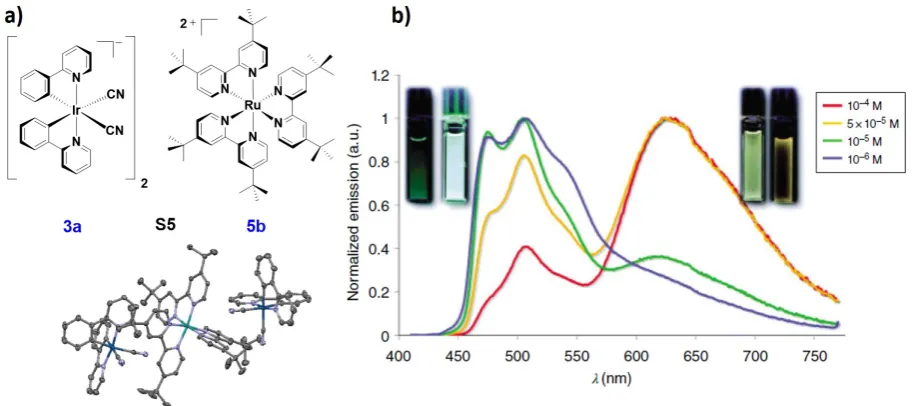
Our group reported[57] the first example of a three component heterometallic ion-pair assembly, S5 (Figure 3) involving two equivalents of complex NBu43a (Figure 2) associated with the red-emitting [Ru(dtbubpy)3]Cl2 5bCl2 (Figure 3a). Upon photoexcitation into the ruthenium complex 1
MLCT absorption band in MeCN, 5bCl2 exhibited the characteristic broad 3MLCT emission centered at l
PL = 630 nm, which is complementary in color compared to the
3LC emission exhibited by complex NBu4
3a (lPL = 477 nm in degassed MeCN). Soft salt S5 nicely illustrates how the emission properties can be modulated upon changes in concentration and medium. At low concentration, the emission of S5 is dominated by the structured 3LC emission of 3a. As the concentration increases, due to increased efficiency of the Fӧrster energy transfer from the anionic Ir(III) donor to the cationic Ru(II) acceptor, the emission profile of
S5 resembles increasingly that of the lower-energy emission of the Ru(II) complex 5b (Figure
3b). In contrast to the emission behavior observed for S3 and S4, the emission of S5 did not
involve either excimers or exciplexes. Further, as a function of the solvent polarity, the
electrostatic interaction of the cation and anion could be modulated and therefore the magnitude
Figure 3. a) Chemical structure of the soft salt S5 with its single crystal x-ray structure; b)
normalized emission spectra of S5 recorded in deaerated MeCN at 298 K at different
concentrations (lexc = 390 nm). Insets are images of MeCN solutions of S5 at different concentrations. Image b) is adapted from ref [57] with permission from The Royal Society of Chemistry.
Soft salt S5 exhibited a significantly enhanced ECL (electrochemiluminescence) signal at similar energy to 5b.[58] This observation is rather unusual considering that for the vast majority of multichromophoric species, the ECL signals could be addressed at different potentials and thus produce multiple emissive readouts.[59-61] The ECL efficiency of S5 was determined to be 2.51%, which is intermediate between the ECL efficiencies of the ionic components 3a (2.83%) and 5b (2.14%). The higher ECL efficiency for S5 compared to 5b is due to the [Ir]·
- [Ru]·+
annihilation process, where [Ir]
acts as a co-reactant and thus reduces the energy required to emit light from the excited [Ru]*.
Godbert and co-workers[62] synthetized green-emitting anionic Ir complexes bearing an
These complexes exhibited high photoluminescence quantum yields of FPL = 69% and FPL =
58%, respectively, with emission maxima, respectively, at 530 nm and 536 nm. When NBu44a
and NBu44b were respectively assembled with the cationic complex [Ir(ppy)2(py-am)]Cl (6bCl in Figure 4a, py-am is 2-pycolylamine), which itself shows an emission at lPL = 490 nm with a FPL of 52%, highly emissive soft salts, S6a and S6b (Figure 4a) were obtained. S6a and S6b areunusual examples of soft salts in which the cation (6b) is the donor unit, while the anions (4a and 4b) are the acceptors. The emission of S6a and S6b involved contributions from both ions with lPL, respectively, at 480, 525 nm and 486, 532 nm and high FPL values of 81% and 83%, respectively.
Figure 4. a) chemical structure of soft salts S6a and S6b and b) chemical structure of the
white-emitting soft salt S7. Inset is image of air-equilibrate DCM solution of S7. The inset
image is adapted from ref [63] with permission from The Royal Society of Chemistry.
A white-emitting soft salt was obtained by Stagni and co-workers[63] by assembling the
blue-emitting anionic Ir(III) complex NBu45a (Figure 4b), bearing dFppy as C^N ligands and
4-benzonitrile tetrazolate as ancillary ligands, with the red-emitting [Ir(ppy)2(ptz-Me)]Cl
complex (ptz-Me is 5-methyl-2-phenyltetrazole) (7bCl, Figure 4b). In aerated DCM, complex
NBu45a exhibited a structured emission profile typical of emission from a 3LC/3MLCT state
with lPL at 462 nm and 492 nm and a FPL of 3.3%. Complex 7bCl, by contrast, exhibited a
complexes 5a and 7b contributed almost equally to the emission of S7 in aerated DCM, and energy transfer between the two ions played a minor role, an almost pure white-light (CIE: x = 0.3288, y = 0.3284) with lPL at 460 nm, 490 nm and 680 nm and a FPL of 2.8% was emitted by the assembly. The poor energy transfer in S7 is probably due to the presence of the bulky 4-benzonitrile tetrazolate in 5a that restricts its interaction with the cation 7b.
In the context of electroluminescence devices, neutral Ir complexes have been extensively
used in Organic Light-Emitting Diodes (OLEDs),[64-66] whereas cationic Ir(III) complexes
have been explored more explicitly as emitters in Light-Emitting Electrochemical Cells
(LEECs).[47, 67] Covalently linked dinuclear iridium complexes have been scarcely
investigated as emitters in solid-state lighting, with only one example available for use in
LEECs[68] and few for OLEDs.[69-75] However, iridium-based soft salts have demonstrated
reasonable performance as emitter materials in OLEDs. The main advantage of using soft salts
in lighting devices relies on the capacity to introduce two phosphorescent centers in one
complex ion, while controlling the intermolecular separation of the two metal centers through
non-covalent interactions. The first examples of iridium soft salts used in OLEDs were reported
by Thompson and co-workers.[55] Notably, OLEDs fabricated by using S2 (Figure 1) as the
emitting material exhibited an external efficiency, EQE, of 4.7% and a luminance of over 7428
cd·m2 (lPL = 586 nm). The good performance of the OLED could be directly linked to the suitable alignment of the HOMO-LUMO levels of the two ionic components of the soft salt.
Figure 5. Chemical structures of iridium soft salts used in OLEDs. a)S8 and b)S9 (top) and S10 (bottom).
the emitting material exhibited a low external quantum efficiency of 0.66% and a luminance of 1114 cd·m-2 (l
EL = 553 nm).
Two iridium soft salts based on ion-paired dinuclear cationic, and mononuclear anionic
complexes were reported by Mayer and co-workers[77] and investigated as emitting materials
in OLEDs (Figure 5b). The unit bridging the two iridium centers in the dinuclear cationic
complexes consisted either of a carbazole derivative for 9bPF6 or a phenylene group in the case
of 10bPF6. Both dinuclear complexes 9bPF6 and 10bPF6 exhibited low FPL in degassed DCM
of 9.1% and 15.0%, respectively, attributed to intramolecular quenching between the two iridium luminophores. As the phenylene bridge favored the communication between the two iridium centers, the electroluminescence performance using S10 was poorer than that using S9 with respective maximum peak current efficiencies of 0.06 and 0.44 cd· A-1
and maximum brightness of 101 and 1022 cd· m-2
.
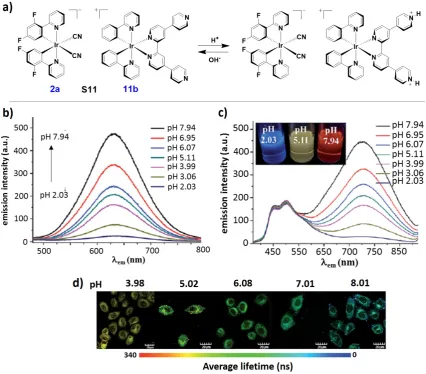
11bCl is pH sensitive as the protonation or deprotonation of its distal pyridine units gives rise to changes in the emission of S11, which can be easily detected by both steady-state and time-resolved luminescence spectroscopy. The cationic complex 11bClshowed a broad orange-red emission in deareated MeCN centered at lPL = 625 nm, which decreased dramatically in intensity with decreasing pH (Figure 6b). By contrast, the structured blue-emission exhibited by the anionic counterpart NBu42a (lPL = 451, 475 nm) was not affected by changes in pH.
Figure 6. a) Design concept of the ratiometric design probe and chemicals structures of 2a, 11b and soft salt S11. b) changes in the phosphorescence emission spectra of 11b (2.0 × 10⁻⁵ M) in the pH range of 2.03 – 7.94 in MeCN/buffer (1:9, v/v). c) changes in the phosphorescence emission spectra of S11 (2.0 × 10⁻⁵
1h) at different pH values. Images b), c) and d) are adapted from Ref. [81] with permission from The Royal Society of Chemistry.
The phosphorescence spectral changes of S11 at different pH values are illustrated in Figure 6c. Enhanced phosphorescence at lPL = 625 nm was observed at basic pH, while at acidic pH the emission of 11b was quenched due to the protonation of the qpy ligand. Thus, at basic pH the emission of S11 was dominated by the orange emission of 11b, the result of efficient energy transfer from 2a, while at acidic pH the emission of S11 was dominated by the structured blue emission of the donor anion. Such a change in phosphorescence from blue to orange with increasing pH values was also detected using confocal luminescence microscopy after incubation of S11 in living HepG-2 cells (Figure 6d).
Figure 7. a) chemical structures of 3a, 12b and soft salt S12 and sensing mechanism of S12. b) changes in phosphorescence emission spectra of S12 in MeCN/H2O (3:2, v/v) with various amount of cysteine added (from 0 to 2 equivalents). Insets are images of S12 without cysteine (left) and with two equivalent of cysteine (right). c) titration curve plotted with emission intensity at 560 nm over that at 485 nm as a function of cysteine equivalents. Images b) and c) are adapted from Ref. [82] - published by OSA publishing.
Schanze and co-workers[83] reported an ion-paired assembly between the anionic poly(phenyleneethynylene) electrolyte (PPESO3
-) and the cationic Ir(III-) complex 4bCl (Figure 2a). Upon excitation of 4b-PPESO3in methanolat 355 nm, the emission of PPESO3- at lPL = 450 nm was completely quenched as a result of Dexter energy transfer from PPESO3-
to 4b with a calculated quenching constant (kq) of around 105
M-1
. A weak phosphorescence from 4b was observed at lPL = 610 nm. Subsequent to the Dexter energy transfer, ultra-fast back-transfer from the triplet state of 4b located at 2.25 eV to the triplet state of PPESO3
2.0 – 2.2 eV was detected by transient absorption spectroscopy. By contrast, back-energy transfer was not observed when PPESO3
was assembled with the Ir(III) complex of composition [Ir(hqx)2(bpy)]Cl (hqx is 2,3-diphenylquinoxaline), which possesses a triplet state at 1.96 eV, which is too low in energy to sensitize the formation of the triplet state of PPESO3
-. This study demonstrates that Ir(III) complexes with appropriate triplet energy can serve to sensitize the triplet state in conjugated polymers.
2.2. Liquid crystals
Interestingly, for n = 3, 4, 5, the complexes were liquid crystalline already at 0 ˚C and remained so up to 130 ˚C.
Figure 8. Chemical structure of LC1 (left) and LC2 (right).
aggregation quenching phenomena and the increasing molecular rigidity present in the condensed phases.
Figure 9. Chemical structure of LC3 (left) and its emission spectra (right) collected from a) crystalline film (green), b) mesophase film (yellow), c) amorphous film (orange-red) and d) DCM solution. Insets are images of samples under UV illumination. Images a), b), c) and d) are adapted with permission. Copyright 2010, Wiley-VCH.[90]
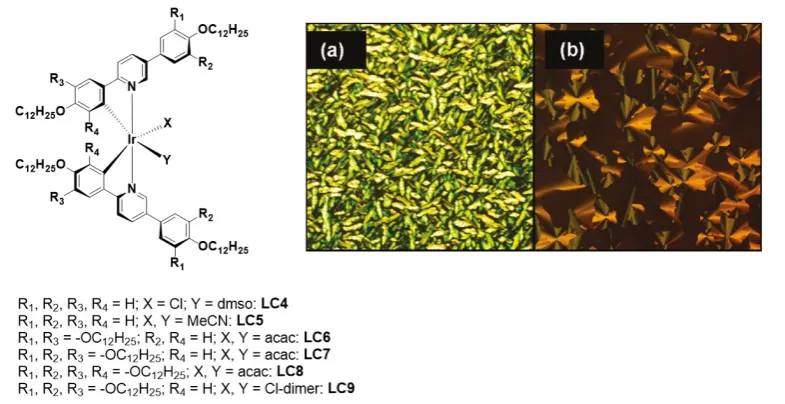
Complexes LC6 and LC7 were not liquid crystalline. It was indeed discovered that three polycatenar chains on each of the C^N ligands were necessary to confer liquid crystallinity upon the complexes. Thus, LC8 was both LC in nature and emissive, exhibiting a columnar hexagonal phase between 31 ˚C and 66 ˚C and emission at lPL = 582 nm with a FPL of 9.1%; no emission lifetime was reported. The µ-dichloro-bridged iridium dimer LC9 (Figure 10) also exhibited a columnar liquid crystal phase from room temperature to 75 ˚C. This iridium dimer was, however, weakly emissive at lPL = 570 nm, exhibiting a low FPL of 0.8% accompanied by a relatively long tPL of 5.1 μs.
Figure 10. Chemical structure of the LC molecular complexes and optical texture of complexes (a) LC5 (155 ˚C on cooling) and (b) LC9 (43 ˚C on cooling). Images a) and b) are adapted with permission from Ref. [91]. Copyright 2011, American Chemical Society.
Figure 11. a) Chemical structures of LC10, LC11, LC12 and LC13. b) optical micrograph (on cooling) of complexes: LC11 isomer 1, 100 ˚C (top-left); LC11 isomer 2, 60 ˚C (top-right); LC11 isomer 1, 100 ˚C (top-left); LC10 racemate, 85 ˚C (bottom-left); LC13, 133 ˚C (bottom-right). Image b) is adapted with permission. Copyright 2012, Wiley-VCH.[92]
Baranoff and co-workers[93] recently reported a modular approach to the design of mesomorphic phosphorescent iridium complexes. In their design, rod-shaped difluorobiphenyl cyclohexyl mesogenic groups were grafted onto the non-chromophoric acac ligand of the core structure [Ir(C^N)2(acac)] in complexes LC14, LC15, LC16 and LC17 (Figure 12). The C^N ligands (ppy and dFppy) dictated the photophysical properties of the complexes while the mesogenic units of the functionalized acac ligands controlled the mesomorphic properties of the materials.
Figure 12. Chemical structures of LC14, LC15, LC16 and LC17.
and 45% and tPL = 1.4 μs and 1.6 μs, respectively. As the functionalization of the acac ligand had little effect on the emission properties of the complexes in solution, the photophysical properties of LC14, LC15, LC16 and LC17 were very similar to those exhibited by the corresponding reference complexes [Ir(ppy)2(acac)] and [Ir(dFppy)2(acac)]. Each of LC14, LC15, LC16 and LC17 exhibited a smectic A mesophase with melting points between 150 ˚C and 170 ˚C. However, due to the unsymmetrical nature of LC16 and LC17, the mesophase of these two complexes were found to be enantiotropic.
Kozhevnikov, Bruce and co-workers[94] recently reported the luminescent and mesomorphic properties of a series of metal complexes (Zn(II), Co(III), Rh(III), Ir(III), Eu(III) and Dy(III)) based on the mesomorphic ligand 5,5ʺ-di(3,4,5-trialkoxyphenyl)terpyridine. Among this series of liquid crystals, the Ir(III) LCs, LC18 and LC19 (Figure 13), exhibited enantiotropic columnar mesophases (Colh) at temperatures higher than 140 ˚C that were dependent on the 5,5ʺ-di(3,4,5-trialkoxyphenyl)terpyridine ligand, with little influence of the iridium metal center.
Figure 13. Chemical structures of LC18 and LC19.
In degassed hexane LC18 and LC19 exhibited broad 3
terpyridine ligand, which increased the rigidity of the Ir(III) complex thereby reducing non-radiative decay pathways. In neat thin films at 298 K LC18 emitted at lPL = 619 nm while complex LC19 was found to be non-emissive. For LC18, the thin film photophysics were unchanged up to 100 ˚C while a 36 nm bathochromic shift was observed from 100 ˚C to 176 ˚C (lexc = 375 nm). This high temperature bathochromic shift was attributed to the reorganisation of LC18 upon entering the liquid crystal phase and generating an excimer-like emission. Excimer emission was also observed for Pt(II) liquid crystals bearing the 5,5ʺ-di(3,4,5-trialkoxyphenyl)terpyridine ligand scaffold.[95]
2.3. Luminescent gels
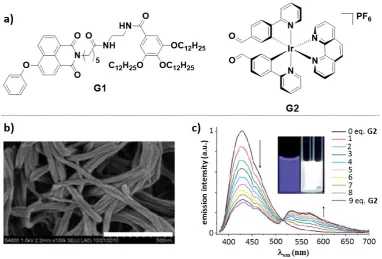
By combining the blue-emitting 1,8-naphtalimide-based gelator G1 with the orange-emitting iridium complex G2 (Figure 14a), Yi and co-workers[101] reported a white-emitting two-components supramolecular gel. G1 exhibited an excellent ability to gelate a series of polar or apolar organic solvents (e.g., cyclohexane, ethyl acetate, acetonitrile, acetone, methanol, propanol and dimethyl sulfoxide). Scanning electron microscopy (SEM) images of the xerogels of G1 showed the formation of interweaving fibers (Figure 14b). G1 could also efficiently form gel networks in acetonitrile in the presence of the iridium complex G2 in a molar ratio G1:G2 = 3:1. This xerogel had almost the same fiber framework as that of the neat G1 xerogel, with the iridium complex G2 assembled into nanoparticles of 20 – 50 nm dispersed into the gel fibers. G1 exhibited a blue fluorescence at lPL = 430 nm with a FPL of 26.7% in MeCN, while after gelation its emission was slightly red-shifted at lPL = 440 nm. The iridium complex G2, on the other hand, exhibited a structured orange emission at lPL = 533, 570 nm with a FPL of 2.2%. Upon photoexcitation of G1 in MeCN, inefficient energy transfer (with efficiency of approximately 0.5 - 5%) to the iridium complex G2 was promoted. However, due to the close proximity of the chromophores G1 and G2 in the gel fibers, the efficiency of the energy transfer increased up to 60 – 70%, leading to white light emission from the gel network of composition G1:G2 = 3:1 (CIE coordinates, x: 0.31, y: 0.39, Figure 14c).
white to blue. As a result, the emission properties exhibited by gel G1:G2 can be exploited for the detection of cysteine.
Figure 14. a) chemical structures of gelator G1 (left) and the iridium complex G2 (right). b) SEM images of xerogel G1 in acetonitrile at 298 K. c) Emission spectral changes of G1 as a result of the addition of G2 from 0.1 to 9 equivalents. Insets are images of the blue emitting G1 and white emitting gel G1:G2. Images b) and c) are adapted from Ref. [101] with permission from The Royal Society of Chemistry.
Szerb, Donnio and co-workers[103] reported that cationic Ir(III) complexes of composition [Ir(ppy)2(bpy)]+
X
spontaneously self-assembled into ordered aqueous gel phases when containing aliphatic carboxylate counterions, X
-, of the type of RCO2
11%, G5: lPL = 540 nm, FPL: 16%). By contrast, due to the long C7H15 aliphatic chain present on the counterion of G6, the complex was found to bepoorly soluble in water and it formed only turbid suspensions when dissolved in aqueous solution. The aggregation process of G3 -G5 into gels was investigated by wide- and small-angle x-ray scattering (WAXS and SAXS) and small-angle neutron scattering (SANS) measurements. At concentrations higher than 1.8 wt%, the gelification of G3-G5 occurred with close packing of supramolecular columns, sheathed in their solvation shells into 2D-rectangular lattices surrounded by their counterions. The overall organization of the gels G3-G5 is classified as a lamellar-columnar phase (Figure 15c).
The quasi-spherical shape of octahedral Ir(III) complexes is intrinsically unfavorable for face-to-face stacking and linearly polarized emission and therefore the number of emissive Ir(III) liquid crystals and gels reported to date are still limited. This contrasts, for example, with cyclometalated Pt(II) complexes that have square planar geometries and interact through both p-p and Pt-Pt bounding interactions, thus exhibiting good alignment with high polarization
ratio.[104, 105] As a result, the number of reports of luminescent liquid crystals and gels to date based on Ir(III) complexes are much fewer in number than those based on Pt(II) chromophores.
2.4. Surfactant-based structures
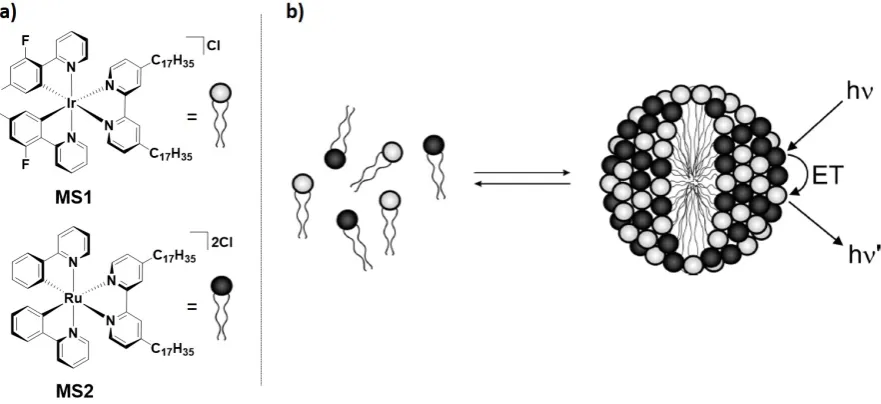
The term surfactant defines molecules soluble in both organic solvents and water. They generally consist of a polar headgroup and an apolar tail that confer amphiphilic behavior to the systems.[21] One of the characteristic feature of surfactants is their ability to self-assemble, under certain conditions, into well-define aggregate structures such as micelles, colloids or highly symmetric volume phases through amphiphilic interactions.[106] Recent advances in nanoscience and colloidal technology have strongly driven the development of colloidal structures with integrated multifunctional properties.[11] In this context, iridium-based surfactants, when opportunely designed, have shown the ability to self-assemble into colloidal structures, giving rise to amphiphilic networks with enhanced photophysical properties.
Figure 16. a) Chemical structure of the metallo-surfactants MS1 and MS2. b) self-aggregation of MS1 and MS2 into mix micelle and schematic illustration of ET from donor Ir to acceptor Ru. Image b) is adapted with permission from Ref. [107]. Copyright 2008, American Chemical Society.
The Ir(III) complex MS3 (Figure 17a) was designed similarly to MS1, to have a polar charged iridium head and long aliphatic tail appended to the ligands with the complex of composition [Ir(ppy)2(N^N)]PF6, where N^N is 2,2'-bipyridine functionalized with six apolar long aliphatic chains, bis-[4,4'-bis(3,4,5-trydodecyloxybenzoyloxymethyl)-2,2'-bipyridyl)].[108] As observed for MS1, MS3 exhibited high tendency to aggregate in water through interactions between the hydrophobic chains, resulting in a blue-shifted emission at lPL = 565 nm with higher FPL of 25.6% and longer bi-exponential emission decays of 210 ns,
700 ns compared to the emission exhibited in THF, where no aggregation was observed (lPL = 605 nm, FPL = 4.5%, tPL = 113 ns).
Figure 17. a) Chemical structures of a)MS3; b)MS4 and MS5 and c) copolymer MS6.
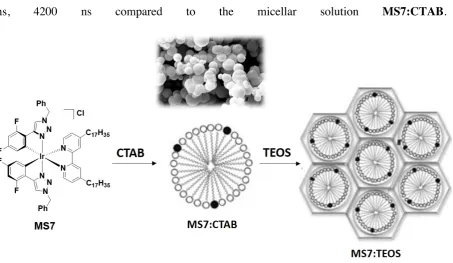
Phosphorescent materials based on templated synthesis of mesoporous silica using micellar solution of the Ir(III) metallosurfactant [Ir(dFptrBz)2(ppy-hd)]Cl (dFptrBz is 1-benzyl-4-(2,4-difluorophenyl)-1H-1,2,3-triazole and bpy-hd is 4,4'-diheptadecyl-2,2'-bipyridine), MS7 in CTAB were also investigated by Stucchi de Camargo, De Cola and co-workers[111] (Figure 18). MS7 exhibited a broad emission at approximately lPL = 500 nm with a FPL of 85% and a tPL = 1043 ns in degassed EtOH-H2O (1:1 v/v) at a concentration of 10-5
[image:34.595.76.530.357.620.2]M. Micellar solutions of MS7:CTAB (1:8000 ratio) also exhibited a broad emission at lPL = 500 nm with lower FPL of 42% and a tPL = 1040 ns. Due to the rigidification of the system and/or more restricted access of oxygen inside the pores of the host silica material, MS7:TEOS exhibited an emission at lPL = 460, 500 nm with a FPL of 45% and significantly longer bi-exponential lifetime of tPL = 1037 ns, 4200 ns compared to the micellar solution MS7:CTAB.
A different type of micellar system was reported by Mauzeroll, Sleiman and co-workers.[112] Through a ring-opening metathesis polymerization (ROMP), a tri-block polymer, MS6 (Figure 17c) containing an iridium complex with a core structure of composition of [Ir(ppy)2(bpy)]
+
as the luminescent unit, oligoethylene glycol, and biotin as biorecognition unit for binding streptavidin (Figure 17c) was prepared. As the Ir(III) blocks are hydrophobic and the PEG-based block is water soluble, the self-assembly of the polymer into a micellar system was possible upon addition of water to an acetonitrile solution of the polymer. Atomic force microscopy (AFM) evidenced the formation of nanoparticles with an average diameter of 20 – 50 nm, where the iridium complexes were located in the core of the micelles, while the biotin recognition units were situated at the surface. As observed for MS1-MS5, the emission of the iridium complex in MS6 was blue-shifted at lPL = 562 nm with slightly higher FPL of 34% compared to its monomeric emission in MeCN (lPL = 579 nm, FPL = 28%). Copolymer MS6 was used for bio-detection[113] and for electrogenerated chemiluminescence.[112]
Two examples of supramolecular polymers incorporating Ir(III) core structures [Ir(C^N)2(pic)][114] and [Ir(dFC^N)2(pic)][115] (pic is a picolinate ligand, and C^N and dFC^N are 2-phenylpyridinato- and 2-(2,4-difluorophenyl)pyridinato- derived cyclometalating ligands) used in OLEDs were reported by Huang, Zhu and co-workers. These systems take advantage of the efficient non-bonding assembly between both the bis(dibenzo-24-crown-8)-functionalized Ir(III) complexes-based monomers with the bis(dibenzylammonium)-tethered co-monomer. The formation of the polymeric assemblies was evidenced by 1
exhibited in neat film a structured emission at lPL = 416, 562, 604 nm with a FPL of 17%. OLEDs fabricated with this polymer showed a turn-on voltage of 6.6 V, a luminous efficiency of 14.6 cd· A-1 at a luminance of 450 cd·
m-2
and an EQEmax of 6.9%. The polymer incorporating the complex [Ir(dFC^N)2(pic)] exhibited in neat film sky-blue structured phosphorescence with lPL = 476, 497 nm and a high FPL of 78%. OLEDs fabricated with this polymer showed a turn-on voltage of 5.6 V, luminous efficiency of 6.89 cd· A-1
at a current density of 2.1 mA· cm-1
and an EQEmax of 3.96%.
2.5. Hydrogen bonding- and p-p-directing supramolecular networks
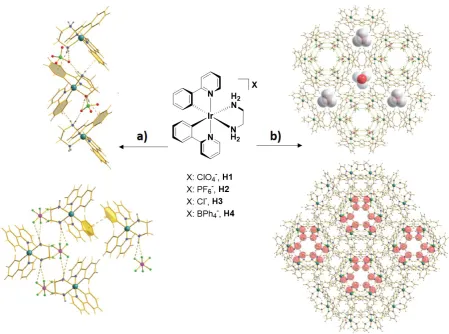
Hydrogen bonding and aromatic p-p-stacking interactions are particularly powerful building motifs employed in crystal engineering. Relevant examples of hydrogen bonding-directing supramolecular assembly of iridium(III) chromophore were reported by Talarico, Ghedini and co-workers[116] (Figure 19). The Ir(III) complexes [Ir(ppy)2(en)]X (en = ethylenediamine), with X
-: ClO4
(H1), PF6
(H2), Cl
(H3) and BH4
interactions, that formed two types of hexagonal channels along the crystallographic c axis
(Figure 19b): (i) empty hydrophilic channels where PF6- or Cl- ions and en ligands were
projected inwards and (ii) hydrophobic channels, defined by the ppy ligand,
accommodating templating solvent molecules. The complexes H1-H4 exhibited identical
Figure 19. Chemical structure of the Iridium complexes H1-H4; a) illustration of the 1D
motif in H1 along the c crystallographic axis (top) and H2 along the a crystallographic axis
(bottom). b) illustration of the crystal packing of H2 (top) and H3 (bottom) showing the
channeled networks along the c crystallographic axis. van der Walls radii (red and white balls)
for the crystallization solvent molecules are showed. Adapted from Ref. [116] with permission
from The Royal Society of Chemistry.
Our group reported two iridium complexes of the composition of [Ir(dfphtl)2(btl)]PF6 (H5)
and [Ir(dfphtl)2(btl)]Cl (H6) (dfphtl is 1-benzyl-4-(2,4-difluorophenylato)-1H-1,2,3-triazole
and btl is 1,1’-dibenzyl-4,4’-bi-1H-1,2,3-triazolyl) that exhibit the formation of 1D-networks
dictated by the hydrogen bonding motifs involving the triazole units (Figure 20).[117, 118]
motifs. The btl ligands formed C-H hydrogen bonds to the anions PF6- in H5 and Cl- in H6 and
a molecule of water, while the dfphtl triazole C-H groups acted as C-H hydrogen bond donors,
forming C-N⋯N bonds to one of the nitrogen atom of the btl ligand (Figure 20b). Complexes
H5 and H6 were not photostable at room temperature neither in solution nor in the solid
state.[117, 119] However, at 77 K in 2-MeTHF glass state H6 exhibited a weak emission at lPL
= 393, 419 nm.
Figure 20. a) Chemical structures of complexes H5 and H6 and b) view of the X-ray structure
of H5 showing the C-N⋯N hydrogen bonds propagating parallel to the c crystallographic axis.
Image b) is adapted from Ref. [118] with permission from The Royal Society of Chemistry.
Holdt and co-workers have shown that homoleptic octahedral Ni(II) and Fe(III) complexes bearing the 1,12-diazaperylene (dap) ligand and PF6
or BF4
as the counterion in [M(dap)3]2+ are able to form supramolecular assemblies in their crystalline state with honeycomb structures via p-p stacking interaction.[120] Homoleptic tetrahedral Cu(I) complexes of 2,11-alkylated dap ligand are similarly able to form supramolecular columnar assemblies through p-p interactions.[121] The work has been subsequently extended to investigate the self-assembly
isophenylisoquinoline, H7) gave a three-dimensional assembly in the crystalline state (Figure 21a). Complex H7 indeed exhibited p-p-stacking interactions involving both the dap and piq ligands, leading to the formation of rectangles consisting of four cationic complexes, assembled together through both p-p and CH-p interactions (Figure 21b). This particular crystal packing gave rise channels of 6.4 Å in height and 3.3 Å in width along the crystallographic c axis (Figure 21c). Complex H7 however was non emissive both in solution and in the crystalline state.
Figure 21. a) chemical structure of H7; b) illustration of the molecular rectangle exhibited by the x-ray structure of H7 by p-p stacking aggregation; c) illustration of the channels exhibited by the x-ray structure of H7. Hydrogen and counterions are omitted for clarity. Images b) and c) are adapted from Ref. [122] with permission from The Royal Society of
Chemistry.
3. Coordination-driven self-assembly
Coordination-driven self-assembly, which is based on the formation of metal-ligand bonds, has
proven to be a powerful method to prepare supramolecular well-defined nanostructures of
such as facile and rapid construction of the final products and high yields.[123-125] In this
section, we highlight the use of Ir(III) complexes as luminescent scaffolds in
coordination-driven self-assembly by describing the recent examples of luminescent coordination polymers,
metal-organic frameworks (MOFs), discrete structures, capsules and cages.
3.1. Coordination polymers, metal-organic frameworks and discrete structures
Coordination polymers (CPs) and metal-organic frameworks (MOFs) are highly crystalline and porous materials constructed from metal ions or clusters usually bound to carboxylate or nitrogen capped organic linkers to form extended one-dimensional (1D), two-dimensional (2D) and three-dimensional (3D) networks.[17, 27, 126, 127] Because of the high surface area and structural tunability, Ir(III)-based CPs and MOFs have been primarily used as functional materials for gas storage and purification, sensing and catalysis.
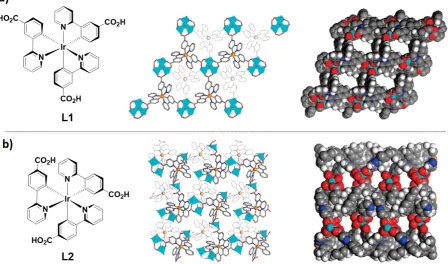
Figure 22. From left to right: a) chemical structure of metalloligand L1; a top view of the 2D bilayer of the x-ray structure of P1 and space-filling model of the x-ray structure of P1. b) chemical structure of metalloligand L2;a top view of the 2D bilayer of the x-ray structure of P2 and space-filling model of the x-ray structure of P2. Adapted with permission from Ref. [128]. Copyright 2010, American Chemical Society.
However, due to its smaller porosity no N2 or CO2 uptake was observed for P2. The solid-state emission of P1 was red-shifted at lPL = 540 nm compared to that of L1 (lPL = 520 nm), while the emission of P2 was blue-shifted at lPL = 550 nm compared to that of L2 (lPL = 575 nm) (Table 1). Both P1 and P2 were sensitive to O2 via the expected efficient and reversible luminescence quenching of the Ir(III) phosphors. When polymers P1 and P2 and metalloligands L1 and L2 were subjected to a gradual increase in O2 partial pressure (from 0.05 to 1.0 atm), their luminescence intensity gradually decreased and, after addition of 1.0 atm of O2, the quenching efficiencies of P1, P2, L1 and L2 were, respectively, 59% and 41%, 16% and 8%. As oxygen can be trapped within the pores of P1 and P2 and thus in persistent close contact with the Ir(III) luminophores, the emission quenching efficiencies of P1 and P2 were correspondingly higher than those of L1 and L2.
Four Ir(III) coordination polymers [Zn(L3)2]· 3DMF· 5H2O (P3a), [Cd(L3)2(H2O)2]· 3DMF· 6H2O (P3b), [Co(L3)2(H2O)2]· 2DMF· 8H2O (P3c) and [Ni(L3)2(H2O)2]· 3DMF· 6H2O (P3d) wereformed byusing [Ir(ppy)2(H2dcbpy)]PF6 (H2dcbpy is 4,4'-dicarboxy-2,2'-bipyridine) as the bridging metalloligand (L3, Figure 23a) and Zn2+
, Cd2+
, Co2+
and Ni2+
exhibited CT emission from single crystals atlPL = 613 nm, lPL = 595 nm, lPL = 587 nm and lPL = 600 nm, respectively with FPL values of 27.4%, 19.3%, 0.1% and 0.2%, respectively (lPL
[image:44.595.80.534.300.445.2]= 613 nm and FPL of 17.8% for L3 in the solid state, Table 1). As reported for P1 and P2, polymers P3a, P3b, P3c, P3d also exhibited reversible oxygen-sensing properties. Indeed, at 1 atm of O2 the emission quenching efficiencies from their single crystals were, respectively, 46%, 74%, 57% and 52%. The emission spectra and photos in Figure 23c show the emission quenching of P3b upon gradual addition of oxygen.
Figure 23. a) Chemical structure of L3; b) illustration of two layers (in yellow and blue) of
the 3D cadmium-bridged structure of P3b with open channels. c) Emission quenching of P3b
upon addition of an increased amount of O2. Insets are images of the emissions from the crystal
P3b, with 100% N2, and with 100% O2. Images b) and c) are adapted from Ref. [129] with
permission from The Royal Society of Chemistry.
In a subsequent report, the same group developed an electrochemical method to produce the
Ir(III)-Zn(II) coordination polymer [Zn(L3)2]· 3DMF· 5H2O (P3a) with greater control over the crystal growing process. With this improved synthetic method, polymer P3a exhibited
higher crystal stability and enhanced oxygen sensing performance.[130] Indeed, when
electrochemically produced, P3a exhibited a high selectivity towards the absorption of O2 with
of P3a, the gradual addition of glucose to the crystals of P3a restored its emission at lPL = 596 nm upon excitation at 405 nm. As the consumption of oxygen due to the combustion reaction between glucose and O2 was linearly correlated to the reduction of the emission quenching of
P3a, quantitative detection of glucose within the concentration range of 0.05 – 6.0 mM was
also possible.
Three luminescent coordination polymers were synthetized by assembling metalloligand L3
with Mg(II) ions, respectively, in H2O, DMF and DEF (DEF is N,N-diethylformamide) to form
Figure 24. a) view of the coordination environments of the Mg(II) ions in P3e, P3f and P3g.
Insets are images of the powder emissions upon UV irradiation. b) View of the 1D chains
exhibited by the coordination polymers. Adapted with permission from Ref. [131]. Copyright
2016, American Chemical Society.
Metalloligand L3 was also used in heteronuclear Ir(III)-Ln(III) coordination polymers as a
light-harvesting antenna to sensitize Ln(III)-based near-infrared (NIR) luminescence from
Gd3+, Yb3+, Er3+ and Nd3+ ions.[132] The polymers Ir-Gd, Ir-Yb, Ir-Er and Ir-Nd are all
isostructural and each crystallized in a triclinic P1 space group where one Ln(III) center is seven-coordinate by five carboxylate oxygen atoms from five L3 ligands and two hydroxylic groups from NaOH added to prepare to polymers, generating a pentagonal bipyramid coordination geometry. In the reference Ir-Gd polymer, as the Gd3+
ions cannot accept energy from the Ir excited state because of the absence of energy levels below 3200 cm-1
luminophore at lPL = 610 nm with a tPL of 8.1 µs (L3 emits in the solid state at lPL = 592 nm with a tPL of 7.8 µs). For the other three luminescent polymers Ir-Ln (Ln: Yb, Er, Nb), the Ir-based emission centred at 610 nm was largely quenched, indicating that Dexter d ® f energy transfer from the Ir(III) units to the Ln3+ ions was efficiently promoted. The fastest energy
transfer rate was observed for the Ir-Nd polymer, with a calculated quenching rate constant
(kq) of 6.8 × 10⁶ s-1, while for Ir-Yb and Ir-Er, kq of 5.0 × 10⁵ s-1 and 6.0 × 10⁶ s-1 were,
respectively, obtained.
A related example of a Ir(III)-Ln(III) discrete structure was reported by Zheng and
co-workers[133] by microwave reaction between the iridium complex [Ir(ppy)2(dppH)], L4 (dppH
is 2-pyridyl phosphonic acid) and Dy(CF3SO3)3 in MeOH at 100 ˚C. The composition of the
resultant structure, P4, was identified to be [Dy(L4)6](CF3SO3)]·8H2O by x-ray diffraction
Figure 25. Chemical structure of complex L4 and X-ray structure of the Ir(III)-Dy(III)
assembly P4. The red balls illustrate the octahedral coordination around the Dy ion (in
light-blue).
Crystallisation of PPN3a (Figure 2a, PPN is bis(triphenylphosphine) iminium cation) in the
presence of excess of the Ln ions Gd, Nd, Eu led to the formation of assemblies based on
Ir-CN-Ln bonding, which generated in the solid state either Ir2Ln2(μ-CN)4 square assemblies or linear trinuclear species with Ir-CN-Ln-NC-Ir cores.[134] In the Ir-Eu and Ir-Nd assemblies the vibronic emission of PPN3a in the solid state at lPL = 484, 507 nm was substantially quenched due to energy transfer to the lower-lying f-f states on these Ln ions. By contrast, similar to that observed for the Ir-Gd polymer previously described,[132] in the Ir2Gd2(μ-CN)4 complex the Gd cannot accept the energy from the Ir chromophore and therefore no energy transfer was promoted.
A heterogeneous coordination polymer, P3h, based on the assembly between metalloligand
L3 and Y3+ ions (Figure 26) was used as a catalyst for the photochemical reduction of
CO2.[135] Similar to the Ir(III)-Ln(III) polymers previously described, P3h crystallizes in a
of their respective energy levels. Indeed, P3h displayed in the crystal state a strong Ir-based emission centered at lPL = 592 nm, with a bi-exponential emission decay with the longest component of tPL = 29.0 µs (Table 1). The emission decay of P3h was found to be almost four times longer than that exhibited by L3 (tPL = 7.8 µs). P3h exhibited remarkable photocatalytic activity for CO2 reduction under visible-light irradiation (lexc = 475 nm). The quantum yield of HCOO- production was 1.2% with a high turnover frequency (TF) of 118.8 µmol (g of cat.)-1 h-1
.
Figure 26. x-ray structure of P3h illustrating: a) pentagonal bipyramid coordination geometry of the Y(III) ions; b) view of 1D-chain structures and c) view of 3D networks. Adapted from Ref. [135] with permission from The Royal Society of Chemistry.
Similar to the behavior of polymers P3a, P3b, P3c and P3e, P3f and P3g, the enhanced emission of MOF1 compared to L3 is attribute to the enhanced rigidity and symmetry experienced by the Ir(III) luminophores in the coordination frameworks, which reduces non-radiative decay modes. MOF1 exhibited good sensing abilities towards nitroaromatic compounds. Remarkably, when aromatic compounds with high nitro content such as TNT (trinitrotoluene) were diffused into the crystal at a concentration of 625 ppm, the emission of MOF1 was quenched by 60%-70% via electron transfer from the Ir(III) luminophores to the nitroaromatic acceptors.
Lin and co-workers[137] successfully incorporated three iridium-based water-oxidation catalysts, [Ir(Cp*)(dcppy)Cl] (L5), [Ir(Cp*)(dcbpy)Cl]Cl (L6) and [Ir(dcbpy)2(OH2)2]OTf (L7) (Figure 27a) (where Cp* is pentamethylcyclopentadienyl, dcppy is 2-phenylpyridine-5,4'-dicarboxylic acid, dcbpy is 2,2'-bipyridine-5,5'-2-phenylpyridine-5,4'-dicarboxylic acid and OTf is trifluoromethyl sulfonate) into the octahedral Zr6O4(OH)4(bpdc)6 framework UiO-67 (bpdc is para-biphenyldicarboxylate), forming, respectively, MOF2, MOF3 and MOF4 (Figure 27a). When these materials were tested as photocatalysts for water oxidation by using cerium ammonium nitrate (CAN) as the oxidant, turnover frequencies (TOFs) of 4.8, 1.9 and 0.4 h-1
for MOF2, MOF3 and MOF4 were, respectively, reported. Higher TOFs of 7.5 and 94.5 h-1
were, however, observed when the Ir(III) complexes bearing elongated linear bridging ligands L8 and L9 (Figure 27b) were, respectively, incorporated into the octahedral zirconium frameworks (MOF5 and MOF6).[138] The higher TOFs of MOF5 and MOF6 compared to MOF2-MOF4 were attributed to the extended networks generated with wider channel sizes where the hydrated Ce4+
Figure 27. a) Chemical structures of the Ir(III) metalloligands L5, L6 and L7. b) Chemical structures of the extended Ir(III) metalloligands L8 and L9. c) Structure model for MOF6 showing the octahedral cage of 1 nm in diameter. Zr, blue polyhedron; Ir, green balls; Cl, dark green, C, grey; N, blue. The red ball in the middle represents the cage cavity. Image c) is adapted with permission from Ref. [138]. Copyright 2012, American Chemical Society.
frameworks and electron-injection into the Pt-nanoparticles. The larger channels of Pt-MOF8, resulting from the use of the elongated ancillary ligand on L11, promoted enhanced catalytic efficiency of Pt-MOF8 compared to Pt-MOF7 under visible light irradiation, with triethylamine (TEA) serving as a sacrificial reducing agent. Over 48h, Pt-MOF8 and Pt-MOF7 exhibited, respectively, TONs of 2400 and 7000 h-1
[image:52.595.102.494.278.537.2]. The MOF materials proved to be very stable and could be collected back after catalytic experiments and recycled for use at least three further times without loss of activity.
Figure 28. Schematic representation of the formation of: a) Pt-MOF7 and b) Pt-MOF8. Red balls are Zr atoms, white linkers are bpy-dc, yellow linkers are L10, green linkers are L11 and in grey are Pt nanoparticles. Adapted with permission from Ref. [139]. Copyright 2012, American Chemical Society.
A supramolecular system composed of the iridium complex [Ir(ppy)2bCD)]Cl
as the photosensitiser, viologen functionalised with two adamantyl moieties as the
electron-relay and cyclodextrin coated platinum nanoparticles as the catalyst, was also tested for
photoinduced hydrogen evolution from water.[140] The system was designed to assemble
through adamantane – cyclodextrin non-covalent interactions and therefore to give rise to
photoinduced electron transfer from the iridium chromophore to the Pt nanoparticle via the
viologen bridge (Figure 29). Interestingly, with ethylendiaminetetra-acetic acid (EDTA)
serving as a sacrificial donor, this supramolecular system could produce almost 32 µmoles
(approximately 0.75 ml) of H2 per hour from 10 ml of H2O, which was a higher yield than the
analogous supramolecular system involving a ruthenium chromophore in
Ru-bpy/viologen/Pt.[141]
Figure 29. Illustration of the supramolecular assembly Ir/viologen/Pt used for
photoproduction of H2. Adapted with permission. Copyright 2012, Wiley-VCH.[140]
Two Ir(III) metalloligands containing six carboxylic acid groups appended at the
(cyclam is 1,4,8,11-tetraazacyclotetradecane), forming two networks of cubic topologies (MOF9 and MOF10).[142] MOF9 and MOF10 both crystallized in trigonal space groups (R-3 and R-(R-3c, respectively) where the Ni(II) cations are in octahedral coordination environments bound to four nitrogen atoms of the cyclam ligand and to two carboxylate groups from two L12 and L13 metalloligands, respectively, along the z-axis. As illustrated in Figure 30c, the crystal packing of MOF9 and MOF10 gave rise to two sets of interlocked primitive cubic networks. The materials exhibited small pore sizes and therefore poor ability to absorb CO2 and N2. For example, at 298 K and 1 atm, the sorption capacity of MOF9 for CO2 was 13.2 cm3
g-1
, while that of MOF10 was 29.6 cm3· g-1
[image:54.595.92.505.384.547.2]. The luminescence properties of MOF9 and MOF10 were not investigated.
Figure 30. a) Chemical structure of L12; b) chemical structure of L13 and c) illustration of
the interlocked cubic topology exhibited by the crystal structures of MOF9 and MOF10.[142]
Image c) is adapted with permission. Copyright 2017, Wiley-VCH.[142]
N,N-dimethylacetamide and DEF is N,N-diethylformamide) were recently reported by Zheng and co-workers.[143] X-ray single-crystal structure analyses revealed that MOF11, MOF12 and MOF13 are isostructural and crystallized in the monoclinic space group P21/n, showing a three dimensional framework where complex L1 bridges three Cd2+
[image:55.595.97.513.218.376.2]ions through its six carboxylate oxygen atoms (Figure 31).
Figure 31. a) Building units of MOF11 and b) View of the 3D structure of MOF11, showing the channels along the b-axes. Solvent molecules are removed for clarity. Image is adapted with permission from Ref. [143]. Copyright 2018, American Chemical Society.
The powder emission of MOF11 was broad, originating from a 3
MLCT state, and red-shifted at lPL = 519 nm with longer tPL of 2.95 µs (Table 1) compared to the powder emission exhibited by complex L1 (lPL = 488, 510 nm, tPL of 1.93 µs). The red-shifted emission observed for MOF11 is due to coordination of the Cd2+
ions to the iridium complex, which decrease the LUMO thereby giving rise to a smaller optical gap, while the increased rigidity reduces non-radiative decay andaccounts for the longer tPL in MOF11 compared to that of L1. MOF11 was found to be soluble in water and emissive at 515 nm. The sensing ability of MOF11 towards metal cations (Na+
, Mg2+ , K+
, Ca2+ , Cr3+
, Mn2+ , Fe3+
, Co2+ , Ni2+
, Cu2+
and Zn2+
) and various anions (F
-, Cl -, Br
-, I -, BrO3
-, IO3 -, NO3
-, CO3 2-, SO4
2-, PF6
-, HPO4
and Cr2O7
analytes, MOF11 exhibited selective sensing for the cation Fe3+
and the anion Cr2O7 with detection limits of 67.8 and 145.1 ppb for Fe3+
and Cr2O7
2-, respectively. MOF11 also exhibited selective sensing of adenosine triphosphate (ATP
2-) over both adenosine diphosphate (ADP 2-) and adenosine monophosphate (AMP
2-). Indeed, following gradual addition of ATP2- to an aqueous solution MOF11 or exposing a PMMA-doped film of MOF11 to vapors of ATP
a significant phosphorescent quenching of MOF11 was observed; no emission quenching was observed when either ADP
and ATP
were added to MOF11.
Figure 32. Formation of the paddlewheel structure P5 by reacting the iridium complex L14 with Cu(II) ions. The x-ray structure of P5 is shown (carbon, oxygen, copper and iridium atoms are shown respectively in grey, red, orange and yellow).
More recently the same group reported two homochiral heterometallic coordination networks involving cyclometalated Ir(III) chiral metallotectons.[145, 146] Enantiopure D- and racemic rac-Ir(III) complexes, D-, rac-L15 and D-, rac-L16, of composition of D-, rac-[Ir(C^N)2(py-alk-bpy)]PF6 (where C^N is ppy in L15 and dFppy in L16 and py-alk-bpy is 5,5'-bis(pyridine-4-ylethynyl)-2,2'-bipyridine) were assembled, respectively, with Cu(I)[145] and Cd(II)[146] ions (Figure 33a and 33b, respectively). When an EtOH solution of [Cu(NCMe)4]BF4 was left to slowly diffuse into an MeCN solution of rac-L15, single crystals suitable for x-ray diffraction were obtained. The structural investigation of these crystals revealed the formation of a grid-type network (Figure 33a), where Cu(II) ions, formed during the crystallization process from oxidation of Cu(I) under ambient conditions, adopted a slightly distorted octahedral geometry, with four pyridyl units of four L15 molecules occupying the square base of the octahedron and two BF4
crystal. No single crystals were obtained when the enantiopure D-L15 was used in the assembly. Metalloligand rac-L15 exhibiteda mixed 3
MLCT/3
[image:58.595.150.456.187.500.2]LLCT emission in the solid state at lPL = 677 nm with a FPL of 3% (Table 1), while no emission could be detected from the grid-type network.
Figure 33. a) Self-assembly between metalloligands D-, rac-L15 and Cu(I) ions yielding the Ir-Cu grid-type network. In orange is illustrated the coordination around the Cu(I) ions.[145] b) Self-assembly between metalloligands D-, rac-L16 and Cd(II) ions yielding the Ir-Cd linear network. In red is illustrated the coordination around the Cd(II) ions.
CdI2 demonstrated the formation identical structures. These resembled infinite 1D networks where the Cd centers adopted a trigonal bipyramidal coordination geometry with the two terminal pyridine moieties of D-L16 and rac-L16 occupying the apical positions, and three iodine atoms located at the trigonal base (Figure 33b). In the case of the network involving rac-L16, consecutive homochiral planes of opposite chirality were packed in a parallel fashion, resulting in the formation of non-chiral crystals. By contrast, the assembly of enantiopure D-L16 with CdI2 resulted in the formation of a chiral 1D network. Metalloligand rac-L16 exhibited structured emission in both degassed THF and in the solid state with two maxima at lPL = 570, 605 nm, but with divergent FPL of 19% (tPL of 1.47 µs) and 2%, respectively (Table
1); no lifetime data were reported in the solid state. The racemic and enantiopure Ir(III)-Cd(II) coordination networks exhibited structured emission in the solid state with two emission maxima red-shifted at lPL = 575, 620 nm and with lower FPL < 1% compared to rac-L16. The red-shifted emissions of the Ir-Cd networks are attributed to the lowering of their LUMO energy levels as a result of the binding of the Lewis-acidic Cd(II) ions to the pyridine moieties of L16.
Table 1.Relevant photophysical properties at 298 K of Ir(III) metalloligands, CPs and MOFs
medium lPL (nm) FPL (%) tPL (µs) reference
L1 powder 520 - 1.9 128, 143
L2 powder 575 - - 128
L3 powder 613 17.8 7.8 129, 131, 132,
135, 136
L4 powder 538 - - 133
L14 DCM 710 - - 144
rac-L15 powder 677 3 145
rac-L16 powder, (THF)
570, 605 2 (1.5) 146
P1 powder 540 - - 128
P2 powder 550 - - 128
P3a crystal 613 27.4 - 129
P3b crystal 595 19.3 - 129
P3d crystal 600 0.2 - 129
P3e powder 544 14.6 7.7 131
P3f powder 554 18.1 13.3 131
P3g powder 570 2.4 7.7 131
P3h crystal 592 - 29.0 135
P4 powder 531 - - 133
MOF1 powder 602 23.6 14.3 136
MOF11 powder 519 2.9 143
3.2. Macrocycles, capsules and cages
In the previous section, we documented extended structures incorporating iridium
metalloligands. Here, we summarize discrete cage-like structure incorporating iridium.
Coordination capsules and cages, formed through the self-assembly of arrays of metal ions and
bridging ligands, have been areas of great interest in supramolecular chemistry during the last
two decades.[147-149] Small guest molecules have been shown to be sequestered within the
cavities of these cages and their host-guest interactions have been exploited in the context of
sensing, gas storage and purification, and for catalysis.[150, 151] In recent years a small
number of photophysically active capsules and cages that include Ir(III) metalloligands as
luminescent units have been reported. In addition, iridium half-sandwich complexes of Cp*Ir
(Cp* is penthamethylcyclopentadienyl) have been extensively used in macrocyclic chemistry
to form a wide range of 2D-assemblies, including molecular squares, rectangles and triangles,
with application in catalysis.[152-154] As these macrocycles have been already reported in
pertinent review articles, they are not included herein.
A luminescent tetranuclear square-like macrocycle was reported by Baranoff and