Available online at www.ijpsdr.com
International Journal of Pharmaceutical Sciences and Drug Research 2012; 4(4): 230-235
230
Research Article
ISSN 0975-248X
Development and Evaluation of Fast Dissolving Tablets of Fosinopril by
Sublimation Method
N. G. Raghavendra Rao
1*, Mahesh Kumar
2, Mettu Srikanth Reddy
1, C. Kistayya
1,
B. Mahipal Reddy
11PG. Department of Pharmaceutics, Jyothishmathi Institute of Pharmaceutical Science, Karimnagar -505 481,
Andhra Pradesh, India
2Department of Pharmaceutics, Luqman College of Pharmacy, Gulbarga-585 102, Karnataka, India
ABSTRACT
Fosinopril is an antihypertensive, angiotensin converting enzyme inhibitor. This is used in the treatment of various cardiovascular disorders such as heart failure, to reduce proteinuria and renal disease in patients with nephropathies, and to prevent stroke, myocardial infarction, and cardiac death in high-risk patients and hypertension. In present research work an attempt has been made to prepare fast dissolving tablets of Fosinopril with increased rate of dissolution may leads to increase bioavailability. The fast dissolving tablets of Fosinopril were prepared by using sublimation method. Croscarmellose sodium is used as a superdisintegrant. Camphor, Urea and Menthol are used as a sublimating agent. The prepared tablets were evaluated for various parameters like weight variation, hardness, friability, disintegration time, drug content, water absorption ratio, wetting time, in-vitrodrug release, FTIR, DSC studies and short term stability studies. IR spectral analysis and DSC study showed that there was no drug interaction with formulation additives of the tablet. The blend was examined for the pre-compressional parameters. The prepared tablets formulations were evaluated for post-compressional parameters. The values of pre-compression parameters evaluated were within prescribed limits and indicated good free flowing property. All the post-compressional parameter are evaluated were prescribed limits and results were within IP acceptable limits. The disintegration time of 17 to 52 sec, water absorption ratio of 50.75 to 84.41%, wetting time of 23.41 to 36.61sec.In-vitro dissolution studies on the promising formulations SF3, SF6 and SF9 formulations were carried out in 6.8 phosphate buffer solution. This data reveals that overall, the formulation SF3, SF6 and SF9 shows nearly faster drug release. The formulations SF3, SF6 and SF9 50 % of drug released in 0.67 min, 0.73min, and 0.69 min, respectively, and 90 % of drug released in 2.93 min, 4.88 min, and 3.83 min, respectively when compared to other tablet formulation. Among all the formulation SF3 were found to be promising and showed a disintegration time of 17 sec, 50 % of drug released in 0.67 min, and 90 % of drug released in 2.93 min. The stability study conducted as per the ICH guidelines and the formulations were found to be stable. The results concluded that fast dissolving tablets Fosinopril showing enhanced dissolution, will lead to improved bioavailability, improved effectiveness and hence better patient compliance.
Keywords:Fast dissolving tablet, Fosinopril, Croscarmellose sodium, Camphor, Menthol, Disintegration time.
INTRODUCTION
Chemically Fosinopril is described as (2S, 4S) - 4-cyclohexyl- 1 - [2- [(2-methyl-1-propanoyloxypropoxy)-(4-phenylbutyl) phosphoryl] acetyl] pyrrolidine-2-carboxylic acid. This is used in the treatment of various cardiovascular disorders such as heart failure, to reduce proteinuria and renal disease in patients with nephropathies, and to prevent stroke,
*Corresponding author: Dr. N. G. Raghavendra Rao,
Principal and Professor, Jyothishmathi Institute of Pharmaceutical Science, Ramakrishna Colony, Thimmapur, Karimnagar-505 481, Andhra Pradesh, India;
Tel.:+91-9966794479, +91-9448570193;
E-mail: [email protected]
myocardial infarction, and cardiac death in high-risk patients and hypertension. Oral bioavailability of Fosinopril is around 36% and having half-life 12 hours.[1-4]
drug delivery over others are ease of swallowing for patients and convenience of taking the medication anytime without the need of water. [5] Pediatric and geriatric patients in particular experienced the greatest difficulty in swallowing tablets as well as people who are ill and supine in bed and those patients who are busy traveling without having access to water. New and novel oral drug delivery systems that dissolve or disperse quickly in a few seconds after placement in the mouth without water can alleviate the problem of swallowing tablets.[5]
The desired criteria for the FDT they should Have a pleasing mouth feel, Leave minimal or no residue in the mouth after oral administration and not require water to swallow, but it should dissolve or disintegrate in the mouth in a matter of seconds.[6-7]
In present research work an attempt has been made to prepare fast dissolving tablets of Fosinopril by using sublimation method. Sublimation method gives good results than direct compression method because it gives faster disintegration time when compared to direct compression method. Therefore, sublimation method appears to be a better option for manufacturing of tablets. The fast disintegrating tablets are prepared by sublimation method, in general based on the action established by super disintegrant such as croscarmellose sodium and sublimating agents such as Camphor, Urea and Menthol. Effects of sublimated tablets (Drug, polymer and sublimating agent) on wetting time, disintegrating time, drug content, in-vitro release, and stability studies parameters have been studied.
MATERIAL AND METHOD
Fosinopril was procured from Chandra analytical Laboratories Hyderabad, Andhra Pradesh. Croscarmellose sodium was procured as a gift sample from Signet (Mumbai), camphor, menthol, mannitol, MCC, aspartame, talc and magnesium stearate purchased from S.D. Fine chem., Mumbai. All other materials were of analytical reagent grade.
Preparation of fast dissolving tablets by direct compression technique [8]
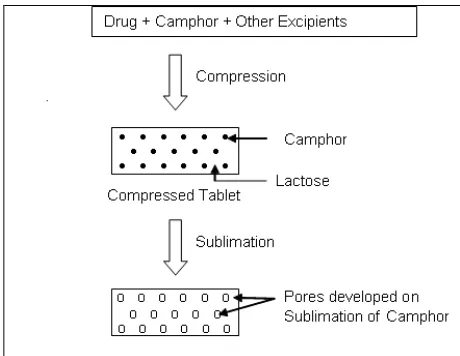
Fosinopril tablets were prepared by sublimation technique. The basic principle involved in preparing fast dissolving tablets by sublimation technique is inert solid ingredients (E.g. urea, urethane, ammonium carbonate, camphor, naphthalene, menthol) were added to other tablet excipients and the blend was compressed into tablet. Removal of volatile material by sublimation generated a porous structure. Compressed tablets containing mannitol and camphor or menthol or urea have been prepared by sublimation technique. The tablets dissolve within 10-20 sec. and exhibit sufficient mechanical strength for practical use.
Nine formulations were developed by varying concentration of subliming agent i.e. camphor, menthol and urea. Accurately weighed ingredients were sifted through sieve no.44 and thoroughly mixed for 10 min and magnesium stearate and other ingredients were added to the blend and thoroughly mixed. The tablets were compressed using Rimek tablet punching machine. The compressed tablets were than subjected to sublimation at 50C for 60 min. The tablets were evaluated for disintegration time and mean tablet weight. Fast dissolving tablets of Fosinopril were prepared by sublimation method according to the formula given in Table 1.
Compatibility studies
IR Studies: IR spectra for pure drug and SF3, SF6 and
SF9powdered tablets were recorded in Infrared
spectrophotometer with KBr pellets.
DSC Studies: DSC studies were carried out pure drug Fosinopril and best formulations like, SF3, SF6 and SF9 DSC scan of about 5 mg; accurately weighed Fosinopril and optimized formulations were performed by using an automatic thermal analyzer system. (DSC60 Shimadzu Corporation, Japan) Sealed and perforated aluminium pans were used in the experiments for all the samples. Temperature calibrations were performed using indium as standard. An empty pan sealed in the same way as for the sample was used as a reference. The entire samples were run at a scanning rate of 10°C/min from 50-300°C.
Table 1: Formulation of Fosinopril fast dissolving tablets prepared by sublimation method (1-tablets)
Ingredient (mg)
Formulation code
SF1 SF2 SF3 SF4 SF5 SF6 SF7 SF8 SF9 Fosinopril 20 20 20 20 20 20 20 20 20
CCS 24 24 24 24 24 24 24 24 24
Camphor 10 20 30 -- -- -- -- --
--Urea -- -- -- 10 20 30 -- --
--Menthol -- -- -- -- -- -- 10 20 30
Aspartame 6 6 6 6 6 6 6 6 6
D-M 45 45 45 45 45 45 45 45 45
MCC 77 67 57 77 67 57 77 67 57
P V P 15 15 15 15 15 15 15 15 15
Talc 1 1 1 1 1 1 1 1 1
Mg St 2 2 2 2 2 2 2 2 2
Total 200 200 200 200 200 200 200 200 200 Note: CCS=Croscarmellose sodium, D-M=D-Mannitol,
MCC=Microcrystalline cellulose (Avicel PH-102), Mg St= Magnesium stearate.
Fig. 1: Schematics figure of Sublimation method for design of Mouth dissolving tablets
Evaluation of Fosinopril tablets
Pre-compression Parameters: The tablet blends were evaluated for their bulk density, tapped density, Carr’s index and flow properties.
Table 2: FTIR interpretation data of selected fast dissolving tablet
S. No. Fosinopril SF3 SF6 SF9 REMARKS
1 3400 3400 3400 3400 3290.This is may be due to OH groups of various polymers used. In some polymers the OH OH of COOH of pure drug. In the spectra of F4.absorption band is observed around is due to ketaral tantamarism.
2 29262858
2926 2908 2859
2923
2857 29232862 C-H stretching of CH3and CH2groups.
3 1759 1756 1757 1756 C=C.
4 16241600 16241601 16231601 16271601 C=C Ring stretching.
5 14521410 14521420 14551424 14551421 C-H Bending of CH3and CH2groups.The slight variation in the values of spectra of polymers is due to steric hindrance.
6 1245 1252 1245 1245 O-H
7 10651014 10821019 10621018 10811020 C-O-C
8 790 786 787 786
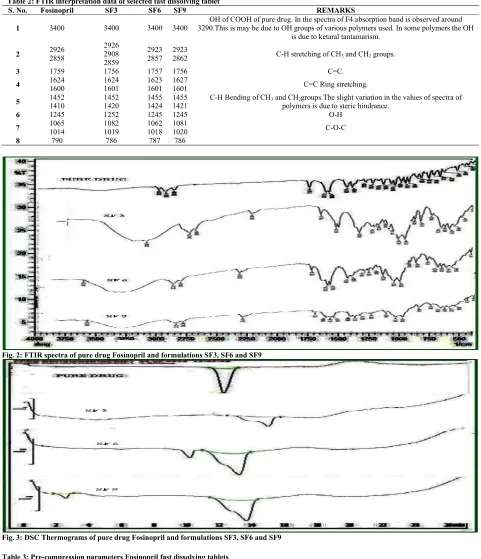
Fig. 2: FTIR spectra of pure drug Fosinopril and formulations SF3, SF6 and SF9
Fig. 3: DSC Thermograms of pure drug Fosinopril and formulations SF3, SF6 and SF9
Table 3: Pre-compression parameters Fosinopril fast dissolving tablets
FC Bulk density (g/cc)SD, n=3 Tapped Density (g/cc)n=3 SD, Angle of repose (degree)SD, n=3 Carr’s(%)SD, n=3index Hausner’s RatioSD, n=3
SF1 0.53 0.002 0.64 0.01 28.32 1.52 17.18 1.0 1.20 0.02
SF2 0.46 0.005 0.62 0.01 27.08 1.20 16.12 1.52 1.19 0.04
SF3 0.55 0.003 0.56 0.02 28.21 1.70 16.66 1.20 1.23 0.03
SF4 0.44 0.008 0.64 0.03 29.11 0.88 15.62 1.31 1.24 0.03
SF5 0.51 0.007 0.53 0.02 28.43 1.46 19.04 1.13 1.23 0.06
SF6 0.50 0.009 0.61 0.02 26.38 1.31 18.03 0.93 1.22 0.07
SF7 0.53 0.002 0.580.31 28.73 1.40 15.87 1.42 1.18 0.11
SF8 0.54 0.005 0.65 0.02 26.10 1.13 16.92 1.10 1.22 0.09
SF9 0.42 0.004 0.56 0.01 27.28 1.26 16.12 0.80 1.24 0.04
Table 4: Post-compression parameters Fosinopril fast dissolving tablets
FC Hardness *(Kg/cm²)
SD
Friability (%)
Thickness* (mm)SD
Weight variation*
(mg)SD SF1 3.3 0.17 0.61 0.07 3.42 0.13 100.10 1.2
SF2 3.2 0.15 0.64 0.09 3.64 0.16 98.32 1.4
SF3 3.3 0.18 0.65 0.10 3.48 0.15 100.44 12.0
SF4 3.2 0.17 0.60 0.03 3.66 0.13 100.66 1.2
SF5 2.9 0.16 0.64 0.12 3.82 0.5 98.75 0.8
SF6 2.8 0.18 0.60 0.11 3.64 0.10 99.59 1.2
SF7 2.9 0.18 0.54 0.13 3.68 0.10 99.99 1.6
SF8 3.2 0.21 0.69 0.10 3.46 0.08 99.54 1.8
SF9 3.4 0.19 0.58 0.13 3.66 0.14 100.84 1.4 *Average of three determinations
Table 5: Post-compression parameters Fosinopril fast dissolving tablets
FC Disintegration time* (sec) SD
Wetting time*(sec)
SD
Water absorption ratio* SD
Drug Content* (%) SD SF1 23.23 1.2 27.42 1.6 84.41 1.3 99.90 1.1
SF2 24.60 0.8 28.41 1.1 82.98 1.6 98.30 1.6
SF3 17.23 0.9 23.41 1.2 80.43 1.9 99.92 1.3
SF4 52.01 1.6 98.62 0.6 78.32 1.0 96.88 0.9
SF5 43.12 1.4 94.32 0.7 81.32 1.1 99.03 0.6
SF6 28.31 1.6 34.62 1.6 82.87 1.7 98.50 1.7
SF7 28.12 1.1 34.14 1.3 75.50 1.8 97.69 1.4
SF8 26.51 0.7 31.34 1.5 83.42 1.8 99.35 1.2
SF9 20.61 0.9 24.31 0.9 74.32 1.1 98.92 1.6 *Average of three determinations
tablets. A tablet was placed in contact between the plungers, and the handle was pressed, the force of fracture was recorded. The friability of the tablets was determined using Roche’s friabilator (Cambel Electronics, Mumbai, India). The in-vitrodisintegration time[9]of a tablet was determined using disintegration test apparatus as per I.P. specifications. Place one tablet in each of the 6 tubes of the basket. Add a disc to each tube and run the apparatus using pH 6.8 (simulated saliva fluid) maintained at 37±2C as the immersion liquid. The assembly should be raised and lowered between 30 cycles per minute in the pH 6.8 maintained at 37±2C. The time in sec. taken for complete disintegration of the tablet with no palpable mass remaining in the apparatus was measured and recorded.
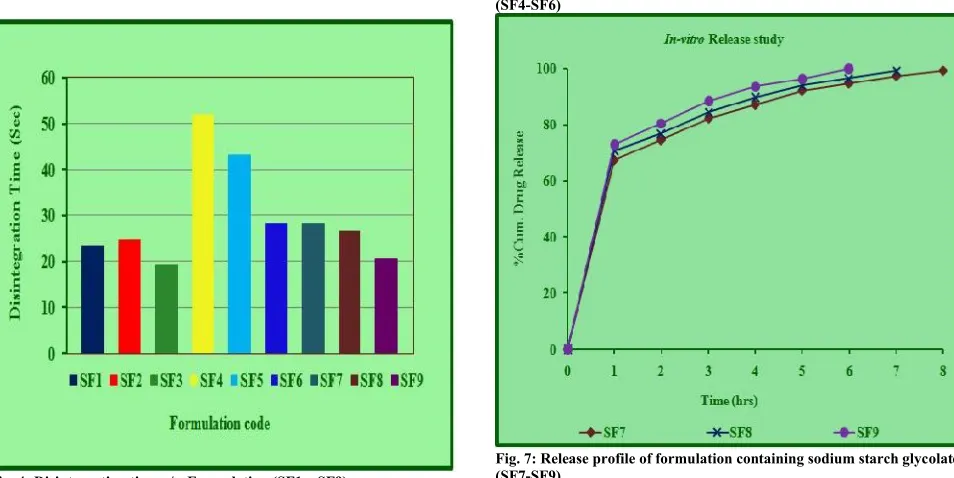
Fig. 4: Disintegration time v/s. Formulation (SF1 – SF9)
Fig. 5: Release profile of formulation containing sodium starch glycolate (SF1-SF3)
Fig. 6: Release profile of formulation containing sodium starch glycolate (SF4-SF6)
Table 6: In-vitro release profile of promising Fosinopril fast dissolving tablets
Formulation
code D2 D4 ParametersD6 D t 50% D t 90%
SF3 84.25 96.65 - 0.67 2.93
SF6 78.77 92.02 97.59 0.73 4.88
SF9 80.61 93.88 99.81 0.69 3.83
Table 7: Result for (25°C/60% RH) for 3 months S.
No. FC Month HardnessKg/cm² percentage Friability Dispersion time (sec)
1 SF3 1
st 2.95 0.65 17.23
2nd 3.13 0.64 18.13
3rd 3.07 0.66 18.29
2 SF6 1
st 2.91 0.60 28.31
2nd 3.01 0.62 29.22
3rd 3.10 0.63 29.71
3 SF9 1
st 2.79 0.66 20.61
2nd 2.99 0.68 21.56
3rd 3.14 0.67 23.61
Table 8: Result for (40°C/75% RH) for 3 months S.
No. FC Month HardnessKg/cm² percentage Friability Dispersion time (sec)
1 SF3 1
st 2.95 0.65 17.23
2nd 3.07 0.66 17.29
3rd 4.03 0.67 17.40
2 SF6 1
st 2.91 0.60 28.31
2nd 3.07 0.66 29.29
3rd 4.05 0.67 30.11
3 SF9 1
st 2.79 0.66 20.61
2nd 3.14 0.67 23.61
3rd 4.01 0.70 24.21
In wetting time[10]a piece of tissue paper folded twice was placed in a small petri dish (i.d = 6.5 cm) containing 10 ml of water, a tablet was placed on the paper, and the time for complete wetting was measured. Three trials for each batch were performed and standard deviation was also determined. The In-vitro Release Studies [11-12] Dissolution rate was studied by using USP type-II apparatus (USP XXIII Dissolution Test Apparatus at 50 rmp) using 900ml of phosphate buffer (pH 6.8) as dissolution medium. Temperature of the dissolution medium was maintained at 370.5°C, aliquot of dissolution medium was withdrawn at every 1 min interval and filtered. The absorbance of filtered solution was measured by UV spectrophotometric method at 205nm and concentration of the drug was determined from standard calibration curve.
The stability study[13]of the tablets was carried out according to International conference on Harmonization guidelines for zone III and IV. The formulations were stored at 25°C/ 60% and 40C / 75 % RH for three months by storing the samples in stability chamber (Thermo Lab, Mumbai).
RESULT AND DISCUSSION
In the present study the IR spectra for pure drug and its formulations (Shown in Fig. 2) with various polymers and other excipients are taken to establish the physical characterization of drug and its formulations. The data table (Table 2) indicates the characteristic absorption bands for different functional groups and bonds present in the drug molecule before and after its formulation. It is the evident from the data table. That there is no shift in the position of characteristic absorption bands of pure drug and its formulations. It means that the drug remains in the same normal form in its pure state and after its formulations. Hence it can be concluded in the present study the drug doesn’t undergo any type of any change during its
formulations indicating that there is no interaction of the drug with the polymers and other excipients used for the study. During the present work in addition to FTIR spectra of the drug and formulations DSC thermo gram analysis also used for studying physical characteristics & for the characterization of the drug and formulations. The thermo gram of pure drug Fosinopril shows endothermic peak corresponding to the temperature 150°C to 152°C.This temperature is an agreement with reported literature value of the Fosinopril drug which is in the range of 149-153°C. The DSC thermo grams of formulation SF3, SF6 and SF9 also exhibit the characteristic endothermic peak for the polymers and Fosinopril drug respectively almost in the same range of temperature (Shown in Fig. 3). The site variation in the nature of peaks may be due to the combination of two or more polymers and excipients used. However the thermal analysis study of Fosinopril and formulations clearly suggest that there is no interaction of the drug with polymer, hence it may be concluded that the melting point range for the drug and it’s formulations do not appreciably change and there is no change in the nature of the DSC peak in the thermo-grams indicates that the drug remains in the form even when it is used for the formulations with varying polymers and excipients. Hence there is no interaction of the drug with polymer.
The values of pre-compression parameters evaluated were within prescribed limits and indicated good free flowing property (Table 3). All the post compressional parameter are evaluated were prescribed limits and results were within IP acceptable limits. Results were shown in (Table 4). In all the formulations, hardness test indicated good mechanical strength ranges from 2.7 to 3.1kg/cm².The friability range is 0.60 to 0.69 % to be well within the approved range (<1%)indicated that tablet had good mechanical resistance. The weight variation was found in all designed formulations in the range 198 to 200 mg. All the tablets passed weight variation test as the average percentage weight variation was within 7.5% i.e.in the pharmacopoeia limits. The thickness was almost uniform in all the formulations and values ranged from 4.7 mm to 4.8 mm. The standard deviation values indicated that all the formulations were within the range. Rapid disintegration within several minutes was observed in all the formulations. The in-vitro disintegration data is tabulated in the (Table 5) and Fig. 4. The in-vitro
disintegration time of fast dissolving tablets were found to be 17 to 52 sec. which is in the range of fulfilling the official requirements. By the addition of super disintegrants the disintegration time increased significantly (P<0.05) tablets prepared.
indicated uniformity of mixing. The wetting time, water absorption ratios and drug content results were tabulated in the Table 5.
In-vitro dissolution studies (Shown in Fig. 5-7) on the promising formulations SF3, SF6 and SF9 formulations were carried out in 6.8 phosphate buffer solution, and the various dissolution parameter values viz., percent drug dissolved in 2 min, 4 min, and 6 min, (D2, D4, D6), t50% and t90% are shown in Table 6 . This data reveals that overall, the formulation SF3, SF6 and SF9 shows nearly faster drug release. The formulations SF3, SF6 and SF9 50 % of drug released in 0.67 min, 0.73min, and 0.69 min, respectively, and 90 % of drug released in 2.93 min, 4.88 min, and 3.83 min, respectively when compared to other tablet formulation. Among all the formulation SF3 were found to be promising and showed a disintegration time of 17 sec, 50 % of drug released in 0.67 min, and 90 % of drug released in 2.93 min. The Table 7, 8 shows the parameters of the tablets after stability study. The promising formulations were subjected to short term stability study by storing the formulations at 25oC/65% and 40oC/75% RH up to three month. The formulations SF3, SF6 and SF9 were selected. After three month the tablets were again analyzed for the hardness, friability, drug content uniformity and disintegration time. The increase in the disintegration time was observed in Tables. This may be due to increase in the hardness of the tablet during storage.
The above results concluded that, although differences existed between the superdisintegrants, the fast dissolving Fosinopril tablets could be prepared by using any of the superdisintegrants used. Overall results indicates that formulation SF3 which contain 15% Croscarmellose sodium and camphor was better one and satisfies all the criteria as fast dissolving tablet. Fosinopril showing enhanced dissolution, may lead to improved bioavailability, improved effectiveness and hence better patient compliance.
ACKNOWLEDGEMENTS
Authors thanks to Chandra analytical Laboratories
Hyderabad (AP), for providing a gift sample of Fosinopril. The authors are also thankful toDr. D. K. Suresh, Director, Luqman College of Pharmacy, Gulbarga for their valuable suggestions and facilities in carrying out this research work. The authors are also thankful to Sri. Juvadi Sagar Rao Garu, Chairman, Jyothishmathi Institute of Pharmaceutical Science, Karimnagar, providing the facilities to publish the research work.
REFERENCES
1. www.drugbank.com/fosinopril.html
2. http://www.rxlist.com/cgi/generic/fosinopril.html 3. http://en.wikipedia.org/wiki/fosinopril
4. www.cims.com
5. Agarwal V, Bhavesh H, Kothari, Derek V. Moe R K. Khankari. Drug Delivery: Fast-Dissolve Systems. In: James swarbrick. Encyclopedia of pharmaceutical technology, 3rded.USA: Informa healthcare 2007:1104-5.
6. Nangude TD, Chatap .VK, Bhise KS, Sharma D.K. Mouth dissolving tablets: Geriatrics and pediatrics friendly drug delivery system. Indian Drugs 2007; 44(6): 471-3.
7. Indurwade NH, Rajyaguru TH, Nakhat PD. Novel approach- Fast dissolving tablets. Indian Drugs 2002; 39(8): 405-8.
8. Lachman L, Libermann HA, Kanig JL. The theory and practice of industrial pharmacy. Varghese Publishing House, 3rd edition; 1991; 297-301.
9. Vijaya KS, Mishra DN. Rapidly disintegrating oral tablets of meloxicam. Indian Drugs 2006; 43(2): 117-21.
10. Raju SA, Rampure MV, Shrisand SB, Swamy PV, Nagendra DK, Baswaraj B, Raghunandan D. Formulation and evaluation of orodispersible tablets of alfuzosin. Int. J Pharm. Tech. Res. 2010; 2 (1): 84-88.
11. Stephen BR, Rajveer CH, Sudarshini SA, Kishore Reddy. Preparation and evaluation of mucoadhesive microcapsules of nimodipine. Int. J Res. Pharm. Sci. 2010; 1(2): 219-224.
12. Desai SA, Kharade SV, Petkar KC and Kuchekar BS. Orodissolving tablets of promethazine hydrochloride. Ind J Pharm Edu Res. 2006; 40(3): 172-4.