Primitive groups, graph endomorphisms and
synchronization
João Araújo
Universidade Aberta, R. Escola Politécnica, 147 1269-001 Lisboa, Portugal
&
CAUL/CEMAT, Universidade de Lisboa 1649-003 Lisboa, Portugal
Wolfram Bentz
CAUL/CEMAT, Universidade de Lisboa 1649-003 Lisboa, Portugal
Peter J. Cameron
Mathematical Institute, University of St Andrews North Haugh, St Andrews KY16 9SS, UK
Gordon Royle
Centre for the Mathematics of Symmetry and Computation The University of Western Australia
Crawley, WA 6009, Australia [email protected]
Artur Schaefer
Mathematical Institute, University of St Andrews North Haugh, St Andrews KY16 9SS, UK
Abstract
Ω→Ωa map which is not a permutation. We say thatGsynchronizesf if the transformation semigrouphG, ficontains a constant map, and thatGis asynchronizing groupifGsynchronizeseverynon-permutation.
A synchronizing group is necessarily primitive, but there are primitive groups that are not synchronizing. Every non-synchronizing primitive group fails to synchronize at least one uniform transformation (that is, transforma-tion whose kernel has parts of equal size), and it had previously been conjec-tured that this was essentially the only way in which a primitive group could fail to be synchronizing — in other words, that a primitive group synchro-nizes every non-uniform transformation.
The first goal of this paper is to prove that this conjecture is false, by ex-hibiting primitive groups that fail to synchronize specific non-uniform trans-formations of ranks5 and6. As it has previously been shown that primi-tive groups synchronize every non-uniform transformation of rank at most 4, these examples are of the lowest possible rank. In addition we produce graphs with primitive automorphism groups that have approximately √n
non-synchronizing ranks, thus refuting another conjecture on the number of non-synchronizing ranks of a primitive group.
The second goal of this paper is to extend the spectrum of ranks for which it is known that primitive groups synchronize every non-uniform transforma-tion of that rank. It has previously been shown that a primitive group of degreensynchronizes every non-uniform transformation of rankn−1and n−2, and here this is extended ton−3andn−4.
In the process, we will obtain a purely graph-theoretical result show-ing that, with limited exceptions, in a vertex-primitive graph the union of neighbourhoods of a set of verticesAis bounded below by a function that is asymptoticallyp|A|.
Determining the exact spectrum of ranks for which there exist non-uniform transformations not synchronized by some primitive group is just one of sev-eral natural, but possibly difficult, problems on automata, primitive groups, graphs and computational algebra arising from this work; these are outlined in the final section.
1
Introduction
LetΩbe a set of size nand letf be a transformation on Ωwhoserank (size of image) smaller thann. (In other words,f is a non-permutation; we sometimes call such a mapf singular). A permutation groupG of degreenon Ωsynchronizes
f if the transformation semigrouphG, ficontains a constant transformation. The
kerneloff is the partition ofΩdetermined by the equivalence relationx ≡ y if and only ifxf = yf. If the parts of the kernel all have the same size, then f is called uniform; it is non-uniform otherwise. A group is called synchronizing
primitive (see [14]) but the converse does not hold and considerable efforts have been made to determine exactly which primitive groups are synchronizing.
To show that a primitive group is not synchronizing it is necessary to find a
witness, which is a transformationf such that hG, fidoesnotcontain a constant map. Neumann [41] proved that any non-synchronizing primitive group has a uni-formwitness. This prompted the definition of a primitive group as beingalmost synchronizingif it synchronizes every non-uniform transformation. In [4] the al-most synchronizing conjecturewas stated. This asserts that primitive groups have no non-uniform witnesses; that is, they are almost synchronizing.
This conjecture has previously been proved for transformations of ranks2,3,
4,n−2andn−1or, in other words, for transformations ofvery low, orvery high, rank (see [6, 41, 45]). In this paper, we prove three main results, showing different outcomes for the “low rank” and the “high rank” cases. A graph admitting a vertex-primitive automorphism group will be called aprimitive graph.
Theorem 1.1 There are primitive graphs admitting non-uniform endomorphisms, and hence not every primitive group is almost synchronizing.
Section 3 describes a number of different graph constructions used to demon-strate this result. This theorem resolves the almost synchronizing conjecture in the negative, but shows that the structure of endomorphisms of primitive graphs can be more complex than previously suspected, prompting the difficult problem of finding a classification of the primitive almost synchronizing groups.
Our second main theorem considers the high rank case and extends the spec-trum of ranks for which transformations of that rank are known to be synchronized by every primitive group.
Theorem 1.2 A primitive group of degreensynchronizes every transformation of rankn−3orn−4.
Sections 4 and 6 detail the somewhat intricate arguments required to deal with the considerable number of graphs that arise in proving this result.
Our third main theorem considers groups of smallpermutation rank. Groups with permutation rank2are doubly transitive and easily seen to be synchronizing, so the first non-trivial case is for groups of rank3. In this case, the group acts primitively on astrongly regulargraph and properties of such graphs can be used to considerably extend then−4bound.
Theorem 1.3 A primitive permutation group of degreenand permutation rank3
The original context of this research is automata theory, as we now outline. Our automata are always finite and deterministic. On reading a symbol, an automaton undergoes a change of state; so each symbol defines atransition, a transformation on the set of states. The set of transformations realised by reading a word (that is, a sequence of symbols) is the semigroup generated by the transitions of the automaton. Thus, from an algebraic viewpoint, an automaton is a subsemigroup of the full transformation semigroup on a finite set with a prescribed set of generators. A deterministic finite-state automaton is said to besynchronizingif there is a finite word such that, after reading this word, the automaton is in a fixed state, in-dependently of its state before reading the word. In other terms, the word evaluates to a transformation of rank1, mapping the set of states to a single state. Such a word is called areset wordorsynchronizing word.
One of the oldest and most famous problems in automata theory, the well-known ˇCerný conjecture, states that if an automaton withnstates has a synchro-nizing word, then there exists one of length(n−1)2. (For many references on the growing bibliography on this problem please see the two websites [42, 46] and also Volkov’s talk [50]; so far the best bound for the length of a reset word is cubic [43].) Solving this conjecture is equivalent to proving that given a setSof transfor-mations on a finite set of sizenthen, if the transformation semigrouphSicontains a constant transformation, then it contains one that can be expressed as a word of length at most(n−1)2in the generators ofS. This conjecture has been established foraperiodic automata, that is, whenhSiis a semigroup with no non-trivial sub-groups [47]. So it remains to prove the conjecture for semisub-groups that do contain non-trivial subgroups, and the case when the semigroup contains a permutation group is a particular instance of this general problem. Indeed, the known exam-ples witnessing the optimality of the ˇCerný bound contain a permutation among the given set of generators.
We note that if a transformation semigroupScontains a transitive groupGbut not a constant function, then the imageIof a transformationf of minimum rank in Sis aG-sectionfor the kernel off, in the sense that for allg∈Gwe have thatIg is asectionortransversal forker(f), a set meeting every kernel class in a single element. In fact, ifIgis not a transversal forker(f), for some permutationg∈G, then|Igf|<|If|and hencef would fail to have minimum rank inS. In addition, the transformationf has uniform kernel (see Neumann [41, Theorem 2.1]).
In earlier work, Araújo and Cameron [6] resolved some additional cases of the conjecture:
Theorem 1.4 A primitive permutation groupGof degreensynchronizes maps of kernel type(k,1, . . . ,1)(fork≥2) and maps of rankn−2, as well as non-uniform maps of rank4or3.
That paper, like the present one, uses a graph-theoretic approach due to the third author [20]. In what follows, graphs are always simple and undirected. The
clique numberof a graph is the largest number of vertices in a complete subgraph, while thechromatic numberis the smallest number of colours required for a proper colouring.
Theorem 1.5 A transformation semigroup does not contain a constant transfor-mation if and only if it is contained in the endomorphism monoid of a non-null graph. Moreover, we may assume that this graph has clique number equal to chro-matic number.
One direction of the theorem is clear, since a non-null graph has no rank 1
endomorphisms. For the other direction, define a graph by joining two vertices if no element of the semigroup maps them to the same place, and show that this graph has the required property. We will elaborate further in the next section.
This paper is in three main parts. In the first part, we show that the almost synchronizing conjecture fails for maps of small rank, so the results in [6] are best possible. We construct four examples of primitive groups (with degrees45,153,
495and495) which fail to synchronize non-uniform maps of rank5. In addition, we find infinitely many examples for rank6, along with yet another sporadic ex-ample of rank7of degree880. Also, we provide a construction of primitive graphs whose automorphism groups have approximately√nnon-synchronizing ranks, re-futing a conjecture of the third author’s on the number of non-synchronising ranks of a primitive group.
In the third part, we consider the special situation where the primitive groupG has permutation rank3, in which case any graph with automorphism group contain-ingGis either trivial or strongly regular. In the latter case, we prove a general result about endomorphisms of strongly regular graphs, and deduce thatGsynchronizes every non-permutation transformation of rank at leastn−(1 +√n−1/12).
The paper ends with a number of natural but challenging problems related to synchronization in primitive groups and in related combinatorial settings.
Given the enormous progress made in the last three or four decades, permu-tation group theory now has the tools to answer questions coming from the real world through transformation semigroups; these questions translate into beautiful statements in the language of permutation groups and combinatorial structures, as shown in many recent investigations (as a small sample, please see [2, 4, 6, 7, 8, 13, 14, 21, 31, 41, 44]).
2
Transformation semigroups and graphs
The critical idea underlying our study is a graph associated to a transformation semigroup in the following way. IfS is a transformation semigroup on Ω, then form a graph, denotedGr(S), with vertex setΩ, and wherevandware adjacent if and only if there is no elementf ofSwhich mapsvandwto the same point. Now the following result is almost immediate (cf.[22, 20]).
Theorem 2.1 (See [6, 22]) Let S be a transformation semigroup on Ω and let
Gr(S)be defined as above. Then
(a) Scontains a map of rank1if and only ifGr(S)is null (i.e., edgeless).
(b) S≤End(Gr(S)), andGr(End(Gr(S))) = Gr(S).
(c) The clique number and chromatic number of Gr(S) are both equal to the minimum rank of an element ofS.
In particular, ifS =hG, fifor some groupG, thenG≤Aut(Gr(S)). So, for example, ifGis primitive and does not synchronizef, thenGr(S)is non-null and has a primitive automorphism group, and so is connected.
in∆ can be collapsed by elements of S. Sometimes, but not always, ∆ is the complement ofGr(S).
We now introduce a refinement of the previous graphGr(S), which will allow us to obtain the results of the remaining cases more easily. The new graph is denoted byGr0(S). The same construction was used in a different context in [21], where it was called thederived graphofGr(S).
Suppose thatGr(S) has clique number and chromatic numberr (where r is the minimum rank of an element ofS). We defineGr0(S)to be the graph with the same vertex set asGr(S), and whose edges are all those edges ofGr(S)which are contained inr-cliques ofGr(S).
Theorem 2.2 LetSbe a transformation semigroup onΩand letGr(S)andGr0(S)
be defined as above. Then
(a) Scontains a map of rank1if and only ifGr0(S)is null.
(b) S≤End(Gr(S))≤End(Gr0(S)).
(c) The clique number and chromatic number of Gr0(S)are both equal to the minimum rank of an element ofS.
(d) Every edge ofGr0(S)is contained in a maximum clique.
(e) If S = hG, fi, where Gis a primitive permutation group andf is a map which is a non-permutation not synchronized byG, thenGr0(S)is neither complete nor null.
Proof Elements of End(Gr(S)) preserve Gr(S) and map maximum cliques to maximum cliques, soEnd(Gr(S))≤End(Gr0(S)). The existence of anr-clique and anr-colouring ofGr0(S)are clear, and so (c) holds; then (a) follows. Part (d) is clear from the definition. For (e), the hypotheses guarantee that the minimum
rank of an element ofSis neither1norn.
Note that strict inequality can hold in (b). IfΓis the disjoint union of complete graphs of different sizes, thenGr0(End(Γ))consists only of the larger complete graph, and has more endomorphisms thanΓdoes.
The next lemma is proved in [6], but since the techniques it introduces are important in subsequent arguments we provide its proof here.
Proof For a ∈ X denote its neighbourhood by N(a). Suppose that a, b ∈ X, witha 6= b, andN(a) = N(b). We are going to use two different techniques to prove that this leads to a contradiction. The first uses the fact that the graph has at least one edge, while the second uses the fact that the graph is not complete.
First: Define the following relation on the vertices: for allx, y∈X,
x≡y ⇔N(x) =N(y).
This is an equivalence relation and we claim that≡is neither the universal relation nor the identity. The latter follows from the fact that by assumptionaandb are different andN(a) = N(b). Regarding the former, there exist adjacent vertices c andd(because X is non-null); now c ∈ N(d) butc /∈ N(c), so c 6≡ d. As Gis a group of automorphisms ofXit follows that Gpreserves≡, a non-trivial equivalence relation, and henceGis imprimitive, a contradiction.
Second: Assume as above that we have a, b ∈ X such that N(a) = N(b). Then the transposition(a b) is an automorphism of the graph. A primitive group containing a transposition is the symmetric group. (This well-known result from the nineteenth century can be found, for example, in [34, p.241].) HenceXis the
complete graph, a contradiction.
We conclude this section recalling another result from [6] aboutprimitive graphs.
Lemma 2.4 ([6, Lemma 8]) Let Γ be a non-null graph with primitive automor-phism groupG, and having chromatic numberr. ThenΓdoes not contain a sub-graph isomorphic to the complete sub-graph onr+ 1vertices with one edge removed.
This lemma was important in [6] and it will be here too (please see the obser-vations after Lemma 6.5).
3
Maps of small rank
In this section, we discuss various counterexamples to the conjecture that primitive groups are almost synchronizing. From the discussion above, it suffices to find a non-null graph Γ with a primitive automorphism group, and then exhibit a non-uniform proper endomorphismf ofΓ. Such an endomorphism is then a witness thatGis not almost synchronizing for any primitive groupG≤Aut(Γ).
In the second subsection, we present infinite families of primitive graphs with non-uniform proper endomorphisms of rank6and above.
3.1 Rank 5 (and 7)
In this subsection, we give the first counterexample to the conjecture that primitive groups are almost synchronizing. In particular, we construct a primitive group of degree45that fails to synchronize a non-uniform map of rank5with kernel type
(5,5,10,10,15). We give two proofs of this, which extend in different ways. Our primitive group isPΓL(2,9)(also known asA6 : 22), acting on45points
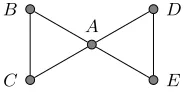
(this isPrimitiveGroup(45,3)in bothGAPand MAGMA). This group has a suborbit of length4, and the orbital graphΓ has the property that any edge is contained in a unique triangle: the closed neighbourhood of a vertex is a “butterfly” consisting of two triangles with a common vertex (see Figure 2). Indeed, this graph is the line graph of the celebratedTutte–Coxeter graphon30vertices, which in turn is the incidence graph of the generalized quadrangleW(2)of order2. The graph was first found by Tutte [48] with a geometric interpretation by Coxeter [26, 49].
LetD be a dihedral subgroup of order10 of the automorphism group of the graph. It is clear that elements of order5inDfix no vertices of the graph, and a little thought shows that their cycles are independent sets in the graph.
The full automorphism group of the graph is the automorphism group of S6
(that is, the group extended by its outer automorphism), and there are two conju-gacy classes of dihedral groups of order10. It is important to take the right one here: we want theD10which isnotcontained inS6.
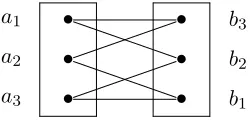
[image:9.612.250.360.517.556.2]For this groupD, we find that each orbit of Dis an independent set inΓ; so there is a homomorphism ofΓin which each orbit is collapsed to a single vertex. A small calculation shows that the image of this homomorphism is the graph shown in Figure 3.1.
Figure 1: Homomorphic image of the Tutte–Coxeter graph
Our second approach uses the fact that the chromatic number and clique num-ber of this graph are each equal to3; thus, each triangle has one vertex in each of the three colour classes, each of size15. So there is a uniform map of rank3not synchronized byG.
We usedGAPto construct the graph (the vertex numbering is determined by the group), and its packageGRAPEto find all the independent sets of size15inΓ
up to the action ofG. One of the two resulting sets is
A={1,2,3,5,10,15,16,17,25,26,27,30,42,44,45}.
The induced subgraph on the complement of this set has two connected compo-nents, a10-cycle and a20-cycle. If we letB andCbe the bipartite blocks in the
10-cycle andDandE those in the20-cycle, we see thatA, B, C, D, Eare all in-dependent sets, and the edges between them are shown in Figure 2. Thus there is a proper endomorphism mapping the graph to the closed neighbourhood of a vertex, with kernel classesA, B, C, D, E.
A D
E C
[image:10.612.259.351.355.403.2]B
Figure 2: The butterfly
Using software developed at St Andrews (see Section 8 for details) we were able to calculate all the proper endomorphisms of this graph: there are 103680
of these, with ranks3, 5and7; the numbers of endomorphisms of each of these ranks are25920, 51840and25920respectively. Then, using GAP, we were able to determine that the endomorphism monoid of this graph is given byEnd(X) =
hG, ti, whereGisPΓL(2,9)andtis the transformation
t=Transformation([1,1,1,14,9,14,28,41,41,1,43,28,28,41,9,1,1,25,25,28,28, 25,41,28,1,1,9,43,14,9,43,28,28,25,41,43,14,28,43,25,14,1,28,1,9]).
The endomorphisms of each possible rank form a single D-class. The structure for the H-classes isS3,D8 andD8for the three classes respectively, whereD8is the
dihedral group on4points. (Note that these groups are the automorphism groups of the induced subgraphs on the image of the maps.)
A very similar example occurs in the line graph of the Biggs–Smith graph
[17, 18], a graph on 153 vertices whose automorphism group is isomorphic to
graph has an endomorphism of rank5and kernel type(6,6,45,45,51)constructed in a virtually identical way.
However, this particular construction gives no additional examples. A vertex-primitive 4-regular graph whose neighbourhood is a butterfly is necessarily the linegraph of anedge-primitive cubic graph. These were classified by Weiss [51], who determined that the complete list is K3,3, the Heawood graph, the Tutte–
Coxeter graph and the Biggs–Smith graph. From either a direct analysis, or simply referring to the small-case computations described in Section 8, it follows that the first two of these do not yield examples.
However, we have found three additional examples with the help of the com-puter. Surprisingly, all three of them are associated with the groupAut(M12) =
M12 : 2. This group has two inequivalent primitive actions of degree495. Each
of them is the automorphism group of a graph of valency6in which the closed neighbourhood of a vertex consists of three triangles with a common vertex, and in each case, the graph has chromatic number3. In each case, there is a subgroup of the automorphism group with orbits of sizes55,55,110,110,165; each orbit is an independent set and the connections between the orbits give a homomorphism onto the butterfly.
The third example is associated with a differentprimitive action ofM12 : 2,
this time of degree880. In this action, M12 : 2is the full automorphism group
of a6-regular graph where each open neighbourhood is the disjoint union of two triangles. The group has a subgroup of order 55, which has 16 equal-sized or-bits each inducing an independent set. These 16 orbits can each be mapped to a single vertex in such a way that the entire graph is mapped onto the closed neighbourhood of a vertex, yielding an endomorphism of rank7, with kernel type
(220,165,165,165,55,55,55). As the closed neighbourhood of a vertex consists of two4-cliques overlapping in a vertex, we may perhaps view this just as a butter-fly with bigger wings?
3.2 Rank 6 and above
While the constructions of the previous subsection seem to be sporadic examples, we can also find several infinite families of vertex-primitive graphs with proper non-uniform endomorphisms.
Recall that theCartesian productXY of two graphsXandY is the graph with vertex setV(XY) =V(X)×V(Y)and where vertices(x1, y1)and(x2, y2)
are adjacent if and only if they have equal entries in one coordinate position and adjacent entries (inX orY accordingly) in the other. Figure 3 shows the graph K4K4both to illustrate the Cartesian product and because it plays a role later in
Figure 3: The graphK4K4
If X is a vertex-primitive graph then the Cartesian product X X is also vertex-primitive, with automorphism group Aut(X) wrSym(2). In addition, if the chromatic and clique number ofX are both equal to k, then V(X) can be partitioned intokcolour classes of equal size — sayV1,V2,. . .,Vk, and there is
a surjective homomorphismXX → KkKk with kernel classes{Vi×Vj |
1≤i, j≤k}. Therefore if there is a homomorphismf :KkKk →X, then by
composing homomorphisms
XX−→KkKk f −
−→X−→XX,
there is an endomorphism ofXX. Moreover, if the homomorphismf is non-uniform, then the endomorphism is also non-uniform.
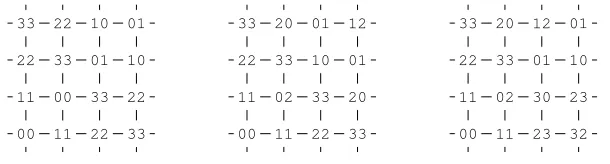
00 11 22 33 11 00 33 22 22 33 01 10 33 22 10 01 00 11 22 33 11 02 33 20 22 33 10 01 33 20 01 12 00 11 22 33 11 02 33 20 23 30 01 12 32 23 10 01
Figure 4: Non-uniform homomorphisms fromK4K4 to its complement
Although at first sight, there appears to be little to be gained from this observa-tion, in practice it is much easier (both computationally and theoretically) to find homomorphisms between the two relatively small graphsKkKk andX, than
working directly with the larger graphXX. Although this finds only a restricted subset of endomorphisms, it turns out to be sufficient to find large numbers of non-uniform examples.
We start by considering the case whereX=KkKk, where we assume that
[image:12.612.154.459.438.520.2]that inKkKktwo distinct vertices are adjacent if and only if they agree in one
coordinate position, while in its complement, they are adjacent if and only if they
disagreein both coordinate positions.
The graphXhas chromatic number and clique number equal tok. (A diagonal set{(i, i) : 0 ≤ i < k} is ak-clique, while using the first coordinate as colour gives ak-colouring.) The homomorphisms we seek are those fromKkKkto its
own complement.
In particular, Figure 4 exhibits three non-uniform homomorphisms of ranks6,
9and12fromK4K4to its complement, where the diagrams show the image of
each vertex, but usingxyto represent(x, y). Verifying that this function is a homo-morphism merely requires checking for each row that the four pairs assigned to it have pairwise distinct first co-ordinates and pairwise distinct second co-ordinates, and similarly for each column. This happens if and only if the pairs are obtained from the super-position of two Latin squares of order4, one determining the first co-ordinate and the other the second co-ordinate. The rank of the homomorphism is then just the total number of distinct pairs that occur — this number ranges from a minimum ofk(when the two Latin squares are identical) to a maximum of k2 (when the two Latin squares are orthogonal). In the example of Figure 4 the kernel types of the homomorphisms are{24,42}, {14,24,4}and{18,24}, which corre-spond to endomorphisms ofXXof the same rank, but with kernel classes each
16times larger.
This argument clearly generalises to allk≥4(non-uniform homomorphisms do not arise whenk <4) and so any two Latin squares of orderk(notnecessarily orthogonal) will determine an endomorphism ofKkKk. Two Latin squares are
said to ber-orthogonalifrdistinct pairs arise when they are superimposed. Thus we find an endomorphism of rankrfrom any pair ofr-orthogonal Latin squares. The following result, due to Colbourn & Zhu [25] and Zhu & Zhang [52] shows exactly which possible ranks arise in this fashion.
Theorem 3.1 There are twor-orthogonal Latin squares of order kif and only if
r∈ {k, k2}ork+ 2≤r≤k2−2, with the following exceptions:
(a) k= 2andr = 4;
(b) k= 3andr ∈ {5,6,7};
(c) k= 4andr ∈ {7,10,11,13,14};
(d) k= 5andr ∈ {8,9,20,22,23};
In particular, for anyk≥4, there is an endomorphism of rankk+2with image twok-cliques overlapping in a(k−2)-clique. Askincreases, we get a sequence of butterflies with increasingly fat bodies, but fixed-size wings.
This construction also sheds some light on the possible non-synchronizing ranks for a group. For a groupGof degreen, anon-synchronizing rankis a value rsatisfying2 ≤r ≤n−1such thatGfails to synchronize some transformation of rankr.
A transitive imprimitive group of degree n, havingm blocks of imprimitiv-ity each of sizek, preserves both a disjoint union ofm complete graphs of size k (which has endomorphisms of ranks all multiples of k) and the complete m-partite graph with parts of size k (which has endomorphisms of all ranks be-tweenk andn inclusive). From this, a short argument shows that such a group has at least(3/4−o(1))n non-synchronizing ranks. The third author had pre-viously that a primitive group has many fewer non-synchronizing ranks, perhaps as few asO(logn). However, as this construction provides approximatelyk2 non-synchronizing ranks for a group of degreek4, this cannot be the case. However, the conjecture may still hold forbasicprimitive groups, those which do not preserve a Cartesian power structure on the underlying set.
It is natural to wonder whether this construction can be used to find non-uniform endomorphisms for graphsother than X = Kk×Kk. Unsurprisingly,
the answer to this question is yes, with the line graph of the complete graphL(Kn)
(also known as thetriangular graph) being a suitable candidate forXwhenevern is even. For exampleL(K6)is a15-vertex graph with chromatic number and clique
number equal to5. The vertices ofL(K6)can be identified with the endpoints of
the corresponding edge inK6, and thus each vertex ofL(K6)is represented by a
2-set of the form{x, y}which we will abbreviate toxy.
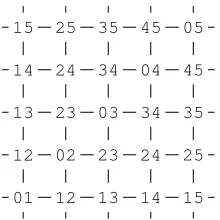
Figure 5 depicts a surjective homomorphism fromK5K5 toL(K6)by
la-belling each of the vertices ofK5 K5 with its image in L(K6) under the
ho-momorphism. For each of the horizontal or vertical lines — corresponding to the cliques ofK5 K5 — it is easy to confirm that the images of the five vertices
in the line share a common element and thus are mapped into a clique ofL(K6).
This homomorphism has rank 15 and kernel type {15,210} and hence yields a non-uniform endomorphism ofL(K6)L(K6)with kernel classes of25times the
size. The pattern shown in Figure 5 can be generalised to all triangular graphs, by defining a map f : Kn−1 Kn−1 −→ L(Kn) by f((a, b)) = {a+ 1, b+ 1}
if a 6= b and f((a, a)) = {0, a+ 1}. This homomorphism has kernel type
{1n−1,2(n−1)(n−2)/2}.
We finish this section with yet another construction that provides an infinite family of rank6non-uniform non-synchronizable transformations.
01 02
03 04
05
[image:15.612.251.361.127.237.2]12 13 14 15 12 23 24 25 13 23 34 35 14 24 34 45 15 25 35 45
Figure 5: A homomorphism fromK5K5toL(K6)
field spanned bye0, . . . , ep−1 (we think of the indices as elements of the integers
modp) with the single relation that their sum is zero. LetΓbe the Cayley graph for V with connection set of size 2p consisting of the vectors ei andei +ei+1
withirunning over the integers modp. It is clear that the groupV : D2p acts as
automorphisms of this graph, and is primitive provided that2 is a primitive root modp(this is the condition forV to be irreducible as aCp-module).
Now let X be the subspace spanned by ei +ei+2 for i = 0,1, . . . , p−5.
These vectors are linearly independent and so span a space of codimension3, with
8cosets. Check that this subspace contains no edge of the graph: no two of its vectors differ by a single basis vector or a sum of two consecutive basis vectors. We can take coset representatives to be0, e0, e1, e0+e1, ep−2, ep−2+e0, ep−2+
e1, ep−2+e0+e1.
Each coset contains no edges of the graph, and indeed the unions(X+e1)∪
(X+ep−2)and(X+e0+e1)∪(X+e0+ep−2)also contain no edges. Collapsing
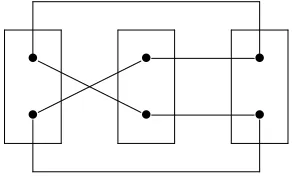
these two unions and the other four cosets to a vertex, we find by inspection that the graph is also a“butterfly” (as shown in Figure 3.2).
Figure 6: Another butterfly
The two vertices forming the butterfly’s body are the correspond to the unions of two cosets in the construction. Now we can find a copy of the butterfly in the graph, using the vertices0ande0for the body, e1 ande0 +e1 for one wing, and
[image:15.612.266.344.520.569.2]with two kernel classes of size2p−3 and four of size2p−4.
4
Maps of rank
n
−
3
The goal of this section is to show that primitive groups synchronize maps of rank n−3. Moreover, we will establish general properties of graphs with primitive automorphism groups that will also be used in the next sections; therefore these results will be stated and proved as generally as possible.
4.1 Groups with elements of small support
At several points during the argument (in this and in the next sections), we will establish that the (primitive) automorphism group of a graph under consideration contains a permutation which is a product of three or four disjoint transpositions, and hence has support of sizem ∈ {6,8}. As the automorphism group of a non-trivial graph is not 2-transitive (in particular, it does not contain An), it follows
from [40] that it has degree less than(m/2 + 1)2. Thus in the worst case, we need
only examine primitive groups of degree less than25, which can easily be handled computationally. For convenience all of the computational results are collated in Section 8.
4.2 A bound on the intersection of neighbourhoods
The goal of this subsection is to prove the following result aboutGr(S), the graph introduced in Section 2. We note that Spiga and Verret [44] have proved some re-sults about neighbourhoods of vertex-primitive graphs that also imply this property. Given a setXwe denote byT(X)the full transformation monoid onX.
Theorem 4.1 LetGbe a group acting primitively on a set X, and suppose that
f ∈T(X)is not synchronized byG. LetSbe the semigroup generated byGand
f, and letkbe the valency of the graphΓ = Gr(S). Then for all distinctx, y∈X, their neighbourhoodsN(x), N(y)inΓsatisfy|N(x)∩N(y)| ≤k−2.
The previous theorem is an important ingredient in the proof of the main results in this paper. Its proof is based on methods from [4, 6, 22] and is a consequence of the following sequence of lemmas.
Lemma 4.2 LetΓbe a non-null graph with primitive automorphism groupG, and having chromatic number and clique number r. Let x be a vertex of Γ, and C
anr-clique containing x. Then for every vertexy 6∈ N(x)∪ {x}, we have that
Proof Assume instead that for somey 6∈N(x)∪ {x}we have(N(x)\N(y))∩
C =∅.Then every element ofC, different fromx, is a neighbour ofy. Thus the setC∪ {y}induces a subgraph that is isomorphic to the complete graph with one
edge removed. This contradicts Lemma 2.4.
We next state an observation on primitive groups and quasiorders (reflexive and transitive relations). The proof is an easy exercise.
Lemma 4.3 LetGbe a permutation group on the finite setX. ThenGis primitive if and only if the onlyG-invariant quasiorders are the identity and the universal relation.
This immediately implies:
Lemma 4.4 LetΓ be a graph with primitive automorphism groupG and clique numberr on the vertex setX. Assume that there are distinct elementsa, b ∈ X
satisfying the following property: everyr-clique containingaalso containsb. Then
Γis complete.
Proof The relation→, defined byx→yif everyr-clique containingxalso con-tainsy, is easily seen to be a quasiorder, and so the result follows from Lemma 4.4.
The following corollary follows from Lemma 2.3, Lemma 4.2 and Lemma 4.4.
Corollary 4.5 LetΓ be a non-complete, non-null graph with primitive automor-phism group G, clique numberr equal to its chromatic number, and valency k. Then for any two distinct verticesx,ywe have|N(x)∩N(y)| ≤k−2.
Proof By Lemma 2.3, no two vertices ofΓhave the same neighbourhood. Hence it suffices to show that there are no distinct verticesx,ysatisfying|N(x)∩N(y)|=
k−1. For a contradiction, suppose thatxandyhave this property.
Assume first thatxandy are not adjacent, and letzbe the unique element in N(x)\N(y). Now letCbe a clique of sizercontainingx. Asy6∈N(x)∪ {x}, it follows from Lemma 4.2 that(N(x)\N(y))∩C 6=∅, and asN(x)\N(y) ={z}, it follows thatz ∈ C. Therefore everyr-clique containingxalso containsz, and so by Lemma 4.4,Γis complete, contradicting the hypotheses onΓ.
If on the other handxandyare adjacent, thenN(x)∪{x}=N(y)∪{y}, which defines a non-trivialG-invariant equivalence relation onX, and soΓis empty or complete, once again contradicting the hypotheses onΓ.
Theorem 4.1 is now an immediate consequence of the previous corollary and Theorem 2.1. The results above apply in particular to the graphGr0(S), where S = hG, fi, since the automorphism group of this graph contains the primitive groupG.
Proposition 4.6 Suppose thatGis primitive and does not synchronize the singular mapf. LetS=hG, fi. ThenGr0(S)has the following properties:
(a) Ifx6=y, then|N(x)∩N(y)| ≤k−2, wherekis the valency ofGr0(S).
(b) Ifxandy are distinct, there exists a maximum clique inGr0(S)containing
xbut noty.
Proof The first claim follows from Lemma 4.4 and Corollary 4.5. For the sec-ond claim, if every maximum clique containingxalso containsy, thenGr0(S)is complete by Lemma 4.4. However, asfis singular,Gr(S)is not complete, and so
neither is its subgraphGr0(S).
4.3 The main result about maps of rankn−3
The aim of this subsection is to prove the following:
Theorem 4.7 Primitive groups synchronize maps of rankn−3.
It is proved in [6] that a primitive groupGsynchronizes every map of kernel type(4,1, . . . ,1). Therefore, to cover all maps of rankn−3, we have to consider the maps of kernel type(3,2,1, . . . ,1)and(2,2,2,1, . . . ,1).
Kernel type(p,2,1, . . . ,1)
It was shown in [6] that every primitive group G synchronizes every map f of kernel type(p,2,1, . . . ,1)forp= 2, and for idempotent maps in the case ofp= 3. We will show that every primitive groupGsynchronizes every mapfof kernel type
(p,2,1, . . . ,1), forp≥3. This result was recently proved independently by Spiga and Verret [44].
Proof LetS=hG, fi, andΓ = Gr(S), letkbe the valency ofΓ. Assume thatG does not synchronizef; thenΓis not null by Theorem 2.1, and it is not complete either asf has non-singleton kernel classes.
LetA={a1, a2}be the two-element kernel class off and letB be its largest
kernel class. Letb1, b2be distinct elements inB, andK =A∪B.
Now let NB be the set of all vertices in K, the complement of K, that are
adjacent to at least one element ofB. As f mapsNB injectively intoN(b1f)\
{a1f}, we get|NB| ≤k−1.
By definition we haveN(b1), N(b2)⊆NB∪A, and
|NB∪A|=|NB|+|A| ≤(k−1) + 2 =k+ 1.
As |N(b1)| = |N(b2)| = k, it follows that |N(b1) ∩N(b2)| ≥ k−1 by the
pigeonhole principle. This contradicts Theorem 4.1, and soGsynchronizesf.
Kernel type(2,2,2,1, . . . ,1)
We are going to prove the following result:
Theorem 4.9 Let G act primitively on X and let f ∈ T(X) have kernel type
(2,2,2,1, . . . ,1). ThenGsynchronizesf.
LetS =hG, fiandΓ = Gr(S). By Theorem 2.1,Sis a set of endomorphisms ofΓ. Assume that Gdoes not synchronize f; thenΓ is not null, once again by Theorem 2.1. MoreoverΓhas clique number equal to its chromatic number. Letk be the valency ofΓ.
LetA = {a1, a2},B = {b1, b2}, C = {c1, c2}be the non-singleton kernel
classes off, and letK =A∪B∪C.
By [41], the smallest non-synchronizing group has degree9; therefore, every primitive group of degree at most8 synchronizes every singular transformation; hence we can assume thatn≥9and sof of kernel type(2,2,2,1, . . .)has at least
3singletons classes so that K 6= ∅. As Γ has primitive automorphism group, it is connected and hence there is at least one edge betweenK andK, say at some ai ∈ A. We claim that there is an edge between AandB ∪C. For the sake of
contradiction, assume otherwise. Then, asf mapsK injectively, bothN(a1)and
N(a2)are mapped injectively toN(a1f)and as all of these sets have sizek, we
get thatN(a1) = N(a2), contradicting Lemma 2.3. So there is an edge between
Aand, sayB, and hence betweena1fandb1f.
Case 1: there are no edges betweenAandC.
We exclude this case with an argument already used. For there are no edges betweenAandC, and so any neighbour ofa1ora2must lie inB∪NA, whereNA
is the set of elements inKthat is adjacent to at least one ofa1, a2.
Now|NA| ≤k−1, as its elements are mapped injectively toN(a1f)\{b1f}by
f, and so|B∪NA| ≤k+ 1. By the pigeonhole principle,|N(a1)∩N(a2)|≥k−1,
contradicting Theorem 4.1.
Case 2: there are edges between every pair from A, B, andC, and hence their imagesa1f, b1f, c1fform a 3-cycle.
Consider the induced subgraph onXf. We will obtain upper and lower bounds on the number of edges inXf, using methods analogous to those used in [6].
Letebe the number of vertices inΓ, and letlbe the number of edges within K.
AsXf is obtained by deleting three vertices ofX, the induced graph onXf contains at moste−3k+ 3edges (a loss ofkedges at each vertex not in the image off, with at most3edges counted twice).
For the lower bound we count how many edges are at most sent to a common image byf. Letr, s, tbe the number of edges betweenAandB,BandC,Cand A, respectively, hencel = r+s+t. Since the setsA, B andC each have two elements, it follows thatr, s, t ≤4. Theseledges are collapsed onto3edges, so we loosel−3edges from withinK.
For eachc ∈ K, such that(c, a1),(c, a2) are edges, we map two edges into
one (and hence lose one). Nowr+tedges connectAtoK\A. These edges are connecting to just two vertices, namelya1 anda2, so one of them connects to at
leastd(r+t)/2eedges from withinK. Hence there are at mostk− d(r+t)/2e
edges between one of theaiandK, and so this is the maximal number of values
c ∈ K for which(c, a1) and(c, a2) are edges. Symmetric arguments yield the
following result.
Lemma 4.10 The transformationfidentifies at mostk− d(r+t)/2eof the edges betweenKandA, at mostk− d(r+s)/2eof the edges betweenKandB, and at mostk− d(s+t)/2eof the edges betweenKandC.
Hence the number of edges inXf is at least
e−(k− d(r+t)/2e) | {z }
loss inK–A
−(k− d(r+s)/2e) | {z }
loss inK–B
−(k− d(s+t)/2e) | {z }
loss inK–C
− (l−3) | {z }
loss withinK
≥
This equals our upper bound. It follows that all estimates used in deriving our bounds must be tight. We have proved half of the following result.
Lemma 4.11 Under the conditions of Case 2, and with notation as above,f iden-tifies exactlyk−(r+t)/2pairs of edges betweenK andA,k−(r+s)/2pairs of edges between K andB, andk −(s+t)/2 pairs of the edges between K
and C. In addition, N(a1) ∩K = N(a2) ∩K, N(b1) ∩K = N(b2)∩ K,
N(c1)∩K=N(c2)∩K.
Proof As our upper and lower bounds agree, the estimates from Lemma 4.10 must be tight. Moreover, the inequality in (1) must be tight, as well, which implies that
(r+t)/2,(r+s)/2,(s+t)/2are equal to their ceilings and hence integers. This proves the first claim.
Thus2k−(r+t), the number of edges betweenAandK, is an even number. In addition,k−(r+t)/2, the number of edges betweenAandK identified by f, is then exactly half of the number of edges betweenAandK. Howeverf can only map at most two such edges onto one, asAhas only2elements. It follows that if(c, a1)is an edge withc∈K, then(c, a2)is an edge as well, and vice versa.
HenceN(a1)∩K =N(a2)∩K, and the remaining claims follow by symmetry.
Theorem 4.1 implies thatN(b1)∪N(b2)must contain at least four vertices that
are in exactly one ofN(b1), N(b2). By Lemma 4.11,N(b1)∩K = N(b2)∩K.
So the four vertices that are in exactly one ofN(b1), N(b2)must bea1, a2, c1, c2,
with each ofb1 andb2 connected to exactly two of them, and sob1 andb2 have
no common neighbour inK. The same holds for the pairs fromA andC. This shows that the two vertices adjacent tob1 cannot both lie inA, for otherwisea1
and a2 would be both adjacent to b1. By symmetry each vertex is adjacent to
exactly one element of the other non-singleton kernel classes. Each vertex with its two neighbours form a transversal for{A, B, C}; thus there are only two possible type of configurations: either the edges form two disjoint3-cycles, both of which intersect all ofA,B,C or the edges form a6-cycle that transversesA,B,C in a periodic order. In different words, we can assume without loss of generality that we havea1−b1−c1anda2−b2−c2. Thus, eithera1−c1 (and hence we have
two3-cyclesa1−b1−c1−a1anda2−b2−c2−a2, see Figure 7), ora1−c2
and we have one6-cyclea1−b1−c1−a2−b2−c2−a1 (see Figure 8).
In either case, the triple transpositiong = (a1a2)(b1b2)(c1c2)is an
automor-phism of the induced subgraph onK. In fact, sinceN(a1)∩K = N(a2)∩K,
N(b1)∩K =N(b2)∩K,N(c1)∩K =N(c2)∩K, the trivial extension ofgis
• • •
[image:22.612.233.378.127.218.2]• • •
Figure 7: One of the two possible induced subgraphs onK
•
• • •
• •
Figure 8: One of the two possible induced subgraphs onK
Theorem 4.12 LetG act primitively onX, and letf ∈ T(X) have kernel type
(2,2,2,1, . . . ,1). ThenGsynchronizesf.
With the results above about transformations of kernel type (3,2,1, . . . ,1)
(taking p = 3in Theorem 4.8) and the results from [6] (k = 4 in Theorem 2) about transformations of kernel type(4,1, . . . ,1), we get Theorem 4.7.
5
Sets with a small neighbourhood
In this section, we will exploit sets of vertices that share a large number of ad-jacent vertices to show that transformations with certain kernel types are always synchronized. A consequence of the results in this section is that primitive groups synchronize every transformation of kernel type(p,3,1, . . . ,1), forp ≥ 4. We also introduce some notation that will be used in the next section.
[image:22.612.232.378.263.353.2]LetΓbe a regular graph with valencyk, and letA⊆V(Γ). We say thatAis a
small neighbourhood set of defectdif| ∪a∈AN(a)| ≤k+d.
We will assume throughout this section thatΓis a graph with primitive auto-morphism group such that for all pairsx,yof distinct verticesΓ,|N(x)∩N(y)| ≤
k− 2. By Corollary 4.5, this holds in particular for all non-complete vertex-primitive graphs with coinciding clique and chromatic number. These graphs are sufficient for establishing our results on synchronization. By the results of [44], this condition actually holds for all but a limited number of vertex-primitive graphs.
Lemma 5.1 LetΓbe as above and assume thatAis a small neighbourhood set of defect2inΓof sizel ≥3. SetNA=∪a∈AN(a). Letx, y, z ∈Abe distinct, and
w∈NA. Then
(a) |N(x)∩N(y)|=k−2,
(b) N(x)∪N(y) =NA,
(c) N(z)⊆N(x)∪N(y),
(d) |N(w)∩A| ≥l−1,
(e) the2elements ofNA\N(z)are inN(x)∩N(y),
(f) NAcontains at least2lelements that are not adjacent to all elements ofA.
Proof The first two claims follow from|N(x)∪N(y)| ≤ k+ 2 in connection with our assumption that|N(x)∩N(y)| ≤ k−2and the pigeonhole principle. The third follows from the second. For the fourth, assume thatx, y ∈A\N(w), x 6= y. Then N(x)∪N(y) 6= NA, asw /∈ N(x)∪N(y), for a contradiction.
For (e) notice that any counterexamplewwould contradict (d). The last claim now
follows from (e).
For d ∈ N, defineld = d2(d+ 1) + 1. It is straightforward to check that ld
satisfies the recursionl1= 2;ld=ld−1+dford≥2.
Lemma 5.2 LetΓbe as above. Ford ≥ 1, Γdoes not contain any small neigh-bourhood setAof defectdand size at leastld.
Proof The proof is by induction ond. The base cased= 1follows directly from our assumptions aboutΓ.
So letd≥2and assume that the result holds for smaller values ofd. By way of contradiction let A be a small neighbourhood set of defect dwith ld distinct
A| > ld−ld−1. Indeed, ifA0 ⊆ A\N(w)for someA0 with |A0| = ld−1, then
∪a∈A0N(a)⊆NA\ {w}, andA0 would be a small neighbourhood set of defect at
mostd−1and sizeld−1. Such anA0does not exist by our inductive assumption,
and so|N(w)∩A|> ld−ld−1.
Now letx, y∈A, andg ∈Gsuch thatxg ∈NA,yg /∈NA. Suchgexists by
primitivity. AsN(x)∪N(y)is contained in a set of sizek+d,N(y)intersects any subset ofN(x)of sized+ 1. The same holds forN(yg)andN(xg). Asxg ∈NA,
there are at least ld−ld−1+ 1 = d+ 1elements in A∩N(xg). Henceyg is
connected to one of those elements, and hence inNA, for a contradiction.
Theorem 5.3 Suppose thatΓis a vertex-primitive graph that is
(a) non-complete;
(b) not isomorphic to the underlying graph of a Cayley digraph ofZpwith con-nection set
p−1 2 −c,
p−1
2 −c+ 1, . . . ,
p−1
2 +c−1,
p−1 2 +c,
for some odd primepand1≤c≤ p−21 −1.
ThenΓ does not contain any small neighbourhood setA of defect dand size at leastld= d2(d+ 1) + 1.
Proof Spiga and Verret [44] list all the vertex-primitive digraphs that contain dis-tinct verticesx, ywithN(x)∩N(y) = k−1. It is straightforward to check that the listed exceptions account for all (loopless) graphs on their list. The result now follows with Lemma 5.2.
We have everything needed to prove the main theorem of this section.
Theorem 5.4 Let d1, . . . , dj ≥ 2 be integers and d = −j + Σdi. Let l ≥
ld= d2(d+ 1) + 1. Then a primitive permutation groupGsynchronizes every map
f of kernel type(l, d1, d2, . . . , dj,1, . . . ,1).
Proof Assume otherwise, and letAbe the kernel class of sizel off, Bi be the
other non-singleton kernel classes off, andx ∈ A. InΓ, the elements ofNAall
map toN(xf)of sizek. This set has at mostk+(d1−1)+(d2−1)+· · ·+(dj−1) =
k+dpreimages. It follows thatA is a small neighbourhood set of defectdand
Theorem 5.4 is applicable ifj= 1andd= 3, in which caseld= 4.In Subsection
6.1, we will show that a primitive permutation group synchronizes every map of kernel type(3,3,1, . . . ,1). Together, these results imply the following corollary (see also Theorem 4.8).
Corollary 5.5 Let p ≥ 3, andG a primitive permutation group onX. Then G
synchronizes every transformation onXof kernel type(p,3,1, . . . ,1).
6
Maps of rank
n
−
4
The aim of this section is to prove the following:
Theorem 6.1 LetGbe a primitive group acting on a set of verticesXwith|X|=
n≥5. ThenGsynchronizes every map of rankn−4.
We will first prove various auxiliary lemmas and describe our general proof strat-egy. The actual proofs involve a large number of subcases and will be divided over the next three subsections, each of which covers a particular kernel type.
Throughout our proof of Theorem 6.1, we assume thatGis a primitive group of degreen over a setX, f is a transformation of rank n−4, andG does not synchronizef. Recall the definition ofGr0preceding Theorem 2.2, page 7. We let
Γ0 = Gr0(S)withS =hG∪ {f}i,kthe valency ofΓ0, andrits clique size. The five possible kernel classes for a map of rank n−4 are (5,1, . . . ,1),
(4,2,1, . . . ,1),(3,3,1, . . . ,1),(3,2,2,1, . . . ,1), and(2,2,2,2,1, . . . ,1). Iff is one of the first two types, the result was shown in [6] and Theorem 4.8. The re-maining three cases are covered in the following subsections.
For each kernel type, we will denote byKthe union of the non-singleton kernel classes off. For any given non-singleton kernel classZ, we letNZ=∪z∈ZN(z),
and letNZ0 = NZ∩K. We repeat that for all such Z, |NZ| ≥ k+ 2, as
neigh-bourhoods of distinct elements inZ may only have intersection of size at most k−2.
We will distinguish several cases by the induced subgraph on the setKf. Let Z be a non-singleton kernel class off with imagez0. Let Y1, . . . , Ym be those
non-singleton kernel classes that map to neighbours ofz0. We refer to the number pZ =|Y1|+· · ·+|Ym|+ (k−m)as thenumber of potential neighboursofZ, and
top0Z=k−mas thenumber of potential singleton kernel class neighboursofZ.
Lemma 6.2 |NZ| ≤pZ,|NZ0 | ≤p0Z.
the image off. Ifz ∈ Z andyis such thatz−y, then ymust be a preimage of a neighbour ofz0, hencey ∈ Yi for someioryis the singleton class preimage of
one of remainingk−melements ofN(z0). The results follow.
Forz∈X, let[z]denote the kernel class off containingz.
Lemma 6.3 Let r be the number of edges in the induced subgraph ofK. Then
r≥ 12Σz∈K(k−p0[z]).
Proof For any givenz∈K, all neighbours ofzthat lie in singleton kernel classes are inN[0z]. By the previous lemma|N[0z]| ≤ p0[z]. Hence zhas at least k−p0[z] neighbours in Z. Summing over all z ∈ K, we obtain a lower bound on the number of pairs in the adjacency relation onK. The result follows.
Lemma 6.4 Suppose that there are snon-singleton kernel classes, and that the induced subgraph onKf hasr0 edges. Letrbe the number of edges inK, then
r≤sk−r0−Σ|NZ0|+ 6,
where the sum is over the non-singleton kernel classesZ off.
Proof Consider the two induced graphs on X and Xf. We will estimate the difference in their number of edges in two ways.
Xf is obtained fromX by deleting 4 vertices, namely the non-images off. Each of these is a vertex ofkedges. Hence we lose4kedges minus the number that we count twice because both of their vertices are non-images off. There are at most6such edges between4vertices. Hence we lose at least4k−6edges.
We obtain another estimate by comparing various subsets of edges and their images under f. We start with those edges that are within K: herer edges are mapped ontor0edges for a loss ofr−r0.
For each non-singleton kernel class,Z letrZbe the number of edges between
ZandK\Z. Then there are|Z|k−rZedges betweenZand elements in singleton
kernel classes. These edges map to the|NZ0|edges between the image ofZand the images ofNZ0. Hence we have an effective loss of|Z|k−rZ− |NZ0 |of edges.
Finally we note that all edges between singleton classes are mapped injectively to other edges, so we do not encounter any loss for them.
Summing up, we obtain a loss of at most
(r−r0) + Σ |Z|k−rZ− |NZ0 |
= r−r0+ Σ|Z|k−ΣrZ−Σ|NZ0 |
= r−r0+|K|k−2r−Σ|NZ0|
edges, where the sums are over the set of non-singleton kernel classes indexed by Z. Comparing with the lower bound4k−6, we get that
r ≤ (|K|k−r0−Σ|NZ0|)−(4k−6) = (|K| −4)k−r0−Σ|NZ0 |+ 6 = sk−r0−Σ|NZ0|+ 6.
In the following, we will only be dealing with kernel classesZ that satisfypZ ∈ {k+ 2, k+ 3}. AspZ ≥ |NZ| ≥ k+ 2, in cases where pZ = k+ 2, we get
thatpZ = |NZ|. Hence every potential neighbour of Z is in fact a neighbour.
In particular, every potential singleton class neighbour is also a neighbour, which implies that|NZ0 |=pZ0 =k−mZ, wheremZis the number of neighbours of the
image ofZinKf. In case thatpZ =k+ 3, one potential neighbour might not be
a neighbour (or might not exist, if the image ofZ has a neighbour that is not in the image off). Hence in this case|NZ0| ∈ {p0Z, p0Z−1}.
Lemma 6.5 Under the conditions of Lemma 6.4, assume that for all non-singleton kernel classesZ,pZ ∈ {k+ 2, k+ 3}. Letdbe the number of kernel classes for whichpZ =k+ 3. Thenr≤r0+d+ 6.
Moreover, for eachZ, letmZ be the number of neighbours of the image ofZ that lie inKf. Ifr = r0 +i+ 6, for some1 ≤ i ≤ d, then there are at leasti
non-singleton kernel classesZfor which|NZ0 |=p0Z−1 =k−mZ−1.
Proof By Lemma 6.4,r ≤sk−r0−Σ|NZ0|+6, and as pointed out after the lemma, we have|NZ0|=k−mZ, ifpz =k+ 2, or|NZ0 | ≥k−mZ−1, ifpz =k+ 3.
Assume that there are exactlyjkernel classesZ for which|NZ0| =k−mZ −1.
Then
r ≤ sk−r0−Σ|NZ0 |+ 6
= sk−r0−(Σ(k−mZ)−j) + 6
= sk−r0− sk−2r0+j+ 6 = r0+j+ 6.
|NZ0 |=k−mZ−1implies thatpZ =k+3, thereforej≤d, and the first statement
of the lemma follows. Assumingr=r0+i+ 6, we obtaini≤j, which shows the
second statement.
number of edges lie within the bounds of Lemmas 6.3 and 6.5 will be further re-stricted and eventually excluded.
One of our most common arguments will be to construct a contradiction to Lemma 2.4. As we will use this construction extensively, we will introduce some special notation for it. By a CME – standing forclique minus one edge– we mean a set of vertices of sizer+ 1that contains at most one non-edge, i.e., a configuration that violates either Lemma 2.4 or the fact thatris the clique number ofΓ0.
For distinct verticesx, y, z, withx−y, the expression CME(x−y, z)means that for anyr-cliqueLthat contains the edge fromxtoy(whose existence follows from the definition ofΓ0), the setL∪ {z}is a CME. A typical application will be thatz is in the same kernel class as one ofxory, and adjacent to the other one. Often we will have thatN[0z] ⊆ N(z)due toz having not enough neighbours in K to omit a vertex fromN[0z]. It then just remains to check that all vertices inK adjacent to bothxandyare also adjacent toz.
Another tool is to utilize small neighbourhood sets of defect2. We always have such a set of size at least2available if we have a kernel classZ withpZ =k+ 2.
By transitivity ofG, every element is then part of such a set. The following lemmas draw consequences in these cases.
Lemma 6.6 Letx, y∈X, such that inΓ,|N(x)∩N(y)|=k−2.
(a) xandyare non-adjacent.
(b) Suppose thatZis a kernel class off such thatN(x)∩Z 6=∅ 6=N(y)∩Z, but thatZ∩N(x)6=Z∩N(y). Thenxf =yf.
Proof Assume that x and y are adjacent. Then x ∈ N(y)\ N(x). Let z be the other element ofN(y)\N(x). By Proposition 4.6, there exists anr-cliqueL containingy, but not containingx. ThenL∪ {x}is a CME, as it hasr+ 1elements and at most one non-edge betweenxandz. By contradiction, we obtain (a).
Now in the situation of (b), say w.l.o.g. thatz∈(Z∩N(y))\N(x). LetLbe anr-clique containingyand avoiding the unique element inN(y)\(N(x)∪ {z}). Thenz ∈ L for otherwiseL0 = L∪ {x} is a CME. Hence z ∈ L0, and L0 is missing two edges, namely(x, y)and(x, z). NowZ∩N(x) 6=∅, hence there is an edge fromxto an element ofZ, and hence the non-edge(x, z)maps to the edge
(xf, zf). It follows thatL0f cannot haver+ 1elements, for otherwise it would be a CME. Sof must identify two elements ofL0. These cannot be any elements of the cliqueL. x is adjacent to all elements ofL\ {y, z}, and(xf, zf)is an edge.
Lemma 6.7 Suppose that inΓ0we have a small neighbourhood set of defect2and size at least2. Then there exist verticesx, y, z ∈ Γ0 such that|N(x)∩N(y)| =
k−2,|N(y)∩N(z)|=k−2,|N(x)∩N(y)∩N(z)|< k−2. Moreover, such triples exist for any chosen vertexy.
Proof Let∼be the relation onΓ0 defined byx ∼ y if eitherx = yor|N(x)∩
N(y)|= k−2. The relation∼is clearly reflexive, symmetric, and preserved by G.
Assume that for allx, y, z ∈ Γ0,|N(x)∩N(y)| = k−2 = |N(y)∩N(z)|
implies that|N(x)∩N(z)| =k−2. Our assumption means that∼is transitive and hence aG-compatible equivalence relation onX. By primitivity ofG, ∼is trivial or universal. However, ∼is non-trivial as we assumed thatΓ0 has a small neighbourhood set of defect2, and it is not universal, as adjacent elements ofΓ0
are not in ∼by Lemma 6.6(a). By contradiction, there exist x, y, z ∈ Γ0, with
|N(x)∩N(y)| = k−2 = |N(y)∩N(z)|, and k−2 > |N(x)∩N(z)| ≥ |N(x)∩N(y)∩N(z)|.
The last assertion follows from the transitivity ofG.
Lemma 6.8 Suppose that inΓ0we have a small neighbourhood set of defect2and size at least2. Lety ∈Γ0, andy0,y¯∈ N(y), y0 6= ¯y. Then there exists aw ∈Γ0
such that|N(y)∩N(w)|=k−2andN(w)∩ {y0,y¯} 6=∅.
Proof Giveny, letx, zbe the elements constructed in Lemma 6.7. Then|N(x)∩
N(y)|=|N(z)∩N(y)|=k−2. We claim that one ofx, zis adjacent to an element of{y0,y¯}. For assume otherwise, then|N(x)∩N(y)∩N(z)|=|N(y)\{y0,y¯}|=
k−2, contradicting Lemma 6.7. The result follows.
Lemma 6.9 Letx, y ∈ Γ0,xf 6= yf, such that{x, y}is a small neighbourhood set of defect 2. LetN =N(x)∩N(y).If for every non-singleton kernel classZof
f,|N ∩Z| ≤1, thenxf andyf are non-adjacent.
Proof As{x, y}is a small neighbourhood set of defect 2,|N|=k−2. Consider N f. As |N ∩ Z| ≤ 1 for all kernel classes Z, f maps N injectively, and so
|N f|=k−2. Moreover,x, yare adjacent to every element inN, and asxf 6=yf, N∪ {x, y}is mapped injectively byf, as well. It follows that|N(xf)∩N(yf)| ≥ |N f|=k−2, which implies that{xf, yf}are also a small neighbourhood set of
defect 2. The result now follows with Lemma 6.6 (a).
Lemma 6.10 LetA1, A2 be small neighbourhood sets of defect2 and size 3. If
Proof LetA1 ={x, y, z1}, A1 ={x, y, z2}. Then
k+ 2≤ |N{x,y}| ≤ |NA1|=k+ 2,
and soN{x,y} =NA1. Symmetrically,NA2 =N{x,y} =NA1 which implies that
NA1∪A2 = NA1, and so|NA1∪A2| = k+ 2. By Lemma 5.2, there are no small
neighbourhood sets of defect2and size4, hencez1 =z2andA1=A2.
6.1 Maps of kernel type(3,3,1, . . . ,1)
Letf be a map of kernel type(3,3,1, . . . ,1),A={a1, a2, a3},B ={b1, b2, b3}
the non-singleton kernel classes off, and assume thatΓ hasr edges betweenA andB. In order forpA≥k+ 2, the images ofAandB need to be connected and
we getk+ 2 =pA=|NA|=pB =|NB|and|NA0 |=|NB0 |=k−1. HenceA, B
are small neighbourhood sets of defect2.
Our next goal is to boundr. By Lemma 5.1, every element ofNAis adjacent
to at least2elements inA, hencer≥6. Lemma 6.5 shows thatr ≤7.
We will treat the two cases r = 6,7 simultaneously. If r = 6, then every element ofB is adjacent to exactly2elements ofAand vice versa. Ifr = 7then exactly one element ofAis adjacent to all vertices inB, exactly one element ofB is adjacent to all vertices inA, and the remaining elements ofA∪B have exactly
2neighbours inK. Hence w.l.o.g., we may assume that all edges inA∪B lie on the6-cyclea1−b3−a2−b1−a3−b2−a1, except for potentially an extra edge
betweena2 andb2 in case thatr = 7. These two configurations are depicted in
Figures 9 and 10.
•
• •
•
• •
a1
a3
a2
b3
b1
[image:30.612.243.368.466.529.2]b2
Figure 9: The induced subgraph onKwith6edges
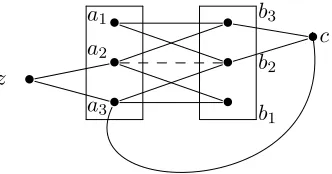
Lemma 6.11 There exist unique elementsz∈ NA0, c ∈NB0 that are not adjacent toa3, b1, respectively. Moreover,cis adjacent toa3.
Proof We have that|N(b1)∩A|= 2. It follows that|N(b1)∩NB0 |=k−2. As |NB0 | = k−1, there is exactly one element cinNB0 that is not connected tob1.
•
• •
•
• •
a1
a3
a2
b3
b1
[image:31.612.242.368.125.190.2]b2
Figure 10: The induced subgraph onKwith7edges
Now consider anr-cliqueLcontaining the edgea3−b2. We have thatb1−a3
andL\{a3, b2} ⊆NB0 ⊆N(b1)∪{c}. It follows thatc∈Lfor otherwiseL∪{b1}
would be a CME, missing only an edge betweenb1 andb2. Hencec−a3.
The construction from this lemma is depicted in Figure 11. Note that there may be additional edges that are not depicted, except for the confirmed non-edges
(c, b1),(z, a1). The dotted edge is the additional edge in the caser= 7.
•
• •
z •
•
• •
a1
a3
a2
b3
b1
b2
c
•
Figure 11: The construction from Lemma 6.11.
Letg∈Gbe such thata1g∈A,a3g /∈A. ConsiderA0 =Ag−1. It is a small
neighbourhood set of defect2, asAhas this property. Moreovera1 ∈A∩A0 but
A 6= A0, as a3g /∈ A. By Lemma 6.10,A0∩A = {a1}. Let A0 = {a1, x, y}.
b3 ∈N(a1)and hence by (d) of Lemma 5.1, one element of x, y, sayx, must be
adjacent tob3. Hencex∈NB\A.
As xf 6= a1f, by Lemma 6.6, N(a1) ∩B = N(x) ∩B = {b2, b3}. As
b1∈/ N(x),x=c, wherecis from Lemma 6.11. By the same lemma, we have that
x−a3. Asxis not adjacent toa1, we have thatx=c=zonce again by Lemma
6.11.
Now, consider the third elementy ofA0. Ify would be adjacent tob2 orb3,
repeating the argument from the previous paragraph yieldsy = c. Asx 6= y, it follows thatyis not adjacent tob2orb3. As
[image:31.612.224.390.345.432.2]it follows thatyis adjacent to every element inN(c)\ {b2, b3}. Soy∈N(a3)and
hencey ∈ NA. Asy /∈N(a1)the uniqueness ofz =ximplies thaty /∈NA0 . So
y∈ B, and hencey =b1, asb2, b3are adjacent toa1. It follows that{a1, b1}is a
small neighbourhood set of defect2.
ConsiderN = N(a1)∩N(b1) of sizek−2. N has no elements in K, and
hence|N∩Z| ≤ 1for all kernel classesZ off. By Lemma 6.9,a1f andb1f are
non-adjacent; however, this is false in our construction.
Our assumption was thatGsynchronizes the transformationf. Hence by con-tradiction, Theorem 6.1 holds for transformations of kernel type(3,3,1, . . . ,1).
6.2 Transformations of kernel type(3,2,2,1, . . . ,1)
LetA = {a1, a2}, B = {b1, b2, b3}, C = {c1, c2} be the non-singleton kernel
classes off. The requirement thatpZ ≥k+ 2for all kernel classesZimplies that
Kf is connected. Hence the induced graph onKf is a2-path or a triangle.
The induced graph onKf is a2-path
The requirement thatpB ≥k+ 2implies that there must be edges fromB to
bothAandC, hencea1f−b1f−c1f.
Letr be the number of edges in K, by Lemma 6.5 we conclude thatr ≤ 8. As|NB0 | = k−2, each element of B has at least 2neighbours inK. Together, these constraints imply that at least one element ofB has exactly2neighbours in K. If this holds for all elements of B, then for at least two distinctx, y ∈ B, N(x)∩N(y)∩K 6= ∅. Otherwise, there arex, y ∈ B, with|N(x)∩K| = 2,
|N(y)∩K| ≥ 3.In both cases, x, y ∈ B satisfy|N(x)∩K|= 2, andN(x)∩
N(y)∩K 6=∅. Say w.l.o.g. thatx=b1,y=b2, andb1−c1−b2.
We claim that we have a CME(b2−c1, b1). For letLbe anr-clique containing
b2, c1, thenL\ {b2, c1} ⊆NB0 . HoweverNB0 ⊆N(b1), as|NB0 |=k−2, andb1
has only two neighbours inK. HenceL∪ {b1}is only missing one edge between
b1andb2, and is a CME.
By contradiction, we can exclude the case thatKfis a2-path.
The images of the non-trivial kernel classes form a triangle
In this case, B is a small neighbourhood set of defect 2, and A and C are small neighbourhood sets of defect2or3. Lemma 6.5 shows that the number of edges r in K satisfiesr ≤ 11. Moreover, by the same lemma ifr = 11, then
Lemma 6.12 Each element ofx ∈A∪Cis adjacent to at least 2 elements ofB, and there is at least one edge fromAtoC.
Proof The first part follows from property (d) of Lemma 5.1. If there would be no edges betweenAandC, thena1, a2could only be adjacent to the3elements in
Band thek−2elements inNA0 , leaving|NA| ≤k+ 1, for a contradiction.
Lemma 6.12 implies thatr ≥9, henceKcontains9,10, or11edges.
Lemma 6.13 There exists an elementx∈Cthat is adjacent to exactly one element ofA.
Proof Lemma 6.12 together with the fact thatrsatisfies9≤r≤11implies that there are1 to3 edges fromAtoC. The statement of the Lemma is true unless there are exactly2edges fromA toC that share a vertex inC. Say w.l.o.g. that these are the edgesa1−c1 −a2, soc2 ∈/ NA. Now, with the results of Lemma
6.12, the2edges betweenAandCrequire thatr ≥10, and hence|NA0| ≤k−3
by assumption. But then
|NA| ≤ |NA0 |+|B|+|{c1}| ≤k+ 1,
contradicting|NA| ≥k+ 2.
Hence, we may assume thatc1−a1, and thatc1is non-adjacent toa2. The following
figure depicts the minimal amount of edges inK.
• •
a2
a1
• •
•
b3
b1
b2 · · ·
· · · · · ·
· · ·
· · · · · ·
• •
c2
c1
By transitivity ofG, there exists a small neighbourhood setD(the image ofB under someg ∈ G) of defect2and size3withc1 ∈ D. Asa1 −c1, by Lemma
5.1(c), there existsd∈D, d6=c1 witha1−d. Hence,d∈NA0 ∪B∪ {c2}. The
following lemmas will examine these possibilities.
Proof Assume otherwise, say thatd=b1. Consider the setN =N(b1)∩N(c1)
with|N|=k−2. Thena1 is the only element inN ∩A, asc1is not adjacent to
a2. The other elements ofN may not be inBorC, asb1andc1are, and hence are
in singleton classes.
N\ {a1}
• •
a2
a1
• •
•
b3
b1
b2 · · ·
· · · · · ·
· · · •
•
c2
c1
By Lemma 6.9, b1f and c1f are non-adjacent. However, this is false, for a
contradiction.
Lemma 6.15 d6=c2.
Proof Assume otherwise. Thenc2−a1, and there are at least two edges between
AandC. Together with at least4edges from AtoB, there are at most5edges fromB toC. AspB = k+ 2, we have B ⊆ NC, and with at most5available
edges, it follows thatN(c1)∩B 6=N(c2)∩B.
N(c2) =ND. As|ND|=k+ 2and|B|= 3,e∈NB.
• •
a2
a1 N(c1)∩B
N(c2)∩B
•e
? ?
B
· · · · · · · · ·
· · · •
•
c2
c1
Now,N(e)∩Bmust differ from one ofN(c1)∩B,N(c2)∩B. This contradicts
Lemma 6.6(b), foref 6=c1f =c2f.
Lemma 6.16 d /∈NA0.
Proof Assume otherwise. By Lemma 6.6(b),N(d)∩A=N(c1)∩A={a1}, and
soa2 ∈/ N(d). This implies thata2must have at leastk−(|NA0 | −1)neighbours
inK.
Now, ifr= 9, then|NA0 | ≤k−2, and soa2requires at least3neighbors inK.
However, Lemma 6.12 accounts for all9edges inK, showing thata2has exactly
2neighbors inK (recall that the edge fromAtoC was assumed to bea1−c1).
This excludes the caser = 9.
Ifr ≥ 10, then|NA0| = k−3, and soa2 requires at least4neighbors in K,
which must be the elements ofB ∪ {c2}. With 3edges from a2 to B, a2 −c2,
a1−c1,2edges froma1toB, and4edges betweenBandC, we see thatr= 11.
• • •d
a2
a1
• •
•
b3
b1
b2 · · ·
· · · · · ·
· · · · · ·
• •
c2
c1
We have excluded every possible location ford. Therefore, Theorem 6.1 holds for transformationsfof kernel type(3,2,2,1, . . . ,1).
6.3 Maps of kernel type(2,2,2,2,1, . . . ,1)
LetA, B, C, D be the non-singleton kernel classes of f, and let A = {a1, a2},
B={b1, b2},C={c1, c2},D={d1, d2}.
For each kernel classZwith imagez0,pZ ≥k+ 2implies thatz0must be
ad-jacent to at least2other images of non-singleton kernel classes. Hence the induced subgraph onKf must have6,5, or4edges, and in the last case, these must form a
4-cycle.
Throughout,gwill denote the transformation(a1a2)(b1b2)(c1c2)(d1d2). As
noted in Subsection 4.1, we are done if we can establish thatgis an automorphism ofΓ0.
The image ofKhas4edges arranged in a cycle
We may suppose that the images of the non-singleton kernel classes area1f−
b1f −c1f − d1f −a1f. In this case each non-trivial kernel class Z satisfies
pZ =k+ 2, and is hence a small neighbourhood set of defect2. HenceZ1 ⊆NZ2
for every pair(Z1, Z2) of adjacent kernel classes. In particular, there are at least
two edges between each such pair.
Letrbe the number of edges inK. By Lemma 6.3 and Lemma 6.5, we have
8≤r≤10.
Kcontains8edges
Here there are exactly two edges between each pair(Z1, Z2)of adjacent kernel
classes. NowZ1 ⊆NZ2 andZ2 ⊆NZ1 is only possible if the two edges between
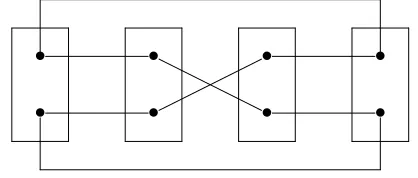
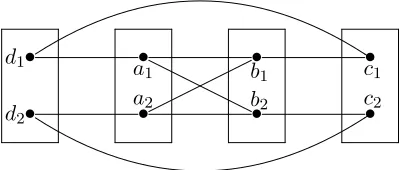
Z1andZ2have disjoint vertices. The only two possible configurations are depicted
in Figures 12 and 13.
It is now easy to check thatgis an automorphism ofΓ0, for a contradiction.
Kcontains9edges
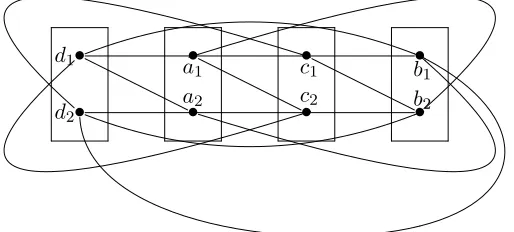
We may assume thatAandB are the unique non-singleton kernel classes that have3edges between them, and thatb1−a1−b2−a2. However in this case, we