OGLE-2018-BLG-0022: A Nearby M-dwarf Binary
R.A. Street,1 E. Bachelet,1Y. Tsapras,2 M.P.G. Hundertmark,2 V. Bozza,3 and M. Dominik4 ROME/REA and MiNDSTEp Teams
ROME/REA Team
D.M. Bramich,5 A. Cassan,6 K. Horne,4 S. Mao,7, 8 A. Saha,9 J. Wambsganss,2, 10 andWeicheng Zang7 MiNDSTEp Team
U.G. Jorgensen,11P. Longa-Pe˜na,12 N. Peixinho,13 S. Sajadian,14 M.J. Burgdorf,15 J. Campbell-White,16 S. Dib,17 D.F. Evans,18 Y.I. Fujii,19, 20 T.C. Hinse,21E. Khalouei,22 S. Lowry,16 S. Rahvar,22 M. Rabus,23
J. Skottfelt,24C. Snodgrass,25, 26 J. Southworth,18 and J. Tregloan-Reed12
1LCOGT, 6740 Cortona Drive, Sutie 102, Goleta, CA 93117, USA.
2Zentrum f¨ur Astronomie der Universit¨at Heidelberg, Astronomisches Rechen-Institut, M¨onchhofstr. 12-14, 69120 Heidelberg, Germany 3Dipartimento di Fisica ”E.R. Canianiello”, Universit´a di Salerno, Via Giovanni Paolo II 132, 84084, Fisciano, Italy
4Centre for Exoplanet Science, SUPA, School of Physics & Astronomy, University of St Andrews, North Haugh, St Andrews KY16 9SS, UK
5New York University Abu Dhabi, Saadiyat Island, Abu Dhabi, PO Box 129188, United Arab Emirates 6Institut dAstrophysique de Paris, Sorbonne Universit´e, CNRS, UMR 7095, 98 bis bd Arago, 75014 Paris, France
7Physics Department and Tsinghua Centre for Astrophysics, Tsinghua University, Beijing 100084, China
8National Astronomical Observatories, Chinese Academy of Sciences, 20A Datun Road, Chaoyang District, Beijing 100012, China 9National Optical Astronomy Observatory, 950 North Cherry Ave., Tucson, AZ 85719, USA
10International Space Science Institute (ISSI), Hallerstraße 6, 3012 Bern, Switzerland
11Niels Bohr Institute & Centre for Star and Planet Formation, University of Copenhagen, Oster Voldgade 5, 1350 Copenhagen, Denmark 12Unidad de Astronom´ıa, Universidad de Antofagasta, Av. Angamos 601, Antofagasta, Chile
13CITEUC - Center for Earth and Space Research of the University of Coimbra, Geophysical and Astronomical Observatory, R. Observatorio s/n, 3040-004 Coimbra, Portugal
14Department of Physics, Isfahan University of Technology, Isfahan 84156-83111, Iran
15Universit¨at Hamburg, Faculty of Mathematics, Informatics and Natural Sciences, Department of Earth Sciences, Meteorological Institute, Bundesstraße 55, 20146 Hamburg, Germany
16Centre for Astrophysics & Planetary Science, The University of Kent, Canterbury CT2 7NH, UK 17Max Planck Institute for Astronomy, K¨onigstuhl 17, D-69117, Heidelberg, Germany
18Astrophysics Group, Keele University, Staffordshire, ST5 5BG, UK
19Department of Physics, Nagoya University, Furo-cho, Chikusa-ku, Nagoya, 464-8602, Japan 20Institute for Advanced Research, Nagoya University, Furo-cho, Chikusa-ku, Nagoya, 464-8601, Japan 21Chungnam National University, Department of Astronomy and Space Science, 34134 Daejeon, Republic of Korea
22Department of Physics, Sharif University of Technology, PO Box 11155-9161 Tehran, Iran
23Instituto de Astronom´ıa, Facultad de F´ısica, Pontificia Universidad Cat´olica de Chile, casilla 306, Santiago 22, Chile, Max-Planck-Institut f¨ur Astronomie, K¨onigstuhl 17, D-69117 Heidelberg, Germany, LCOGT, 6740 Cortona Dr., Suite 102, Goleta, CA
93111, USA, Department of Physics, University of California, Santa Barbara, CA 93106-9530, USA
24Centre for Electronic Imaging, Department of Physical Sciences, The Open University, Milton Keynes, MK7 6AA, UK 25School of Physical Sciences, Faculty of Science, Technology, Engineering and Mathematics, The Open University, Walton Hall, Milton
Keynes, MK7 6AA, UK
26Institute for Astronomy, University of Edinburgh, Royal Observatory, Edinburgh EH9 3HJ, UK
(Received January 1, 2018; Revised January 7, 2018; Accepted March 22, 2019)
Submitted to AJ
ABSTRACT
We report observations of the binary microlensing event OGLE-2018-BLG-0022, provided by the ROME/REA Survey, which indicate that the lens is a low-mass binary star consisting of
Corresponding author: R.A. Street [email protected]
M3 (0.375±0.020 M) and M7 (0.098±0.005 M) components. The lens is unusually close, at
0.998±0.047 kpc, compared with the majority of microlensing events, and despite its intrinsically low luminosity, it is likely that AO observations in the near future will be able to provide an independent confirmation of the lens masses.
1. INTRODUCTION
Microlensing offers a way to explore the populations of stellar and planetary systems in regions of the Galaxy where they are too faint to study via alternative techniques, and at orbital separations where reflex-based and transit methods are inefficient. Seventy-two planetary systems discovered by their lensing signature have been published to date1but notably the method is also sensitive to many other intrinsically low-luminosity objects, including late-type stars and brown dwarfs as well as compact objects, including white dwarfs and black holes (Wyrzykowski et al. 2016), since the technique depends on the gravity, rather than the light, from the lensing system.
A microlensing event occurs when a foreground object crosses the observer’s line of sight to an unrelated luminous source in the background, causing the latter to brighten and fade as the objects move into and out of alignment. Since the events are transient, occurring unpredictably2and without repetition, surveys typically maximize their yield by photometric monitoring of densely populated regions of the Galactic Bulge, where the microlensing optical depth, or probability of lensing is greatest, Γ=[18.74±0.91]×10−6exp[(0.53±0.05)(3-|b|)] star−1 yr−1 for|l|<5◦ (Sumi and
Penny 2016), resulting in∼2000 events being discovered per year, of which∼10 % are due to binary lenses. While the guiding scientific goal of most of these surveys is generally the discovery of exoplanets, they yield binary lens systems with a wide range of mass ratios, all of which must be carefully observed and assessed to determine the true nature of the lensing system.
Here we present multi-band observations of the microlensing event OGLE-2018-BLG-0022 from the new ROME/REA survey, along with a description of the analysis process. In the next section, we outline the essential theoretical model parameters and our motivation for this observing strategy, followed by a brief description of the ROME/REA project and observations of this event. The light curve modeling and analyses are presented in Sections5and6and we discuss their implications for the nature of the lens in Section7.
2. CHARACTERIZING MICROLENSING EVENTS
A foreground lensing object of massML, at distanceDLfrom the observer, deflects the light from a background source
at distance DS with a characteristic angular radius,θE =
q
4GML c2
DLS
DLDS (Refsdal 1964), whereDLS is the distance between the lens and source. As the relative proper motion,µrelof the lens and source narrows their projected angular
separationu(t) to a minimumu0at timet0, the source appears magnified as a function of time, with the magnification
given by A(t) = u2+2
u√u2+4. Microlensing events have a characteristic Einstein crossing time, tE, defined as the time
taken for the source to crossθE in a lens-centered geometry.
At their simplest, single, point lens microlensing events are described by just three parameters,t0,u0,tE, and binary lenses require just three more: the mass ratio of the lens components, q = ML,2/ML,1, their angular separation, s,
normalized byθE andα, the counterclockwise angle between the binary axis and the source trajectory.
All of these parameters may be measured directly from time-series photometry in a single passband, but unfortunately this alone does not reveal the physical nature of the lens, since θE has a mass-distance degeneracy (Dominik 1999). This ambiguity is most commonly broken by measuring two effects.
The motion of the observer during the event requires a modification of u(t) to take microlensing parallax, πE = (πE,N, πE,E), into account. This may be measured as a skew in the light curve of events withtE&30 d, or otherwise by combining simultaneous light curves from widely separated observers, such as on Earth and in space (e.g. Dong et al. 2007;Shvartzvald et al. 2016). Although both lens and source may be kiloparsecs distant from the observer, the finite angular size of the latter can nevertheless introduce detectable distortions around the peak of the light curve, parameterized as ρ =θS/θE. ρ can then be used to determineθE, if an independent measurement is made of the angular radius of the sourceθS.
As microlensing sources are typically faint, with I &15.0 mag, their angular sizes are most easily estimated from stellar models based on their spectral type. This is usually constrained from a low-cadence light curve of the event in
1Source: NASA Exoplanet Archive, https://exoplanetarchive.ipac.caltech.edu/
a second optical bandpass, since the microlensing magnification can be used to distinguish the light from the source from other stars blended within the same Point Spread Function (PSF). Ongoing microlensing surveys, such as the Optical Gravitational Lensing Experiment (OGLE3 Udalski et al. 1992), Microlensing Observations in Astrophysics
(MOA4and Korea Microlensing Telescope Network (KMTNet,Park et al. 2012), typically obtain imaging data in two broadband filters, usually Bessell-V, I. Priority is given toI-band observations in order to properly constrain all light curve features, withV-band data obtained at a much lower and variable cadence.
3. THE ROME/REA PROJECT
The goal of the ROME/REA Microlensing Project (described inTsapras et al.) is to ensure that the source stars of microlensing events within its footprint are well characterized and hence that the physical nature of the lensing objects can be determined. The project has adopted a novel observing strategy designed to complement those of the existing surveys, which combines both regular survey-mode observations (ROME, Robotic Observations of Microlensing Events) in three passbands with higher cadence single-filter (REA, REActive mode) observations obtained around the event peaks, or in response to caustic crossings. This strategy takes advantage of the multiple 1 m telescopes at each site of the Las Cumbres Observatory Telescope Network (LCO) and the flexibility offered by the network’s robotic scheduling system (Saunders et al. 2014).
The ROME survey monitors 20 selected fields in the Galactic Bulge where the rate of microlensing events is highest (Sumi and Penny 2016). The field of view of each pointing is 260×260, determined by the field of theSinistrocameras of the LCO 1 m network, giving a total survey footprint of 3.76 sq. deg. A triplet of 300 s exposures in SDSS-g0,
-r0 and -i0 are obtained in each survey visit to a field, and all 20 fields are surveyed with a nominal cadence of once every 7 hrs thanks to the geographic distribution of the LCO network (Brown et al. 2013). Specifically, ROME/REA uses the LCO Southern Ring of identical 1 m telescopes at Cerro Tololo Inter-American Observatory (CTIO), Chile, the South African Astronomical Observatory (SAAO), South Africa and Siding Spring Observatory (SSO), Australia. ROME survey observations are therefore conducted around the clock, as long as the fields are visible from each site, between April 1 to October 31 each year, starting in 2017.
As such, the ROME survey was designed to complement other ongoing surveys, by improving the color data available to characterize microlensing source stars and filling a gap between the surveys that observe the Bulge at high cadence but predominantly in a single filter and very wide-field surveys that obtain multi-bandpass data but sometimes at a cadence that is too low to provide useful constraints to microlensing events. For example, OGLE and KMTNet obtain data in V at <1 d cadence but I band data at intervals<15 min, while the Zwicky Transient Factory observes the northern Plane nightly in SDSS-r and occasionally in SDSS-g. ROME/REA complements the wavelength coverage of the NIR UKIRT (Shvartzvald et al. 2017) and VVV surveys (Minniti et al. 2010).
4. OBSERVATIONS AND DATA REDUCTION
The event OGLE-2018-BLG-0022 was first discovered and classified as a microlensing event by OGLE on 2018 February 7, and subsequently re-identified by the same survey as OGLE-2018-BLG-0052 on 2018 February 21. The same object was also independently discovered by MOA on 2018 February 25, who assigned the label MOA-2018-BLG-031.
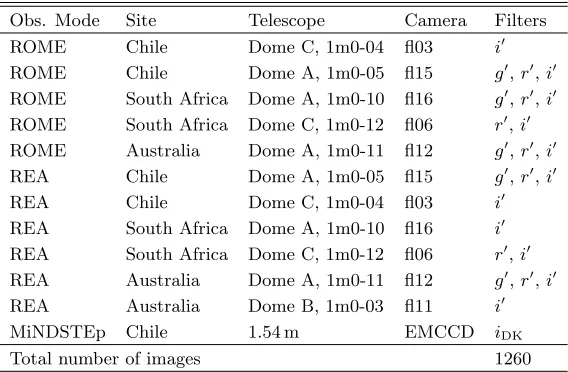
With RA, Dec coordinates of 17:59:27.04, -28:36:37.00 (J2000.0), this event lies within the boundaries of ROME-FIELD-16. ROME observations of this field began on 2017 March 18 using the LCO facilities summarized in Table1. In general, we endeavored to conduct ROME and REA observations using a consistent set of cameras at the 3 sites in order to limit the number of datasets and any calibration offsets between them, so the majority of our data was provided by 3 instruments. However, the LCO network is designed to optimize its schedule globally by moving observation requests between telescopes, and REA-mode observations in particular were obtained from multiple cameras for this reason. Over the longer term, it was also necessary occasionally to transfer ROME observations between telescopes at the same site, when technical issues affected the original instruments. Nevertheless, all data were obtained using the Sinistroclass of optical cameras, all of which consist of 4k×4k Fairchild CCDs operated in bin 1×1 mode with a pixel scale of 0.38900pix−1.
On 2018 March 13 the ARTEMiS anomaly detection system (Dominik et al. 2008a) found that the light curve of the event was deviating from a point-source, point-lens model on the rising section of its light curve, and subsequent
3http://ogle.astrouw.edu.pl/
Table 1. Summary of telescopes and instruments used
Obs. Mode Site Telescope Camera Filters ROME Chile Dome C, 1m0-04 fl03 i0
ROME Chile Dome A, 1m0-05 fl15 g0,r0,i0
ROME South Africa Dome A, 1m0-10 fl16 g0,r0,i0
ROME South Africa Dome C, 1m0-12 fl06 r0,i0
ROME Australia Dome A, 1m0-11 fl12 g0,r0,i0
REA Chile Dome A, 1m0-05 fl15 g0,r0,i0
REA Chile Dome C, 1m0-04 fl03 i0
REA South Africa Dome A, 1m0-10 fl16 i0
REA South Africa Dome C, 1m0-12 fl06 r0,i0
REA Australia Dome A, 1m0-11 fl12 g0,r0,i0
REA Australia Dome B, 1m0-03 fl11 i0
MiNDSTEp Chile 1.54 m EMCCD iDK
Total number of images 1260
modeling efforts by Bozza, Cassan, Bachelet and Hirao5 confirmed that the event was most likely caused by a binary
lens. As the event brightened towards its peak magnification it met the criteria for REA and our RoboTAP target prioritization software (Hundertmark et al. 2018) began to schedule REA-mode observations in addition to those for ROME. The models provided by V. Bozza’s RTModel system for real-time analysis (Bozza 2010) provided predictions regarding the timing of future caustic crossings that were used to plan observations. Following the ROME/REA strategy, REA-LO mode, single-filter observations were automatically requested every hour, while REA-HI observations were triggered to ensure data would be obtained at high-cadence (every 15 min) for the periods of predicted caustic crossing. Photometry was provided to RTModel from several teams including ROME/REA while the event was in progress, which allowed both the model predictions and the REA observations to be updated accordingly until the event was observed to return to the source’s baseline brightness. REA-mode observations continued until after the peak of the event, ending on 2018 June 10.
All ROME/REA imaging data were preprocessed by the standard LCOBANZAIpipeline to remove the instrumental signatures, then reduced using a Difference Image Analysis (DIA) pipeline based on theDanDIApackage byBramich
(2008);Bramich et al.(2013) to produce light curve photometry.
Independently of ROME/REA, MiNDSTEp observations with the Danish 1.54,m in Chile were triggered auto-matically by the SIGNALMEN anomaly detector (Dominik et al. 2007), operated as part of the ARTEMiS system6
(Dominik et al. 2008b, 2010), in conjunction with real-time modeling of anomalous events provided by RTModel7
(Bozza et al. 2018). They began on 2018 April 25 and continued until 2018 May 18, with the goal of ensuring high-cadence coverage of the anomaly. These data were obtained with the EMCCD camera equipped with a long-pass filter with a short-wavelength cut off at 6500 ˚A, making the filter function resemble a combined SDSS-i0 plus SDSS-z0 plus the long-wavelength part of the SDSS-r0 filter, denoted asiDK in Table1. These data were reduced with a version of theDanDIApackage (Bramich 2008) which has been optimized for the reduction of data from this EMCCD instrument (Skottfelt et al. 2015;Evans et al. 2016).
5. LIGHT CURVE ANALYSIS
Some residual structures remained after the initial processing. As the event timescale is relatively long (tE>50 d), it was likely that annual parallax and, potentially, the orbital motion of the lens may be significant. We therefore explore these two second-order effects and find a great improvement of the model likelihood.
Since the light curve presents clear signatures of a multiple lens, we began by fitting a simple Uniform-Source Binary Lens (USBL) model to the light curve data, where both lens and observer were considered to be static, using the pyLIMA modeling package (Bachelet et al. 2017). It should be noted that pyLIMA’s geometric convention is to place the most massive body on the left, and α is defined to be the counterclockwise angle between the binary axis and
5Private communications 6http://www.artemis-uk.org/
the source trajectory. Initial model fits indicated significant deviations around the peak that are typically introduced when the angular radius of the source star is non-negligible relative to the angular size of the caustic. We therefore investigated finite-source binary lens (FSBL) models, and took the limb-darkening of the source into account when computing the magnification of the source. A linear limb-darkening model is commonly sufficient for microlensing models, and we adopt the widely-used formalism (Albrow et al. 1999):
Iλ=
Fλ πθ2
∗
1−Γλ
1−3 2cosφ
, (1)
where Iλ is the intensity of the source at wavelength, λ, Fλ is the total flux from the source in a given passband andφis the angle between the line of sight to the observer and the normal to the stellar surface. The limb-darkening coefficient, Γλ is related to the uλ limb-darkening coefficients derived from the ATLAS stellar atmosphere models presented (Claret and Bloemen 2011) by the expression:
Γλ= 2uλ 3−uλ
. (2)
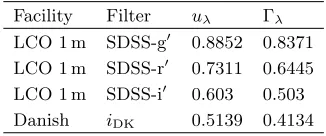
[image:5.612.223.386.307.375.2]The values ofuλ and Γλapplied for each dataset are presented in Table2.
Table 2. Linear limb-darkening coefficients used
Facility Filter uλ Γλ
LCO 1 m SDSS-g0 0.8852 0.8371 LCO 1 m SDSS-r0 0.7311 0.6445 LCO 1 m SDSS-i0 0.603 0.503 Danish iDK 0.5139 0.4134
The PSF naturally differs between datasets acquired from different observing sites and instruments. In the crowded star fields of the Galactic Bulge, the PSF of the source star is highly likely to be blended with those of neighboring stars. The measured flux of the target at timetin datasetk,f(t, k) is calculated as a function of lensing magnification, A(t),f(t, k) =A(t)fs(k) +fb(k). Here,fs(k) is the flux of the source star and fb(k) represents the flux of all stars blended with the source in the data set. A regression fit was performed in the course of the modeling process to measurefsandfb for each data set.
pyLIMA’s Differential Evolution (DE,Storn and Price 1997) solution-finding algorithm was used to explore parameter space and zero in on the region that best represents the data, after which we mapped the posterior distribution of each region using a Monte-Carlo Markov Chain (MCMC) algorithm (emcee; Foreman-Mackey et al. 2013). Once the parameter space minimum had been localized, the best-fitting model parameters were identified using the Levenberg-Marquardt algorithm (Levenberg 1944; Marquardt 1963) or the Trust Region Reflective algorithm (Coleman and Li 1994;Branch et al. 1999).
The DE algorithm was initially given as few restrictions as possible (t0to lie within±50 d of the event peak; -0.3≤
u0≤0.3) so that it would explore a wide parameter space and identify all possible minima for further study. The DE
algorithm outputs the fit parameters for each candidate solution, which can be used to map the parameter space as shown in Figure1. By design, the algorithm returns more solutions in regions whereχ2 minima are located, so a 2D
histogram of the number of solutions per element of log10(s) vs. log10(q) space indicates where solutions lie and further investigation is required. This exploration indicated a single but extended minimum, and consistently converged on solutions where the source-lens relative trajectory intersected the central caustic. The origin of the coordinate system was set to that of the central caustic during the modeling process, for increased stability of fit, so the impact parameter uc, is measured relative to this point.
Following common practise (e.g. Skowron et al. 2015), we renormalized the photometric errors,σ(k), of each dataset, k, according to the expression (in magnitude units):
σ(k)0=
q
a2
0(k) +a21(k)σ(k)2. (3)
The coefficientsa0(k), a1(k) were estimated by requiring that the reducedχ2red= 1. If the fit could not be constrained
[image:6.612.105.509.278.401.2]then the coefficients were set to 0.0 and 1.0, respectively. This could occur for a variety of reasons, the most common being that the majority of measurements in a given dataset were taken primarily over the peak of the event, where the rescaling fit was heavily influenced by residuals from the model, particularly around caustic crossings. This was mitigated to some degree by iterating the model fitted with the rescaling process, to verify that the uncertainties of specific data points were not being excessively scaled. A second problem was that the photometric uncertainties for a given dataset spanned a relatively short numerical range, leading to instability in the linear regression fit of the above function, and resulting in statistically nonsensical coefficients. Lastly, for some datasets the residual scatter in the photometry was accurately represented by the uncertainties, implying that no rescaling was required. The adopted values are given in Table3.
Table 3. Coefficients used in the rescaling of photometric uncertainties for each dataset and filter.
Facility g0 r0 i0 iDK
a0 a1 a0 a1 a0 a1 a0 a1
Chile, Dome A, fl15 0.0 1.0 0.0 1.0 0.0 1.0 - -Chile, Dome C, fl03 - - 0.0 1.0 - - - -South Africa, Dome A, fl16 0.047±0.03 1.0 0.0 1.0 0.019±0.004 2.874±1.597 - -South Africa, Dome C, fl06 - - 0.0 1.0 0.0 1.0 - -Australia, Dome A, fl12 0.0 1.0 0.0 1.0 0.0 2.445±0.831 - -Australia, Dome B, fl11 - - - - 0.0 1.0 - -Danish, 1.54,m, DFOSC - - - 0.0 1.0
As there are both wide- and close-binary configurations that can produce very similar caustic structures (the well-documented close-wide degeneracy, Dominik 1999, 2009), we split the parameter space into two regions, s > 1 and
s <1, which were explored separately. For this event, the close-binary solutions proved to be a significantly better fit
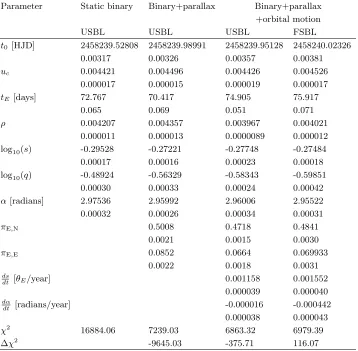
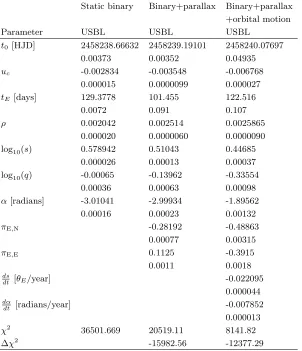
than the wide-binary models; the parameters of the best fitting models in each case are presented in Tables4–5. We found a significant improvement inχ2was achieved by including microlensing parallax, which is expected for an event
of this duration, and also lens binary orbital motion.
At each stage of modeling, as these effects were included, we explored finite-source, binary-lens (FSBL) models as well as USBL models. While the best-fitting of these models indicated similar parameters to the USBL models, their χ2 values were found to be somewhat higher. A close examination of the residuals showed that this is driven by a
small number (5) of data points around the caustic crossing at 2458232.7, where the model is most sensitive to the limb-darkening of the source star. Two of the datapoints are in SDSS-g’ band and 3 are in SDSS-i’, which in principle might provide an independent constraint on Γ. Regrettably, the caustic crossing occurred between the end of the night in Chile and the start of the night in Australia, and the data points were obtained from different instruments, under different conditions. This is a situation where residual systematic noise in the photometry can easily exceed the finite source signature, so proceeding with finite-source models was judged to be unsafe.
Figure2 displays the light curve data overlaid with the best-fitting model, a uniform-source close-binary lens, and a plot of the source’s trajectory relative to the lens plane and caustic structures is shown in Figure3. We note that there is a second degeneracy: lens-source relative trajectories with a negative uc value could in principle produce a very similar light curve. These solutions were allowed during our fitting process, but were always disfavored in the results. This would not strongly impact the physical characteristics of the lens inferred from the best-fit model.
6. SOURCE COLOR ANALYSIS
1.0
0.5
0.0
0.5
1.0
log
10(s)
6
5
4
3
2
1
0
log
10(q
)
N DE samples
10
110
210
310
410
51.0
0.5
0.0
0.5
1.0
log
10(s)
6
5
4
3
2
1
0
log
10(q
)
log
10(
2)
[image:7.612.63.575.63.326.2]5.5
6.0
6.5
7.0
7.5
Figure 1. Maps of the (log10(s) vs. log10(q)) parameter space mapped out by a Differential Evolution (DE) algorithm. (Left) A 2D histogram of the number of DE samples for each pixel in the parameter space, (right) a 2D histogram of the chi-square values of each pixel. This plot was downsampled by a factor of 2 without loss of detail to minimize the plot filesize.
images taken sequentially on 2017 July 26 between 04:05 – 04:17 UTC were selected as the reference images for these datasets because they were obtained in the best seeing, transparency and sky background conditions. These images were used as the reference images for the DIA pipeline. PSF fitting photometry was conducted on the same images, in order to determine the reference fluxes of all detected stars.
The positions of all detected stars (as determined from the World Coordinate System fit, WCS, for each image) were cross-matched against the VPHAS+ catalog (Drew et al. 2014), from which calibrated SDSS-g, -r and -i magnitudes were extracted. To mitigate the impact of differential extinction across the field of view, stars within 2 arcmin of the lensed star were selected for the purpose of measuring the photometric transformation from LCO instrumental magnitudes to the VPHAS+ system. Color-magnitude diagrams from the ROME data are presented in Figure4.
While this procedure provides an approximate photometric calibration, fields in the Galactic Bulge suffer from high extinction, which is often spatially variable across the field of view of a single ROME exposure. To account for this, it has become standard practice in microlensing to measure the offset of the Red Clump from its expected magnitude and color.
Red Clump giant stars are often used as standard candles, since their absolute luminosity is constant, being relatively insensitive to changes in metalicity and age, and they occur with high frequency across the Galactic Plane. Recently,
Ruiz-Dern et al. (2018) summarized Red Clump photometric properties in a wide range of photometric systems, including their absolute magnitudes in the SDSS passbands: Mg,RC,0= 1.331±0.056 mag,Mr,RC,0= 0.552±0.026 mag,
Mi,RC,0= 0.262±0.032 mag.
To determine the apparent magnitude and colors of the Red Clump stars, we assume that they are located in the Galactic Bar. Nataf et al. (2013) indicated that the Galactic Bar is orientated at a viewing angle of φBar = 40◦,
meaning that the distance to the Red Clump,DRC, is a function of Galactic longitude,l:
R0
DRC
=sinφBar+l φBar
= cosl+ sinlcotφBar, (4)
whereR0 = 8.16 kpc (we note that the bar angle may be somewhat smaller,Cao et al. 2013;Wegg and Gerhard 2013,
10
12
14
16
Mag
provided by pyLIMA
USBL lsca_ip coja_gp coja_ip coja_rp cojb_ip cpta_gp cpta_ip cpta_rp cptc_ip cptc_rp lsca_gp lsca_rp lscc_rp Danish
0.2
0.1
0.0
0.1
Residuals
0.2
0.1
0.0
0.1
Residuals
0.2
0.1
0.0
0.1
Residuals
0.2
0.1
0.0
0.1
Residuals
2457850
2458000
2458150
2458300
2458450
HJD
0.2
0.1
0.0
0.1
Residuals
245822524582302458235245824024582452458250
11.0
11.5
12.0
12.5
13.0
2458220 2458225 2458230 2458235
13.900 13.925 13.950 13.975 14.000 14.025 14.050 14.075 14.100
[image:8.612.136.480.62.649.2]OGLE-2018-BLG-0022
1.5
1.0
0.5
0.0
0.5
1.0
1.5
X [
E
]
1.5
1.0
0.5
0.0
0.5
1.0
1.5
Y [
E
[image:9.612.138.481.61.405.2]]
Figure 3. Plot of the lens plane in a lens-centric geometry, showing the caustic structures for the binary lens in red in relation to the source-lens relative trajectory in blue. The dotted black lines represent the critical curve.
used this to estimate the apparent photometric properties (denoted bymλ,RC,0for different passbands,λ) summarized
in Table6.
The Red Clump is clearly identifiable in the ROME color-magnitude diagrams (Fig.4). Stars within 2 arcmin of the target were used to measure the centroid of the Clump in magnitude and color by applying the following selection cuts: 15.5≤i≤16.5 mag, 16.2≤r≤17.5 mag, 17.8≤g≤19.5 mag, 0.8≤(r−i)≤1.2 mag, 1.5≤(g−r)≤2.2 mag. The measured centroids of the Red Clump are presented in Table6.
The offset of the Red Clump from its expected photometric properties was used to estimate the extinction,Aλ, and reddening,E(color) for the Red Clump along the line of sight to the target.
These quantities were then used to correct the photometric properties of the source and blend, as derived from the best-fitting light curve model, assuming that they have the same extinction and reddening as the Red Clump. The resulting data are summarized in Table7.
We note that the ROME survey strategy provides a useful means to verify the source flux determined from the model. Since ROME observations are always conducted as a sequence of back-to-back (g0,r0,i0) exposures taken within ∼15 mins of each other, the magnification of the event can normally be taken to be approximately the same for all 3 images in a trio (excluding caustic crossings). These observations can be used to measure the source color and blend flux independently of the model, as follows. The total flux measured in a given passband λ, fλ consists of the source flux,fS,λ, multiplied by the lensing magnification, A, combined with the flux from any other blended stars along the
line of sight,fb,λ: fλ(t) =fS,λA(t) +fb,λ. Contemporaneous fluxes in multiple passbands can be combined as:
fλ,1(t) =
fS,λ,1
fS,λ,2
Table 4. Parameters of the best-fitting close-binary models. Uncertainties are indicated in the second line for each parameter. ∆χ2 is calculated from the difference inχ2 between the each fit and the fit in its neighboring column to the left.
Parameter Static binary Binary+parallax Binary+parallax +orbital motion
USBL USBL USBL FSBL
t0 [HJD] 2458239.52808 2458239.98991 2458239.95128 2458240.02326 0.00317 0.00326 0.00357 0.00381
uc 0.004421 0.004496 0.004426 0.004526
0.000017 0.000015 0.000019 0.000017
tE [days] 72.767 70.417 74.905 75.917
0.065 0.069 0.051 0.071
ρ 0.004207 0.004357 0.003967 0.004021 0.000011 0.000013 0.0000089 0.000012 log10(s) -0.29528 -0.27221 -0.27748 -0.27484 0.00017 0.00016 0.00023 0.00018 log10(q) -0.48924 -0.56329 -0.58343 -0.59851
0.00030 0.00033 0.00024 0.00042
α[radians] 2.97536 2.95992 2.96006 2.95522 0.00032 0.00026 0.00034 0.00031
πE,N 0.5008 0.4718 0.4841
0.0021 0.0015 0.0030
πE,E 0.0852 0.0664 0.069933
0.0022 0.0018 0.0031
ds
dt [θE/year] 0.001158 0.001552
0.000039 0.000040
dα
dt [radians/year] -0.000016 -0.000442
0.000038 0.000043
χ2 16884.06 7239.03 6863.32 6979.39
∆χ2 -9645.03 -375.71 116.07
This allows the source color to be measured by linear regression from the slope of the fluxes in different pass-bands, plotted against one another. Applying this technique, we measured: (g−r)S = 2.115±0.007 mag, (g−i)S
= 3.253±0.007 mag, (r−i)S = 1.138±0.002 mag. These values are consistent with the colors determined from the
model-predicted source fluxes in Table7The resulting timeseries of source color measurements are show in Fig.4, and can be evaluated relative to the crosshairs indicating the source color measured from the light curve analysis.
The source star’s location on the color-color diagram (Figure5) was compared with theoretical stellar isochrones derived from the parsec model8 (Bressan et al. 2012) for solar metallicity and ages ranging from 3.98×10⁶ to
1.26×10¹⁰yrs, to find the closest matching colors for each isochrone. This analysis indicated a source effective
temperature ofTeff = 4290.9±50.0 K, suggesting that the source star is a K-type star.
The angular radius,θS, for the source star was then calculated using the relationships between the limb-darkened θS and stellar colors in SDSS passbands derived fromBoyajian et al. (2014). Both color indices for which coefficients were published yielded consistent estimates: θS,(g−r) = 7.144±0.319µas andθS,(g−i) = 7.431±0.232µas. We adopt
an average of these two results,θS= 7.288±0.394µas.
The final required constraint is to determine the distance to the source, so thatρ=θS/θEcan be used to measure the Einstein radius. The best way to provide this constraint would be a measurement of the source’s parallax from theGaia mission (Gaia Collaboration et al. 2016), although its source catalog is restricted to the brightest stars only in Bulge fields, owing to limitations of the on-board processing. The Gaia Data Release 2 catalog (Gaia Collaboration et al. 2018) reported a source (id=4062576103277425536) within 0.185 arcsec of this event, though its parallax measurement
Table 5. Parameters of the best-fitting wide-binary models. Uncertainties are indicated in the second line for each parameter. ∆χ2 is calculated from the difference inχ2 between the each fit and the fit in its neighboring column to the left.
Static binary Binary+parallax Binary+parallax +orbital motion
Parameter USBL USBL USBL
t0 [HJD] 2458238.66632 2458239.19101 2458240.07697 0.00373 0.00352 0.04935
uc -0.002834 -0.003548 -0.006768
0.000015 0.0000099 0.000027
tE [days] 129.3778 101.455 122.516
0.0072 0.091 0.107
ρ 0.002042 0.002514 0.0025865 0.000020 0.0000060 0.0000090 log10(s) 0.578942 0.51043 0.44685
0.000026 0.00013 0.00037 log10(q) -0.00065 -0.13962 -0.33554
0.00036 0.00063 0.00098
α[radians] -3.01041 -2.99934 -1.89562 0.00016 0.00023 0.00132
πE,N -0.28192 -0.48863
0.00077 0.00315
πE,E 0.1125 -0.3915
0.0011 0.0018
ds
dt [θE/year] -0.022095
0.000044
dα
dt [radians/year] -0.007852
0.000013
χ2 36501.669 20519.11 8141.82
∆χ2 -15982.56 -12377.29
(0.13233847489290135±0.10027593536929187 mas) was flagged as uncertain. The catalog of distances provided by
Bailer-Jones et al. (2018) gave an ill-constrained measurement of 8342+12860−5333 pc. It should also be borne in mind that this measurement reflects the flux of the source+blend, at baseline, and the methodology was not optimized for crowded fields.
However, the source angular radii derived fromBoyajian et al. (2014) and the color indices imply that the source is a giant, and its position on the color-magnitude diagrams is consistent with a Red Clump giant in the Bulge at a distance of 7.87 kpc, as calculated earlier. Adopting this distance for the source, we infer a radius of 12.330±0.666R.
Combining these quantities, with the parameters of our best-fitting model, we infer the physical properties of the lens from the following relations. The angular Einstein radius, θE, was extracted from the ratio of source radiiρin Einstein andθSin absolute units. This quantity relates directly to the total lens mass,ML, the lens distance,DL and the lens-source separation,DLS.
θE=
θS
ρ =
s
4GML
µDLc2
, (6)
µ= 1 + DL
DLS
, (7)
0.0 0.2 0.4 0.6 0.8 1.0 1.2 1.4 SDSS (r-i) [mag]
14
15
16
17
18
19
20
21
SDSS-r [mag]
Ar
Stars within ROME field Stars < 2.0arcmin of target Source crosshairs
Blend Blended target Red Clump centroid
0.5 1.0 1.5 2.0 2.5 3.0 3.5 4.0
SDSS (g-i) [mag] 14
15
16
17
18
19
20
21
22
SDSS-g [mag]
Ag
Stars within ROME field Stars < 2.0arcmin of target Source crosshairs
[image:12.612.80.536.59.295.2]Blend Blended target Red Clump centroid
Figure 4. ROME color-magnitude diagrams for the field containing OGLE-2018-BLG-0022. Stars within 2 arcmin of the target are highlighted in dark brown, whereas stars in the rest of the field are plotted in yellow. The center of the Red Clump is marked with a green square, and that of the blend by a blue triangle. The magnitude of the source+blend is plotted as a function of time as black + symbols. The magenta diamond marks the location of the source, overlaid with crosshairs. An arrow indicates the extinction vector at the distance of the lens.
Table 6. Photometric properties of the Red Clump, with absolute magnitudes (Mλ)
taken fromRuiz-Dern et al.(2018), and the measured properties from ROME data.
Mg,RC,0 1.331±0.056 mag
Mr,RC,0 0.552±0.026 mag
Mi,RC,0 0.262±0.032 mag
(g−r)RC,0 0.779±0.062 mag
(g−i)RC,0 1.069±0.064 mag
(r−i)RC,0 0.290±0.041 mag
mg,RC,0 15.810±0.056 mag
mr,RC,0 15.031±0.026 mag
mi,RC,0 14.741±0.032 mag
mg,RC,centroid 18.85±0.30 mag mr,RC,centroid 17.01±0.25 mag mi,RC,centroid 16.03±0.24 mag
(g−r)RC,centroid 1.87±0.13 mag
(r−i)RC,centroid 1.01±0.06 mag Ag 3.037±0.056 mag
Ar 1.981±0.026 mag
Ai 1.290±0.032 mag
E(g−r) 1.091±0.062 mag
[image:12.612.235.402.456.701.2]1.0
0.5
0.0
0.5
1.0
1.5
2.0
SDSS (g-r) [mag]
1.00
0.75
0.50
0.25
0.00
0.25
0.50
0.75
1.00
SDSS (r-i) [mag]
O8IIIB1/2III
B3IIIB5IIIB9IIIA0IIIA3III A5IIIA7IIIF0III
F2IIIF5III
G0III G5IIIG8III K0IIIK1IIIK2IIIK3III
K4III K5III
M0III M1III M2III M3III
Source
Stars within ROME field
Stars < 2.0arcmin of target
Blend
[image:13.612.95.518.252.699.2]Blended target
Table 7. Photometric properties of the source star (S) and blend (b).
mg,S 19.484±0.007 mag mg,b 20.462±0.027 mag
mr,S 17.369±0.002 mag mr,b 18.895±0.013 mag
mi,S 16.231±0.001 mag mi,b 18.294±0.013 mag
(g−r)S 2.115±0.007 mag (g−r)b 1.567±0.030 mag
(g−i)S 3.253±0.007 mag (g−i)b 2.168±0.030 mag
(r−i)S 1.138±0.002 mag (r−i)b 0.601±0.018 mag
mg,S,0 16.447±0.056 mag mr,S,0 15.388±0.026 mag mi,S,0 14.941±0.032 mag
(g−r)S,0 1.059±0.007 mag
(g−i)S,0 1.506±0.007 mag
(r−i)S,0 0.447±0.002 mag
πL=πrel+πS, (8)
πS= 1AU/DS, (9)
DL= 1AU/πL. (10)
The resulting lens properties are summarized in Table 8. The lens masses are consistent with a low-mass stellar binary composed of an M6-7 star orbiting an M3 star.
Table 8. Physical properties of the source and lens system.
Parameter Units Value
θS µas 7.288±0.394
θE µas 1837.145±99.384
RS R 12.327±0.666
ML,tot M 0.473±0.026
ML,1 M 0.376±0.020
ML,2 M 0.098±0.005
DL Kpc 0.998±0.047
a⊥ AU 0.967±0.070
µ mas yr−1 8.96±0.48
7. ASSESSMENT OF THE LENS AND BLENDED FLUX
The lensing system in this case is relatively close, compared with other microlensing discoveries, and its location suggests that the binary may lie in the Galactic Disk. Given the measured masses, the simplest explanation is that the lens consists of two main sequence components. However, we noted that, with a distance modulus of 9.99±0.47 mag, a main sequence binary might be detectable, and we estimated its likely photometric properties as follows.
We extracted the absolute magnitudes of M-type stars from a PARSEC isochrone, assuming solar age and metallicity, and calculated the expected apparent magnitudes of the binary at the lens distance (see Table9). These magnitudes are significantly brighter than the limiting magnitude of the ROME data (limited by the sky background,∼21.969 mag [SDSS-g],∼21.989 mag [SDSS-r],∼22.010 mag [SDSS-i]), and suggest that the lens could be contributing to the blend flux we measured from the light curve.
[image:14.612.215.397.383.516.2]colour excess to the lens star to be E(B−V) = 0.235±0.032 mag (Fig.6). This was used to estimate the extinction inV-band,AV =RVE(B−V), where the reddening,RV was estimated for the Galactic Bulge byNataf et al.(2013) to be ∼2.5±0.2. We therefore foundAV = 0.59±0.09 mag. This was used to estimate the extinction in Sloan filters by applying the transforms derived by Schlafly and Finkbeiner (2011), interpolating between the discrete values of RV they provided to arrive at extinction values for this field ofA(SDSS−g) = 0.851±0.118 mag,A(SDSS−r) = 0.532±
0.074 mag,A(SDSS−i)= 0.382±0.053 mag. The extinction-corrected apparent magnitudes for the lens binary scenario
[image:15.612.204.408.196.599.2]are presented at the bottom of Table9.
Table 9. Predicted photometric properties of the lens system. Apparent magnitudes are calculated for the measured lens distance without extinction or reddening, except for the bottom section.
Quantity M3-dwarf M7-dwarf MS-binary
[mag] M3+M7
MB 13.175 21.124 13.174
MV 11.574 18.674 11.572
Mg 11.933 19.149 11.932
Mr 10.409 17.181 10.407
Mi 9.475 14.700 9.466
MJ 7.566 11.033 7.522
MH 7.014 10.458 6.969
MKs 6.779 10.178 6.733
(B−V) 1.601 2.450 1.602 (g−r) 1.524 1.968 1.525 (r−i) 0.934 2.481 0.941 (J−H) 0.552 0.575 0.553 (H−Ks) 0.235 0.280 0.237 (J−Ks) 0.787 0.855 0.790
mB 23.169 31.118 23.168
mV 21.568 28.668 21.566
mg 21.927 29.143 21.926
mr 20.403 27.175 20.401
mi 19.469 24.694 19.460
mJ 17.560 21.027 17.516
mH 17.008 20.452 16.963
mKs 16.773 20.172 16.727
mV,corr 22.155 29.255 22.153
(B−V)corr 1.836 2.685 1.837
mg,corr 22.778 29.994 22.777
mr,corr 20.935 27.707 20.933
mi,corr 19.851 25.076 19.842
(g−r)corr 1.843 2.287 1.844
(r−i)corr 1.084 2.631 1.091
The measured blend photometry in Table7 indicates one or more objects that are significantly brighter than the photometry predicted for a main sequence M3+M7 binary, implying that the light originates from a separate object(s) – a common situation in the crowded star fields of the Galactic Bulge. Nevertheless, we note that the lens should be easily detectable in 2–4 m-class telescopes, particularly in the NIR.
8. CONCLUSIONS
4
6
8
10
12
14
16
18
Distance Modulus [mag]
0.0
0.2
0.4
0.6
0.8
1.0
[image:16.612.97.519.65.481.2]E(B-V) [mag]
Figure 6. Colour excess as a function of distance modulus along the line of sight to OGLE-2018-BLG-0022, derived from the 3D extinction maps published by Green et al.(2015). The purple dash-dotted line marks the distance modulus of the source star while the blue dashed line indicates that of the lens.
microlens –∼1 kpc away – and the object shows a correspondingly high relative proper motion of 8.96 mas yr−1. This
makes it a good candidate for high spatial resolution AO imaging in the relatively near future which, as discussed by
Henderson et al.(2014), could provide an independent verification of the lens mass determination. While the proximity of the lens, resulting in a large (1.84 mas) angular Einstein radius, would have been resolvable to interferometry, as demonstrated by Dong et al. (2018), the source star in this case was too faint for current instruments. The discov-ery highlight’s microlensing’s capability to map populations beyond the solar neighborhood that would otherwise be hidden by their intrinsically faint luminosities.
9. ACKNOWLEDGEMENTS
Halpha Survey of the Southern Galactic Plane and Bulge (VPHAS+, www.vphas.eu). This work also made use of data from the European Space Agency (ESA) missionGaia(https://www.cosmos.esa.int/gaia), processed by theGaia Data Processing and Analysis Consortium (DPAC,https://www.cosmos.esa.int/web/gaia/dpac/consortium). Funding for the DPAC has been provided by national institutions, in particular the institutions participating in the Gaia Multilateral Agreement. CITEUC is funded by National Funds through FCT - Foundation for Science and Technology (project: UID/Multi/00611/2013) and FEDER - European Regional Development Fund through COMPETE 2020 Operational Programme Competitiveness and Internationalization (project: POCI-01-0145-FEDER-006922). The work by SS and SR was supported by a grant (95843339) from the Iran National Science Foundation (INSF). DMB acknowledges the support of the NYU Abu Dhabi Research Enhancement Fund under grant RE124. This research uses data obtained through the Telescope Access Program (TAP), which has been funded by the National Astronomical Observatories of China, the Chinese Academy of Sciences, and the Special Fund for Astronomy from the Ministry of Finance. This work was partly supported by the National Science Foundation of China (Grant No. 11333003, 11390372 and 11761131004 to SM).
REFERENCES
M. D. Albrow, J.-P. Beaulieu, J. A. R. Caldwell, D. L.
DePoy, M. Dominik, B. S. Gaudi, A. Gould, J. Greenhill,
K. Hill, S. Kane, R. Martin, J. Menzies, R. M. Naber,
R. W. Pogge, K. R. Pollard, P. D. Sackett, K. C. Sahu,
P. Vermaak, R. Watson, A. Williams, and PLANET
Collaboration. A Complete Set of Solutions for Caustic
Crossing Binary Microlensing Events. ApJ, 522:
1022–1036, September 1999.
https://doi.org/10.1086/307699.
E. Bachelet, D. M. Bramich, C. Han, J. Greenhill, R. A. Street, A. Gould, G. D’Ago, K. AlSubai, M. Dominik, R. Figuera Jaimes, K. Horne, M. Hundertmark, N. Kains, C. Snodgrass, I. A. Steele, Y. Tsapras, RoboNet Collaboration, M. D. Albrow, V. Batista, J.-P. Beaulieu, D. P. Bennett, S. Brillant, J. A. R. Caldwell, A. Cassan, A. Cole, C. Coutures, S. Dieters, D. Dominis Prester, J. Donatowicz, P. Fouqu´e, K. Hill, J.-B. Marquette, J. Menzies, C. Pere, C. Ranc,
J. Wambsganss, D. Warren, PLANET Collaboration, L. A. de Almeida, J.-Y. Choi, D. L. DePoy, S. Dong, L.-W. Hung, K.-H. Hwang, F. Jablonski, Y. K. Jung, S. Kaspi, N. Klein, C.-U. Lee, D. Maoz, J. A. Mu˜noz, D. Nataf, H. Park, R. W. Pogge, D. Polishook, I.-G. Shin, A. Shporer, J. C. Yee,µFUN Collaboration, F. Abe, A. Bhattacharya, I. A. Bond, C. S. Botzler, M. Freeman, A. Fukui, Y. Itow, N. Koshimoto, C. H. Ling, K. Masuda, Y. Matsubara, Y. Muraki, K. Ohnishi, L. C. Philpott, N. Rattenbury, T. Saito, D. J. Sullivan, T. Sumi, D. Suzuki, P. J. Tristram, A. Yonehara, MOA Collaboration, V. Bozza, S. Calchi Novati, S. Ciceri, P. Galianni, S.-H. Gu, K. Harpsøe, T. C. Hinse, U. G. Jørgensen, D. Juncher, H. Korhonen, L. Mancini, C. Melchiorre, A. Popovas, A. Postiglione, M. Rabus, S. Rahvar, R. W. Schmidt, G. Scarpetta, J. Skottfelt, J. Southworth, A. Stabile, J. Surdej, X.-B. Wang, O. Wertz, and MiNDSTEp Collaboration. Red Noise Versus Planetary Interpretations in the Microlensing Event Ogle-2013-BLG-446. ApJ, 812:136, October 2015.
https://doi.org/10.1088/0004-637X/812/2/136. E. Bachelet, M. Norbury, V. Bozza, and R. Street.
pyLIMA: An Open-source Package for Microlensing Modeling. I. Presentation of the Software and Analysis of Single-lens Models. AJ, 154:203, November 2017.
C. A. L. Bailer-Jones, J. Rybizki, M. Fouesneau,
G. Mantelet, and R. Andrae. Estimating Distance from Parallaxes. IV. Distances to 1.33 Billion Stars in Gaia Data Release 2. AJ, 156:58, August 2018.
https://doi.org/10.3847/1538-3881/aacb21.
I. A. Bond, F. Abe, R. J. Dodd, J. B. Hearnshaw, M. Honda, J. Jugaku, P. M. Kilmartin, A. Marles, K. Masuda, Y. Matsubara, Y. Muraki, T. Nakamura,
G. Nankivell, S. Noda, C. Noguchi, K. Ohnishi, N. J. Rattenbury, M. Reid, T. Saito, H. Sato, M. Sekiguchi, J. Skuljan, D. J. Sullivan, T. Sumi, M. Takeuti, Y. Watase, S. Wilkinson, R. Yamada, T. Yanagisawa,
and P. C. M. Yock. Real-time difference imaging analysis of MOA Galactic bulge observations during 2000. MNRAS, 327:868–880, November 2001.
https://doi.org/10.1046/j.1365-8711.2001.04776.x.
T. S. Boyajian, G. van Belle, and K. von Braun. Stellar Diameters and Temperatures. IV. Predicting Stellar Angular Diameters. AJ, 147:47, March 2014.
https://doi.org/10.1088/0004-6256/147/3/47.
V. Bozza. Microlensing with an advanced contour
integration algorithm: Green’s theorem to third order, error control, optimal sampling and limb darkening. MNRAS, 408:2188–2200, November 2010.
https://doi.org/10.1111/j.1365-2966.2010.17265.x.
V. Bozza, E. Bachelet, F. Bartoli´c, T. M. Heintz, A. R. Hoag, and M. Hundertmark. VBBINARYLENSING: a public package for microlensing light-curve computation. MNRAS, 479:5157–5167, October 2018.
https://doi.org/10.1093/mnras/sty1791.
D. M. Bramich. A new algorithm for difference image analysis. MNRAS, 386:L77–L81, May 2008.
https://doi.org/10.1111/j.1745-3933.2008.00464.x.
D. M. Bramich. Predicted microlensing events from
analysis of Gaia Data Release 2. A&A, 618:A44, October 2018. https://doi.org/10.1051/0004-6361/201833505.
D. M. Bramich, K. Horne, M. D. Albrow, Y. Tsapras, C. Snodgrass, R. A. Street, M. Hundertmark, N. Kains,
A. Arellano Ferro, J. R. Figuera, and S. Giridhar. Difference image analysis: extension to a spatially varying photometric scale factor and other
considerations. MNRAS, 428:2275–2289, January 2013.
https://doi.org/10.1093/mnras/sts184.
M.A. Branch, F.T. Coleman, and Y. Li. A subspace, interior, and conjugate gradient method for large-scale bound-constrained minimization problems. SIAM
Journal on Scientific Computing, 21, 12 1999.
https://doi.org/10.1137/S1064827595289108.
A. Bressan, P. Marigo, L. Girardi, B. Salasnich, C. Dal
Cero, S. Rubele, and A. Nanni. PARSEC: stellar tracks
and isochrones with the PAdova and TRieste Stellar
Evolution Code. MNRAS, 427:127–145, November 2012.
https://doi.org/10.1111/j.1365-2966.2012.21948.x.
T. M. Brown, N. Baliber, F. B. Bianco, M. Bowman,
B. Burleson, P. Conway, M. Crellin, ´E. Depagne, J. De
Vera, B. Dilday, D. Dragomir, M. Dubberley, J. D.
Eastman, M. Elphick, M. Falarski, S. Foale, M. Ford,
B. J. Fulton, J. Garza, E. L. Gomez, M. Graham,
R. Greene, B. Haldeman, E. Hawkins, B. Haworth,
R. Haynes, M. Hidas, A. E. Hjelstrom, D. A. Howell,
J. Hygelund, T. A. Lister, R. Lobdill, J. Martinez, D. S.
Mullins, M. Norbury, J. Parrent, R. Paulson, D. L.
Petry, A. Pickles, V. Posner, W. E. Rosing, R. Ross,
D. J. Sand, E. S. Saunders, J. Shobbrook, A. Shporer,
R. A. Street, D. Thomas, Y. Tsapras, J. R. Tufts,
S. Valenti, K. Vander Horst, Z. Walker, G. White, and
M. Willis. Las Cumbres Observatory Global Telescope
Network. PASP, 125:1031, September 2013.
https://doi.org/10.1086/673168.
L. Cao, S. Mao, D. Nataf, N. J. Rattenbury, and A. Gould.
A new photometric model of the Galactic bar using red
clump giants. MNRAS, 434:595–605, September 2013.
K. C. Chambers, E. A. Magnier, N. Metcalfe, H. A. Flewelling, M. E. Huber, C. Z. Waters, L. Denneau, P. W. Draper, D. Farrow, D. P. Finkbeiner, C. Holmberg, J. Koppenhoefer, P. A. Price, R. P. Saglia, E. F. Schlafly,
S. J. Smartt, W. Sweeney, R. J. Wainscoat, W. S. Burgett, T. Grav, J. N. Heasley, K. W. Hodapp, R. Jedicke, N. Kaiser, R.-P. Kudritzki, G. A. Luppino,
R. H. Lupton, D. G. Monet, J. S. Morgan, P. M. Onaka, C. W. Stubbs, J. L. Tonry, E. Banados, E. F. Bell, R. Bender, E. J. Bernard, M. T. Botticella, S. Casertano,
S. Chastel, W.-P. Chen, X. Chen, S. Cole, N. Deacon, C. Frenk, A. Fitzsimmons, S. Gezari, C. Goessl, T. Goggia, B. Goldman, E. K. Grebel, N. C. Hambly,
G. Hasinger, A. F. Heavens, T. M. Heckman,
R. Henderson, T. Henning, M. Holman, U. Hopp, W.-H. Ip, S. Isani, C. D. Keyes, A. Koekemoer, R. Kotak, K. S.
Long, J. R Lucey, M. Liu, N. F. Martin, B. McLean, E. Morganson, D. N. A. Murphy, M. A.
Nieto-Santisteban, P. Norberg, J. A. Peacock, E. A. Pier,
M. Postman, N. Primak, C. Rae, A. Rest, A. Riess, A. Riffeser, H. W. Rix, S. Roser, E. Schilbach, A. S. B. Schultz, D. Scolnic, A. Szalay, S. Seitz, B. Shiao, E. Small, K. W. Smith, D. Soderblom, A. N. Taylor,
A. R. Thakar, J. Thiel, D. Thilker, Y. Urata, J. Valenti, F. Walter, S. P. Watters, S. Werner, R. White, W. M. Wood-Vasey, and R. Wyse. The Pan-STARRS1 Surveys.
ArXiv e-prints, December 2016.
A. Claret and S. Bloemen. Gravity and limb-darkening coefficients for the Kepler, CoRoT, Spitzer, uvby,
UBVRIJHK, and Sloan photometric systems. A&A, 529: A75, May 2011.
https://doi.org/10.1051/0004-6361/201116451.
F.T. Coleman and Y. Li. On the convergence of reflective
newton methods for large-scale nonlinear minimization subject to bounds. Math. Program., 67:189–224, 10 1994.
https://doi.org/10.1007/BF01582221.
M. Dominik. The binary gravitational lens and its extreme cases. A&A, 349:108–125, September 1999.
M. Dominik. Parameter degeneracies and
(un)predictability of gravitational microlensing events.
MNRAS, 393:816–821, March 2009.
https://doi.org/10.1111/j.1365-2966.2008.14276.x.
M. Dominik, N. J. Rattenbury, A. Allan, S. Mao, D. M.
Bramich, M. J. Burgdorf, E. Kerins, Y. Tsapras, and L. Wyrzykowski. An anomaly detector with immediate feedback to hunt for planets of Earth mass and below by
microlensing. MNRAS, 380:792–804, September 2007.
https://doi.org/10.1111/j.1365-2966.2007.12124.x.
M. Dominik, K. Horne, A. Allan, N. J. Rattenbury,
Y. Tsapras, C. Snodgrass, M. F. Bode, M. J. Burgdorf,
S. N. Fraser, E. Kerins, C. J. Mottram, I. A. Steele,
R. A. Street, P. J. Wheatley, and L. Wyrzykowski.
ARTEMiS (Automated Robotic Terrestrial Exoplanet
Microlensing Search): A possible expert-system based
cooperative effort to hunt for planets of Earth mass and
below. Astronomische Nachrichten, 329:248, March
2008b. https://doi.org/10.1002/asna.200710928.
M. Dominik, K. Horne, A. Allan, N. J. Rattenbury,
Y. Tsapras, C. Snodgrass, M. F. Bode, M. J. Burgdorf,
S. N. Fraser, E. Kerins, C. J. Mottram, I. A. Steele,
R. A. Street, P. J. Wheatley, and L. Wyrzykowski.
ARTEMiS (Automated Robotic Terrestrial Exoplanet
Microlensing Search): A possible expert-system based
cooperative effort to hunt for planets of Earth mass and
below. Astronomische Nachrichten, 329:248, March
2008a. https://doi.org/10.1002/asna.200710928.
M. Dominik, U. G. Jørgensen, N. J. Rattenbury,
M. Mathiasen, T. C. Hinse, S. Calchi Novati, K. Harpsøe,
V. Bozza, T. Anguita, M. J. Burgdorf, K. Horne,
M. Hundertmark, E. Kerins, P. Kjærgaard, C. Liebig,
L. Mancini, G. Masi, S. Rahvar, D. Ricci, G. Scarpetta,
C. Snodgrass, J. Southworth, R. A. Street, J. Surdej,
C. C. Th¨one, Y. Tsapras, J. Wambsganss, and M. Zub.
Realisation of a fully-deterministic microlensing
observing strategy for inferring planet populations.
Astronomische Nachrichten, 331:671, July 2010.
https://doi.org/10.1002/asna.201011400.
S. Dong, A. Udalski, A. Gould, W. T. Reach, G. W.
Christie, A. F. Boden, D. P. Bennett, G. Fazio,
K. Griest, M. K. Szyma´nski, M. Kubiak, I. Soszy´nski,
G. Pietrzy´nski, O. Szewczyk, L. Wyrzykowski,
K. Ulaczyk, T. Wieckowski, B. Paczy´nski, D. L. DePoy,
R. W. Pogge, G. W. Preston, I. B. Thompson, and B. M.
Patten. First Space-Based Microlens Parallax
Measurement: Spitzer Observations of
OGLE-2005-SMC-001. ApJ, 664:862–878, August 2007.
https://doi.org/10.1086/518536.
Subo Dong, A. M´erand, F. Delplancke-Str¨obele, Andrew
Gould, Ping Chen, R. Post, C. S. Kochanek, K. Z.
Stanek, G. W. Christie, Robert Mutel, T. Natusch,
T. W. S. Holoien, J. L. Prieto, B. J. Shappee, and
Todd A. Thompson. First Resolution of Microlensed
Images. arXiv e-prints, art. arXiv:1809.08243,
J. E. Drew, E. Gonzalez-Solares, R. Greimel, M. J. Irwin, A. K¨upc¨u Yoldas, J. Lewis, G. Barentsen, J. Eisl¨offel,
H. J. Farnhill, W. E. Martin, J. R. Walsh, N. A. Walton,
M. Mohr-Smith, R. Raddi, S. E. Sale, N. J. Wright, P. Groot, M. J. Barlow, R. L. M. Corradi, J. J. Drake,
J. Fabregat, D. J. Frew, B. T. G¨ansicke, C. Knigge,
A. Mampaso, R. A. H. Morris, T. Naylor, Q. A. Parker, S. Phillipps, C. Ruhland, D. Steeghs, Y. C. Unruh, J. S.
Vink, R. Wesson, and A. A. Zijlstra. The VST
Photometric HαSurvey of the Southern Galactic Plane
and Bulge (VPHAS+). MNRAS, 440:2036–2058, May 2014. https://doi.org/10.1093/mnras/stu394.
D. F. Evans, J. Southworth, P. F. L. Maxted, J. Skottfelt,
M. Hundertmark, U. G. Jørgensen, M. Dominik, K. A.
Alsubai, M. I. Andersen, V. Bozza, D. M. Bramich, M. J. Burgdorf, S. Ciceri, G. D’Ago, R. Figuera Jaimes, S.-H.
Gu, T. Haugbølle, T. C. Hinse, D. Juncher, N. Kains,
E. Kerins, H. Korhonen, M. Kuffmeier, L. Mancini,
N. Peixinho, A. Popovas, M. Rabus, S. Rahvar, R. W. Schmidt, C. Snodgrass, D. Starkey, J. Surdej,
R. Tronsgaard, C. von Essen, Y.-B. Wang, and O. Wertz.
High-resolution Imaging of Transiting Extrasolar Planetary systems (HITEP). I. Lucky imaging
observations of 101 systems in the southern hemisphere.
A&A, 589:A58, May 2016.
https://doi.org/https://doi.org/10.1051/0004-6361/201527970.
D. Foreman-Mackey, D. W. Hogg, D. Lang, and
J. Goodman. emcee: The MCMC Hammer. PASP, 125:
306, March 2013. https://doi.org/10.1086/670067.
Gaia Collaboration, T. Prusti, J. H. J. de Bruijne, A. G. A. Brown, A. Vallenari, C. Babusiaux, C. A. L.
Bailer-Jones, U. Bastian, M. Biermann, D. W. Evans,
and et al. The Gaia mission. A&A, 595:A1, November 2016. https://doi.org/10.1051/0004-6361/201629272.
Gaia Collaboration, A. G. A. Brown, A. Vallenari,
T. Prusti, J. H. J. de Bruijne, C. Babusiaux, and
C. A. L. Bailer-Jones. Gaia Data Release 2. Summary of
the contents and survey properties. ArXiv e-prints, April 2018.
G. M. Green, E. F. Schlafly, D. P. Finkbeiner, H.-W. Rix,
N. Martin, W. Burgett, P. W. Draper, H. Flewelling,
K. Hodapp, N. Kaiser, R. P. Kudritzki, E. Magnier, N. Metcalfe, P. Price, J. Tonry, and R. Wainscoat. A
Three-dimensional Map of Milky Way Dust. ApJ, 810:
25, September 2015.
https://doi.org/10.1088/0004-637X/810/1/25.
C. B. Henderson, H. Park, T. Sumi, A. Udalski, A. Gould,
Y. Tsapras, C. Han, B. S. Gaudi, V. Bozza, F. Abe,
D. P. Bennett, I. A. Bond, C. S. Botzler, M. Freeman,
A. Fukui, D. Fukunaga, Y. Itow, N. Koshimoto, C. H.
Ling, K. Masuda, Y. Matsubara, Y. Muraki, S. Namba,
K. Ohnishi, N. J. Rattenbury, To Saito, D. J. Sullivan,
D. Suzuki, W. L. Sweatman, P. J. Tristram, N. Tsurumi,
K. Wada, N. Yamai, P. C. M. Yock, A. Yonehara, MOA
Collaboration, M. K. Szyma´nski, M. Kubiak,
G. Pietrzy´nski, I. Soszy´nski, J. Skowron, S. Koz lowski,
R. Poleski, K. Ulaczyk, L. Wyrzykowski, P. Pietrukowicz,
OGLE Collaboration, L. A. Almeida, M. Bos, J. Y. Choi,
G. W. Christie, D. L. Depoy, S. Dong, M. Friedmann,
K. H. Hwang, F. Jablonski, Y. K. Jung, S. Kaspi, C. U.
Lee, D. Maoz, J. McCormick, D. Moorhouse, T. Natusch,
H. Ngan, R. W. Pogge, I. G. Shin, Y. Shvartzvald, T. G.
Tan, G. Thornley, J. C. Yee,µFUN Collaboration,
A. Allan, D. M. Bramich, P. Browne, M. Dominik,
K. Horne, M. Hundertmark, R. Figuera Jaimes,
N. Kains, C. Snodgrass, I. A. Steele, R. A. Street, and
RoboNet Collaboration. Candidate Gravitational
Microlensing Events for Future Direct Lens Imaging.
ApJ, 794:71, October 2014.
https://doi.org/10.1088/0004-637X/794/1/71.
M. Hundertmark, R. A. Street, Y. Tsapras, E. Bachelet,
M. Dominik, K. Horne, V. Bozza, D. M. Bramich,
A. Cassan, G. D’Ago, R. Figuera Jaimes, N. Kains,
C. Ranc, R. W. Schmidt, C. Snodgrass, J. Wambsganss,
I. A. Steele, S. Mao, K. Ment, J. Menzies, Z. Li, S. Cross,
D. Maoz, and Y. Shvartzvald. RoboTAP: Target
priorities for robotic microlensing observations. A&A,
609:A55, January 2018.
https://doi.org/10.1051/0004-6361/201730692.
K. Levenberg. A Method for the Solution of Certain
Non-Linear Problems in Least Squares. Quarterly of
Applied Mathematics, 2:164, 1944.
D. Marquardt. An Algorithm for Least-Squares Estimation
of Nonlinear Parameters. SIAM Journal on Applied
Mathematics, 11:431, 1963.
D. Minniti, P. W. Lucas, J. P. Emerson, R. K. Saito,
M. Hempel, P. Pietrukowicz, A. V. Ahumada, M. V.
Alonso, J. Alonso-Garcia, J. I. Arias, R. M.
Bandyopadhyay, R. H. Barb´a, B. Barbuy, L. R. Bedin,
E. Bica, J. Borissova, L. Bronfman, G. Carraro,
M. Catelan, J. J. Clari´a, N. Cross, R. de Grijs, I. D´ek´any,
J. E. Drew, C. Fari˜na, C. Feinstein, E. Fern´andez Laj´us,
R. C. Gamen, D. Geisler, W. Gieren, B. Goldman, O. A.
Gonzalez, G. Gunthardt, S. Gurovich, N. C. Hambly,
M. J. Irwin, V. D. Ivanov, A. Jord´an, E. Kerins,
K. Kinemuchi, R. Kurtev, M. L´opez-Corredoira,
T. Maccarone, N. Masetti, D. Merlo, M. Messineo, I. F.
Mirabel, L. Monaco, L. Morelli, N. Padilla, T. Palma,
M. C. Parisi, G. Pignata, M. Rejkuba, A. Roman-Lopes,
S. E. Sale, M. R. Schreiber, A. C. Schr¨oder, M. Smith,
Jr. , L. Sodr´e, M. Soto, M. Tamura, C. Tappert, M. A.
Thompson, I. Toledo, M. Zoccali, and G. Pietrzynski.
VISTA Variables in the Via Lactea (VVV): The public
ESO near-IR variability survey of the Milky Way.
NewA, 15:433–443, July 2010.
https://doi.org/10.1016/j.newast.2009.12.002.
D. M. Nataf, A. Gould, P. Fouqu´e, O. A. Gonzalez, J. A.
Johnson, J. Skowron, A. Udalski, M. K. Szyma´nski,
M. Kubiak, G. Pietrzy´nski, I. Soszy´nski, K. Ulaczyk,
L. Wyrzykowski, and R. Poleski. Reddening and
Extinction toward the Galactic Bulge from OGLE-III:
The Inner Milky Way’s RV ˜ 2.5 Extinction Curve. ApJ,
769:88, June 2013.
https://doi.org/10.1088/0004-637X/769/2/88.
B.-G. Park, S.-L. Kim, J. W. Lee, B.-C. Lee, C.-U. Lee,
C. Han, M. Kim, D.-S. Moon, H.-K. Moon, S.-C. Rey,
E.-C. Sung, and H. Sung. Korea Microlensing Telescope
Network: science cases. InGround-based and Airborne
Telescopes IV, volume 8444 ofProc. SPIE, page 844447,
September 2012. https://doi.org/10.1117/12.925826.
A. J. Pickles. A Stellar Spectral Flux Library: 1150-25000 ˚
A. PASP, 110:863–878, July 1998.
https://doi.org/10.1086/316197.
S. Refsdal. The gravitational lens effect. MNRAS, 128:
295, 1964. https://doi.org/10.1093/mnras/128.4.295.
L. Ruiz-Dern, C. Babusiaux, F. Arenou, C. Turon, and
R. Lallement. Empirical photometric calibration of the
Gaia red clump: Colours, effective temperature, and
absolute magnitude. A&A, 609:A116, January 2018.
https://doi.org/10.1051/0004-6361/201731572.
T. Sako, T. Sekiguchi, M. Sasaki, K. Okajima, F. Abe, I. A.
Bond, J. B. Hearnshaw, Y. Itow, K. Kamiya, P. M.
Kilmartin, K. Masuda, Y. Matsubara, Y. Muraki, N. J.
Rattenbury, D. J. Sullivan, T. Sumi, P. Tristram,
T. Yanagisawa, and P. C. M. Yock. MOA-cam3: a
wide-field mosaic CCD camera for a gravitational
microlensing survey in New Zealand. Experimental
Astronomy, 22:51–66, October 2008.
https://doi.org/10.1007/s10686-007-9082-5.
E.S. Saunders, S. Lampoudi, T.A. Lister, M. Norbury, and
Z. Walker. Novel scheduling approaches in the era of
multi-telescope networks, 2014. URL
https://doi.org/10.1117/12.2056642.
E. F. Schlafly and D. P. Finkbeiner. Measuring Reddening
with Sloan Digital Sky Survey Stellar Spectra and
Recalibrating SFD. ApJ, 737:103, August 2011.
https://doi.org/10.1088/0004-637X/737/2/103.
Y. Shvartzvald, Z. Li, A. Udalski, A. Gould, T. Sumi, R. A.
Street, S. Calchi Novati, M. Hundertmark, V. Bozza,
C. Beichman, G. Bryden, S. Carey, J. Drummond,
M. Fausnaugh, B. S. Gaudi, C. B. Henderson, T. G. Tan,
B. Wibking, R. W. Pogge, J. C. Yee, W. Zhu, (Spitzer
Team, Y. Tsapras, E. Bachelet, M. Dominik, D. M.
Bramich, A. Cassan, R. Figuera Jaimes, K. Horne,
C. Ranc, R. Schmidt, C. Snodgrass, J. Wambsganss, I. A.
Steele, J. Menzies, S. Mao, (RoboNet, R. Poleski,
M. Pawlak, M. K. Szyma´nski, J. Skowron, P. Mr´oz,
S. Koz lowski, L. Wyrzykowski, P. Pietrukowicz,
I. Soszy´nski, K. Ulaczyk, (OGLE Group, F. Abe,
Y. Asakura, R. K. Barry, D. P. Bennett,
A. Bhattacharya, I. A. Bond, M. Freeman, Y. Hirao,
Y. Itow, N. Koshimoto, M. C. A. Li, C. H. Ling,
K. Masuda, A. Fukui, Y. Matsubara, Y. Muraki,
M. Nagakane, T. Nishioka, K. Ohnishi, H. Oyokawa,
N. J. Rattenbury, T. Saito, A. Sharan, D. J. Sullivan,
D. Suzuki, P. J. Tristram, A. Yonehara, (MOA Group,
U. G. Jørgensen, M. J. Burgdorf, S. Ciceri, G. D’Ago,
D. F. Evans, T. C. Hinse, N. Kains, E. Kerins,
H. Korhonen, L. Mancini, A. Popovas, M. Rabus,
S. Rahvar, G. Scarpetta, J. Skottfelt, J. Southworth,
N. Peixinho, P. Verma, (MiNDSTEp, B. Sbarufatti, J. A.
Kennea, N. Gehrels, and (Swift. The First Simultaneous
Microlensing Observations by Two Space Telescopes:
Spitzer and Swift Reveal a Brown Dwarf in Event
OGLE-2015-BLG-1319. ApJ, 831:183, November 2016.
Y. Shvartzvald, G. Bryden, A. Gould, C. B. Henderson,
S. B. Howell, and C. Beichman. UKIRT Microlensing
Surveys as a Pathfinder for WFIRST: The Detection of
Five Highly Extinguished Low-b Events. AJ, 153:61,
February 2017.
https://doi.org/10.3847/1538-3881/153/2/61.
J. Skottfelt, D. M. Bramich, M. Hundertmark, U. G.
Jørgensen, N. Michaelsen, P. Kjærgaard, J. Southworth,
A. N. Sørensen, M. F. Andersen, M. I. Andersen,
J. Christensen-Dalsgaard, S. Frandsen, F. Grundahl,
K. B. W. Harpsøe, H. Kjeldsen, and P. L. Pall´e. The
two-colour EMCCD instrument for the Danish 1.54 m
telescope and SONG. A&A, 574:A54, February 2015.
https://doi.org/https://doi.org/10.1051/0004-6361/201425260.
J. Skowron, I. G. Shin, A. Udalski, C. Han, T. Sumi, Y. Shvartzvald, A. Gould, D. Dominis Prester, R. A. Street, U. G. Jørgensen, D. P. Bennett, V. Bozza, M. K. Szyma´nski, M. Kubiak, G. Pietrzy´nski, I. Soszy´nski, R. Poleski, S. Koz lowski, P. Pietrukowicz, K. Ulaczyk, L. Wyrzykowski, OGLE Collaboration, F. Abe,
A. Bhattacharya, I. A. Bond, C. S. Botzler, M. Freeman, A. Fukui, D. Fukunaga, Y. Itow, C. H. Ling,
N. Koshimoto, K. Masuda, Y. Matsubara, Y. Muraki, S. Namba, K. Ohnishi, L. C. Philpott, N. Rattenbury, T. Saito, D. J. Sullivan, D. Suzuki, P. J. Tristram, P. C. M. Yock, MOA Collaboration, D. Maoz, S. Kaspi, M. Friedmann, Wise Group, L. A. Almeida, V. Batista, G. Christie, J. Y. Choi, D. L. DePoy, B. S. Gaudi, C. Henderson, K. H. Hwang, F. Jablonski, Y. K. Jung, C. U. Lee, J. McCormick, T. Natusch, H. Ngan, H. Park, R. W. Pogge, J. C. Yee,µFUN Collaboration, M. D. Albrow, E. Bachelet, J. P. Beaulieu, S. Brillant, J. A. R. Caldwell, A. Cassan, A. Cole, E. Corrales, Ch. Coutures, S. Dieters, J. Donatowicz, P. Fouqu´e, J. Greenhill, N. Kains, S. R. Kane, D. Kubas, J. B. Marquette, R. Martin, J. Menzies, K. R. Pollard, C. Ranc, K. C. Sahu, J. Wambsganss, A. Williams, D. Wouters, PLANET Collaboration, Y. Tsapras, D. M. Bramich, K. Horne, M. Hundertmark, C. Snodgrass, I. A. Steele, RoboNet Collaboration, K. A. Alsubai, P. Browne, M. J. Burgdorf, S. Calchi Novati, P. Dodds, M. Dominik, S. Dreizler, X. S. Fang, C. H. Gu, Hardis, K. Harpsøe, F. V. Hessman, T. C. Hinse, A. Hornstrup,
J. Jessen-Hansen, E. Kerins, C. Liebig, M. Lund, M. Lundkvist, L. Mancini, M. Mathiasen, M. T. Penny, S. Rahvar, D. Ricci, G. Scarpetta, J. Skottfelt,
J. Southworth, J. Surdej, J. Tregloan-Reed, O. Wertz, and MiNDSTEp Consortium. OGLE-2011-BLG-0265Lb: A Jovian Microlensing Planet Orbiting an M Dwarf. ApJ, 804:33, May 2015.
https://doi.org/10.1088/0004-637X/804/1/33.
M. F. Skrutskie, R. M. Cutri, R. Stiening, M. D. Weinberg, S. Schneider, J. M. Carpenter, C. Beichman, R. Capps, T. Chester, J. Elias, J. Huchra, J. Liebert, C. Lonsdale, D. G. Monet, S. Price, P. Seitzer, T. Jarrett, J. D. Kirkpatrick, J. E. Gizis, E. Howard, T. Evans, J. Fowler, L. Fullmer, R. Hurt, R. Light, E. L. Kopan, K. A. Marsh, H. L. McCallon, R. Tam, S. Van Dyk, and S. Wheelock. The Two Micron All Sky Survey (2MASS). AJ, 131: 1163–1183, February 2006.
https://doi.org/10.1086/498708.
T. Sumi and M. T. Penny. Possible Solution of the Long-standing Discrepancy in the Microlensing Optical Depth toward the Galactic Bulge by Correcting the Stellar Number Count. ApJ, 827:139, August 2016.
https://doi.org/10.3847/0004-637X/827/2/139.
T. Sumi, F. Abe, I. A. Bond, R. J. Dodd, J. B. Hearnshaw, M. Honda, M. Honma, Y. Kan-ya, P. M. Kilmartin, K. Masuda, Y. Matsubara, Y. Muraki, T. Nakamura, R. Nishi, S. Noda, K. Ohnishi, O. K. L. Petterson, N. J. Rattenbury, M. Reid, T. Saito, Y. Saito, H. Sato, M. Sekiguchi, J. Skuljan, D. J. Sullivan, M. Takeuti, P. J. Tristram, S. Wilkinson, T. Yanagisawa, and P. C. M. Yock. Microlensing Optical Depth toward the Galactic Bulge from Microlensing Observations in Astrophysics Group Observations during 2000 with Difference Image Analysis. ApJ, 591:204–227, July 2003.
https://doi.org/10.1086/375212.
Y. Tsapras, E. Bachelet, M.P.G. Hundertmark, R.A. Street, and et al. The ROME/REA Project.
A. Udalski, M. Szymanski, J. Kaluzny, M. Kubiak, and
M. Mateo. The Optical Gravitational Lensing
Experiment. AcA, 42:253–284, 1992.
C. Wegg and O. Gerhard. Mapping the three-dimensional
density of the Galactic bulge with VVV red clump stars.
MNRAS, 435:1874–1887, November 2013.
https://doi.org/10.1093/mnras/stt1376.
L. Wyrzykowski, Z. Kostrzewa-Rutkowska, J. Skowron,
K. A. Rybicki, P. Mr´oz, S. Koz lowski, A. Udalski, M. K.
Szyma´nski, G. Pietrzy´nski, I. Soszy´nski, K. Ulaczyk,
P. Pietrukowicz, R. Poleski, M. Pawlak, K. I lkiewicz, and
N. J. Rattenbury. Black hole, neutron star and white
dwarf candidates from microlensing with OGLE-III.
MNRAS, 458:3012–3026, May 2016.