The Fifteenth Data Release of the Sloan Digital Sky Surveys: First Release of
MaNGA-derived Quantities, Data Visualization Tools, and Stellar Library
D. S. Aguado1, Romina Ahumada2, Andrés Almeida3, Scott F. Anderson4, Brett H. Andrews5 , Borja Anguiano6, Erik Aquino Ortíz7, Alfonso Aragón-Salamanca8, Maria Argudo-Fernández9,10, Marie Aubert11, Vladimir Avila-Reese7 ,
Carles Badenes5 , Sandro Barboza Rembold12,13, Kat Barger14 , Jorge Barrera-Ballesteros15 , Dominic Bates16, Julian Bautista17 , Rachael L. Beaton18 , Timothy C. Beers19 , Francesco Belfiore20,21, Mariangela Bernardi22,
Matthew Bershady23,24 , Florian Beutler17, Jonathan Bird25, Dmitry Bizyaev26,27 , Guillermo A. Blanc18, Michael R. Blanton28 , Michael Blomqvist29, Adam S. Bolton30, Médéric Boquien9, Jura Borissova31,32, Jo Bovy33,34 , William Nielsen Brandt35,36,37 , Jonathan Brinkmann26, Joel R. Brownstein38 , Kevin Bundy20 , Adam Burgasser39 ,
Nell Byler4 , Mariana Cano Diaz7,40, Michele Cappellari41 , Ricardo Carrera42 , Bernardo Cervantes Sodi43, Yanping Chen44 , Brian Cherinka45, Peter Doohyun Choi46, Haeun Chung47 , Damien Coffey48, Julia M. Comerford49, Johan Comparat48, Kevin Covey50 , Gabriele da Silva Ilha12,13, Luiz da Costa13,51, Yu Sophia Dai52 , Guillermo Damke3,53,
Jeremy Darling49 , Roger Davies41, Kyle Dawson38 , Victoria de Sainte Agathe54, Alice Deconto Machado12,13, Agnese Del Moro48, Nathan De Lee25,55 , Aleksandar M. Diamond-Stanic56, Helena Domínguez Sánchez22, John Donor14,
Niv Drory57 , Hélion du Mas des Bourboux38, Chris Duckworth16, Tom Dwelly48, Garrett Ebelke6, Eric Emsellem21,58 , Stephanie Escoffier11, José G. Fernández-Trincado2,59,60, Diane Feuillet61 , Johanna-Laina Fischer22, Scott W. Fleming45 , Amelia Fraser-McKelvie8, Gordon Freischlad26, Peter M. Frinchaboy14 , Hai Fu62 , Lluís Galbany5 , Rafael Garcia-Dias1,63,
D. A. García-Hernández1,63, Luis Alberto Garma Oehmichen7, Marcio Antonio Geimba Maia13,51, Héctor Gil-Marín64,65, Kathleen Grabowski26, Meng Gu66 , Hong Guo67 , Jaewon Ha46, Emily Harrington68,69, Sten Hasselquist70,
Christian R. Hayes6 , Fred Hearty35, Hector Hernandez Toledo7, Harry Hicks71, David W. Hogg28 ,
Kelly Holley-Bockelmann25 , Jon A. Holtzman70 , Bau-Ching Hsieh72 , Jason A. S. Hunt34 , Ho Seong Hwang47 , Héctor J. Ibarra-Medel7 , Camilo Eduardo Jimenez Angel1,63, Jennifer Johnson73 , Amy Jones74, Henrik Jönsson75 , Karen Kinemuchi26,70 , Juna Kollmeier18 , Coleman Krawczyk17, Kathryn Kreckel61 , Sandor Kruk41 , Ivan Lacerna32,76 ,
Ting-Wen Lan77 , Richard R. Lane32,78, David R. Law45 , Young-Bae Lee46, Cheng Li79, Jianhui Lian17 , Lihwai Lin
(林俐暉)72
, Yen-Ting Lin72 , Chris Lintott41 , Dan Long26, Penélope Longa-Peña9, J. Ted Mackereth80, Axel de la Macorra81, Steven R. Majewski6 , Olena Malanushenko26, Arturo Manchado 1,63,82, Claudia Maraston17,
Vivek Mariappan35, Mariarosa Marinelli83, Rui Marques-Chaves1,63 , Thomas Masseron1,63, Karen L. Masters
(何凱論) 17,69,108
, Richard M. McDermid84, Nicolás Medina Peña31, Sofia Meneses-Goytia17, Andrea Merloni48, Michael Merrifield8 , Szabolcs Meszaros85,109, Dante Minniti32,86,87 , Rebecca Minsley56, Demitri Muna88 , Adam D. Myers89,
Preethi Nair74, Janaina Correa do Nascimento12,13, Jeffrey A. Newman5 , Christian Nitschelm9, Matthew D Olmstead90, Audrey Oravetz26, Daniel Oravetz26, René A. Ortega Minakata7, Zach Pace23 , Nelson Padilla78 , Pedro A. Palicio1,63,
Kaike Pan26 , Hsi-An Pan72 , Taniya Parikh17, James Parker, III26, Sebastien Peirani91, Samantha Penny17, Will J. Percival17,92,93, Ismael Perez-Fournon1,63 , Thomas Peterken8, Marc H. Pinsonneault73 , Abhishek Prakash94 , M. Jordan Raddick15, Anand Raichoor95, Rogemar A. Riffel12,13, Rogério Riffel13,96, Hans-Walter Rix61 , Annie C. Robin60 , Alexandre Roman-Lopes97 , Benjamin Rose19 , Ashley J. Ross88 , Graziano Rossi46, Kate Rowlands15, Kate H. R. Rubin98 ,
Sebastián F. Sánchez7, José R. Sánchez-Gallego4, Conor Sayres4, Adam Schaefer23, Ricardo P. Schiavon80, Jaderson S. Schimoia12,13 , Edward Schlafly99 , David Schlegel99 , Donald P. Schneider35,36, Mathias Schultheis100 ,
Hee-Jong Seo101, Shoaib J. Shamsi69, Zhengyi Shao67, Shiyin Shen67 , Shravan Shetty23, Gregory Simonian73,
Rebecca J. Smethurst8,41, Jennifer Sobeck4 , Barbara J. Souter15, Ashley Spindler102, David V. Stark77 , Keivan G. Stassun25 , Matthias Steinmetz103 , Thaisa Storchi-Bergmann13,96 , Guy S. Stringfellow49 , Genaro Suárez104, Jing Sun14, Manuchehr Taghizadeh-Popp15,105, Michael S. Talbot38, Jamie Tayar73 , Aniruddha R. Thakar15, Daniel Thomas17,
Patricia Tissera86 , Rita Tojeiro16, Nicholas W. Troup6 , Eduardo Unda-Sanzana9, Octavio Valenzuela7,
Mariana Vargas-Magaña81, José Antonio Vázquez-Mata7, David Wake106 , Benjamin Alan Weaver30, Anne-Marie Weijmans16, Kyle B. Westfall20 , Vivienne Wild16, John Wilson6, Emily Woods56, Renbin Yan107 , Meng Yang16, Olga Zamora1,63, Gail Zasowski38 , Kai Zhang99 , Zheng Zheng52, Zheng Zheng38 , Guangtun Zhu15,110 , Joel C. Zinn73 , and Hu Zou52
1
Instituto de Astrofísica de Canarias, E-38205 La Laguna, Tenerife, Spain 2
Departamento de Astronomia, Casilla 160-C, Universidad de Concepcion, Concepcion, Chile 3
Instituto de Investigación Multidisciplinario en Ciencia y Tecnología, Universidad de La Serena, Benavente 980, La Serena, Chile 4
Department of Astronomy, Box 351580, University of Washington, Seattle, WA 98195, USA 5
PITT PACC, Department of Physics and Astronomy, University of Pittsburgh, Pittsburgh, PA 15260, USA 6
Department of Astronomy, University of Virginia, 530 McCormick Road, Charlottesville, VA 22904-4325, USA 7
Instituto de Astronomía, Universidad Nacional Autónoma de México, A.P. 70-264, 04510, México, D.F., México 8
School of Physics & Astronomy, University of Nottingham, Nottingham, NG7 2RD, UK 9Centro de Astronomía(CITEVA), Universidad de Antofagasta, Avenida Angamos 601 Antofagasta, Chile 10
Chinese Academy of Sciences South America Center for Astronomy, China-Chile Joint Center for Astronomy, Camino El Observatorio 1515, Las Condes, Santiago, Chile
11
12
Departamento de Física, CCNE, Universidade Federal de Santa Maria, 97105-900, Santa Maria, RS, Brazil 13Laboratório Interinstitucional de e-Astronomia, 77 Rua General José Cristino, Rio de Janeiro, 20921-400, Brazil
14
Department of Physics and Astronomy, Texas Christian University, Fort Worth, TX 76129, USA 15
Department of Physics and Astronomy, Johns Hopkins University, 3400 N. Charles Street, Baltimore, MD 21218, USA 16
School of Physics and Astronomy, University of St Andrews, North Haugh, St Andrews, KY16 9SS, UK 17
Institute of Cosmology & Gravitation, University of Portsmouth, Dennis Sciama Building, Portsmouth, PO1 3FX, UK 18
The Observatories of the Carnegie Institution for Science, 813 Santa Barbara St., Pasadena, CA 91101, USA 19
Department of Physics and JINA Center for the Evolution of the Elements, University of Notre Dame, Notre Dame, IN 46556, USA 20
University of California Observatories, University of California, Santa Cruz, CA 95064, USA 21
European Southern Observatory, Karl-Schwarzschild-Str. 2, D-85748 Garching, Germany 22Department of Physics and Astronomy, University of Pennsylvania, Philadelphia, PA 19104, USA 23
Department of Astronomy, University of Wisconsin-Madison, 475 N. Charter St., Madison, WI 53726, USA 24
South African Astronomical Observatory, P.O. Box 9, Observatory 7935, Cape Town, South Africa 25
Department of Physics & Astronomy, Vanderbilt University, 6301 Stevenson Center Lane, Nashville, TN 37235, USA 26
Apache Point Observatory, P.O. Box 59, Sunspot, NM 88349, USA 27
Sternberg Astronomical Institute, Moscow State University, Universitetskij pr. 13, 119991 Moscow, Russia 28
Center for Cosmology and Particle Physics, Department of Physics, New York University, 726 Broadway, Room 1005, New York, NY 10003, USA 29
Aix Marseille Univ, CNRS, LAM, Laboratoire d’Astrophysique de Marseille, Marseille, France 30
National Optical Astronomy Observatory, 950 North Cherry Avenue, Tucson, AZ 85719, USA 31
Instituto de Física y Astronomía, Universidad de Valparaíso, Av. Gran Bretaña 1111, Playa Ancha, Casilla 5030, Chile 32
Instituto Milenio de Astrofísica, Av. Vicuña Mackenna 4860, Macul, Santiago, Chile 33
Department of Astronomy and Astrophysics, University of Toronto, 50 St. George Street, Toronto, ON, M5S 3H4, Canada 34
Dunlap Institute for Astronomy and Astrophysics, University of Toronto, 50 St. George Street, Toronto, Ontario M5S 3H4, Canada 35
Department of Astronomy and Astrophysics, Eberly College of Science, The Pennsylvania State University, 525 Davey Laboratory, University Park, PA 16802, USA
36
Institute for Gravitation and the Cosmos, The Pennsylvania State University, University Park, PA 16802, USA 37
Department of Physics, The Pennsylvania State University, University Park, PA 16802, USA 38
Department of Physics and Astronomy, University of Utah, 115 S. 1400 E., Salt Lake City, UT 84112, USA 39
Center for Astrophysics and Space Science, University of California San Diego, La Jolla, CA 92093, USA 40
CONACYT Research Fellow - Instituto de Astronomía, Universidad Nacional Autónoma de México, A.P. 70-264, 04510, D.F., México 41
Sub-department of Astrophysics, Department of Physics, University of Oxford, Denys Wilkinson Building, Keble Road, Oxford OX1 3RH, UK 42
Astronomical Observatory of Padova, National Institute of Astrophysics, Vicolo Osservatorio 5, I-35122—Padova, Italy 43
Instituto de Radioastronomía y Astrofísica, Universidad Nacional Autónoma de México, Campus Morelia, A.P. 3-72, C.P. 58089 Michoacán, México 44
New York University Abu Dhabi, P.O. BOX 129188, Abu Dhabi, UAE 45
Space Telescope Science Institute, 3700 San Martin Drive, Baltimore, MD 21218, USA 46
Department of Astronomy and Space Science, Sejong University, Seoul 143-747, Republic of Korea 47
Korea Institute for Advanced Study, 85 Hoegiro, Dongdaemun-gu, Seoul 02455, Republic of Korea 48
Max-Planck-Institut für extraterrestrische Physik, Gießenbachstr. 1, D-85748 Garching, Germany 49
Center for Astrophysics and Space Astronomy, Department of Astrophysical and Planetary Sciences, University of Colorado, 389 UCB, Boulder, CO 80309-0389, USA
50
Department of Physics and Astronomy, Western Washington University, 516 High Street, Bellingham, WA 98225, USA 51
Observatório Nacional, R. Gal. Jose Cristino 77, Rio de Janeiro, RJ 20921-400, Brazil 52
National Astronomical Observatories, Chinese Academy of Sciences, 20A Datun Road, Chaoyang District, Beijing 100012, Peopleʼs Republic of China 53
AURA Observatory in Chile, Cisternas 1500, La Serena, Chile 54
LPNHE, CNRS/IN2P3, Université Pierre et Marie Curie Paris 6, Université Denis Diderot Paris, 4 place Jussieu, F-75252 Paris CEDEX, France 55
Department of Physics, Geology, and Engineering Technology, Northern Kentucky University, Highland Heights, KY 41099, USA 56
Department of Physics and Astronomy, Bates College, 44 Campus Avenue, Lewiston, ME 04240, USA 57
McDonald Observatory, The University of Texas at Austin, 1 University Station, Austin, TX 78712, USA 58
Univ Lyon, Univ Lyon 1, Ens de Lyon, CNRS, Centre de Recherche Astrophysique de Lyon UMR5574, F-69230, Saint-Genis-Laval, France 59
Instituto de Astronomía y Ciencias Planetarias, Universidad de Atacama, Copayapu 485, Copiapó, Chile 60
Institut UTINAM, CNRS UMR6213, Univ. Bourgogne Franche-Comté, OSU THETA Franche-Comté-Bourgogne, Observatoire de Besançon, BP 1615, F-25010 Besançon Cedex, France
61
Max-Planck-Institut für Astronomie, Königstuhl 17, D-69117 Heidelberg, Germany 62
Department of Physics & Astronomy, University of Iowa, Iowa City, IA 52245, USA 63
Departamento de Astrofísica, Universidad de La Laguna(ULL), E-38206 La Laguna, Tenerife, Spain 64
Sorbonne Universités, Institut Lagrange de Paris(ILP), 98 bis Boulevard Arago, F-75014 Paris, France 65
Laboratoire de Physique Nucléaire et de Hautes Energies, Université Pierre et Marie Curie, 4 Place Jussieu, F-75005 Paris, France 66
Harvard-Smithsonian Center for Astrophysics, 60 Garden St., Cambridge, MA 02138, USA 67
Shanghai Astronomical Observatory, Chinese Academy of Sciences, 80 Nandan Road, Shanghai 200030, Peopleʼs Republic of China 68Department of Physics, Bryn Mawr College, Bryn Mawr, PA 19010, USA
69
Department of Physics and Astronomy, Haverford College, 370 Lancaster Avenue, Haverford, PA 19041, USA;[email protected]
70
Department of Astronomy, New Mexico State University, Box 30001, MSC 4500, Las Cruces, NM 88003, USA 71
School of Maths and Physics, University of Portsmouth, Portsmouth, PO1 3FX, UK 72
Academia Sinica Institute of Astronomy and Astrophysics, P.O. Box 23-141, Taipei 10617, Taiwan 73
Department of Astronomy, Ohio State University, 140 W. 18th Ave., Columbus, OH 43210, USA 74
Department of Physics and Astronomy, University of Alabama, Tuscaloosa, AL 35487-0324, USA 75
Lund Observatory, Department of Astronomy and Theoretical Physics, Lund University, Box 43, SE-22100 Lund, Sweden 76
Instituto de Astronomía, Universidad Católica del Norte, Av. Angamos 0610, Antofagasta, Chile
77Kavli Institute for the Physics and Mathematics of the Universe, Todai Institutes for Advanced Study, the University of Tokyo, Kashiwa, 277-8583, Japan 78
Instituto de Astrofísica, Pontificia Universidad Católica de Chile, Av. Vicuna Mackenna 4860, 782-0436 Macul, Santiago, Chile 79
Tsinghua Center for Astrophysics & Department of Physics, Tsinghua University, Beijing 100084, Peopleʼs Republic of China 80
Astrophysics Research Institute, Liverpool John Moores University, IC2, Liverpool Science Park, 146 Brownlow Hill, Liverpool L3 5RF, UK 81
Instituto de Física, Universidad Nacional Autónoma de México, Apdo. Postal 20-364, México 82
Consejo Superior de Investigaciones Científicas, Spain;[email protected]
83
Department of Physics, Virginia Commonwealth University, Richmond, VA 23220-4116, USA 84
85
ELTE Gothard Astrophysical Observatory, H-9704 Szombathely, Szent Imre herceg st. 112, Hungary
86Departamento de Física, Facultad de Ciencias Exactas, Universidad Andres Bello, Av. Fernandez Concha 700, Las Condes, Santiago, Chile 87
Vatican Observatory, V00120 Vatican City State, Italy 88
Center for Cosmology and AstroParticle Physics, The Ohio State University, 191 W. Woodruff Avenue, Columbus, OH 43210, USA 89
Department of Physics and Astronomy, University of Wyoming, Laramie, WY 82071, USA 90
Kings College, 133 North River Street, Wilkes-Barre, PA 18711, USA 91
Institut d‘Astropysique de Paris, UMR 7095, CNRS—UPMC, 98bis bd Arago, F-75014 Paris, France 92
Department of Physics and Astronomy, University of Waterloo, 200 University Ave W, Waterloo, ON N2L 3G1, Canada 93
Perimeter Institute for Theoretical Physics, 31 Caroline St. North, Waterloo, ON N2L 2Y5, Canada 94
Infrared Processing and Analysis Center, California Institute of Technology, MC 100-22, 1200 E California Boulevard, Pasadena, CA 91125, USA 95Institute of Physics, Laboratory of Astrophysics, Ecole Polytechnique Fédérale de Lausanne(EPFL), Observatoire de Sauverny, 1290 Versoix, Switzerland
96
Instituto de Física, Universidade Federal do Rio Grande do Sul Av. Bento Gonçalves 9500, CEP 91501-970, Porto Alegre, RS, Brazil 97
Departamento de Física, Facultad de Ciencias, Universidad de La Serena, Cisternas 1200, La Serena, Chile 98
Department of Astronomy, San Diego State University, San Diego, CA 92182, USA 99
Lawrence Berkeley National Laboratory, 1 Cyclotron Road, Berkeley, CA 94720, USA 100
Laboratoire Lagrange, Université Côte d’Azur, Observatoire de la Côte d’Azur, CNRS, Blvd de l’Observatoire, F-06304 Nice, France 101
Department of Physics and Astronomy, Ohio University, Clippinger Labs, Athens, OH 45701, USA 102
Department of Physical Sciences, The Open University, Milton Keynes, MK7 6AA, UK 103
Leibniz-Institut für Astrophysik Potsdam(AIP), An der Sternwarte 16, D-14482 Potsdam, Germany 104
Instituto de Astronomía, Universidad Nacional Autónoma de México, Unidad Académica en Ensenada, Ensenada BC 22860, México 105
Institute for Data Intensive Engineering and Science, Johns Hopkins University, 3400 N. Charles Street, Baltimore, MD 21218, USA 106
Department of Physics, University of North Carolina Asheville, One University Heights, Asheville, NC 28804, USA 107
Department of Physics and Astronomy, University of Kentucky, 505 Rose Street, Lexington, KY, 40506-0055, USA Received 2018 August 2; revised 2018 November 30; accepted 2018 December 3; published 2019 January 31
Abstract
Twenty years have passed sincefirst light for the Sloan Digital Sky Survey(SDSS). Here, we release data taken by the fourth phase of SDSS (SDSS-IV)across itsfirst three years of operation(2014 July–2017 July). This is the third data release for SDSS-IV, and the 15th from SDSS (Data Release Fifteen; DR15). New data come from MaNGA—we release 4824 data cubes, as well as thefirst stellar spectra in the MaNGA Stellar Library(MaStar), thefirst set of survey-supported analysis products(e.g., stellar and gas kinematics, emission-line and other maps) from the MaNGA Data Analysis Pipeline, and a new data visualization and access tool we call“Marvin.”The next data release, DR16, will include new data from both APOGEE-2 and eBOSS; those surveys release no new data here, but we document updates and corrections to their data processing pipelines. The release is cumulative; it also includes the most recent reductions and calibrations of all data taken by SDSS sincefirst light. In this paper, we describe the location and format of the data and tools and cite technical references describing how it was obtained and processed. The SDSS website (www.sdss.org) has also been updated, providing links to data downloads, tutorials, and examples of data use. Although SDSS-IV will continue to collect astronomical data until 2020, and will be followed by SDSS-V(2020–2025), we end this paper by describing plans to ensure the sustainability of the SDSS data archive for many years beyond the collection of data.
Key words:atlases –catalogs– surveys
1. Introduction
The Sloan Digital Sky Survey(SDSS; York et al.2000)data releases began with the Early Data Release, or EDR, in 2001 June (Stoughton et al. 2002)and have been heavily used by astronomers and the broader public since that time (Raddick et al. 2014a, 2014b). Here, we present the 15th public data release from SDSS, or DR15, made publicly available on 2018 December 10.
SDSS has been marked by four phases so far, with plans for a fifth. Details are available in the papers describing SDSS-I
(EDR, DR1–DR5; York et al. 2000), SDSS-II (DR6–DR7; Frieman et al. 2008; Yanny et al. 2009), SDSS-III (DR8– DR12; Eisenstein et al. 2011), and SDSS-IV (DR13–DR15;
Blanton et al.2017). Kollmeier et al.(2017)described the plans for SDSS-V, to start in mid-2020.
The data releases contain information about SDSS optical broadband imaging, optical spectroscopy, and infrared spectroscopy. Currently, SDSS-IV conducts optical and infra-red spectroscopy (using two dedicated spectrographs; Smee et al.2013; Wilson et al.2018)at the 2.5 m Sloan Foundation Telescope at Apache Point Observatory (APO; Gunn et al. 2006) and infrared spectroscopy at the du Pont Telescope at Las Campanas Observatory(LCO; Bowen & Vaughan1973). SDSS-IV began observations in 2014 July and consists of three programs:
1. The extended Baryon Oscillation Spectroscopic Survey
(eBOSS; Dawson et al.2016)is surveying galaxies and quasars at redshiftsz~0.6–3.5 for large- scale structure. It includes two major subprograms:
(a)The SPectroscopic IDentification of ERosita Sources
(SPIDERS; Dwelly et al.2017)investigates the nature of X-ray-emitting sources, including active galactic nuclei(AGNs)and galaxy clusters.
108
SDSS-IV Spokesperson. 109
Premium Postdoctoral Fellow of the Hungarian Academy of Sciences. 110
Hubble Fellow.
(b) The Time Domain Spectroscopic Survey (TDSS; Morganson et al. 2015) is exploring the physical nature of time-variable sources through spectroscopy. 2. Mapping Nearby Galaxies at APO (MaNGA; Bundy et al.2015)uses integral-field spectroscopy(IFS)to study a representative sample of ∼10,000 nearby galaxies. 3. APOGEE-2 (the second phase of the APO Galactic
Evolution Experiment or APOGEE; Majewski et al. 2017)performs a large-scale and systematic investigation of the entire Milky Way with near-infrared, high-resolution, and multiplexed instrumentation.
SDSS-IV has had two previous data releases (DR13 and DR14; Albareti et al. 2017 and Abolfathi et al. 2018, respectively), which contain the first two years of eBOSS, MaNGA, and APOGEE-2 data and new calibrations of the SDSS imaging data set.
DR15 contains new reductions and new data from MaNGA. This release includes thefirst three years of MaNGA data plus a new suite of derived data products based on the MaNGA data cubes, a new data access tool for MaNGA known as Marvin, and data from a large ancillary program aimed at improving the stellar library available for MaNGA (MaStar; the MaNGA Stellar Library).
The full scope of the data release is described in Section 2, and information on the data distribution is given in Section 3. Each of the subsurveys is described in its own section, with MaNGA in Section4 and APOGEE-2 and eBOSS(including SPIDERS and TDSS)in Sections5.1and5.2, respectively. We discuss future plans for SDSS-IV and beyond in Section 6. Readers wanting a glossary of terms and acronyms used in SDSS can find one athttps://www.sdss.org/dr15/help/ glossary/.
2. Scope of Data Release 15
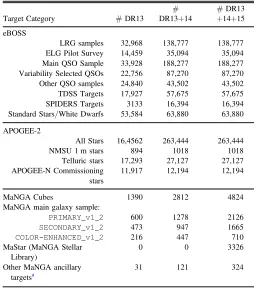
As with all previous SDSS public data releases, DR15 is cumulative and includes all data products that have been publicly released in earlier SDSS data releases. All previous releases are archived online to facilitate science replication; however, we recommend new users always make use of the latest DR(even when using older data)to ensure they are using the most recent reduction routines. The scope of DR15 is shown in Table 1, and its components can be summarized as follows.
1. MaNGA integral-field spectroscopic data from 285 plates, including 119 plates observed between 2016 September 26 (MJD 57658) and 2017 June 29 (MJD 57934)that are newly released data in DR15. This data set is identical to the internally released MaNGA Product Launch-7(MPL-7)and contains the same set of galaxies but processed with a different version of the reduction pipeline from the earlier internally released MPL-6. DR15 contains 4824 reconstructed 3D data cubes, of which 4688 are target galaxies (the remainder are ancillary targets, which include galaxies, parts of galaxies, and some deep sky fields). This data set includes 67 repeat observations, so that the total number of unique galaxies in this data release is 4621. Most of these galaxies are part of the MaNGA main sample, but ancillary target galaxies are also included in this count
(see Table 4for a summary of these).
2. In addition to the MaNGA data cubes, DR15 also releases for the first time data products generated by the Data Analysis Pipeline(see Section4.1.2). These products are available for all data cubes in DR15, with the exception of the cubes generated by some ancillary programs(i.e., Coma, IC 342, and M31) if they do not have redshifts
(e.g., skyfields).
3. Alongside the new MaNGA data, and data products, DR15 also marks the launch of Marvin, a new tool to visualize and analyze MaNGA data cubes and maps(see Section4.2).
4. DR15 is the first public data release for the MaNGA Stellar Library, MaStar(see Section4.3), which contains 3326 optical stellar spectra.
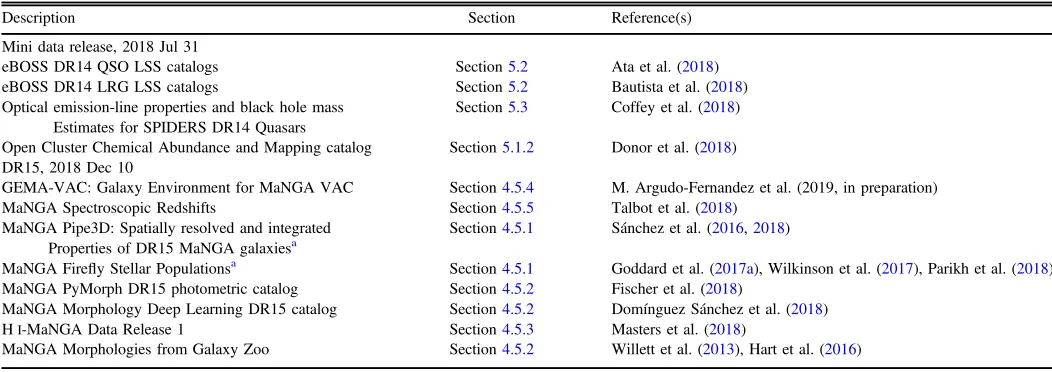
5. In addition to updates to two previously released Value Added Catalogs (VACs), DR15 also includes six new VACs contributed by the MaNGA team (see Table 2). This brings the total number of VACs in the SDSS public data releases to 40.
6. Finally, DR15 includes a re-release of all previous versions of SDSS data releases. This includes the most
recent data releases for APOGEE-2 and eBOSS
[image:4.612.315.569.74.362.2](described in Abolfathi et al.2018, DR14), and the most recent release of the SDSS imaging data (described in Albareti et al. 2017, DR13). Data of previous SDSS surveys are also included: the Legacy Spectra were finalized in DR8(Aihara et al.2011), and the SEGUE-1 and SEGUE-2 spectra in DR9 (Ahn et al. 2012). The
Table 1
Reduced SDSS-IV Spectroscopic Data in DR15
Target Category #DR13
# DR13+14
#DR13 +14+15 eBOSS
LRG samples 32,968 138,777 138,777 ELG Pilot Survey 14,459 35,094 35,094 Main QSO Sample 33,928 188,277 188,277 Variability Selected QSOs 22,756 87,270 87,270 Other QSO samples 24,840 43,502 43,502 TDSS Targets 17,927 57,675 57,675 SPIDERS Targets 3133 16,394 16,394 Standard Stars/White Dwarfs 53,584 63,880 63,880
APOGEE-2
All Stars 16,4562 263,444 263,444 NMSU 1 m stars 894 1018 1018 Telluric stars 17,293 27,127 27,127 APOGEE-N Commissioning
stars
11,917 12,194 12,194
MaNGA Cubes 1390 2812 4824
MaNGA main galaxy sample:
PRIMARY_v1_2 600 1278 2126
SECONDARY_v1_2 473 947 1665
COLOR-ENHANCED_v1_2 216 447 710 MaStar(MaNGA Stellar
Library)
0 0 3326
Other MaNGA ancillary targetsa
31 121 324
Note. a
MARVELS spectra were last re-reduced for DR12(Alam et al.2015).
3. Data Distribution
The DR15 data can be accessed through a variety of mechanisms, depending on the type of data file and the needs of the user. All data access methods are described on the SDSS website (https://www.sdss.org/dr15/data_access), and we also provide tutorials and examples for accessing and working with SDSS data products at https://www.sdss.org/dr15/ tutorials. We describe our four main data access mechanisms below.
All raw and processed imaging and spectroscopic data can be accessed through the Science Archive Server(SAS,https:// data.sdss.org/sas/dr15). This site includes intermediate data products and VACs. The SAS is a file-based system, from which data can be directly downloaded by browsing or in bulk mode using rsync, wget, or Globus Online. Bulk downloading methods are outlined at https://www.sdss.org/dr15/data_ access/bulk. All data files available on the SAS have a data model (https://data.sdss.org/datamodel), which provides a detailed overview of the content of each datafile.
Processed optical and infrared spectra, as well as processed imaging, can also be accessed on the SAS through the Science Archive Webapp (SAW), an interactive web application
(webapp;http://dr15.sdss.org links to the DR15 version). In DR15, the SAW is serving MaStar spectra for the first time. Through this webapp, users can display individual spectra and overlay model fits included on the SAS. There is a search option available to select spectra based on, e.g., plate number, coordinates, redshift, or ancillary observing program. Searches can be saved for future references as permalinks. Spectra can be directly downloaded from the SAS through the webapp, and links are included to the SkyServer Explore page for each object. The user can select SDSS data releases back to DR8
(the SAW was originally developed during SDSS-III so serves data from that phase of SDSS onwards only), but is encouraged to always use the most recent data release athttps://data.sdss. org/home.
MaNGA data cubes and maps are not available in the SAW, but can be visualized and analyzed through Marvin. Marvin, described in detail in Section4.2, provides links to the SAS for downloading datafiles, as well as the SkyServer Explore page. The Catalog Archive Server (CAS; Thakar 2008; Thakar et al. 2008) stores the catalogs of DR15: these include photometric, spectroscopic, and derived properties. Some of the VACs also have catalogs that are stored on the CAS. The CAS can be accessed through the SkyServer webapp(https:// skyserver.sdss.org), which provides Explore tools as well as the option of browser-based queries in synchronous mode. CASJobs (https://skyserver.sdss.org/casjobs) is suitable for more extensive queries, which are executed in asynchronous or batch mode, and offers users personal storage space for query results (Li & Thakar 2008). The CAS is integrated with SciServer(https://www.sciserver.org), which offers several data-driven science services, including SciServer Compute, a system that allows users to run Jupyter notebooks in Docker containers, directly accessing the SDSS catalogs.
All of the data reduction software that are used by the various SDSS-IV teams to reduce and process their data
(including links to the Marvin Repository on Github) is publicly available athttps://www.sdss.org/dr15/software/ products.
4. MaNGA
The MaNGA survey uses a custom-built instrument(Drory et al. 2015), which feeds fibers from a suite of hexagonal bundles into the BOSS spectrograph(Smee et al.2013). Over its plannedfive years of operations, MaNGA aims to get data for ∼10,000 nearby galaxies (Law et al. 2015; Yan et al. 2016a,2016b; see Wake et al.2017 for details on the sample selection).
[image:5.612.42.568.74.260.2]DR15 consists of MaNGA observations taken during thefirst three years of the survey (up to summer 2017) and nearly doubles the sample size of fully reduced galaxy data products previously released in DR14(Abolfathi et al.2018). These data products include raw data, intermediate reductions such asfl ux-calibrated spectra from individual exposures, and final data cubes and row-stacked spectra (RSS) produced using the
Table 2
New or Updated Value Added Catalogs
Description Section Reference(s)
Mini data release, 2018 Jul 31
eBOSS DR14 QSO LSS catalogs Section5.2 Ata et al.(2018)
eBOSS DR14 LRG LSS catalogs Section5.2 Bautista et al.(2018)
Optical emission-line properties and black hole mass Section5.3 Coffey et al.(2018)
Estimates for SPIDERS DR14 Quasars
Open Cluster Chemical Abundance and Mapping catalog Section5.1.2 Donor et al.(2018)
DR15, 2018 Dec 10
GEMA-VAC: Galaxy Environment for MaNGA VAC Section4.5.4 M. Argudo-Fernandez et al.(2019, in preparation) MaNGA Spectroscopic Redshifts Section4.5.5 Talbot et al.(2018)
MaNGA Pipe3D: Spatially resolved and integrated Section4.5.1 Sánchez et al.(2016,2018)
Properties of DR15 MaNGA galaxiesa
MaNGA Firefly Stellar Populationsa Section4.5.1 Goddard et al.(2017a), Wilkinson et al.(2017), Parikh et al.(2018)
MaNGA PyMorph DR15 photometric catalog Section4.5.2 Fischer et al.(2018)
MaNGA Morphology Deep Learning DR15 catalog Section4.5.2 Domínguez Sánchez et al.(2018)
HI-MaNGA Data Release 1 Section4.5.3 Masters et al.(2018)
MaNGA Morphologies from Galaxy Zoo Section4.5.2 Willett et al.(2013), Hart et al.(2016)
Note. a
MaNGA Data Reduction Pipeline (DRP; Law et al. 2016). DR15 includes DRP data products for 4824 MaNGA cubes distributed among 285 plates, corresponding to 4621 unique galaxies plus 67 repeat observations and 118 special targets from the ancillary programs (see Section 4.4). Unlike in previous data releases, data cubes and summary RSSfiles are no longer produced for the 12 seven-fiber mini bundles on each plate that target bright stars and are used to derive the spectrophotometric calibration vector for each exposure (see Yan et al.2016b); these observations will from here on instead be included in the MaStar stellar spectral library (see Section 4.3).
In addition, for thefirst time, DR15 includes the release of derived spectroscopic products (e.g., stellar kinematics, emis-sion-line diagnostic maps, etc.) from the MaNGA DAP
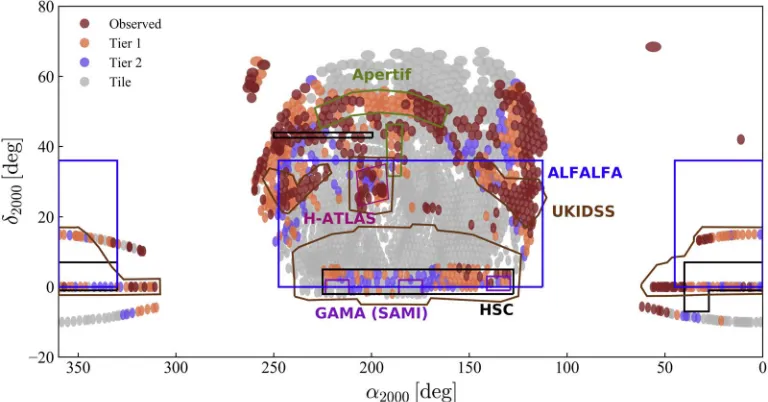
(Belfiore et al.2019; Westfall et al.2019); see Section4.1.2. We provide the sky footprint of MaNGA galaxies released in DR15 in Figure1, while the projectedfinal survey footprint is shown overlaid on the footprint of other relevant surveys and
for two different expectations for weather at the telescope in Figure2.
4.1. MaNGA Data and Data Products
4.1.1. The Data Reduction Pipeline
[image:6.612.114.497.57.184.2]The MaNGA DRP is the IDL-based software suite that produces final flux-calibrated data cubes from the raw dispersedfiber spectra obtained at APO. The DRP is described in detail by Law et al.(2016)and consists of two stages. The “2d” DRP processes individual exposures, applying bias and overscan corrections, extracting the one-dimensional fiber spectra, sky-subtracting and flux-calibrating the spectra, and combining information from the four individual cameras in the BOSS spectrographs into a single set of RSS(mgCFramefiles) on a common wavelength grid. The“3d”DRP uses astrometric information to combine the mgCFrame fiber spectra from individual exposures into a composite data cube on a regularized 0 5 grid, along with information about the inverse
Figure 1.The sky distribution(Mollweide equatorial projection for decl.>-20)of MaNGA plates released in DR15(purple). This is overlaid on a plot of all possible MaNGA plates(in gray). MaNGA targets are selected from a sample with SDSS-I photometry and redshifts; hence, this footprint corresponds to Data Release 7 imaging data(Abazajian et al.2009). Each plate contains 17 MaNGA targets, and around 30% of all possible plates will be observed in the full six-year survey. The most likelyfinal footprint is indicated in Figure2.
[image:6.612.114.498.244.445.2]variance, spaxel mask, instrumental resolution, and other key parameters. The mgCFrame per-exposure files are produced on both linear and logarithmic wavelength grids directly from the raw detector pixel sampling, and used to construct the corresponding logarithmic and linearly sampled data cubes.
The DRP data products released in DR15 are largely similar to those released in DR13 and DR14 (and identical to the internal collaboration release MPL-7) and consist of multi-extension FITS files giving the flux, inverse variance, mask, and other information for each object. The metadata from all of our observations are summarized in a FITS binary table, “drpall-v2_4_3.fits,”detailing the coordinates, targeting information, redshift, data quality, etc. The version of the MaNGA DRP used for DR15(v2_4_3)111incorporates some significant changes compared to the DR14 version of the pipeline(v2_1_2). These changes include the following:
1. The MaNGA DRP has been extended to produced one-dimensional reduced spectra for each of the MaStar targets observed during bright time; details of these modifications are described in Section4.3.
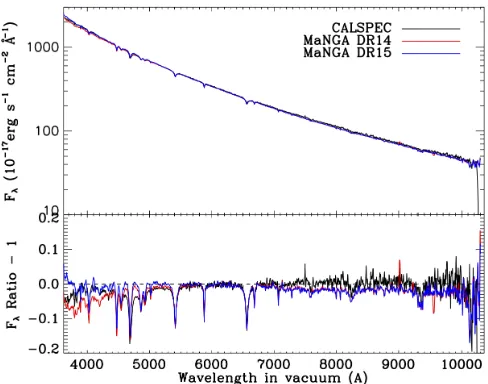
2. DR15 introduces some significant changes in the overall flux calibration relative to DR13/DR14 (and relative to the description by Yan et al. 2016b). Foremost among these is the use of BOSZ stellar spectral models (Bohlin et al.2017)instead of the original Kurucz templates built in 2003 to derive the spectrophotometric calibration based on contemporaneous observations of standard stars with the MaNGA seven-fiber mini bundles. Since the BOSZ templates picked by the pipeline are bluer by 0.03 mag in SDSSu−rcolor than the version of the Kurucz models produced in 2003, this change slightly increases the overallflux blueward of 4000Åin the MaNGA data cubes. Test observations of hot white dwarfs compared to ideal blackbody models generally show better perfor-mance using the new BOSZ calibration(as illustrated in Figure 3). Additionally, the throughput loss vector applied to the observational data is now smoother at many wavelengths; high-frequency basis spline fits are still used in telluric regions, but the spline has a much lower frequency outside the telluric regions to avoid introducing artifacts due to slight template mismatches. This significantly reduces the amount of artificially high-frequency, low-level (∼few percent) variations seen in the resulting spectra from earlier versions. The list of telluric regions is also updated.
3. Many aspects of the spectral line-spread function(LSF) estimation in the DRP have changed in DR15 in order to improve the level of agreement with independent estimates (observations of bright stars and galaxies previously observed at higher spectral resolution, obser-vations of the solar spectrum, etc.). These changes include the use of a Gaussian comb method to propagate LSF estimates through the wavelength rectification step, computation of both pre-pixelized and post-pixelized LSF estimates,112 improved interpolation over masked regions, and a modified arc lamp reference line list to
improve LSF estimation and wavelength calibration in the far blue by rejecting poor-quality lines. The DRP data products contain additional extensions to describe this new information, including a 3D cube describing the effective LSF at each spaxel within the MaNGA data cube as a function of wavelength; this combines the information known about the LSF in each individualfiber spectrum to describe the net effect of stacking spectra with slightly different resolutions. The LSF changes and assessment against various observational calibrators will be described in greater detail by D. Law et al.(2019, in preparation).
4. The DRP data cubes now contain extensions describing the spatial covariance introduced in the data cubes by the cube-building algorithm. This information is provided in the form of sparse correlation matrices at the character-istic wavelengths of the SDSS griz filters and can be interpolated to estimate the correlation matrix at any other wavelength in the MaNGA data cubes. Note that the DR14 paper incorrectly stated that those data included these extensions. They did not(the team-internal MPL-5, which is the most similar MPL to DR14, did, but DR14 itself did not), so this is the first release of these extensions.
[image:7.612.322.566.51.243.2]5. The DRPall summary file for DR15 contains 10 additional columns with respect to DR14. These columns include an estimate of the targeting redshiftzthat is used as the starting guess by the DAP when analyzing the MaNGA data cubes.zis generally identical to the NASA-Sloan Atlas(NSA) (Blanton et al.2011)catalog redshift for the majority of MaNGA galaxies, but the origin of the redshift can vary for galaxies in the ∼25 MaNGA
Figure 3.Flux calibration difference between DR14 and DR15 MaNGA data reductions. The upper panel shows the spectra for an Oke standard, HZ 21, a T=100,000K star(Oke & Shipman1971; Reynolds et al.2003), as given by the CALSPEC database(black)and by MaNGA in DR14(red)and DR15
(blue)averaging over nine exposures taken on plate 7444. The small difference at the blue wavelengths can be seen more obviously in the bottom panel where we divide these three spectra by a T=100,000K blackbody spectrum normalized at 6000–6100 Å. Ignoring the absorption lines, this provides a test of our flux calibration. Using the BOSZ templates in DR15, the resulting continuum of this white dwarf agrees much better with the blackbody spectrum below 5000 Å, which is significantly improved compared to DR14, which uses the version of the Kurucz models (Kurucz 1979; Kurucz & Avrett 1981)
produced in 2003, and to CALSPEC.(One can also compare this with Figure9 of Yan et al.2016b).
111
https://svn.sdss.org/public/repo/manga/mangadrp/tags/v2_4_3
112
ancillary programs. Additional columns include a variety of estimates of the volume weights for the MaNGA primary and secondary galaxy samples.
6. Additional under-the-hood modifications to the DRP have been made for DR15 that provide minor bug fixes and performance improvements. These include modifi ca-tions to the reference pixel flatfields for certain MJDs, updates to the reference bias and bad pixel masks, better rejection of saturated pixels, updates to the algorithms governing weighting of the wavelength rectification algorithm near ultrabright emission lines, etc. A detailed change log can be found in the DRP online repository.113 When working with the MaNGA data, note that there are several quality-control features that should be used to ensure the best scientific quality output. First, each MaNGA data cube has a FITS header keyword DRP3QUAL that describes the overall quality of the cube (identifying issues such as focus problems, flux-calibration problems, large numbers of dead fibers, etc.). About 1% of the data cubes are flagged as significantly problematic(i.e., have the CRITICAL quality bit set)and should be treated with extreme caution. Additionally, there is a 3d mask extension to each data cube that contains spaxel-by-spaxel information about problematic regions within the cube. This mask identifies issues such as deadfibers(which can cause local glitches and holes within the cube), foreground stars that should be masked by analysis packages such as the DAP, etc. Although the vast majority of cosmic rays and other transient features are detected by the DRP and flagged (either for removal or masking), lower intensity glitches(e.g., where the edge of a cosmic-ray track intersects with a bright emission line)can sometimes be missed and propagate into thefinal data cubes where they show up as unmasked hot pixels. Future improvements to the DRP may further address this issue, but caution is thus always advised when searching for isolated emission features in the data cubes.
For information on downloading MaNGA data in DR15, please see Section3; new for DR15 is the Marvin interface to MaNGA data(see Section4.2below).
4.1.2. The Data Analysis Pipeline
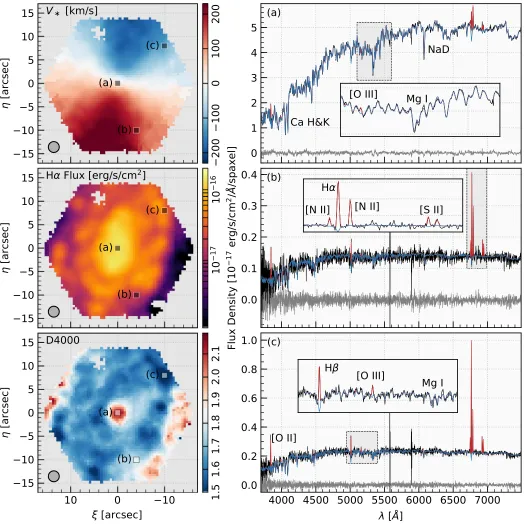
The MaNGA DAP is the SDSS-IV software package that analyzes the data produced by the MaNGA DRP. The DAP currently focuses on “model-independent” properties, i.e., those relatively basic spectral properties that require minimal assumptions to derive. For DR15, these products include stellar and ionized-gas kinematics, nebular emission-line fluxes and equivalent widths, and spectral indices for numerous absorp-tion features, such as the Lick indices (Worthey & Ottaviani1997; Trager et al.1998)and D4000(Bruzual1983). Examples of the DAP-provided measurements and model fits are shown in Figure 4, discussed through the rest of this section.
An overview of the DAP is provided by Westfall et al.
(2019). There, we describe the general workflow of the pipeline, explain the detailed algorithm used for each of its primary products, provide high-level assessments of its performance, and describe the delivered data products in detail. In-depth assessments of the stellar kinematics, ionized-gas kinematics, emission-line fluxes, and emission-line
equivalent widths are provided by Westfall et al.(2019) and Belfiore et al. (2019). All survey-provided properties are currently derived from the data cubes sampled in constant steps of the logarithm of the wavelength (i.e., the LOGCUBEfiles). However, the core functions are developed to consider each spectrum largely independently.
The DAP allows for a number of different options when analyzing the data, which we refer to as the analysis mode or
DAPTYPE. In DR15, the DAPTYPE joins the keywords
identifying the type of spatial binning applied (e.g., Voronoi-binned to signal-to-noise ratio (S/N)10, VOR10), the parametric form of the line-of-sight velocity distribution
(LOSVD)used for the stellar kinematics(a Gaussian function,
GAU), and the template set used to model the stellar continuum
(a hierarchically clustered distillation of the MILES stellar library, MILESHC). For DR15, two DAPTYPEs have been
made available, VOR10-GAU-MILESHC and
HYB10-GAU-MILESHC. That is, only the binning approach differs between
the two availableDAPTYPEs, primarily distinguishing whether or not the main analysis steps are performed on binned spectra or individual spaxels. The stellar LOSVD is always assumed to be Gaussian, and the 42 templates resulting from a hierarchical clustering analysis of the MILES stellar library ( Sánchez-Blázquez et al.2006; Falcón-Barroso et al. 2011) are always used for the continuum templates; details regarding the latter are discussed in Westfall et al.(2019).
In thefirst mode(VOR10-GAU-MILESHC), the spaxels are binned using the Voronoi-binning scheme from Cappellari & Copin (2003) to a minimum g-band S/N of 10 per spectral pixel. Thefirst mode then performs all subsequent analysis on those binned spectra. Alternatively, the second mode(
HYB10-GAU-MILESHC) only performs the stellar kinematics on the
binned spectra; the subsequent emission-line and spectral-index measurements are all performed on individual spaxels. This “hybrid” binning approach is likely the approach that most users will want to use in their analysis. The main exception to this is if any subsequent analyses depend on, e.g., the availability of emission-line models for the binned spectra, as is the case for theFIREFLYVAC(Wilkinson et al.2017; see Section 4.5.1). The example data shown in Figure 4 are for observation 8138-12704 following from the hybrid-binning approach. Close inspection of the stellar velocity field will show that outermost regions have been binned together, all showing the same stellar velocity measurement. However, the Hαflux and D4000 maps have measurements for each spaxel. The DAP is executed for all observations obtained by the MaNGA survey; however, some observations, primarily those obtained for our ancillary science programs, do not have all the required parameters currently needed as input by the DAP. Additionally, a few observations (<0.3%) trip corner failure modes of the DAP leading to errors in the construction of its main outputfiles. These issues mean that not allLOGCUBEfiles provided by the DRP have associated DAP products. For those observations that are successfully analyzed(4718 in total), the DAP provides two main output files for each DAPTYPE, the
MAPS file and the modelLOGCUBE file. Examples of how to access and plot the data in thesefiles are provided in a set of tutorials on the data-release website athttps://www.sdss.org/ dr15/manga/manga-tutorials/dap-tutorial/.
The MAPS file contains all of the derived properties organized as a series of maps, or images, that have the same on-sky projection as a single wavelength channel in the
113https://svn.sdss.org/public/repo/manga/mangadrp/tags/v2_4_3/
analyzed DRPLOGCUBEfile. The images in the left panels of Figure4are example maps taken from the DAPMAPSfile for observation 8138-12704. The maps are organized in a series of extensions grouped by the measurement they provide. Some extensions contain a single image with all of the relevant data, whereas other extensions have multiple images, one for, e.g.,
each of the measured emission lines. For example, the
STELLAR_VEL extension has a single image with the
measured single-component stellar velocity measured for each spatial bin (like that shown in Figure 4), while the
SPECINDEXextension has 46 images, organized similarly to
[image:9.612.45.569.50.574.2]the wavelength channels in the DRP data cubes (the D4000
map shown in Figure 4 is in the 44th channel of the
SPECINDEXextension).
The DAP-output modelLOGCUBEfile provides both the S/ N-binned spectra and the best-fitting model spectra. From these files, users can plot the best-fitting model spectra against the data, as demonstrated in Figure 4, as an assessment of the success of the DAP. This is particularly useful when a result of thefit, e.g., the Hαflux, seems questionable. Indeed, Westfall et al. (2019) note regimes where the DAP has not been appropriately tailored to provide a successful fit; this is particularly true for spectra with very broad emission lines, such as the broad-line regions of AGNs. Users are encouraged to make sure they are well aware of these limitations in the context of their science goals. Finally, in combination with the
DRPLOGCUBEfile, users can use the modelLOGCUBEdata to
construct emission-line-only or stellar-continuum-only data cubes by subtracting the relevant model data.
Although we have endeavored to make the output data user-friendly, there are a few usage quirks of which users should be aware:
1. As with all SDSS data products, users are strongly encouraged to understand and use the provided quality flags, for those data provided as masks. The mask bits provide important information as to whether or not users should trust the provided measurements in their particular use case. The conservative approach of ignoring any measurement where the mask bit is nonzero is safe, at least in the sense of not including any measurements we know to be dubious. However, the DAP makes use of an
UNRELIABLE flag that is intended to be more of a
warning that users should consider how the measure-ments affect their science as opposed to an outright rejection of the value. The UNRELIABLE flag is put to limited use in DR15, only flagging measurements that hinge on bandpass integrals(emission-line moments and non-parametric equivalent widths, and spectral indices) where any pixels are masked within the bandpass. However, this bit may become more extensively used in future releases as we continue to vet the results of the analysis. A more extensive discussion of the mask bits and their usage is provided by Westfall et al. (2019). 2. To keep the format of the outputfiles consistent with the
DRP LOGCUBE files, the spectra and
binned-spectra measurements are repeated for each spaxel within a given bin. This means that, e.g., the stellar velocity dispersion measured for a given binned spectrum is provided in the output DAP map at the location of each spaxel in that bin. Of course, when analyzing the output, one should most often only be concerned with the unique measurements for each observation. To this end, we provide an extension in theMAPSfile that provides a“bin ID”for each spaxel. Spaxels excluded from any analysis
(as in the buffer region during the data cube construction) are given a bin ID of−1. This allows the user to select all of the unique measurements byfinding the locations of all unique bin ID values, ignoring anything with a bin ID of −1. Tutorials for selecting the unique measurements in the DAP-output maps are provided via the data-release website athttps://www.sdss.org/dr15/manga/ manga-tutorials/dap-tutorial/.
3. Corrections that have not been applied to the data in the outputfiles are provided for a few quantities in theMAPS
file. The stellar velocity dispersion and ionized-gas velocity dispersions are provided as measured from the core pPXF software (Cappellari & Emsellem 2004; Cappellari2017)used by the DAP. This means that any instrumental effects present during thefitting process are also present in the output data. For both the stellar and ionized-gas dispersions, we have estimated the instru-mental corrections for each measurement and provided the result in extensions in the MAPS file. These corrections should be applied when using the data for science. For the velocity dispersion measurements, our purpose in not applying the corrections ourselves is to allow the user freedom in how they deal with measure-ments of the dispersion that are below our measurement of the instrumental resolution. Such issues can be pernicious at low velocity dispersion, and the treatment of these data can have significant effects on, e.g., the construction of a radially averaged velocity dispersion profile (see Westfall et al. 2019, who discuss this at length, and also Penny et al.2016, who discuss this issue for dwarf galaxies). Corrections are also provided (but not applied) for the spectral indices to convert the measurement to zero velocity dispersion at the spectral resolution of the MILES stellar templates(Beifiori et al. 2011) used during the stellar-continuum fit. Additional details regarding these corrections are provided in Westfall et al. (2019), and tutorials demonstrating how to apply them to the data are provided via the data-release website.
4. In the hybrid-binning scheme, the stellar kinematics are performed on the binned spectra, but the emission-line fits are performed on the individual spaxels. When comparing the model to the data, the user must compare the emission-line modeling results to the DRPLOGCUBE
spectra, not to the binned spectra provided in the DAP model LOGCUBE file, unless the “binned” spectrum is actually from a single spaxel. Tutorials for how to overplot the correct stellar-continuum and emission-line models are provided via the data-release website. Finally, similar to theDRPallfile provided by the MaNGA DRP, the DAP constructs a summary table called theDAPall
file. This summary file collates useful data from the output DAPfiles, as well as providing some global quantities drawn from basic assessments of the output maps, that may be useful for sample selection. For example, the DAPall file provides the luminosity-weighted stellar velocity dispersion and inte-grated star formation rate within 1 Re. The sophistication of
4.2. Marvin Access to MaNGA
Marvin(Cherinka et al.2018)114is a new tool designed for streamlined access to the MaNGA data, optimized for overcoming the challenges of searching, accessing, and visualizing the complexity of the MaNGA data set. Whereas previous generations of SDSS took spectra only of the centers of galaxies, MaNGA takes many spectra of each galaxy, in a hexagonal grid across the face of each(IFU bundle), which are combined into afinal data cube. This means that for each object there is not a single spectrum, but in fact a suite of complex results in one or more data cubes. The motivation forMarvin
arises from the additional complexity of MaNGA data, namely the spatial interconnectivity of its spectra.
Marvinallows the user to:
1. access reduced MaNGA data cubes locally, remotely, or via a web interface.
2. access and visualize data analysis products. 3. perform powerful queries on the metadata.
4. abstract the MaNGA data model and write code that is agnostic to where the data actually live.
5. make better visualization and scientific decisions by mitigating common mistakes when accessing these types of data.
Marvinhas two main components: a webapp and a Python
package of tools, both using an underlying Marvin API (or Application Programming Interface). The webapp, Marvin Web,115 provides an easily accessible interface for searching the MaNGA data set and visual exploration of individual MaNGA galaxies. TheMarvinsuite of Python tools,Marvin
Tools, provides seamless programmatic access to the
MaNGA data for more in-depth scientific analysis and inclusion in your science workflow. Marvin contains a multimodal data access system that provides remote access to MaNGAfiles or subdata contained within, downloads MaNGA files to work with on the user’s local machine, and seamlessly transitions between the two with a negligible change in syntax. Existing 3d data cube visualizers in astronomy, as well as in other scientific disciplines, often come as standalone desktop applications designed to visualize and interact with individual files local to a client machine. However, these tools are highly specific, limited to exploringfiles one at a time, and still require manually downloading all data locally. AlthoughMarvinis a tool for 3d cube visualization, its focus is on streamlined data access from local or remote sources, with a clear separation of components into browser-based visualization and program-matic data tools, rather than on providing yet another desktop-based cube viewer. Marvinʼs design allows for users to rapidly explore and access the data in a manner of their choosing, while still providing enoughflexibility to, if desired, plug the data into existing cube viewers available in the astronomy community.
The components ofMarvinare described in more detail in
the Marvin paper (Cherinka et al. 2019) as well as in the
Marvin documentation,116 which also contains tutorials and
example Jupyter notebooks. In addition, we briefly introduce them below.
4.2.1. Marvin Web
Marvin Web provides quick visual access to the set of
MaNGA galaxies. It provides a dynamic, interactive, point-and-click view of individual galaxies to explore the output from the MaNGA DRP and DAP (Sections 4.1.1 and 4.1.2, respectively), along with galaxy information from the NSA catalog(Blanton et al.2011).117
We show a screenshot of the View-Spectra page ofMarvin Webin Figure5. By clicking anywhere within the galaxy IFU bundle on the SDSS three-color image, or any Data Analysis 2D Map, the user can explore the spectrum at that location for quick inspection. The visualized spectrum is interactive as well, allowing panning and zooming.
Additional pages thatMarvin Webprovides are:
1. a Query page, for searching the MaNGA data set through an SQL-like interface;
2. a Plate page, containing all MaNGA galaxies observed on a given SDSS plate;
3. and an Image Roulette page, for randomly sampling images of MaNGA galaxies.
Tutorials for navigating Marvin Web can be found athttps://www.sdss.org/dr15/manga/manga-tutorials/ marvin-tutorial/marvin-web/.
Marvin Web is designed as a gateway to entry into real
MaNGA data, providing commonly desired functionalities all in one location, as well as code snippets to help transition users into a more programmatic environment using the Marvin
Tools.
4.2.2. The Marvin Tools
Marvin Tools provide a programmatic interaction with
the MaNGA data, enabling rigorous and repeatable science-grade analyses.Marvin Toolscome in the form of a Python package that provides convenience classes and functions that simplify the processes of searching, accessing, downloading, and interacting with MaNGA data; selecting a sample; running a user-defined analysis code; and producing publication-quality figures.
Marvin Tools are a pip-installable product, packaged
undersdss-marvin, with full installation instructions at the Marvin documentation website118 and the source code on Github.119
Overall,Marvin Toolsallow for easier access to the data without knowing much about the data model, by seamlessly connecting all of the MaNGA data products, eliminating the need to micromanage a multitude offiles. The user can do all of their analysis from one interface.
4.2.3. Queries in Marvin
Both Marvin Web and Tools provide interfaces for
searching the MaNGA data set through a Structured Query Language (SQL)-like interface, either via a web form or a Python class. The Marvin Query system uses a simplified
SQL syntax that focuses only on a filter condition using Boolean logic operators and a list of parameters to return. This eliminates the need to learn the full SQL language and the
114
https://www.sdss.org/dr15/manga/marvin/
115
https://dr15.sdss.org/marvin
116
https://sdss-marvin.readthedocs.io/en/stable/
117
https://www.sdss.org/dr15/manga/manga-target-selection/nsa/
118
https://sdss-marvin.readthedocs.io/en/stable/installation.html
119
detailed MaNGA database layout. With this query system, users can make queries across the entire MaNGA sample using traditional global galaxy properties (functionality to perform intragalaxy queries using individual spaxel measurements is planned for a future release). Tutorials for querying with
Marvin can be found for the web120and for the tools.121
4.3. MaStar: A Large and Comprehensive Stellar Spectral Library
Stellar spectral libraries are an essential tool for manyfields in astronomy. They are especially useful for modeling spectra of external galaxies, including fitting for redshift and stellar kinematics,fitting the continuum to isolate emission lines, and calculating stellar population models (e.g., Leitherer et al. 1999; Bruzual & Charlot 2003; Maraston 2005; Conroy & Gunn 2010; Vazdekis et al.2010; Conroy2013)to derive the age, metallicity, and stellar mass of the stellar populations from integrated light spectra. They are also useful for Galactic astronomy and stellar astronomy. Although theoretical spectral libraries have been substantially improved over the years, they are still not realistic enough for certain stellar types(e.g., very cold stars and carbon stars), due to the incomplete line list and difficult-to-model physical effects, such as convection,
microturbulence, and deviations from plane-parallel geometry and local thermodynamic equilibrium (non-LTE). Therefore, empirical libraries are still needed for many applications and for calibrating the theoretical models, provided one is able to assign robust stellar parameters to the empirical spectra.
At the beginning of the MaNGA survey, there were no empirical stellar libraries available covering the entire MaNGA wavelength range with a spectral resolution that is equal to or higher than that of MaNGA. Current state-of-the-art empirical stellar libraries also have some other shortcomings. Some libraries have issues withflux calibration or telluric subtraction. Furthermore, all existing libraries have limited stellar parameter space coverage, lacking sufficient sampling in especially cool dwarfs, carbon stars, metal-poor stars, and very hot stars. They also do not sufficiently sample the[a/Fe]versus[Fe/H]space
(see Maraston & Strömbäck2011for a discussion of all these problems). These issues prompted us to take advantage of a parallel observing opportunity in SDSS-IV for assembling an empirical stellar spectral library that samples a wider stellar parameter space with a larger number of stars than any previous library, and matches MaNGA’s wavelength coverage and spectral resolution.
[image:12.612.47.566.56.384.2]Included in this data release is the first version of the MaNGA Stellar Library (MaStar). These observations are performed by piggybacking on the APOGEE-2N observations during bright time. MaNGA fiber bundles are plugged along with APOGEEfibers into these APOGEE-led plates to observe
Figure 5.Screenshot of the galaxy maps view ofMarvin Webfor the MaNGA galaxy 12-193481(Mrk 848). The SDSS three-color image of the galaxy is shown in the top-left part of thefigure. The upper-right panel shows the spectrum of the spaxel at the position(37, 37), which corresponds to the center of the bundle(shown by the red dot). The maps show the(lower left)stellar kinematics,(lower middle)Hαemission-lineflux, and(lower right)D4000 spectral index for this galaxy based on its unbinned spectral data cube from the MaNGA DAP(see Section4.1.2).
120
https://www.sdss.org/dr15/manga/manga-tutorials/marvin-tutorial/ marvin-web/
121
selected stars. As a result, the MaStar stellar spectra are observed using exactly the same instrument as MaNGA galaxies so they provide an ideal set of templates for modeling stellar continuum and stellar populations in MaNGA galaxies. The program has so far observed several thousands of stars, each with several epochs of observation. The version we are releasing in DR15 includes 8646 good quality spectra for 3321 unique stars, which cover a wide range in stellar parameter space. The details of the target selection, data reduction, flux calibration, and stellar parameter distribution are described by Yan et al.(2018). Here we provide a brief summary.
4.3.1. Target Selection
Good target selection is essential to achieve wide sampling of the stellar parameter space. We aim to cover the stellar parameter space as completely as possible and sample it roughly evenly. We base our selection primarily on existing stellar parameter catalogs, including APOGEE-1 and -2
(Majewski et al. 2017), SEGUE (Yanny et al. 2009), and LAMOST(Luo et al.2015). Given thefield plan of APOGEE-2, we select all of the stars available in these catalogs in the planned APOGEE-2 footprint. For each star, we count its neighboring stars in stellar parameter space(Teff,logg,[Fe/H]) and assign it a selection weight that is inversely proportional to its number of neighbors. The number of APOGEE-2 targeting designs for eachfield is also taken into account. We then draw our targets randomly in proportion to the normalized selection weight. This method flattens the stellar parameter space distribution and picks rare stars in those fields where they are available.
Infields without stars with known stellar parameters, we use spectral energy distribution(SED)fitting to search for hot and cool stars to patch the stellar parameter distribution at the hot and cool ends.
The targets are required to have g- or i-band magnitude brighter than 17.5in order to achieve an S/N greater than 50 per pixel in 3 hr of integration, although not all fields have the same integration time or the same number of visits. They are also required to be fainter than 12.7 mag in bothg- andi -bands in order to stay below the saturation limit of the detector for 15 minute exposures. We later lowered the saturation limit to 11.7 to include more luminous stars, with a slight offset in fiber placement for stars with magnitudes between 11.7 and 12.7. This slight offset does not affect ourflux calibration due to our unique calibration procedure.
These magnitude limits yield relatively few OB stars and blue supergiants, as they have to be very distant or very extincted to fall within this magnitude range. Therefore, we are currently adjusting our exposure time in certainfields to expand our parameter space distribution in the blue and luminous end. Thefirst version of the library does not have many such stars, but we will improve on this for the final version, which we expect to come out in thefinal SDSS-IV Data Release.
4.3.2. Observations
Observations for MaStar are obtained in a similar fashion to the MaNGA observations except that they are conducted under bright time and without dithering. Since we are piggybacking on APOGEE-2, if APOGEE-2 visits afield multiple times, we would obtain multiple visits for the stars on that plate as well. Therefore, some stars have many visits and some stars have
only one visit. Each visit of APOGEE-2 is typically 67 minutes long, which would allow us to take four 15 minute exposures, unless interrupted by weather or other reasons. Each plate has 17 science targets and 12 standard stars, same as MaNGA. We takeflat and arc frames before each visit.
4.3.3. Data Reduction
The reduction of the MaStar data is handled by the MaNGA DRP(see Section4.1.1, Law et al.2016). It has two stages. The first stage processes the raw calibration frames and science frames to produce the sky-subtracted,flux-calibrated, camera-combined spectra for eachfiber in each exposure. The second stage differs between MaNGA galaxy data and MaStar stellar data. For MaStar stellar data, we evaluate theflux ratios among fibers in a bundle as a function of wavelength and constrain the exact location of the star relative to the fiber positions. This procedure helps us derive the light loss due to the finitefiber aperture as a function of wavelength. This procedure takes into account the profile of the PSF and the differential atmosphere refraction. It is similar to how we handle flux calibration in MaNGA data(Yan et al.2016b). We then correct the spectra for this aperture-induced light loss and arrive at thefinalfl ux-calibrated stellar spectra. Comparison with photometry shows that our relativeflux calibration are accurate to 5% between the g-andr-bands, and to 3% betweenrandi, and between thei andzbands.
For each star, we combine the spectra from multiple exposures on the same night and refer to these combined spectra as “visit spectra.” We do not combine spectra from different nights together for the same star, because they can have different instrumental resolution vectors and some stars could be variable stars. By summer 2017, we have obtained 17,309 visit spectra for 6042 unique stars. Because not all visit spectra are of high quality, as we will discuss below, we selected only those with high quality and present this subset as the primary set to be released. The primary set contains 8646 visit spectra for 3321 unique stars.
The final spectra are not corrected for foreground dust extinction. Users should make these corrections before using them.
4.3.4. Quality Control
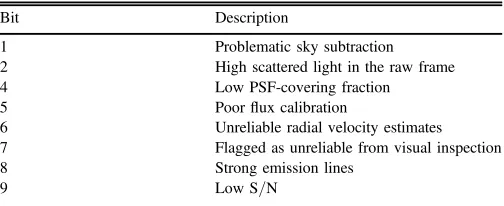
A stellar library requires strict quality control. We have a number of quality assessments carried out in the pipeline toflag poor-quality spectra. We identify cases having low S/N, bad sky subtraction, high scattered light, low PSF-covering fraction, uncertain radial velocity (RV) measurement, and/or those with problematic flux calibration. Each spectrum we release has an associated quality bitmask(MJDQUALfor each visit spectrum)giving these quality information. We provide a summary of these in Table 3 and describe them in more detail here.
A large fraction of the observed stars have problematicflux calibration due to the fact that the standard stars on those plates have much less extinction than given by the Schlegel et al.