1
Effect of extended cefquinome treatment on clinical persistence or recurrence of environmental 2
clinical mastitis 3
4
5
6
J. M. Swinkels a*, T. J. G. M. Lam a, b, M. J. Green c, and A. J. Bradley c, d 7
8
a GD Animal Health Service, Deventer, The Netherlands, 9
10
b Department of Farm Animal Health, Faculty of Veterinary Medicine, Utrecht University, The Netherlands 11
12
c University of Nottingham, School of Veterinary Medicine and Science, Leicestershire, United Kingdom 13
14
d Quality Milk Management Services Ltd., Wells, Somerset, United Kingdom 15
16
17
* Corresponding author. Tel: +31-651532957 18
E-mail: [email protected] (J.M. Swinkels) 19
20
21
22
23
24
Abstract 26
27
The efficacy of antibiotic treatment of clinical mastitis (CM) is classically evaluated using 28
bacteriological cure. This provides a concise and objective way of assessing efficacy, but unfortunately 29
does not reflect the field situation where persistence or recurrence of clinical signs lead to perceived 30
treatment failure. If clinical signs persist or recur, intramammary (IMM) treatment is often extended or 31
supplemented with parenteral treatment, in the expectation of a more efficient elimination of clinical 32
signs or a lower probability of recurrence of clinical signs. The objective of this study was to evaluate 33
the efficacy against clinical persistence or recurrence of three cefquinome treatment regimes, standard 34
1.5-day intramammary (SIMM), 5-day extended intramammary (EIMM) and combination of EIMM 35
plus 5-day extended parenteral (ECOMBO) treatment. The study was conducted on three dairy farms 36
with a high recurrence rate of environmental mastitis. Efficacy was evaluated using a multi-level model 37
at the quarter and at the cow level, based on the persistence or recurrence of clinical signs at any time 38
during a 105-day period following the end of the initial treatment, independent of pathogen. The most 39
prevalent pathogens were E. coli (16.9%) and S. uberis (11.97%). EIMM and ECOMBO significantly 40
decreased the persistence or recurrence of CM by 8 % and 6 % at the quarter level and by 9 % and 8 % 41
at the cow level, respectively. ECOMBO may not reduce the persistence or recurrence of CM beyond 42
EIMM. Whilst extended treatment regimens offered an improved outcome in this study, the producer 43
and practitioner need to carefully consider such regimens from the perspective of prudent antibiotic use. 44
45
Keywords: Bovine; Lactation; Mammary gland; Extended treatment; Antibiotic 46
Introduction 48
Environmental pathogens, particularly Streptococcus uberis and Escherichia coli, can be a cause 49
of persistent intramammary infection (Van Eennenaam et al., 1995, Döpfer et al., 1999, Bradley and 50
Green, 2001). On some farms, with a low bulk milk somatic cell count (BMSCC) and high incidence of 51
clinical mastitis (CM), a significant proportion of CM may occur in a limited number of animals as a 52
result of a high level of recurrence (Houben et al., 1993, Lam et al., 1996, Zadoks et al., 2001). 53
Recurrent CM cases have been described as being as severe as index cases, with comparable impact on 54
milk yield and probability of death (Bar et al., 2007). Moreover, cows with recurrent CM are at a higher 55
risk for culling (Bar et al., 2008). 56
57
Recurrent CM is usually defined by initial disappearance and subsequent re-occurrence of 58
clinical signs after a preset number of days. Using this definition, recurrent CM can be due to a 59
recrudescence of a persistent IMM infection due to failure to cure (Pinzón-Sánchez et al., 2011), or as a 60
result of re-infection of the quarter after successful cure. However, differentiating between persistence 61
of infection and re-infection is not possible in the field. Generally, in practice, the disappearance of 62
clinical signs is considered as cure, whereas persistence or recurrence of clinical signs is considered as 63
treatment failure. This treatment failure is what is evaluated in this study. 64
65
One of the consequences of successful elimination of the causative bacteria is a shortened 66
timeframe during which infection can spread to other cows in the herd, via the milking machine, the 67
milker or the environment. Potentially, improving bacteriological cure rates decreases the infection 68
prevents the recrudescence of persistent infections (Van Eenennaam et al., 1995). These indirect effects 70
of cure may play a role in decreasing the overall incidence of CM. 71
72
A number of approaches to improve bacteriological cure of CM have been evaluated, such as 73
extending treatment duration (Sol et al., 2000, Oliver et al., 2004, Milne et al., 2005) and additional 74
parenteral therapy (Shpighel et al., 1997, Erskine et al., 2002, Wenz et al., 2005). However, such studies 75
have not evaluated the long-term outcome of treatment, nor do they necessarily accurately reflect the 76
field situation where CM treatment outcomes are assessed by the elimination of clinical signs, such as 77
abnormal milk, swelling or redness of the udder. In the field, if clinical signs persist or recur, 78
intramammary (IMM) treatment is often extended or reinstated with parenteral treatment in the 79
expectation of a more effective elimination of clinical signs, leading to the use of additional antibiotic on 80
farm. However, there are few reports on the effects of extended treatment, with or without parenteral 81
treatment, on CM persistence or recurrence. 82
83
Clinical mastitis can be treated with different types of antibiotics. Cefquinome is a broad-84
spectrum β-lactam antibiotic for the treatment of CM, via the IMM and parenteral routes and is licensed 85
as a combination therapy for E. coli mastitis in the UK. Concurrent use of IMM and parenteral 86
cefquinome in CM has been evaluated (Shpigel et al., 1997, Ehinger et al, 2006). In herds in which
87
environmental mastitis predominates, the etiology is necessarily diverse thereby demanding a
broad-88
spectrum antibiotic for first treatment of CM in the absence of previous identification of the causative
89
pathogen.
The aim of this study was to evaluate the effect of different cefquinome treatment regimes in a 91
field based context on the likelihood of clinical persistence or recurrence of CM in dairy herds with high 92
recurrence rates of environmental mastitis. 93
94
Material and Methods 95
96
Farms 97
98
Three commercial dairy farms in Somerset, UK, were selected on the basis of access to electronic 99
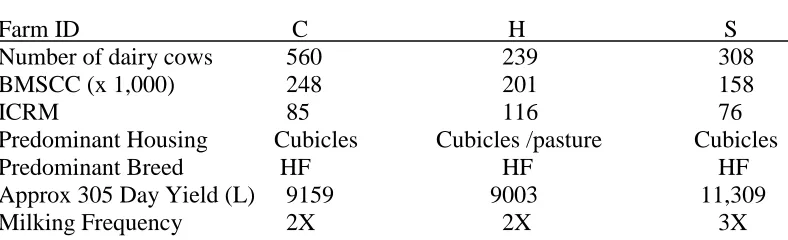
records, a history of a high rate of recurrence of CM and a predominance of environmental mastitis (Table 100
1). CM cases were sampled from August 2009 until November 2010. Monthly milk production, individual 101
cow somatic cell count (SCC) and all CM cases had been recorded for at least 12 months prior to the start of 102
the study. Milking protocols were comparable between farms, post milking teat disinfection, pre-dipping or 103
pre-wiping and inspection for CM was practiced on all farms in all cows throughout lactation. Milking 104
procedures and equipment did not change during the study period. All three farms used blanket antibiotic 105
dry cow treatment. 106
107
Animals 108
109
Lactating Holstein Friesian dairy cows with CM in one or more quarters were enrolled. Animal 110
parity, yield, historic SCC, CM history, treatment history and relevant clinical data were recorded 111
contemporaneously onto data capture forms or retrieved from on-farm software. 112
Inclusion and exclusion criteria 114
115
Cows were eligible for the study if they were in good general health and had four functional 116
quarters free from clinically significant udder, teat and teat orifice lesions. Cows were followed for 105 117
days after treatment and when cows were dried off or removed from the herd earlier, right censoring was 118
used. Data from animals that were dried off or removed from the herd due to death or culling were 119
analysed until the day of dry off or removal. 120
121
Treatment allocation 122
123
Cows were randomly allocated to a treatment group, by the herdspersons based on line numbers. 124
Line numbers were allocated randomly on farm at the moment animals joined the herd. Cows that 125
developed CM were sampled aseptically before treatment, according to their pre-assigned treatment 126
group. When clinical signs did not resolve (‘treatment failure’) during the 105 day period after the last 127
treatment of an animal’s first enrolled clinical case, or if clinical signs disappeared and recurred at any 128
time point during that period, the cows were treated again with the same treatment regime on all 129
subsequent occasions. 130
131
Treatment 132
133
All treatments were administered by farm personnel and three different regimes were evaluated; 134
1) 1.5-day IMM treatment with cefquinome 75 mg (Cobactan LC, MSD Animal Health), twice on the 135
2) 5-day IMM treatment with cefquinome 75 mg, six times, twice on the first day, at two consecutive 137
milkings, 4 times once a day, at the morning milking (EIMM), 138
3) 5-day combination treatment with cefquinome 75 mg IMM, six times, twice on the first day at two 139
consecutive milkings and once, at the morning milking on the following 4 days, plus cefquinome 140
sulphate suspension (1 mg/kg, Cobactan 2.5%, MSD Animal Health) by intramuscular injection five 141
times at 24-hour intervals (ECOMBO). 142
143
Post admission withdrawal 144
145
Animals were withdrawn post admission due to missing data, injury or disability or 146
abnormalities, or concomitant disease or disease other than CM requiring antibiotic or anti-inflammatory 147
treatment. 148
149
Detection of CM, persistence of clinical signs and milk sampling 150
151
CM was defined as a quarter with any visible change of milk aspect and was identified by farm 152
personnel, who had been trained and assessed in the detection, classification and sampling of CM. 153
Individual cases were assessed for persistence or recurrence of clinical signs at every milking (twice 154
daily on two units and thrice daily on one unit). The severity of CM was classified using a three-grade 155
scale: Grade 1, mild (only clots in the milk); Grade 2, moderate (milk aspect changes in colour and / or 156
consistency and / or presence of clots, heat, pain and/or swelling of the udder); and Grade 3, severe 157
(milk aspect changes in colour and / or consistency and / or presence of clots, fever, depression, 158
Any concurrent treatments were also recorded. Prior to treatment farm personnel collected milk samples 160
from affected quarters. Milk samples were frozen (-20 °C) and collected for submission to the laboratory 161
on a weekly basis. 162
163
Laboratory Methods 164
165
Microbiological investigation and SCC were carried out using the standard milk sample 166
examination techniques, according to the standard recommended by the International Dairy Federation 167
(Bulletin No 132, 1981), International Standard 13366-1:1997 (E) and 13366-2:1997 (G). More 168
specifically, 3 plates were used, 10 L of secretion was inoculated onto sheep blood agar and Edward’s 169
agar; 100 L of secretion was inoculated onto MacConkey agar to enhance the detection of 170
Enterobacteriaceae before incubation at 37 oC. All plates were read at 24, 48, and 72 h. Organisms 171
were identified and quantified using standard laboratory techniques (NMC, 1999; Quinn et al., 1994). 172
Escherichia coli was identified by colony morphology, oxidase, and indole tests; other 173
Enterobacteriaceae were identified using a microtube identification system (RapiD 20 E, bioMérieux, 174
Basingstoke, UK). 175
176
Efficacy of treatment 177
178
Treatment was considered effective if clinical signs had resolved after the last treatment and did 179
not recur in the 105 day period after treatment, independent of the bacteria involved. To allow 180
assessment of the potential benefits of systemic treatment on concurrently infected (but not clinically 181
efficacy was based on clinical persistence or clinical recurrence of CM in the same quarter. At the cow 183
level, lack of efficacy was based on clinical persistence or clinical recurrence of CM in the same cow, 184
irrespective of the quarter involved. 185
186
Data handling and Statistical analysis 187
188
In this randomized, positive controlled, unmasked, three treatment group study, the null 189
hypothesis was that there was no difference in time to clinical recurrence of CM between groups. This 190
hypothesis was analyzed in a multi-level model. The clinically affected quarter was the experimental 191
unit, with the subsequent analysis taking into account the effect of clustering of cases within quarters, 192
and quarters within cows. Inevitably in studies such as this some cows were allocated to treatment group 193
incorrectly. In order to ensure compliance in a large field based study such as this, farmers were allowed 194
some discretion in individual cow treatment allocation. Analysis explored the impact of deviations from 195
the predefined treatment protocols. 196
197
Cow and farm data were transferred to a database (Microsoft Access 2003) and all fields were 198
checked for unusual or impossible entries. Data fields were coded as categorical or continuous, as 199
appropriate, and data transformations carried out for continuous data to normalize distribution, when 200
necessary. 201
202
The outcome variable of interest was the persistence or recurrence of clinical signs of mastitis after 203
the end of treatment. Initial analysis consisted of descriptive statistics and graphical assessment. 204
persistence or recurrence (‘treatment failure’) of CM. To construct this curve, the 105 day post treatment 206
study period was divided into 7-day blocks. Each case in each block was coded as recurrent or persistent 207
(CM=1) or not recurrent or persistent (CM=0) at the quarter level. Cows were censored at the end of the 208
105-day follow-up period, at the end of lactation, or after death or culling. Discrete time survival models 209
with random effects were specified so that correlations within the data (cases within quarters and quarters 210
within cows) were accounted for as appropriate in a (frailty) model. The model took the form; 211
212
CMtijk ~ Bernoulli probability (mean = µtijk)
213
214
Logit (µtijk) = α + log ttijk + log ttijk2 + log ttijk3 + log ttijk4 + β1Xijk + β2Xjk + β3Xk + ujk + vk
215
216
where t is the week of lactation after previous CM, i, j and k denote the ith CM case in the jth quarter of the
217
kth cow, πijk the fitted probability of clinical persistence or recurrence of CM after treatment for case i in
218
quarter j of cow k, α the regression intercept, Xijk the vector of covariates at case level, β1 the coefficients
219
for covariates Xik, Xjk the vector of quarter level covariates, β2 the coefficients for covariates Xjk, Xk the
220
vector of cow level covariates, β3 the coefficients for covariates Xk, uj the random effect to reflect residual
221
variation between quarters and vk the random effect to reflect residual variation between cows (both random
222
effects assumed to be normally distributed with mean = 0 and variances Ωu and Ωv respectively).
223
224
The distributions of covariates were assessed and transformations or re-categorization carried out 225
as deemed appropriate on biological grounds. Model building was carried out using MLwiN with 226
penalized quasi-likelihood for parameter estimation (Rasbash et al., 2010). To avoid the potential biased 227
selected using Markov chain Monte Carlo (MCMC) for parameter estimation in WinBUGS 229
(Spiegelhalter et al., 2004) using methods described in detail previously (Green et al., 2004). Covariates 230
remained in the model when the 95% credibility intervals for the odds ratios did not include 1.00. 231
Biologically plausible interactions between significant covariates were tested and included when the 232
95% credibility intervals for the odds ratio of the interaction term did not include 1.00. 233
234
Predictions of the survival time to clinical persistence or recurrence of CM after treatment were 235
made using posterior predictive assessments (Gelman et al., 1996, Green et al., 2007). This incorporates 236
the full model posterior predictive distribution, and was used to evaluate model fit and to illustrate the 237
predicted impact of treatment on time to recurrence of CM. The effects of additional treatments were 238
evaluated statistically by including terms for the extra treatments in multivariate models. 239
240
Results 241
242
CM occurred in 1008 cases on the three study farms, of which 994, mainly mild to moderate 243
cases, were enrolled (Table 2). Fourteen cases (1008-994) were excluded due to missing data. Ninety-244
three cows were incorrectly allocated to treatment group, 124 received a NSAID concurrently and 106 245
received additional systemic antibiotics. These data were included in the statistical analysis and included 246
as covariates in the initial analysis. There was a large variety of pathogens obtained from the samples 247
and they are listed in Table 3. The most frequently isolated pathogens were E. coli (16.9%) and Strep. 248
uberis (12%). These pathogens can be associated with typical environmental CM aetiology which was 249
seen in both first and recurrent cases. Milk production, parity, underlying mastitis pathogens, CM 250
252
Quarter level 253
254
Clinical persistence or recurrence at the quarter level is shown in Table 4. EIMM and ECOMBO 255
treatment reduced the clinical persistence or recurrence of CM by 8% and 6%, respectively (EIMM, 256
OR= 0.38, 95% CI [0.12-0.50] and ECOMBO, OR=0.26, 95% CI [0.19-0.72]). ECOMBO did not 257
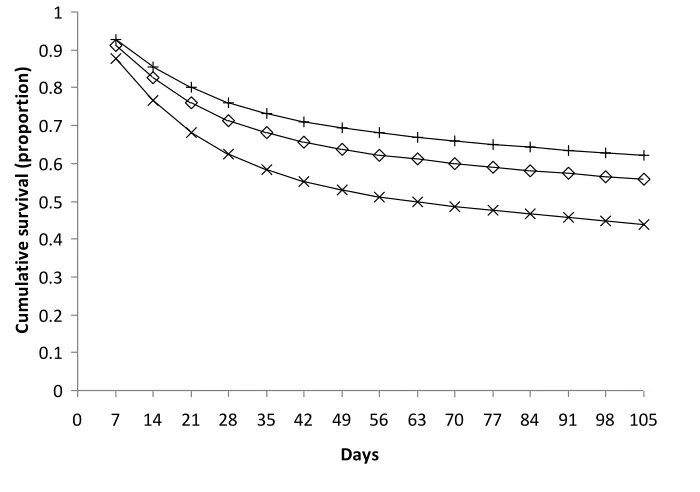
further decrease clinical persistence or recurrence when compared to EIMM alone. The time to quarter 258
level clinical persistence or recurrence for the three treatment groups is illustrated in Fig. 1. A posterior 259
prediction of treatment effects is shown in Fig. 2, which is comparable to the survival curve in Fig. 1, 260
demonstrating good model fit, illustrates the predicted outcome for the three treatment groups based on 261
the final model. Other significant covariates for quarter level clinical persistence or recurrence were 262
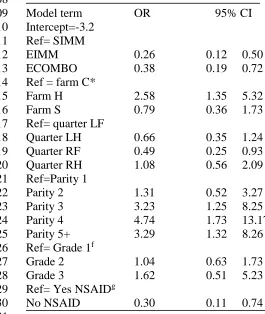
farm, quarter location, parity and NSAID treatment. Infection severity was not a risk for persistence or 263
recurrence (Table 6). 264
265
Cow level 266
267
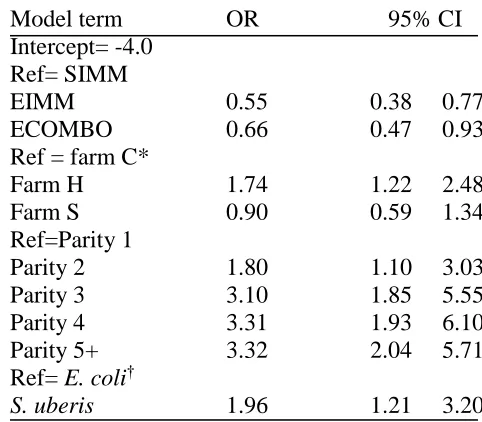
Cow level clinical persistence or recurrence rates are presented in Table 5. The reduction in CM 268
persistence or recurrence was 9% for EIMM and 8% after ECOMBO (EIMM, OR= 0.55, 95% CI [0.38-269
0.77] and ECOMBO, OR=0.66, 95% CI [0.47-0.93]). The final multivariate model showed that, apart 270
from treatment regime, the significant covariates for clinical persistence or recurrence of CM at the cow 271
level were farm, quarter location, parity, and Strep. uberis infection compared to E. coli infection (Table 272
7). 273
Discussion 275
276
Bacteriological cure is classically used to assess mastitis treatment efficacy because it is a 277
concise and objective parameter. On farm, treatment efficacy is evaluated based on resolution of clinical 278
signs and lack of recurrence. Persistence or recurrence of clinical signs often results in extended 279
intramammary treatment or additional parenteral treatment, expecting a more efficient elimination of 280
clinical signs and/or a lower probability of recurrence of clinical signs. 281
282
In this study, EIMM and ECOMBO were associated with a significant decrease in the probability 283
of persistent or recurrent CM, both at the quarter level and at the cow level when compared to SIMM, in 284
line with other recent findings (Pinzón-Sánchez et al., 2011). This suggests that extended and more 285
‘aggressive’ treatment regimens can be beneficial for individual cows when clinical persistence or 286
recurrence rates are high. A reduction in persistent or recurrent CM can be due simply to higher 287
bacteriological cure after extended treatment (Sol et al., 2000, Oliver et al., 2004, Pinzón-Sánchez et al. 288
2011), though it could also be as a result of a decrease in the risk of re-infection with another pathogen. 289
290
Our study differs from earlier studies in that E. coli was the most frequently isolated pathogen 291
(Table 3). Döpfer et al. (1999) and Bradley and Green (2001) used molecular methods to demonstrate 292
that clinical E. coli mastitis can recur, and that recurrent E. coli strains may be cow adapted. We found 293
that Strep. uberis CM was nearly twice as likely to clinically persist or recur as E. coli CM. We also 294
found a numerical reduction in clinical persistence or recurrence of E. coli CM after EIMM compared to 295
studies that show that antibiotic treatment of E. coli CM should be avoided because it is not effective 297
(Pyörälä et al., 1998) or not expected to be effective in recurrent cases (Schukken et al., 2004). 298
299
An often overlooked, indirect effect of increasing bacteriological cure is a lower infection 300
pressure, simply because cured quarters are no longer able to spread infection to other quarters or other 301
cows (Swinkels et al., 2005a, 2005b; Barlow et al., 2009). This means extended treatment may not only 302
result in a higher bacteriological cure but may also have an indirect effect in a herd, such as an overall 303
lower re-infection rate and thus, less persistence or recurrence of CM. Because treatment strategies were 304
compared within herds, the ‘infection pressure’ for each treatment group was the same and could not 305
have influenced differences between treatment groups. 306
307
Clinical persistence or recurrence of CM was higher at the level of the cow (58%) than the 308
quarter (43%). This was expected, because at the cow level, CM can occur in any of the four quarters. 309
The difference between clinical persistence or recurrence at the cow and quarter level was not large and 310
indicates that the probability of CM recurrence in the other three quarters was relatively low and shows 311
persistence or recurrence mainly occurred in the originally affected quarter. This can be either caused by 312
the fact that chronically infected quarters may ‘flare-up’ after treatment (Houben et al., 1993, Lam et al., 313
1996, Zadoks et al., 2001) and/or that previously infected quarters are more susceptible to new infection 314
(Zadoks et al., 2001). 315
316
Our model was not built to compare ECOMBO and EIMM treatment directly as both were 317
compared to SIMM. However, we believe ECOMBO treatment was not likely to have reduced 318
probability of clinical persistence or recurrence at the cow level was numerically higher in the 320
ECOMBO group than in the EIMM group (Figure 1). However, it is possible that additional parenteral 321
treatment in the ECOMBO group contributed to removal of subclinical infections (with minor 322
pathogens) in the same cow (Sérieys et al., 2005), making those quarters more susceptible to new 323
infections, thereby increasing the likelihood of subsequent CM and recurrence at the cow level. This is 324
in line with the findings of Wenz et al. (2005), who concluded that parenteral treatment with a 325
cephalosporin in addition to standard IMM cephalosporin treatment had no effect on recurrence of mild 326
E. coli CM. Our results suggest that ECOMBO treatment with cefquinome may have no added value 327
over EIMM treatment on farms with a high rate of recurrence where environmental pathogens 328
predominate. 329
330
For quarters in cows with an additional NSAID treatment, clinical persistence or recurrence was 331
significantly higher (Table 6) compared to quarters in cows where NSAID treatment was not used. This 332
is unexpected, because clinical symptoms are assumed to resolve more quickly after NSAID treatment. 333
It may be that farm personnel used additional NSAID treatment in cows which they suspected clinical 334
symptoms to resolve more slowly or which they perceived to be more sensitive to mastitis and thus more 335
likely to recur. 336
337
Prudent antibiotic use is a pre-requisite in modern agriculture and demands evidence-based 338
justification for extended treatment. Exposure of bacteria to antibiotics increases the risk of selection for 339
antibiotic resistance. EIMM treatment led to increased antibiotic use (from three to six tubes per case) 340
and an increase in the duration of exposure to antimicrobials, which was not compensated by the 8-9% 341
antibiotic exposure, albeit that that exposure was largely confined to the mammary microbiome. The 343
ECOMBO approach clearly increased antibiotic exposure compared to EIMM, as well as resulting in 344
exposure of the gut flora to antimicrobial activity, and did not seem to lower persistence or recurrence of 345
CM beyond EIMM. This study challenges the perception that additional parenteral treatment will 346
improve the outcome of all CM and re-enforces the need for such approaches to only be used for known 347
pathogens. Whilst research suggests the use of parenteral antibiotics in severe mastitis cases may be 348
helpful (Wenz et al., 2001, Erskine et al., 2002), further research is needed to better define the need 349
and/or criteria for the use of systemic antibiotics in the treatment of mild and moderate cases of CM. 350
351
In conclusion, both EIMM and ECOMBO cefquinome treatment significantly reduced the 352
persistence or recurrence of CM on farms with a high incidence of mild and moderate environmental 353
mastitis. Because additional extended parenteral treatment beyond EIMM may not reduce clinical 354
persistence or recurrence, the producer and practitioner need to carefully consider such regimes from the 355
perspective of prudent antibiotic use. 356
357
Conflict of interest statement 358
359
The study was sponsored by MSD Animal Health. 360
361
Acknowledgement 362
363
The authors wish to thank Rinse Jan Boersma for his critical comments and Linda Horspool for writing 364
366
References 367
368
Bar, D., Gröhn, Y.T., Bennett, G., Gonzalez, R.N., Hertl, J.A., Schulte, H.F., Tauer, L.W., Welcome, 369
F.L., Schukken, Y.H., 2007. Effect of repeated episodes of generic clinical mastitis on milk yield in 370
dairy cows. Journal of Dairy Science 90, 4643-4653. 371
372
Bar, D., Tauer, L.W., Bennett, G., Gonzalez, R.N., Hertl, J.A., Schukken, Y.H., Schulte, H.F., Welcome, 373
F.L., Gröhn, Y.T., 2008. The cost of generic clinical mastitis in dairy cows as estimated by using 374
dynamic programming. Journal of Dairy Science 91, 2205-2214. 375
376
Barlow, J.W., White, L.J., Zadoks, R.N., Schukken, Y.H., 2009. A mathematical model demonstrating 377
indirect and overall effects of lactation therapy targeting subclinical mastitis in dairy herds. Preventive 378
Veterinary Medicine 90, 31–42. 379
380
Bradley, A.J., Green, M.J., 2001. Adaptation of Escherichia coli to the bovine mammary gland. Journal 381
of Clinical Microbiology 39, 1845-1849. 382
383
Browne, W.J., Draper D., 2006. A comparison of bayesian and likelihood-based methods for fitting 384
multilevel models. Bayesian Analysis 1, 473-514. 385
386
Döpfer, D., Barkema, H.W., Lam, T.J.G.M., Schukken, Y.H., Gaastra, W., 1999. Recurrent clinical 387
mastitis caused by Escherichia coli in dairy cows. Journal of Dairy Science 82, 80-85. 388
389
Ehinger, A.M., Schmidt, H., Kietzmann, M., 2006. Tissue distribution of cefquinome after 390
intramammary and ‘‘systemic’’ administration in the isolated perfused bovine udder. The Veterinary 391
Journal 172, 147-153. 392
393
Erskine, R.J., Bartlett, P.C., VanLente, J.L., Phipps, C.R., 2002. Efficacy of systemic ceftiofur as a
394
therapy for severe clinical mastitis in dairy cattle. Journal of Dairy Science 85, 2571-2575.
395 396
Gelman, A., Meng, X.L., Stern, H., 1996. Posterior predictive assessment of model fitness via realized 397
discrepancies. Statistica Sinica 6, 733-807. 398
399
Green, M.J., Burton, P.R., Green, L.E., Schukken, Y.H., Bradley, A.J., Peeler, E.J., Medley, G.F., 2004. 400
The use of Markov chain Monte Carlo for analysis of correlated binary data: patterns of somatic cells in 401
milk and the risk of clinical mastitis in dairy cows. Preventive Veterinary Medicine 16, 157-174. 402
403
Green, M.J., Bradley, A.J., Medley, G.F., Browne, W.J., 2007. Cow, farm and management factors 404
during the dry period that determine the rate of clinical mastitis after calving. Journal of Dairy Science 405
90, 3764-3776. 406
Houben, E.H.P., Dijkhuizen, A.A., van Arendonk, J.A.M., Huirne, R., 1993. Short- and long-term
408
production losses and repeatability of clinical mastitis in dairy cattle. Journal of Dairy Science 76,
2561-409
2578.
410 411
Lam, T.J.G.M., Lipman, L.J., Schukken, Y.H., Gaastra, W., Brand, A., 1996. Epidemiological 412
characteristics of bovine clinical mastitis caused by Staphylococcus aureus and Escherichia coli studied 413
by DNA fingerprinting. American Journal of Veterinary Research 57, 39-42. 414
415
Milne, M.H., Biggs, A.M., Barrett, D.C., Young, F.J., Doherty, S., Innocent, G.T., 416
Fitzpatrick, J.L., 2005. Treatment of persistent intramammary infections with Streptococcus uberis in 417
dairy cows. Veterinary Record 157, 245-250. 418
419
NMC, 1999. Laboratory Handbook on Bovine mastitis. National Mastitis Council Inc, Madison, WI. 420
421
Oliver, S.P., Almeida, R.A., Gillespie, B.E., Headrick, S.J., Dowlen, H.H., Johnson, D.L., Lamar, K.C.,
422
Chester, S.T., Moseley, W.M., 2004. Extended ceftiofur therapy for treatment of experimentally-induced
423
Streptococcus uberis mastitis in lactating dairy cattle. Journal of Dairy Science 87, 3322-3329.
424 425
Pinzón-Sánchez C., Ruegg, P.L., 2011. Risk factors associated with short-term post-treatment outcomes 426
of clinical mastitis. Journal of Dairy Science 94, 3397-3410. 427
428
Pyörälä S.H., Pyörälä, E.O., 1998. Efficacy of parenteral administration of three antimicrobial agents in 429
treatment of clinical mastitis in lactating cows. Journal of the American Veterinary Medical Association 430
212, 407-412. 431
432
Quinn, P.J., Carter, M.E., Markey, B., Carter, G.R., 1994. Clinical Veterinary Microbiology. Wolfe, 433
London, England. 434
435
Rasbash, J., Browne, W.J., Healy, M., Cameron, B., Charlton, C., 2010. MLwiN Version 2.22. In 436
multilevel models project (Centre for multilevel modeling, Bristol). 437
438
Schukken, Y.H., Dogan, B., Klaessig, S., Simpson, K., Almeida, R., Srinivasan, V., Gillespie, B.,Oliver, 439
S., 2004. Chronic and recurrent coliforms, implications for lactation therapy. In: Proceedings of the 440
Annual Meeting of the National Mastitis Council, pp. 35-40. 441
442
Sérieys, F., Raguet, Y., Goby, L., Schmidt, H., Friton., G., 2005. Comparative efficacy of local and
443
systemic antibiotic treatment in lactating cows with clinical mastitis. Journal of Dairy Science 88, 93-99.
444 445
Shpigel, Y., Levin, D., Winkler, M., Saran, A., Ziv, G., Böttner, A., 1997. Efficacy of cefquinome for 446
treatment of cows with mastitis experimentally induced using Escherichia coli. Journal of Dairy Science 447
80, 318-323. 448
449
Sol, J., Sampimon, O.C., Barkema, H.W., Schukken, Y.H., 2000. Factors associated with cure after 450
therapy of clinical mastitis caused by Staphylococcus aureus. Journal of Dairy Science 83, 278–284. 451
Spiegelhalter, D.J., Thomas, A., Best, N., 2004. WinBUGS Version 1.4.1. (Cambridge, UK, MRC 453
Biostatistics Unit). 454
455
Swinkels, J.M., Hogeveen, H., Zadoks, R.N., 2005a. A partial budget model to estimate economic
456
benefits of lactational treatment of subclinical Staphylococcus aureus mastitis. Journal of Dairy Science
457
88, 4273-4287.
458 459
Swinkels, J.M., Rooijendijk, J.G.A., Zadoks, R.N., Hogeveen, H., 2005b. Use of partial budgeting to
460
determine the economic benefits of antibiotic treatment of chronic subclinical mastitis caused by
461
Streptococcus uberis or Streptococcus dysgalactiae. Journal of Dairy Research, 72, 75-85.
462 463
Van Eenennaam, A.L., Gardner, A., Holmes, J., Perani, J.L., Anderson, R.J., Cullor, J.S., Guterbocks, 464
W.U., 1995. Financial analysis of alternative treatments for clinical mastitis associated with 465
environmental pathogens. Journal of Dairy Science 78, 2086-2095. 466
467
Wenz, J.R., Barrington, G.M., Garry, F.B., McSweeney, K.D., Dinsmore, R.P., Goodell, G., Callan, 468
R.J., 2001. Bacteraemia associated with naturally occurring acute coliform mastitis in dairy cows. 469
Journal of the American Veterinary Medical Association 219, 976-981. 470
471
Wenz, J.R., Garry, F.B., Lombard, J.E., Elia, R., Prentice, D., Dinsmore, R.P., 2005.
472
Short Communication: Efficacy of parenteral ceftiofur for treatment of systemically mild clinical
473
mastitis in dairy cattle. Journal of Dairy Science 88, 3496-3499.
474 475
Zadoks, R.N., Allore, H.G., Barkema, H.W., Sampimon, O.C., Wellenberg, G.J., Gröhn, Y.T.,
476
Schukken, Y.H., 2001. Cow- and quarter-level risk factors for Streptococcus uberis and Staphylococcus
477
aureus mastitis. Journal of Dairy Science 84, 2649-2663.
478
Table 1. The characteristics of the three herds involved in the study 480
481
Farm ID C H S
482
Number of dairy cows 560 239 308
483
BMSCC (x 1,000) 248 201 158
484
ICRM 85 116 76
485
Predominant Housing Cubicles Cubicles /pasture Cubicles 486
Predominant Breed HF HF HF
487
Approx 305 Day Yield (L) 9159 9003 11,309 488
Milking Frequency 2X 2X 3X
489 490
BMSCC, bulk milk somatic cell count, 12 months rolling mean; IRCM, incidence rate of clinical 491
mastitis (number of quarter cases per 100 cows per year). 492
Table 2. Severity of clinical mastitis, indicated in numbers of cases and percentages in parenthesis 526
527
Clinical signs SIMM EIMM ECOMBO Total
528
Grade 1 175 (57) 192 (60) 222 (60) 589 (59)
529
Grade 2 109 (36) 100 (31) 125 (34) 334 (34)
530
Grade 3 21 (7) 26 (8) 24 (6) 71 (7) 531
Total 305 (100) 318 (100) 371 (100) 994 (100) 532
533
Grade 1, mild (only clots in the milk); Grade 2, moderate (milk aspect changes in colour and / or 534
consistency and / or presence of clots, heat, pain and/or swelling of the udder); and Grade 3, severe 535
(milk aspect changes in colour and / or consistency and / or presence of clots, fever, depression, 536
anorexia, very swollen udder); SIMM, intramammary cefquinome treatment for 1.5 days; EIMM, 537
extended intramammary cefquinome treatment for 5 days; ECOMBO, extended combined 538
intramammary and parenteral cefquinome treatment for 5 days. 539
540 541
Table 3. Aetiology of clinical mastitis cases per treatment group 543
544
Treatment 545
Diagnosis (n) SIMM EIMM ECOMBO Total Total (%)
546
E. coli 54 55 59 168 16.90
547
S. uberis 31 41 47 119 11.97
548
S. dysgalactiae 14 13 22 49 4.93
549
S. aureus 11 17 14 42 4.23
550
Bacillus spp. 9 14 14 37 3.72
551
Yeast spp. 14 13 7 34 3.42
552
Enterococcus spp. 10 8 6 24 2.41
553
Klebsiella spp. 6 8 3 17 1.71
554
Prototheca spp. 11 3 1 15 1.51
555
A. pyogenes 2 1 10 13 1.31
556
Enterobacter spp. 4 2 3 9 0.91
557
Aerococcus 3 1 4 8 0.80
558
Pseudomonas spp. 2 3 3 8 0.80
559
Other major pathogens 8 12 8 28 2.81
560
Any Enterobacterial involvement 76 83 77 236 23.74
561
Mixed aetiology (major pathogens) 16 22 30 68 6.84
562
Corynebacterium spp. 17 19 30 66 6.64
563
Coagulase negative Staph 12 11 30 53 5.33
564
Mixed aetiology (minor pathogens) 9 11 13 33 3.32
565
Contaminated 11 11 8 30 3.02
566
No growth 61 53 59 173 17.40
567
Grand Total 305 318 371 994 100.00
568 569
SIMM, intramammary cefquinome treatment for 1.5 days; EIMM, extended intramammary cefquinome 570
treatment for 5 days; ECOMBO, extended combined intramammary and parenteral cefquinome 571
treatment for 5 days. 572
Table 4. Numbers and percentages (between brackets) of persistence or recurrence of clinical mastitis at 575
the quarter level within 105 days after the end of treatment of the initial clinical mastitis, irrespective of 576
the isolated bacterial species 577
578
Treatment 579
Recurrence SIMM EIMM ECOMBO Total
580
No (%) 158 (52) 192 (60) 216 (58) 566 (57)
581
Yes (%) 147 (48) 126 (40)* 155 (42)* 428 (43)
582
Total 305 318 371 994
583 584
SIMM, intramammary cefquinome treatment for 1.5 days; EIMM, extended intramammary cefquinome 585
treatment for 5 days; ECOMBO, extended combined intramammary and parenteral cefquinome 586
treatment for 5 days; *, The odds ratio (OR) of recurrence after EIMM and after ECOMBO treatment
587
were statistically significantly different from the SIMM treatment group (EIMM, OR = 0.38, 95% CI 588
[0.12-0.50] and ECOMBO, OR=0.26, 95% CI [0.19-0.72]. 589
Table 5. Numbers and percentages (between brackets) of persistence or recurrence of clinical mastitis at 591
the cow level within 105 days after the end of treatment of the initial clinical mastitis, irrespective of the 592
isolated bacterial species 593
594
Treatment 595
Recurrence SIMM EIMM ECOMBO Total
596
No (%) 111 (36) 144 (45) 162 (44) 417 (42)
597
Yes (%) 194 (64) 174 (55)* 209 (56)* 577 (58)
598
Total 305 318 371 994
599 600
SIMM, intramammary cefquinome treatment for 1.5 days; EIMM, extended intramammary cefquinome 601
treatment for 5 days; ECOMBO, extended combined intramammary and parenteral cefquinome 602
treatment for 5 days; *,the Odds Ratio (OR) of recurrence of EIMM and ECOMBO treatment were
603
statistically significantly different from the SIMM treatment group (EIMM, OR= 0.55, 95% CI [0.38-604
Table 6. Final model outcome of the multivariate analysis of probability of clinical persistence or 606
recurrence at the quarter level 607
608
Model term OR 95% CI
609
Intercept=-3.2 610
Ref= SIMM 611
EIMM 0.26 0.12 0.50 612
ECOMBO 0.38 0.19 0.72
613
Ref = farm C* 614
Farm H 2.58 1.35 5.32
615
Farm S 0.79 0.36 1.73
616
Ref= quarter LF 617
Quarter LH 0.66 0.35 1.24
618
Quarter RF 0.49 0.25 0.93
619
Quarter RH 1.08 0.56 2.09
620
Ref=Parity 1 621
Parity 2 1.31 0.52 3.27
622
Parity 3 3.23 1.25 8.25
623
Parity 4 4.74 1.73 13.17
624
Parity 5+ 3.29 1.32 8.26
625
Ref= Grade 1f
626
Grade 2 1.04 0.63 1.73
627
Grade 3 1.62 0.51 5.23
628
Ref= Yes NSAIDg 629
No NSAID 0.30 0.11 0.74
630 631
Ref, reference parameter; SIMM, intramammary cefquinome treatment for 1.5 days; EIMM, extended 632
intramammary cefquinome treatment for 5 days; ECOMBO, extended combined intramammary and 633
parenteral cefquinome treatment for 5 days; *, for farm characteristics, see Table 1; LF, left front; RF, 634
right front; LH, left hind; LF, left front; Grade 1, Mild; Only clots in the milk, Grade 2, Moderate; Heat, 635
pain and/or swelling of the udder, Grade 3, Severe; Fever, depression, anorexia, very swollen udder; yes 636
NSAID, non-steroidal anti-inflammatory drug given in addition to antibiotics. 637
Table 7. Final outcome of the multivariate model of the probability of clinical persistence or recurrence 639
at the cow level 640
641
Model term OR 95% CI
642
Intercept= -4.0 643
Ref= SIMM 644
EIMM 0.55 0.38 0.77 645
ECOMBO 0.66 0.47 0.93
646
Ref = farm C* 647
Farm H 1.74 1.22 2.48
648
Farm S 0.90 0.59 1.34
649
Ref=Parity 1 650
Parity 2 1.80 1.10 3.03
651
Parity 3 3.10 1.85 5.55
652
Parity 4 3.31 1.93 6.10
653
Parity 5+ 3.32 2.04 5.71
654
Ref= E. coli† 655
S. uberis 1.96 1.21 3.20
656 657
Ref, reference parameter; SIMM, intramammary cefquinome treatment for 1.5 days; EIMM, extended 658
intramammary cefquinome treatment for 5 days; ECOMBO, extended combined intramammary and 659
parenteral cefquinome treatment for 5 days; *, for farm characteristics, see Table 1; †, recurrence of 660
clinical mastitis causing pathogen - recurrence of other bacteria was not significantly different from the 661
Figure 1. Legend 663
Figure 1 Kaplan Meier survival curve, illustrating cumulative survival (=no persistence or recurrence) at 666
the quarter level, during 105 days after initial treatment for the 3 different treatment groups 667
668 669
670 671 672
x,
short intramammary cefquinome treatment (SIMM) for 1.5 days;+
, extended intramammary 673(EIMM) cefquinome treatment for 5 days;
◊,
extended combined intramammary and parenteral 674cefquinome treatment (ECOMBO) for 5 days. 675
676
Both EIMM and ECOMBO treatment reduced persistence or recurrence of clinical mastitis significantly 677
compared to the SIMM (EIMM, OR = 0.38, 95% CI [0.12-0.50] and ECOMBO, OR=0.26, 95% CI 678
[0.19-0.72]. 679
680 681 682 683 684 685 686 687 688 689 690 691 692 693
Cu
m
u
lativ
e
su
rviv
al
(pro
p
o
rtion
)
694 695 696 697 698 699 700
Figure 2. 701
702
The Bayesian prediction of survival (=no persistence or recurrence) of clinical mastitis after initial 703
treatment from the multilevel model. The prediction is made for every quarter assuming it could receive 704
each treatment 705
706
707
x,
short intramammary cefquinome treatment (SIMM) for 1.5 days;+
, extended intramammary 708(EIMM) cefquinome treatment for 5 days;
◊,
extended combined intramammary and parenteral 709cefquinome treatment (ECOMBO) for 5 days. 710
711
0 0.1 0.2 0.3 0.4 0.5 0.6 0.7 0.8 0.9 1
0 7 14 21 28 35 42 49 56 63 70 77 84 91 98 105
Days
C
u
mu
la
ti
ve
s
u
rv
iv
al
(p
ro
p
o
rt
io
n
[image:29.612.91.441.257.503.2]