Michael H. Albert Department of Computer Science
University of Otago Dunedin, New Zealand
Steve Linton School of Computer Science
University of St Andrews St Andrews, Fife, Scotland
Nik Ruˇskuc
School of Mathematics and Statistics University of St Andrews St Andrews, Fife, Scotland
Vincent Vatter Department of Mathematics
University of Florida Gainesville, Florida, USA
Steve Waton
School of Mathematics and Statistics University of St Andrews St Andrews, Fife, Scotland
A selection of points drawn from a convex polygon, no two with the same vertical or horizontal coordinate, yields a permutation in a canonical fashion. We characterise and enumerate those per-mutations which arise in this manner and exhibit some interest-ing structural properties of the permutation class they form. We conclude with a permutation analogue of the celebrated Happy Ending Problem.
Date:December 19, 2010
Key words and phrases. algebraic generating function, insertion encoding, permutation class, restricted permutation
AMS 2000 Subject Classification.05A05, 05A15
Figure 1:Convex and standard drawings of the permutation 1243.
1. INTRODUCTION
A set ofnpoints in the plane, no two in the same vertical or horizontal line (we call such a setgeneric) forms a permutation in a canonical manner: label the points from bottom to top using the numbers 1 to n, then read these labels from left to right. Similarly, every permutation of length n may be plotted as a set of points in the plane; indeed, viewed this way permutations serve as class representatives for generic points sets in the plane under the equivalence relation of “stretching and shrinking axes”. More formally, two sets
SandT of points on the plane are said to beorder isomorphicif there are strictly increasing functionsf, g : R 7→ Rsuch that{(f(s1), g(s2)) : (s1, s2) ∈ S} = T. Every finite generic
point set Xis order isomorphic to the plot of a unique permutationπ. In such a case we say thatXisa plotofπ.
The permutationπ is said to contain the permutationσ, writtenσ ≤ π, if a plot ofπ
contains a subset order isomorphic to the plot ofσ, or equivalently, if πcontains a subse-quence of values in the same relative order as the entries ofσ; otherwiseπ is said toavoid σ. We refer to a set of permutations closed downward under this ordering (i.e., a downset) as apermutation class. That is,Cis a permutation class if and only if wheneverπ ∈ C and
σ ≤ π then σ ∈ C. Every permutation class can be characterised by the set of minimal permutations not belonging to the class, itsbasis. In other words,β is in the basis ofCif
β /∈ Cbutα∈ C for allα < β.
The class of permutations order isomorphic to finite generic subsets of a circle has been studied by Vatter and Waton [12]. Here we consider a much larger class, the class of all
convex permutations, i.e., those permutations order isomorphic to a finite convex generic set. For example, the permutation1243 is convex, as can be seen from Figure1. Note that the “standard” drawing of 1243 — the drawing with integer coordinates on the right of Figure 1— is not convex. There are far fewer permutations whose standard drawing is convex than there are convex permutations1. It is clear that the set of all convex
permuta-tions forms a permutation class, which we call theconvex class.
1The sequence which enumerates those permutations whose standard drawings are convex by length
be-gins
1,2,6,20,66,188,466,1022,2098,4032,
while the sequence enumerating the convex permutations begins
1,2,6,24,104,464,2088,9392,42064,187296.
Figure 2:The basis of the convex class.
2. CHARACTERISATION
Our first task is to characterise the convex permutations. We do so by identifying the basis of the class.
Theorem 2.1. The basis of the convex class consists of all16permutationsβof length5satisfying β(3) = 3, such that the elementsβ(1)andβ(2)are neither both smaller than, nor both larger than
3(see Figure2).
We can also rephrase Theorem2.1in a manner which may be more familiar to students of discrete geometry: a permutation can be drawn in convex position if and only if every five point subpermutation can be drawn in convex position.
Before our proof of Theorem2.1, we show that the permutations in Figure2form the basis for a differently defined class. The entry π(i) of the permutation π is said to be a
left-to-right minimumif there is no lesser entry to left ofπ(i). We similarly defineleft-to-right maximum,right-to-left minimumandright-to-left maximum. An entry is said to beextremalif it is of any of these four types, and anextremal permutation is one in which every entry is extremal.
Note that the set of extremal permutations forms a permutation class (which we call theextremal class), because removing entries will not affect the status of the left-to-right or right-to-left minima or maxima which remain. Therefore it makes sense to ask for the basis of this class, i.e., the minimal permutations which are not extremal.
Proof. Clearly no extremal permutation may contain any of these permutations. On the other hand, suppose that the permutationπ is not extremal, and thus has a nonextremal pointπ(i). It follows thatπ must contain a left-to-right minimum below and to the left of
π(i), a left-to-right maximum above and to the left ofπ(i), a right-to-left minimum below and to the right ofπ(i), and a right-to-left maximum above and to the right ofπ(i). These four extreme points together withπ(i)give rise to one of the proposed basis elements.
Any convex drawing of a permutation shows it to be extremal, so to prove Theorem2.1
we need only establish the converse, that every extremal permutation is convex. We first need to consider some associated constructions.
A permutation is calledunimodalif it can be written as the concatenation of an increas-ing followed by a decreasincreas-ing sequence (either of which might be empty). An equivalent characterization is that such a permutation avoids the patterns213and312.
Lemma 2.3. Letπbe a unimodal permutation of lengthnand let real numbersx1< x2<· · ·< xn
be given. Then, there is a convex plot ofπsuch that for eachi,1≤i≤n, the point corresponding toπ(i)has first coordinatexi.
Proof. We proceed by induction, the casen= 1being trivial. Letπandx1 < x2<· · ·< xn
be given, satisfying the hypotheses above. Eitherπ(1) = 1or π(n) = 1. Without loss of generality suppose that it is the former. By induction, we can plot the subpermutation of
π obtained by deleting the first element using points(xi, yi)(2 ≤ i ≤ n). Now place the
first element at a point (x1, y1)with y1 < min{y2, . . . , yn}and also sufficiently small that
the resulting plot is convex.
By symmetry, a dual result applies to permutations avoiding132and231: given any prescribed sequencex1 < x2 <· · · < xnsuch a permutation has a convex plot withπ(i)
being represented by a point(xi, yi)for1≤i≤n. We also note that in either case, having
produced such a plot we may, by compressing the vertical scale (that is, applying the map (x, y)7→(x, cy)for some0< c <1arrange that the maximum of the absolute value of the slope of any segment connecting points of the plot can be made as small as we wish.
Lemma 2.4. Any permutation which avoids 321 can be drawn on any pair of parallel lines of
positive slope.
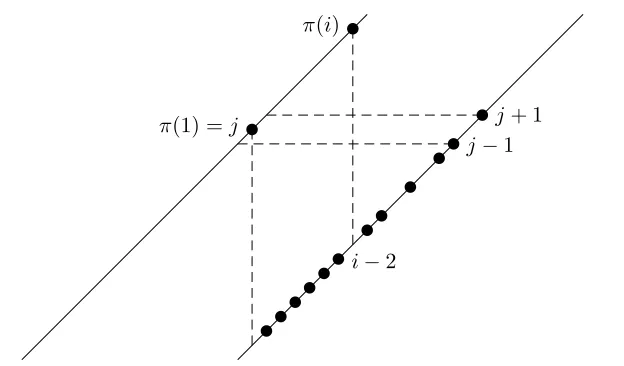
Proof. Fix two parallel lines of positive slope and takeπto be a321-avoiding permutation. We prove the claim by induction; the base case whereπ is the empty permutation being trivial, let us suppose thatπhas at least one point and letπ(1) =j.
Asπavoids321, the subsequence formed by the entries below and to the right ofπ(1) is 1,2, . . . , j −1. If all these entries occur contiguously then it is easy to draw π on the two lines: first draw (by induction) the permutation obtained by removing the entries
π(1),1,2, . . . , j−1 on the lines, and then place points corresponding to these removed entries below and to the left of this drawing.
Otherwise the entriesπ(1),1,2, . . . , j −1do not occur contiguously in π. Denote by
i−2
j−1
j+ 1
π(1) =j
[image:5.612.137.449.108.291.2]π(i)
Figure 3:Drawing a321-avoiding permutation on two parallel lines.
π(1),1,2, . . . , i−2, π(i). By induction we can draw the permutation obtained by removing the entriesπ(1),1,2, . . . , i−2on our lines. Asπ(i)> j−1, the point corresponding toj−1 must lie on the bottom line in this drawing, while the point corresponding toπ(i)must lie to the left and above this point on the top line. To produce a drawing ofπwe now add, as depicted in Figure3, a point (which will correspond toπ(1)) lying vertically between the points corresponding toj−1andj+ 1on the top line (this new point must necessary lie belowπ(i)becauseπ(i)≥j+ 1) andi−2points on the bottom line horizontally between this new point and the point corresponding toπ(i).
We remark that Lemma2.4can also be deduced from the work of Fanti, Frosini, Grazz-ini, Pinzani, and Rinaldi [9].
We are now ready to prove the main theorem of the section.
Proof of Theorem2.1.We need to prove that every extremal permutation,π, can be drawn in convex position. We label the topmost, bottommost, rightmost and leftmost points of such a permutation asT,B,RandLrespectively. We shall consider the possible permutations formed by these elements. There are eleven cases in all,{1,12,21,132,213,231,312,2143, 2413,3142,3412}; after symmetry these reduce to five cases:
1: In this caseT,B,RandLare identical, so such a permutation has length one and is trivially convex.
12: Here we must haveL=BandR=T. The set of all points whose values lie between those ofLandRinclusive must avoid321(for otherwise, a copy of321together with
LandRwould yield a non-extremal subpermutation). Since this accounts for all the points, the permutation may be drawn on two parallel lines.
132: In this case L = B corresponds to the ‘1’, while T corresponds to the ‘3’ and R
avoid321 and so can be drawn on two parallel lines. Choose such a drawing, and then choose points on the horizontal line through R which correctly represent the relative positions of the remaining elements with respect to the elements below R. These remaining elements form a unimodal permutation and so can now be drawn as a convex cap, with a maximum slope smaller than that of the two parallel lines. The resulting set of points is a convex plot ofπ.
2143: Here all four of the points T, B, R andL are distinct. As in the case ‘12’, the set of all points whose values lie between those of L andR inclusive must avoid 321, so these points can be drawn on two parallel lines. As in the case ‘132’, take the horizontal lines through R and throughL and choose a set of points along these lines which correctly represent the positions of the remaining elements with respect to one another, and those already plotted. The elements aboveR are unimodal and so can now be drawn on a convex cap as above, while those belowLcan be handled symmetrically.
2413: This case is essentially the same as the preceding one.
3. ENUMERATION
The convex class has received some previous attention, and has been enumerated indepen-dently in at least four different ways. Mansour and Severini [10] give the enumeration of the extremal class (which is the same as the convex class by the results of the previous sec-tion), which they call “square permutations”. Also, a string of papers — Fanti, Frosini, Grazzini, Pinzani, and Rinaldi [8], Disanto, Frosini, Pinzani, and Rinaldi [4], Bernini, Disanto, Pinzani, and Rinaldi [2], Disanto, Frosini, Rinaldi, and Pinzani [5] — investigate the convex class and its connection to “convex permutominoes”; the enumeration of the convex class occurs in [4]. Finally, Duchi and Poulalhon [6] have given the enumeration using the ECO method.
We include here our independent enumeration of the convex class in order to show how it can be obtained in an essentially automatic fashion from the fact that the convex permutations can be represented as a context-free language with respect to the insertion encoding (which we define briefly below.)
The insertion encoding of Albert, Linton and Ruˇskuc [1], provides a correspondence between permutation classes and formal languages. This correspondence associates with each permutation a word describing how it is built in a step-by-step process. At each step a new maximum entrynis inserted into an openslot(represented by a3), until the permutation is complete, at which point no open slots remain. The insertion can occur in one of four ways:
• A slot can be filled (replacing3byn).
• A new maximum can be placed on the right of the slot (replacing3by3n).
• A new maximum can be placed in the middle of the slot (replacing3by3n3).
These operations are called fills (denotedf), lefts (denotedl), rights (denotedr) and middles (denotedm), respectively. In addition these symbols are subscripted by the slot they apply to, where for i ≥ 1 the subscriptirefers to the ith slot from the left and −irefers to the
ith slot from the right. Note that two slots will never occur contiguously. For example, the permutation31254has insertion encodingm1l2f1r1f1because its evolution is
3 313 3123
3123 31234
31254
Each intermediate step in this process is called aconfiguration.
In some cases, characterised in [1], the insertion encoding of a permutation class forms a regular language, from which the (rational) generating function for the class can be rou-tinely computed. The convex class does not meet these conditions, but as noted previously the encodings of its elements do form a context-free language and hence procuring its gen-erating function requires little more effort.
Theorem 3.1. The generating function for the convex class is
t 1−6t+ 10t2
−4t2√ 1−4t
(1−4t)2
Proof. Using the insertion encoding to build a convex permutation, consider the insertion of an arbitrary entry in a configuration. If, before the insertion, there were smaller entries on both sides of it and, after the insertion, there are slots on both sides of it, then the entry inserted will inevitably become the ‘3’ in one of the basis entries of the convex class. Thus, no such insertions can be permitted. On the other hand, if every entry is inserted in such a way that there are smaller entries on at most one side of it, or slots remain on at most one side of it after insertion, then no entry can play the role of a ‘3’ in one of the basis entries of the convex class and hence the final permutation produced will be convex. We summarise these conditions with the following four rules, which depend on the number of slots in the configuration and on whether an entry or a slot occurs at each of the two ends of the configuration:
(B) If there are entries at both ends of the configuration then the only permitted oper-ations are at the left-most and right-most slots. (For example, in the configuration 13233, the allowed operations aref±1,l1, andr−1.)
(S) If there is an entry at a single end of the configuration then at that end we must either fill the slot or insert a new maximum toward that end (e.g., if the entry is on the right, we are allowed to fill the right-most slot or perform a right on it), while at the other end all operations are possible. (For example, in the configuration31233, the allowed operations aref±1,r±1,m1, andl1.)
(N) If there are entries at neither end of the configuration then all operations are possible in the two (or one, in the case of the configuration3) outermost slots. (For example, in the configuration312333, the allowed operations aref±1,l±1,r±1, andm±1.)
The enumeration strategy follows this summary (and is essentially mechanical, given the descriptions above). Specifically, we introduce six generating functions. Each counts (with the coefficient of tk
) the number of words of length kwhich can complete a con-figuration to a member of the convex class. Three of these count the number of ways to complete configurations with a single slot, depending on if the configuration has entries on
Both ends, aSingle end, orNeither end; we denote these byB1(t),S1(t), andN1(t). The
other three — B(t, z),S(t, z), and N(t, z) — count ways to complete configurations with two or more slots; the coefficient of tk
zs−2
in these generating functions is the number of words of lengthkwhich can complete a configuration of the given form withsslots to a member of the convex class. Our goal is therefore to computeN1(t), the number of words
of lengthk which can complete a configuration with a single slot and entries on neither end (in other words, the configuration3) to a member of the convex class.
We compute these generating functions, beginning with theBs which are very straight-forward. ForB1, we have small entries on both ends of the configuration and a single slot
in the middle, so the allowed operations arel1,r1, andf1 (the last of which terminates the encoding). Thus
B1(t) = 2tB1(t) +t= t
1−2t.
(This generating function should otherwise be clear from the allowed operations: we can choose any word in {l1,r1}∗, and then terminate it with f1.) If there are s ≥ 2 slots and small entries at both ends, then the allowed operations arel1,r−1andf±1 and we have
B(t, z) = 2tB(t, z) + 2tB1(t) + 2tzB(t, z) =
2t2
(1−2t)(1−2t−2tz).
Here, the first term corresponds to the result of usingl1orr−1as this increases the number
of symbols in the encoding by one (hence the factor of t) without changing the number of slots. For thef±1 possibilities, we might have started with two slots, and left only one
(hence2tB1(t)), or with three or more, and left one fewer (hence2tzB(t, z)). Similar
The situation for theSgenerating functions is a little more complex. For simplicity we assume that there are entries at the right hand end of the configuration (and hence not at the left). The allowed operations are thenf1andl1(leading toB configurations),m1andr1
(leading toSconfigurations) andf−1andr−1(also leading toSconfigurations). These are
all distinct if there are at least two slots, but only the operations carrying a1subscript can be applied when there is a single slot. Thus:
S1(t) = t+tB1(t) +tS(t,0) +tS1(t)
S(t, z) = tS1(t) +tzS(t, z) +
t(S(t, z)−S(t,0))
z + 2tS(t, z) + (t+tz)B(t, z) +tB1(t).
The S(t, z) terms in the second equation can be collected together in order to apply the kernel method:
1−2t−tz− t z
S(t, z) =tS1(t)−
tS(t,0)
z + (t+tz)B(t, z) +tB1(t).
Setting the first factor on the left equal to0, specifically
z= 1−2t−
√
1−4t
2t ,
and substituting in the right hand side allows us to produce a second equation connecting
S1(t)andS(t,0). Solving this system yields
S1(t) = t √
1−4t,
S(t,0) = (2t 2
−3t+ 1)√1−4t−4t2
+ 5t−1 (1−2t)(1−4t) .
In turn, we can now substitute these values in the original equation and solve for
S(t, z). The resulting complex expression is of interest only as an ingredient in the next step of the computation so we shall not reproduce it here. Maple code available from the authors can also be used to generate it, or to verify any of the computations and formulas found in this proof.
We repeat this procedure to produce theNgenerating functions. This time the original equations are
N1(t) = t+tN(t,0) + 2tS1(t),
N(t, z) = 2tN(t, z) + 2t(N(t, z)−N(t,0))
z + (2t+ 2tz)B(t, z) + 2tB1(t).
The kernel in this case is simplyz= 2t/(1−2t)and substitution and simplification yields
N1(t) =
t 1−6t+ 10t2
−4t2√ 1−4t
(1−4t)2 .
Given the simple form of the generating function it is possible to express the number of permutations of lengthnin the convex class in closed form (forn >1) as:
2(n+ 2)4n−3−4(2n−5)
2(n−3)
n−3
.
A possible avenue for further exploration would be to enumerate permutations with a prescribed number of “interior points”. From this viewpoint, the formula we have derived counts permutations with0interior points.
4. A HAPPY ENDING ANALOGUE
The Happy Ending Problem, due to Klein, first appeared in Erd˝os and Szekeres [7] as:
“Can we find for a given number n a number N(n) such that from any set containing at least N points it is possible to selectnpoints forming a convex polygon?”
Here we consider the analogous quantity for permutations: letf(n)denote the largest integer such that every permutation of lengthf(n)contains a convex permutation of length
n.
The Erd˝os-Szekeres Theorem on monotone subsequences from that same paper gives one upper bound: every permutation of length at least(n−1)2
+ 1contains a monotone subpermutation of length at leastn, and since monotone permutations are convex,f(n)≤ (n−1)2
+ 1. A theorem of Chung [3] gives an improved upper bound. She proved that all permutations of length at least(n2
+n+ 1)/3contain a unimodal (and hence convex) subpermutation (i.e., in our language, a permutation that can be drawn on a convex cap or cup) of length at leastn. Forf(n)we are able to give an upper bound of approximately
n2
/4. Define
h(n) =
(
n−2
2 2
+ 2 for evenn,
n−1
2 2
for oddn.
Proposition 4.1. Every permutation of length greater thanh(n)contains a123- or321-avoiding subpermutation (and thus in particular, a convex subpermutation) of length at leastn.
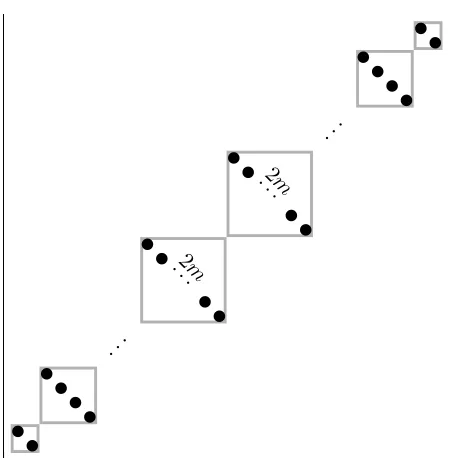
. ..
. ..2m
. ..2m
[image:11.612.175.400.101.330.2]. ..
Figure 4:A permutation of lengthm(2m+ 2)with longest convex subpermutation of length4m.
We provide an explicit construction to establish a lower bound.
Proposition 4.2. For each positive integerm, there is a permutation of lengthm(2m+ 2)that has no convex subpermutation of length4m+ 1.
Proof. Alayered permutation is one that can be constructed by replacing each point in an increasing permutation with a decreasing sequence of points, i.e. a layered permutation is a sequence of decreases, each lying above and to the right of the preceding one. Our example is a layered permutation with2m layers. The firstm layers have lengths which increase by2each time from2up tomwhile the remainingmlayers have lengths which decrease by2from2mback to2, see Figure4. If a convex subpermutation of this permu-tation contains more than two points from any layer, then it cannot contain points both in layers above and below that one. It follows that the longest convex subpermutation has length4m.
The preceding proposition gives a lower bound forf(n)which is asymptoticallyn2 /8. Thuslimn→∞f(n)/n2 — if it exists — lies between1/8and1/4.
REFERENCES
[2] BERNINI, A., DISANTO, F., PINZANI, R., AND RINALDI, S. Permutations defining convex permutominoes.J. Integer Seq. 10, 9 (2007), Article 07.9.7, 26.
[3] CHUNG, F. R. K. On unimodal subsequences. J. Combin. Theory Ser. A 29, 3 (1980), 267–279.
[4] DISANTO, F., FROSINI, A., PINZANI, R.,AND RINALDI, S. A closed formula for the number of convex permutominoes. Electron. J. Combin. 14, 1 (2007), Research Paper 57, 17 pp.
[5] DISANTO, F., FROSINI, A., RINALDI, S., AND PINZANI, R. The combinatorics of convex permutominoes.Southeast Asian Bull. Math. 32, 5 (2008), 883–912.
[6] DUCHI, E., AND POULALHON, D. On square permutations. InFifth Colloquium on
Mathematics and Computer Science, Discrete Math. Theor. Comput. Sci. Proc., AI. Assoc. Discrete Math. Theor. Comput. Sci., Nancy, 2008, pp. 207–222.
[7] ERDOS˝ , P.,ANDSZEKERES, G. A combinatorial problem in geometry. Compos. Math. 2(1935), 463–470.
[8] FANTI, I., FROSINI, A., GRAZZINI, E., PINZANI, R., ANDRINALDI, S. Polyominoes determined by permutations. InFourth Colloquium on Mathematics and Computer Sci-ence Algorithms, Trees, Combinatorics and Probabilities, Discrete Math. Theor. Comput. Sci. Proc., AG. Assoc. Discrete Math. Theor. Comput. Sci., Nancy, 2006, pp. 381–389.
[9] FANTI, I., FROSINI, A., GRAZZINI, E., PINZANI, R., ANDRINALDI, S. Characteriza-tion and enumeraCharacteriza-tion of some classes of permutominoes.Pure Math. Appl. (PU.M.A.) 18, 3-4 (2007), 265–290.
[10] MANSOUR, T., AND SEVERINI, S. Grid polygons from permutations and their enu-meration by the kernel method. In Formal power series and algebraic combinatorics (Nankai Univ., 2007)(2007).
[11] SAGAN, B. E.The Symmetric Group, second ed., vol. 203 ofGraduate Texts in
Mathemat-ics. Springer-Verlag, New York, 2001.