Using a Virtual University World to aid Overseas PGT
Orientation
Ishbel Duncan, Janie Brooks & Paula Miles
University of St Andrews
(Schools of Computer Science, ELT & Psychology)
ABSTRACT: The Virtual St Andrews (ViStA) project aims to embed students within a Virtual Environment which duplicates, as near as possible, the real University’s centre, functions and social areas. The main project objectives are to allow Postgraduate Taught students, especially international students who only have one year to acculturate, work, socialize and graduate, to experience a pre-arrival orientation, meeting current and prospective students online as well as learning where designated staff and buildings are. The hypothesis that drives the research and virtual world development, is that online activities reduce acclimatisation stress and improve socialization, well being and study readiness. The project aim is to develop a Virtual World through which prospective or incoming students can learn about the University, talk to current students, seek advice and complete tasks that lead them through the orientation process. The world is growing organically through student projects and staff additions.
1 Introduction
Initially constructed by researchers in the School of Computer Science (Duncan) who have experience in other immersive environments, ViStA was co-directed by a member of staff from English Language Teaching (Brooks). Therefore from the very beginning, ViStA was intended primarily as a vehicle for overseas students, with an emphasis on the Postgraduate Taught students. Overseas postgraduate students coming to study in the UK for only one year on a taught Masters degree are faced with many urgent requirements: to be inducted and oriented within a few days, to understand the expectations of academic staff and the University’s rules and regulations, to discover where buildings or staff are situated as well as settle into residences or other accommodation and to make contact with other students. The decision to build a virtual St Andrews was based on the observation of many staff and students that one year postgraduate overseas students, in particular, need some help in understanding the University system and finding their way around their new physical environment. These Postgraduate Taught students (PGT) have a shorter time to between entry to the University and their final assessment than undergraduate or doctoral students, making their acculturation a particularly high stakes activity.
2 Virtual Environments
Virtual Worlds (VWs) are an important tool in modern teaching as well as the entertainment industries. As immersive environments they can lead the user, via an avatar with some projected (and protected) identity, through a series of escapist games and interactions, or through a series of defined learning objectives. Duncan et al. (2012) showed that there has been an explosion in interest in using VWs for educational purposes, from primary and secondary educational constructive learning through to Higher Educational with a particular focus on constructive learning. More interactive that a Massive Open Online Courses (MOOCs), VWs enable students to self learn, group learn and self direct. Further, VWs also include a sense of gaming and fun through the social elements, for example, students can gather in coffee areas, quads or rooms to chat privately or to a group within a set distance (about 30m in-world).
Mennecke (2008) stated that VWs are part of the domain of multiplayer online games but without organised gameplay; the user can meander through a VW or interact with scenarios as they wish, or meet with and work together with other users. VW examples are the Sims
(http://thesims.ea.com/en_us/home), a game with multiple environments such as towns,
hospitals, holiday islands to visit, or the online game worlds Second Life
(http://secondlife.com/) and Active Worlds (www.activeworlds.com). In these two online
worlds, personally designed avatars can roam, build, interact or quest. Both have educational islands (servers) from a large list of Universities and Colleges, which have bought space to build an environment for their students to interact and learn in. Another system commonly used is OpenSim (http://opensimulator.org/) which is an open source VW simulator. The University of St Andrews School of Computer Science uses OpenSim to build multiple environments for students such as the Laconia Acropolis Project, St Andrews Cathedral and Castle, Linlithgow Palace, the Brora Salt Pans of the 16th and 18th Centuries, Eyemouth Fort, Caen Highland Township, Scone Abbey as well as a Virtual Humanitarian Disaster (VHD) Simulation (http://openvirtualworlds.org/). Some of these have been built in conjunction with Scottish Heritage, the National Trust for Scotland or with other academic schools in the University such as History, Archaeology or Management. The simulated worlds are rich in visual and cognitive entertainment. Users can wander through the worlds, or interact with constantly changing scenarios.
Within an immersive environment, the cognitive awareness of a user is altered by an artificial environment. Users effectively suspend belief, partially or completely, enabling them to interact and react to stimuli in the artificial world. This is applicable to board gamers players being mentally immersed in their game or to musicians in their music. Players within a virtual environment cave, where they experience a total immersion within the world and their actions, use tactical or sensory motor accoutrements to enable a complete sensation of being within that environment. Users of Active Worlds, Second Life or OpenSim have a narrative immersion in that they feel emotionally invested in the experience even though they interact through keyboard, mouse or touchpad. They may even progress to a form of spatial immersion when the game play is projected or they feel so convinced by the reality of the simulation that their awareness is totally embedded within the experience. We use the terms Virtual Worlds as well as immersion as the simulations are growing increasingly real to afford the user a sense of being in-world.
million users at the time of writing, and Asia currently has 35% of its population online but with a total population of over 1.386 billion people, this demonstrates a vast target for online educational support as well as learning within games.
2.1 Pedagogical Issues
Many articles have been written on the different aspects of the educational uses of Virtual Environments. Duncan et al. (2012) investigated over 100 articles on Virtual Environments, Virtual Worlds and Virtual Learning Environments and noted different categories of published work on educational activities, learning theories, environments as well as research areas.
Educational activities in VWs included virtual field work, virtual laboratories, collaborative construction, collaborative simulations, role playing, game based learning, virtual quests as well as lectures or lessons. Collaborative Simulation was the most common, accounting for nearly half of the reviewed literature; collaborative constructional activities were also growing in number. Game-based learning, virtual quests, role play and lectures or lessons were also seen in the reviewed literature. Most articles discussed higher or further education.
According to Twining (Twining, 2009), experiments have been performed by integrating different learning theories into educational activities. Constructivist techniques such as problem and game based learning are often used in Virtual Worlds or Environments because they support experiential learning. Groupwork scenarios can build on team strengths and interests and help develop skill and confidence levels. Games support interactivity and discussion. Collaborative tools such as wikis, blogs, co-authoring and social networking are both indicated and well used in Virtual Worlds. Direct instruction is still used though online lectures for colleges and universities and webinars, web based seminars, are common in industry. Problem-based learning, collaborative, experimental, instructional, constructivist, didactic and interactive learning were all identified in currently available environments. Collaborative work was the most common educational activity, with knowledge building a close second. Surprisingly, problem-based learning was only mentioned in one in seven of publications prior to 2012.
The Learning Environments that are used by the researchers were basically Web 2.0 based VLEs such as Moodle, Blackboard and WebCT and 3D web technologies such as Second Life (www.SecondLife.com) and Active Worlds (www.activeworlds.com).
Apart from educational activities and pedagogical development, University researchers elsewhere are working on aspects of identity, embodiment and geo-spatial representation as well as usability, deployment, knowledge-passing and co-ordination in a learning environment. Essentially, Virtual Worlds or Environments are a growing area of educational research and a potential learning area for the classroom of the future.
2.2 The Virtual St Andrews
ViStA was originally created as a Virtual World orientation site for overseas students and has been used and evaluated by current MLitt and MSc students from the Arts and Science faculties. One year postgraduate students have very little time to be inducted, oriented and then embedded into their course. They also have to settle into residences and the social side of university life before producing work at Masters level, quite commonly in English as a second language. As a university St Andrews has over 2000 international students a year, nearly 1/3rd of the student population and the PG population is expected to grow subject to
of St Andrews would be a useful tool to impart knowledge and to guide students through their new physical environment. The use of ViStA allows students to get to know the University, and possibly key staff or each other, before arrival. Although this does not directly impact onto teaching and learning, it was expected that a positive response from students might be achievable, therefore demonstrating a positive effect on learning from prior engagement and a welcoming attitude from the University.
The research plan allowed us to develop structured activities to encourage friendships and contacts to ease the transition into UK Higher Education student life. Current students were also encouraged to participate by both entering the world and chatting with prospective student avatars.
To gain entry to the ViStA world go to the URL: http://openvirtualworlds.org/ViStA/register/
[image:4.595.76.503.268.523.2]and following registration one can download a viewer before entering the virtual medieval St Salvator’s Quad at the centre of the University.
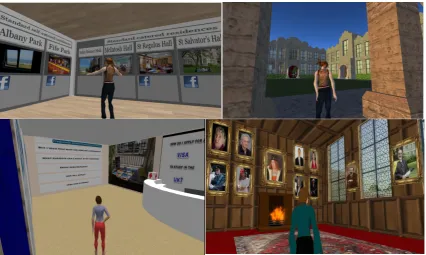
Figure 1 shows images of the current ViStA and demonstrates the use of rooms, access to social media, and historical and current information about the city and University.
3. Transition Project Aims and Objectives
Easing the transition to tertiary education is multi-faceted; the project aims to not only visually represent the city and University of St Andrews, but also to develop a sense of familiarity and socialisation before students physically arrive in the area. Further, educational and administrative issues are also signalled as being important factors to students unused to the Scottish or even the UK educational system and the terminologies used. Learning techniques and standards as well as educational tools; the Moodles, MOOCs, online management sytems and registration systems are all potential points of stress and anxiety. Objective 1 was therefore to discover the areas of concern to pre-arrival and new PGT students.
From an initial survey, the researchers found that students were more concerned about non academic issues; accommodation, socialisation and shopping were high on their list of pre-arrival questions. It appeared that students were more willing to accept that the educational transition to studying in the UK was to have its own obstacles that they expected to be helped through, whereas the differences in the residences and how active were the student societies were questions that were of concern. Therefore, Objective 2 became a question of how to ease the transitions before student arrival through ViStA.
By enabling engagement with students pre-arrival through contact with current students and staff and also bridging the divide between home and St Andrews by providing imagery through videos and in-world content, ViStA became a vehicle for pre arrival orientation, information gathering and a tool for stress reduction. To develop a sense of familiarity and socialisation, links to facebook and other social media groups for residences, societies and academic Schools were embedded in ViStA. The intent was to reduce anxiety and loneliness both before and at arrival by allowing access to a safe and private environment where students can be anonymous avatars, dressing in any way they wish. A separate but important staff-student connection here was to link staff and students in-world either as automated avatars or real staff through chat facilities. The St Andrews Advice and Support Centre (ASC) staff were keen to have pre-arrival chats with worried students, either privately as in one–to-one or at a timed event. Thus, Objective 2 spawned a number of sub-objectives of content and contact.
Objective 3 of the ViStA project is to embed good educational practices and learning techniques. As the University operates in a global context with students coming from over 70 countries, many from outwith the EU, allowing students to read and learn about UK teaching practices and techniques, our grading system and feedback systems would aid transition to their academic experience. The expectation is that allowing a flexibility of provision of learning tools and experiences would enhance students who learn by different modes
3.1 Current Status
Initial trials with ViStA elicited the following feedback:
§ Students found the system easy to use and felt confident with using it.
§ They wanted to know more about St Andrews once they had been in-world
§ They wanted to chat to current students but there was a mix of responses for wishing to talk to staff in-world
§ Students wanted to explore more of St Andrews than was currently available in ViStA.
§ More videos or information about student accommodation, transport to St Andrews and available shopping were amongst the highest requests for further content.
stated benefit in being in-world, they were very keen to visit more and found ViStA interesting and wanted to add content. Some students wanted more functionality such as having meeting places where timed meetings or chatting could take place.
Currently two in-world projects are being developed. The first is for communication to be either one-to-many, as in a member of staff of student talking to a group on students within an in-world room, or one-to-one private, as in a staff member in ASC helping a student without anyone overhearing. In-world avatars can normally hear conversations within a set distance so it is important to change the chat to private or to use Instant Messaging to enable privacy.
A second project is considering acculturation stress by measuring the mood of students pre arrival (through Moodle and discussion fora) and then monitoring stress levels throughout the academic year. The working hypothesis is that there are peaks of student stress at arrival and again around Spring when exams and dissertation plans become due. However, this work raises ethical questions as no two student groups within one cohort can be treated differently. Consequently the pre-arrival tests have to be done without ViStA and with ViStA on two separate years to determine if ViStA is a useful vehicle for stress reduction. The project is moving towards its second trial, that is using ViStA this year. These works are ongong over the summer of 2015.
3.2 Future Plans
Currently several students and staff wish to add content to ViStA with respect to general content (requiring a contents management system) or to activities which require objectives, structures and goals. Separately the team are intending to investigate mobile access and activities to allow students to move around, meet up and perform quests either in-world or in the physical world. This work is also leading the researchers to examine gaming constructs as educational tools but more work on automatic feedback and guidance is needed. Virtual Worlds and Environments can be the basis of the classroom of the future, embedding good educational techniques with interesting activities to enable both group work and self directed learning. However, specialists from computer science are required to build artificially intelligent avatars, games engines and activities together with educational experts, language specialists and psychology researchers. The future of education through Virtual Worlds is cross discipline and cross cultural, but also complicated and exciting work.
4 References
Duncan, I., Miller, A. & Jiang, S. 2012. A Taxonomy of virtual worlds usage in education.
British Journal of Educational Technology, 43, 6, 949-964, November 2012
Lord, P. & Dawson, C. 2002. The Induction Needs of International Students at postgraduate level http://www.llas.ac.uk/materialsbank/mb080/LO_3/lord_business_sc.pdf
Mennecke, B.E. 2008. Second Life and other Virtual Worlds: A Roadmap for Research.
Communications of the AIS, 22, 271-388.
Smith, R.A. & Khawaja, N.G. 2011. A Review of the acculturation experiences of international students. International Journal of Intercultural Relations 35 (2011) 699-713
Twining, P. 2009. Exploring the Educational potential of Virtual Worlds - Some Reflections From the SPP. British Journal of Educational Technology, 40, 496-514.