Acta Cryst.(2002). E58, i21±i22 DOI: 10.1107/S1600536802001721 Kang and Miller AgBaBi
i21
inorganic papers
Acta Crystallographica Section E
Structure Reports
Online ISSN 1600-5368
The intermetallic compound BaAgBi
Sung Kwon Kanga* and Gordon J.
Millerb
aDepartment of Chemistry, Chungnam National
University, Daejeon, 305-764, South Korea, and
bDepartment of Chemistry, Iowa State
University, Ames, IA 50011, USA
Correspondence e-mail: [email protected]
Key indicators Single-crystal X-ray study T= 293 K
Mean(Ag±Ba) = 0.0004 AÊ Rfactor = 0.038 wRfactor = 0.102
Data-to-parameter ratio = 16.6
For details of how these key indicators were automatically derived from the article, see http://journals.iucr.org/e.
#2002 International Union of Crystallography Printed in Great Britain ± all rights reserved
Barium silver bismuth is isostructural with ZrBeSi. The Ag and Bi atoms form planar honeycomb layers with an AgÐBi distance of 2.8534 (4) AÊ. The displacement parameters of Ag and Bi show a strong anisotropy.
Comment
During studies on the ternary barium±silver±bismuth system, the intermetallic compound BaAgBi was obtained as a side product. Previously, this compound was prepared by stoi-chiometric reaction of the elements and characterized by X-ray powder diffraction (Merloet al., 1990).
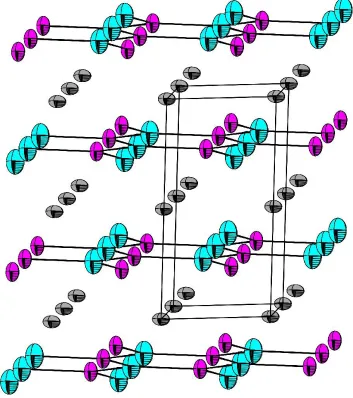
BaAgBi is isostructural with ZrBeSi (Vogel & Schuster, 1980). The Ag and Bi atoms form planar hexagonal sheets like graphite, with Ag and Bi alternating in the layer. The Ba atoms lie between two layers and are positioned over the centers of the hexagonal rings. The shortest interatomic distance, AgÐ Bi, is 2.8534 (4) AÊ, and each Ba atom is surrounded by six Au and six Sb atoms at distances of 3.6533 (4) AÊ. The displace-ment parameters of the Ag and Bi atoms display a strong anisotropy; the U11 values of the Ag and Bi atoms are
0.0120 (11) and 0.0066 (7) AÊ2 while the U
33 values are
0.0231 (18) and 0.0140 (10) AÊ2, respectively. This anisotropy
also appears in several ZrBeSi-type compounds, such as EuZnGe (PoÈttgen, 1995), CaCuBi (Merlo et al., 1990), and EuAgAs (Tomuschat & Schuster, 1981), suggesting the possibility of interlayer interactions.
Received 17 January 2002 Accepted 28 January 2002 Online 8 February 2002
Figure 1
Experimental
BaAgBi was obtained as a by-product when Ba [rod, Alfa±Aesar (99.99%)], Ag [powder,ÿ100 mesh, Alfa±Aesar (99.999%)], and Bi [powder, ÿ100 mesh, Alfa±Aesar (99.999%)] were loaded into a tantalum tube (Nobel-Met. Ltd, >99.85%, 0.375 in. OD) in a 1:1:2 molar ratio in an Ar-®lled glovebox. The tube was sealed in an arc-melter under argon, placed in a fused-silica jacket, and heated at 973 K for 3 days. The reaction container was cooled slowly to 673 K at 10 K hÿ1, and then quenched to room temperature. When the
tantalum tube was opened in the Ar-®lled glovebox, grey irregular-shaped crystals of BaAgBi were found in the product. Single crystals were mounted in 0.3 mm thin-walled capillaries for diffraction experiments.
Crystal data
AgBaBi
Mr= 454.19 Hexagonal,P63=mmc a= 4.9423 (7) AÊ
c= 9.1251 (18) AÊ
V= 193.03 (5) AÊ3 Z= 2
Dx= 7.814 Mg mÿ3
MoKradiation Cell parameters from 27
re¯ections = 6.5±14.4 = 60.31 mmÿ1 T= 293 (2) K Irregular, grey 0.090.030.03 mm
Data collection
Rigaku AFC-6Rdiffractometer 2/!scans
Absorption correction: scan (Northet al., 1968)
Tmin= 0.132,Tmax= 0.164
133 measured re¯ections 133 independent re¯ections 89 re¯ections withI> 2(I)
max= 30.0 h= 0!6
k= 0!3
l= 0!12
3 standard re¯ections every 100 re¯ections intensity decay: 0.9%
Re®nement
Re®nement onF2 R[F2> 2(F2)] = 0.038 wR(F2) = 0.102 S= 1.16 133 re¯ections 8 parameters
w= 1/[2(F
o2) + (0.0405P)2 + 2.2564P]
whereP= (Fo2+ 2Fc2)/3 (/)max< 0.001
max= 2.76 e AÊÿ3
min=ÿ3.98 e AÊÿ3
Extinction correction:SHELXL
Extinction coef®cient: 0.011 (2)
Table 1
Selected geometric parameters (AÊ,).
BaÐBii 3.6533 (4)
BaÐAg 3.6533 (4) AgÐBi
ii 2.8534 (4)
BiiiÐAgÐBiiii 120 AgiiÐBiÐAgiii 120
Symmetry codes: (i) 1ÿx;1ÿy;1ÿz; (ii) 1ÿx;2ÿy;1ÿz; (iii)ÿx;1ÿy;1ÿz.
Based on the observed systematic absences, space groupsP31c,
P31c,P63mc,P63/mmc, andP62care allowed. Space groupP63/mmc
was initially selected and con®rmed by comparing the re®nement results with those of the other four space groups. The Ba, Ag, and Bi atoms were readily located from theEmap, and re®ned with aniso-tropic displacement parameters. The re¯ection 124 was omitted from the re®nement because of possible interference from the beam stop of the X-ray diffractometer. The largest residuals in the ®nal differ-ence map were 2.76 e AÊÿ3at a distance of 0.74 AÊ from Bi, andÿ3.98e
AÊÿ3at a distance of 0.92 AÊ from Bi.
Data collection: TEXSAN (Molecular Structure Corporation, 1990); cell re®nement: TEXSAN; data reduction: TEXSAN; program(s) used to solve structure: SHELXS97 (Sheldrick, 1997); program(s) used to re®ne structure:SHELXL97 (Sheldrick, 1997); software used to prepare material for publication:WinGX(Farrugia, 1999).
The authors wish to acknowledge the ®nancial support of the Korean Research Foundation made in the programme year of 2000 (project No. DP0222).
References
Farrugia, L. J. (1999).J. Appl. Cryst.32, 837±838.
Merlo, F., Pani, M. & Fornasini, M. L. (1990).J. Less Common Met.166, 319± 327.
Molecular Structure Corporation (1990).TEXSAN.Version 6.0. MSC, 3200 Research Forest Drive, The Woodlands, TX 77381, USA.
North, A. C. T., Phillips, D. C. & Mathews, F. S. (1968).Acta Cryst, A24, 351± 359.
PoÈttgen, R. (1995).Z. Kristallogr.210, 924±928.
Sheldrick, G. M. (1997). SHELXS97 and SHELXL97. University of GoÈttingen, Germany.
supporting information
sup-1
Acta Cryst. (2002). E58, i21–i22supporting information
Acta Cryst. (2002). E58, i21–i22 [doi:10.1107/S1600536802001721]
The intermetallic compound BaAgBi
Sung Kwon Kang and Gordon J. Miller
S1. Comment
During studies on the ternary barium–silver–bismuth system, the intermetallic compound BaAgBi was obtained as a side
product. Previously, this compound was prepared by stoichiometric reaction of the elements and characterized by X-ray
powder diffraction (Merlo et al., 1990).
BaAgBi is isostructural with ZrBeSi (Vogel & Schuster, 1980). The Ag and Bi atoms form planar hexagonal sheets like
graphite, with Ag and Bi alternating in the layer. The Ba atoms lie between two layers and are positioned over the centers
of the hexagonal rings. The shortest interatomic distance, Ag—Bi, is 2.8534 (4) Å, and each Ba atom is surrounded by six
Au and six Sb atoms at distances of 3.6533 (4) Å. The displacement parameters of the Ag and Bi atoms display a strong
anisotropy; the U11 values of the Ag and Bi atoms are 0.0120 (11) and 0.0066 (7) Å2 while the U33 values are 0.0231 (18)
and 0.0140 (10) Å2, respectively. This anisotropy also appears in several ZrBeSi-type compounds, such as EuZnGe
(Pöttgen, 1995), CaCuBi (Merlo et al., 1990), and EuAgAs (Tomuschat & Schuster, 1981), suggesting the possibility of
interlayer interactions.
S2. Experimental
BaAgBi was obtained as a by-product when Ba [rod, Alfa-Aesar (99.99%)], Ag [powder, -100 mesh, Alfa-Aesar
(99.999%)], and Bi [powder, -100 mesh, Alfa-Aesar (99.999%)] were loaded into a tantalum tube (Nobel-Met. Ltd.,
>99.85%, 0.375 in. OD) in a 1:1:2 molar ratio in an Ar-filled glovebox. The tube was sealed in an arc-melter under argon,
placed in a fused-silica jacket, and heated at 973 K for 3 days. The reaction container was cooled slowly to 673 K at 10 K
h-1, and then quenched to room temperature. When the tantalum tube was opened in the Ar-filled glovebox, grey
irregular-shaped crystals of BaAgBi were found in the product. Single crystals were mounted in 0.3 mm thin-walled
capillaries for diffraction experiments.
S3. Refinement
Space groups P31c, P31c, P63mc, P63/mmc, and P62c were allowed based on the observed systematic absences. Space
group P63/mmc was initially selected and confirmed by comparing the refinement results with the other four space
groups. The Ba, Ag, and Bi atoms were readily located from the E-map, and refined with anisotropic displacement
parameters. The reflection 124 was omitted from the refinement because of possible interference from the beam stop of
the X-ray diffractometer. The largest residuals in the final difference map were 2.76 e Å-3 at a distance of 0.74 Å from Bi,
Figure 1
The layer structure of BaAgBi along the z axis. Displacement ellipsoids are drawn at the 99% probability level. Key: Ba
grey, Ag blue, Bi red.
(I)
Crystal data
AgBaBi
Mr = 454.19
Hexagonal, P63/mmc Hall symbol: -P 6c 2c
a = 4.9423 (7) Å
c = 9.1251 (18) Å
V = 193.03 (5) Å3
Z = 2
F(000) = 372
Dx = 7.814 Mg m−3
Mo Kα radiation, λ = 0.71073 Å Cell parameters from 27 reflections
θ = 6.5–14.4°
µ = 60.31 mm−1
T = 293 K Irregular, grey
supporting information
sup-3
Acta Cryst. (2002). E58, i21–i22Data collection
Rigaku AFC-6R diffractometer 2θ/ω scans
Absorption correction: ψ scan (North et al., 1968)
Tmin = 0.132, Tmax = 0.164 133 measured reflections 133 independent reflections
89 reflections with I > 2σ(I)
Rint = 0
θmax = 30.0°, θmin = 4.5°
h = 0→6
k = 0→3
l = 0→12
3 standard reflections every 100 reflections intensity decay: 0.9%
Refinement
Refinement on F2 Least-squares matrix: full
R[F2 > 2σ(F2)] = 0.038
wR(F2) = 0.102
S = 1.16 133 reflections 8 parameters 0 restraints
w = 1/[σ2(F
o2) + (0.0405P)2 + 2.2564P] where P = (Fo2 + 2Fc2)/3
(Δ/σ)max < 0.001 Δρmax = 2.76 e Å−3 Δρmin = −3.98 e Å−3
Extinction correction: SHELXL, Fc*=kFc[1+0.001xFc2λ3/sin(2θ)]-1/4 Extinction coefficient: 0.011 (2)
Special details
Geometry. All e.s.d.'s (except the e.s.d. in the dihedral angle between two l.s. planes) are estimated using the full covariance matrix. The cell e.s.d.'s are taken into account individually in the estimation of e.s.d.'s in distances, angles and torsion angles; correlations between e.s.d.'s in cell parameters are only used when they are defined by crystal symmetry. An approximate (isotropic) treatment of cell e.s.d.'s is used for estimating e.s.d.'s involving l.s. planes.
Fractional atomic coordinates and isotropic or equivalent isotropic displacement parameters (Å2)
x y z Uiso*/Ueq
Ba 0 0 0 0.0094 (7)
Ag 0.3333 0.6667 0.25 0.0157 (9)
Bi 0.3333 0.6667 0.75 0.0091 (7)
Atomic displacement parameters (Å2)
U11 U22 U33 U12 U13 U23
Ba 0.0113 (10) 0.0113 (10) 0.0057 (12) 0.0057 (5) 0 0 Ag 0.0120 (11) 0.0120 (11) 0.0231 (18) 0.0060 (6) 0 0
Bi 0.0066 (7) 0.0066 (7) 0.0140 (10) 0.0033 (4) 0 0
Geometric parameters (Å, º)
Ba—Bii 3.6533 (4) Ag—Baxiii 3.6533 (4)
Ba—Ag 3.6533 (4) Ag—Baxiv 3.6533 (4)
Ba—Biii 3.6533 (4) Ag—Baxv 3.6533 (4)
Ba—Agiii 3.6533 (4) Ag—Baxvi 3.6533 (4)
Ba—Biiv 3.6533 (4) Ag—Baxvii 3.6533 (4)
Ba—Agv 3.6533 (4) Bi—Agxii 2.8534 (4)
Ba—Bivi 3.6533 (4) Bi—Agiv 2.8534 (4)
Ba—Agvii 3.6533 (4) Bi—Agi 2.8534 (4)
Ba—Biix 3.6533 (4) Bi—Baxvi 3.6533 (4)
Ba—Agx 3.6533 (4) Bi—Baxv 3.6533 (4)
Ba—Bixi 3.6533 (4) Bi—Baxix 3.6533 (4)
Ag—Bixii 2.8534 (4) Bi—Baxx 3.6533 (4)
Ag—Biiv 2.8534 (4) Bi—Baxiii 3.6533 (4)
Ag—Bii 2.8534 (4)
Bii—Ba—Ag 45.975 (5) Bixii—Ag—Ba 141.358 (7)
Bii—Ba—Biii 180 Biiv—Ag—Ba 67.012 (2)
Ag—Ba—Biii 134.025 (5) Bii—Ag—Ba 67.012 (2)
Bii—Ba—Agiii 134.025 (5) Bixii—Ag—Baxiii 67.012 (2)
Ag—Ba—Agiii 180 Biiv—Ag—Baxiii 141.358 (7)
Biii—Ba—Agiii 45.975 (5) Bii—Ag—Baxiii 67.012 (2) Bii—Ba—Biiv 85.129 (10) Ba—Ag—Baxiii 134.025 (5) Ag—Ba—Biiv 45.975 (5) Bixii—Ag—Baxiv 67.012 (2) Biii—Ba—Biiv 94.871 (10) Biiv—Ag—Baxiv 67.012 (2) Agiii—Ba—Biiv 134.025 (5) Bii—Ag—Baxiv 141.358 (7)
Bii—Ba—Agv 45.975 (5) Ba—Ag—Baxiv 85.129 (10)
Ag—Ba—Agv 85.129 (10) Baxiii—Ag—Baxiv 134.025 (5) Biii—Ba—Agv 134.025 (5) Bixii—Ag—Baxv 67.012 (2) Agiii—Ba—Agv 94.871 (10) Biiv—Ag—Baxv 67.012 (2) Biiv—Ba—Agv 102.717 (14) Bii—Ag—Baxv 141.358 (7)
Bii—Ba—Bivi 94.871 (10) Ba—Ag—Baxv 134.025 (5)
Ag—Ba—Bivi 134.025 (5) Baxiii—Ag—Baxv 85.129 (10) Biii—Ba—Bivi 85.129 (10) Baxiv—Ag—Baxv 77.283 (14) Agiii—Ba—Bivi 45.975 (5) Bixii—Ag—Baxvi 141.358 (7)
Biiv—Ba—Bivi 180 Biiv—Ag—Baxvi 67.012 (2)
Agv—Ba—Bivi 77.283 (14) Bii—Ag—Baxvi 67.012 (2) Bii—Ba—Agvii 134.025 (5) Ba—Ag—Baxvi 77.283 (14) Ag—Ba—Agvii 94.871 (10) Baxiii—Ag—Baxvi 85.129 (10) Biii—Ba—Agvii 45.975 (5) Baxiv—Ag—Baxvi 134.025 (5) Agiii—Ba—Agvii 85.129 (10) Baxv—Ag—Baxvi 85.129 (10) Biiv—Ba—Agvii 77.283 (14) Bixii—Ag—Baxvii 67.012 (2)
Agv—Ba—Agvii 180 Biiv—Ag—Baxvii 141.358 (7)
supporting information
sup-5
Acta Cryst. (2002). E58, i21–i22Agv—Ba—Biix 45.975 (5) Agi—Bi—Baxvi 67.012 (2) Bivi—Ba—Biix 94.871 (10) Baxviii—Bi—Baxvi 134.025 (5) Agvii—Ba—Biix 134.025 (5) Agxii—Bi—Baxv 67.012 (2) Agviii—Ba—Biix 45.975 (5) Agiv—Bi—Baxv 67.012 (2) Bii—Ba—Agx 77.283 (14) Agi—Bi—Baxv 141.358 (7) Ag—Ba—Agx 94.871 (10) Baxviii—Bi—Baxv 134.025 (5) Biii—Ba—Agx 102.717 (14) Baxvi—Bi—Baxv 85.129 (10) Agiii—Ba—Agx 85.129 (10) Agxii—Bi—Baxix 67.012 (2) Biiv—Ba—Agx 134.025 (5) Agiv—Bi—Baxix 67.012 (2) Agv—Ba—Agx 94.871 (10) Agi—Bi—Baxix 141.358 (7) Bivi—Ba—Agx 45.975 (5) Baxviii—Bi—Baxix 85.129 (10) Agvii—Ba—Agx 85.129 (10) Baxvi—Bi—Baxix 134.025 (5)
Agviii—Ba—Agx 180 Baxv—Bi—Baxix 77.283 (14)
Biix—Ba—Agx 134.025 (5) Agxii—Bi—Baxx 141.358 (7) Bii—Ba—Bixi 94.871 (10) Agiv—Bi—Baxx 67.012 (2)
Ag—Ba—Bixi 77.283 (14) Agi—Bi—Baxx 67.012 (2)
Biii—Ba—Bixi 85.129 (10) Baxviii—Bi—Baxx 85.129 (10) Agiii—Ba—Bixi 102.717 (14) Baxvi—Bi—Baxx 77.283 (14) Biiv—Ba—Bixi 94.871 (10) Baxv—Bi—Baxx 134.025 (5) Agv—Ba—Bixi 134.025 (5) Baxix—Bi—Baxx 85.129 (10) Bivi—Ba—Bixi 85.129 (10) Agxii—Bi—Baxiii 67.012 (2) Agvii—Ba—Bixi 45.975 (5) Agiv—Bi—Baxiii 141.358 (7) Agviii—Ba—Bixi 134.025 (5) Agi—Bi—Baxiii 67.012 (2) Biix—Ba—Bixi 180 Baxviii—Bi—Baxiii 77.283 (14) Agx—Ba—Bixi 45.975 (5) Baxvi—Bi—Baxiii 85.129 (10)
Bixii—Ag—Biiv 120 Baxv—Bi—Baxiii 85.129 (10)
Bixii—Ag—Bii 120 Baxix—Bi—Baxiii 134.025 (5)
Biiv—Ag—Bii 120 Baxx—Bi—Baxiii 134.025 (5)
Symmetry codes: (i) −x+1, −y+1, −z+1; (ii) x−1, y−1, z−1; (iii) −x, −y, −z; (iv) −x, −y+1, −z+1; (v) x, y−1, z; (vi) x, y−1, z−1; (vii) −x, −y+1, −z; (viii) x−1,