xv
Preface
Design patterns and object-oriented programming. They hold such promise to make your life as a software designer and developer eas-ier. Their terminology is bandied about every day in the technical and even the popular press. But it can be hard to learn them, to become proficient with them, to understand what is really going on.
Perhaps you have been using an object-oriented or object-based language for years. Have you learned that the true power of objects is not inheritance but is in “encapsulating behaviors”? Perhaps you are curious about design patterns and have found the literature a bit too esoteric and high-falutin. If so, this book is for you.
It is based on years of teaching this material to software developers, both experienced and new to object orientation. It is based upon the belief—and our experience—that once you understand the basic principles and motivations that underlie these concepts, why they are doing what they do, your learning curve will be incredibly shorter. And in our discussion of design patterns, you will under-stand the true mindset of object orientation, which is a necessity before you can become proficient.
As you read this book, you will gain a solid understanding of the ten most essential design patterns. You will learn that design pat-terns do not exist on their own, but are supposed to work in con-cert with other design patterns to help you create more robust applications. You will gain enough of a foundation that you will be able to read the design pattern literature, if you want to, and possi-bly discover patterns on your own.
Most importantly, you will be better equipped to create flexible and complete software that is easier to maintain.
xvi Preface
From Object Orientation to Patterns to True Object Orientation
In many ways, this book is a retelling of my personal experience learning design patterns. Prior to studying design patterns, I consid-ered myself to be reasonably expert in object-oriented analysis and design. My track record had included several fairly impressive designs and implementations in many industries. I knew C++ and was beginning to learn Java. The objects in my code were well-formed and tightly encapsulated. I could design excellent data abstractions for inheritance hierarchies. I thought I knew object-orientation.
Now, looking back, I see that I really did not understand the full capabilities of object-oriented design, even though I was doing things the way the experts advised. It wasn’t until I began to learn design patterns that my object-oriented design abilities expanded and deepened. Knowing design patterns has made me a better designer, even when I don’t use these patterns directly.
Preface xvii
I was convinced that design patterns were the greatest thing to hap-pen to software design since the invention of object-oriented design.
However, when I looked at my work at the time, I saw that I was not incorporating any design patterns into my code.
I just figured I didn’t know enough design patterns yet and needed to learn more. At the time, I only knew about six of them. Then I had what could be called an epiphany. I was working on a project as a mentor in object-oriented design and was asked to create a high-level design for the project. The leader of the project was extremely sharp, but was fairly new to object-oriented design.
The problem itself wasn’t that difficult, but it required a great deal of attention to make sure the code was going to be easy to main-tain. Literally, after about two minutes of looking at the problem, I had developed a design based on my normal approach of data abstraction. Unfortunately, it was very clear this was not going to be a good design. Data abstraction alone had failed me. I had to find something better.
Two hours later, after applying every design technique I knew, I was no better off. My design was essentially the same. What was most frustrating was that I knew there was a better design. I just couldn’t see it. Ironically, I also knew of four design patterns that “lived” in my problem but I couldn’t see how to use them. Here I was—a supposed expert in object-oriented design—baffled by a simple problem!
Feeling very frustrated, I took a break and started walking down the hall to clear my head, telling myself I would not think of the problem for at least 10 minutes. Well, 30 seconds later, I was think-ing about it again! But I had gotten an insight that changed my view of design patterns: rather than using patterns as individual items, I should use the design patterns together.
xviii Preface
Patterns are supposed to be sewn together to solve a problem.
I had heard this before, but hadn’t really understood it. Because patterns in software have been introduced as design patterns, I had always labored under the assumption that they had mostly to do with design. My thoughts were that in the design world, the pat-terns came as pretty much well-formed relationships between classes. Then, I read Christopher Alexander’s amazing book, The Timeless Way of Building. I learned that patterns existed at all levels— analysis, design, and implementation. Alexander discusses using patterns to help in the understanding of the problem domain (even in describing it), not in creating the design after the problem domain is understood.
My mistake had been in trying to create the classes in my problem domain and then stitch them together to make a final system, a process which Alexander calls a particularly bad idea. I had never asked if I had the right classes because they just seemed so right, so obvious; they were the classes that immediately came to mind as I started my analysis, the “nouns” in the description of the system that we had been taught to look for. But I had struggled trying to piece them together.
When I stepped back and used design patterns and Alexander’s approach to guide me in the creation of my classes, a far superior solution unfolded in only a matter of minutes. It was a good design and we put it into production. I was excited—excited to have designed a good solution and excited about the power of design patterns. It was then that I started incorporating design patterns into my development work and my teaching.
I began to discover that programmers who were new to object-ori-ented design could learn design patterns, and in doing so, develop a basic set of object-oriented design skills. It was true for me and it was true for the students that I was teaching.
Preface xix
Imagine my surprise! The design pattern books I had been reading and the design pattern experts I had been talking to were saying that you really needed to have a good grounding in object-oriented design before embarking on a study of design patterns. Neverthe-less, I saw, with my own eyes, that students who learned ori-ented design concurrently with design patterns learned object-oriented design faster than those just studying object-object-oriented design. They even seemed to learn design patterns at almost the same rate as experienced object-oriented practitioners.
I began to use design patterns as a basis for my teaching. I began to call my classes Pattern Oriented Design: Design Patterns from Analysis to Implementation.
I wanted my students to understand these patterns and began to discover that using an exploratory approach was the best way to foster this understanding. For instance, I found that it was better to present the Bridge pattern by presenting a problem and then have my students try to design a solution to the problem using a few guiding principles and strategies that I had found were present in most of the patterns. In their exploration, the students discovered the solution—called the Bridge pattern—and remembered it.
In any event, I found that these guiding principles and strategies could be used to “derive” several of the design patterns. By “derive a design pattern,” I mean that if I looked at a problem that I knew could be solved by a design pattern, I could use the guiding princi-ples and strategies to come up with the solution that is expressed in the pattern. I made it clear to my students that we weren’t really coming up with design patterns this way. Instead, I was just illus-trating one possible thought process that the people who came up with the original solutions, those that were eventually classified as design patterns, might have used.
xx Preface
My abilities to explain these few, but powerful, principles and strat-egies improved. As they did, I found that it became more useful to explain an increasing number of the Gang of Four patterns. In fact, I use these principles and strategies to explain 12 of the 14 patterns I discuss in my design patterns course.
I found that I was using these principles in my own designs both with and without patterns. This didn’t surprise me. If using these strategies resulted in a design equivalent to a design pattern when I knew the pattern was present, that meant they were giving me a way to derive excellent designs (since patterns are excellent designs by definition). Why would I get any poorer designs from these tech-niques just because I didn’t know the name of the pattern that might or might not be present anyway?
These insights helped hone my training process (and now my writ-ing process). I had already been teachwrit-ing my courses on several lev-els. I was teaching the fundamentals of object-oriented analysis and design. I did that by teaching design patterns and using them to
A slight digression.
Preface xxi
illustrate good examples of object-oriented analysis and design. In addition, by using the patterns to teach the concepts of object orien-tation, my students were also better able to understand the princi-ples of object orientation. And by teaching the guiding principrinci-ples and strategies, my students were able to create designs of compara-ble quality to the patterns themselves.
I relate this story because this book follows much the same pattern as my course (pun intended). In fact, from Chapter 3 on, this book is very much the first day of my two-day course: Pattern Oriented Design: Design Patterns from Analysis to Implementation.
As you read this book, you will learn the patterns. But even more importantly, you will learn why they work and how they can work together, and the principles and strategies upon which they rely. It will be useful to draw on your own experiences. When I present a problem in the text, it is helpful if you imagine a similar problem that you have come across. This book isn’t about new bits of infor-mation or new patterns to apply, but rather a new way of looking at object-oriented software development. I hope that your own expe-riences, connected with the principles of design patterns, will prove to be a powerful ally in your learning.
Alan Shalloway December, 2000
From Artificial Intelligence to Patterns to True Object Orientation
My journey into design patterns had a different starting point than Alan’s but we have reached the same conclusions:
xxii Preface
abstractly and because they represent the collected experiences of many other analysts.
• Patterns help people to learn principles of object orientation. The patterns help to explain why we do what we do with objects.
I started my career in artificial intelligence (AI) creating rule-based expert systems. This involves listening to experts and creating mod-els of their decision-making processes and then coding these modmod-els into rules in a knowledge-based system. As I built these systems, I began to see repeating themes: in common types of problems, experts tended to work in similar ways. For example, experts who diagnose problems with equipment tend to look for simple, quick fixes first, then they get more systematic, breaking the problem into component parts; but in their systematic diagnosis, they tend to try first inexpensive tests or tests that will eliminate broad classes of problems before other kinds of tests. This was true whether we were diagnosing problems in a computer or a piece of oil field equipment.
Today, I would call these recurring themes patterns. Intuitively, I began to look for these recurring themes as I was designing new expert systems. My mind was open and friendly to the idea of pat-terns, even though I did not know what they were.
Then, in 1994, I discovered that researchers in Europe had codified these patterns of expert behavior and put them into a package that they called Knowledge Analysis and Design Support, or KADS. Dr. Karen Gardner, a most gifted analyst, modeler, mentor, and human being, began to apply KADS to her work in the United States. She extended the Europeans work to apply KADS to object-oriented systems. She opened my eyes to an entire world of pat-tern-based analysis and design that was forming in the software world, in large part due to Christopher Alexander s work. Her book, Cognitive Patterns (Cambridge University Press, 1998) describes this work.
Preface xxiii
Suddenly, I had a structure for modeling expert behaviors without getting trapped by the complexities and exceptions too early. I was able to complete my next three projects in less time, with less rework, and with greater satisfaction by end-users, because:
• Ι could design models more quickly because the patterns pre-dicted for me what ought to be there. They told me what the essential objects were and what to pay special attention to. • Ι was able to communicate much more effectively with experts
because we had a more structured way to deal with the details and exceptions.
• Τhe patterns allowed me to develop better end-user training for my system because the patterns predicted the most important features of the system.
This last point is significant. Patterns help end-users understand systems because they provide the context for the system, why we are doing things in a certain way. We can use patterns to describe the guiding principles and strategies of the system. And we can use patterns to develop the best examples to help end-users understand the system.
I was hooked.
So, when a design patterns study group started at my place of employment, I was eager to go. This is where I met Alan who had reached a similar point in his work as an object-oriented designer and mentor. The result is this book.
I hope that the principles in this book help you in your own jour-ney to become a more effective and efficient analyst.
xxiv Preface
A Note About Conventions Used in This Book
In the writing of this book, we had to make several choices about style and convention. Some of our choices have surprised our read-ers. So, it is worth a few comments about why we have chosen to do what we have done.
Approach Rationale
First person voice This book is a collaborative effort between two authors. We debated and refined our ideas to find the best ways to explain these concepts. Alan tried them out in his courses and we refined some more. We chose to use the first person singular in the body of this book because it allows us to tell the story in what we hope is a more engaging and natural style.
Scanning text We have tried to make this book easy to scan so that you can get the main points even if you do not read the body, or so that you can quickly find the information you need. We make significant use of tables and bulleted lists. We provide text in the outside margin that summarizes paragraphs. With the discussion of each pattern, we provide a summary table of the key features of the pattern. Our hope is that these will make the book that much more accessible.
Code fragments This book is about analysis and design more than implementation. Our intent is to help you think about crafting good designs based on the insights and best practices of the object-oriented community, as
expressed in design patterns. One of the challenges for all of us program-mers is to avoid going to the implementation too early, doing before think-ing. Knowing this, we have purposefully tried to stay away from too much discussion on implementation. Our code examples may seem a bit light-weight and fragmentary. Specifically, we never provide error checking in the code. This is because we are trying to use the code to illustrate concepts.
Strategies and principles
Ours is an introductory book. It will help you be able to get up to speed quickly with design patterns. You will understand the principles and strate-gies that motivate design patterns. After reading this book, you can go on to a more scholarly or reference book. The last chapter will point you to many of the references that we have found useful.
Preface xxv
Feedback
Design patterns are a work in progress, a conversation amongst practitioners who discover best practices, who discover fundamen-tal principles in object orientation.
We covet your feedback on this book:
• What did we do well or poorly?
• Are there errors that need to be corrected?
• Was there something that was confusingly written?
Please visit us at the Web site for this book. The URL is http:// www.netobjectives.com/dpexplained. At this site, you will find a form that you can use to send us your comments and questions. You will also find our latest research.
Show breadth and give a taste
We are trying give you a taste for design patterns, to expose you to the breadth of the pattern world but not go into depth in any of them (see the previous point).
Our thought was this: If you brought someone to the USA for a two week visit, what would you show them? Maybe a few sites to help them get familiar with architectures, communities, the feel of cities and the vast spaces that separate them, freeways, and coffee shops. But you would not be able to show them everything. To fill in their knowledge, you might choose to show them slide shows of many other sites and cities to give them a taste of the country. Then, they could make plans for future visits. We are showing you the major sites in design patterns and then giving you tastes of other areas so that you can plan your own journey into patterns.
xxvi Preface
Acknowledgments
Almost every preface ends with a list of acknowledgments of those who helped in the development of the book. We never fully appre-ciated how true this was until doing a book of our own. Such an effort is truly a work of a community. The list of people to whom we are in debt is long. The following people are especially signifi-cant to us:
• Debbie Lafferty from Addison-Wesley, who never grew tired of encouraging us and keeping us on track.
• Scott Bain, our colleague who patiently reviewed this work and gave us insights.
• And especially Leigh and Jill, our patient wives, who put up with us and encouraged us in our dream of this book.
Special thanks from Alan:
• Several of my students early on had an impact they probably never knew. Many times during my courses I hesitated to project new ideas, feeling I should stick with the tried and true. However, their enthusiasm in my new concepts when I first started my courses encouraged me to project more and more of my own ideas into the curriculum I was putting together. Thanks to Lance Young, Peter Shirley, John Terrell, and Karen Allen. They serve as a constant reminder to me how encour-agement can go a long way.
• Thanks to John Vlissides for his thoughtful comments and tough questions.
Special thanks from Jim:
• Dr. Karen Gardner, a mentor and wise teacher in patterns of human thought.
Preface xxvii
• Dr. Marel Norwood and Arthur Murphy, my initial collabora-tors in KADS and pattern-based analysis.
• Brad VanBeek who gave me the space to grow in this discipline. • Alex Sidey who coached me in the discipline and mysteries of
3
C
HAPTER
1
The Object-Oriented
Paradigm
Overview
In this chapter
This chapter introduces you to the object-oriented paradigm by comparing and contrasting it with something familiar: standard structured programming.
The object-oriented paradigm grew out of a need to meet the chal-lenges of past practices using standard structured programming. By being clear about these challenges, we can better see the advan-tages of object-oriented programming, as well as gain a better understanding of this mechanism.
This chapter will not make you an expert on object-oriented meth-ods. It will not even introduce you to all of the basic object-oriented concepts. It will, however, prepare you for the rest of this book, which will explain the proper use of object-oriented design meth-ods as practiced by the experts.
In this chapter,
• I discuss a common method of analysis, called functional decomposition.
• I address the problem of requirements and the need to deal with change (the scourge of programming!).
• I describe the object-oriented paradigm and show its use in action.
4 Part I • An Introduction to Object-Oriented Software Development
• I point out special object methods.
• I provide a table of important object terminology used in this chapter on page 21.
Before The Object-Oriented Paradigm: Functional Decomposition
Functional decompo-sition is a natural way to deal with complexity
Let’s start out by examining a common approach to software devel-opment. If I were to give you the task of writing code to access a description of shapes that were stored in a database and then dis-play them, it would be natural to think in terms of the steps required. For example, you might think that you would solve the problem by doing the following:
1. Locate the list of shapes in the database.
2. Open up the list of shapes.
3. Sort the list according to some rules.
4. Display the individual shapes on the monitor.
You could take any one of these steps and further break down the steps required to implement it. For example, you could break down Step 4 as follows:
For each shape in the list, do the following:
4a. Identify type of shape.
4b. Get location of shape.
4c. Call appropriate function that will display shape, giving it the shape’s location.
This is called functional decomposition because the analyst breaks down (decomposes) the problem into the functional steps that compose it. You and I do this because it is easier to deal with smaller pieces than it is to deal with the problem in its entirety. It is the same approach I might use to write a recipe for making lasagna,
Chapter 1 • The Object-Oriented Paradigm 5
or instructions to assemble a bicycle. We use this approach so often and so naturally that we seldom question it or ask if there are other alternatives.
The challenge with this approach: dealing with change
The problem with functional decomposition is that it does not help us prepare the code for possible changes in the future, for a graceful evolution. When change is required, it is often because I want to add a new variation to an existing theme. For example, I might have to deal with new shapes or new ways to display shapes. If I have put all of the logic that implements the steps into one large function or module, then virtually any change to the steps will require changes to that function or module.
And change creates opportunities for mistakes and unintended con-sequences. Or, as I like to say,
Many bugs originate with changes to code.
Verify this assertion for yourself. Think of a time when you wanted to make a change to your code, but were afraid to put it in because you knew that modifying the code in one place could break it somewhere else. Why might this happen? Must the code pay atten-tion to all of its funcatten-tions and how they might be used? How might the functions interact with one another? Were there too many details for the function to pay attention to, such as the logic it was trying to implement, the things with which it was interacting, the data it was using? As it is with people, trying to focus on too many things at once begs for errors when anything changes.
And no matter how hard you try, no matter how well you do your analysis, you can never get all of the requirements from the user. Too much is unknown about the future. Things change. They always do . . .
And nothing you can do will stop change. But you do not have to be overcome by it.
6 Part I • An Introduction to Object-Oriented Software Development
The Problem of Requirements
Requirements always change
Ask software developers what they know to be true about the requirements they get from users. They will often say:
• Requirements are incomplete.
• Requirements are usually wrong.
• Requirements (and users) are misleading.
• Requirements do not tell the whole story.
One thing you will never hear is, “not only were our requirements complete, clear, and understandable, but they laid out all of the functionality we were going to need for the next five years!”
In my thirty years of experience writing software, the main thing I have learned about requirements is that . . .
Requirements always change.
I have also learned that most developers think this is a bad thing. But few of them write their code to handle changing requirements well.
Requirements change for a very simple set of reasons:
• The users’ view of their needs change as a result of their discus-sions with developers and from seeing new possibilities for the software.
• The developers’ view of the users’ problem domain changes as they develop software to automate it and thus become more familiar with it.
• The environment in which the software is being developed changes. (Who anticipated, five years ago, Web development as it is today?)
Chapter 1 • The Object-Oriented Paradigm 7
This does not mean you and I can give up on gathering good requirements. It does mean that we must write our code to accom-modate change. It also means we should stop beating ourselves up (or our customers, for that matter) for things that will naturally occur.
Dealing with Changes:
Using Functional Decomposition
Using modularity to contain variation
Look a little closer at the problem of displaying shapes. How can I write the code so that it is easier to handle shifting requirements? Rather than writing one large function, I could make it more modular.
For example, in Step 4c on page 4, where I “Call appropriate function that will display shape, giving it the shape’s location,” I could write a module like that shown in Example 1-1.
Example 1-1 Using Modularity to Contain Variation
function: display shape
input: type of shape, description of shape action:
switch (type of shape)
case square: put display function for square here case circle: put display function for circle here
Change happens! Deal with it.
• In all but the simplest cases, requirements will always change, no matter how well we do the initial analysis!
• Rather than complaining about changing requirements, we should change the development process so that we can address change more effectively.
8 Part I • An Introduction to Object-Oriented Software Development
Then, when I receive a requirement to be able to display a new type of shape—a triangle, for instance—I only need to change this mod-ule (hopefully!).
Problems with modularity in a functional decompo-sition approach
There are some problems with this approach, however. For exam-ple, I said that the inputs to the module were the type of shape and a description of the shape. Depending upon how I am storing shapes, it may or may not be possible to have a consistent tion of shapes that will work well for all shapes. What if the descrip-tion of the shape is sometimes stored as an array of points? Would that still work?
Modularity definitely helps to make the code more understandable, and understandability makes the code easier to maintain. But mod-ularity does not always help code deal with all of the variation it might encounter.
Low cohesion, tight coupling
With the approach that I have used so far, I find that I have two sig-nificant problems, which go by the terms low cohesion and tight cou-pling. In his book Code Complete, Steve McConnell gives an excellent description of both cohesion and coupling. He says,
• Cohesion refers to how “closely the operations in a routine are
related.”1
I have heard other people refer to cohesion as clarity because the more that operations are related in a routine (or a class), the easier it is to understand things.
• Coupling refers to “the strength of a connection between two routines. Coupling is a complement to cohesion. Cohesion describes how strongly the internal contents of a routine are
1. McConnell, S., Code Complete: A Practical Handbook of Software Construction,
Redmond: Microsoft Press, 1993, p. 81. (Note: McConnell did not invent these terms, we just happen to like his definitions of them best.)
Chapter 1 • The Object-Oriented Paradigm 9
related to each other. Coupling describes how strongly a rou-tine is related to other rourou-tines. The goal is to create rourou-tines with internal integrity (strong cohesion) and small, direct,
visi-ble, and flexible relations to other routines (loose coupling).”2
Changing a function, or even data used by a function, can wreak havoc on other functions
Most programmers have had the experience of making a change to a function or piece of data in one area of the code that then has an unexpected impact on other pieces of code. This type of bug is called an “unwanted side effect.” That is because while we get the impact we want (the change), we also get other impacts we don’t want—bugs! What is worse, these bugs are often difficult to find because we usually don’t notice the relationship that caused the side effects in the first place (if we had, we wouldn’t have changed it the way we did).
In fact, bugs of this type lead me to a rather startling observation:
We really do not spend much time fixing bugs.
I think fixing bugs takes a short period of time in the maintenance and debugging process. The overwhelming amount of time spent in maintenance and debugging is on finding bugs and taking the time to avoid unwanted side effects. The actual fix is relatively short!
Since unwanted side effects are often the hardest bugs to find, hav-ing a function that touches many different pieces of data makes it more likely that a change in requirements will result in a problem.
10 Part I • An Introduction to Object-Oriented Software Development
Functional decompo-sition focuses on the wrong thing
With functional decomposition, changing requirements causes my software development and maintenance efforts to thrash. I am focused primarily on the functions. Changes to one set of functions or data impact other sets of functions and other sets of data, which in turn impact other functions that must be changed. Like a snow-ball that picks up snow as it rolls downhill, a focus on functions leads to a cascade of changes from which it is difficult to escape.
Dealing with Changing Requirements
How do people do things?
To figure out a way around the problem of changing requirements and to see if there is an alternative to functional decomposition, let’s look at how people do things. Let’s say that you were an instructor at a conference. People in your class had another class to attend following yours, but didn’t know where it was located. One of your responsibilities is to make sure everyone knows how to get to their next class.
If you were to follow a structured programming approach, you might do the following:
1. Get list of people in the class.
2. For each person on this list:
a. Find the next class they are taking.
b. Find the location of that class.
The devil is in the side effects.
• A focus on functions is likely to cause side effects that are dif-ficult to find.
• Most of the time spent in maintenance and debugging is not spent on fixing bugs, but in finding them and seeing how to avoid unwanted side effects from the fix.
Chapter 1 • The Object-Oriented Paradigm 11
c. Find the way to get from your classroom to the person’s next class.
d. Tell the person how to get to their next class.
To do this would require the following procedures:
1. A way of getting the list of people in the class
2. A way of getting the schedule for each person in the class
3. A program that gives someone directions from your classroom to any other classroom
4. A control program that works for each person in the class and does the required steps for each person
Doubtful you’d follow this approach
I doubt that you would actually follow this approach. Instead, you would probably post directions to go from this classroom to the other classrooms and then tell everyone in the class, “I have posted the locations of the classes following this in the back of the room, as well as the locations of the other classrooms. Please use them to go to your next classroom.” You would expect that everyone would know what their next class was, that they could find the classroom they were to go to from the list, and could then follow the direc-tions for going to the classrooms themselves.
What is the difference between these approaches?
• In the first one—giving explicit directions to everyone—you have to pay close attention to a lot of details. No one other than you is responsible for anything. You will go crazy!
• In the second case, you give general instructions and then expect that each person will figure out how to do the task him-self or herhim-self.
12 Part I • An Introduction to Object-Oriented Software Development
Shifting responsi-bility from yourself to individuals . . .
The biggest difference is this shift of responsibility. In the first case, you are responsible for everything; in the second case, stu-dents are responsible for their own behavior. In both cases, the same things must be implemented, but the organization is very different.
What is the impact of this?
To see the effect of this reorganization of responsibilities, let’s see what happens when some new requirements are specified.
Suppose I am now told to give special instructions to graduate stu-dents who are assisting at the conference. Perhaps they need to col-lect course evaluations and take them to the conference office before they can go to the next class. In the first case, I would have to modify the control program to distinguish the graduate students from the undergraduates, and then give special instructions to the graduate students. It’s possible that I would have to modify this pro-gram considerably.
. . . can minimize changes
However, in the second case—where people are responsible for themselves—I would just have to write an additional routine for graduate students to follow. The control program would still just say, “Go to your next class.” Each person would simply follow the instructions appropriate for himself or herself.
Why the difference? This is a significant difference for the control program. In one case, it would have to be modified every time there was a new category of students with special instructions that they might be expected to follow. In the other one, new categories of students have to be responsible for themselves.
What makes it happen?
There are three different things going on that make this happen. They are:
Chapter 1 • The Object-Oriented Paradigm 13
• The people are responsible for themselves, instead of the con-trol program being responsible for them. (Note that to accom-plish this, a person must also be aware of what type of student he or she is.)
• The control program can talk to different types of people (grad-uate students and regular students) as if they were exactly the same.
• The control program does not need to know about any special steps that students might need to take when moving from class to class.
Different perspectives
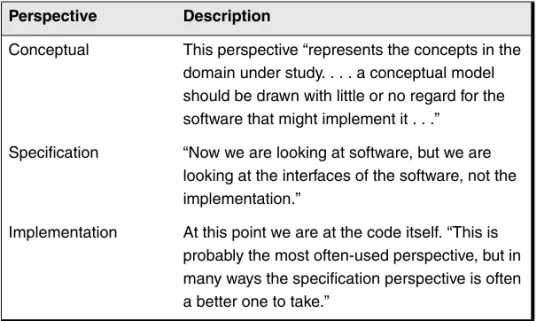
To fully understand the implications of this, it’s important to estab-lish some terminology. In UML Distilled, Martin Fowler describes three different perspectives in the software development process.3 These are described in Table 1-1.
3. Fowler, M., Scott, K., UML Distilled: A Brief Guide to the Standard Object Modeling Language, 2nd Edition, Reading, Mass.: Addison-Wesley, 1999, pp. 51–52. Table 1-1 Perspectives in the Software Development Process
Perspective Description
Conceptual This perspective “represents the concepts in the domain under study. . . . a conceptual model should be drawn with little or no regard for the software that might implement it . . .”
Specification “Now we are looking at software, but we are looking at the interfaces of the software, not the implementation.”
Implementation At this point we are at the code itself. “This is probably the most often-used perspective, but in many ways the specification perspective is often a better one to take.”
14 Part I • An Introduction to Object-Oriented Software Development
How perspectives help
Look again at the previous example of “Go to your next class.” Notice that you—as the instructor—are communicating with the people at the conceptuallevel. In other words, you are telling people what you want, not how to do it. However, the way they go to their next class is very specific. They are following specific instructions and in doing so are working at the implementation level.
Communicating at one level (conceptually) while performing at another level (implementation) results in the requestor (the instructor) not knowing exactly what is happening, only knowing conceptually what is happening. This can be very powerful. Let’s see how to take these notions and write programs that take advan-tage of them.
The Object-Oriented Paradigm
Using objects shifts responsibility to a more local level
The object-oriented paradigm is centered on the concept of the object. Everything is focused on objects. I write code organized around objects, not functions.
What is an object? Objects have traditionally been defined as data with methods (the object-oriented term for functions). Unfortunately, this is a very limiting way of looking at objects. I will look at a better definition of objects shortly (and again in Chapter 8, “Expanding Our Horizons”). When I talk about the data of an object, these can be sim-ple things like numbers and character strings, or they can be other objects.
The advantage of using objects is that I can define things that are responsible for themselves. (See Table 1-2.) Objects inherently know what type they are. The data in an object allow it to know what state it is in and the code in the object allows it to function properly (that is, do what it is supposed to do).
Chapter 1 • The Object-Oriented Paradigm 15
In this case, the objects were identified by looking at the entities in the problem domain. I identified the responsibilities (or methods) for each object by looking at what these entities need to do. This is consistent with the technique of finding objects by looking for the nouns in the requirements and finding methods by looking for verbs. I find this technique to be quite limiting and will show a bet-ter way throughout the book. For now, it is a way to get us started.
How to think about objects
The best way to think about what an object is, is to think of it as something with responsibilities. A good design rule is that objects should be responsible for themselves and should have those responsibilities clearly defined. This is why I say one of the respon-sibilities of a student object is knowing how to go from one class-room to the next.
Or, taking Fowler’s perspective
I can also look at objects using the framework of Fowler’s perspec-tives:
• At the conceptual level, an object is a set of responsibilities.4 Table 1-2 Objects and Their Responsibilities
This Object . . . Is Responsible For . . .
Student Knowing which classroom they are in
Knowing which classroom they are to go to next Going from one classroom to the next
Instructor Telling people to go to next classroom
Classroom Having a location
Direction giver Given two classrooms, giving directions from one classroom to the other
4. I am roughly paraphrasing Bertrand Meyer’s work of Design by Contract as out-lined in Object-Oriented Software Construction, Upper Saddle River, N.J.: Prentice Hall, 1997, p. 331.
16 Part I • An Introduction to Object-Oriented Software Development
• At the specification level, an object is a set of methods that can be invoked by other objects or by itself.
• At the implementation level, an object is code and data.
Unfortunately, object-oriented design is often taught and talked about only at the implementation level—in terms of code and data—rather than at the conceptual or specification level. But there is great power in thinking about objects in these latter ways as well!
Objects have interfaces for other objects to use
Since objects have responsibilities and objects are responsible for themselves, there has to be a way to tell objects what to do. Remember that objects have data to tell the object about itself and methods to implement functionality. Many methods of an object will be identified as callable by other objects. The collection of these methods is called the object’s public interface.
For example, in the classroom example, I could write the Student
object with the method gotoNextClassroom(). I would not need to pass any parameters in because each student would be responsi-ble for itself. That is, it would know:
• What it needs to be able to move
• How to get any additional information it needs to perform this task
Organizing objects around the class
Initially, there was only one kind of student—a regular student who goes from class to class. Note that there would be many of these “regular students” in my classroom (my system). But what if I want to have more kinds of students? It seems inefficient for each student type to have its own set of methods to tell it what it can do, espe-cially for tasks that are common to all students.
A more efficient approach would be to have a set of methods associ-ated with all students that each one could use or tailor to their own
Chapter 1 • The Object-Oriented Paradigm 17
needs. I want to define a “general student” to contain the defini-tions of these common methods. Then, I can have all manner of specialized students, each of whom has to keep track of his or her own private information.
In object-oriented terms, this general student is called a class. A class is a definition of the behavior of an object. It contains a complete description of:
• The data elements the object contains
• The methods the object can do
• The way these data elements and methods can be accessed
Since the data elements an object contains can vary, each object of the same type may have different data but will have the same func-tionality (as defined in the methods).
Objects are
instances of classes
To get an object, I tell the program that I want a new object of this type (that is, the class that the object belongs to). This new object is called an instance of the class. Creating instances of a class is called
instantiation.
Working with objects in the example
Writing the “Go to the next classroom” example using an object-ori-ented approach is much simpler. The program would look like this:
1. Start the control program.
2. Instantiate the collection of students in the classroom.
3. Tell the collection to have the students go to their next class.
4. The collection tells each student to go to their next class.
5. Each student:
a. Finds where his next class is
b. Determines how to get there
18 Part I • An Introduction to Object-Oriented Software Development
c. Goes there
4. Done.
The need for an abstract type
This works fine until I need to add another student type, such as the graduate student.
I have a dilemma. It appears that I must allow any type of student into the collection (either regular or graduate student). The prob-lem facing me is how do I want the collection to refer to its constit-uents? Since I am talking about implementing this in code, the collection will actually be an array or something of some type of object. If the collection were named something like,
Regular-Students, then I would not be able to put GraduateStudents
into the collection. If I say that the collection is just a group of objects, how can I be sure that I do not include the wrong type of object (that is, something that doesn’t do “Go to your next class”)?
The solution is straightforward. I need a general type that encom-passes more than one specific type. In this case, I want a Student
type that includes both RegularStudents and
GraduateStu-dents. In object-oriented terms, we call Student an abstract class.
Abstract classes define what a set of classes can do
Abstract classes define what other, related, classes can do. These “other” classes are classes that represent a particular type of related behavior. Such a class is often called a concrete class because it repre-sents a specific, or nonchanging, implementation of a concept.
In the example, the abstract class is Student. There are two types of Students represented by the concrete classes,
Regular-Students and GraduateStudents. RegularStudent is one kind of Student and GraduateStudent is also a kind of Student.
This type of relationship is called an is-a relationship, which is for-mally called inheritance. Thus, the RegularStudent class inherits from Student. Other ways to say this would be, the
Graduate-Student derives from,specializes, or is a subclassofStudent.
Chapter 1 • The Object-Oriented Paradigm 19
Going the other way, “the Student class is the base class, generalizes,
or is the superclass ofGraduateStudent and of RegularStudent.
Abstract classes act as placeholders for other classes
Abstract classes act as placeholders for other classes. I use them to define the methods their derived classes must implement. Abstract classes can also contain common methods that can be used by all der-ivations. Whether a derived class uses the default behavior or replaces it with its own variation is up to the derivation (this is con-sistent with the mandate that objects be responsible for themselves).
This means that I can have the controller contain Students. The reference type used will be Student. The compiler can check that anything referred to by this Student reference is, in fact, a kind of
Student. This gives the best of both worlds:
• The collection only needs to deal with Students (thereby allowing the instructor object just to deal with students).
• Yet, I still get type checking (only Students that can “Go to their next classroom” are included).
• And, each kind of Student is left to implement its functionality in its own way.
Abstract classes are more than classes that do not get instantiated.
Abstract classes are often described as classes that do not get instantiated. This definition is accurate—at the implementation level. But that is too limited. It is more helpful to define abstract classes at the conceptual level. Thus, at the conceptual level, abstract classes are simply placeholders for other classes.
That is, they give us a way to assign a name to a set of related classes. This lets us treat this set as one concept.
In the object-oriented paradigm, you must constantly think about your problem from all three levels of perspective.
20 Part I • An Introduction to Object-Oriented Software Development
Visibility Since the objects are responsible for themselves, there are many things they do not need to expose to other objects. Earlier, I men-tioned the concept of the public interface—those methods that are accessible by other objects. In object-oriented systems, the main types of accessibility are:
• Public—Anything can see it.
• Protected—Only objects of this class and derived classes can see it.
• Private—Only objects from this class can see it.
Encapsulation This leads to the concept of encapsulation. Encapsulation has often been described simply as hiding data. Objects generally do not expose their internal data members to the outside world (that is, their visibility is protected or private).
But encapsulation refers to more than hiding data. In general, encapsulation means any kind of hiding.
In the example, the instructor did not know which were the regular students and which were the graduate students. The type of student is hidden from the instructor (I am encapsulating the type of stu-dent). As you will see later in the book, this is a very important concept.
Polymorphism Another term to learn is polymorphism.
In object-oriented languages, we often refer to objects with one type of reference that is an abstract class type. However, what we are actually referring to are specific instances of classes derived from their abstract classes.
Thus, when I tell the objects to do something conceptually through the abstract reference, I get different behavior, depending upon the specific type of derived object I have. Polymorphism derives from
poly (meaning many) and morph (meaning form). Thus, it means
Chapter 1 • The Object-Oriented Paradigm 21
many forms. This is an appropriate name because I have many differ-ent forms of behavior for the same call.
In the example, the instructor tells the students to “Go to your next classroom.” However, depending upon the type of student, they will exhibit different behavior (hence polymorphism).
Review of Object-Oriented Terminology
Term Description
Object An entity that has responsibilities. I implement these by writing a class (in code) that defines data members (the variables associated with the objects) and meth-ods (the functions associated with the objects).
Class The repository of methods. Defines the data members of objects. Code is organized around the class.
Encapsulation Typically defined as data-hiding, but better thought of as any kind of hiding.
Inheritance Having one class be a special kind of another class. These specialized classes are called derivations of the base class (the initial class). The base class is some-times called the superclass while the derived classes are sometimes called the subclasses.
Instance A particular example of a class (it is always an object).
Instantiation The process of creating an instance of a class.
Polymorphism Being able to refer to different derivations of a class in the same way, but getting the behavior appropriate to the derived class being referred to.
Perspectives There are three different perspectives for looking at objects: conceptual, specification, and implementation. These distinctions are helpful in understanding the relationship between abstract classes and their deriva-tions. The abstract class defines how to solve things conceptually. It also gives the specification for commu-nicating with any object derived from it. Each derivation provides the specific implementation needed.
22 Part I • An Introduction to Object-Oriented Software Development
Object-Oriented Programming in Action
New example Let’s re-examine the shapes example discussed at the beginning of the chapter. How would I implement it in an object-oriented man-ner? Remember that it has to do the following:
1. Locate the list of shapes in the database.
2. Open up the list of shapes.
3. Sort the list according to some rules.
4. Display the individual shapes on the monitor.
To solve this in an object-oriented manner, I need to define the objects and the responsibilities they would have.
Using objects in the Shape program
The objects I would need are:
Class Responsibilities (Methods)
ShapeDataBase getCollection—get a specified collection of
shapes
Shape (an abstract class)
display—defines interface for Shapes
getX—return X location of Shape (used for sorting)
getY—return Y location of Shape (used for sorting)
Square (derived from Shape)
display—display a square (represented by this object)
Circle (derived from Shape)
display—display a circle (represented by this object)
Collection display—tell all contained shapes to display
sort—sort the collection of shapes
Display drawLine—draw a line on the screen
Chapter 1 • The Object-Oriented Paradigm 23
Running the program
The main program would now look like this:
1. Main program creates an instance of the database object.
2. Main program asks the database object to find the set of shapes I am interested in and to instantiate a collection object contain-ing all of the shapes (actually, it will instantiate circles and squares that the collection will hold).
3. Main program asks the collection to sort the shapes.
4. Main program asks the collection to display the shapes.
5. The collection asks each shape it contains to display itself.
6. Each shape displays itself (using the Display object) according to the type of shape I have.
Why this helps— handling new requirements
Let’s see how this helps to handle new requirements (remember, requirements always change). For example, consider the following new requirements:
• Add new kinds of shapes (such as a triangle). To introduce
a new kind of shape, only two steps are required:
– Create a new derivation of Shape that defines the shape. – In the new derivation, implement a version of the display
method that is appropriate for that shape.
• Change the sorting algorithm. To change the method for
sorting the shapes, only one step is required:
– Modify the method in Collection. Every shape will use the new algorithm.
Bottom line: The object-oriented approach has limited the impact of changing requirements.
24 Part I • An Introduction to Object-Oriented Software Development
Encapsulation revisited
There are several advantages to encapsulation. The fact that it hides things from the user directly implies the following:
• Using things is easier because the user does not need to worry about implementation issues.
• Implementations can be changed without worrying about the caller. (Since the caller didn’t know how it was implemented in the first place, there shouldn’t be any dependencies.)
• The insides of an object are unknown to outside objects—they are used by the object to help implement the function specified by the object’s interface.
Benefit:
reduced side effects
Finally, consider the problem of unwanted side effects that arise when functions are changed. This kind of bug is addressed effec-tively with encapsulation. The internals of objects are unknown to other objects. If I use encapsulation and follow the strategy that objects are responsible for themselves, then the only way to affect an object will be to call a method on that object. The object’s data and the way it implements its responsibilities are shielded from changes caused by other objects.
Special Object Methods
Creating and destroying
I have talked about methods that are called by other objects or pos-sibly used by an object itself. But what happens when objects are
Encapsulation saves us.
• The more I make my objects responsible for their own behaviors, the less the controlling programs have to be responsible for.
• Encapsulation makes changes to an object’s internal behavior transparent to other objects.
• Encapsulation helps to prevent unwanted side effects.
Chapter 1 • The Object-Oriented Paradigm 25
created? What happens when they go away? If objects are self-contained units, then it would be a good idea to have methods to handle these situations.
These special methods do, in fact, exist and are called constructors
and destructors.
Constructors initialize, or set up, an object
A constructor is a special method that is automatically called when the object is created. Its purpose is to handle starting up the object. This is part of an object’s mandate to be responsible for itself. The constructor is the natural place to do initializations, set default information, set up relationships with other objects, or do anything else that is needed to make a well-defined object. All object-ori-ented languages look for a constructor method and execute it when the object is created.
By using constructors properly it is easier to eliminate (or at least minimize) uninitialized variables. This type of error usually occurs from carelessness on the part of the developer. By having a set, con-sistent place for all initializations throughout your code (that is, the constructors of your objects) it is easier to ensure that initializations take place. Errors caused by uninitialized variables are easy to fix but hard to find, so this convention (with the automatic calling of the constructor) can increase the efficiency of programmers.
Destructors clean up an object when it is no longer needed (when it has been deleted)
A destructor is a special method that helps an object clean up after itself when the object goes out of existence; that is, when the object is destroyed. All object-oriented languages look for a destructor method and execute it when the object is being deleted. As with the constructor, the use of the destructor is part of the object’s mandate to be responsible for itself.
Destructors are typically used for releasing resources when objects are no longer needed. Since Java has garbage collection (auto-cleanup of objects no longer in use), destructors are not as important
26 Part I • An Introduction to Object-Oriented Software Development
in Java as they are in C++. In C++, it is common for an object’s destructor also to destroy other objects that are used only by this object.
Summary
In this chapter In this chapter, I have shown how object orientation helps us mini-mize consequences of shifting requirements on a system and how it contrasts with functional decomposition.
I covered a number of the essential concepts in object-oriented pro-gramming and have introduced and described the primary termi-nology. These are essential to understanding the concepts in the rest of this book. (See Tables 1-3 and 1-4.)
Table 1-3 Object-Oriented Concepts
Concept Review
Functional decomposition
Structured programmers usually approach program design with functional decomposition. Functional decomposition is the method of breaking down a problem into smaller and smaller functions. Each function is subdivided until it is manageable.
Changing requirements
Changing requirements are inherent to the development process. Rather than blaming users or ourselves about the seemingly impossible task of getting good and complete requirements, we should use development methods that deal with changing requirements more effectively.
Objects Objects are defined by their responsibilities. Objects simplify the tasks of programs that use them by being responsible for themselves.
Constructors and destructors
An object has special methods that are called when it is created and deleted. These special methods are:
• Constructors, which initialize or set up an object. • Destructors, which clean up an object when it is deleted.
All object-oriented languages use constructors and destructors to help manage objects.
Chapter 1 • The Object-Oriented Paradigm 27
Table 1-4 Object-Oriented Terminology
Term Definition
Abstract class Defines the methods and common attributes of a set of classes that are conceptually similar. Abstract classes are never instantiated.
Attribute Data associated with an object (also called a data member).
Class Blueprint of an object—defines the methods and data of an object of its type.
Constructor Special method that is invoked when an object is created.
Encapsulation Any kind of hiding. Objects encapsulate their data. Abstract classes encapsulate their derived concrete classes.
Derived class A class that is specialized from a superclass. Contains all of the attributes and methods of the superclass but may also contain other attributes or dif-ferent method implementations.
Destructor Special method that is invoked when an object is deleted.
Functional decomposition
A method of analysis in which a problem is broken into smaller and smaller functions.
Inheritance The way that a class is specialized, used to relate derived classes from their abstractions.
Instance A particular object of a class.
Instantiation The process of creating an instance of a class.
Member Either data or method of a class.
Method Functions that are associated with an object.
Object An entity with responsibilities. A special, self-contained holder of both data and methods that operate on that data. An object’s data are protected from external objects.
Polymorphism The ability of related objects to implement methods that are specialized to their type.
Superclass A class from which other classes are derived. Contains the master defini-tions of attributes and methods that all derived classes will use (and possi-bly will override).
CHAPTER
2
The UML— The Unified
Modeling Language
Overview
This chapter gives a brief overview of the Unified Modeling Language (UML), which is the modeling language of the object-oriented com-munity. If you do not already know the UML, this chapter will give you the minimal understanding you will need to be able to read the diagrams contained in this book.
In this chapter,
•I describe what the UML is and why to use it.
•I discuss the UML diagrams that are essential to this book:
- The Class Diagram
- The Interaction Diagram
In this chapter
What Is the UML?
The UML is a visual language (meaning a drawing notation with semantics) used to create models of programs. By models of pro-grams, I mean a diagrammatic representation of the programs in which one can see the relationships between the objects in the code.
The UML has several different diagrams — some for analysis, others for design, and still others for implementation (or more accurately,
3O Part I • An Introduction to Object-Oriented Software Development
for the dissemination, that is, the distribution of the code) (see Table 2-1). Each diagram shows the relationships among the different sets of entities, depending upon the purpose of the diagram.
Table 2 -1 UML Diagrams and Their Purposes
When You Are... Use the UML Diagram...
In the analysis phase
Looking at object
interactions
In the design phase
Looking at an object's
behaviors that differ based upon the state that the object is in
In the deployment phase
Use Case Diagrams, which involve entities interacting with the system (say, users and other systems) and the function points that I need to implement.
Activity Diagrams, which focus on workflow of the problem domain (the actual space where people and other agents are working, the sub-ject area of the program) rather than the logic flow of the program.
Note: Since this book is principally focused on design, I will not cover Use Case Diagrams or Activity Diagrams here.
Interaction Diagrams, which show how specific objects interact with each other. Since they deal with specific cases rather than general situations, they are helpful both when checking
requirements and when checking designs. The most popular kind of Interaction Diagram is the Sequence Diagram.
Class Diagrams, which detail the relationships between the classes.
State Diagrams, which detail the different states an object may be in as well as the transitions between these states.
Chapter 2 • The UML— The Unified Modeling Language 31
Why Use the UML?
The UML is used primarily for communication— with myself, my Principally for team members, and with my customers. Poor requirements (either communications incomplete or inaccurate) are ubiquitous in the field of software
development. The UML gives us tools to gather better requirements.
The UML gives a way to determine if my understanding of the sys- tern is the same as others'. Because systems are complex and have different types of information that must be conveyed, it offers dif-ferent diagrams specializing in the difdif-ferent types of information.
One easy way to see the value of the UML is to recall your last sev- eral design reviews. If you have ever been in a review where some-one starts talking about their code and describes it without a modeling language like the UML, almost certainly their talk was both confusing as well as being much longer than necessary. The UML is not only a better way of describing object-oriented designs, it also forces the designer to think through his or her approach (since it must be written down).
The Class Diagram
The most basic of UML diagrams is the Class Diagram. It both The basic modeling describes classes and shows the relationships between them. The diagram
types of relationships that are possible are
•When one class is a "kind of" another class: the is-a relationship
•When there are associations between two classes
- One class "contains" another class: the has-a relationship
- One class "uses" another class
For clarity
32 Part I • An Introduction to Object-Oriented Software Development
There are variations on these themes. For example, to say some-thing contains somesome-thing else can mean that
•The contained item is a part of the containing item (like an engine in a car).
•I have a collection of things that can exist on their own (like airplanes at an airport).
The first example is called composition while the second is called aggregation.1
Different ways of showing class information
Figure 2-1 illustrates several important things. First, each rectangle represents a class. In the UML, I can represent up to three things in a class:
•The name of the class
•The data members of the class
•The methods (functions) of the class
Figure 2 -1 The Class Diagram — its three variations.
I have three different ways of showing these.
• The leftmost rectangle shows just the class' name. I would use this type of class representation when more detailed information is not needed.
Chapter 2 • The UML— The Unified Modeling Language 33
•The middle rectangle shows both the name and the methods of the class. In this case, the Square2 has the method display. The plus sign (+) in front of display (the name of the method) means that this method is public — that is, objects other than objects of this class can call it.
•The rightmost rectangle shows what I had before (the name and methods of the class) as well as data members of the class. In this case, the minus sign (-) before the data member length (which is of type double) indicates that this data member's value is private, that is it is unavailable to anything other than the object to which it belongs.3
UML notation for access.
You can control the accessibility of a class' data and method members. You can use the UML to notate which accessibility you want each member to have. The three types of accessibility avail-able in most object-oriented languages are as follows:
• Public: notated with a plus sign (+).
This means all objects can access this data or method.
• Protected: notated with a pound sign (#).
This means only this class and all of its derivations (including derivations from its derivations) can access this data or method.
• Private: notated with a minus sign (-).
This means that only methods of this class can access this data or method. (Note: Some languages further restrict this to the particular object.)
2. Whenever we refer to a class name, we will bold it as done here.
34 Part I • An Introduction to Object-Oriented Software Development
Class Diagrams also show relationships
Class Diagrams can also show relationships between different classes. Figure 2-2 shows the relationship between the Shape class and several classes that derive from it.
Figure 2-2 The Class Diagram showing the is-a relationships.
Showing the is-a relationship
Figure 2-2 represents several things. First, the arrowhead under the Shape class means that those classes poin ting to Shape derive from Shape. Furthermore, since Shape is italicized that means it is an abstract class. An abstract class is a class that is used to define an interface for the classes that derive from it.
Showing the has -a relationship
There are actually two different kinds of has-a relationships. One object can have another object where the contained object is a part of the containing object— or not. In Figure 2-3, I show Airports "having" Aircraft. Aircraft are not part of Airports, but I can still say the Airport has them. This type of relationship is called
aggregation.