FORMULATION OF KETACONAZOLE LOADED FAST
DISINTEGRANT TABLET:
IN- VITRO
EVALUATION STUDY
Sachin Shinde*, Gharge Varsha, Bhandwalkar Omkar, Bhandare Pooja, Dadas Tushar,
Gadhave Jayant
Gourishankar Institute of Pharmaceutical Education & Research, Limb, Satara, Maharashtra,
India.
ABSTRACT
The main objective of the present investigation was to In- Vitro
evaluation of ketaconazole tablet formulation of fast disintegrant
tablet. Ketoconazole was used the treatment of oral thrushes and
systemic infections. The tablets of the ketaconazole were prepared by
direct compression technique. Among the different routes of
administration, the oral route of administration continues to be the
most preferred route. Due to various advantages including ease of
ingestion, avoidance of pain, versatility and most importantly patient
compliance. Recently fast dissolving tablets have started gaining
popularity and acceptance as a drug delivery system, mainly because
they are easy to administer and lead to better In Novel Drug Delivery System (NDDS) aim
for designing forms, convenient to be manufactured and administered free side effects,
offering immediate release and enhanced bioavailability. The prepared tablets evaluated in
terms of their pre-compression studies, post-compression studies and in vitro study. The
Disintegration study and In-vitro study showed that formulation of batch F7gives better result than the other batches.
KEYWORDS: Ketoconazole, sodium starch glycolate, enhanced bioavailability,
Disintegration study, and In vitro study.
INTRODUCTION
Drug delivery refers to approaches, formulations, technologies, and systems for transporting a
pharmaceutical compound in the body as needed to safely achieve its desired therapeutic
effect. Oral delivery is the gold standard in the pharmaceutical industry where it is safest,
Volume 7, Issue 16, 668-678. Research Article ISSN 2277– 7105
Article Received on 22 June 2018,
Revised on 11 July 2018, Accepted on 01 August 2018
DOI: 10.20959/wjpr201816-12916
*Corresponding Author
Shinde Sachin
Gourishankar Institute of
Pharmaceutical Education &
Research, Limb, Satara,
most convenient and most useful method of drug delivery having the major patient
fulfillment. Some tablets are intended to melt in saliva remarkably quickly, within a few
seconds, and these are fast-dissolving tablets. Fast dissolving tablets dissolve quickly in the
mouth saliva without the of water. Others contain agents to improve the rate of disintegration
in the oral cavity, and are more properly termed fast disintegrating tablets, as they may take
up to a minute to completely fall to pieces.[1]
„Fast Dissolve‟, „Quick Dissolve‟, „Rapid Melt‟, „Quick Disintegrating‟, ‟Mouth Dissolving‟, „Orally Disintegrating‟, „Oro Dispersible‟, „Melt-In-Mouth‟, etc. are terms that represent the
same drug delivery system. Recently orally disintegrating (OD) tablet technology has been
approved by United States Pharmacopoeia (USP), Center for Drug Evaluation and Research
(CDER). USFDA defined OD tablet as “a solid dosage form containing medical substances,
which disintegrates rapidly, usually within a matter of seconds, when placed upon the
tongue”. Recently European pharmacopoeia also adopted the term “oro-dispersible tablets” as
a tablet that is to be placed in the mouth where it disperses rapidly before swallowing.[2]
The dosage forms dissolve or disintegrate in the patient‟s mouth within 15 seconds to 3
minutes without the need of water or chewing. Despite various terminologies used;
oro-dispersible tablets are here to offer unique form of drug delivery with many advantages over
the conventional oral solid dosage forms.[3] The proper choice of Superdisintegrants and its
consistency of performance are of critical importance to the formulation development of such
tablets. In more recent years, increasing attention has been paid to formulating not only fast
dissolving and/or disintegrating tablets that are swallowed, but also orally disintegrating
tablets that are intended to dissolve and/or disintegrate rapidly in water and to be
swallowed.[4] Superdisintegrants are more effective at lower concentrations with greater
Disintegrating efficiency and mechanical strength. On contact with water the
superdisintegrants swell, hydrate, change volume or form and produce a disruptive change in
the tablet.[5] Effective superdisintegrants provide improved compatibility and have no
negative impact on the mechanical strength of formulations containing high dose drugs, some
commonly used superdisintegrants are cross linked carboxyl methyl cellulose
(Croscarmellose), sodium starch glycolate, polyvinylpyrroli done etc.[6] In the present
investigation prepared tablets evaluated in terms of their pre-compression studies,
MATERIALS AND METHOD
Materials
Ketaconazole was obtained from Alembic Pvt. Ltd; Vadodara. sodium starch glycolate,
microcrystalline cellulose and Avicel PH 102 were a Gift sample from Loba Chemic
Mumbai. All other chemicals and ingredients were used for study are of Analytical grade.
Methods[13, 14,15,16,17]
The composition of different formulations of Ketoconazole, fast disintegrant tablets is shown
in Table No.1. Different tablet formulations were prepared by direct compression technique.
All the powders passed through 40/60 mesh sieve. The required quantity of pure drug,
various polymers and other ingredients were mixed thoroughly. Talc and magnesium stearate
were finally added as a glidant and lubricant respectively. The blend was directly compressed
by KBr Press Each tablet containing 100 mg of pure Ketoconazole.
Evaluation Parameters
Pre-formulation Studies
Fourier Transform Infrared Spectroscopy[18]
The fourier transform infra-red analysis was conducted for the structure characterization.
FTIR spectra of the pure drug Ketoconazole, Approximately 5mg of samples were mixed
with 50mg of spectroscopic grade KBr, samples were scanned in the IR range from 500 to
3500 cm-1, with a resolution of 4 cm-1.
Pre-compression studies of fast disintegrant tablet granules
Bulk density[19]
It is ratio of total mass of powder to the bulk volume of powder. It was measured by pouring
the weighed powder into a measuring cylinder and volume was noted as bulk density (Db).
It expressed in gm/cc and is given by: Db =M/Vb
Where, M= is the mass of powder.
Vb= is the bulk volume of powder.
Tapped Density[19]
It is the ratio of total mass of powdered to the tapped volume of powder. The tapped volume
was measured by tapping the powder to a constant volume.
Where, M= is the mass of powder.
Vt = is the tapped volume of the powder.
Hauser Ratio[20]
Hausner Ratio is an indirect index of ease of powder flow. It is calculated by the following
formula.
Hausner Ratio =Dt/Db
Where, Dt = Tapped density.
Db = Bulk density.
Hausner Ratio value of powder show in table.
Swelling index[21]
The study was carried out using a 100 ml stoppered graduated cylinder. The initial bulk
volume of 1 gm of starch was noted water was added in sufficient quantity of water to
produce 100 ml of a uniform dispersion and was stored at room temperature and the sediment
volume of the swollen mass was measured after 24 hour.
Carr’s index (I)[21]
It indicates the ease with which a material can be induced to flow. It is expressed as a
percentage and is given by.
Carr’s index (%) = (Tapped density –Pour density)/Tapped densityX100 Carr‟s index values of powder show in table.
Angle of repose (θ)[22]
The frictional force in a loose powder can be measured by the angle of repose. It is defined as
maximum angle possible between the freely sliding surface of a pile of powder and the
horizontal plane.
tanθ =tan-1
(h/r)
Where, θ = is the angle of repose
h=is the height
r =is the radius
Post-compression studies Ketoconazole, fast disintegrant tablets
Hardness or Crushing strength Test[22]
Hardness of the tablet was determined using the Monsanto hardness tester (The lower plunger
was placed in contact with the tablet and a zero reading was taken. The plunger was then
forced against a spring by tuning a threaded bolt until the tablet fractured. As the spring was
compressed a pointer rides along a gauge in the barrel to indicate the force. The force
required to break the tablet is measured in kilograms and a crushing strength of 4Kg is
usually considered to be the minimum for satisfactory tablets. Oral tablets normally have a
hardness of 4 to 10 kg; however, hypodermic and chewable tablets have a hardness of 3 kg
and some sustained release tablets have a hardness of 10-20 kg5.
Thickness Test[23]
The thickness of the tablet is mostly related to the tablet hardness can be uses as initial
control parameter. Ten tablets were randomly selected from each tablet thickness was
determined using a Vernier calliper and the reading was recorded in millimeters.
Friability Test[24]
The pre-weighed tablets were placed in the friabilator (EF-2, Electro lab, Mumbai) which
was then operated for 100rpm, then dusted and reweighed. The Conventional compressed
tablets that lose less than 0.5-1.0% of their weight are generally considered acceptable.
Friability index =I-F/IX 100.
Where,
I - Initial weight, F - Final weight.
Weight variation test[24]
Weights of 20 individual tablets were noted and their mean weight also calculated. The
percentage deviation was calculated by using the following formula,
Percentage deviation = [X-X*/ X] × 100
X - Actual weight of the tablet,
X*- Average weight of the tablet.
Estimation of Drug Content[25]
An accurately weighed amount of powdered Aceclofenac (100 mg) was extracted with water
and the solution was filtered through 0.45 μ membrane filter paper. The absorbance was
Calculation
The amount of Aceclofenac present in tablet can be calculated using the formula
At/As x Sw/100 x 100.
Where,
At = Absorbance of sample preparation,
As = Absorbance of Standard preparation,
Sw = weight at Aceclofenac working standard (mg)
In vitro Drug Release Studies[26,27,28]
The in vitro drug release study was carried out for 24 hours using USP paddle type dissolution test apparatus in phosphate buffer (pH 6.8) at 75 rpm maintaining temperature at
37±0.50c. A 10ml of samples were collected from each vessel at 0, 2, 4, 8, 12, 16 and 24
hours and analyzed by UV spectrophotometer at 275 nm. The withdrawn sample was
immediately replaced by equal volume of fresh buffer. The dissolution data obtained were
plotted as percentage drug release versus time.
7) In Vitro Disintegration[29, 30, 31, 32]
Six tablets of each formulation were used to determine disintegration time. Phosphate buffer
(pH 6.8) was used as a disintegration medium and temperature was maintained 37±0.5 0
C.
Average disintegration time of six tablets was determined. Phosphate buffer Media volume
900 ml.
RESULTS AND DISCUSSION
Table No.1: Formulation of different batches of Ketoconazole Fast Disintegrant Tablets.
(mg/tab).
Ingredients F1 F2 F3 F4 F5 F6 F7 F8 F9
Ketoconazole 100 100 100 100 100 100 100 100 100 Sodium starch Glycolate 5 10 15 20 25 30 35 40 45 Microcrystalline cellulose 324 319 314 309 304 299 294 289 284
Talc 3 3 3 3 3 3 3 3 3
Magneshium stearate 5 5 5 5 5 5 5 5 5
Aspartame 3 3 3 3 3 3 3 3 3
Table No.2: Angle of Repose I.P limits.
Angle of repose Flow property
25-30 Excellent
31-35 God
36-40 Fair 41-45 Passable
46-55 Poor
56-65 Very Poor >66 Very, Very Poor
Table No.3: Carr’s Index I.P limits.
Carr’s index (%) Type of flow
5-15 Excellent
12-18 Good
18-23 Fair to passable
23-35 Poor
35-38 Very poor >40 Extremely poor
Table No.4: Hausner’s Ratio I.P Limits.
Hausner’s Ratio Type of flow
<1.25 Good 1.25-1.5 Moderate
[image:7.595.46.554.593.771.2]>1.5 Poor
Table No.5: Pre-compression studies of Ketoconazole Fast Disintegrant granules
Properties F1 F2 F3 F4 F5 F6 F7 F8 F9
Bulk Density 0.576 0.434 0.666 0.476 0..421 0.325 0.525 0.485 5685 Tapped Density 0.425 0.555 0.833 0.625 0.523 0.325 0.425 0.654 0.632 Hausner‟s Ratio 1.512 1.271 1.250 1.312 1.498 1.458 1.428 1.421 1.625 % Carr‟s Index 23.520 21.746 20.004 23.824 22.522 25.458 24.231 24.333 25.532 Angle Of Repose 27.580 25.590 28.300 28.750 29.032 27.151 26.120 28.542 29.231
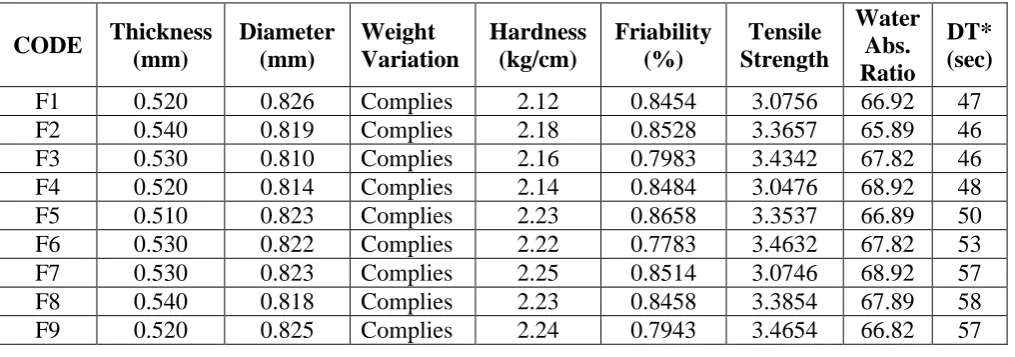
Table No.6: Post-compression studies of Ketoconazole Fast Disintegrant Tablets
CODE Thickness
(mm) Diameter (mm) Weight Variation Hardness (kg/cm) Friability (%) Tensile Strength Water Abs. Ratio DT* (sec)
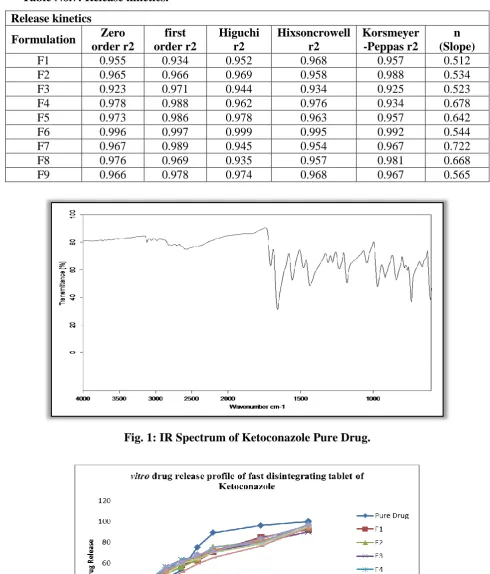
Table No.7: Release kinetics.
Release kinetics
Formulation Zero
order r2
first order r2
Higuchi r2
Hixsoncrowell r2
Korsmeyer -Peppas r2
n (Slope)
F1 0.955 0.934 0.952 0.968 0.957 0.512
F2 0.965 0.966 0.969 0.958 0.988 0.534
F3 0.923 0.971 0.944 0.934 0.925 0.523
F4 0.978 0.988 0.962 0.976 0.934 0.678
F5 0.973 0.986 0.978 0.963 0.957 0.642
F6 0.996 0.997 0.999 0.995 0.992 0.544
F7 0.967 0.989 0.945 0.954 0.967 0.722
F8 0.976 0.969 0.935 0.957 0.981 0.668
[image:8.595.50.541.82.657.2]F9 0.966 0.978 0.974 0.968 0.967 0.565
CONCLUSION
The Fast disintegrating tablets of Ketoconazole were successfully formulated by direct
compression technique. The Fast disintegrating tablets of Ketoconazole containing synthetic
superdisintegrant showed satisfactory results more than 60min and the drug release of sodium
starch glycolate has better release of drug when it is compared to other.
ACKNOWLEDGEMENT
The authors are sincerely thanks to the Gourishankar Institute of Pharmaceutical Education &
Research, Limb, Satara, India for providing the facilities to complete this research work.
BIBLIOGRAPHY
1. Gharge VG, Comparative Evaluation Of Disintegtrant Properties In Nimesulide Tablet
Formulation By Using Natural And Synthetic Superdisintegrant, International Journal of
Research in Pharmaceutical and Nano Sciences, 2017; 6(1): 1-9.
2. Swamy N, Sachin N, Abbas Z. Design and Characterization of Oral Dispersible Tablets
of Enalapril Maleate Using a Co-Processed Excipient, Journal of Applied Pharmaceutical
Science, 2012; 2(11): 040-049.
3. Divya L., Ravichandiran V., Lavakumar V., Sowmya C., Venkateshan N., Niranjan M.
Preparation and Evaluation of Fluoxeitine Hydrochloride Oral Dispersible Tablets, Int J
Pharm Pharm Sci, 2014; 6(2): 216-222.
4. Venkateswara B., Theja N., Navaneetha K. Formulation And Evaluation Of Dispersible
Tablets Of Olmesartan Medoxomil, ejbps, 2015; 2(1): 250-260.
5. Mohanachandran P., Sindhumol P., Kiran T. SUPERDISINTEGRANTS: AN
OVERVIEW, International Journal of Pharmaceutical Sciences Review and Research,
2011; 6(1): 105-109.
6. Vikas S., Vandana A., Chanda R. Use Of Natural Superdisintegrant In Mouth Dissolving
Tablet- An Emerging Trend, International Bulletin of Drug Research, 2011; 1(2): 46-54.
7. Piyush G, H. P. Sachdev. Safety of oral use of nimesulide in children, systemic review of randomized controlled trials. Indian Pediatr, 2003; 17: 518‐31.
8. Shangraw R., Vol. 4, 2nd Ed., Marcel Dekker, Newyork USA, 1988; 85.
9. Armstrong N., Pharm. Technol. Eur, 1989; 9: 24.
10.Jivraj M., L. Martini G. Thomson C., PSTT, 2000; 3: 58.
11.Rubinstein M. Churchill U, 1998; 304.
13.Jain C, Naruka P., Formulation And Evaluation of Fast Dissolving Tablets Of Valsartan,
International Journal of Pharmacy and Pharmaceutical Sciences, 2009; 1(1): 219-226.
14.Ehsan A, Dr. Shaimaa N. Abd Al Hammid. Formulation and Evaluation of Rosuvastatin
Orodispersible Tablets, International Journal of Pharmacy and Pharmaceutical Sciences,
2013; 5(2): 339-346.
15.Khinchi M, Gupta M, Bhandari A, Sharma N, Agarwal D. Design and development of
Orally Disintegrating Tablets of Famotidine Prepared by Direct Compression Method
Using Different Superdisintegrants, Journal of Applied Pharmaceutical Science, 2011;
01(01): 50-58.
16.Leela M, Ramana G, Digpati R. Formulation and Evaluation of Oral disintegrated tablets
of Alfuzosin Hydrochloride using superdisintegrants, Journal of Applied Pharmaceutical
Science, 2011; 01(09): 161-165.
17.Priyanka N, Kusum S, Iti C, Madhu V, Mohd Y, Azad K, Rajat S, Nandini G. Orally
disintegrating tablets: formulation, preparation techniques and evaluation, Journal of
Applied Pharmaceutical Science, 2011; 01(04): 35-45.
18.Omaima A, Mohammed A., Nagia A., Ahmed S. Formulation and Optimization of Mouth
Dissolve Tablets Containing Rofecoxib Solid Dispersion, AAPS Pharm Sci Tech, 2006; 7(2): E1-E9.
19.Kumar V, Ajaykumar B. Formulation and evaluation of rapid disintegration tablets of
moxifloxacin HCl, Scholars Research Library, 2013; 5(1): 238-250.
20.Sandeep D., Sri Lakshmi I., Umamaheswara R. Formulation and Evaluation Of Fast
Disintegrating Piroxicam Tablets, International Journal of Research in Pharmaceutical and Nano Sciences, 2013; 2(6): 714-722.
21.Ravi K, Swati P. Formulation Evaluation of Mouth Dissolving Tablets of Fenofibrate
Using Sublimation Technique, International Journal of Chem Tech Research, 2009; 1(4): 840-850.
22.Kalpesh G, Lalit T., Kori M., Sharmab C., Nemac R. Formulation and Characterization of
Fast Disintegrating Tablet of Aceclofenac by using Sublimation Method, International Journal of Pharmaceutical Sciences and Drug Research, 2011; 3(1): 19-22.
23.Anmol E, Nidhi P, Smit C, Hitesh J, Umesh U. Effect Of Mode Of Addition Of
Superdisintegrants On Fast Dissolving Tablet Of Diclofenac Sodium, Mintage journal of Pharmaceutical & Medical Sciences, 2015; 4(3): 4-8.
25.Sunitha H, Parthiban S., Vikneshwiri A, Senthil G, Tamiz M. Development And
Evaluation Of Captopril Fast Disintegrating Or Dissolving Tablets By Complexation
Techniques Using Guar Gum As A Superdisintegrant, International Journal of Research in Pharmaceutical and Nano Sciences, 2015; 4(2): 72-84.
26.Dr. Lakshmi C.S.R, Nitesh P, Hitesh P, Sagar A. Formulation And Evaluation Of Oral
Dispersible Tablets Of Cinnarizine Using Sublimation Technique, 2011; 6(2): 178-182.
27.Manju N, Loveleen K, Janita C, Pratima S. Dissolution Enhancement of Domperidone
Fast Disintegrating Tablet Using Modified Locust Bean Gum by Solid Dispersion
Technique, Journal of Pharmaceutical Technology, Research and Management, 2016; 4(1): 1–11.
28.Suhas S, Mahendra S. Development, characterization and optimization of fast-dissolve
tablets of Esomeprazole & Enalapril by using solid dispersion technique. Journal of Pharmacy Research, 2014; 8(9): 1326-1335.
29.Patil Pradeep S, More Akshata K., Kadam Sunil, Vishwasrao Vishal, Patel Yagnik,
Formulation And Evaluation Of Orodispersible Tablets Of Perindopril Erbumine Using
Natural Superdisintegrant, Journal of Drug Delivery & Therapeutics, 2013; 3(5): 44-48. 30.Akhila S, Ramyadevi D, B.N. Vedha H. Effect Of Impact And Attrition Milling On
Nimesulide For Solubility Enhancement, Int J App Pharm, 2013; 5(2): 1-7.
31.Khaled M, Ahmed K Seham S. Preparation and Evaluation of Orodispersible Tablets
Containing Hydroxylbutyl-β-Cyclodextrin-Simvastatin Solid Dispersion, Tropical Journal of Pharmaceutical Research, 2013; 12(4): 469-476.
32.Vijay B, Kiran T, Raj kumar D, Jithan A. Preparation and Evaluation of Orodispersable
Tablets of Carbamazepine using Different Superdisintegrating Agents, Int. J. PharmTech Res, 2014; 7(3): 438-447.
33.Gore Meghana, Gurav Yogesh and Gharge Varsha. Formulation and Evaluation of
Sustained Release Tablets of Propranolol Hydrochloride, World Journal of Pharmacy and
Pharmaceutical Sciences, 2017; 6(12): 521-529.
34.Mali Alpesh Mahadeo, Ghodake Ganesh, Gharge Varsha, “Enhancement Of
Bioavailability Of Ibuprofen By Using Solid Dispersion Technique”, European Journal of