50
ISSN: 2250 – 2688Received: 11/04/2016 Revised: 22/05/2016 Accepted: 12/06/2016
Bhawna Mishra, Rizwana Khan, Manish Rajoriya and Anil Kharia Modern Institute of Pharmaceutical Sciences
Alwasa, Behind Rewati Range, Sanwer Road, Indore (MP)-453111
Correspondence Bhawna Mishra
Modern Institute of Pharmaceutical Sciences
Alwasa, Behind Rewati Range, Sanwer Road, Indore (MP)-453111
E mail: [email protected]
Formulation and Evaluation of Fast Dissolving Tablet of
Glimepiride
Bhawna Mishra, Rizwana Khan, Manish Rajoriya and Anil Kharia
ABSTRACT
Glimepiride is a first third generation sulphonyl urea agent for the treatment type II diabetes mellitus. The main objective of present work was to formulate and evaluate fast dissolving tablet of glimepiride by using different concentration of super disintegrating agents. Glimepiride is given once daily in doses from 1-8 mg. The fast dissolving tablets of glimepiride was prepared from F1-F4 by direct compression method.The drug and excipients were evaluated for angle of repose, bulk density, tapped density, Carr’s index and hausner’s ratio for the determination of flow property of powder. The formulated tablets were evaluated for thickness, hardness, friability, wetting time, water absorption and dispersion time. The obtained results were clearly indicating that the formulated tablets results are within the range and when compared with all formulations, F4 was the best formulation among the four formulations.
Keywords: Glimepiride, Fast Dissolving Tablet, Direct Compression Method and super disintegrating agents
1. INTRODUCTION
Diabetes mellitus is a condition in which a person has a high blood sugar level, either because the body doesn’t produce enough insulin, or because body cells don’t properly respond to the insulin that is produced. Insulin is a hormone produced in the pancreas which enables body cells to absorb glucose, to turn into energy. If the body cells do not absorb the glucose, the glucose accumulates in the blood, leading to vascular, nerve, and other complications. Diabetes mellitus is mainly classified as four types. They are, Type -I, Type –II, Gestational diabetes, and other types of diabetes.
Glimepiride is the first III generation sulphonyl urea it is a very potent sulphonyl urea with long duration of action. It is practically insoluble in water, Soluble in dimethyl formamide, slightly soluble in methanol, sparingly soluble in methylene chloride. It also dissolves in dilute alkali and in dilute acids. Half life is Approximately 5 hours following single dose. Completely (100%) absorbed after oral administration. Over 99.5% bound to plasma protein1-6. Glimepiride is used with diet to lower blood glucose by increasing the secretion of insulin from pancreas andincreasing the sensitivity of peripheral tissues to insulin 7-8
. The mechanism of action of Glimepiride in lowering blood glucose appears to be dependent on stimulation the release of insulin from functioning pancreatic beta cells, and increasing sensitivity of peripheral tissues to insulin 9-12.
51
2. MATERIALS AND METHODS 2.1 Drug and chemicals used
Glimepiride was received as a gift sample from Ipca Laboratories Ltd, Ratlam and other excipients such as talc, sodium starch glycolate, lactose were obtained from the Modern Laboratories, Indore.
2.2 Method used
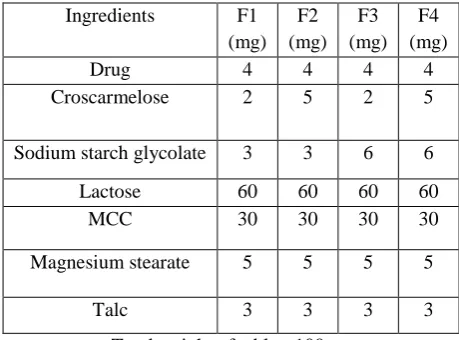
The Glimepiride tablets were formulated by Direct Compression Method (Table No 1).
2.3 Evaluation of Glimepiride Tablet by Pre compression
2.3.1 Bulk density (BD)
It is the ratio of total mass of powder to the bulk volume of powder. It was measured by pouring the weighed powder in to a measuring cylinder and the volume was noted. It is expressed in gm/ml is given by
BD = M/Vo
Where, M = The mass of powder, Vo = The bulk volume of powder
2.3.2 Tapped bulk density (TBD)
It is the ratio of total mass of powder of the tapped volume of powder. A quantity of 2 g of powder from formula, previously lightly shaken to break any agglomerates formed, was introduced into a 10 mL measuring cylinder. After the initial volume was observed, the cylinder was allowed to fall under its own weight onto a hard surface from the height of 2.5 cm at 2-second intervals. The tapping was continued until no further change in volume was noted. TBD were calculated using the following formulas,
TBD = M/Vt
Where, M = The mass of powder, Vt = The tapped volume of powder
2.3.3 Angle of repose (θ)
The frictional force in a loose powder can be measure by angle of repose (θ). This is the maximum angle responsible between the surface of a pile of powder and the horizontal plane is used to determine the flow property of granules.
The angle of repose of granules was determined by the funnel method. The accurately weighed granules were taken in a
funnel. The height of the funnel was adjusted in such a way that the tip of the funnel just touched the apex of the heap of the granules. The granules were allowed to flow through the funnel freely onto the surface. The diameter of the powder cone was measured and angle of repose was calculated using the following equation:
tan θ = h/r
θ = tan-1 (h/r)
Where, h = the height of the pile of powder, r = the radius of the pile of powder
2.4 Powder Flow Properties
2.4.1 Carr’s index (I)
The compressibility index of the granules was determined by Carr’s compressibility index
Carr’s index (%) = [(TBD – BD) *100]/TBD
Where,TBD = Tapped density of the powder, BD = Bulk density of the powder
2.4.2 Hausner’s Ratio
This value was calculated by making use of BD and TBD.
Hausner’s Ratio = TBD ⁄BD
Where, TBD = Tapped density of the powder, BD = Bulk density of the powder
Lower Hausner’s ratio (<1.25) indicates better flow properties than higher ones (>1.25).
2.5 Post compression parameters
2.5.1 Thickness
The dimensions of tablets are thickness and diameter. Thickness and diameter of a tablet were measured by venire caliper.
2.5.2 Hardness
52
2.5.3 Friability
Friability of the tablet was determined using Roche friabilator. Friability test was performed to assess the effect of friction and shock which may often cause tablets to chip, cap or break. Weighed tablets sample was placed in the chamber and the Roche friabilator was operated for 100 revolutions (at 25 rpm) and the tablets were then dusted and reweighed again. The tablets that losses less than 0.5-1.0 % of their weights are generally considered.
% F = {1-(Wt/W)} ×100
Where, % F = friability in percentage
W = Initial weight of tablet, Wt = weight of tablets after revolution
2.5.4 Wetting Time
Twice folded tissue paper was placed in a Petri dish having an internal diameter of 5 cm, containing 6 ml of water. A tablet was carefully placed on the surface of the tissue paper in the Petri dish. The time required for water to reach the upper surface of the tablet and to completely wet it was noted as the wetting time.
2.5.5 Water Absorption Ratio
Water absorption ratio (R) was determined according to the following equation:
R = 100 x (Wa – Wb)/ Wb
Where, Wb and Wa were tablet weights before and after water absorption, respectively.
2.5.6 Dispersion time
In vitro dispersion time was measured by dropping a tablet in a beaker containing 50 ml of distilled water. One tablet from each formulation was randomly selected and in vitro
dispersion time was performed.
3. RESULTS AND DISCUSSION
Result of all evaluation parameters of Glimepiride Fast Dissolving Tablet is summarised in Table No 2.
4. CONCLUSION
Fast dissolving tablets of Glimepiride was successfully prepared. Fast dissolving tablets were prepared by direct compression method. The method was employed to formulate tablets because of its cost effectiveness and due to less number of manufacturing steps. The formulation F-4 containing glimepiride
(4 mg), Croscarmelose (5 mg), sodium starch glycolate (6 mg), Microcrystalline cellulose (30mg), magnesium stearate (5 mg), talc (3 mg), lactose (60 mg) was selected as best formulation because it takes less dispersion time (2 min) Hence, Formulation F4 is the best formulation among the four formulations.
5.0 ACKNOWLEDGEMENTS
The authors wish to thank the management of Modern Institute of Pharmaceutical Sciences Indore for supporting this work. Authors wish to acknowledge the Ipca Laboratories Ltd Ratlam for providing the Glimepiride as gift sample and also wish to thanks colleagues& students of department of Pharmaceutics for their co-operation in carrying out this work.
REFERENCES
1. The Expert Committee on the Diagnosis and Classification of Diabetes Mellitus. Report of the Expert Committee on the Diagnosis and Classification of Diabetes Mellitus. Diabetes Care1997; 20: 1183–97. 2. Lieberman A. Herbert, Lachman Lion, Schwartz B. Joseph.
Pharmaceutica dosage forms: Tablets, CBS Publisher and Distributers New Delhi. 2005; 3: 200-214.
3. Ito A. and Sugihara M. Development of oral dosage form for elderly patients: use of agar as base of rapidly disintegrating oral tablets. Chem Pham Bull 2011; 11: 2132-2136.
4. Sunada H and Bi Y, Preparation, evaluation and optimization of rapidly disintegrating tablets. Powder Technology2012; 122: 188–198. 5. Jayesh P, Manish R. Tablet Formulation design and manufacture: Oral
immediate release application. Pharma times 2009; 4: 21-29 .
6. Narmada GY. Formulation, Evaluation and Optimization of Fast Dissolving Tablets Containing Amlodipine Besylateby Sublimation Method, ARS Pharmaceutica 1950; 3: 129-144.
7. Deepak S, Mankaran S, Dinesh K & Gurmeet S. Formulation Development and Evaluation of Fast Disintegrating Tablet of Cetirizine Hydrochloride: A Novel Drug Delivery for Paediatrics and Geriatrics Journal of Pharmaceutics 2014; 8-16.
53
Table No.1: Composition of glimepiride fast dissolving tablet
Ingredients F1 (mg)
F2 (mg)
F3 (mg)
F4 (mg)
Drug 4 4 4 4
Croscarmelose 2 5 2 5
Sodium starch glycolate 3 3 6 6
Lactose 60 60 60 60
MCC 30 30 30 30
Magnesium stearate 5 5 5 5
Talc 3 3 3 3
Total weight of tablet=100mg
Table No. 2: Evaluation Parameter of Glimepiride Fast Dissolving Tablet
S.NO Physical parameter F1 F2 F3 F4
1. Bulk density 0.575 0.547 0.588 0.499
2. Tapped density 0.862 0.875 0.981 0.898
3. Hausner’s ratio (%) 1.27 1.17 1.15 1.16
4. Carr’s index (%) 18 16 13 61
5. Angle of repose 38 37 32 33
6. Thickness (mm) 0.2 0.2 0.3 0.3
7. Hardness (kg/cm2) 1.2 1.2 1.3 1.3
8. Friability (%) 0.98 0.96 0.95 0.93
9. Wetting time (min) 20 18 15 10
10. Water Absorption Ratio 77.22 84.46 85.85 91.83
11. Dispersion Time(Min) 4 3.5 3 2
54
9. Shu T. Studies of rapidly disintegrating tablets in oral cavity usingcoground mixture of mannitol with crospovidone, Chem Pharm Bull 2002; 50:193-8.
10. Kuccherkar B. Mouth dissolving tablets: A novel drug delivery system. Pharma. Times 2013; 35: 3-10.
11. Fu Y, Yang S, Jeong SH, Kimura S, Park K. Orally fast disintegrating tablets: Developments, technologies, taste masking and clinical studies. Critical reviews in therapeutic drug carrier system2004; 21: 433-76. 12. Mizumoto T, Masuda Y et al. Formulation design of a novel fast
disintegrating tablet. International Journal of Pharmaceutics 2005; 306: 83-90.