FORMULATION, DEVELOPMENT AND EVALUATION OF
GASTRO-RETENTIVE FLOATING TABLETS OF LAFUTIDINE
*Revati Tatyasaheb Deore
Department of Pharmaceutics, Savitribai Phule University of Pune. K.B.H.S.S. Trust’s,
Institute of Pharmacy, Bhaygaon Road, Malegaon, Nasik(423105).
ABSTRACT
The purpose of present investigation was to develop and evaluate floating drug delivery system of Lafutidine; a novel H2 receptor antagonist. The floating tablets of Lafutidine were prepared by low density and effervescent technique using HPMC K15M, Bees wax, Carnuba wax and Cetyl alcohol polymers. The pre-compression and
post-compression evaluation were performed as per pharmacopoeial standards. The tablets were prepared by melt granulation method. Dissolution measurements were carried out in a (USP) dissolution testing apparatus II (Basket type). Compatibility study was performed by physical observation, FTIR. The compatibility study of the prepared Lafutidine floating tablets confirms that there is no interaction between the drug and polymers used. The release data were subjected to different models in order to evaluate their release kinetics and mechanisms. The drug release kinetics was observed by Non-fickian diffusion mechanism. The floating lag time were found to be significantly increased with the increasing concentration of the polymers. After the dissolution study of prepared Lafutidine floating tablet by low density and effervescent technique it was concluded that the formulation with Bees wax and Carnuba wax shows better sustained release effect. The release kinetic data implies that the release mechanism of all the formulations was Non-fickian. The developed floating tablets of Lafutidine may be used to prolong drug release for at least 12h, thereby improving the bioavaibility and patient compliance.
KEYWORDS: Floating Tablet, Bees Wax, Carnuba Wax, Cetyl Alcohol, Melt granulation.
Volume 7, Issue 18, 786-797. Research Article ISSN 2277– 7105
Article Received on 22 August 2018,
Revised on 12 Sept. 2018, Accepted on 02 October 2018
DOI: 10.20959/wjpr201818-13481
*Corresponding Author
Revati Tatyasaheb Deore
Department of
Pharmaceutics, Savitribai
Phule University of Pune. K.B.H.S.S. Trust’s, Institute
of Pharmacy, Bhaygaon
Road, Malegaon,
INTRODUCTION
Oral sustained or controlled drug delivery system is complicated by restricted gastric residence time. Faster gastrointestinal transit can prevent complete drug release in the absorption window zone and reduce the efficacy dose since the majority of drugs are absorbed in stomach or the upper part of small intestine.[1] One of the most realistic technology for achieving prolonged and predictable drug delivery profile in the GI tract is to control gastric residence time (GRT). The Gastroretentive drug delivery system can be retained in the stomach and assist in improving the oral sustained or controlled delivery of drugs that have an absorption window in a particular region of the gastro-intestinal tract.[2],[3] Floating drug delivery system has bulk density lower than gastric fluids and thus remains buoyant in the stomach without affecting the gastric emptying rate for a prolonged period of
time. While the system is floating on the gastric content, the drug is released slowly at a desired rate from the system, which results in increased gastro retentive time and reduces fluctuation in plasma drug concentration.[4],[5] There are a several approaches that can be used currently to prolong gastric retention time, such as floating drug delivery systems, also known as hydrodynamically balanced systems, swelling and expanding systems, raft system, polymeric bioadhesive systems, modified-shape systems, high-density systems, and other delayed gastric emptying devices.[6],[7],[8] Lafutidine is 2nd generation histamine H2-receptor antagonist[9], used in the treatment of gastric ulcers, duodenal ulcers, and gastric mucosal lesions associated with acute gastritis and acute exacerbation of chronic gastritis.[10],[11] It is absorbed in the stomach and small intestine, reaches gastric cells via the systemic circulation and rapidly binds to gastric cell histamine H2 receptors, resulting in immediate inhibition of gastric acid secretion.[12] Present investigation was focused on gastro retention of Lafutidine using floating technique and sustained release using low density waxy polymers.
MATERIALS AND METHODS
Materials
Methods
1. Fourier transform infrared spectroscopy (FTIR) study: 10mg test sample mixed with the 10mg dry powder of potassium bromide. The mixture was taken in a sampler and the
spectrum was recorded by scanning in the wavelength region of 4000-400 cm-1 using FTIR
spectrophotometer.[33]
2. Floating tablets of Lafutidine prepared by Melt Granulation
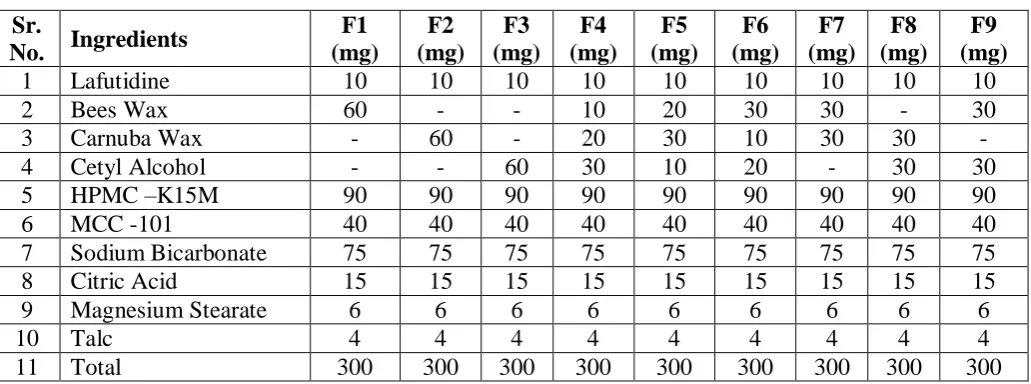
[image:3.595.42.558.426.618.2]Lafutidine floating tablets were prepared by melt granulation technique using drug and variable concentration of polymers like Bees wax, Carnuba wax, Cetyl alcohol, HPMC K15M and gas generating agents like Sodium Bicarbonate, Citric acid and additives like MCC- 101, Mg-stearate, and Talc were used. The respective polymers except Waxes were passed through the sieve no. 40. The waxes were molten in porcelain dish on hot plate and drug was added to it then optional additives (composition listed in table-1) except Talc were added in above molten mixture. The resultant mixture was allowed to solidify at room temperature and then passed through seive no. 16 to form granules. The powder blended was then lubricated with talc and then compressed on a tablet punching machine.
Table 1: Composition of gastro retentive floating tablets of Lafutidine.
Sr.
No. Ingredients
F1 (mg) F2 (mg) F3 (mg) F4 (mg) F5 (mg) F6 (mg) F7 (mg) F8 (mg) F9 (mg)
1 Lafutidine 10 10 10 10 10 10 10 10 10
2 Bees Wax 60 - - 10 20 30 30 - 30
3 Carnuba Wax - 60 - 20 30 10 30 30 -
4 Cetyl Alcohol - - 60 30 10 20 - 30 30
5 HPMC –K15M 90 90 90 90 90 90 90 90 90
6 MCC -101 40 40 40 40 40 40 40 40 40
7 Sodium Bicarbonate 75 75 75 75 75 75 75 75 75
8 Citric Acid 15 15 15 15 15 15 15 15 15
9 Magnesium Stearate 6 6 6 6 6 6 6 6 6
10 Talc 4 4 4 4 4 4 4 4 4
11 Total 300 300 300 300 300 300 300 300 300
3. Micromeritic properties: Granules were prepared by melt granulation technique and characterized by bulk density, tapped density, hausner’s ratio, Carr’s index and angle of
repose.[18],[19]
5. Hardness: The hardness of 10 tablets was measured using Monsanto Hardness tester.[21] for four minutes. After four minutes the tablets were weighed again.[22]
6. Friability: The % friability of the tablets was determined using Roche friabilator. 10 tablets were initially weighed and transferred to the friabilator. The friabilator was operated at 25 rpm.
F = x100
W W W
initial final initial
7. In-vitro Buoyancy studies
The tablets were placed in a beaker containing 0.1N hydrochloride solution (200 ml). The time required for the tablet to rise to the surface was determined as floating lag time and time period for which tablet remains at surface was determined as total floating time.[22]
8. Swelling Index of tablets
The swelling of floating tablets were determined by swelling the tablets in 0.1 N HCl at the
room temperature. Swollen weight of the tablet determined then swelling index was calculated by following equation.[26],[ 27]
Swelling Index = WT - WO/WO
Where, W0= initial weight of tablet
WT= final weight of tablet
9. In vitro drug release study
Drug release was studied using six station dissolution apparatus United States Pharmacopeia
(USP) Dissolution Testing Apparatus 2 (Basket method), in 900 ml of 0.1 N hydrochloric
acid at 37± 10C and 50 rpm One tablet was placed in each vessel and the study was
performed for a period of 12 hours. 5 ml of thesample was withdrawn at regular intervals and
the same volume of pre-warmed (37± 10C) fresh dissolution medium was replaced. The
samples withdrawn were filtered and drug content in each sample was analyzed after suitable
RESULT AND DISCUSSION
Lafutidine floating tablets were fabricated to augment the gastric residence time of the active ingredient, which could be retained in the stomach for a longer time, improving the buoyancy and sustain drug release. The floating tablets were prepared by utilizing sustain release polymers, low density polymers and gas generating agents.
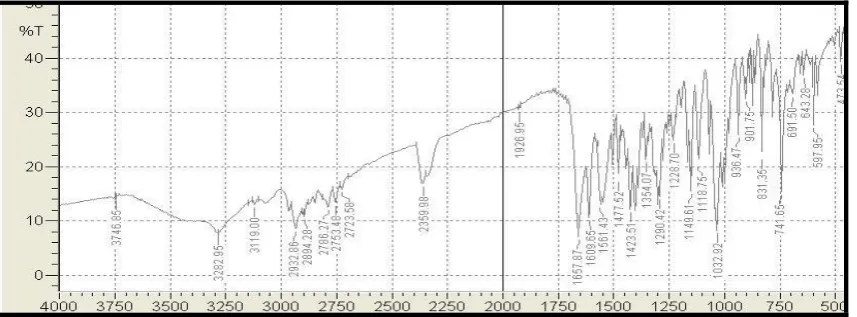
The FTIR spectrum of pure Lafutidine showed peaks corresponds to the functional group present in the structure of the drug. FT-IR spectrum of Lafutidine is shown in figure 1. FTIR spectra of pure Lafutidine showed characteristic sharp peaks of alkenes stretching (-CH3,
-CH2 and –CH) vibration at 2932.86 cm-1. Also exhibited C=O stretch at 1657.87 cm-1. A
[image:5.595.86.510.390.544.2]selective stretching vibration at 1546.96 cm-1 and 1290.42 cm-1 for primary and secondary amine was also observed. For functional groups like S=O stretch and –C-S stretch showed vibrations at 1032.92 and 741.65 cm-1 respectively. The same peaks were also found in the spectra of the formulations of Lafutidine using various polymers, which indicated that there was no drug polymer interaction.
Figure 1: FT-IR spectrum of Lafutidine.
[image:5.595.87.516.591.749.2]Table 2: Charaterization of pre-compressional parameters of granules of Lafutidine.
Formulation code Angle of
repose(0) S
Bulk density(g/ml) Tapped density(g/ml) Carr’s index (%) Hausner’s ratio
F1 32.27 ±0.32 0.545± 0.54 0.639±0.22 14.71 1.172
F2 29.42±0.21 0.568±0.32 0.651±0.54 12.74 1.146
F3 30.17±0.12 0.542±0.67 0.618±0.21 12.29 1.140
F4 29.74±0.33 0.535±0.85 0.597±0.23 10.16 1.113
F5 27.64±0.24 0.543±0.90 0.593±0.34 7.2 1.07
F6 27.12±0.54 0.537±0.21 0.573±0.54 6.14 1.06
F7 32.57±0.76 0.584±0.32 0.674±0.65 13.35 1.154
F8 33.34±0.65 0.563±0.24 0.679±0.76 17.08 1.206
F9 31.86± 0.12 0.593±0.87 0.686± 0.52 13.55 1.156
Post compression evaluation of lafutidine floating tablets
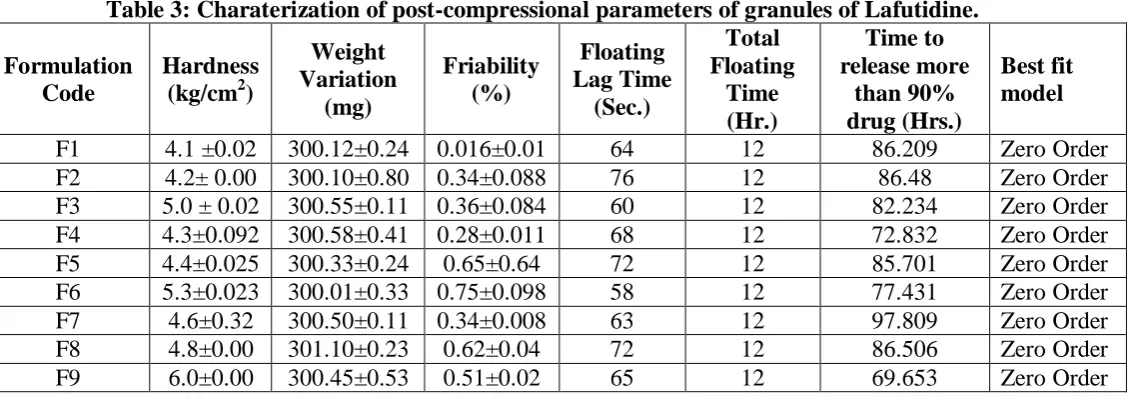
The prepared floating tablets were compressed at constant pressure. All tablets were shown
hardness between 4.1 to 6.0 kg/cm2. All prepared tablets were shown weight variation within
[image:6.595.19.586.363.563.2]±5% limit and friability within ±1% limit.
Table 3: Charaterization of post-compressional parameters of granules of Lafutidine.
Formulation Code
Hardness (kg/cm2)
Weight Variation (mg) Friability (%) Floating Lag Time (Sec.) Total Floating Time (Hr.) Time to release more than 90% drug (Hrs.) Best fit model
F1 4.1 ±0.02 300.12±0.24 0.016±0.01 64 12 86.209 Zero Order
F2 4.2± 0.00 300.10±0.80 0.34±0.088 76 12 86.48 Zero Order
F3 5.0 ± 0.02 300.55±0.11 0.36±0.084 60 12 82.234 Zero Order
F4 4.3±0.092 300.58±0.41 0.28±0.011 68 12 72.832 Zero Order
F5 4.4±0.025 300.33±0.24 0.65±0.64 72 12 85.701 Zero Order
F6 5.3±0.023 300.01±0.33 0.75±0.098 58 12 77.431 Zero Order
F7 4.6±0.32 300.50±0.11 0.34±0.008 63 12 97.809 Zero Order
F8 4.8±0.00 301.10±0.23 0.62±0.04 72 12 86.506 Zero Order
F9 6.0±0.00 300.45±0.53 0.51±0.02 65 12 69.653 Zero Order
In Vitro Buoyancy Studies
Floating lag time of prepared tablets was found between 58 to 76 seconds and all tablets were floated for more than 12 hours.
All the tablets were floated by effervescent and low density swelled matrix approach. Sodium bicarbonate was added as a gas-generating agent. Sodium bicarbonate induced carbon dioxide
generation in existence of dissolution medium (0.1 M hydrochloric acid). It was observed that the gas generated is trapped and protected within the swelled matrix, formed by hydration of low density polymer Bees wax and Carnuba wax, thus reducing the density of the tablet
buoyancy studies. In this study, penetration of water into tablets prepared with Bees wax, Carnuba wax was rather slow, causing delayed matrix formation and subsequent increase in the floating lag time compared to the tablets prepared with Cetyl alcohol.
In-vitro dissolution studies
In vitro dissolution studies of all the formulations of floating tablets of lafutidine were carried
out in 0.1N HCl. The study was performed for 12hr and cumulative drug release was at every one hour. Prepared floating tablets contain 30% HPMC K15M as sustain release polymer.
It was observed that the F1 formulation batch contain polymer concentration 20% Bees wax showed drug release 90.2% at 12 hr. The F2 formulation batch contain 20% Carnuba wax showed drug release 86.48% at 12 hr. The F3 formulation batch contain 20% Cetyl alcohol showed drug release 82.234% at 12 hr. The F4 formulation batch contain 3.3%, 6.6% and 10% Bees wax, Carnuba wax and Cetyl alcohol respectively showed drug release 72.832% at 12 hr. The F5 formulation batch contains 6.6%, 10% and 3.3% Bees wax, Carnuba wax and Cetyl alcohol respectively showed drug release 85.701% at 12 hr. The F6 formulation batch contain 10%, 3.3% and 6.6% Bees wax, Carnuba wax and Cetyl alcohol respectively concentration showed drug release 77.431% at 12 hr. The F7 formulation batch contain 10% Bees wax and 10% Carnuba wax showed drug release 97.809% at 12 hr. The F8 formulation batch contain 10% Carnuba wax and 10% Cetyl alcohol showed drug release 86.506% at 12 hr. The F9 formulation batch contain 10% Bees wax and 10% Cetyl alcohol showed drug
release 69.153% at 12 hr. The F7 formulation batch shows more drug release than other formulation batches that is it shows sustained drug release for 12 hrs, from these it the optimized formulation from all the formulation batches.
Analysis of release mechanism
The drug release statistics of optimized formulation F7 were fitted to models representing Higuchi’s, zero order, first order and Korsmeyer’s equation kinetics to be acquainted with the
release mechanisms. In the present study, in-vitro release profiles could be best articulated by
Higuchi’s equation as optimized formulation F7 showed good linearity (R2
Figure 3: Zero Order release model of formulation F1 – F9.
[image:8.595.87.509.428.552.2]Figure 4: First Order release model of formulation F1 – F9.
Figure 5: Higuchi model of formulation F1 – F9 and Marketed.
Figure 6: Korsmeyer-Peppas Release Model of formulation F1- F9 and Marketed. Korsmeyer-Peppas Release Model
[image:8.595.94.508.595.739.2]Stability study of optimized formulation
The optimized floating tablets F7 were preferred for stability study on the source of in vitro
buoyancy and in-vitro drug dissolution studies. The tablets were investigated at 40°C/75%
RH for 2 months. From the data, the formulation is found to be stable under the conditions
mentioned before since there was no noteworthy change in the percentage amount of drug content (Table 4). Thus, it was found that the floating tablets of Lafutidine (F7) were unwavering under these storage conditions for at least 2 months.
Table 4: Stability studies of stomach specific floating tablets of Lafutidine.
Stability (400C ± 20C and 75% RH ± 5%)
Physical
changes %CDR
Floating Study
Initial No 89.660 Floating
15 days No 88.79 Floating
30 days No 95.59 Floating
45 days No 89.00 Floating
60 days No 96.15 Floating
CONCLUSION
Buoyant delivery systems are promising dosage forms which could be a better alternative to the conventional oral dosage forms in order to improve bioavailability by increasing the gastric retention time of the drug.
From the compatibility studies, it is concluded that, HPMC K15M, Bees wax, Carnuba wax and Cetyl alcohol were compatible with drug Lafutidine and thus suitable for the formulation of Lafutidine floating tablets. Lafutidine tablets were fabricated by melt granulation method.
In-vitro buoyancy studies were performed for all the formulations, F1 to F9 by using 0.1 N
HCL solutions at 370C. Tablet containing Bees wax and Carnuba wax(F7) showed good buoyancy with very short lag time and long floatation time of more than 12 hrs in 0.1 N HCL.
In-Vitro release study is performed for 12 hrs. Optimized formula containing (F7) showed
better release compare to other formulations and it followed zero order kinetics. The non-Fickian diffusion was confirmed as the drug release mechanism from this formulation. From
this study, it was concluded that Bees wax and Carnuba wax can be used in formulation of Lafutidine sustained release gastro retentive floating drug delivery system. Overall, this study concludes that viscosity of the polymer is a major factor affecting the drug release and floating properties of FDDS.
ACKNOWLEDGEMENTS
The authors are sincerely thankful to Dr. Avinash Gangurde for their support. We are also thankful to Pure Chem. Laboratory Pvt. Ltd, Ankaleshwar for providing the gift sample of Lafutidine.
REFERENCES
1. Iannuccelli V, Coppi G, Bernabei MT and Cameroni R. Air compartment multiple-unit system for prolonged gastric residence. Part I. Formulation study. Int. J. Pharm, 1998; 174: 47-54.
2. A.A. Deshpande, C.T. Rhodes, N.H. Shah, A.W. Malick. Controlled-release drug delivery
systems for prolonged gastric residence: An overview. Drug. Dev. Ind. Pharm, 1996; 22: 631–39.
3. S.J. Hwang, H. Park and K. Park, Critical reviews in therapeutic drug delivery system, 1998; 15(3): 243-284.
4. Lee J., Park.J and Choi. H. Optimization of Sotalol Floating and Bioadhesive Extended Release Tablet Formulations. J. Microencapsul, 1999; 16(6): 715-29.
5. Khatri S, Girdhani D, Pahwa R. Recent advances in floating drug delivery system. The Indian Pharmacist, 2007; 6: 17–20.
6. A.V. Mayavanshi and S.S. Gajjar. Floating drug delivery systems to increase gastric retention of drugs: A Review. Research J. Pharm. and Tech., 2008; 1(4): 345-348.
7. S. Arora, J. Ali, A. Ahuja, et al. Floating drug delivery systems: a review. AAPS Pharm.
Sci. Tech., 2005; 6(3): 372-390.
8. G. Chawla, A. Bansal. A means to address regional variability in intestinal drug absorption. Pharm. Tech., 2003; 27: 50-68.
9. Kawa K, Shimatani T, Hayato S, Morikawa N, Tazuma S. Pharmacokinetic and
pharmacodynamic properties of lafutidine after postprandial oral administration in healthy subjects: Comparison with famotidine. Biol Pharm Bull, 2007; 30: 1003-6.
10.Onodera S, Shibata M, Tanaka M, Inaba N, Yamaura T, Ohnishi H. Gastroprotective activity of FRG-8813, a novel histamine H2-receptor antagonist, in rats. Jpn J Pharmacol, 1995; 68: 161-73.
11.Hong Wen. (Encyclopedia of Pharmaceutical Technology: Adsorption at Solid Surfaces:
12.Wamagishi H, Koike T, Ohara S, Horii T, Kikuchi R, Kobayashi S, et al. Stronger inhibition of gastric acid secretion by lafutidine, a novel H2 receptor antagonist, than by the proton pump inhibitor lansoprazole. World J Gastroenterol, 2008; 14: 2406-10.
13.Onodera S, Shibata M, Tanaka M, Inaba N, Arai Y, Aoyama M, et al. Gastroprotective
mechanism of lafutidine, a novel anti-ulcer drug with histamine H2-receptor antagonistic activity. Arzneimittel for schung, 1999; 49: 519-26.
14.Ichikawa T, Ishihara K, Saigenji K, Hotta K. Lafutidine-induced stimulation of mucin biosynthesis mediated by nitric oxide is limited to the surface mucous cells of rat gastric oxyntic mucosa. Life Sci., 1998; 62: 259-64.
15.Ichikawa T, Ishihara K, Saigenji K, Hotta K. Effects of acid-inhibitory antiulcer drugs on mucin biosynthesis in the rat stomach. Eur J Pharmacol, 1994; 251: 107.
16.Inaba N, Shibata M, Onodera S, Tanaka M, Suzuki T, Yamaura T, et al. Studies on histamine H2-receptor antagonistic property of FRG-8813, a novel anti-ulcer drug. Nihon Yakurigaku Zasshi, 1995; 105: 231-41.
17.Chawla G and Bansal A. A means to address regional variability in intestinal drug absorption, Pharm Technol, 2003; 2: 50-68.
18.Shah D., Shah Y., Rampradhan M. Development and evaluation of controlled release diltiazem micro particles using crosslinkedpoly (vinyl alcohol), Drug Dev Ind Pharm, 1997; 23: 567-574.
19.Aulton ME, Wells TI. “Pharmaceutics: The Science of Dosage Form Design”, London,
England: Churchill Livingstone; 1988 Indian Pharmacopoeia, The Controller of Publications: Delhi, 1996; II: 734-36.
20.Banker, G.S.; Anderson, N.R. In The Theory and Practice of Industrial Pharmacy, Lachmann, L., Liberman, H.A.; Kaing, J.L.Eds. Varghese Publishing House: Bombay, 1987; 297-99.
21.Rosa M, Zia H, Rhodes T. Dosing and testing in vitro of a bioadhesive and floating drug
delivery system for oral application. Int. J. Pharm., 1994; 105: 65-70.
22.Dorozyn´ski P, Jachowicz R, Kulinowski P, Kwiecin´ski S, Szybin´ski K, Skórka T, et al.
The macromolecular polymers for the preparation of hydro dynamically balanced systems: Methods of evaluation. Drug Dev Ind Pharm, 2004; 30: 947-57.
23.Atyabi F, Sharma H, Mohammad H, Fell J. In vitro evaluation of a novel gastro retentive
formulation based on ion exchange resins. J Control Release, 1996; 42: 105-13.
24.Korsmeyer R, Gurny R, Peppas N. Mechanisms of solute release from porous hydrophilic
25.Tokumara Tadakazu and Machida Yoshiharn. Preparation of Amoxicillin antragastric buoyant sustained release tablets and Dissolution characteristics. J. Controlled Release, 2006; 110: 581- 586.
26.Chavanpatil D M, Jain P, Choudhari S, Shear R, Vavia R P; Novel sustained release, swellable and bioadhesive gastro retentive drug delivery system for ofloxacin. Int. J. Pharm, 2006; 316: 86-92.
27.Gibaldi M, Feldman S. Establishment of sink conditions in dissolution rate
determinations. Theoretical considerations and application to non disintegrating dosage forms. J Pharm Sci., 1967; 56: 1238-42.
28.Higuchi T. Mechanism of sustained-action medication. Theoretical analysis of rate of release of solid drugs dispersed in solid matrices. J Pharm Sci., 1963; 52: 1145-9.
29.Hixson AW, Crowell JH. Dependence of reaction velocity upon surface agitation. Ind Eng Chem., 1931; 23: 923-93.
30.Peppas NA. Analysis of Fickian and non-Fickian drug release from polymers. Pharm Acta Helv., 1985; 60: 110-1.
31.Mathews BR. Regulatory aspects of stability testing in Europe. Drug Dev Ind Pharm, 1999; 25: 831-56.
32.Priyanka P., et al., “Drug-Excipient compatibility studies: First step for dosage form development”, The Pharma Innovation Journal, 2015; 4(5): 14-20.
33.Ganesh K.G., et al., “Formulation and development of Mucoadhesive tablet of Lafutidine
by using design of experiment”, International journal of Pharmacy and analytical research, 2015; 4(4): 442-455.