REVIEW
A multi-disciplinary perspective on emergent and future
innovations in peer review [version 2; referees: 2 approved]
Jonathan P. Tennant
,
Jonathan M. Dugan
, Daniel Graziotin
,
Damien C. Jacques
, François Waldner
, Daniel Mietchen , Yehia Elkhatib
,
Lauren B. Collister
, Christina K. Pikas
, Tom Crick
, Paola Masuzzo
,
Anthony Caravaggi
, Devin R. Berg
, Kyle E. Niemeyer
,
Tony Ross-Hellauer
, Sara Mannheimer
, Lillian Rigling
,
Daniel S. Katz
, Bastian Greshake Tzovaras
,
Josmel Pacheco-Mendoza
, Nazeefa Fatima
, Marta Poblet
,
Marios Isaakidis
, Dasapta Erwin Irawan
, Sébastien Renaut
,
Christopher R. Madan
, Lisa Matthias
, Jesper Nørgaard Kjær
,
Daniel Paul O'Donnell
, Cameron Neylon
, Sarah Kearns
,
Manojkumar Selvaraju
, Julien Colomb
38
Imperial College London, London, UK ScienceOpen, Berlin, Germany
Berkeley Institute for Data Science, University of California, Berkeley, CA, USA Institute of Software Technology, University of Stuttgart, Stuttgart, Germany Earth and Life Institute, Université catholique de Louvain, Louvain-la-Neuve, Belgium Data Science Institute, University of Virginia, Charlottesville, VA, USA
School of Computing and Communications, Lancaster University, Lancaster, UK University Library System, University of Pittsburgh, Pittsburgh, PA, USA Johns Hopkins University Applied Physics Laboratory, Laurel, MD, USA
Cardiff Metropolitan University, Cardiff, UK
VIB-UGent Center for Medical Biotechnology, Ghent, Belgium Department of Biochemistry, Ghent University, Ghent, Belgium
School of Biological, Earth and Environmental Sciences, University College Cork, Cork, Ireland Engineering & Technology Department, University of Wisconsin-Stout, Menomonie, WI, USA
School of Mechanical, Industrial, and Manufacturing Engineering, Oregon State University, Corvallis, OR, USA State and University Library, University of Göttingen, Göttingen, Germany
Montana State University, Bozeman, MT, USA Western University Libraries, London, ON, USA
National Center for Supercomputing Applications, University of Illinois at Urbana-Champaign, Urbana, IL, USA Department of Computer Science, University of Illinois Urbana-Champaign, Urbana, IL, USA
Department of Electrical and Computer Engineering, University of Illinois Urbana-Champaign, Urbana, IL, USA School of Information Sciences, University of Illinois at Urbana-Champaign, Urbana, IL, USA
Institute of Cell Biology and Neuroscience, Goethe University Frankfurt, Frankfurt, Germany Universidad San Ignacio de Loyola, Lima, Peru
Department of Biology, Faculty of Science, Lund University, Lund, Sweden Graduate School of Business and Law, RMIT University, Melbourne, Australia Department of Computer Science, University College London, London, UK
Department of Groundwater Engineering, Faculty of Earth Sciences and Technology, Institut Teknologi Bandung, Bandung, Indonesia
1,2
3
4
5
5
6
7
8
9
10
11,12
13
14
15
16
17
18
19-22
23
24
25
26
27
28
29
30
31
32
33
34
35
36,37
38
Open Peer Review
Discuss this article
(3) Comments
Department of Groundwater Engineering, Faculty of Earth Sciences and Technology, Institut Teknologi Bandung, Bandung, Indonesia Département de Sciences Biologiques, Institut de Recherche en Biologie Végétale, Université de Montréal, Montreal, QC, Canada School of Psychology, University of Nottingham, Nottingham, UK
OpenAIRE, University of Göttingen, Göttingen, Germany
Department of Affective Disorders, Psychiatric Research Academy, Aarhus University Hospital, Risskov, Denmark
Department of English and Centre for the Study of Scholarly Communications, University of Lethbridge, Lethbridge, AB, Canada Centre for Culture and Technology, Curtin University, Perth, Australia
Department of Chemical Biology, University of Michigan, Ann Arbor, MI, USA
Saudi Human Genome Program, King Abdulaziz City for Science and Technology (KACST), Riyadh, Saudi Arabia Integrated Gulf Biosystems, Riyadh, Saudi Arabia
Independent Researcher, Berlin, Germany
Abstract
Peer review of research articles is a core part of our scholarly communication system. In spite of its importance, the status and purpose of peer review is often contested. What is its role in our modern digital research and communications infrastructure? Does it perform to the high standards with which it is generally regarded? Studies of peer review have shown that it is prone to bias and abuse in numerous dimensions, frequently unreliable, and can fail to detect even fraudulent research. With the advent of web
technologies, we are now witnessing a phase of innovation and
experimentation in our approaches to peer review. These developments prompted us to examine emerging models of peer review from a range of disciplines and venues, and to ask how they might address some of the issues with our current systems of peer review. We examine the functionality of a range of social Web platforms, and compare these with the traits underlying a viable peer review system: quality control, quantified performance metrics as engagement incentives, and certification and reputation. Ideally, any new systems will demonstrate that they out-perform and reduce the biases of existing models as much as possible. We conclude that there is considerable scope for new peer review initiatives to be developed, each with their own potential issues and advantages. We also propose a novel hybrid platform model that could, at least partially, resolve many of the socio-technical issues associated with peer review, and potentially disrupt the entire scholarly communication system. Success for any such development relies on reaching a critical threshold of research community engagement with both the process and the platform, and therefore cannot be achieved without a significant change of incentives in research environments.
28 29 30 31 32 33 34 35 36 37 38
Referee Status:
Invited Referees
version 2
published 01 Nov 2017
version 1
published 20 Jul 2017
1 2
report
report
report
report
, Ottawa Hospital
David Moher
Research Institute, Canada
1
, Queensland Virginia Barbour
University of Technology (QUT), Australia
2
20 Jul 2017, :1151 (doi: )
First published: 6 10.12688/f1000research.12037.1
01 Nov 2017, :1151 (doi: )
Latest published: 6 10.12688/f1000research.12037.2
Jonathan P. Tennant ( )
Corresponding author: [email protected]
: Conceptualization, Writing – Original Draft Preparation, Writing – Review & Editing; : Writing – Original Draft
Author roles: Tennant JP Dugan JM
Preparation, Writing – Review & Editing; Graziotin D: Writing – Original Draft Preparation, Writing – Review & Editing; Jacques DC: Writing – Original Draft Preparation, Writing – Review & Editing; Waldner F: Writing – Original Draft Preparation, Writing – Review & Editing; Mietchen D: Writing – Original Draft Preparation, Writing – Review & Editing; Elkhatib Y: Writing – Original Draft Preparation, Writing – Review & Editing; B.
: Writing – Original Draft Preparation, Writing – Review & Editing; : Writing – Original Draft Preparation, Writing – Review &
Collister L Pikas CK
Editing; Crick T: Writing – Original Draft Preparation, Writing – Review & Editing; Masuzzo P: Writing – Original Draft Preparation, Writing – Review & Editing; Caravaggi A: Writing – Original Draft Preparation, Writing – Review & Editing; Berg DR: Writing – Original Draft Preparation, Writing – Review & Editing; Niemeyer KE: Writing – Original Draft Preparation, Writing – Review & Editing; Ross-Hellauer T: Writing – Original Draft Preparation, Writing – Review & Editing; Mannheimer S: Writing – Original Draft Preparation, Writing – Review & Editing; Rigling L: Writing – Original Draft Preparation, Writing – Review & Editing; Katz DS: Writing – Original Draft Preparation, Writing – Review & Editing; Greshake
: Writing – Original Draft Preparation, Writing – Review & Editing; : Writing – Original Draft Preparation, Writing –
Tzovaras B Pacheco-Mendoza J
Review & Editing; Fatima N: Writing – Original Draft Preparation, Writing – Review & Editing; Poblet M: Writing – Original Draft Preparation, Writing – Review & Editing; Isaakidis M: Writing – Original Draft Preparation, Writing – Review & Editing; Irawan DE: Writing – Original Draft Preparation, Writing – Review & Editing; Renaut S: Writing – Original Draft Preparation, Writing – Review & Editing; Madan CR: Writing – Original Draft Preparation, Writing – Review & Editing; Matthias L: Writing – Original Draft Preparation, Writing – Review & Editing; Nørgaard Kjær J: Writing – Original Draft Preparation, Writing – Review & Editing; O'Donnell DP: Writing – Original Draft Preparation, Writing – Review & Editing; Neylon C: Writing – Original Draft Preparation, Writing – Review & Editing; Kearns S: Writing – Original Draft Preparation, Writing – Review & Editing;
: Writing – Original Draft Preparation, Writing – Review & Editing; : Writing – Original Draft Preparation, Writing – Review &
Selvaraju M Colomb J
Editing
JPT works for ScienceOpen and is the founder of paleorXiv; TRH and LM work for OpenAIRE; LM works for Aletheia; DM is Competing interests:
a co-founder of RIO Journal, on the Editorial Board of PLOS Computational Biology and on the Board of WikiProject Med; CN and DPD are the President and Vice-President of FORCE11, respectively.
Tennant JP, Dugan JM, Graziotin D
How to cite this article: et al.A multi-disciplinary perspective on emergent and future innovations in
2017, :1151 (doi: )
peer review [version 2; referees: 2 approved]F1000Research 6 10.12688/f1000research.12037.2
© 2017 Tennant JP . This is an open access article distributed under the terms of the ,
Copyright: et al Creative Commons Attribution Licence
which permits unrestricted use, distribution, and reproduction in any medium, provided the original work is properly cited.
TRH was supported by funding from the European Commission H2020 project OpenAIRE2020 (Grant agreement: 643410, Grant information:
Call: H2020-EINFRA-2014-1). The publication costs of this article were funded by Imperial College London.
The funders had no role in study design, data collection and analysis, decision to publish, or preparation of the manuscript.
20 Jul 2017, :1151 (doi: )
1 Introduction
Peer review is a core part of our self-regulating global scholar-ship system. It defines the process in which professional experts (peers) are invited to critically assess the quality, novelty, theoreti-cal and empiritheoreti-cal validity, and potential impact of research by oth-ers, typically while it is in the form of a manuscript for an article, conference, or book (Daniel, 1993; Kronick, 1990; Spier, 2002;
Zuckerman & Merton, 1971). For the purposes of this article, we are exclusively addressing peer review in the context of manu-script selection for scientific research articles, with some initial considerations of other outputs such as software and data. In this form, peer review is becoming increasingly central as a principle of mutual control in the development of scholarly communities that are adapting to digital, information-rich, publishing-driven research ecosystems. Consequently, peer review is a vital component at the core of research communication processes, with repercussions for the very structure of academia, which largely operates through a peer reviewed publication-based reward and incentive system (Moore et al., 2017). Different forms of peer review beyond that for manuscripts are also clearly important and used in other con-texts such as academic appointments, measurement time, research ethics or research grants (see, e.g., Fitzpatrick, 2011b, p. 16), but a holistic discussion of all forms of peer review is beyond the scope of the present article.
Peer review is not a singular or static entity. It comes in various flavors that result from different approaches to the relative tim-ing of the review in the publication cycle, the reciprocal transpar-ency of the process, and the contrasting and disciplinary practices (Ross-Hellauer, 2017). Such interdisciplinary differences have made the study and understanding of peer review highly com-plex, and implementing any systemic changes to peer review is fraught with the challenges of synchronous adoption between het-erogeneous communities often with vastly different social norms and practices. The criteria used for evaluation, including meth-odological soundness or expected scholarly impact, are typically important variables to consider, and again vary substantially between disciplines. However, peer review is still often perceived as a “gold standard” (e.g., D’Andrea & O’Dwyer (2017); Mayden (2012)), despite the inherent diversity of the process and never
intended to be used as such. Peer review is applied inconsistently both in theory and practice (Casnici et al., 2017; Pontille & Torny, 2015), and generally lacks any form of transparency or formal standardization. As such, it remains difficult to know precisely what a “peer reviewed publication” means.
Traditionally, the function of peer review has been as a vet-ting procedure or gatekeeper to assist the distribution of limited resources—for instance, space in peer reviewed print publication venues. With the advent of the internet, the physical constraints on distribution are no longer present, and, at least in theory, we are now able to disseminate research content rapidly and at relatively negligible cost (Moore et al., 2017). This has led to the innovation and increasing popularity of digital-only publication venues that vet submissions based exclusively on the soundness of the research, often termed “mega-journals” (e.g., PLOS ONE, PeerJ, the Frontiers series). Such a flexibility in the filter function of peer review reduces, but does not eliminate, the role of peer review as a selective gatekeeper, and can be considered to be “impact neu-tral.” Due to such digital experimentations, ongoing discussions about peer review are intimately linked with contemporaneous developments in Open Access (OA) publishing and to broader changes in open scholarship (Tennant et al., 2016).
The goal of this article is to investigate the historical evolution in the theory and application of peer review in a socio-technological context. We use this as the basis to consider how specific traits of consumer social Web platforms can be combined to create an optimized hybrid peer review model that we suggest will be more efficient, democratic, and accountable than existing processes.
1.0.1 Methods
This article provides a general review of conventional journal arti-cle peer review and evaluation of recent and current innovations in the field. It is not a systematic review or meta-analysis of the empir-ical literature. Rather, a team of researchers with diverse exper-tise in the sciences, scholarly publishing and communication, and libraries pooled their knowledge to collaboratively and itera-tively analyze and report on the present literature and current innovations. The reviewed and cited articles within were identi-fied and selected through searches of general research databases (e.g., Web of Science, Google Scholar, and Scopus) as well as spe-cialized research databases (e.g., Library & Information Science Abstracts (LISA) and PubMed). Particularly relevant articles were used to seed identification of cited, citing, and articles related by citation. The team co-ordinated efforts using an online collabora-tion tool (Slack) to share, discuss, debate, and come to consen-sus. Authoring and editing was also done collaboratively and in public view using Overleaf. Each co-author independently con-tributed original content and participated in the reviewing, editing and discussion process.
1.1 The history and evolution of peer review
Any discussion on innovations in peer review must appreciate its historical context. By understanding the history of scholarly publishing and the interwoven evolution of peer review, we rec-ognize that neither are static entities, but covary with each other. By learning from historical experiences, we can also become more
Amendments from Version 1
We have made various minor changes throughout the manuscript in terms of style and content. Some of the major changes we have made include:
1. Making the text more concise to reduce repetition 2. Clarifying elements of the history of peer review 3. Checked the language throughout to be more objective 4. Added a Methods section
5. Clarified more clearly where we do not have evidence for some aspects of peer review
6. Included further comments on reviewer training and the role of editors
7. Minor edits have also been made to the figures and tables 8. The Competing interests section has been updated See referee reports
aware of how to shape future directions of peer review evolution and gain insight to what the process should look like in an optimal world. The actual term “peer review” only appears in the scien-tific press in the 1960s. Even in the 1970s, it was often associated with grant review and not with evaluation and selection for pub-lishing (Baldwin, 2017a). However, the history of evaluation and selection processes for publication clearly predates the 1970s.
1.1.1 The early history of peer review. The origins of a form of “peer review” for scholarly research articles are commonly associated with the formation of national academies in 17th century Europe, although some have found foreshadowing of the practice (Al-Rahawi, c900; Csiszar, 2016; Fyfe et al., 2017;
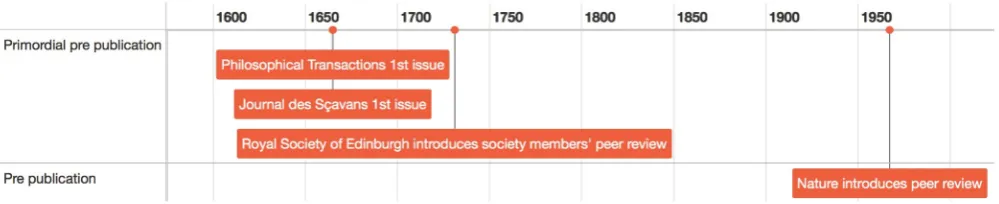
Spier, 2002). We call this period the primordial time of peer review (Figure 1), but note that the term “peer review” was not formally used then. Biagioli (2002) described in detail the grad-ual differentiation of peer review from book censorship, and the role that state licensing and censorship systems played in 16th century Europe; a period when monographs were the primary mode of communication. Several years after the Royal Society of London (1660) was established, it created its own in-house jour-nal, Philosophical Transactions. Around the same time, Denis de Sallo published the first issue of Journal des Sçavans, and both of these journals were first published in 1665 (Manten, 1980;
Oldenburg, 1665; Zuckerman & Merton, 1971). With this origin, early forms of peer evaluation emerged as part of the social prac-tices of gentlemanly learned societies (Kronick, 1990; Moxham & Fyfe, 2017; Spier, 2002). The development of these prototypi-cal scientific journals gradually replaced the exchange of experi-mental reports and findings through correspondence, formalizing a process that had been essentially personal and informal until then. “Peer review”, during this time, was more of a civil, collegial discussion in the form of letters between authors and the publica-tion editors (Baldwin, 2017b). Social pressures of generating new audiences for research, as well as new technological developments such as the steam-powered press, were also crucial (Shuttleworth & Charnley, 2016). From these early developments, the process of independent review of scientific reports by acknowledged experts, besides the editors themselves, gradually emerged (Csiszar, 2016). However, the review process was more similar to non-scholarly publishing, as the editors were the only ones to appraise manu-scripts before printing (Burnham, 1990). The primary purpose of this process was to select information for publication to account for the limited distribution capacity, and remained the authoritative purpose of such evaluation for more than two centuries.
1.1.2 Adaptation through commercialisation. Peer review in forms that we would now recognize emerged in the early 19th century due to the increasing professionalism of science, and primarily through English scholarly societies. During the 19th century, there was a proliferation of scientific journals, and the diversity, quantity, and specialization of the material presented to journal editors increased. Peer evaluations evolved to become more about judgements of scientific integrity, but the intention of any such process was never for the purposes of gate-keeping (Csiszar, 2016). Research diversification made it necessary to seek assistance outside the immediate group of knowledgeable reviewers from the journals’ sponsoring societies (Burnham, 1990). Evaluation evolved to become a largely outsourced process, which still per-sists in modern scholarly publishing today. The current system of formal peer review, and use of the term itself, only emerged in the mid-20th century in a very piecemeal fashion (and in some disci-plines, the late 20th century or early 21st; see Graf, 2014, for an example of a major philological journal which began systematic peer review in 2011). Nature, now considered a top journal, did not initiate any sort of peer review process until at least 1967, only becoming part of the formalised process in 1973 (nature.com/ nature/history/timeline_1960s.html).
[image:5.612.57.557.608.710.2]This editor-led process of peer review became increasingly main-stream and important in the post-World War II decades, and is what we term “traditional” or “conventional” peer review through-out this article. Such expansion was primarily due to the devel-opment of a modern academic prestige economy based on the perception of quality or excellence surrounding journal-based pub-lications (Baldwin, 2017a; Fyfe et al., 2017). Peer review increas-ingly gained symbolic capital as a process of objective judgement and consensus. The term itself became formalised in research processes, borrowed from government bodies who employed it for aiding selective distribution of research funds (Csiszar, 2016). The increasing professionalism of academies enabled commer-cial publishers to use peer review as a way of legitimizing their journals (Baldwin, 2015; Fyfe et al., 2017), and capitalized on the traditional perception of peer review as voluntary duty by academics to provide these services. A consequence of this was that peer review became a more homogenized process that enabled private publishing companies to thrive, and eventually establish a dominant, oligopolistic marketplace position (Larivière et al., 2015). This represented a shift from peer review as a more syn-ergistic activity among scholars, to commercial entities selling it as an added value service back to the same academic community who was performing it freely for them. The estimated cost of peer
review is a minimum of £1.9bn per year (in 2008; Research Information Network (2008)), representing a substantial vested financial interest in maintaining the current process of peer review (Smith, 2010). Neither account for overhead costs in publisher management, or the redundancy of the reject-resubmit cycle authors enter due to the competition for the symbolic value of journal prestige (Jubb, 2016).
The result of this is that modern peer review has become enor-mously complicated. By allowing the process to become man-aged by a hyper-competitive industry, developments in scholarly publishing have become strongly coupled to the transforming nature of academic research institutes. These institutes have now evolved into internationally competitive businesses that strive for
impact through journal publication. Often this is now mediated by commercial publishers through attempts to align their products with the academic ideal of research excellence (Moore et al., 2017). Such a consequence is plausibly related to, or even a consequence of, broader shifts towards a more competitive neoliberal aca-demic culture (Raaper, 2016). Here, emphasis is largely placed on production and standing, value, or utility (Gupta, 2016), as opposed to the original primary focus of research on discovery and novelty.
[image:6.612.60.558.255.699.2]1.1.3 The peer review revolution. In the last several decades, and boosted by the emergence of Web-based technologies, there have been substantial innovative efforts to decouple peer review from the publishing process (Figure 2; Schmidt & Görögh (2017)),
and the ever increasing volume of published research. Much of this experimentation has been based on earlier precedents, and in some cases a total reversal back to historical processes. Such decou-pling attempts have typically been achieved by adopting peer review as an overlay process on top of formally published research articles, or by pursuing a “publish first, filter later” protocol, with peer review taking place after the initial publication of research results (BioMed Central, 2017; McKiernan et al., 2016; Moed, 2007). Here, the meaning of “publication” becomes “making public,” as in the legal and common use as opposed to the scholarly publishing sense where it also implies peer reviewed, a trait unique to research scholarship. In fields such as Physics, Mathematics, and Eco-nomics, it is common for authors to send their colleagues either paper or electronic copies of their manuscripts for pre-submission evaluation. Launched in 1991, arXiv (arxiv.org) formalized this process by creating a central network for whole communities to access such e-prints. Today, arXiv has more than one mil-lion e-prints from various research fields and receives more than 8,000 monthly submissions (arXiv, 2017). Here, e-prints or pre-prints are not formally peer reviewed prior to publication, but still undergo a certain degree of moderation by experts in order to fil-ter out non-scientific content. This practice represents a significant shift, as public dissemination was decoupled from a formalised editorial peer review process. Such practice results in increased visibility and combined rates of citation for articles that are depos-ited both in repositories like arXiv and traditional journal venues (Davis & Fromerth, 2007; Moed, 2007).
The launch of Open Journal Systems (openjournalsystems.com; OJS) in 2001 offered a step towards bringing journals and peer review back to their community-led roots, by providing the tech-nology to implement a range of potential peer review models within a low-cost open source platform. As of 2015, the OJS plat-form provided the technical infrastructure and editorial and peer review workflow management support to more than 10,000 jour-nals (Public Knowledge Project, 2016). Its exceptionally low cost was perhaps responsible for around half of these journals appearing in the developing world (Edgar & Willinsky, 2010).
The past five to ten years have seen an accelerating wave of innovation in peer review, which we term “the revolution” phase (Figure 2; note that this is a non-exhaustive overview of the peer review landscape). Initiatives such as the San Francisco Declara-tion on Research Assessment (ascb.org/dora/; DORA), that called for systemic changes in the way that scientific research outputs are evaluated, and advances in Web-based technologies, are likely catalysts for such innovation. Born-digital journals, such as the PLOS series, introduced commenting on published papers, and Rapid Responses by BMJ has been highly successful in providing a platform for formalised comments (bmj.com/rapid-responses). Such initiatives spurred developments in cross-publisher anno-tation platforms like PubPeer (pubpeer.com/) and PaperHive (paperhive.org/). Some journals, such as F1000 Research (f1000research.com/) and The Winnower (thewinnower.com/), rely exclusively on a model where peer review is conducted after the manuscripts are made publicly available. Other services, such as Publons (publons.com/), enable reviewers to claim recogni-tion for their activities as referees. Originally, Academic Karma
(academickarma.org/) offered a similar service to Publons, but has since adapted its model to facilitate peer review of preprints. Plat-forms such as ScienceOpen (scienceopen.com/) provide a search engine combined with peer review across publishers on all docu-ments, regardless of whether manuscripts have been previously reviewed. Each of these innovations has partial parallels to other social Web applications or platforms in terms of transparency, reputation, performance assessment, and community engage-ment. It remains to be seen whether these new models of evalua-tion will become more popular than tradievalua-tional peer review, either singularly or in combination.
1.1.4 Evidence from studies of peer review. Several empirical studies on peer review have been reported in the past few decades, mostly at the journal- or population-level. These studies typically use several different approaches to gather evidence on the function-ality of peer review. Some, such as Bornmann & Daniel (2010b);
Daniel (1993); Zuckerman & Merton (1971), used access to jour-nal editorial archives to calculate acceptances, assess inter-reviewer agreement, and compare acceptance rates to various article, topic, and author features. Others interviewed or surveyed authors, reviewers, and editors to assess attitudes and behaviours, while others conducted randomized controlled trials to assess aspects of peer review bias (Justice et al., 1998; Overbeke, 1999). A system-atic review of these studies concluded that evidence supporting the effectiveness of peer review training initiatives was inconclusive (Galipeau et al., 2015), and that major knowledge gaps existed in our application of peer review as a method to ensure high quality of scientific research outputs.
In spite of such studies, there appears to be a widening gulf between the rate of innovation and the availability of quantitative, empirical research regarding the utility and validity of modern peer review systems (Squazzoni et al., 2017a; Squazzoni et al., 2017b). This should be deeply concerning given the significance that has been attached to peer review as a form of community mod-eration in scholarly research. Indeed, very few journals appear to be committed to objectively assess their effectiveness during peer review (Lee & Moher, 2017). The consequence of this is that much remains unknown about the “black box” of peer review, as it is sometimes called (Smith, 2006). The optimal designs for understanding and assessing the effectiveness of peer review, and therefore improving it, remain poorly understood, as the data required to do so are often not available (Bruce et al., 2016;
Galipeau et al., 2015). This also makes it very hard to measure and assess the quality, standard, and consistency of peer review not only between articles and journals, but also on a system-wide scale in the scholarly literature. Research into such aspects of peer review is quite time-consuming and intensive, particularly when investigating traits such as validity, and often criteria for assessing these are based on post-hoc measures such as citation frequency.
Despite the criticisms levied at the implementation of peer review, it remains clear that the ideal of it still plays a fundamental role in scholarly communication (Goodman et al., 1994; Mulligan
Gibson et al., 2008; Greaves et al., 2006; Mulligan et al., 2013). One primary reason why peer review has persisted is that it remains a unique way of assigning credit to authors and differentiating research publications from other types of literature, including blogs, media articles, and books. This perception, combined with a general lack of awareness or appreciation of the historic evolu-tion of peer review, research examining its potential flaws, and the conflation of the process with the ideology, has sustained its near-ubiquitous usage and continued proliferation in academia. There remains a widely-held perception that peer review is a singular and static process, and thus its wide acceptance as a social norm. It is difficult to move away from a process that has now become so deeply embedded within global research institutes. The consequence of this is that validation offered through peer review remains one of the essential pillars of trust in scholarly com-munication, irrespective of any potential flaws (Haider & Åström, 2017).
In the following section, we summarize the ebb and flow of the debate around the various and complex aspects of conventional peer review. In particular, we highlight how innovative systems are attempting to resolve some of the major issues associated with traditional models, explore how new platforms could improve the process in the future, and consider what this means for the identity, role, and purpose of peer review within diverse research communities. The aim of this discussion is not to undermine any specific model of peer review in a quest for systemic upheaval, or to advocate any particular alternative model. Rather, we acknowledge that the idea of peer review is critical for research and advancing our knowledge, and as such we provide a foundation for future exploration and creativity in improving an essential component of scholarly communication.
1.2 The role and purpose of modern peer review
The systematic use of external peer review has become entwined with the core activities of scholarly communication. Without approval through peer review to assess importance, validity, and journal suitability, research articles do not become part of the body of scientific knowledge. While in the digital world the costs of dissemination are very low, the marginal cost of publishing articles is far from zero (e.g., due to time and management, host-ing, markethost-ing, and technical and ethical checks). The economic motivations for continuing to impose selectivity in a digital envi-ronment, and applying peer review as a mechanism for this, have received limited attention or questioning, and are often simply regarded as how things are done. Use of selectivity is now often attributed to quality control, but may be more about building the brand and the demand from specific publishers or venues. Proprietary reviewer databases that enable high selectivity are seen as a good business asset. In fact, the attribution is based on the false assumption that peer review requires careful selection of specific reviewers to assure a definitive level of adequate quality, termed the “Fallacy of Misplaced Focus” by Kelty et al. (2008).
In addition to being used to judge submitted material for accept-ance at a journal, review comments provided to the authors serve to improve the work and the writing and analysis skills of the authors. This feedback can lead to improvements to the submitted
work that are iterated between the authors, reviewers, and edi-tor, until the work is either accepted or the editor decides that it cannot be made acceptable for their specific scientific journal. In other cases, it allows the authors to improve their work to pre-pare for a new submission to another venue. In both cases, a good (i.e., constructive) peer review should provide general feedback that allows authors to improve their skills and competency at preparing and presenting their research. In a sense, good peer review can serve as distributed mentorship.
In many cases, there is an attempt to link the goals of peer review processes with Mertonian norms (Lee et al., 2013; Merton, 1973) (i.e., universalism, communalism, disinterestedness, and organized scepticism) as a way of showing their relation to shared community values. The Mertonian norm of organized scepticism is the most obvious link, while the norm of disinterestedness can be linked to efforts to reduce systemic bias, and the norm of com-munalism to the expectation of contribution to peer review as part of community membership (i.e., duty). In contrast to the empha-sis on supposedly shared social values, relatively little attention has been paid to the diversity of processes of peer review across journals, disciplines, and time (an early exception is Zuckerman &Merton (1971)). This is especially the case as the (scientific) scholarly community appears overall to have a strong investment in a “creation myth” that links the beginning of scholarly publish-ing—the founding of The Philosophical Transactions of the Royal Society—to the invention of peer review. The two are often regarded to be coupled by necessity, largely ignoring the complex and inter-woven histories of peer review and publishing. This has conse-quences, as the individual identity of a scholar is strongly tied to specific forms of publication that are evaluated in particular ways (Moore et al., 2017). A scholar’s first research article, doctoral thesis, or first book are significant life events. Membership of a community, therefore, is validated by the peers who review this newly contributed work. Community investment in the idea that these processes have “always been followed” appears very strong, but ultimately remains a fallacy.
As mentioned above, there is an increasing quantity and quality of research that examines how publication processes, selection, and peer review evolved from the 17th to the early 20th century, and how this relates to broader social patterns (Baldwin, 2017a;
Baldwin, 2017b; Fyfe et al., 2017; Moxham & Fyfe, 2017). However, much less research critically explores the diversity of selection of peer review processes in the mid- to late-20th century. Indeed, there seems to be a remarkable discrepancy between the historical work we do have (Baldwin, 2017a; Gupta, 2016; Rennie, 2016; Shuttleworth & Charnley, 2016) and appar-ent community views that “we have always done it this way,” alongside what sometimes feels like a wilful effort to ignore the current diversity of practice. The result of this is an overall lack of evidence about the mechanics of peer review (e.g., time taken to review, conflict resolution, demographics of engaged par-ties, acceptance rates, quality of reviews, inherent biases, impact of referee training), both in terms of the traditional process and ongoing innovations, that obfuscates our understanding of the functionality and effectiveness of the present system (Jefferson
misconstrued as evidence for the failure of these systems, but interpreted more as representing difficulties in empirically assess-ing the effectiveness of a diversity of practices in peer review.
Such a discrepancy between a dynamic history and remembered consistency could be a consequence of peer review processes being central to both scholarly identity as a whole and to the iden-tity and boundaries of specific communities (Moore et al., 2017). Indeed, this story linking identity to peer review is taught to junior researchers as a community norm, often without the much-needed historical context. More work on how peer review, alongside other community practices, contributes to commu-nity building and sustainability would be valuable. Examining criticisms of conventional peer review and proposals for change through the lens of community formation and identity may be a productive avenue for future research.
1.3 Criticisms of the conventional peer review system In spite of its clear relevance, widespread acceptance, and long-standing practice, the academic community does not appear to have a clear consensus on the operational functionality of peer review, and what its effects in a diverse modern research world are. There is a discrepancy between how peer review is regarded as a process and how it is actually performed. While peer review is still generally perceived as key to quality control for research, it has been argued that mistakes are becoming more frequent in the process (Margalida & Colomer, 2016; Smith, 2006), and that peer review is not being applied as rigorously as generally perceived. As a result, it has become the target of widespread criticism, with a range of empirical studies investigating the reliability, cred-ibility and fairness of the scholarly publishing and peer review process (e.g., (Bruce et al., 2016; Cole, 2000; Eckberg, 1991;
Ghosh et al., 2012; Jefferson et al., 2002; Kostoff, 1995;
Ross-Hellauer, 2017; Schroter et al., 2006; Walker & Rocha da Silva, 2015)). In response to this, initiatives like the EQUATOR network (equator-network.org) have been important to improve the reporting of research and its peer review according to stand-ardised criteria. Another response has been COPE, the Commit-tee on Publication Ethics (publicationethics.org), established in 1997 to address potential cases of abuse and misconduct during the publication process (specifically regarding author miscon-duct), and later created specific guidelines for peer review. Yet, the effectiveness of this initiative at a system-level remains unclear. A popular editorial in The BMJ made some quiter serious allega-tions at peer review, stating that it is “slow, expensive, profligate of academic time, highly subjective, prone to bias, easily abused, poor at detecting gross defects, and almost useless at detecting fraud” (Smith, 2006). In addition, beyond editorials, a substantial corpus of studies has now critically examined the technical aspects of conventional journal article peer review (e.g., (Armstrong, 1997;
Bruce et al., 2016; Jefferson et al., 2007; Overbeke, 1999; Pöschl, 2012; Siler et al., 2015a)), with overlapping and some times contrasting results.
The issue is that, ultimately, this uncertainty in standards and implementation can, at least in part, potentially lead to wide-spread failures in research quality and integrity (Ioannidis, 2005;
Jefferson et al., 2002), and even the rise of formal retractions in extreme cases (Steen et al., 2013). Issues resulting from peer review
failure range from simple gate-keeping errors, based on differ-ences in opinion of the perceived impact of research, to failing to detect fraudulent or incorrect work, which then enters the scientific record (Baxt et al., 1998; Gøtzsche, 1989; Haug, 2015; Moore
et al., 2017; Pocock et al., 1987; Schroter et al., 2004; Smith, 2006). A final issue regards peer review by and for non-native Eng-lish speaking authors, which can lead to cases of linguistic ine-quality and language-oriented research segregation, in a world where research is increasingly becoming more globally com-petitive (Salager-Meyer, 2008, Salager-Meyer, 2014). Such criticisms should be a cause for concern given that traditional peer review is still viewed by some, almost by concession, as a gold standard and requirement for the publication of research results (Mayden, 2012). All of this suggests that, while the concept of peer review remains logical and required, it is the practical imple-mentation of it that demands further attention.
1.3.1 Peer review needs to be peer reviewed. Attempts to repro-duce how peer review selects what is worthy of publication dem-onstrate that the process is generally adequate for detecting reliable research, but often fails to recognize the research that has the great-est impact (Mahoney, 1977; Moore et al., 2017; Siler et al., 2015b). Many critics now view traditional peer review as sub-optimal and detrimental to research because it causes publication delays, with repercussions on the dissemination of novel research (Armstrong, 1997; Bornmann & Daniel, 2010a; Brembs, 2015;
Eisen, 2011; Jubb, 2016; Vines, 2015b). Reviewer fatigue and redundancy when articles go through multiple rounds of peer review at different journal venues (Breuning et al., 2015; Fox
et al., 2017; Jubb, 2016; Moore et al., 2017) are just some of the major criticisms levied at the technical implementation of peer review. In addition, some view many common forms of peer review as flawed because they operate within a closed and opaque sys-tem. This makes it impossible to trace the discussions that led to (sometimes substantial) revisions to the original research (Bedeian, 2003), the decision process leading to the final publication, or whether peer review even took place. By operating as a closed system, it protects the status quo and suppresses research viewed as radical, innovative, or contrary to the theoretical or established perspectives of referees (Alvesson & Sandberg, 2014; Benda & Engels, 2011; Horrobin, 1990; Mahoney, 1977; Merton, 1968; Siler
et al., 2015a; Siler & Strang, 2017), even though it is precisely these factors that underpin and advance research. As a consequence, questions arise as to the competency, effectiveness, and integrity, as well as participatory elements, of traditional peer review, such as: who are the gatekeepers and how are the gates constructed; what is the balance between author-reviewer-editor tensions and how are these power relations and conflicts resolved; what are the inherent biases associated with this; does this enable a fair or struc-turally inclined system of peer review to exist; and what are the repercussions for this on our knowledge generation and communi-cation systems?
2 The traits and trends affecting modern peer review
less onerous and less expensive to operate than the alternatives. Double blind peer review, where both authors and reviewers are reciprocally anonymous, requires considerable effort to remove all traces of the author’s identity from the manuscript under review (Blank, 1991). For a detailed comparison of double versus single blind review, Snodgrass (2007) provides an excellent sum-mary. The advent of “open peer review” introduced substan-tial additional complexity into the discussion (Ross-Hellauer, 2017).
The recent diversification of peer review is intrinsically cou-pled with wider developments in scholarly publishing. When it comes to the gate-keeping function of peer review, innovation is noticeable in some digital-only, or “born open,” journals, such as PLOS ONE and PeerJ. These explicitly request referees to ignore any notion of novelty, significance, or impact, before it becomes accessible to the research community. Instead, reviewers are asked to focus on whether the research was conducted properly and that the conclusions are based on the presented results. This arguably more objective method has met some resistance, even receiving the somewhat derogatory term “peer review lite” from some cor-ners of the scholarly publishing industry (Pinfield, 2016). Such a sentiment can be viewed as a hangover from the commercial age of non-digital publishing, and now seems superfluous and dis-cordant with any modern Web-based model of scholarly commu-nication. Indeed, when PLOS ONE started publishing in 2006, it initiated the phenomenon of open access “mega journals”, which had distinct publishing criteria to traditional journals (i.e., broad scope, large size, objective peer review), and which have since become incredibly successful ventures (Wakeling et al., 2016). Some even view the desire for emphasis on novelty in publishing to have counter-productive effects on scientific progress and the organization of scientific communities (Cohen, 2017), and jour-nals based on the model of PLOS ONE represent a solution to this. The relative timing of peer review to publication is a further major innovation, with journals such as F1000 Research publishing prior to any formal peer review, with the process occurring con-tinuously and articles updated iteratively. Some of the advantages and disadvantages of these different variations of peer review are explored in Table 2.
2.1 The development of open peer review
New suggestions to modify peer review vary, between fairly incre-mental small-scale changes, to those that encompass an almost total and radical transformation of the present system. A core ques-tion is how to transform tradiques-tional peer review into a process that is aligned with the latest advances in what is now widely termed
“open science”. This is tied to broader developments in how we as a society communicate, thanks to the inherent capacity that the Web provides for open, collaborative, and social communication. Many of the suggestions and new models for opening peer review up are geared towards increasing different levels of transparency, and ulti-mately the reliability, efficiency, and accountability of the publish-ing process. These traits are desired by all actors in the system, and increasing transparency moves peer review towards a more open model.
Novel ideas about “Open Peer Review” (OPR) systems are rap-idly emerging, and innovation has been accelerating over the last several years (Figure 2; Table 3). The advent of OPR is complex, as the term can refer to multiple different parts of the process and is often used inter-changeably or conflated without appropriate prior definition. Currently, there is no formally established defini-tion of OPR that is accepted by the scholarly research and pub-lishing community (Ford, 2013). The most simple definitions by
McCormack (2009) and Mulligan et al. (2008) presented OPR as a process that does not attempt “to mask the identity of authors or reviewers” (McCormack, 2009, p.63), thereby explicitly refer-ring to open in terms of personal identification or anonymity. Ware (2011, p.25) expanded on reviewer disclosure practices: “Open peer review can mean the opposite of double blind, in which authors’ and reviewers’ identities are both known to each other (and some-times publicly disclosed), but discussion is complicated by the fact that it is also used to describe other approaches such as where the reviewers remain anonymous but their reports are published.” Other authors define OPR distinctly, for example by including the publication of all dialogue during the process (Shotton, 2012), or running it as a publicly participative commentary (Greaves et al., 2006).
However, the context of this transparency and the implications of different modes of transparency at different stages of the review process are both very rarely explored. Progress towards achiev-ing transparency has been variable but generally slow across the publishing system. Engagement with experimental open models is still far from common, in part perhaps due to a lack of rigorous evaluation and empirical demonstration that they are more effec-tive processes. A consequence of this is the entrenchment of the ubiquitously practiced and much more favored traditional model (which, as noted above, is also diverse). However, as history shows, such a process is non-traditional but nonetheless currently held in high regard. Practices such as self-publishing and predatory or deceptive publishing cast a shadow of doubt on the validity of research posted openly online that follow these models, includ-ing those with traditional scholarly imprints (Fitzpatrick, 2011a;
[image:10.612.95.260.114.180.2]Tennant et al., 2016). The inertia hindering widespread adoption of new models of peer review can be ascribed to what is often termed “cultural inertia”, and affects many aspects of scholarly research. Cultural inertia, the tendency of communities to cling to a traditional trajectory, is shaped by a complex ecosystem of indi-viduals and groups. These often have highly polarized motivations (i.e., capitalistic commercialism versus knowledge generation versus careerism versus output measurement), and an academic hierarchy that imposes a power dynamic that can suppress innova-tive practices (Burris, 2004; Magee & Galinsky, 2008).
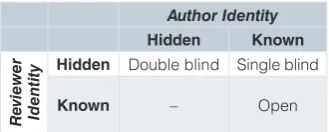
Table 1. Types of reciprocal identification or anonymity in the peer review process.
Author Identity
Hidden Known
R
eview
er
Identity
Hidden Double blind Single blind
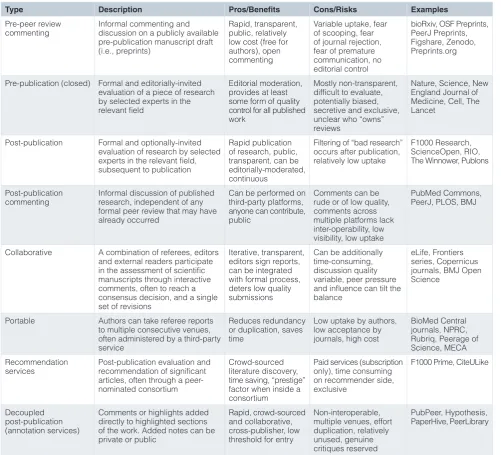
Table 2. Advantages and disadvantages of the different approaches to peer review. Note that combinations of these approaches can co-exist. NPRC: Neuroscience Peer Review Consortium.
Type Description Pros/Benefits Cons/Risks Examples
Pre-peer review
commenting Informal commenting and discussion on a publicly available pre-publication manuscript draft (i.e., preprints)
Rapid, transparent, public, relatively low cost (free for authors), open commenting
Variable uptake, fear of scooping, fear of journal rejection, fear of premature communication, no editorial control
[image:11.612.59.561.108.563.2]bioRxiv, OSF Preprints, PeerJ Preprints, Figshare, Zenodo, Preprints.org
Pre-publication (closed) Formal and editorially-invited evaluation of a piece of research by selected experts in the relevant field
Editorial moderation, provides at least some form of quality control for all published work
Mostly non-transparent, difficult to evaluate, potentially biased, secretive and exclusive, unclear who “owns” reviews
Nature, Science, New England Journal of Medicine, Cell, The Lancet
Post-publication Formal and optionally-invited evaluation of research by selected experts in the relevant field, subsequent to publication
Rapid publication of research, public, transparent, can be editorially-moderated, continuous
Filtering of “bad research” occurs after publication, relatively low uptake
F1000 Research, ScienceOpen, RIO, The Winnower, Publons
Post-publication
commenting Informal discussion of published research, independent of any formal peer review that may have already occurred
Can be performed on third-party platforms, anyone can contribute, public
Comments can be rude or of low quality, comments across multiple platforms lack inter-operability, low visibility, low uptake
PubMed Commons, PeerJ, PLOS, BMJ
Collaborative A combination of referees, editors and external readers participate in the assessment of scientific manuscripts through interactive comments, often to reach a consensus decision, and a single set of revisions
Iterative, transparent, editors sign reports, can be integrated with formal process, deters low quality submissions
Can be additionally time-consuming, discussion quality variable, peer pressure and influence can tilt the balance
eLife, Frontiers series, Copernicus journals, BMJ Open Science
Portable Authors can take referee reports to multiple consecutive venues, often administered by a third-party service
Reduces redundancy or duplication, saves time
Low uptake by authors, low acceptance by journals, high cost
BioMed Central journals, NPRC, Rubriq, Peerage of Science, MECA Recommendation
services Post-publication evaluation and recommendation of significant articles, often through a peer-nominated consortium
Crowd-sourced literature discovery, time saving, “prestige” factor when inside a consortium
Paid services (subscription only), time consuming on recommender side, exclusive
F1000 Prime, CiteULike
Decoupled post-publication (annotation services)
Comments or highlights added directly to highlighted sections of the work. Added notes can be private or public
Rapid, crowd-sourced and collaborative, cross-publisher, low threshold for entry
Non-interoperable, multiple venues, effort duplication, relatively unused, genuine critiques reserved
PubPeer, Hypothesis, PaperHive, PeerLibrary
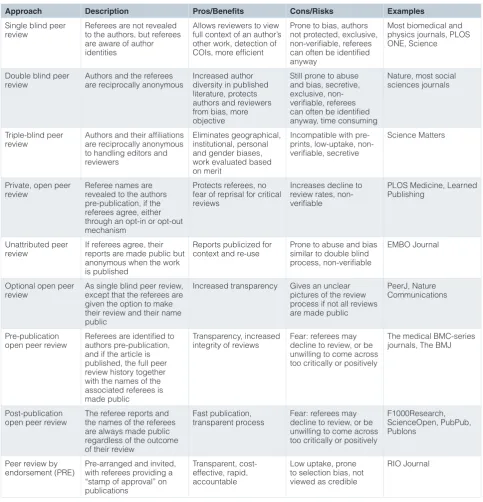
How and where we inject transparency has implications for the magnitude of transformation required and, therefore, the gen-eral concept of OPR is highly heterogeneous in meaning, scope, and consequences. A recent survey by OpenAIRE found 122 dif-ferent definitions of OPR in use, exemplifying the extent of this issue. This diversity was distilled into a single proposed definition comprising seven different traits of OPR: participation, identity, reports, interaction, platforms, pre-review manuscripts, and final-version commenting (Ross-Hellauer, 2017). The various parts of the “revolutionary” phase of peer review undoubtedly have differ-ent combinations of these OPR traits, and it remains a very hetero-geneous landscape. Table 3 provides an overview of the advantages
and disadvantages of the different approaches to anonymity and openness in peer review.
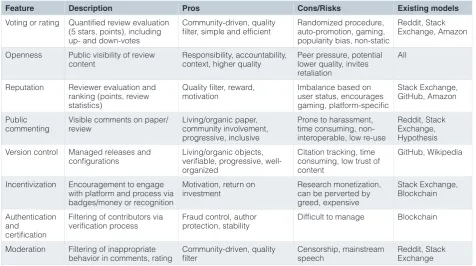
The ongoing discussions and innovations around peer review (and OPR) can be sorted into four main categories, which are examined in more detail below. Each of these feed into the wider core issues in peer review of incentivizing engagement, providing appropriate recognition and certification, and quality control and moderation:
1. How can referees receive credit or recognition for their work, and what form should this take;
Table 3. Pros and cons of different approaches to anonymity in peer review.
Approach Description Pros/Benefits Cons/Risks Examples
Single blind peer
review Referees are not revealed to the authors, but referees are aware of author identities
Allows reviewers to view full context of an author’s other work, detection of COIs, more efficient
Prone to bias, authors not protected, exclusive, non-verifiable, referees can often be identified anyway
Most biomedical and physics journals, PLOS ONE, Science
Double blind peer
review Authors and the referees are reciprocally anonymous Increased author diversity in published literature, protects authors and reviewers from bias, more objective
Still prone to abuse and bias, secretive, exclusive, non- verifiable, referees can often be identified anyway, time consuming
Nature, most social sciences journals
Triple-blind peer
review Authors and their affiliations are reciprocally anonymous to handling editors and reviewers
Eliminates geographical, institutional, personal and gender biases, work evaluated based on merit
Incompatible with pre-prints, low-uptake, non- verifiable, secretive
Science Matters
Private, open peer
review Referee names are revealed to the authors pre-publication, if the referees agree, either through an opt-in or opt-out mechanism
Protects referees, no fear of reprisal for critical reviews
Increases decline to review rates, non-verifiable
PLOS Medicine, Learned Publishing
Unattributed peer
review If referees agree, their reports are made public but anonymous when the work is published
Reports publicized for
context and re-use Prone to abuse and bias similar to double blind process, non-verifiable
EMBO Journal
Optional open peer
review As single blind peer review, except that the referees are given the option to make their review and their name public
Increased transparency Gives an unclear pictures of the review process if not all reviews are made public
PeerJ, Nature Communications
Pre-publication
open peer review Referees are identified to authors pre-publication, and if the article is published, the full peer review history together with the names of the associated referees is made public
Transparency, increased
integrity of reviews Fear: referees may decline to review, or be unwilling to come across too critically or positively
The medical BMC-series journals, The BMJ
Post-publication
open peer review The referee reports and the names of the referees are always made public regardless of the outcome of their review
Fast publication,
transparent process Fear: referees may decline to review, or be unwilling to come across too critically or positively
F1000Research, ScienceOpen, PubPub, Publons
Peer review by
endorsement (PRE) Pre-arranged and invited, with referees providing a “stamp of approval” on publications
Transparent, cost-effective, rapid, accountable
Low uptake, prone to selection bias, not viewed as credible
RIO Journal
3. Should referees remain anonymous or have their identities disclosed;
4. Should peer review occur prior or subsequent to the publica-tion process (i.e., publish then filter).
2.2 Giving credit to peer reviewers
A vast majority of researchers see peer review as an integral and fundamental part of their work Mulligan et al. (2013). They often
(Larsen & Von Ins, 2010). Some estimates are even as high as 2–2.5 million per year (Plume & van Weijen, 2014), and this number is expected to double approximately every nine years at current rates (Bornmann & Mutz, 2015). Several potential solutions exist to make sure that the review process does not cause a bottleneck in the current system:
• Increase the total pool of potential referees,
• Editorial staff more thoroughly vet submissions prior to send-ing for review,
• Increase acceptance rates to avoid review duplication,
• Impose a production cap on authors,
• Decrease the number of referees per paper, and/or
• Decrease the time spent on peer review.
Of these, the latter two can both potentially reduce the quality of peer review and therefore affect the overall quality of published research. Paradoxically, while the Web empowers us to communi-cate information virtually instantaneously, the turn around time for peer reviewed publications remains quite long by comparison. One potential solution is to encourage referees by providing additional recognition and credit for their work. The present lack of bona fide incentives for referees is perhaps one of the main factors responsi-ble for indifference to editorial outcomes, which ultimately leads to the increased proliferation of low quality research (D’Andrea & O’Dwyer, 2017; Jefferson et al., 2007; Wang et al., 2016).
2.2.1 Traditional methods of recognition. One current way to recognize peer reviewers is to thank anonymous referees in the Acknowledgement sections of published papers. In these cases, the referees will not receive any public recognition for their work, unless they explicitly agree to sign their reviews. Generally, journals do not provide any remuneration or compensation for these services. Notable exceptions are the UK-based publisher Veruscript (veruscript.com/about/who-we-are) and Collabra (collabra.org/ about/our-model), published by University of California Press. Other journals provide reward incentives to reviewers, such as free subscriptions or discounts on author-facing open access fees. Another common form of acknowledgement is a private thank you note from the journal or editor, which usually takes the form of an automated email upon completion of the review. In addi-tion, journals often list and thank all reviewers in a special issue or on their website once a year, thus providing another way to recognise reviewers. Some journals even offer annual prizes to reward exceptional referee activities (e.g., the Journal of Clinical Epidemiology; www.jclinepi.com/article/S0895-4356(16)30707-7/fulltext). Another idea that journals and publishers have tried implementing is to list the best reviewers for their journal (e.g., by Vines (2015a) for Molecular Ecology), or, on the basis of a suggestion by Pullum (1984), naming referees who recom-mend acceptance in the article colophon (a single blind version of this recommendation was adopted by Digital Medievalist from 2005–2016; see Wikipedia contributors, 2017, and bit.ly/ DigitalMedievalistArchive for examples preserved in the Inter-net Archive). Digital Medievalist stopped using this model and removed the colophon as part of its move to the Open Library of
Humanities; cf. journal.digitalmedievalist.org). As such, authors can then integrate this into their scholarly profiles in order to differentiate themselves from other researchers or referees. Currently, peer review is poorly acknowledged by practically all research assessment bodies, institutions, granting agencies, as well as publishers, in the process of professional advancement or evaluation. Instead, it is viewed as expected or normal behaviour for all researchers to contribute in some form to peer review.
2.2.2 Increasing demand for recognition. These traditional approaches of credit fall short of any sort of systematic feed-back or recognition, such as that granted through publications. A change here is clearly required for the wealth of currently unrewarded time and effort given to peer review by academics. A recent survey of nearly 3,000 peer reviewers by the large pub-lisher Wiley showed that feedback and acknowledgement for work as referees are valued far above either cash reimbursements or payment in kind (Warne, 2016) (although Mulligan et al. (2013)
found that referees would prefer either compensation by way of free subscriptions, or the waiver of colour or other publication charges). Wiley’s survey reports that 80% of researchers agree that there is insufficient recognition for peer review as a valuable research activity and that researchers would actually commit more time to peer review if it became a formally recognized activity for assessments, funding opportunities, and promotion (Warne, 2016). While this may be true, it is important to note that commercial publishers have a vested interest in retaining the current, freely provided service of peer review, since this is what provides their journals the main stamp of legitimacy and quality (“added value”) as society-led journals. Therefore, one of the root causes for the lack of appropriate recognition and incentivization is publish-ers with have strong motivations to find non-monetary forms of reviewer recognition. Indeed, the business model of almost every scholarly publisher is predicated on free work by peer reviewers, and it is unlikely that the present system would function financially with market-rate reimbursement for reviewers. Other research shows a similar picture, with approximately 70% of respondents to a small survey done by Nicholson &Alperin (2016) indicating that they would list peer review as a professional service on their curriculum vitae. 27% of respondents mentioned formal recogni-tion in assessment as a factor that would motivate them to partici-pate in public peer review. These numbers indicate that the lack of credit referees receive for peer review is likely a strong con-tributing factor to the perceived stagnation of traditional models. Furthermore, acceptance rates are lower in humanities and social sciences, and higher in physical sciences and engineering jour-nals (Ware, 2008), as well as differences based on relative referee seniority (Casnici et al., 2017). This means there are distinct discipli-nary variations in the number of reviews performed by a researcher relative to their publications, and suggests that there is scope for using this to either provide different incentive structures or to increase acceptance rates and therefore decrease referee fatigue (Fox et al., 2017; Lyman, 2013).