1 Full title:
The challenge of measuring IL-33 in serum using commercial ELISA: Lessons from asthma.
Running title:
Measuring serum IL-33 in asthma
M.E. Ketelaar1,2, 3,*, M.C. Nawijn2, D.E. Shaw1, G.H. Koppelman3,#, I. Sayers1,# 1. Division of Respiratory Medicine, University of Nottingham, Nottingham, United Kingdom;
2. University of Groningen, University Medical Center Groningen, Department of Pathology and Medical Biology, Laboratory
of Allergology and Pulmonary Diseases, Groningen, The Netherlands;
3. University of Groningen, University Medical Center Groningen, Pediatric Pulmonology and Pediatric Allergology, Beatrix
Children’s Hospital, Groningen Research Institute for Asthma and COPD, Groningen, The Netherlands.
# These authors share senior authorship
*Corresponding author: e-mail [email protected], tel +31 50 361 1107, fax +31 50 361 1704
2 Abstract
Background- Interleukin-33 (IL-33) has been subject of extensive study in the context of
inflammatory disorders, particularly in asthma. Many human biological samples, including serum, have been used to determine the protein levels of IL-33, aiming to investigate its involvement in asthma. Reliable methods are required to study the association of IL-33 with disease, especially
considering the complex nature of serum samples.
Objective- We evaluated four IL-33 ELISA kits, aiming to determine a robust and reproducible
approach to quantifying IL-33 in human serum from asthma patients.
Methods- IL-33 levels were investigated in serum of well-defined asthma patients by the Quantikine,
DuoSet (both R&D systems), ADI-900-201 (Enzo Life Sciences), and SKR038 (GenWay Biotech Inc San Diego USA) immunoassays, as well as spiking experiments were performed using recombinant
IL-33 and its soluble receptor IL-1RL1-a.
Results- We show that 1) IL-33 is difficult to detect by ELISA in human serum, due to lack of
sensitivity and specificity of currently available assays; 2) human serum interferes with IL-33 quantification, in part through IL-1RL1-a; 3) using non-serum certified kits may lead to spurious
findings.
Conclusion and Clinical Relevance- If IL-33 is to be studied in the serum of asthma patients and other
diseases, a more sensitive and specific assay method is required, which will be vital for further understanding and targeting of the IL-33/IL-1RL1 axis in human disease.
3 To the editor:
Accumulating evidence suggests that Interleukin-33 (IL-33) and its receptor
Interleukin-1-receptor-like-1 (IL-1RL1, also called ST2) play a critical role in the pathogenesis of asthma. Multiple genetic association studies and meta-analyses have identified several independent polymorphisms in the IL33 and IL1RL1 regions that are associated with human asthma (reviewed in [1,2]). IL-33 is an alarmin
released from damaged cells, including the lung epithelium, following allergic, viral or bacterial stimuli [1,3]. Extracellular IL-33 induces IL-1RL1 signalling, activating innate and adaptive immune cells,
including innate type 2 helper cells (ILC2) and Th2 cells, resulting in increased production of type-2 cytokines IL-4, IL-5 and IL-13 [3].
IL-33 is produced as a full length (IL-33FL) 32kDa protein, which is the active form of IL-33, released upon necrosis of structural cells [1,3]. IL-33FL can be cleaved by caspases-1, -3, and -7 at
D178, resulting in IL-33179-270, which is believed to result in inactivation of IL-33 during apoptosis, a
non-immunogenic programmed cell death [4]. IL-33FL can also be cleaved by the (neutrophil) enzymes
elastase (IL-3395-270,) cathepsin G (IL-3399-270) and proteinase 3 (IL-33109-270), whilst retaining its activity
[4].
When not appropriately regulated, extracellular IL-33 could contribute to chronic or exaggerated type-2 inflammation. A well-described regulatory mechanism of (extracellular) IL-33 is its
capture by the soluble form of its receptor (IL-1RL1-a or sST2), thereby preventing the immunogenic activity of extracellular IL-33 [1,4]. In asthma, the IL-33/IL-1RL1 pathway seems to be dysregulated. Indeed, IL-33 levels have been reported to be increased in induced sputum, bronchial lavage fluid
(BALF) and lung epithelial cells of patients with asthma compared to non-asthmatic controls [5,6]. Despite these studies, it is unknown whether serum levels of IL-33 represent a suitable biomarker for
asthma or subgroups of asthma.
In the current study we set out to investigate the level of IL-33 in serum of well-characterised
patients with asthma, aiming to evaluate its suitability as a biomarker for asthma phenotypes. Since this requires a robust method to quantify IL-33 in human serum, we evaluated four human IL-33 ELISA
kits including three assays specifically designed for serum samples (Quantikine® by R&D systems Abingdon UK, ADI-900-201® by Enzo LifeScience Exeter UK, SKR038® by GenWay Biotech San
Diego USA). We also included an assay for quantification of IL-33 in general biological samples (DuoSet® by R&D systems Abingdon UK). For IL-33 quantification we obtained serum samples from
45 asthma patients recruited from both Groningen and Nottingham (mild asthma n=25, moderate asthma n=10, severe asthma n=10, based on the GINA 2012 criteria, http://www.ginasthma.org/), of whom
n=17 (mild asthma n=7, moderate asthma n=5, severe asthma n=5) were used across all four methods. Serum was separated from whole blood samples in serum separating tubes using centrifugation after a 2040 minutes clotting time at room temperature. Serum was aliquoted and immediately frozen at
4 at -80oC, while working tubes were stored at -20oC. Care was taken to keep identical freeze/thaw cycles
among the comparisons.
Both studies had approval of local medical ethical committees and patients had given written informed consent. Recombinant IL-33 (from each of the kits) and IL-1RL1-a (sST2; from R&D) were used to determine specificity, sensitivity and interference of IL-1RL1 in each of the assays.
Using the three kits specifically designed for serum, the level of IL-33 was at or below the lower limit of detection (LLD) in serum from asthma patients (table 1 and figure 1, LLD being the
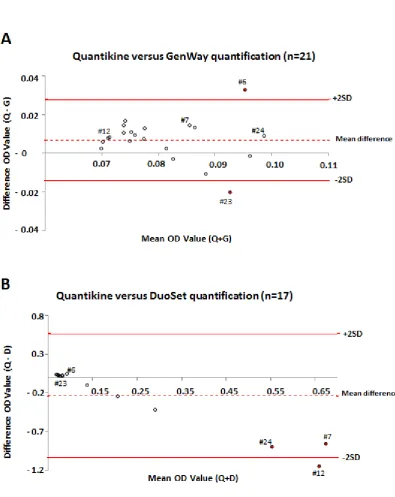
detection limit as defined by each manufacturer). In contrast, the DuoSet showed a clear signal above the LLD in 76% of the samples, and a higher signal in ~17.5% of the serum samples. Indeed, when
directly compared to the other assays, the DuoSet assay showed multiple deviating values, some of which were in a tenfold higher range (figure 1B). This discrepancy is striking, and could not easily be
explained by possible confounding factors, such as asthma severity.
To evaluate specificity and sensitivity of the assays, we tested whether these were able to
accurately quantify a known concentration of IL-33 when serum was present or in the presence of its soluble receptor IL-1RL1-a. This is important as IL-33 may exist in both free and IL-1RL1-a
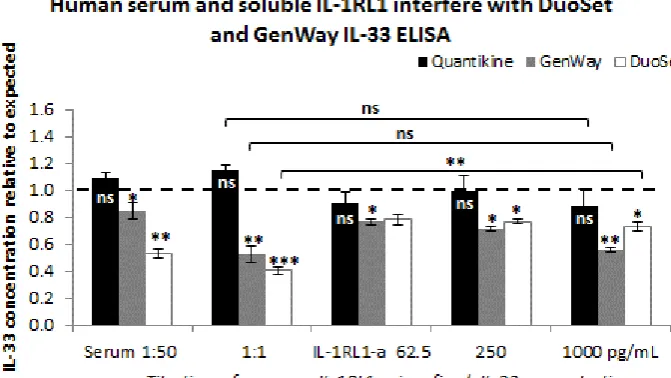
complexed forms in serum [1,4]. Both serum and recombinant IL-1RL1-a interfered significantly with the quantification of IL-33 in two of these ELISA kits (figure 1C). The Quantikine kit showed
accurate detection of recombinant IL-33 irrespective of serum dilution and presence of IL-1RL1-a, indicating its technical feasibility of measuring IL-33 in serum, at least up to its LLD. These data strongly suggest that the high IL-33 measurements using the DuoSet kit in our asthma patients are
unreliable, as the more sensitive and specific Quantikine kit did not measure IL-33 in any of these serum samples.
The overall lack of IL-33 detection in our serum samples suggests that IL-33 is present at very low levels in serum of these patients limiting our ability to study serum IL-33. Therefore, the activity
of the IL-33/IL-1RL1 pathway might specifically be increased in severe asthma or during exacerbations, as suggested by studies correlating IL-33/IL-1RL1 levels with asthma severity [5-7], or it may indicate
that serum is not the best compartment to study IL-33 levels, as IL-33 protein has previously been detected in BALF of patients with mild and moderate asthma severity [5].
Another explanation for the lack of detection of 33 in serum samples would be that the IL-33 present in serum has undergone posttranslational modifications that preclude its detection by the
antibodies used in these kits, such as cleavage by cathepsins or elastase. Unfortunately, detailed information on the exact IL-33 epitope detected by the antibodies used in these ELISA kits is lacking
to experimentally test this. As far as we are aware, no (proteomics) study has investigated the exact protein isoforms of IL-33 present in human serum, which we think are useful to enable the development of methods to detect specific IL-33 isoforms, and to improve the availability of such information.
IL-1RL1-5 a (sST2) interfere with accurate quantification of IL-33 in a dose dependent manner in the GenWay and DuoSet ELISA kits. Hence, the level of IL-1RL1-a in serum should perhaps be treated as a covariate
when using these kits. Nevertheless, since the maximum interfering effect of IL-1RL1-a is less than the effect of serum, at least in the DuoSet (see figure 1C), other factors may be present in serum that interfere with accurate detection of IL-33, such as serum globulins and albumins, potentially further
complicating the use of these assays.
Other studies in allergic disorders have reported difficulties in detecting IL-33 in serum using ELISA;
ranging from zero positive samples (n=24 allergic rhinitis patients using the Quantikine kit [8]) to detectable values in every sample, but at the lower range of the standard curve (n= 37 wheezing children
using the GenWay kit [6]). Furthermore, also in a non-allergic inflammatory disorder (Sjögren), measurement of IL-33 by the currently used immunoassays was shown to be problematic [9]. Digital
or multiplex immunoassays could be promising novel methods in the measurement of IL-33 [10]. In summary, we show that 1) IL-33 is difficult to detect by ELISA in human serum, due to lack
of sensitivity and specificity of currently available assays 2) human serum interferes with IL-33 quantification in part through IL-1RL1-a, 3) using non serum certified kits may lead to spurious
6 Author contributions: M. Ketelaar/M. Nawijn/G. Koppelman/I. Sayers designed the study.
M. Ketelaar completed the experimental work and statistical analyses. D. Shaw and G. Koppelman were the collectors of clinical samples and patient information. All authors contributed to the design,
interpretation of data, and revision of the article. All authors had access to the data and read and approved the final manuscript.
Acknowledgements: M. Ketelaar was supported by a joint ERS/EMBO Long-Term Research
Fellowship 2013-2060, as part of her MD-PhD program. The Dutch Asthma Study (G. Koppelman) was funded by the Netherlands Lung Foundation, grants 95.09, 98.48 and 3.2.09.081JU. The Asthma
UK Study (I. Sayers) was supported by Asthma UK Grant AUK-PG-2013-188. MEC approval numbers are MREC/99/4/001 and UK CRN 11820/IRAS 97142.
Competing interests statement: The funders had no role in study design; the collection, analysis, and interpretation of data; the writing of the article; nor the decision to submit it for publication.
7 Tables+Figure:
Table 1 Percentage of positive signals for each IL-33 immunoassay.
Shown are the discrepancies between the relative number of positive signals for the Quantikine, GenWay, EnzoLS and DuoSet IL-33 immunoassays, by comparing the percentage of signals above background and above the lower limit of detection of each assay. * background based on the 95%CI of the value of the blank well of the assay, ** based on the 95%CI of the lower limit of detection each assay, CI= confidence interval. LLD=Lower limit of detection of each kit, as defined by the manufacturer of each assay: Quantikine
[image:7.595.73.529.133.239.2](6.25pg/mL), GenWay 31.25pg/mL),Enzo LS (3.4pg/mL) and DuoSet (23.4pg/mL). Table 1. Percentage of positive signals for each IL-33 immunoassay
IL-33 assay N % of samples above background* % of samples above LLD**
Quantikine 45 38 2
GenWay 22 23 0
Enzo LS 17 8 0
9
Figure 1 Comparison of IL-33 immunoassays and identification of potential confounders.
The upper Bland Altman Plot [fig. A] compares Optical Density (OD) values of the IL-33 immunoassays Quantikine (Q) and GenWay (G), (n=21); similar data wereobserved when comparing Quantikine or GenWay to the EnzoLS kit (data not shown, n=17).
The lower Bland Altman Plot [fig. B] compares the OD values of the Quantikine kit with the DuoSet (D) kit (n=17); which is representative for the comparison of the EnzoLS and GenWay assay to DuoSet (not shown, n=17). In the plots, the difference in OD value of each sample as measured by Quantikine versus GenWay (Q-G=Quantikine minus GenWay), respectively Quantikine versus DuoSet (Q-D= Quantikine minus DuoSet) is depicted on the y-axis. This is set against the average of the OD value for each sample as measured by the two compared kits (x-axis: Q+G= mean OD value of Quantikine and GenWay for each sample, Q+D= mean OD value of Quantikine and DuoSet) . Red dots indicate deviating samples (>1SD from the mean difference). Unique identifiers (#) labeling these deviating samples enable comparison between panels (A) and (B). In fig. C, the influence of serum or IL-1RL1-a on IL-33 detection is shown.
X-axis: Serum (1:50 or 1:1) or IL-1RL1-a (62.5, 250, 1000 pg/mL final concentration) was spiked into a fixed (end) concentration of recombinant IL-33, being the middle of each kits’ standard curve (IL-33 concentration of 50 pg/mL, 250 pg/mL, 187.5 pg/mL for Quantikine, GenWay and DuoSet respectively).
Y-axis: the measured IL-33 concentration is expressed as proportion of the expected IL-33 concentration. Groups are compared by ANOVA, using Games-Howell post-hoc testing. Results of the statistical comparison between measured IL-33 concentration and expected IL-33 concentration are indicated, as well as differences in measured IL-33 concentrations after addition of 1000 pg/mL IL-1RL-1a versus addition of 1:1 serum. Note: 1000pg/mL represents the maximum interfering effect of IL-1RL-1a, as no differences with 2000 pg/mL and 4000 pg/mL were found (p>0.3 compared to 1000 pg/ml IL-1RL-1a, not shown.)
Values are based on duplicate readings of an N=2-3 experimental replicates.
10 References
1. Grotenboer NS, Ketelaar ME, Koppelman GH, Nawijn MC. Decoding asthma: translating genetic variation in IL33 and IL1RL1 into disease pathophysiology. The Journal of allergy and clinical immunology 2013 Mar;131(3):856-65.
2. Portelli MA, Hodge EF, Sayers I. Genetic risk factors for the development of allergic disease identified by genome-wide association. Clinical and experimental allergy: journal of the British Society for Allergy and Clinical Immunology 2015 Jan;45(1):21-31.
3. Licona-Limon P, Kim LK, Palm NW, Flavell RA. TH2, allergy and group 2 innate lymphoid cells. Nature immunology 2013 Jun;14(6):536-42.
4. Afonina IS, Muller C, Martin SJ, Beyaert R. Proteolytic Processing of Interleukin-1 Family Cytokines: Variations on a Common Theme. Immunity 2015 Jun 16;42(6):991-1004.
5. Prefontaine DF, Nadigel J, Chouiali F, Audusseau S, Semlali A, Chakir J, Martin JG, Hamid Q. Increased IL-33 expression by epithelial cells in bronchial asthma. The Journal of allergy and clinical immunology 2010 Mar;125(3):752-4.
6. Hamzaoui A, Berraies AF, Kaabachi WF, Haifa MF, Ammar JF, Kamel H. Induced sputum levels of IL-33 and soluble ST2 in young asthmatic children. The Journal of asthma: official journal of the Association for the Care of Asthma 2013 Oct;50(8):803-9.
7. Guo Z, Wu JF, Zhao JF, Liu FF, Chen YF, Bi LF, Liu SF, Dong L. IL-33 promotes airway remodeling and is a marker of asthma disease severity. The Journal of asthma: official journal of the Association for the Care of Asthma 2014 Oct;51(8):863-9.
8. Asaka D, Yoshikawa MF, Nakayama TF, Yoshimura TF, Moriyama HF, Otori N. Elevated levels of interleukin-33 in the nasal secretions of patients with allergic rhinitis. International archives of allergy and immunology 2012;158 Suppl 1:47-50.
9. Rivière E, Ly B, Boudaoud S, Chavez H, Nocturne G, Chanson P, Miceli Richard C, Mariette X. Pitfalls for detecting interleukin-33 by ELISA in the serum of patients with primary Sjögren syndrome: comparison of different kits. Ann Rheum Dis. 2015 Dec. [Epub ahead of print]