Support for Evolving Software Architectures in the ArchWare ADL
1
Ron Morrison,
1Graham Kirby,
1Dharini Balasubramaniam,
1Kath Mickan,
2Flavio Oquendo,
2
Sorana Cîmpan,
3Brian Warboys,
3Bob Snowdon,
3R Mark Greenwood
1
School of Computer Science, University of St Andrews, St Andrews, Fife KY16 9SS, UK
2
ESIA, Université de Savoie, 5 Chemin de Bellevue, 74940 – Annecy-le-Vieux, France
3
Department of Computer Science, University of Manchester, Manchester M13 9PL, UK
{ron, graham, dharini, kath}@dcs.st-and.ac.uk
{Flavio.Oquendo, Sorana.Cimpan}@esia.univ-savoie.fr
{brian, rsnowdon, markg}@cs.man.ac.uk
Abstract
Software that cannot evolve is condemned to atrophy: it cannot accommodate the constant revision and re-negotiation of its business goals nor intercept the poten-tial of new technology. To accommodate change in soft-ware systems we have defined an active softsoft-ware archi-tecture to be: dynamic in that the structure and cardinal-ity of the components and interactions are changeable during execution; updatable in that components can be replaced; decomposable in that an executing system may be (partially) stopped and split up into its components and interactions; and reflective in that the specification of components and interactions may be evolved during execution.
Here we describe the facilities of the ArchWare archi-tecture description language (ADL) for specifying active architectures. The contribution of the work is the unique combination of concepts including: a -calculus based communication and expression language for specifying executable architectures; hyper-code as an underlying representation of system execution that can be used for introspection; a decomposition operator to incrementally break up executing systems; and structural reflection for creating new components and binding them into running systems.
1
Introduction
Software architectures [1, 2] describe systems in terms of their components and interactions between compo-nents. We define an active software architecture to be: dynamic in that the structure and cardinality of the com-ponents and interactions are changeable during execution; updatable in that components can be replaced dynami-cally; decomposable in that an executing system may be (partially) stopped and split up into its components and
interactions; and reflective in that the specification of components and interactions may be evolved during exe-cution.
Active architectures address problems of co-evolution in dynamically changing commercial environments where business changes create pressures on the software to evolve, and at the same time technology changes create pressures on the business to evolve. The business effects of introducing, or changing, such software systems are often emergent and require their software architecture models to accommodate their demands by being dynami-cally evolvable themselves.
Often evolution is achieved by taking the system off-line, editing and re-compiling the source code, and finally rebinding or starting up the new system. In many cases, especially in long-lived systems, such an approach is in-feasible since: the source code may no longer be available; there may be valuable data encapsulated in the closure of executing components; the cost of assembly may be pro-hibitive; or down-time may not be an option. Examples of such systems include: continuously running business process models; autonomic systems; GRID applications; self-adapting/tuning systems; peer-to-peer routing sys-tems; control syssys-tems; and pervasive computing applica-tions.
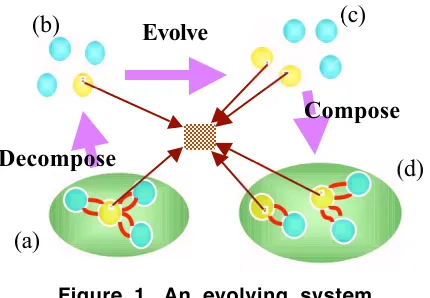
Figure 1. An evolving system
The essence of an active architecture is that it encom-passes the evolution of the architectural specification (model) as well as the evolution of the enacted system. Our claim is that active architectures require a paradigm shift in ADLs.
This paper describes the ArchWare Architecture De-scription Language [3], which is sufficiently rich to pro-vide executable specifications of active systems. We de-fine a core language on which architectural styles can be layered and on which a construction methodology can be applied. Our focus is on the base technologies required to support dynamic and evolvable systems including: a -calculus based communication and expression language for specifying executable architectures; hyper-code as an underlying representation of system execution that can be used for introspection; a decomposition operator to in-crementally break up executing systems; and structural reflection for creating new components and binding them into running systems. The contribution of the work is the unique combination of these concepts.
2
Related work
Hitherto researchers have proposed many formal ADLs for representing and analysing architectural designs. Ad-age [4] supports the use of architectural frameworks in the avionics industry; Aesop [5] has architectural styles; MetaH [6] has specific guidance for real-time avionics control software; SADL [7] provides a formal basis for architectural refinement; C2 [8] supports the description of user interface systems; Wright [9] supports the specifi-cation and analysis of interactions and UniCon [10] sup-ports a mixture of heterogeneous component and connec-tor types.
Gerel [11] accommodates changes that are robust to system evolution. It supports the definition of generic programmed changes and provides for changes that are only applied when a precondition is satisfied by the cur-rent configuration.
LEDA [12] is an ADL based on the -calculus which aims to address problems of refinement and validation by combining formal methods with object-oriented concepts. Systems can be checked for compatibility before being
composed. Re-use is encouraged by polymorphism of behaviours, which allows architectures to be parameter-ised.
Containment Units [13] provide a mechanism for deal-ing with anticipated change. ArchStudio [14] is a tool suite that supports architecture-based development. Changes are made to an architectural model and then rei-fied into implementation by a runtime architecture infra-structure. In [15], specific component managers identify external architecture changes by listening to events, and then react in order to preserve architecture constraints. The constraints themselves cannot be evolved.
Darwin [16] is a declarative binding language for building distributed systems, which is based on the -calculus. It has a similar structure to the ArchWare ADL but a more limited approach to evolution. In Darwin, evolution is restricted to the creation of new bindings between components and the instantiation of new compo-nents. Dynamic instantiation is either lazy or direct. In lazy instantiation, instances of a component are created, as they are needed in the computation. In direct instantia-tion, a component’s context is statically defined, but the component itself can be defined in a ‘meta-level configu-ration’, essentially a Darwin script, and instantiation driven by interpreting this script at run-time.
ArchJava [17] is an extension to Java that unifies a system’s software architecture and implementation. The type system ensures that implementation code conforms to architectural constraints. It provides for dynamic archi-tectures only in that statically defined components can be dynamically instantiated and connected.
Each ADL has its own focus according to needs and taste with little integration of the overlapping ADL con-cepts. ACME [18] is an attempt at such integration but does it at the level of a lowest common denominator.
Most work on ADLs concentrates on the specification and enactment model where the formal properties of the system are specified, analysed and then executed. Where dynamic evolution is considered, its scope is limited and it is treated as distinct from the initial system develop-ment. The focus of the ArchWare project [19] is in evolv-ing systems, with emergent properties, where the system is executing continuously. The model specification and the model enactment are both regarded as part of a single executing state. At any point in time the model specifica-tion will be an accurate descripspecifica-tion of the model execu-tion.
Our work on hyper-code intersects Intentional Pro-gramming [20], which creates a proPro-gramming environ-ment based on a graph representation of the program. Compilation invokes generators that operate over the graph to assemble the program.
3
Change in active architectures
We have identified three architectural kinds of change in active architectures. These are:
Evolve
Compose
Decompose
(a)
(b)
(c)
[image:2.612.71.286.77.226.2]• Dynamic change: allows the topology of the compo-nents and interactions to be changed dynamically. New components and interactions may be created during execution.
• Update change: allows components to be replaced. • Evolutionary change: allows the specification of the
components and interactions to be changed during execution.
There are three main stages involved in evolving active architectures:
• deciding when changes are required; all changes are made in response to some stimulus
• deciding what changes are required in reaction to the stimulus and the environment
• applying the change via an appropriate change mechanism
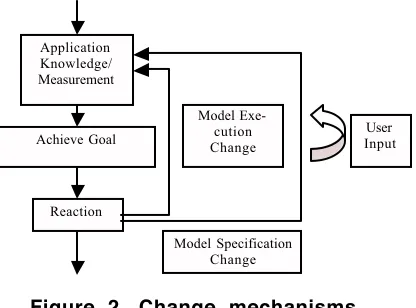
Taken from the field of control systems, Figure 2 shows how application knowledge, obtained by measure-ment perhaps, is used to achieve a goal, causing a reac-tion. The reaction may be to continue execution or to initiate some change mechanism.
Figure 2. Change mechanisms
In an active architecture the specification of the archi-tectural model changes with the model execution. Thus changes during execution will change the specification and changes to the specification will affect the execution. However at any time in the execution of the model the specification is dynamically up-to-date.
In the ArchWare ADL we have provided a number of change mechanisms reflecting our estimate of the fre-quency of the expected type of change. Dynamic change and update change are made using mechanisms built into the specification language. For example, this may be add-ing more components to execute in parallel or passadd-ing components to other components through connections (dynamic change) or replacing a component from a library of parts by assignment (update change).
Evolutionary change is characterised by changing specifications and requires a reflective system. That part of the system to be changed is stopped, its specification altered and the new specification enacted in the executing model. Evolutionary change may be implemented using introspection on the component to be changed to yield its
specification, and reflection to rebind the new specifica-tion. The reflection itself can use existing specifications to make the alterations. In the limit user input may be necessary to accommodate unpredicted emergent behav-iour.
4
ArchWare overview
This work is undertaken within the EC funded Arch-Ware software architecture framework. The ArchArch-Ware pro-ject takes a holistic view of software development. Its aims are to advance and integrate research on software architecture and reflective systems to develop languages, frameworks and tools for architecting and engineering dynamic and evolvable software systems. The important aspects of the ArchWare approach can be described as fol-lows:
• a formal, style-based, executable architecture descrip-tion language to describe architectural structure, be-haviour, qualities and evolution of systems
• a suite of tools based on the ADL for architecture design and analysis
• run-time and environment framework to support the development and deployment of software systems and coordination of design and analysis tools • generic and customisable process models for
evolu-tionary, architecture-centric development of software systems
5
The ArchWare Style Language
The ArchWare style language provides a framework for formalising software architectures based on the concepts of components and connectors. It is used to define fami-lies of architectures that have common structure and sat-isfy the same properties.
The style language makes use of both the underlying ArchWare ADL (see Section 6) and the ArchWare AAL (Architecture Analysis Language). The structure and be-haviour of an architecture family are specified using the ADL while the constraints on the family are specified using the AAL.
Styles in ArchWare are defined as property-guarded ab-stractions that may be applied to yield instances of an architecture conforming to the style.
A style definition consists of the following parts: • types
• constituent elements • constraints
• analysis
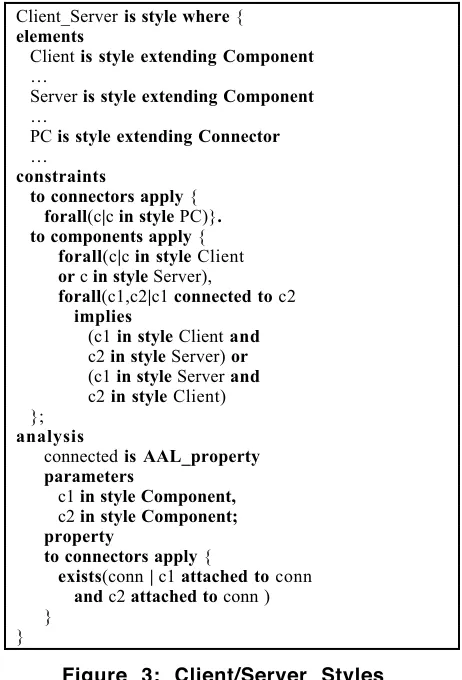
Figure 3 shows a specification of a Client-Server style. Client_Server defines three elements to be used in its specification. Client and Server are component styles whilePC (procedure call) is a connector style. Three con-straints are specified for Client_Server:
• a components can only be a Client or a Server • aClient can only be connected to a Server
Application Knowledge/ Measurement
Achieve Goal
Reaction
Model Exe-cution Change
User Input
[image:3.612.82.290.315.469.2]• aServer can only be connected to a Client
In the analysis part, connected checks whether two com-ponents are connected.
Client_Serveris style where {
elements
Clientis style extending Component
…
Serveris style extending Component
…
PCis style extending Connector
…
constraints
to connectors apply {
forall(c|cin style PC)}. to components apply {
forall(c|cin style Client
orcin style Server),
forall(c1,c2|c1connected to c2
implies
(c1in style Clientand
c2in style Server) or
(c1in style Serverand
c2in style Client) };
analysis
connectedis AAL_property parameters
c1in style Component,
c2in style Component; property
to connectors apply {
exists(conn|c1attached to conn
andc2attached to conn ) }
}
Figure 3: Client/Server Styles
The architecture styles can be used to specify evolution but can be also be part of the evolution of another com-ponent. The theorem provers and model checkers that ensure correctness must be integrated within the evolu-tionary process to spark change when a constraint is vio-lated, an issue for current research. Here we concentrate on the required environment and base technologies within the ArchWare ADL for dynamic expression and evolution. These include the following:
• a formal foundation based on higher-order -calculus [21] for specifying components of architectures with dynamic structure and cardinality
• integration of a -calculus based language for com-munication and an expression based language to yield executable specifications
• hyper-code as a representation for system execution to support reification
• adecompose operator essential to break up active systems into their components prior to evolution and recomposition
• structural reflection to support evolution
The theoretical foundation enables formal analysis of the architecture and proof of its desired properties. Execu-table specifications reduce the cost and complexity of
separately implementing the corresponding software sys-tems. The separation of concerns of co-ordination, com-munication and computation of components make the system easier to understand and evolve. Dynamic expres-sion is built into the constructs of the language. The fa-cilities for composition and reification together with sup-port for decomposition and reflection enable evolving systems.
Formal analysis of architectures in the ADL is per-formed at the style layer. The styles specify the desirable properties of the architecture and theorem provers and model checkers are used to verify these properties. It is important to note that the formal checking may be applied to a static description incrementally to a trace of the exe-cuting system. However, we concentrate here on the facili-ties for evolution in the ADL.
6
The ArchWare ADL
The ArchWare ADL is the simplest of a family of lan-guages designed for modelling active software architec-tures based on the concepts of -calculus, persistent pro-gramming and dynamic system composition and decom-position.
The ArchWare ADL is a strongly, and mostly stati-cally, typed persistent language. The ADL system con-sists of the language and its populated persistent envi-ronment and uses the persistent store to support itself. To model the component and communication algebra, the ADL supports the concepts of behaviours, abstractions of behaviours and connections between behaviours. Com-munication between components, represented by behav-iours, is via channels, represented by connections. For expressing data the language also supports a number of data types: integer,boolean,real,string, locations, views,sequences and higher order functions. These can be regarded as syntactic sugar since they can all be en-coded in the -calculus. The language also supports all the basic -calculus and expression based operations as well as composition and decomposition.
The ArchWare ADL is designed using the three princi-ples of abstraction, correspondence and type completeness [22-24].
• The principle of abstraction allows abstractions over every semantically meaningful syntactic category in the language. Thus functions are abstractions over expressions.
• The principle of correspondence states that the rules for introducing and using names should be the same throughout. In particular there should be a one-to-one correspondence between introducing names in decla-rations and as parameters.
• The principle of type completeness states that the rules for using data types must be complete with no gaps. For example, general rules for type construc-tors should have no exceptions.
[image:4.612.67.298.107.447.2] [image:4.612.66.297.110.447.2]power-ful. They are small in that there are no exceptions to the rules and powerful since every combination is valid. These properties are important in the design of hyper-code and its programmable interface (see later in Section 7).
The ArchWare ADL is designed using a layered ap-proach with the above-mentioned principles of program-ming language design guiding the process. Layering the language helps to separate different concerns. There are currently three layers in the ArchWare ADL:
• The base layer defines a coordination language with-out data values corresponding to non-higher-order monadic-calculus.
• The first order layer adds data values and abstractions and corresponds to non-higher-order polyadic -calculus.
• The higher order layer corresponds to higher-order polyadic-calculus. We present this layer in this pa-per.
6.1 The ArchWare ADL type system
The ArchWare ADL type system is based on the no-tion of types as a set structure imposed over the value space. Membership of the type sets is defined in terms of common attributes possessed by values, such as the op-erations defined over them. These sets or types partition the value space. They may be predefined, like integer, or they may be formed by using one of the predefined type constructors such as view.
The constructors obey the principle of type complete-ness. That is, where a type may be used in a constructor, any type is legal without exception. This has two bene-fits. Firstly, since all the rules are very general and with-out exceptions, a very rich type system may be described using a small number of defining rules. This reduces the complexity of the defining rules. Secondly the type con-structors are as powerful as is possible since there are no restrictions on their domain.
The universe of discourse of the ArchWare ADL can be described as follows. The following base types are de-fined:
1. The scalar data types are integer,real, and boolean. 2. Typestring is the type of a character string; this type
embraces the empty string and single characters. 3 . Type any is an infinite union type; values of this
type consist of a value of any type together with a representation of that type.
4. Typebehaviour is the type of an executing process. The following type constructors are defined:
5. For any type t,location [t] is the type of a location that contains a value of type t.
6. For any type t,sequence[t]is the type of a sequence with elements of type t.
7 . For identifiers I1,...,In and types t1,...,tn, view[I1:
t1,...In: tn] is the type of a view with fields Ii and
cor-responding types ti, for i = 1..n and n 0.
8. For any types t and t1,...,tn, function[t1,...,tn] t is
the type of a function with parameter types ti, for
i = 1..n, where n 0, and result type t. Functions abstract over expressions.
9. For types t1, …, tn,connection[t1, …, tn] is the type
of a connection (channel in -calculus) which can send or receive values of types t1,…,tn where n 0.
1 0 . For any types t1,...,tn,abstraction[t1,...,tn] is the
type of an abstraction with parameter types ti, for
i = 1..n, where n 0. Abstractions abstract over be-haviours.
The world of data values is defined by the closure of rules 1 to 4 under the recursive application of rules 5 to 10.
6.2 Control constructs in the ArchWare ADL
The ArchWare ADL provides all of the usual control structures associated with expression-based languages, namely sequence, choice, iteration, and function call in-cluding recursion. To allow update change the ADL uses locations and assignment. Any data type may be stored in a location and be updated by a value of the same type.
Since the ArchWare ADL is formally based on the higher-order -calculus it provides constructs analogous to those provided by the -calculus for specifying control flow, communication and dynamic topology. The default execution pattern for behaviours in the ADL is parallel. In addition the ADL provides a rich set of control con-structs.
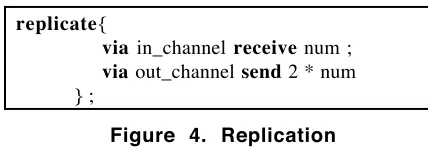
Replication of a behaviour, indicated by ! in the -calculus, is equivalent to a potentially infinite number of copies of that behaviour executing in parallel. This allows the specification of dynamic structure since replication generates copies as they are required. In Figure 4, the shown behaviour is replicated each time a value is re-ceived on connection in_channel. The behaviour waits at its reduction limit1 for input. Upon receiving input it creates a clone of itself waiting at the reduction limit, and sends twice the received value on the out_channel. Many clones of the behaviour may be executing in parallel thus capturing dynamic topologies in the architecture, and supporting dynamic change.
replicate{
via in_channel receive num ;
via out_channel send 2 * num } ;
Figure 4. Replication
Thechoose clause, denoted by + in the -calculus, al-lows the non-deterministic selection of one behaviour
1
[image:5.612.324.538.573.649.2]from two or more behaviours. In Figure 5, one of behav-ioursclient1,client2 or client3 will be chosen at random by the run-time system.
valueclient1 = … ;
valueclient2 = … ;
valueclient3 = … ;
choose { client1
or client2
or client3
} ;
Figure 5. Choice
Sequence, indicated by “.” or then in the -calculus, is denoted by “;” in the ADL. Therefore in Figure 4, num will be received on in_channel by the behaviour before the output value is sent on out_channel.
The-calculus also provides the facility to restrict names to processes. In the ArchWare ADL this restriction is enabled partly by block structured programming scope rules and partly by an explicit free construct that specifies the values to be available for further binding.
6.3 Components
Software architectures describe systems in terms of their components and their interactions. Components are units of structure and functionality. In the ArchWare ADL components can be modelled by behaviours that are analogous to processes in the -calculus. The code in Figure 4 specifies a server component that receives a number and sends back twice its value.
In order to facilitate design and reuse, the ADL allows the definition of abstractions that abstract over behav-iours. Applying an abstraction results in a behaviour as illustrated in Figure 6.
value server = abstraction()
replicate
{ via in_channel receive num ;
via out_channel send 2 * num } ;
server() ; ! applies the abstraction to yield a behaviour
Figure 6. Abstraction
There are two aspects to the interaction between com-ponents: coordination and communication. The former is concerned with synchronisation of components and the latter with exchange of data between components. Con-nections, analogous to channels in the -calculus, are used for both aspects.
Behaviours can communicate, i.e. send and receive values, via connections if they share connections or if their connections have been explicitly unified. Empty messages via connections are used for coordination alone.
So far we have seen how to implement dynamic change through replicate, and update change through loca-tions and assignment. We now turn our attention to the facilities for unexpected evolutionary change: hyper-code, decomposition, reflection and reification.
7
Hyper-code
Thehyper-code abstraction was introduced in [25] as a means of unifying the concepts of source code, executable code and data in a programming system. The motivation is that this may ease the task of the programmer, who is presented with a simpler environment in which the con-ceptually unnecessary distinction between these forms is removed. In terms of Brooks’ essences and accidents, this distinction is an accident resulting from inadequacies in existing programming tools; it is not essential to the con-struction and understanding of software systems [26]. In a hyper-code system the user composes hyper-code and the system executes it. When evolving the system, for exam-ple because an error has occurred, the user only ever sees a hyper-code representation of the program, which may now be partially executed. The hyper-code source representa-tion of the program is structured and contains text and links to extant values.
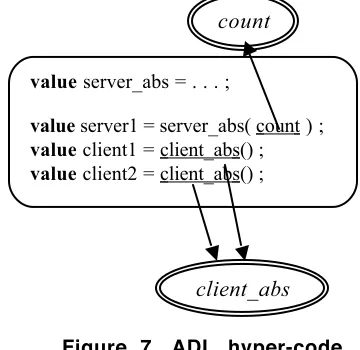
Figure 7 shows an example of a hyper-code representa-tion in the ArchWare ADL. The links embedded in it are represented by underlined tokens to allow them to be dis-tinguished from the surrounding text. The first link is to an integer location value count that is used as a parameter in the application of the server_abs abstraction. The pro-gram also has two links to a previously defined abstrac-tionclient_abs. Hyper-code models sharing by permitting a number of links to the same value. Note that code val-ues (client_abs) are denoted using exactly the same mechanism as data values (count). Note also that the value names used in this description have been associated with the values for clarity only, and are not part of the semantics of the hyper-code.
Figure 7. ADL hyper-code
The importance of hyper-code in active architectures is value server_abs = . . . ;
value server1 = server_abs( count ) ; value client1 = client_abs() ; value client2 = client_abs() ; count
[image:6.612.69.297.118.224.2] [image:6.612.334.514.514.689.2]that it is rich enough to represent executing code. Thus as the program executes, the hyper-code changes in line with the semantics of the language. Since hyper-code can repre-sent closure, through sharing links, it may be used as a representation for introspection of the executing system. Hyper-code provides the basic facility of preserving con-sistent state information across the system as it evolves.
There are a number of possible views of the concept of hyper-code. Most relevant to active architectures is the notion that hyper-code is an active executing graph with a programmable interface. In software engineering terms there is always a way of reverse engineering the executing computation so that it may be seen and programmed over.
8
Composition and decomposition
An essential property of evolutionary systems is the ability to decompose a running system into its constitu-ent componconstitu-ents, and compose evolved or new compo-nents to form a new system, while preserving any state or shared data if desirable.
The ArchWare ADL provides a compose operator which operates over a number of behaviours (components) and returns a single handle to these behaviours executing in parallel. The result of this composition is also a behav-iour. Thus hierarchical systems may be modelled by components that are made up of other components. Figure 8 illustrates composition.
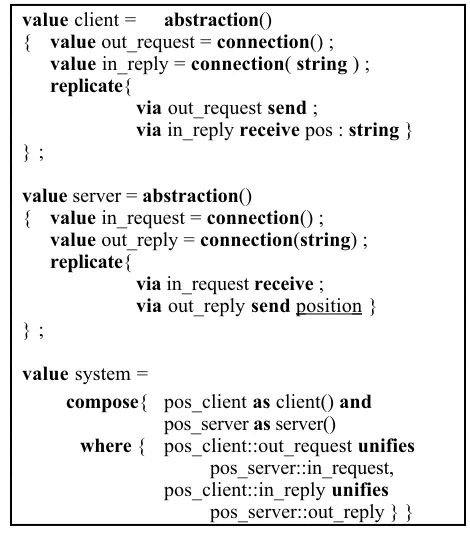
Behavioursclient and server are composed to give sys-tem. The as construct permits meaningful labels to be associated with behaviours. As the details of client and server are not of interest in this example, the result value position sent by server is shown as a hyper-link which has previously been defined.
value channel_1 = connection() ;
value channel_2 = connection(string ) ;
value client = replicate{
via channel_1 send ;
via channel_2 receive pos : string } ;
value server = replicate{
via channel_1 receive ;
via channel_2 sendposition } ;
value system = compose{ pos_client as client
and pos_server as server }
Figure 8. Composition
The ADL also provides a decompose operator that breaks up a behaviour into its constituent behaviours. Decomposing a composite behaviour will undo any unifi-cation associated with the corresponding composition. On decomposition each constituent behaviour will eventually reach its reduction limit. Figure 9 illustrates the use of
[image:7.612.321.556.402.669.2]the decomposition operator on the composition from Figure 8.
Decomposition returns a sequence of views consisting of behaviours and their labels (if any) in the order that they were composed. All the behaviours are at their reduc-tion limit for that composireduc-tion. Figure 9 shows how these behaviours and their labels may be accessed from the sequence. These behaviours can be returned to the user as hyper-code, modified and recomposed.
value pos_seq = decompose system ;
value client_val = pos_seq::1.bhvr ; value server_val = pos_seq::2.bhvr ; value comp1_label = pos_seq::1.label
Figure 9. Decomposition
Explicit composition is not always required since two behaviours will communicate if they share the same con-nection and communication is ready. Composition gives a handle to the new composed behaviours. The higher order nature of the language means that two behaviours that have been sent to a third may wish to communicate but do not share the same connection value. The compose operation has a variant that allows the unification of con-nection values during composition to facilitate communi-cation in these circumstances. Figure 10 shows an exam-ple of unification.
value client = abstraction() { value out_request = connection() ;
value in_reply = connection(string ) ; replicate{
via out_request send ;
via in_reply receive pos : string } } ;
value server = abstraction()
{ value in_request = connection() ; value out_reply = connection(string) ; replicate{
via in_request receive ; via out_reply sendposition } } ;
value system =
compose{ pos_client as client() and pos_serveras server()
where { pos_client::out_request unifies pos_server::in_request, pos_client::in_replyunifies
pos_server::out_reply } }
[image:7.612.67.296.467.633.2]9
Reflection and reification
A hyper-code system may be thought of as operating within two abstract domains: entities (E) and representa-tions (R). E contains all the first class values defined by the language while R contains the concrete representations of the values in E. Given these domains, four domain operations over E and R may be defined.
• reflect maps a representation to its corresponding en-tity (RE)
• reify maps an entity to a corresponding representation (ER)
• execute executes an entity, possibly generating a result (EE)
• transform maps one representation to another (RR) Reflection and reification are of particular interest since they play a vital role in evolving systems. Once a system is decomposed, reification allows us to view representa-tions of its components. These may be evolved to capture new requirements. Reflection allows evolved or new components to be bound back into the system.
The ability of hyper-code to capture closures allows us to represent parts of a system after decomposition without losing their context. It provides representations that can be used for both evolving the components and recompos-ing them into the new system.
The ArchWare ADL provides specific operations for reflect and reify. Evolution is effected by decomposing the selected part of the system, reifying the components, applying a transformation and finally reflecting the code. The specific evolutionary process may be abstracted by writing a style to specify the evolution and the constraints upon it.
10 An example of evolution
The concepts discussed in earlier sections are now il-lustrated using a (by necessity simple) example written in the ArchWare ADL. This example is based on a long run-ningin silico experiment [27]. The user is a scientist who wants to run the experiment from a desktop-based client. The experiment itself runs on a server machine with ac-cess to a range of resources, e.g. corporate databases. The scientist’s client will connect to a server that disseminates data about the status of the experiment. The client also allows the scientist to control (start and end) the experi-ment. Initially there will be a single client and a single server, but later the system will be evolved so that the functionality of the server is split into two.
The functionality of the server and the client can be modelled as abstractions in the ArchWare ADL. When applied, these abstractions yield executing behaviours. Such behaviours are the components that make up the client-server system. The repetitive nature of both the client and the server is captured using replication. Thus the dynamic nature of the system is already present in that the server may replicate itself to deal with data from the
experiment and the client may replicate itself in parallel to react to the data sent by the server.
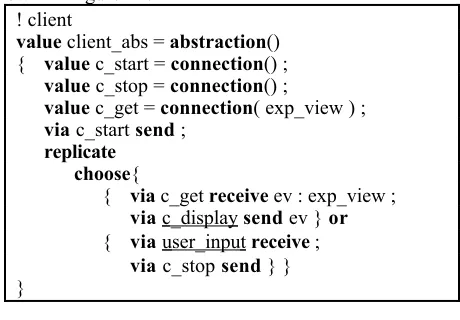
Since exact details of the experiment are not of interest to this example, we will assume that values of data type exp_view provide all necessary information about the ex-periment. The client abstraction can then be defined as shown in Figure 11.
! client
value client_abs = abstraction() { value c_start = connection() ;
value c_stop = connection() ;
value c_get = connection( exp_view ) ; via c_start send ;
replicate choose{
{ via c_get receive ev : exp_view ; viac_displaysend ev } or { viauser_inputreceive ;
via c_stop send } } }
Figure 11. The client abstraction
The client defines the connections it needs to commu-nicate on, sends a message to start the experiment and then on demand replicates itself to choose either to receive details of the experiment and display it to the user or to receive a command from the user and send a message to end the experiment. The former provides the scientist with an ongoing view of the experiment and the latter with the means to stop the experiment if its progress is not satisfactory. c_display and user_input connections are shown as hyper-links in the code as they have previously been defined elsewhere.
Figure 12 shows the definition of the server abstrac-tion. The body of the server mirrors that of the client. It defines its connections, receives the start message, begins the experiment and then on demand replicates itself to choose either to receive the stop message and end the ex-periment or to receive the current values of the exex-periment and send them on. As before connection exp_input and functionstop_experiment are shown as hyper-links.
! server
value server_abs = abstraction() { value s_start = connection() ;
value s_stop = connection() ;
value s_put = connection( exp_view ) ; via s_start receive ;
start_experiment () ; replicate
choose{
{ via s_stop receive ; stop_experiment () } or
{ viaexp_inputreceive current_view ; via s_put send current_view } } }
[image:8.612.324.554.147.307.2] [image:8.612.324.556.538.696.2]Having defined server and client abstractions, we can now create a client-server system by composing instances of the server and the client abstractions with appropriate unification. Unification ensures that corresponding client and server connections are matched for communication. Defining the composition as a value gives us a handle (CS_system1) to the resulting behaviour. Figure 13 shows the composition of one client and one server.
Theas construct allows users to associate meaningful labels with behaviours being composed. In addition to aiding the identification of behaviours after decomposi-tion, this facility also connections to be uniquely identi-fied for unification.
! client-server system value CS_system1 = compose{
clientas client_abs() and server as server_abs() where{ client::c_start unifies server::s_start,
client::c_stopunifies server::s_stop, client::c_getunifies server::s_put } }
Figure 13. The client-server system
Once the system starts executing, we may wish to change its structure. The scientist may want to share a view of the in silico experiment with colleagues, or the experiment may take longer than expected and the scien-tist may wish to get advice before deciding whether the server should be stopped, aborting the experiment.
We begin this process by decomposing the system into its component parts as shown in Figure 14. The re-sult of this decomposition is a sequence of views contain-ing the followcontain-ing information about each behaviour of the system: label, behaviour value and list of connections. In long-running systems, labels associated with behaviours may help identify their purpose and identity.
! decompose system
value cs_seq = decompose CS_system1
Figure 14. Decomposition
Necessary changes can then be made by evolving or redefining some components. In this case we wish to split the functionality of the server into two by creating two new servers, one serving status alone, which can be shared among multiple clients, and the other serving the com-mand messages, of which the scientist who started the experiment wants to retain control. Therefore we create two new abstractions to replace the old server_abs.
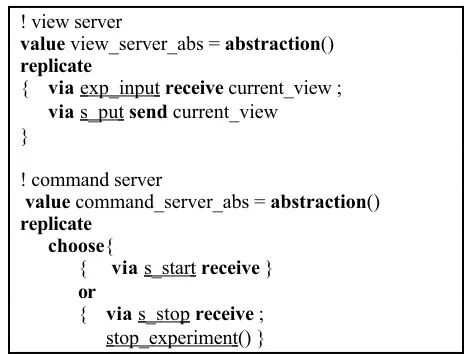
Using hyper-code representations of the abstractions will enable us to define the new abstractions to use the current values of variables without having to explicitly store and reinitialise them as shown in Figure 15. Ab-stractionview_server_abs disseminates status information about the experiment while command_server_abs allows
the experiment to be controlled. Note that start messages are ignored as the experiment has already been running.
! view server
value view_server_abs = abstraction() replicate
{ viaexp_inputreceive current_view ; vias_putsend current_view }
! command server
valuecommand_server_abs = abstraction() replicate
choose{
{ vias_startreceive } or
{ vias_stopreceive ; stop_experiment () }
Figure 15. The new server abstractions
A new client-server system can then be formed by composing the two new servers with the decomposed client appropriately as shown in Figure 16.
! make new client-server system value CS_system2 =
compose{ client as cs_seq::1.bhvr
and view_serveras view_server_abs()
and command_serveras command_server_abs() where{
client::c_startunifies command_server::s_start, client::c_stopunifies command_server::s_stop, client::c_getunifies view_server::s_put } } ;
Figure 16. The evolved system
Now the client will communicate with both servers. If experiment information is required the client will talk to view_server and if the scientist wishes to control the ex-periment then the client will talk to command_server.
11 Conclusions
This paper describes the ArchWare Architecture De-scription Language, which is sufficiently rich to provide executable specifications of active systems. We define a core language on which architectural styles can be layered and on which a construction methodology can be applied. We focussed on the base technologies required to support evolvable systems and presented examples of how the ADL may be used to model active architectures. In par-ticular, we showed how architectures specified in the ADL were dynamic, updateable, decomposable and reflective.
[image:9.612.322.555.105.282.2] [image:9.612.68.297.230.334.2] [image:9.612.324.554.355.481.2]architectural transformations. Furthermore we recognise the role that hyper-code may have in reverse engineering. For reliability it is important that the architectural defini-tion of a system is automatically kept consistent with the state of the system at all times during its execution and evolution. Our approach to meeting these requirements involves the combination of a number of technologies: reflection, reification and representation for closure (hyper-code).
We have combined these with a variant of the -calculus that yields dynamic expressions and communica-tion while providing the basis for formal analysis tools in the form of theorem provers, type checkers and model checkers.
These elements provide a core evolutionary support system. At the time of writing the core ArchWare ADL, the hyper-code, the decomposition operator and the reflec-tive mechanism are all implemented and being used to specify evolvable software architectures.
12
References
[1] D. Garlan and M. Shaw, “An Introduction to Software Ar-chitecture”, in Advances in Software Engineering and Knowledge Engineering, vol. 1, V. Ambriola and G. Tortora, Eds. New Jersey, USA: World Scientific Publishing Com-pany, 1993.
[2] D. Perry and A. L. Wolf, “Foundations for the Study of Software Architecture”, ACM SIGSOFT Software Engineering Notes, vol. 17, pp. 40-52, 1992.
[3] F. Oquendo, S. Cîmpan, D. Balasubramaniam, G. N. C. Kirby, and R. Morrison, “The ArchWare ADL: Definition of the Textual Concrete Syntax”, Technical Report D1.2b, ArchWare Project IST-2001-32360, 2002
[4] L. Coglianese and R. Szymanski, “DSSA-ADAGE: An En-vironment for Architecture-Based Avionics Development”, Proc. AGARD'93, 1993.
[5] D. Garlan, R. Allen, and J. Ockerbloom, “Exploiting Style in Architectural Design Environments”, Proc. 2nd ACM SIGSOFT Symposium on Foundations of Software Engineer-ing, New Orleans, Louisiana, USA, pp. 175-188, 1994. [6] P. Binns, M. Englehart, M. Jackson, and S. Vestal, “Do-main-Specific Software Architecture for Guidance, Naviga-tion and Control”, International Journal of Software Engi-neering and Knowledge EngiEngi-neering, 1995.
[7] M. Moriconi and R. A. Riemenschneider, “Introduction to SADL 1.0: A Language for Specifying Software Architecture Hierarchies”, Technical Report SRI-CSL-97-01, Computer Science Laboratory, SRI International, 1997
[8] R. N. Taylor, N. Medvidovic, K. M. Anderson, E. J. White-head, J. E. Robbins, K. A. Nies, P. Oreizy, and D. L. Dubrow, “A Component- and Message-Based Architectural Style for GUI Software”,IEEE Transactions on Software Engineering, vol. 22 no. 6, pp. 390-406, 1996.
[9] R. J. Allen, “A Formal Approach to Software Architecture”, PhD Thesis, Carnegie Mellon University, Technical Report CMU-CS-97-144, 1997
[10] M. Shaw, R. DeLine, D. V. Klein, T. L. Ross, D. M. Young, and G. Zelesnik, “Abstractions for Software Architecture and Tools to Support Them”, IEEE Transactions on Software Engineering, vol. 21 no. 4, pp. 314-335, 1995.
[11] M. Endler and J. Wei, “Programming Generic Dynamic Reconfiguration for Distributed Applications”, Proc. Interna-tional Workshop on Configurable Distributed Systems, Lon-don, pp. 68-79, 1992.
[12] C. Canal, E. Pimentel, and J. M. Troya, “Specification and Refinement of Dynamic Software Architectures”, Proc. 1st IEEE/IFIP Conference on Software Architecture (WICSA1), San Antonio, TX, USA, pp. 107-126, 1999.
[13] J. M. Cobleigh, L. J. Osterweil, A. Wise, and B. S. Lerner, “Containment Units: A Hierarchically Composable Architec-ture for Adaptive Systems”, Proc. 10th ACM SIGSOFT Sym-posium on Foundations of Software Engineering, Charleston, SC, USA, pp. 159-165, 2002.
[14] P. Oreizy, N. Medvidovic, and R. N. Taylor, “Architec-ture-Based Runtime Software Evolution”, Proc. International Conference on Software Engineering (ICSE 98), Kyoto, Japan, pp. 177-186, 1998.
[15] I. Georgiadis, J. Magee, and J. Kramer, “Self-Organising Software Architectures for Distributed Systems”, Proc. 1st ACM SIGSOFT Workshop on Self-Healing Systems, Charles-ton, SC, USA, pp. 33-38, 2002.
[16] J. Magee, N. Dulay, S. Eisenbach, and J. Kramer, “Speci-fying Distributed Software Architectures”, in Lecture Notes in Computer Science 989, W. Schäfer and P. Botella, Eds.: Springer, pp. 137-153, 1995.
[17] J. Aldrich, C. Chambers, and D. Notkin, “Architectural Reasoning in ArchJava”, Proc. 16th European Conference on Object Oriented Programming (ECOOP’02), Malaga, Spain, pp. 334-367, 2002.
[18] D. Garlan, R. Monroe, and D. Wile, “ACME: An Architec-ture Description Interchange Language”, Proc. Conference of the Centre for Advanced Studies on Collaborative Research (CASCON'97), Toronto, Canada, pp. 169-183, 1997. [19] “ArchWare Project”, http://www.arch-ware.org
[20] K. Czarnecki and U. Eisenecker, Generative Program-ming: Methods, Tools and Applications: Addison-Wesley, 2000.
[21] R. Milner, Communicating and Mobile Systems: The Pi-Calculus: Cambridge University Press, 1999.
[22] C. Strachey, Fundamental Concepts in Programming Languages: Oxford University Press, 1967.
[23] R. D. Tennent, “Language Design Methods Based on Semantic Principles”, Acta Informatica, vol. 8, pp. 97-112, 1977.
[24] R. Morrison, “On the Development of Algol”, PhD The-sis, University of St Andrews, 1979
[25] G. N. C. Kirby, R. C. H. Connor, Q. I. Cutts, A. Dearle, A. M. Farkas, and R. Morrison, “Persistent Hyper-Programs”, in
Persistent Object Systems,Workshops in Computing, A. Al-bano and R. Morrison, Eds.: Springer-Verlag, pp. 86-106, 1992.
[26] E. Zirintsis, “Towards Simplification of the Software Development Process: The Hyper-Code Abstraction”, PhD Thesis, University of St Andrews, 2000