RESTRICTED PERMUTATIONS, ANTICHAINS, ATOMIC
CLASSES AND STACK SORTING
Maximilian M. Murphy
A Thesis Submitted for the Degree of PhD at the
University of St Andrews
2003
Full metadata for this item is available in St Andrews Research Repository
at:
http://research-repository.st-andrews.ac.uk/
Please use this identifier to cite or link to this item: http://hdl.handle.net/10023/11023
\
.,Restricted Permutations, Antichains,
Atomic Classes and Stack Sorting
M.M. Murphy
PhD Thesis
February 2, 2003
Declarations
hereby certify that this thesis has
been composed by myself, that it is a record of my own work, and that
it has not been accepted in any previous application for a higher degree.
Signed: Date:
aJ/oz/zOO.3
2. I was admitted as a research student and as a candidate for the degree
of PhD on 17 September 1999. The higher investigation of which this
is a record was carried out in the University of St Andrews between
September 1999 and September 2002.
Signed: Date:
0
)/02/2.00]3. In submitting this thesis to the University of St Andrews I understand
that I am giving permission for it to be made available in accordance
with the regulations of the University Library for the time being in
force, subject to any copyright vested in the work not being affected
thereby. I also understand that the title and abstract will be published,
and that a copy of the work may be supplied to any bona fide library
or research worker.
Signed: Date:
OZ/0:;/2003
Certification
I hereby certify that the candidate has fulfilled the conditions of the
resolu-tions and regularesolu-tions appro . t t d of Ph.D.
Signature of Supervisor: Date:
03
(02/
~oo~
Acknowledgements
I am highly indebted to my supervisor, Nik Ru§kuc, for having curried me
along, put up with my temperamental humours and bad organisation, and
for having learnt a subject entirely new to him, purely for this purpose. His
wife, Ester, too is to thank, for fine food, and she will wish to know whether I
have slacked at my work at all on account of doing mathematics. The answer
I withhold.
I would like to thank Michael Atkinson for having introduced me to the
subject of closed classes and for having freely given plenty of help, information
and open problems on the subject. I would also like to thank his family for
tolerating me to come and stay with them during my trip to New Zealand.
I acknowledge generous funding from the EPSRC.
Zu den Ubrigen, Ihr wisst wer Ihr seit. Besonders meiner Mutter will Ich
danken. Auch Hans Otto Carmesin, Frances Williams, Quint Murphy, Tet
Murphy und Ille Supremo. Und Pater mei, letztens weil meine Schuld zu
ihm so offensichtlich ist.
Abstract
Involvement is a partial order on all finite permutations, of infinite
dimen-sion and having subsets isomorphic to every countable partial order with
finite descending chains. It has attacted the attention of some celebrated
mathematicians including Paul Erdos and, due to its close links with sorting
devices, Donald Knuth.
We compare and contrast two presentations of closed classes that depend
on the partial order of involvement: Basis or Avoidance Set, and Union of
Atomic Classes. We examine how the basis is affected by a comprehensive
list of closed class constructions and decompositions.
The partial order of involvement contains infinite antichains. We develop
the concept of a fundamental antichain. We compare the concept of
'fun-damental' with other definitions of minimality for antichains, and compare
fundamental permutation antichains with fundamental antichains in graph
theory. The justification for investigating fundamental antichains is the nice
patterns they produce. We forward the case for classifying the fundamental
permutation antichains.
Sorting devices have close links with closed classes. We consider two
sorting devices, constructed from stacks in series, in detail.
We give a comment on an enumerative conjecture by Ira Gessel.
We demonstrate, with a remarkable example, that there exist two closed
classes, equinumerous, one of which has a single basis element, the other
infinitely many basis elements.
We present this paper as a comprehensive analysis of the partial order of
permutation involvement. We regard the main research contributions offered
here to be the examples that demonstrate what is, and what is not, possible;
although there are numerous structure results that do not fall under this
cat-egory. We propose the classification of fundamental permutation antichains
as one of the principal problems for closed classes today, and consider this as
a problem whose solution will have wide significance for the study of partial
Contents
Declarations
Certification
Acknowledgements
Abstract
1 Introduction
1.1 Origins..
1.2 Closed Classes.
1.2.1 The Partial Order.
1.2.2 Representation: Sub and the Basis
1.3 Atomic Classes . . . .
1.4 Summary of Chapters
1.4.1 Notation.
1.5 Some Exercises .
1.6 Permutation Symmetries
Xl
iii
v
vii
IX 1
1
5
8
10
13
19
22
24
2 Constructions
2.1 Union and Intersection of Closed Classes
2.1.1 Some More Advanced Material.
2.2 Direct and Skew Sum . . . .
29
29
31
34
2.2.1 Sum Indecomposable: The Increasing Oscillating
Se-quence . . . .
2.2.2 The form of Basis Elements of Y EEl Z
2.2.3 Corollaries . . . .
2.2.4 X EEl Y Infinitely Based .
2.2.5 Sum, Skew and Strong Completion
2.2.6 Sum, Skew and Strong Decidability
2.3 Expansion and the Wreath Product
2.3.1 Wreath Structure and P
2.3.2 Wreath Product Bases
2.4 Juxtaposition . . . .
2.4.1
2.4.2
Basis of Juxtaposition
A Conjecture
2.5 Differentiation . . . .
2.5.1 Differentiation and Atomic Classes
2.5.2 Differentiation and the Basis.
2.5.3 Recent Development
2.6 Merges . . . .
3 Antichains
3.1 Definition . . . . .
3.2 Infinite Antichains
CONTENTS
3.3 Antichain Classes
3.3.1 Finitely Based Infinite Antichain Classes
3.3.2 Infinitely Based Antichain Classes.
3.4 Maximal, Trim, Fundamental
3.4.1 Definitions...
3.4.2 Some Technical Results.
3.4.3 Comparison of Maximal, Trim and Fundamental.
3.4.4 Further Comparison . . . .
3.4.5 A Chain Structure for Strongly Trim Antichains?
3.4.6 Antichains as Bases: Atomic classes .
3.4.7 The Delayed Example
3.5 Partially Well Ordered
3.5.1 Definition . . .
xiii
110
112
· 124
· 129
· 131
· 134
136
139
· 141
· 142
· 145
· 152
154
3.5.2 Higman's Theorem and Strong Completion. 155
3.5.3 Some Classes with Small Bases . . . . 159
3.5.4 Higman's Theorem and the Wreath Product . 160
The demi-closed nature of P
3.5.5 Results...
4 Atomic Classes
4.1 Introduction.
4.2 Closed Classes as Unions of Atomic Classes .
4.3 The Decision Problem . . . .
4.3.1 Partially Well Ordered Classes .
4.4 Modifying the Basis. . . .
4.5 Further Modification of the Basis
· 161
· 174
185
· 185
· 187
· 196
· 205
· 209
4.5.1 A List of Non-Atomic Classes · 216
5 Natural Classes
5.1 Introduction.
219
· 219
5.2 Natural and Sum Complete Classes
5.3 The Structure of 7f . • • •
5.4 Bounds on Differentiation
5.4.1
5.4.2
5.4.3
Bases Remain Finite
A Bound on Minimal n such that
on
X =on+
I X . X as SubCr) EEl A(C)5.5 The Decision Problem
5.6 Miscellaneous
6 Bibliothek
6.1 Antichains
6.2 Short Bases
· 220
· 222
· 233
· 233
· 235
· 238
· 243
· 246
247
· 249
· 256
6.2.1 One Basis Element of Length Three. . 256
6.2.2 Two Basis Elements of Length Three . 257
6.2.3 One Basis Element of Length Four . 258
6.2.4 One Basis Element of Length Three and One of Length
Four . . . 258
6.3 Two Basis Elements of Length Four .
6.4 Three Basis Elements . . . .
7 A Practical Example: The M Machine
7.1 The basis of M ..
7.2 Algorithms as Words
· 262
· 269
271
· 274
CONTENTS
7.3 Algorithms and Plane Trees
7.4 IGM-Trees and ,8(0, 1)-Trees: enumeration.
8 A Harder Example: S2
8.1 Introduction.
Relations H and V
8.1.1 Algorithms versus Relations ..
8.1.2 Duality . . . .
8.1.3 Some Consequences involving V and H .
8.2 Some Infinite Sets of Basis Elements
8.3 Conjecture...
8.4 Onwards and Upwards:
sn .
9 Gessel's enumerative conjecture
A Markov Chain selection
B Notes for Programmers
Bibliography
Index
Subject Neighbourhood
xv
· 283
· 295
301 · 301
· 304
· 308
· 312
· 314
· 316
· 322
· 327
Chapter
1
Introduction
Origins, Sorting Machines, Partial Order of Involvement, Closed
Classes, Representation by Sub and Basis, Atomic Classes,
Sym-metries, Summary of Chapters
1.1
Origins
The following is a typical example of the type of demi-mechanical sorting
machine in which this subject has its roots.
Output
S2
Input1234
....
.-!l
A P a a a'l~fI 7 8 9 · · · ·
UW
A sequence is sorted by two stacks in series.
The purpose of machines of this sort is to take a finite numerical sequence
as an input and process the terms in such a manner that when output, smaller
terms precede greater ones. In this case the permissible moves are as follows:
p: Moves to the top of the right stack the first term still in the input.
A: Moves to the top of the left stack the top term of the right stack.
fL: Moves to the output the top term of the left stack.
For example if the input sequence is 3764251 then a satisfactory sorting
might consist of the following:
1. Perform a p operation to move the 3 from the input to the right stack.
2. Move the 7 from the input to the left stack by means of a p and a A
operation. Repeat to place the 6 on top of the 7, and the 4 on the 6.
3. Move the 3 onto the 4 by a A operation.
4. Take the 2 from the input and place it on the left stack, on top of the
3.
5. Place the 5 in the now empty right stack.
6. Transfer the 1 from the input to the output by means of a p, a A and
a fL.
7. Move all the remaining terms to the output as follows: The 2, 3 and 4
may be output from the left stack by fL operations, the 5 may follow by
1.1. ORIGINS 3
As a sorting machine of arbitrary input the above is incompetent. Every
term in an input may be acted upon only thrice and, in the entire system,
there are only three different types of operation that may be performed. Thus
any successful sorting of an input sequence of length n may be expressed
as a word of length 3n over an alphabet of three letters. So there are at
most 33n distinct sorting processes of inputs of length n, far fewer than the
n! permutations of length n, and everyone of these permutations must be
treated differently if it is to be sorted successfully. At least, we do require that
n is large because only n
>
50 implies that 27n<
n!. Thus for sufficientlylong input it may not be possible for the machine to sort the input. A similar
analysis can be performed on all the machines that will appear in this thesis.
It may fairly be said that to sort is their ambition, but not always their effect.
(To be a little more accurate, the number of distinct ways of passing n
terms through 52 is the three dimensional Catalan number, which is 2
*
(3*
n)!/(n!
*
(n+
I)!*
(n+
2)!), according to [31]. The bound this gives is barelyan improvement though: The reader may be bemused to know that it reduces
the earlier bound of 50 by one. In fact there can be several ways of sorting a
given sequence in 52 and the shortest permutation that 52 cannot sort has
length 7.)
We will concern ourselves not with the speed or the number of moves with
which such a machine can sort a given input but rather with the question of
what input the machine can sort. In "The art of computer programming"
[17J D.E. Knuth considered the problem of rearranging railway carriages in
a shunting station or by means of sections of parallel track. The problem
Figure 1.1: A queue (above) and stack (below) in parallel.
networks, some of which, specifically those involving stacks, queues and
de-ques and double ended queues are considered in [13].
In spite of their limitations machines of this sort are remarkably common.
Applications include sorting when the input is by nature somehow restricted
to the set of permutations that can be sorted. Application can also be found
in modelling disorder: A process of feeding a sequence into the right of the
above machine and removing a sorted output on the left may be considered
as a disordering performed in reverse, the set of sortable sequences being
precisely those that may be produced as disorderings of ordered sequences
fed into the left side of the above machine.
One specific application for restricted sorting devices arises in
network-ing: A piece of information that must be sent from one node to another in
a network may be split into smaller chunks, each of which makes its way
independently from the one node to the other. The separation of the chunks
1.2. CLOSED CLASSES 5
of the network only a restricted set of permutations will be possible. The
duality between permuting through a finite network and sorting through
an-other suggests that this is an ideal situation for applying a restricted sorting
device, that may well operate in linear time and therefore be faster than any
universal sorting machine can possibly be. This application is hypothetical,
we have not investigated its practicality or how much of an improvement it
might offer.
1.2
Closed Classes
We consider only two sorting devices in detail, M and 82, and those only at
the end of this thesis. Our main thrust is to establish a theoretical structure
that is applicable to all sorting devices. To this end we select two easily
mathematicised invariants of common sorting devices and develop a theory
around them.
Closure in Sorting Machines
The first invariant, about to be presented, can be illustrated with the above
sorting machine 82: The machine can sort, for instance, the input 415623
into ascending order. It is evident that if we remove the term 4 from this
input then we can still sort the resulting sequence, which is 15623, by the
same sorting procedure that we used for the entire sequence but now omitting
any move previously applied to the now missing term. Thus if the machine
can sort a given input sequence then it can also sort every subsequence of
Order Isomorphism
The second invariant, also illustrated, is that the actual values of input terms
is irrelevant. We are concerned in producing an output in ascending order,
thus we are concerned with which terms are greater than which other terms.
Thus if we know that 1423 can be sorted then we also know that the sequences
-11045 and 2534 and all other sequences like them can also be sorted. The
sequences 1423 and -11045 are said to be order isomorphic, which is defined
formally as follows:
Definition 1 Let a
=
al . . . am and {3=
b1 . . . bm be sequences of equallength. Then a and {3 are said to be order isomorphic, and we write a ~ {3,
if for every i, j E {1, 2, ... , m} we have that ai
<
aj if and only if bi<
bj .Involvement of one Sequence in Another
This leads to the next definition. We say that sequences such as 1423 that
are order isomorphic to a subsequence 1523 of 415623, are involved in 415623.
The full definition is as follows:
Definition 2 Let a and {3 be sequences. Then a is said to be involved in
{3 if a is order isomorphic to some subsequence of {3. If a is involved in {3
but is not order isomorphic to the entirety of {3 then a is said to be properly
involved in {3. If A and B are sets of sequences then we say that A is involved
in B if every element of A is involved in an element of B. We may write
1.2. CLOSED CLASSES 7
Closed Classes Defined
From this point on we discard from our consideration input sequences that
have two or more terms of equal value. In sorting of such a sequence one
of the equal terms must be output before the others. Thus this first term
output might as well be given a smaller label - only in very few machines
does re-Iabelling affect the sorting procedure. Thus the sequence 14243 can
be sorted by, for instance, the above machine S2 if and only if one of the
sequences 15243 and 14253 can be sorted. Thus we can reasonably claim to
'understand' the set of arbitrary sequences that can be sorted by a machine
if we already understand the set of all non-repeating sequences that might
be sorted by the same.
We extend this input simplification a little further: Every finite
non-repeating sequence of length n is order isomorphic to some permutation of
the numbers 1 ... n. As the machines we will consider are all invariant under
order isomorphism it suffices for our purposes to know which finite
permu-tations can be sorted.
This leaves us with the objects of our attention:
Definition 3 A set X of permutations is said to be closed if every
permu-tation involved in an element of X is itself also an element of X.
We warn the reader that if X is a set of permutations then we will
occa-sionally state that some sequence is an element of X, meaning that the
per-mutation order isomorphic to that sequence, which is always non-repeating,
is an element of X. It might be preferable to regard order isomorphism as
but the notational overhead this involves is forbidding.
1.2.1
The Partial Order
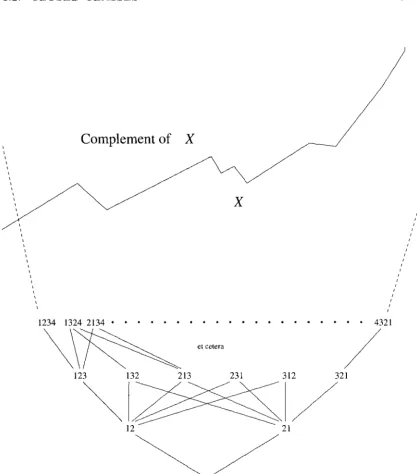
Involvement forms a partial order over the set of all permutations. The lower
reaches of this partial order are shown in Figure 1.2. The partial order is
rich in its complexity. The following should be noticed immediately:
• There are only countably many finite permutations, hence the number
of nodes in the partial order is countable.
• The partial order has the property that every descending chain is finite.
Indeed a permutation properly involved in another is shorter than it
and sequences cannot become arbitrarily short.
• Maximal ascending chains in the set of all permutations are always
infi-nite. Maximal ascending chains within a closed class may, in principle,
be either infinite or finite.
As this is only a partial order there are permutations that are not involved
in each other, and so we will have antichains, defined in the usual sense:
Definition 4 A set A of permutations is said to be an antichain if every
two distinct elements of A are incomparable under the partial order of
in-volvement.
An example of an antichain is the set of all permutations of some given
length.
Chains and antichains will be of considerable importance throughout this
1.2. CLOSED CLASSES 9 \ \ \ \ \ \ \ \ \ \ \ \ \ \ \ \ \ \
Complement of X
X
1234 1324 2134' • • • • • 4321
\ \ '
et cetera/
123 132 213 231 312 321
~
12 21/
~/
I I
Figure 1.2: The partial order of involvement: In the ordering 1324 involves 123,
132, 213, 12, 21 and 1, but does not involve e.g. 321. Closed classes may be thought
of as the set of all permutation lying below some "dividing line" , as shown.
[image:26.613.80.497.109.582.2]1.2.2
Representation: Sub and the Basis
We may give a closed class by listing all the elements of that class, however
that is in general not a very efficient method. The intrinsic structure of
closed classes permits us to abbreviate this mechanism. The simplest method
of doing so is as follows: If a closed class contains the permutation 145263
then we also know that it contains all permutations involved in 145263, we
do not need to add this information. Thus we introduce our first method of
representing closed classes:
Definition 5 Let A be a set of sequences. The closure of A is the set of all
finite permutations order isomorphic to an element of
A
or properly involvedin such an element and is denoted by Sub(A).
If a closed class X contains elements M maximal under involvement and
if every element of the class is involved in one of those maximal elements
then X can be described by the unique minimal expression Sub(M). Note
that the set of maximal permutations in a class forms an antichain. However
in general the set of maximal elements in a class is not sufficient to define it.
For instance the set S of all permutations and the set I of all
increas-ing sequences (123 ... n) are both closed classes, neither has any maximal
elements whatsoever, and yet these classes are undeniably distinct.
Further-more in the absence of defining maximal elements there is no minimal way
of represening a closed class using the Sub notation, as used here. Consider
I as a case study. Without the advantage of unique minimal representation
the Sub notation loses some of its charm. Our second method of describing
1.2. CLOSED CLASSES 11
the complement of X:
By definition, if X is a closed class of permutations and a is an element
of X, and if
f3
is involved in a then we must have thatf3
is an element of X.The contrapositive states that if
f3
is not in the closed class X then neither isa. Moreover since all descending chains in involvement are finite this implies
that there exists a shortest permutation involved in a and not in X. The
set 8(X) of all such minimal elements of the complement of X is called the
basis of X. Every element in the complement of X involves an element of
B(X) and no element of X involves an element of 8(X). Indeed X can be
described as the set of permutations that avoid the elements of B and we
write X = A(8(X)). We define this notation formally as follows:
Definition 6 Let X be a closed class. Then the basis 8(X) of X is the set
of permutations minimal under involvement and not in X. If F is a set of
permutations then the avoidance set A(F) is the set of all permutations that
do not involve any element of F.
The principal advantage that the Sub notation maintains over the basis is
that Sub gives examples of elements in the class being described. It is easier
to imagine an arbitrary element of a class if one knows the properties of
the elements of the class, rather than some properties that elements cannot
have. This is especially important with relatively complicated classes of
permutations but we will attempt to illustrate the principle:
Example 7 The finite closed class with the single maximal element 2134 is
Example 8 The closed class that consists of permutations that a) begin with
a decreasing sequence of length at most three, and b) continue to the end with
an increasing sequence of terms all greater than the first decreasing set, e.g.
21345, can be written either as SUb(3214567 . .. ) or as A(132, 231, 312, 4321).
The former is our first example of taking the closure of an infinite sequence.
Example 9 Let I merge R be the set of permutations such as 912856743
that consist of a meld of an increasing and a decreasing subsequence, in this
case 12567 and 9843. Then I merge R is a closed class. (We permit the empty
subsequence, thus the trivial permutation 1 consists of the subsequence 1 and
the empty sequence.) The basis of I merge R consists of the two permutations
2143 and 3412, as given in [10], so I merge R = A(2143, 3412).
Alternatively we may write
I merge R = Sub{14325, 183654729,
1 12 3 10 5 8 7 6 9 4 11 2 13,
1 16 3 14 5 12 7 10 9 8 11 6 134 15 2 17,
... }.
The latter may seem clumsy but at least if we plot one of these sequences
then we will instantly have an idea of what we are dealing with, whereas
with the basis notation one might well have to experiment a good deal
be-fore getting the same clear idea. Incidentally there are many different Sub
representations of this class. Specifically here the reader should not be
con-cerned that we use a sequence that oscillates strictly between the terms of
increasing and decreasing subsequences. This is merely a convenient choice,
1.3. ATOMIC CLASSES 13
Even the verbal description of this class is in character descriptive, not a
set of restrictions. That in itself is a good reason for pursuing constructive
representations for closed classes.
Note that the basis of a closed class is an antichain. The elements of the
basis are minimal under involvement, thus they cannot be comparable.
1.3
Atomic Classes
The concept that we here introduce, of atomic classes, is designed to strengthen
the Sub notation to overcome some of its weaknesses. The principal failing
of the Sub notation is non-uniqueness. This problem occurs only when the
class that is being described is not equal to the closure of the set of maximal
elements. The situations where this occurs all have this one thing in
com-mon: The class contains an infinite ascending chain of permutations. Atomic
classes as introduced here, it transpires, describe precisely closures of
ascend-ing chains. We first define the classes and then show this connection.
Definition 10 Let A, B be ordered sets and let 7r be a bijection from A
to B. From every finite subset U of A a permutation may be obtained as
follows:
Then 7r (Ul)7r
(U2) ...
7r(un)
is a sequence of distinct elements of B and is orderB(A, B, n) is the set of all such permutations. An atomic class is a set
of permutations that can be expressed in the form B(A, B, n) for some A, B
and n.
Essentially this is an extension of the notion of closure. We hereby define
Sub(n) to have the same meaning as B(A, B, n). This extension is consistent
with our earler definition of Sub. By default we will use the Sub notation
rather than B(A, B, n). The latter is more established and when the domain
and range of a function are of interest we will use it, however in most cases
that extra information is unnecessary.
Example 11 Let A
=
B=
[0,1) and let n, a function from A to B, bedefined by:
n(x) = { 0
1-x
if x = 0
otherwise
Then B(A,
B,
n)
is the set of all permutations having the form n (n -1)(n-2) ... 1 or 1 n (n - 1) (n - 2) ... 32.
Example 12 The set I of all increasing permutations 123 ... n is an atomic
class, however the union of I and R, the set of all decreasing permutations is
not atomic. Indeed suppose that I uRis expressible as B(A, B, n) for some
A, Band n. As 12 is an element of I there must be a pair of elements aI, a2
of A such that al
<
a2 and n(ad<
n(a2)' Similarly as 21 is an elementof R there must exist two elements a3, a4, not necessarily both distinct from
aI, a2, such that a3
<
a4 and n(a3)>
n(a4). However if we consider thepermutation in B(A,B,n) corresponding to {al,a2,a3,a4} then we rapidly
reach a contradiction: for that permutation contains both an increasing pair
1.3. ATOMIC CLASSES 15
Example 13 Let I merge I be the set of all permutations consisting of a
meld of two increasing subsequences, such as 13246578 that consists of 134678
and 25. Then I merge I is an atomic class with representation Sub(
7r)
where7r
is a function on the real numbers defined by:7r(x) = { x
x+1
if x is rational
otherwise
To see that this is an accurate representation it may help to note that
every element of I merge I can be expressed as a meld of a 'large' and a
'small' increasing subsequence, the terms of the large sequence being greater
than all preceding terms of the small sequence. The representation follows
from this. The basis of I merge I is {321}.1
Definition 14 Let
X
be a closed set of permutations.X
is said to havethe join property if for every two elements 0: and
13
of X, we have that Xcontains an element, that involves both 0: and
13.
Theorem 15 Let X be a closed class. Then the following are equivalent:
1. X has the join property.
2. X can be expressed as U~l SUb(Pi) = Sub(pd U SUb(P2) U ... for some ascending chain of permutations Pl
:5
P2:5
P3:5 ....
3. X is atomic.
4.
X is not the union of two proper closed subclasses.That 1 and 3 are equivalent is due to Mike Atkinson and Robert Beals in
a private communication. We give a full proof none the less.
PROOF: 1 =} 2: Suppose that X has the join property. Let PI be any
permutation in X. Then Sub(pd is a subset of X. It is therefore clear that
if PI, P2, ... is a sequence of permutations in X then SUb(Pl) U SUb(P2) U ...
is a subset of X.
Given that X has the join property we can ensure that if (31, (32, ... is any
sequence of permutations in X then each SUb(Pi) contains (3i by the following
mechanism: We can let PI
=
(31, and for each integer i2::
2 we can let Pibe some permutation in X that involves both Pi-l and (3i. This also ensures
that PI
=S
P2=S ....
Since every set of finite permutations is finite or countable this completes
the proof.
2 =} 3: First note that the closure of any finite permutation PI is
express-ible as 8(Al' B l , 7rd for some function 7rl over the real numbers. Furthermore
note that if P2 involves PI then we can extend the function 7rl to obtain an
atomic representation 8(A2' B2, 7r2) for SUb(P2). That is, there exists a
func-tion 7r2 with range and domain A2 ;2 AI, B2 ;2 B l , both subsets of the real numbers, and with the properties that: i) 7r2 restricted to Al is equal
to 7rl and ii) if the set A2 = {aI, a2, ... ,an} with al
<
a2< ... <
an then 7r2(A2) = 7r2(al)7r2(a2) ... 7r2(an) is order isomorphic to P2, which implies that1.3. ATOMIC CLASSES
s
Output
1234 .... ~+I
W
Input
6822713 ....
et cetera
17
Figure 1.3: The archetypal sorting device: A single stack. Observation: If ever the contents of the stack become disordered by a large term lying on top of a
smaller term then S cannot successfully complete sorting. Basis: A single stack
can sort every input sequence except for those that contain a subsequence of the
form 231. For instance 532416 cannot be sorted because of the subsequence 341
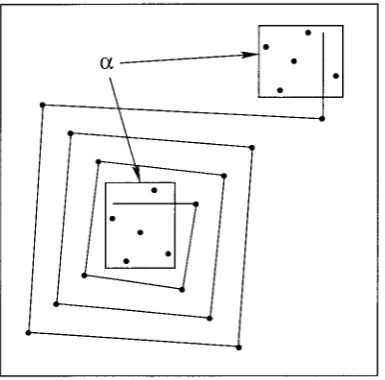
or 241. One stack sortable permutations are precisely defined by A(231). On the
right is an atomic (and fractal) representation of A(231). Everyone stack sortable
permutation can be plotted on the black lines of the representation. Instantly we
can see what elements of A(231) look like. Enumeration: It has been shown by
Knuth [18] that the number of one-stack sortable permutations is the nth Catalan
number, n!(~~l)!. One definition of the Catalan numbers is the number of ways of
expressing n pairs of brackets in a balanced form. For instance C2 = 2 because
(0)
and
00
are the only balanced expressions of two pairs of brackets. To contrast,0)( is an unbalanced expression. Now note that there is a one-one correspondence
between S sortable permutations and the sequences of push and pop operations
used to sort them. And that there is a one-one correspondence between such
push-pop sequences and balanced expressions of brackets. This case study illustrates
Thus we can define a sequence of functions 7f1, 7f2, 7f3, . . . on subsets of
the real numbers, each function 7fi generating an atomic representation of
SUb(pi). As each of these functions is an extension of the preceding one this
sequence converges to a function 7f, having the properties that: i) the domain
A of 7f is the union of the domains AI, A2 , . . . of the functions 7f1, 7f2, . . . , and
ii) for each domain
A
(i E Z+), the function 7f restricted toA
is equal to7fi. Then B(A, B, 7f) is equal to the union of all B(A, Bi , 7fi), for:
It is clear that each B(Ai' Bi , 7fi) is a subset of B(A, B, 7f). Secondly since
each Ai is a subset of its successor Ai+l we have that every finite subset of
A
is also a finite subset of someA;
therefore the permutation generated by7f from such a subset is also generated by some 7fi and is contained in the
corresponding B(Ai' Bi , 7fi).
Thus B(A, B, 7f) is an atomic representation of X, as required.
3:::} 1: Suppose that X = B(A, B, 7f) and that a and 13 are some
permu-tations in X. Then there exist subsets
Al
andA2
of the domain of 7f thatgenerate a and 13. The union of
Al
andA2
therefore generates a permutationin X involving both a and
13,
fulfilling the requirements of join.1 :::} 4: Suppose that X has the join property and suppose that X is the
union of two proper closed subclasses Y and Z. Let
13
and, be permutationsin X \ Y and X \ Z respectively. The class X has the join property, therefore
there exists a permutation 8 in X that involves both 13 and ,. X is equal to
the union of Y and Z and therefore 8 is contained in at least one of these.
However if 8 is in Y then by closure so is " which cannot be. By symmetry
8 is not in Z, which yields a contradiction. Thus if X has the join property
1.4. SUMMARY OF CHAPTERS
19
-.1 ==?- -.4: Suppose that X does not have the join property, and denote
the basis of X by B(X). There exist two permutations K, and A in X such
that every element of X involves at most one of K, and A. Then X is equal to
the union of A({K,} U B(X)), which is the set of elements of X that do not
involve K" and of A({A} U B(X)), which is the set of elements of X that do
not involve A. Furthermore these are proper subclasses of X. This completes
the proof.
•
1.4 Summary of Chapters
This thesis has three main thrusts.
First, it provides a comprehensive summary of the presently known
struc-ture theory of closed classes. It is intended to be an expanded version of [1]
containing some significant developments and a substantial strengthening of
existing theory. The Constructions chapter is dedicated to this purpose.
Secondly, it examines the decidability problem for whether an arbitrary
closed class, given by its basis, is atomic. We solve this question in one case,
the remaining cases are still open.
Thirdly, it attacks the most popular question in closed permutation classes
- that of enumeration - the question of how many permutations of each length
a given closed class has. We solve it for one class, M, of the permutations
sortable by two ordered stacks in series2
. We do not solve it for the general
2 A full definition of what we mean by ordered is given in the introduction to the chapter
two stacks in series, S2, but we do conjecture a connection between
permu-tations that can be sorted by S2 and a set of coloured graphs. Finally we
add a comment aimed at the ongoing debate of arbitrary closed classes.
To these ends there are certain qualities that can interest us in any closed
class. We therefore are liable to ask the following:
• What is the basis of the class? Is the class finitely based?
• Is a class atomic? If not then can we express it as a union of atomic
classes? (This corresponds to the question of "How is the class
express-ible by the Sub notation?". The tangexpress-ible objects that are elements
max-imal under involvement correspond precisely to finite maxmax-imal atomic
subclasses.)
• How many elements of each length does a class have? Is the class finite?
Can we, for computational purposes, determine in polynomial time, or
better, whether or not a given permutation is in the class?
• Does a class contain an infinite antichain? (A class that does not is
said to be partially well ordered and has certain nice properties with
regard to its atomic decomposition.)
Constructions
In Chapter 2 we introduce constructions and decompositions widely used
within this field. It is its own best introduction and has, added to it, various
theorems and counterexamples designed to show how how these cost ructions
1.4. SUMMARY OF CHAPTERS 21
• If two classes are defined by their respective bases then what is the
basis of their merge?
• Is the merge of two finitely based classes necessarily finitely based?
• If two closed classes are given by their bases then what is the basis of
their wreath product? If the two classes are finitely based is it decidable
whether or not their wreath is finitely based? Is there a terminating
mechanism that will deliver the basis of the wreath of two classes,
providing that the wreath is finitely based?
• Is it true that the union of an infinitely based atomic class X and
another class Y that does not contain X is necessarily infinitely based?
Antichains
As these appear everywhere within this subject it seems reasonable to add
a chapter on them. The classification of all antichains is a favourite topic of
mine and is as yet still incomplete.
Atomic Classes and Natural Classes
The most important single theme in Atomic classes is the following question:
• If a closed class has a finite basis is it possible to determine from the
basis whether the class is atomic?
The question is still open in the general case. The set of all natural classes
is a subset of the set of all atomic classes and we show that it is decidable
Bibliothek
There is compiled library of antichains that the author regards as being in
some sense 'nice' or 'significant', and a list of finitely based classes including
properties known about them, especially enumeration, if known, is given, and
if classes are known to be partially well ordered (contain no infinite anti chain )
then this is also stated.
Sorting Machines, and Conclusion
We consider two specifically, M and 52. The machine M we here declare to
be identical to 52 except that both stacks are ordered so that no term is ever
placed on top of a smaller term in either stack.
We draw conclusions relevant and perhaps even necessary for any analysis
of machines composed of lesser machines placed in parallel or in series.
We also sketch out the open problems that we regard to be most important
for the development of closed classes, and those that are most interesting in
their own right. The two species of problem largely coincide.
Gessel's Conjecture
In the remaining chapter and appendices we present miscellanea and notes
for programmers.
1.4.1
Notation
We denote sequences, subsequences and permutations by Greek letters. The
1.4. SUMMARY OF CHAPTERS 23
example an antichain U~2 is defined III the library, and its elements, all
permutations, are denoted UI , U2 , ••..
We denote the terms of a sequence or permutation by lower case Latin
letters. We avoid the use of commas and brackets wherever possible, so we
will usually write J1
=
ala2a3 instead of J1=
(aI,
a2, a3) to represent the three terms of some one sequence J1.We follow common tradition and denote sets by capital letters, either
Latin or Greek.
We will frequently have to deal with subsequences of some given sequence,
and we may modify these subsequences in an argument. For instance if r; is
a subsequence of a permutation 7r and if Pj is a term of 7r not in r; then we
may wish to consider the subsequence of 7r that consists of all the terms of
r; and the term Pj. We denote this by r; U Pj. We may also wish to consider the subsequence that contains precisely those terms of 7r that do not lie in
r;. We denote that by 7r \ r;. Essentially we treat sequences as sets of self
organising material. We defend this as follows: A sequence is a function.
A function is a set of ordered pairs, the first entry being an element of the
domain, the second an element of the range. A restriction of a function is
therefore a subset of that function, and we may use set notation to indicate
the union, intersection and complement of such restricted functions. We
are of the opinion that this yields the most natural and intuitively obvious
notation for our purposes, and we will use it.
We call the permutation 1 the trivial permutation, and the permutation
Notation for Closed Sets
We denote the set of all permutations that avoid or do not involve any
element of some set of permutations B by A(B).
We denote the basis of a closed class X by B(X). The letter B is also
used for the representation of atomic classes, unfortunately both uses are
established by convention. However the format of B(A, B,
7r)
and B(X) is sufficiently different that there is little opportunity for confusion.Some Closed Sets
We denote by I the set of all increasing sequences 123 ... n, and by R the
set of all decreasing permutations n (n - 1) ... 3 2 1. Accordingly we also
denote by In and
Rn
the permutations 123 ... nand n ... 321 respectively.We follow broader mathematical usage when we let S denote the set of
all permutations. There have been cases in the literature where S has been
used to denote the set of Separable permutations, which is a special class in
restricted permutations. When the latter appear we will conveniently not
associate a letter with them to avoid confusion in so far as we are able.
1.5
Some Exercises
Exercise 16 Prove that the number of permutations oflength n+1 involving
a given permutation of length n is (n
+
1)2 - 2n = n2+
1.It is too long an exercise to verify that there are two permutations of
length four that are involved in different numbers of permutations of length
1.5. SOME EXERCISES 25
number of permutations of given length in a class with given basis is not a
trivial task.
Exercise 17 Prove that for every non-negative integer pEN there exists a
closed class X and a number N such that for each integer n
2:
N there exist precisely p elements of X with length n.Prove that there exists a class Y such that Y has precisely 2n
- 1 elements
of length n.
Prove that there exists a class Z and an integer
f
such that Z contains precisely 3f*
c permutations of length c. Repeat for higher exponents.It is open whether for any natural number p
>
2 there exists a closedclass K that has precisely pU permutations of length u, for some fixed integer
f
and large enough u.Exercise 18 Prove that the partial order of involvement has infinite
dimen-sion. Figure 1.4 contains a result that may help.
Exercise 19 (Harder)
Prove that every partial order with count ably many elements and no
infinite descending chains is contained in the partial order of involvement.
This exercise may be easier after reading the chapter on antichains.
A Pleasant Result
Theorem 20 Every permutation
r
of length at least mn+
1 involves eitherFigure 1.4: "The standard example (of an n dimensional partially ordered set) Sn
is isomorphic to the poset formed by the I-element and (n - I)-element subsets of
the n-element set [n] ordered by inclusion." - taken from [35]. It would appear that
dimension theory was first introduced by Dushnick and Miller in [36] where this
definition of Sn is extended so as to be able to generate 'transfinite' as well as finite
dimensional partial orders. The reader is advised not to confuse the meaning of
Sn used here with the permutation oriented meaning used elsewhere in the thesis.
The proof that we give is attributed to Erdos and Szekeres on page 154
of [15].
PROOF: Suppose that 'Y contains no increasing subsequence of length
greater than m.
For every i E {1, 2, ... , m} define Li to be the set of terms 9 E 'Y such
that every increasing subsequence of maximal length, subject to terminating
with g, has length i.
By our supposition every term of'Y is contained in at least one (and in
fact precisely one) of these sets. Thus by the pigeonhole principle there exists
at least one set Lk k E {1, ... , m} that has at least n
+
1 elements.Finally, note that the elements of Lk form a decreasing subsequence of 'Y.
1.6. PERMUTATION SYMMETRIES
a( /)
5
4
3
2
1
1 2 3 4 5
27
Three Symmetries
a(R) -1
-->:
- - + - - - t R ( a )
•
Figure 1.5: Plotting the permutation a
=
54132. The three symmetries, a-I =35421, a(R) = aR = 23145 and R(a) = 12534 can be thought of as reflections, as
shown on the right.
1.6 Permutation Symmetries
There are eight symmetries of a permutation, as there are for a square. We
introduce them here so that we may use them freely later.
We clarify the analogy with the square: If 0; is a permutation of length
n
then 0; is a bijection on Z~ = {1, 2, ... ,n}.
Thus 0; may be plotted on thereal plane with coordinates x and y, see Figure 1.5. The image of 0; will lie
within the square with boundaries x
=
0, x=
n+ 1, y=
0 and y=
n+ 1.Every symmetry of that square will transform the plotted points into the
plot of another permutation of length n. We denote those symmetries that
we will use in this text as follows:
• Inversion: We give
0;-1
the usual meaning of the permutation such that0;(0;-1)
=0;-1(0;)
= In, where In is the identity permutation onzt.
plot of a over the first diagonal, where y = x.
• Reversal: If a = al a2 ... an then the permutation anan-l ... al obtained
by listing the terms of a in reverse is denoted a(R) or aR
. This is
logically justifiable in terms of composition of functions because Rn
represents the permutation n n - 1 ... 2 1. Reversal is equivalent to
reflection over the line x =
nt
1.• Upturnment is equivalent to reflection over the horizontal axis y =
nt
1and is denoted by R( a), as composition of mappings might demand. If
the ith term of
a
is ai then that of R(a)
is n+
1 - ai.• We will not reserve a specific notation for the reflection (R( aR)
t
1 orany of the rotations.
Symmetries are useful when enumerating sets of permutations. If a
per-mutation avoids 123 then its reverse will avoid 321, reversal is a bijection,
thus there is no need to enumerate the number of permutations of given
Chapter
2
Constructions
Union, Intersection, Direct and Skew Sum, Direct and Skew
Com-pletion, Strong ComCom-pletion, Sum Decidability, Direct and Skew
Expansion, Wreath Product, Interval Free Permutations P,
Juxta-position, Differentiation, Merge
2.1
Union and Intersection of Closed Classes
Theorem 21 [1] If X and Yare closed classes then X
n
Y is closed.Fur-thermore if X = A(Bd and Y
=
A(B2) then Xn
Y=
A(BI U B2)'PROOF: This is elementary and follows from the definitions of closed class
and basis. •
Definition 22 Let Do and
f3
be permutations. A merge of Do andf3
is apermutation consisting of two not necessarily disjoint subsequences order
isomorphic to Do and
f3.
A minimal merge of some permutations 0: and (3 is a permutation that
is minimal subject to involving both 0: and (3. The definition extends to
sets in a natural way: The merge of two sets of permutations is the set of
all permutations that are a merge of a permutation in the one set and a
permutation in the other. The minimal merge of two sets is however defined
slightly differently:
Definition 23 Let A and B be sets of permutations. Then the minimal
merge of A and B is the set of permutations, minimal under involvement, in
the merge of A and B.
This does not necessarily include every minimal merge of an element
of A and an element of B. It is in fact very easily possible to have two
infinite sets, such as I and R, the sets of increasing and decreasing sequences,
whose minimal merge consists of but a single permutation, in this case the
permutation 1.
Theorem 24
(l)
If X and Yare closed classes thenXu
Y is closed. Fur-thermore if X=
A(B1 ) and Y=
A(B2 ) then the basis of X U Y is theminimal merge of Bl and B2 ·
PROOF: To see that
XuY
is closed is elementary. Note that a permutation5 is not in
Xu
Y if and only if it involves elements of both Bl and B2 . Thusthe basis of X U Y is the set of permutations such as 5, minimal under
inclusion subject to involving elements of both Bl and B2 , which is precisely
the minimal merge of Bl and B2 • Quad erat demonstrandum.
2.1. UNION AND INTERSECTION OF CLOSED CLASSES
31
Corollary 25 If X and Yare finitely based then so is X U Y. Indeed if X
and Y have no basis elements of length greater than m and n respectively
then X U Y has no basis elements of length greater than m
+
n.The above results may all be derived from Theorem 2.1 on page 30 of [1].
Note: A(BI
n
B2 ) is in general a larger set than and invariably containsXU Y, assuming that Bl and B2 are the bases of X and Y respectively.
2.1.1
Some More Advanced Material.
This section contains concepts that are only introduced in later chapters,
the reader is not expected to comprehend it in first perusal. It contains
some results, that the logician may be assured have not been used later in
this thesis, and an open conjecture concerning unions of closed classes. The
author is confident that similar questions regarding intersections of classes, as
opposed to unions of classes, are sufficiently easily answered as not to warrant
dedicated coverage. The author also awaits questions about intersections that
are worthy of attention!
Theorem 26 There exists an infinitely based class X and a finitely based
class Y such that neither class is contained within the other and such that
the union of X and Y is finitely based. Similarly there exist two infinitely
based classes X and Y whose union is finitely based.
PROOF:
based.
We present two infinitely based classes whose union is finitely
Let A and B be infinite anti chains all of whose elements lie in A(321) and
length less than five. Such antichains exist and examples may be found in
the Bibliothek. Let X be the set consisting of all permutations not in A
but properly involved in an element of A, and additionally let X contain all
elements of the set
A(123).
Thus:X
=A(123)
U (Sub(A) \ A).X is infinitely based because every element of A is a basis element. (As every
element of
A
has length at least five and avoids 321, every element ofA
mustinvolve 123 and therefore is not an element of X. Hovever if anyone term is
removed from an element of
A
then we obtain a sequence order isomorphicto an element of Sub(A) \ A.)
Similarly let:
Y =
A(321)
U (Sub(B) \ B).Y also is infinitely based, however:
XUY
(A(123)
U (Sub(A) \ A)) U(A(321)
U (Sub(B) \ B))(A(123)
U (Sub(B) \ B)) U(A(321)
U (Sub(A) \ A))A(123)
UA(321)
which is finitely based.
If Y is instead defined to be
A(321)
then it is still true that neither set iscontained within the other, and yet the union of X and Y is unaltered and
has the same finite basis.
•
Conjecture 27 The union of an infinitely based atomic class X and any
other closed class Y that is neither a subset nor a superset of X is by necessity
2.1. UNION AND INTERSECTION OF CLOSED CLASSES
33
The proof of this conjecture is not eased by the fact that if B is the
basis of some infinitely based atomic class X then not every element of X is
involved in an element of B, as is demonstrated in the following: Let A be
an infinite, maximal and fundamental antichain in
A(321).
(There are onlyfour such antichains.) Let X
=
(Sub(A) \ A) EB Sub(l). Then only finitelymany basis elements of X are not elements of A, and it is not true that every
element of X is involved in a basis element of X. (The conjecture would be
a straightforward corollary of this aforementioned fact not holding, however
the fact stands.)
Maximal Elements: There exist two classes, both infinite and neither
contained in the other, such that every element of each class is contained
within a maximal element of that class, but where the intersection contains
no maximal elements. The intersection is, by necessity, infinite.
Proof: Consider the closures of the fundamental antichains ~~ U and Ui;
listed in the library. Their intersection is the closure of an infinite increasing
oscillating sequence. Q.E.D.
The entirety of the chapter on atomic classes concerns itself with writing
closed classes as unions of lesser closed classes. Of especial interest is
Theo-rem 182 which states that a finitely based non-atomic class can be written as
a union of two incomparable finitely based closed classes, and Theorem 188
from which it follows that every partially well ordered class is expressible as
-6
5
4
S
urn3
2
123 ...
-.---~
Compo nents
A sorting machine 1
Figure 2.1: Sum decomposition occurs naturally with sorting devices that produce
an increasing output: Smaller sum components are sorted first.
2.2 Direct and Skew Sum
Definition 28 The direct sum a E9 (3 of two permutations a and (3 is the
permutation
r
= glg2 ... gn where for some i we have that gl ... gi is order isomorphic to a, that gi+1 ... gn is order isomorphic to (3 and that for all j, kwith j ::; i
<
k we have that gj<
gk.Example 29 If a
=
21 and (3=
312 then a E9 (3=
21534, as 21 = a and 534 -::::: 312 = (3.This definition extends to sets of permutations in a natural way:
X E9 Y = {a E9 (3la EX; (3 E Y}
The definition of skew sum is similar:
Definition 30 The skew sum a
e
(3 of two permutations a and (3 is the permutationr
= glg2 ... gn where for some i we have that g1 ... gi is order isomorphic to a, that gi+1 ... gn is order isomorphic to (3 and that for all j, kwith j ::; i
<
k we have that gj>
gk.2.2. DIRECT AND SKEW SUM 35
2.2.1
Sum Indecomposable: The Increasing
Oscillat-ing Sequence
Definition 32 A permutation I that is expressible as Q' EB f3 or Q' 8 f3 where
Q' and f3 are non empty permutations is said to be sum decomposable or skew
decomposable respectively.
Definition 33 Let Q' = al ... an be a sequence. A contiguous subsequence
aiai+l ... aj of Q' is said to be a sum component if it is greater than all the
terms it succeeds and less than all the terms it precedes, and is not order
isomorphic to a sum decomposable permutation.
The definition of a skew component is analogous.
We introduce a sequence about which the structure of sum
indecompos-able sequences revolves, namely the increasing oscillating sequence. It is best
first seen as an infinite sequence so that we may ignore end effects. It is a
sequence that, in a sense adapted for infinite sequences, is sum
indecompos-able. Minimally so, in that if any term is removed then the result is sum
decomposable. The sequence is defined by:
... -3 -6 -1 -4 1 -230527496118 ...
A conventional increasing oscillating sequence is a finite sum
indecom-posable sequence order isomorphic to some subsequence of the increasing
oscillating sequence. An example of such a sequence is 31527486. It is
typ-ical in that if any term is removed from this then, with two exceptions, the
resulting sequence is sum decomposable. For instance if 5 is removed then