Labelling Topics using Unsupervised Graph-based Methods
Nikolaos Aletras and Mark StevensonDepartment of Computer Science University of Sheffield Regent Court, 211 Portobello
Sheffield, S1 4DP United Kingdom
{n.aletras, m.stevenson}@dcs.shef.ac.uk
Abstract
This paper introduces an unsupervised graph-based method that selects textual labels for automatically generated topics. Our approach uses the topic keywords to query a search engine and generate a graph from the words contained in the results. PageRank is then used to weigh the words in the graph and score the candidate labels. The state-of-the-art method for this task is supervised (Lau et al., 2011). Evaluation on a standard data set shows that the per-formance of our approach is consistently superior to previously reported methods.
1 Introduction
Topic models (Hofmann, 1999; Blei et al., 2003) have proved to be a useful way to represent the content of document collections, e.g. (Chaney and Blei, 2012; Ganguly et al., 2013; Gretarsson et al., 2012; Hinneburg et al., 2012; Snyder et al., 2013). In these interfaces, topics need to be pre-sented to users in an easily interpretable way. A common way to represent topics is as set of key-words generated from thenterms with the highest marginal probabilities. For example, a topic about the global financial crisis could be represented by its top 10 most probable terms: FINANCIAL, BANK, MARKET, GOVERNMENT, MORTGAGE, BAILOUT,BILLION, STREET, WALL, CRISIS. But
interpreting such lists is not always straightfor-ward, particularly since background knowledge may be required (Chang et al., 2009).
Textual labels could assist with the interpre-tations of topics and researchers have developed methods to generate these automatically (Mei et al., 2007; Lau et al., 2010; Lau et al., 2011). For example, a topic which has keywords SCHOOL, STUDENT, UNIVERSITY, COLLEGE, TEACHER, CLASS, EDUCATION, LEARN, HIGH, PROGRAM,
could be labelled as EDUCATIONand a suitable
la-bel for the topic shown above would be GLOBAL
FINANCIALCRISIS. Approaches that make use of
alternative modalities, such as images (Aletras and Stevenson, 2013), have also been proposed.
Mei et al. (2007) label topics using statistically significant bigrams identified in a reference collec-tion. Magatti et al. (2009) introduced an approach for labelling topics that relied on two hierarchical knowledge resources labelled by humans, while Lau et al. (2010) proposed selecting the most rep-resentative word from a topic as its label. Hulpus et al. (2013) make use of structured data from DB-pedia to label topics.
Lau et al. (2011) proposed a method for auto-matically labelling topics using information from Wikipedia. A set of candidate labels is gener-ated from Wikipedia article titles by querying us-ing topic terms. Additional labels are then gen-erated by chunk parsing the article titles to iden-tify n-grams that represent Wikipedia articles as well. Outlier labels (less relevant to the topic) are identified and removed. Finally, the top-5 topic terms are added to the candidate set. The la-bels are ranked using Support Vector Regression (SVR) (Vapnik, 1998) and features extracted us-ing word association measures (i.e. PMI, t-test,χ2
and Dice coefficient), lexical features and search engine ranking. Lau et al. (2011) report two ver-sions of their approach, one unsupervised (which is used as a baseline) and another which is super-vised. They reported that the supervised version achieves better performance than a previously re-ported approach (Mei et al., 2007).
This paper introduces an alternative graph-based approach which is unsupervised and less computationally intensive than Lau et al. (2011). Our method uses topic keywords to form a query. A graph is generated from the words contained in the search results and these are then ranked using the PageRank algorithm (Page et al., 1999;
{‘Description’: ‘Microsoft will accelerate your journey to cloud computing with an agile and responsive datacenter built from your existing technology investments.’, ‘DisplayUrl’: ‘www.microsoft.com/en-us/server-cloud/datacenter/virtualization.aspx’, ‘ID’: ‘a42b0908-174e-4f25-b59c-70bdf394a9da’,
‘Title’: ‘Microsoft | Server & Cloud | Datacenter | Virtualization ...’,
‘Url’: ‘http://www.microsoft.com/en-us/server-cloud/datacenter/virtualization.aspx’, ... }
Figure 1: Sample of the metadata associated with a search result.
cea and Tarau, 2004). Evaluation on a standard data set shows that our method consistently out-performs the best performing previously reported method, which is supervised (Lau et al., 2011).
2 Methodology
We use the topic keywords to query a search en-gine. We assume that the search results returned are relevant to the topic and can be used to identify and weigh relevant keywords. The most impor-tant keywords can be used to generate keyphrases for labelling the topic or weight pre-existing can-didate labels.
2.1 Retrieving and Processing Text Information
We use the approach described by Lau et al. (2011) to generate candidate labels from Wikipedia arti-cles. The 10 terms with the highest marginal prob-abilities in the topic are used to query Wikipedia and the titles of the articles retrieved used as candi-date labels. Further candicandi-date labels are generated by processing the titles of these articles to identify noun chunks and n-grams within the noun chunks that are themselves the titles of Wikipedia arti-cles. Outlier labels, identified using a similarity measure (Grieser et al., 2011), are removed. This method has been proved to produce labels which effectively summarise a topic’s main subject.
However, it should be noted that our method is flexible and could be applied to any set of can-didate labels. We have experimented with various approaches to candidate label generation but chose to report results using the approach described by Lau et al. (2011) to allow direct comparison of ap-proaches.
Information obtained from web searches is used to identify the best labels from the set of candi-dates. The topnkeywords, i.e. those with highest marginal probability within the topic, are used to
form a query which was submitted to the Bing1 search engine. Textual information included in the Title field2 of the search results metadata was ex-tracted. Each title was tokenised using openNLP3 and stop words removed.
Figure 1 shows a sample of the metadata asso-ciated with a search result for the topic:VMWARE, SERVER, VIRTUAL, ORACLE, UPDATE, VIRTU -ALIZATION, APPLICATION, INFRASTRUCTURE, MANAGEMENT,MICROSOFT.
2.2 Creating a Text Graph
We consider any remaining words in the search result metadata as nodes, v ∈ V, in a graph
G= (V, E). Each node is connected to its
neigh-bouring words in a context window of±nwords. In the previous example, the words added to the graph from the Title of the search result are mi-crosoft, server, cloud, datacenter and virtualiza-tion.
We consider both unweighted and weighted graphs. When the graph is unweighted we assume that all the edges have a weight e = 1. In addi-tion, we weight the edges of the graph by comput-ing the relatedness between two nodes,viandvj, as their normalised Pointwise Mutual Information (NPMI) (Bouma, 2009). Word co-occurrences are computed using Wikipedia as a a reference cor-pus. Pairs of words are connected with edges only if NPMI(wi, wj) > 0.2avoiding connections be-tween words co-occurring by chance and hence in-troducing noise.
2.3 Identifying Important Terms
Important terms are identified by applying the PageRank algorithm (Page et al., 1999) in a sim-ilar way to the approach used by Mihalcea and
1http://www.bing.com/
2We also experimented with using the Description field
but found that this reduced performance.
Tarau (2004) for document keyphrase extraction. The PageRank score (P r) overGfor a word (vi) can be computed by the following equation:
P r(vi) =d· X
vj∈C(vi)
sim(vi, vj) P
vk∈C(vj)
sim(vj, vk)P r(vj)
+ (1−d)v (1)
whereC(vi)denotes the set of vertices which are connected to the vertexvi.dis the damping factor which is set to the default value ofd= 0.85(Page et al., 1999). In standard PageRank all elements of the vector v are the same, 1
N where N is the number of nodes in the graph.
2.4 Ranking Labels
Given a candidate label L = {w1, ..., wm} con-taining m keywords, we compute the score of L
by simply adding the PageRank scores of its con-stituent keywords:
Score(L) =Xm
i=1
P r(wi) (2)
The label with the highest score amongst the set of candidates is selected to represent the topic. We also experimented with normalised versions of the score, e.g. mean of the PageRank scores. How-ever, this has a negative effect on performance since it favoured short labels of one or two words which were not sufficiently descriptive of the top-ics. In addition, we expect that candidate labels containing words that do not appear in the graph (with the exception of stop words) are unlikely to be good labels for the topic. In these cases the score of the candidate label is set to 0. We also experimented with removing this restriction but found that it lowered performance.
3 Experimental Evaluation
3.1 Data
We evaluate our method on the publicly avail-able data set published by Lau et al. (2011). The data set consists of 228 topics generated using text documents from four domains, i.e. blog posts (BLOGS), books (BOOKS), news articles (NEWS) and scientific articles from the biomedi-cal domain (PUBMED). Each topic is represented by its ten most probable keywords. It is also as-sociated with candidate labels and human ratings
denoting the appropriateness of a label given the topic. The full data set consists of approximately 6,000 candidate labels (27 labels per topic). 3.2 Evaluation Metrics
Our evaluation follows the framework proposed by Lau et al. (2011) using two metrics, i.e. Top-1 average ratingandnDCG, to compare various labelling methods.
Top-1 average ratingis the average human rat-ing (between 0 and 3) assigned to the top-ranked label proposed by the system. This provides an in-dication of the overall quality of the label the sys-tem judges as the best one.
Normalised discounted cumulative gain (nDCG) (J¨arvelin and Kek¨al¨ainen, 2002; Croft et al., 2009) compares the label ranking proposed by the system to the ranking provided by human annotators. The discounted cumulative gain at position p, DCGp, is computed using the following equation:
DCGp =rel1+ p X
i=2 reli
log2(i) (3)
wherereliis the relevance of the label to the topic in positioni. Then nDCG is computed as:
nDCGp = IDCGDCGp
p (4)
where IDCGp is the superviseed ranking of the image labels, in our experiments this is the rank-ing provided by the scores in the human annotated data set.
3.3 Model Parameters
Our proposed model requires two parameters to be set: the context window size when connecting neighbouring words in the graph and the number of the search results considered when constructing the graph.
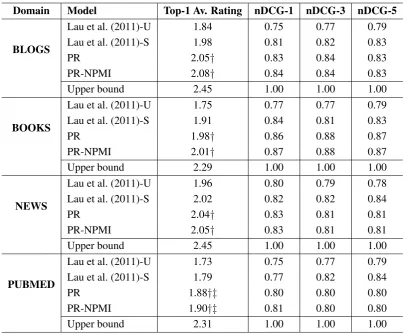
Domain Model Top-1 Av. Rating nDCG-1 nDCG-3 nDCG-5
BLOGS
Lau et al. (2011)-U 1.84 0.75 0.77 0.79
Lau et al. (2011)-S 1.98 0.81 0.82 0.83
PR 2.05† 0.83 0.84 0.83
PR-NPMI 2.08† 0.84 0.84 0.83
Upper bound 2.45 1.00 1.00 1.00
BOOKS
Lau et al. (2011)-U 1.75 0.77 0.77 0.79
Lau et al. (2011)-S 1.91 0.84 0.81 0.83
PR 1.98† 0.86 0.88 0.87
PR-NPMI 2.01† 0.87 0.88 0.87
Upper bound 2.29 1.00 1.00 1.00
NEWS
Lau et al. (2011)-U 1.96 0.80 0.79 0.78
Lau et al. (2011)-S 2.02 0.82 0.82 0.84
PR 2.04† 0.83 0.81 0.81
PR-NPMI 2.05† 0.83 0.81 0.81
Upper bound 2.45 1.00 1.00 1.00
PUBMED
Lau et al. (2011)-U 1.73 0.75 0.77 0.79
Lau et al. (2011)-S 1.79 0.77 0.82 0.84
PR 1.88†‡ 0.80 0.80 0.80
PR-NPMI 1.90†‡ 0.81 0.80 0.80
[image:4.595.96.506.60.394.2]Upper bound 2.31 1.00 1.00 1.00
Table 1: Results for Various Approaches to Topic Labelling (†: significant difference (t-test, p <0.05) to Lau et al. (2011)-U;‡: significant difference (p <0.05) to Lau et al. (2011)-S).
4 Results and Discussion
Results are shown in Table 1. Performance when PageRank is applied to the unweighted (PR) and NPMI-weighted graphs (PR-NPMI) (see Section 2.2) is shown. Performance of the best unsuper-vised (Lau et al. (2011)-U) and supervised (Lau et al. (2011)-S) methods reported by Lau et al. (2011) are shown. Lau et al. (2011)-U uses the av-erage χ2 scores between the topic keywords and
the label keywords while Lau et al. (2011)-S uses SVR to combine evidence from all features. In addition, upper bound figures, the maximum pos-sible value given the scores assigned by the anno-tators, are also shown.
The results obtained by applying PageRank over the unweighted graph (2.05, 1.98, 2.04 and 1.88) are consistently better than the supervised and unsupervised methods reported by Lau et al. (2011) for the Top-1 Average scores and this im-provement is observed in all domains. The differ-ence is significant (t-test, p < 0.05) for the un-supervised method. A slight improvement in
per-formance is observed when the weighted graph is used (2.08, 2.01, 2.05 and 1.90). This is expected since the weighted graph contains additional in-formation about word relatedness. For example, the wordhardwareis more related and, therefore, closer in the graph to the wordvirtualizationthan to the wordinvestments.
Results from the nDCG metric imply that our methods provide better rankings of the candidate labels in the majority of the cases. It is outper-formed by the best supervised approach in two do-mains, NEWS and PUBMED, using the nDCG-3 and nDCG-5 metrics. However, the best label proposed by our methods is judged to be better (as shown by the nDCG-1 and Top-1 Av. Rat-ing scores), demonstratRat-ing that it is only the lower ranked labels in our approach that are not as good as the supervised approach.
50 100 150 200 250 300 1.7
1.8 1.9 2 2.1 2.2
Number of Search Results
Top-1
Av
.Rating
(a) BLOGS
50 100 150 200 250 300 1.7
1.8 1.9 2 2.1 2.2
Number of Search Results (b) BOOKS
50 100 150 200 250 300 1.7
1.8 1.9 2 2.1 2.2
Number of Search Results
Top-1
Av
.Rating
(c) NEWS
50 100 150 200 250 300 1.7
1.8 1.9 2 2.1 2.2
Number of Search Results Lau et al. (2011)-U
Lau et al. (2011)-S PR PR-NPMI
[image:5.595.95.482.60.415.2](d) PUBMED
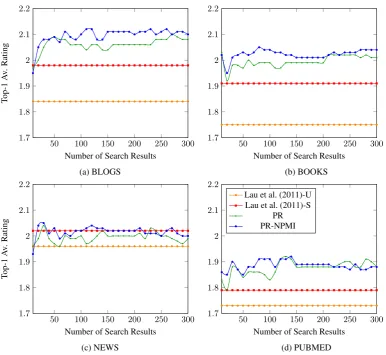
Figure 2: Top-1 Average Rating obtained for different number of search results.
term importance. Consequently, it is not necessary to measure semantic similarity between topic key-words and candidate labels as previous approaches have done. In addition, performance improvement gained from using the weighted graph is mod-est, suggesting that the computation of association scores over a large reference corpus could be omit-ted if resources are limiomit-ted.
In Figure 2, we show the scores of Top-1 av-erage rating obtained in the different domains by experimenting with the number of search results used to generate the text graph. The most inter-esting finding is that performance is stable when 30 or more search results are considered. In addi-tion, we observe that quality of the topic labels in the four domains remains stable, and higher than the supervised method, when the number of search results used is between 150 and 200. The only domain in which performance of the supervised method is sometimes better than the approach pro-posed here is NEWS. The main reason is that news topics are more fine grained and the candidate
labels of better quality (Lau et al., 2011) which has direct impact in good performance of ranking methods.
5 Conclusion
We described an unsupervised graph-based method to associate textual labels with automati-cally generated topics. Our approach uses results retrieved from a search engine using the topic keywords as a query. A graph is generated from the words contained in the search results metadata and candidate labels ranked using the PageRank algorithm. Evaluation on a standard data set shows that our method consistently outperforms the supervised state-of-the-art method for the task.
Acknowledgments
References
Nikolaos Aletras and Mark Stevenson. 2013. Rep-resenting topics using images. In Proceedings of the 2013 Conference of the North American Chap-ter of the Association for Computational Linguistics: Human Language Technologies, pages 158–167, At-lanta, Georgia.
David M. Blei, Andrew Y. Ng, and Michael I. Jordan. 2003. Latent Dirichlet Allocation. Journal of Ma-chine Learning Research, 3:993–1022.
Gerlof Bouma. 2009. Normalized (pointwise) mutual information in collocation extraction. In Proceed-ings of GSCL.
Allison June-Barlow Chaney and David M. Blei. 2012. Visualizing topic models. In Proceedings of the Sixth International AAAI Conference on Weblogs and Social Media, Dublin, Ireland.
Jonathan Chang, Jordan Boyd-Graber, and Sean Ger-rish. 2009. Reading Tea Leaves: How Humans In-terpret Topic Models. Neural Information, pages 1– 9.
Bruce W. Croft, Donald Metzler, and Trevor Strohman. 2009. Search engines: Information retrieval in practice. Addison-Wesley.
Debasis Ganguly, Manisha Ganguly, Johannes Level-ing, and Gareth J.F. Jones. 2013. TopicVis: A GUI for Topic-based feedback and navigation. In Pro-ceedings of the Thirty-Sixth Annual International ACM SIGIR Conference on Research and Develop-ment in Information Retrieval (SIGIR 13), Dublin, Ireland.
Brynjar Gretarsson, John O’Donovan, Svetlin Bostand-jiev, Tobias H¨ollerer, Arthur Asuncion, David New-man, and Padhraic Smyth. 2012. TopicNets: Visual analysis of large text corpora with topic modeling.
ACM Trans. Intell. Syst. Technol., 3(2):23:1–23:26.
Karl Grieser, Timothy Baldwin, Fabian Bohnert, and Liz Sonenberg. 2011. Using Ontological and Doc-ument Similarity to Estimate Museum Exhibit Re-latedness.Journal on Computing and Cultural Her-itage (JOCCH), 3(3):10:1–10:20.
Alexander Hinneburg, Rico Preiss, and Ren´e Schr¨oder. 2012. TopicExplorer: Exploring document collec-tions with topic models. In Peter A. Flach, Tijl Bie, and Nello Cristianini, editors,Machine Learn-ing and Knowledge Discovery in Databases, volume 7524 of Lecture Notes in Computer Science, pages 838–841. Springer Berlin Heidelberg.
Thomas Hofmann. 1999. Probabilistic latent semantic indexing. InProceedings of the 22nd Annual Inter-national ACM SIGIR Conference on Research and Development in Information Retrieval (SIGIR ’99), pages 50–57, Berkeley, California, United States.
Ioana Hulpus, Conor Hayes, Marcel Karnstedt, and Derek Greene. 2013. Unsupervised graph-based topic labelling using DBpedia. InProceedings of the 6th ACM International Conference on Web Search and Data Mining (WSDM ’13), pages 465–474, Rome, Italy.
Kalervo J¨arvelin and Jaana Kek¨al¨ainen. 2002. Cumu-lated gain-based evaluation of IR techniques. ACM Trans. Inf. Syst., 20(4):422–446.
Jey Han Lau, David Newman, Sarvnaz Karimi, and Timothy Baldwin. 2010. Best topic word selec-tion for topic labelling. In The 23rd International Conference on Computational Linguistics (COLING ’10), pages 605–613, Beijing, China.
Jey Han Lau, Karl Grieser, David Newman, and Tim-othy Baldwin. 2011. Automatic labelling of topic models. In Proceedings of the 49th Annual Meet-ing of the Association for Computational LMeet-inguis- Linguis-tics: Human Language Technologies, pages 1536– 1545, Portland, Oregon, USA.
Davide Magatti, Silvia Calegari, Davide Ciucci, and Fabio Stella. 2009. Automatic Labeling of Top-ics. InProceedings of the 9th International Confer-ence on Intelligent Systems Design and Applications (ICSDA ’09), pages 1227–1232, Pisa, Italy.
Qiaozhu Mei, Xuehua Shen, and Cheng Xiang Zhai. 2007. Automatic Labeling of Multinomial Topic Models. In Proceedings of the 13th ACM Inter-national Conference on Knowledge Discovery and Data Mining (SIGKDD ’07), pages 490–499, San Jose, California.
Rada Mihalcea and Paul Tarau. 2004. TextRank: Bringing order into texts. InProceedings of Inter-national Conference on Empirical Methods in Natu-ral Language Processing (EMNLP ’04), pages 404– 411, Barcelona, Spain.
Lawrence Page, Sergey Brin, Rajeev Motwani, and Terry Winograd. 1999. The PageRank citation ranking: Bringing order to the web. Technical Re-port 1999-66, Stanford InfoLab.
Justin Snyder, Rebecca Knowles, Mark Dredze, Matthew Gormley, and Travis Wolfe. 2013. Topic models and metadata for visualizing text corpora. In
Proceedings of the 2013 NAACL-HLT Demonstra-tion Session, pages 5–9, Atlanta, Georgia. Associa-tion for ComputaAssocia-tional Linguistics.