Clustering Polysemic Subcategorization Frame Distributions Semantically
Anna Korhonen∗
Computer Laboratory University of Cambridge
15 JJ Thomson Avenue Cambridge CB3 0FD, UK
Yuval Krymolowski
Division of Informatics University of Edinburgh
2 Buccleuch Place Edinburgh EH8 9LW
Scotland, UK
Zvika Marx
Interdisciplinary Center for Neural Computation,
The Hebrew University Jerusalem, Israel
Abstract
Previous research has demonstrated the utility of clustering in inducing semantic verb classes from undisambiguated cor-pus data. We describe a new approach which involves clustering
subcategoriza-tion frame (SCF) distributions using the
Information Bottleneck and nearest
neigh-bour methods. In contrast to previous
work, we particularly focus on cluster-ing polysemic verbs. A novel evaluation scheme is proposed which accounts for the effect of polysemy on the clusters, of-fering us a good insight into the potential and limitations of semantically classifying
undisambiguatedSCFdata.
1 Introduction
Classifications which aim to capture the close rela-tion between the syntax and semantics of verbs have attracted a considerable research interest in both lin-guistics and computational linlin-guistics (e.g. (Jack-endoff, 1990; Levin, 1993; Pinker, 1989; Dang et al., 1998; Dorr, 1997; Merlo and Stevenson, 2001)). While such classifications may not provide a means for full semantic inferencing, they can capture gen-eralizations over a range of linguistic properties, and can therefore be used as a means of reducing redun-dancy in the lexicon and for filling gaps in lexical knowledge.
∗
This work was partly supported by UK EPSRC project GR/N36462/93: ‘Robust Accurate Statistical Parsing (RASP)’.
Verb classifications have, in fact, been used to
support many natural language processing (NLP)
tasks, such as language generation, machine transla-tion (Dorr, 1997), document classificatransla-tion (Klavans and Kan, 1998), word sense disambiguation (Dorr and Jones, 1996) and subcategorization acquisition (Korhonen, 2002).
One attractive property of these classifications is that they make it possible, to a certain extent, to in-fer the semantics of a verb on the basis of its syn-tactic behaviour. In recent years several attempts have been made to automatically induce semantic verb classes from (mainly) syntactic information in corpus data (Joanis, 2002; Merlo et al., 2002; Schulte im Walde and Brew, 2002).
In this paper, we focus on the particular task
of classifying subcategorization frame (SCF)
distri-butions in a semantically motivated manner. Pre-vious research has demonstrated that clustering can be useful in inferring Levin-style semantic classes (Levin, 1993) from both English and Ger-man verb subcategorization information (Brew and Schulte im Walde, 2002; Schulte im Walde, 2000; Schulte im Walde and Brew, 2002).
We propose a novel approach, which involves: (i)
obtaining SCF frequency information from a
lexi-con extracted automatically using the comprehen-sive system of Briscoe and Carroll (1997) and (ii) applying a clustering mechanism to this informa-tion. We use clustering methods that process raw distributional data directly, avoiding complex pre-processing steps required by many advanced meth-ods (e.g. Brew and Schulte im Walde (2002)).
empha-sis to polysemy. Earlier work has largely ignored this issue by assuming a single gold standard class for each verb (whether polysemic or not). The rel-atively good clustering results obtained suggest that many polysemic verbs do have some predominating sense in corpus data. However, this sense can vary across corpora (Roland et al., 2000), and assuming a single sense is inadequate for an important group of medium and high frequency verbs whose distribu-tion of senses in balanced corpus data is flat rather than zipfian (Preiss and Korhonen, 2002).
To allow for sense variation, we introduce a new evaluation scheme against a polysemic gold stan-dard. This helps to explain the results and offers a better insight into the potential and limitations of
clustering undisambiguatedSCFdata semantically.
We discuss our gold standards and the choice of
test verbs in section 2. Section 3 describes the
method for subcategorization acquisition and sec-tion 4 presents the approach to clustering. Details of the experimental evaluation are supplied in sec-tion 5. Secsec-tion 6 concludes with direcsec-tions for future work.
2 Semantic Verb Classes and Test Verbs
Levin’s taxonomy of verbs and their classes (Levin, 1993) is the largest syntactic-semantic verb classifi-cation in English, employed widely in evaluation of automatic classifications. It provides a classification of 3,024 verbs (4,186 senses) into 48 broad / 192 fine grained classes. Although it is quite extensive, it is not exhaustive. As it primarily concentrates on
verbs taking NPand PP complements and does not
provide a comprehensive set of senses for verbs, it is not suitable for evaluation of polysemic classifi-cations.
We employed as a gold standard a substan-tially extended version of Levin’s classification
constructed by Korhonen (2003). This
incorpo-rates Levin’s classes, 26 additional classes by
Dorr (1997)1, and 57 new classes for verb types not
covered comprehensively by Levin or Dorr.
110 test verbs were chosen from this gold stan-dard, 78 polysemic and 32 monosemous ones. Some low frequency verbs were included to investigate the
1
These classes are incorporated in the ’LCS database’ (http://www.umiacs.umd.edu/∼bonnie/verbs-English.lcs).
effect of sparse data on clustering performance. To ensure that our gold standard covers all (or most) senses of these verbs, we looked into WordNet (Miller, 1990) and assigned all the WordNet senses
of the verbs to gold standard classes.2
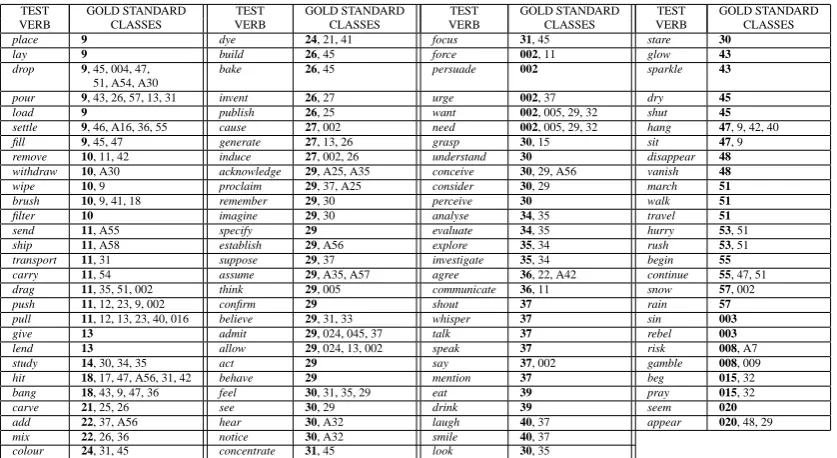
Two versions of the gold standard were created: monosemous and polysemic. The monosemous one lists only a single sense for each test verb, that cor-responding to its predominant (most frequent) sense in WordNet. The polysemic one provides a compre-hensive list of senses for each verb. The test verbs and their classes are shown in table 1. The classes are indicated by number codes from the classifica-tions of Levin, Dorr (the classes starting with 0) and
Korhonen (the classes starting with A).3 The
pre-dominant sense is indicated by bold font.
3 Subcategorization Information
We obtain ourSCFdata using the subcategorization
acquisition system of Briscoe and Carroll (1997). We expect the use of this system to be benefi-cial: it employs a robust statistical parser (Briscoe and Carroll, 2002) which yields complete though
shallow parses, and a comprehensiveSCFclassifier,
which incorporates 163 SCF distinctions, a
super-set of those found in the ANLT (Boguraev et al.,
1987) andCOMLEX (Grishman et al., 1994)
dictio-naries. The SCFs abstract over specific
lexically-governed particles and prepositions and specific predicate selectional preferences but include some derived semi-predictable bounded dependency con-structions, such as particle and dative movement.
78 of these ‘coarse-grained’SCFs appeared in our
data. In addition, a set of 160 fine grained frames were employed. These were obtained by
parameter-izing two high frequencySCFs for prepositions: the
simplePP andNP+ PP frames. The scope was
re-stricted to these two frames to prevent sparse data problems in clustering.
A SCF lexicon was acquired using this system
from the British National Corpus (Leech, 1992,
BNC) so that the maximum of 7000 citations were
2
As WordNet incorporates particularly fine grained sense distinctions, some senses were found which did not appear in our gold standard. As many of them appeared marginal and/or low in frequency, we did not consider these additional senses in our experiment.
3
TEST GOLD STANDARD TEST GOLD STANDARD TEST GOLD STANDARD TEST GOLD STANDARD VERB CLASSES VERB CLASSES VERB CLASSES VERB CLASSES
place 9 dye 24, 21, 41 focus 31, 45 stare 30
lay 9 build 26, 45 force 002, 11 glow 43
drop 9, 45, 004, 47, bake 26, 45 persuade 002 sparkle 43 51, A54, A30
pour 9, 43, 26, 57, 13, 31 invent 26, 27 urge 002, 37 dry 45
load 9 publish 26, 25 want 002, 005, 29, 32 shut 45
settle 9, 46, A16, 36, 55 cause 27, 002 need 002, 005, 29, 32 hang 47, 9, 42, 40
fill 9, 45, 47 generate 27, 13, 26 grasp 30, 15 sit 47, 9
remove 10, 11, 42 induce 27, 002, 26 understand 30 disappear 48
withdraw 10, A30 acknowledge 29, A25, A35 conceive 30, 29, A56 vanish 48
wipe 10, 9 proclaim 29, 37, A25 consider 30, 29 march 51
brush 10, 9, 41, 18 remember 29, 30 perceive 30 walk 51
filter 10 imagine 29, 30 analyse 34, 35 travel 51
send 11, A55 specify 29 evaluate 34, 35 hurry 53, 51
ship 11, A58 establish 29, A56 explore 35, 34 rush 53, 51
transport 11, 31 suppose 29, 37 investigate 35, 34 begin 55
carry 11, 54 assume 29, A35, A57 agree 36, 22, A42 continue 55, 47, 51
drag 11, 35, 51, 002 think 29, 005 communicate 36, 11 snow 57, 002
push 11, 12, 23, 9, 002 confirm 29 shout 37 rain 57
pull 11, 12, 13, 23, 40, 016 believe 29, 31, 33 whisper 37 sin 003
give 13 admit 29, 024, 045, 37 talk 37 rebel 003
lend 13 allow 29, 024, 13, 002 speak 37 risk 008, A7
study 14, 30, 34, 35 act 29 say 37, 002 gamble 008, 009
hit 18, 17, 47, A56, 31, 42 behave 29 mention 37 beg 015, 32
bang 18, 43, 9, 47, 36 feel 30, 31, 35, 29 eat 39 pray 015, 32
carve 21, 25, 26 see 30, 29 drink 39 seem 020
add 22, 37, A56 hear 30, A32 laugh 40, 37 appear 020, 48, 29
mix 22, 26, 36 notice 30, A32 smile 40, 37
[image:3.595.98.517.70.299.2]colour 24, 31, 45 concentrate 31, 45 look 30, 35
Table 1:Test verbs and their monosemous/polysemic gold standard senses
used per test verb. The lexicon was evaluated against manually analysed corpus data after an empirically defined threshold of 0.025 was set on relative
fre-quencies ofSCFs to remove noisySCFs. The method
yielded 71.8% precision and 34.5% recall. When we removed the filtering threshold, and evaluated the
noisy distribution, F-measure4dropped from 44.9 to
38.51.5
4 Clustering Method
Data clustering is a process which aims to partition a given set into subsets (clusters) of elements that are similar to one another, while ensuring that elements that are not similar are assigned to different clusters. We use clustering for partitioning a set of verbs. Our
hypothesis is that information about SCFs and their
associated frequencies is relevant for identifying
se-mantically related verbs. Hence, we useSCFs as
rel-evance features to guide the clustering process.6
4
F =2precision+recall·precision·recall
5
These figures are not particularly impressive because our evaluation is exceptionally hard. We use 1) highly polysemic test verbs, 2) a high number of SCFs and 3) evaluate against manually analysed data rather than dictionaries (the latter have high precision but low recall).
6
The relevance of the features to the task is evident when comparing the probability of a randomly chosen pair of verbs
verbiandverbjto share the same predominant sense (4.5%)
with the probability obtained whenverbjis the JS-divergence
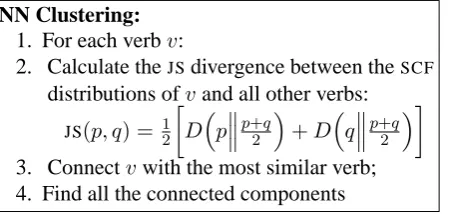
We chose two clustering methods which do not in-volve task-oriented tuning (such as pre-fixed thresh-olds or restricted cluster sizes) and which approach data straightforwardly, in its distributional form: (i) a simple hard method that collects the nearest
neigh-bours (NN) of each verb (figure 1), and (ii) the
In-formation Bottleneck (IB), an iterative soft method
(Tishby et al., 1999) based on information-theoretic grounds.
The NN method is very simple, but it has some
disadvantages. It outputs only one clustering config-uration, and therefore does not allow examination of different cluster granularities. It is also highly sensitive to noise. Few exceptional neighbourhood relations contradicting the typical trends in the data are enough to cause the formation of a single cluster which encompasses all elements.
Therefore we employed the more sophisticated
IB method as well. The IB quantifies the
rele-vance information of a SCF distribution with
re-spect to output clusters, through their mutual
infor-mationI(Clusters;SCFs). The relevance
tion is maximized, while the compression informa-tion I(Clusters;V erbs) is minimized. This en-sures optimal compression of data through clusters. The tradeoff between the two constraints is realized
NN Clustering:
1. For each verbv:
2. Calculate theJSdivergence between theSCF
distributions ofvand all other verbs:
JS(p, q) = 12
D
p
p+q 2
+D
q
p+q 2
3. Connectvwith the most similar verb;
[image:4.595.297.539.71.195.2]4. Find all the connected components
Figure 1: Connected components nearest neighbour (NN)
clustering.Dis the Kullback-Leibler distance.
through minimizing the cost term:
L=I(Clusters;V erbs)−βI(Clusters;SCFs),
whereβis a parameter that balances the constraints.
The IBiterative algorithm finds a local minimum
of the above cost term. It takes three inputs: (i)SCF
-verb distributions, (ii) the desired number of clusters
K, and (iii) the value ofβ.
Starting from a random configuration, the
algo-rithm repeatedly calculates, for each clusterK, verb
V and SCF S, the following probabilities: (i) the
marginal proportion of the cluster p(K); (ii) the
probability p(S|K) for a SCF to occur with
mem-bers of the cluster; and (iii) the probabilityp(K|V)
for a verb to be assigned to the cluster. These prob-abilities are used, each in its turn, for calculating the other probabilities (figure 2). The collection of all
p(S|K)’s for a fixed clusterK can be regarded as a
probabilistic center (centroid) of that cluster in the
SCFspace.
The IB method gives an indication of the
most informative values of K.7 Intensifying the
weight β attached to the relevance information
I(Clusters;SCFs) allows us to increase the
num-berKof distinct clusters being produced (while too
smallβ would cause some of the output clusters to
be identical to one another). Hence, the relevance
in-formation grows withK. Accordingly, we consider
as the most informative output configurations those for which the relevance information increases more
sharply betweenK −1andKclusters than between
KandK+ 1.
7
Most works on clustering ignore this issue and refer to an arbitrarily chosen number of clusters, or to the number of gold standard classes, which cannot be assumed in realistic applica-tions.
IB Clustering (fixedβ):
Perform till convergence, for each time step
t= 1,2, . . . :
1. zt(K, V) = pt−1(K)e−βD[p(S|V)kpt−1(S|K)] (Whent= 1, initializezt(K, V)arbitrarily)
2. pt(K|V) = Pzt(K,V)
K0zt(K0,V)
3. pt(K) =PV p(V)pt(K|V)
4. pt(S|K) =PV p(S|V)pt(V|K)
Figure 2:Information Bottleneck (IB) iterative clustering.D
is the Kullback-Leibler distance.
When the weight of relevance grows, the
assign-ment to clusters is more constrained andp(K|V)
be-comes more similar to hard clustering. Let
K(V) = argmax K
p(K|V)
denote the most probable cluster of a verb V.
For K ≥ 30, more than 85% of the verbs have
p(K(V)|V)>90%which makes the output cluster-ing approximately hard. For this reason, we decided
to use onlyK(V) as output and defer a further
ex-ploration of the soft output to future work.
5 Experimental Evaluation
5.1 Data
The input data to clustering was obtained from the
automatically acquiredSCFlexicon for our 110 test
verbs (section 2). The counts were extracted from
unfiltered (noisy)SCFdistributions in this lexicon.8
The NN algorithm produced 24 clusters on this
in-put. From the IB algorithm, we requested K = 2
to 60 clusters. The upper limit was chosen so as
to slightly exceed the case when the average
clus-ter size110/K = 2. We chose for evaluation the
IB results for K = 25,35 and 42. For these
val-ues, the SCF relevance satisfies our criterion for a
notable improvement in cluster quality (section 4).
The valueK= 35is very close to the actual number
(34) of predominant senses in the gold standard. In
this way, theIByields structural information beyond
clustering.
8
[image:4.595.77.302.72.179.2]5.2 Method
A number of different strategies have been proposed for evaluation of clustering. We concentrate here on those which deliver a numerical value which is easy to interpret, and do not introduce biases towards spe-cific numbers of classes or class sizes. As we cur-rently assign a single sense to each polysemic verb (sec. 5.4) the measures we use are also applicable for evaluation against a polysemous gold standard.
Our first measure, the adjusted pairwise preci-sion (APP), evaluates clusters in terms of verb pairs
(Schulte im Walde and Brew, 2002)9:
APP= K1 K
P
i=1
num. of correct pairs inki
num. of pairs inki ·
|ki|−1
|ki|+1.
APP is the average proportion of all within-cluster
pairs that are correctly co-assigned. It is multiplied by a factor that increases with cluster size. This fac-tor compensates for a bias towards small clusters.
Our second measure is derived from purity, a global measure which evaluates the mean precision of the clusters, weighted according to the cluster size (Stevenson and Joanis, 2003). We associate with each cluster its most prevalent semantic class, and
denote the number of verbs in a clusterK that take
its prevalent class by nprevalent(K). Verbs that do
not take this class are considered as errors. Given our task, we are only interested in classes which con-tain two or more verbs. We therefore disregard those
clusters wherenprevalent(K) = 1. This leads us to
define modified purity:
mPUR=
P
nprevalent(ki)≥2
nprevalent(ki)
number of verbs .
The modification we introduce to purity removes the bias towards the trivial configuration comprised of only singletons.
5.3 Evaluation Against the Predominant Sense
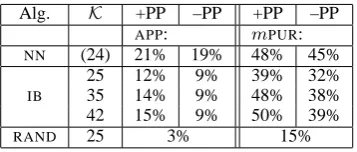
We first evaluated the clusters against the predom-inant sense, i.e. using the monosemous gold stan-dard. The results, shown in Table 2, demonstrate that both clustering methods perform significantly
9
Our definition differs by a factor of 2 from that of Schulte im Walde and Brew (2002).
Alg. K +PP –PP +PP –PP
APP: mPUR: NN (24) 21% 19% 48% 45%
25 12% 9% 39% 32%
IB 35 14% 9% 48% 38%
42 15% 9% 50% 39%
[image:5.595.338.517.70.146.2]RAND 25 3% 15%
Table 2: Clustering performance on the predominant senses, with and without prepositions. The last entry presents the per-formance of random clustering withK= 25, which yielded the best results among the three valuesK=25,35 and42.
better on the task than our random clustering base-line. Both methods show clearly better performance
with fine-grainedSCFs (with prepositions, +PP) than
with coarse-grained ones (-PP).
Surprisingly, the simple NN method performs
very similarly to the more sophisticated IB. Being
based on pairwise similarities, it shows better
per-formance than IBon the pairwise measure. The IB
is, however, slightly better according to the global
measure (2% withK = 42). The fact that the NN
method performs better than the IB with similarK
values (NNK = 24vs.IBK= 25) seems to suggest
that the JS divergence provides a better model for
the predominant class than the compression model
of the IB. However, it is likely that the IB
perfor-mance suffered due to our choice of test data. As the method is global, it performs better when the target classes are represented by a high number of verbs. In our experiment, many semantic classes were rep-resented by two verbs only (section 2).
Nevertheless, theIB method has the clear
advan-tage that it allows for more clusters to be produced. At best it classified half of the verbs correctly
ac-cording to their predominant sense (mPUR= 50%).
Although this leaves room for improvement, the sult compares favourably to previously published
re-sults10. We argue, however, that evaluation against a
monosemous gold standard reveals only part of the picture.
10
K Pred. Multiple Pred. Multiple sense senses sense senses
APP: mPUR:
NN:
(24) 21% 29% (23% + 5σ) 48% 60% (46%+ 2σ) IB:
[image:6.595.73.300.71.164.2]25 12% 18% (14% + 5σ) 39% 48% (43%+ 3σ) 35 14% 20% (16% + 6σ) 47% 59% (50%+ 4σ) 42 15% 19% (16% + 3σ) 50% 59% (54%+ 2σ)
Table 3:Evaluation against the monosemous (Pred.) and pol-ysemous (Multiple) gold standards. The figures in parentheses are results of evaluation on randomly polysemous data+ sig-nificance of the actual figure. Results were obtained with fine-grainedSCFs (including prepositions).
5.4 Evaluation Against Multiple Senses
In evaluation against the polysemic gold standard, we assume that a verb which is polysemous in our corpus data may appear in a cluster with verbs that share any of its senses. In order to evaluate the clus-ters against polysemous data, we assigned each
pol-ysemic verbV a single sense: the one it shares with
the highest number of verbs in the clusterK(V).
Table 3 shows the results against polysemic and monosemous gold standards. The former are
notice-ably better than the latter (e.g.IBwithK = 42is 9%
better). Clearly, allowing for multiple gold standard classes makes it easier to obtain better results with evaluation.
In order to show that polysemy makes a non-trivial contribution in shaping the clusters, we mea-sured the improvement that can be due to pure chance by creating randomly polysemous gold dards. We constructed 100 sets of random gold stan-dards. In each iteration, the verbs kept their original predominant senses, but the set of additional senses was taken entirely from another verb - chosen at ran-dom. By doing so, we preserved the dominant sense of each verb, the total frequency of all senses and the correlations between the additional senses.
The results included in table 3 indicate, with
99.5%confidence (3σand above), that the improve-ment obtained with the polysemous gold standard is
not artificial (except in two cases with 95%
confi-dence).
5.5 Qualitative Analysis of Polysemy
We performed qualitative analysis to further inves-tigate the effect of polysemy on clustering
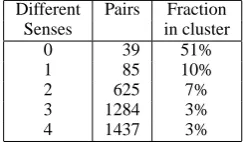
perfor-Different Pairs Fraction Senses in cluster
0 39 51%
1 85 10%
2 625 7%
3 1284 3%
[image:6.595.365.487.72.143.2]4 1437 3%
Table 4: The fraction of verb pairs clustered together, as a function of the number of different senses between pair mem-bers (results of theNNalgorithm)
Common one irregular no irregular Senses Pairs in cluster Pairs in cluster
0 2180 3% 3018 3%
1 388 9% 331 12%
2 44 20% 31 35%
Table 5: The fraction of verb pairs clustered together, as a function of the number of shared senses (results of theNN algo-rithm)
mance. The results in table 4 demonstrate that the more two verbs differ in their senses, the lower their chance of ending up in the same cluster. From the figures in table 5 we see that the probability of two verbs to appear in the same cluster increases with the number of senses they share. Interestingly, it is not only the degree of polysemy which influences the results, but also the type. For verb pairs where at least one of the members displays ‘irregular’ poly-semy (i.e. it does not share its full set of senses with any other verb), the probability of co-occurrence in the same cluster is far lower than for verbs which are polysemic in a ‘regular’ manner (Table 5).
Manual cluster analysis against the polysemic gold standard revealed a yet more comprehensive
picture. Consider the following clusters (theIB
out-put withK= 42):
A1: talk (37), speak (37) A2: look (30, 35), stare (30)
A3: focus (31, 45), concentrate (31, 45) A4: add (22, 37, A56)
We identified a close relation between the clus-tering performance and the following patterns of se-mantic behaviour:
1) Monosemy: We had 32 monosemous test
verbs. 10 gold standard classes included 2 or more
or these. 7 classes were correctly acquired
[image:6.595.324.527.198.250.2]2) Predominant sense: 10 clusters were exam-ined by hand whose members got correctly classi-fied together, despite one of them being polysemous (e.g. A2). In 8 cases there was a clear indication in
the data (when examining SCFs and the selectional
preferences on argument heads) that the polysemous verb indeed had its predominant sense in the rele-vant class and that the co-occurrence was not due to noise.
3) Regular Polysemy: Several clusters were pro-duced which represent linguistically plausible inter-sective classes (e.g. A3) (Dang et al., 1998) rather than single classes.
4) Irregular Polysemy: Verbs with irregular
pol-ysemy11were frequently assigned to singleton
clus-ters. For example, add (A4) has a ‘combining and
attaching’ sense in class 22 which involvesNP and
PP SCFs and another ‘communication’ sense in 37
which takes sententialSCFs. Irregular polysemy was
not a marginal phenomenon: it explains 5 of the 10 singletons in our data.
These observations confirm that evaluation
against a polysemic gold standard is necessary in order to fully explain the results from clustering.
5.6 Qualitative Analysis of Errors
Finally, to provide feedback for further development of our verb classification approach, we performed a qualitative analysis of errors not resulting from
poly-semy. Consider the following clusters (theIBoutput
forK= 42):
B1: place (9), build (26, 45),
publish (26, 25), carve (21, 25, 26) B2: sin (003), rain (57), snow (57, 002) B3: agree (36, 22, A42), appear (020, 48, 29),
begin (55), continue (55, 47, 51) B4: beg (015, 32)
Three main error types were identified:
1) Syntactic idiosyncracy: This was the most fre-quent error type, exemplified in B1, where place is incorrectly clustered with build, publish and carve merely because it takes similar prepositions to these verbs (e.g. in, on, into).
2) Sparse data: Many of the low frequency verbs (we had 12 with frequency less than 300) performed
11
Recall our definition of irregular polysemy, section 5.4.
poorly. In B2, sin (which had 53 occurrences) is classified with rain and snow because it does not occur in our data with the preposition against -the ‘hallmark’ of its gold standard class (’Conspire Verbs’).
3) Problems in SCF acquisition: These were not
numerous but occurred e.g. when the system could not distinguish between different control (e.g. sub-ject/object equi/raising) constructions (B3).
6 Discussion and Conclusions
This paper has presented a novel approach to auto-matic semantic classification of verbs. This involved
applying theNNandIBmethods to cluster polysemic
SCF distributions extracted from corpus data using
Briscoe and Carroll’s (1997) system. A principled evaluation scheme was introduced which enabled us to investigate the effect of polysemy on the resulting classification.
Our investigation revealed that polysemy has a considerable impact on the clusters formed: pol-ysemic verbs with a clear predominant sense and those with similar regular polysemy are frequently classified together. Homonymic verbs or verbs with strong irregular polysemy tend to resist any classifi-cation.
While it is clear that evaluation should account for these cases rather than ignore them, the issue of polysemy is related to another, bigger issue: the po-tential and limitations of clustering in inducing
se-mantic information from polysemic SCF data. Our
results show that it is unrealistic to expect that the ‘important’ (high frequency) verbs in language fall into classes corresponding to single senses. How-ever, they also suggest that clustering can be used for novel, previously unexplored purposes: to de-tect from corpus data general patterns of seman-tic behaviour (monosemy, predominant sense, reg-ular/irregular polysemy).
ap-proaches in clustering, developing our gold standard classification further, and extending our experiments to a larger number of verbs and verb classes.
References
B. Boguraev, E. J. Briscoe, J. Carroll, D. Carter, and C. Grover. 1987. The derivation of a grammatically-indexed lexicon from the longman dictionary of con-temporary english. In Proc. of the 25th ACL, pages
193–200, Stanford, CA.
C. Brew and S. Schulte im Walde. 2002. Spectral clus-tering for german verbs. In Conference on Empirical
Methods in Natural Language Processing,
Philadel-phia, USA.
E. J. Briscoe and J. Carroll. 1997. Automatic extraction of subcategorization from corpora. In5thACL Confer-ence on Applied Natural Language Processing, pages
356–363, Washington DC.
E. J. Briscoe and J. Carroll. 2002. Robust accurate sta-tistical annotation of general text. In3rdInternational Conference on Language Resources and Evaluation,
pages 1499–1504, Las Palmas, Gran Canaria.
H. T. Dang, K. Kipper, M. Palmer, and J. Rosenzweig. 1998. Investigating regular sense extensions based on intersective Levin classes. In Proc. of COLING/ACL, pages 293–299, Montreal, Canada.
B. Dorr and D. Jones. 1996. Role of word sense disam-biguation in lexical acquisition: predicting semantics from syntactic cues. In16thInternational Conference on Computational Linguistics, pages 322–333,
Copen-hagen, Denmark.
B. Dorr. 1997. Large-scale dictionary construction for foreign language tutoring and interlingual machine translation. Machine Translation, 12(4):271–325.
R. Grishman, C. Macleod, and A. Meyers. 1994. Com-lex syntax: building a computational Com-lexicon. In
In-ternational Conference on Computational Linguistics,
pages 268–272, Kyoto, Japan.
R. Jackendoff. 1990. Semantic Structures. MIT Press, Cambridge, Massachusetts.
E. Joanis. 2002. Automatic verb classification using a general feature space. Master’s thesis, University of Toronto.
J. L. Klavans and M. Kan. 1998. Role of verbs in docu-ment analysis. In Proc. of COLING/ACL, pages 680– 686, Montreal, Canada.
A. Korhonen. 2002. Subcategorization Acquisition.
Ph.D. thesis, University of Cambridge, UK.
A. Korhonen. 2003. Extending Levin’s Classification
with New Verb Classes. Unpublished manuscript,
Uni-versity of Cambridge Computer Laboratory.
G. Leech. 1992. 100 million words of english: the british national corpus. Language Research, 28(1):1–13.
B. Levin. 1993. English Verb Classes and Alternations. Chicago University Press, Chicago.
P. Merlo and S. Stevenson. 2001. Automatic verb clas-sification based on statistical distributions of argument structure. Computational Linguistics, 27(3):373–408.
P. Merlo, S. Stevenson, V. Tsang, and G. Allaria. 2002. A multilingual paradigm for automatic verb classifica-tion. In Proc. of the40thACL, Pennsylvania, USA.
G. A. Miller. 1990. WordNet: An on-line lexi-cal database. International Journal of Lexicography, 3(4):235–312.
S. Pinker. 1989. Learnability and Cognition: The
Acqui-sition of Argument Structure. MIT Press, Cambridge,
Massachusetts.
J. Preiss and A. Korhonen. 2002. Improving subcate-gorization acquisition with WSD. In ACL Workshop
on Word Sense Disambiguation: Recent Successes and Future Directions, Philadelphia, USA.
D. Roland, D. Jurafsky, L. Menn, S. Gahl, E. Elder, and C. Riddoch. 2000. Verb subcatecorization frequency differences between business-news and balanced cor-pora. In ACL Workshop on Comparing Corpora, pages 28–34.
S. Schulte im Walde and C. Brew. 2002. Inducing ger-man seger-mantic verb classes from purely syntactic sub-categorisation information. In Proc. of the40thACL,
Philadephia, USA.
S. Schulte im Walde. 2000. Clustering verbs seman-tically according to their alternation behaviour. In
Proc. of COLING-2000, pages 747–753, Saarbr¨ucken,
Germany.
S. Stevenson and E. Joanis. 2003. Semi-supervised verb-class discovery using noisy features. In Proc. of
CoNLL-2003, Edmonton, Canada.