Relating Probabilistic Grammars and A u t o m a t a
S t e v e n A b n e y D a v i d M c A l l e s t e r F e r n a n d o P e r e i r aA T & T Labs-Research 180 P a r k Ave F l o r h a m P a r k NJ 07932
{abney, dmac, pereira}@research.att.com
A b s t r a c t
Both probabilistic context-free grammars (PCFGs) and shift-reduce probabilistic push- down a u t o m a t a (PPDAs) have been used for language modeling and maximum likelihood parsing. We investigate the precise relationship between these two formalisms, showing that, while they define the same classes of probabilis- tic languages, they appear to impose different inductive biases.
1 I n t r o d u c t i o n
Current work in stochastic language models and maximum likelihood parsers falls into two main approaches. The first approach (Collins, 1998; Charniak, 1997) uses directly the defini- tion of stochastic grammar, defining the prob- ability of a parse tree as the probability that a certain top-down stochastic generative pro- cess produces that tree. The second approach (Briscoe and Carroll, 1993; Black et al., 1992; Magerman, 1994; Ratnaparkhi, 1997; Chelba and Jelinek, 1998) defines the probability of a parse tree as the probability that a certain shift- reduce stochastic parsing automaton outputs that tree. These two approaches correspond to the classical notions of context-free grammars and nondeterministic pushdown automata re- spectively. It is well known that these two clas- sical formalisms define the same language class. In this paper, we show that probabilistic context- free grammars (PCFGs) and probabilistic push- down automata (PPDAs) define the same class of distributions on strings, thus extending the classical result to the stochastic case. We also touch on the perhaps more interesting ques- tion of whether PCFGs and shift-reduce pars- ing models have the same inductive bias with respect to the automatic learning of model pa- rameters from data. Though we cannot provide a definitive answer, the constructions we use to
answer the equivalence question involve blow- ups in the number of parameters in both direc- tions, suggesting that the two models impose different inductive biases.
We are concerned here with probabilistic shift-reduce parsing models that define prob- ability distributions over word sequences, and in particular the model of Chelba and Je- linek (1998). Most other probabilistic shift- reduce parsing models (Briscoe and Carroll, 1993; Black et al., 1992; Magerman, 1994; Rat- naparkhi, 1997) give only the conditional prob- ability of a parse tree given a word sequence. Collins (1998) has argued that those models fail to capture the appropriate dependency relations of natural language. Furthermore, they are not directly comparable to PCFGs, which define probability distributions over word sequences.
To make the discussion somewhat more con- crete, we now present a simplified version of the Chelba-Jelinek model. Consider the following sentence:
The small woman gave the fat man her sandwich.
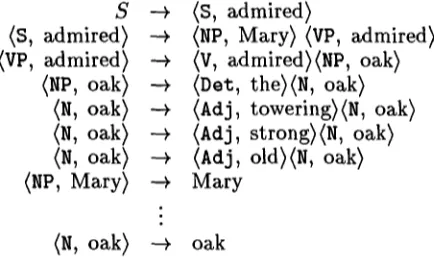
S --+ (S, admired)
(S, admired) --+ (NP, Mary)(VP, admired) (VP, admired) -+ (V, admired)(Np, oak)
(NP, oak) -+ (Det, the)(N, oak)
(N,
oak) -+ (Adj, towering> (N, oak> (N, oak> -~ (Adj, strong>(N, oak> (N,oak) -+
(hdj, old>(N,oak)
(NP, Mary) -+ Mary
(N, oak) -+ oak
Figure 1: Lexicalized context-free g r a m m a r
sition by generating the next word. This is done in a manner similar to t h a t of a trigram model except that, rather than generate the next word based on the two preceding words, it generates the next word based on the two top- most stack entries. In this example the Chelba- Jelinek model generates the word "her" from (V, gave)(NP, man) while a classical trigram model would generate "her" from "fat man".
We now contrast Chelba-Jelinek style mod- els with lexicalized P C F G models. A P C F G is a context-free g r a m m a r in which each produc- tion is associated with a weight in the interval [0, 1] and such t h a t the weights of the produc- tions from any given nonterminal sum to 1. For instance, the sentence
Mary admired the towering strong old oak
can be derived using a lexicalized P C F G based on the productions in Figure 1. Production probabilities in the P C F G would reflect the like- lihood t h a t a phrase headed by a certain word can be expanded in a certain way. Since it can be difficult to estimate fully these likelihoods, we might restrict ourselves to models based on
bilexical
relationships (Eisner, 1997), those be- tween pairs of words. The simplest bilexical re- lationship is a bigram statistic, the fraction of times t h a t "oak" follows "old". Bilexical rela- tionships for a P C F G include t h a t between the head-word of a phrase and the head-word of a non-head immediate constituent, for instance. In particular, the generation of the above sen- tence using a P C F G based on Figure 1 would exploit a bilexical statistic between "towering" and "oak" contained in the weight of the fifth production. This bilexical relationship between"towering" and "oak" would not be exploited in either a trigram model or in a Chelba-Jelinek style model. In a Chelba-Jelinek style model one must generate "towering" before generating "oak" and then "oak" must be generated from (Adj, strong), (Adj, old). In this example the Chelba-Jelinek model behaves more like a clas- sical trigram model than like a P C F G model.
This contrast between P P D A s and P C F G s is formalized in theorem 1, which exhibits a P C F G for which no stochastic parameterization of the corresponding shift-reduce parser yields the same probability distribution over strings. T h a t is, the standard shift-reduce translation from CFGs to PDAs cannot be generalized to the stochastic case.
We give two ways of getting around the above difficulty. The first is to construct a
top-down
P P D A t h a t mimics directly the process of gen- erating a P C F G derivation from the start sym- bol by repeatedly replacing the leftmost non- terminal in a sentential form by the right-hand side of one of its rules. Theorem 2 states t h a t any P C F G can be translated into a top- down P P D A . Conversely, theorem 3 states t h a t any P P D A can be translated to a P C F G , not just those t h a t are top-down P P D A s for some P C F G . Hence P C F G s and general P P D A s de- fine the same class of stochastic languages.
Unfortunately, top-down P P D A s do not al- low the simple left-to-right processing t h a t mo- tivates shift-reduce PPDAs. A second way around the difficulty formalized in theorem 1 is to encode additional information about the derivation context with richer stack and state alphabets. Theorem 7 shows t h a t it is thus possible to translate an arbitrary P C F G to a shift-reduce P P D A . The construction requires a fair a m o u n t of machinery including proofs t h a t any P C F G can be p u t in Chomsky normal form, that weights can be renormalized to ensure t h a t the result of g r a m m a r transformations can be made into PCFGs, t h a t any P C F G can be put in Greibach normal form, and, finally, t h a t a Greibach normal form P C F G can be converted to a shift-reduce P P D A .
[image:2.612.72.289.95.225.2]C F languages. In the conversion from shift- reduce P P D A s to P C F G s , there is also a blow- up, if a less d r a m a t i c one, leaving open the pos- sibility t h a t t h e biases are incomparable, and t h a t neither formalism is inherently more con- cise.
Our main conclusion is then that, while the generative and shift-reduce parsing approaches are weakly equivalent, t h e y impose different in- ductive biases.
2 P r o b a b i l i s t i c a n d W e i g h t e d G r a m m a r s
For the r e m a i n d e r of the paper, we fix a terminal alphabet E and a nonterminal alphabet N , to which we m a y add auxiliary symbols as needed. A weighted context-free g r a m m a r ( W C F G ) consists of a distinguished s t a r t symbol S E N plus a finite set of weighted productions of the form X -~ a, (alternately, u : X --~ a), where X E N , a E ( N t 2 E ) * and the weight u is a non- negative real number. A probabilistic context- free g r a m m a r ( P C F G ) is a W C F G such t h a t for all X , )-~u:x-~a u = 1. Since weights are non- negative, this also implies t h a t u <_ 1 for any individual production.
A P C F G defines a stochastic process with sentential forms as states, and leftmost rewrit- ing steps as transitions. In the more general case of W C F G s , we can no longer speak of stochastic processes; but weighted parse trees and sets of weighted parse trees are still well- defined notions.
We define a parse tree to be a tree whose nodes are labeled with productions. Suppose node ~ is labeled X -~ a [ Y 1 , . . . , Y n ] , where we write a [ Y 1 , . . . , Y n ] for a string whose nonter- minal symbols are
Y1,...,Y~.
We say t h a t ~'s nonterminal label is X and its weight is u. The subtree rooted at ~ is said to be rooted in X . ~ is well-labeled just in case it has n children, whose nonterminal labels are Y 1 , . . . , Yn, respectively. Note t h a t a terminal node is well-labeled only if a is e m p t y or consists exclusively of terminal symbols. We say a W C F GG admits
a tree d just in case all nodes of d are well-labeled, and all labels are productions of G. Note t h a t no requirement is placed on the nonterminal of the root node of d; in particular, it need not be S.We define the weight of a tree d, denoted
Wa(d),
orW(d)
if G is clear from context, to be the p r o d u c t of weights of its nodes. Thedepth
r ( d ) of d is the length of the longest path from
root to leaf in d. The
root production it(d)
is the label of the root node. T h eroot symbol p(d)
is the left-hand side of ~r(d). T h eyield a(d)
of the tree d is defined in the s t a n d a r d way as the string of terminal symbols "parsed" by t h e tree. It is convenient to t r e a t the functions 7r, p, a, and r as r a n d o m variables over trees. We write, for example, {p = X } as an abbreviation for{dip(d)=
X } ; andWG(p = X)
represents the sum of weights of such trees. If the sum diverges, we setWG(p
= X ) = oo. We callIIXHG = WG(p = X)
t h enorm
of X , and IIGII = IISlla the norm of the g r a m m a r .A W C F G G is called
convergent
if [[G[[ < oo. If G is a P C F G then [[G[[ =WG(p
"- S ) < 1, t h a t is, all P C F G s are convergent. A P C F G G is calledconsistent
if ]]GII = 1. A sufficient condition for the consistency of a P C F G is given in (Booth and T h o m p s o n , 1973). If (I) and • are two sets of parse trees such t h a t 0 <WG(~) <
co we define PG((I)]~) to be
WG(~Nqt)/WG(kO).
For any terminal string y and g r a m m a r G such t h a t 0 <
WG(p
-- S) < co we definePG(Y)
to bePa(a = YIP = S).
3 S t o c h a s t i c P u s h - D o w n A u t o m a t a We use a s o m e w h a t n o n s t a n d a r d definition of pushdown a u t o m a t o n for convenience, b u t all our results hold for a variety of essentially equiv- alent definitions. In addition to t h e terminal alphabet ~ , we will use sets of stack symbols and states as needed. A weighted push-down a u t o m a t o n ( W P D A ) consists of a distinguished s t a r t s t a t e q0, a distinguished s t a r t stack symbol X0 and a finite set of transitions of the following form where p and q are states, a E E L.J {e}, X and Z1, ..., Zn are stack symbols, and w is a nonnegative real weight:
x , p a ~ Zl ... Zn, q
A W P D A is a probabilistic push-down a u t o m a - ton ( P P D A ) if all weights are in t h e interval [0, 1] and for each pair of a stack symbol X and a state q the sum of the weights of all transitions of the form
X , p ~ Z1 ...Z=, q
equals 1. A ma- chine configuration is a pair (fl, q) of a finite sequence fl of stack symbols (a stack) and a ma- chine s t a t e q. A machine configuration is calledhalting
if the stack is empty. If M is a P P D A containing the transitionX , p ~ Z1...Zn,q
probability w of being transformed into the con- figuration (f~Z1...Zn, q> where this transfor- mation has the effect of "outputting" a if a ¢ e. A complete execution of M is a sequence of tran- sitions between configurations starting in the initial configuration <X0, q0> and ending in a configuration with an e m p t y stack. The prob- ability of a complete execution is the product of the probabilities of the individual transitions between configurations in t h a t execution. For any P P D A M and y E E* we define
PM(Y)
to be the sum of the probabilities of all complete executions o u t p u t t i n g y. A P P D A M is called consistent if)-~ye~*
PM(Y)
=1.
We first show t h a t the well known shift- reduce conversion of CFGs into PDAs can not be made to handle the stochastic case. Given a (non-probabilistic) C F G G in Chomsky normal form we define a (non-probabilistic) shift-reduce P D A
SIt(G) as
follows. The stack symbols ofSIt(G)
are taken to be nonterminals of G plus the special symbols T and ±. The states ofSR(G)
are in one-to-one correspondence with the stack symbols and we will abuse notation by using the same symbols for both states and stack symbols. The initial stack symbol is 1 and the initial state is (the state corresponding to) _L. For each production of the form X --+ a in G the P D ASIt(G)
contains all shift transi- tions of the following formY , Z - ~ YZ, X
The P D A
SR(G)
also contains the following ter- mination transitions where S is the start symbol of G.E
1 , S -+,
T
I,T -~,T
Note t h a t if G consists entirely of productions of the form S -+ a these transitions suffice. More generally, for each production of the form X -+
Y Z
in G the P D ASR(G)
contains the following reduce transitions.Y, Z -~, X
All reachable configurations are in one of the following four forms where the first is the initial configuration, the second is a template for all intermediate configurations with a E N*, and the last two are terminal configurations.
<1, 1>, <11., x>, <I,T>,
T>
Furthermore, a configuration of the form (l_l_a, X) can be reached after o u t p u t t i n g y if and only if a X :~ y. In particular, the machine can reach configuration (±_L, S) o u t p u t t i n g y if and only if S :~ y. So the machine
SR(G)
generates the same language as G.
We now show t h a t the shift-reduce transla- tion of CFGs into PDAs does not generalize to the stochastic case. For any P C F G G we define the underlying C F G to be the result of erasing all weights from the productions of G.
T h e o r e m 1
There exists a consistent PCFG G
in Chomsky normal .form with underlying CFG
G' such that no consistent weighting M of the
PDA SR(G ~) has the property that PM(Y) =
Pa(u) for all U e
To prove the theorem take G to be the fol- lowing grammar.
1_ 1_
S -~ AX1, S 3+ BY1
X, -~ CX2, X2 -~ CA
Yl
Cy2, Y2 A, C B
A - ~ a, S - ~ b, C - ~ c
Note t h a t G generates
acca
andbccb
each with probability ½. Let M be a consistent P P D A whose transitions consist of some weight- ing of the transitions ofSR(G').
We will as- sume t h a tPM(Y) = PG(Y)
for all y E E* and derive a contradiction. Call the nonter- minals A, B, and C preterminals. Note t h a t the only reduce transitions inSR(G ~)
com- bining two preterminals are C, A -~,X2 and C, B -~,Y2. Hence the only machine configu- ration reachable after o u t p u t t i n g the sequenceace
is(.I__LAC, C>.
IfPM(acca)
-- ½ andPM(accb)
-- 0 then the machine in configuration(.I_±AC, C>
must deterministically move to con- figuration( I ± A C C , A>.
But this implies t h a t configuration( I I B C , C>
also deterministically moves to configuration<±±BCC, A>
so we havePM(bccb) -= 0
which violates the assumptions about M. ,,T h e o r e m 2 Any string distribution definable
by
a consistent PCFG is also definable by a top- down PPDA.Here we consider only PCFGs in Chom- sky normal f o r m - - t h e generalization to arbi- trary PCFGs is straightforward. Any PCFG in Chomsky normal form can be translated to a top-down P P D A by translating each weighted production of the form X --~ Y Z to the set of expansion moves of the form W, X ~ WZ, Y and each production of the form X -~ a to the set of pop moves of the form Z, X 72-'~, Z. •
We also have the following converse of the above theorem.
T h e o r e m 3 Any string distribution definable
by
a consistent PPDA is definable by a PCFG.The proof, omitted here, uses a weighted ver- sion of the standard translation of a PDA into a CFG followed by a renormalization step using lemma 5. We note t h a t it does in general in- volve an increase in the number of parameters in the derived PCFG.
In this paper we are primarily interested in shift-reduce PPDAs which we now define for- mally. In a shift-reduce P P D A there is a one- to-one correspondence between states and stack symbols and every transition has one of the fol- lowing two forms.
Y, Z a - ~ Y Z , X a ¢ E EgW
Y, Z -~+ , X
Transitions of the first type are called shift transitions and transitions of the second type are called reduce transitions. Shift transitions output a terminal symbol and push a single symbol on the stack. Reduce transitions are e-transitions t h a t combine two stack symbols. The above theorems leave open the question of whether shift-reduce PPDAs can express arbi- trary context-free distributions. Our main the- orem is that they can. To prove this some ad- ditional machinery is needed.
4 C h o m s k y N o r m a l F o r m
A P C F G is in Chomsky normal form (CNF) if all productions are either of the form X -St a, a E E or X -~ Y1Y2, Y1,Y2 E N. Our next theorem states, in essence, that any PCFG can be converted to Chomsky normal form.
T h e o r e m 4 For any consistent PCFG G with PG(e) < 1 there exists a consistent PCFG C(G) in Chomsky normal form such that, for all y E E+:
Pa(y)
- ea(yly # e)
P C ( G ) ( Y ) -- 1 - P a ( e )
To prove the theorem, note first that, without loss of generality, we can assume t h a t all pro- ductions in G are of one of the forms X --~ Y Z , X -5t Y, X -~ a, or X -Y+ e. More specifi- cally, any production not in one of these forms must have the form X -5t ¢rfl where a and fl are nonempty strings. Such a production can be replaced by X -~ AB, A -~ a, and B 2+ fl where A and B are fresh nonterminal symbols. By repeatedly applying this binarization trans- formation we get a g r a m m a r in the desired form defining the same distribution on strings.
We now assume t h a t all productions o f G are in one of the above four forms. This im- plies that a node in a G-derivation has at most two children. A node with two children will be called a branching node. Branching nodes must be labeled with a production of the form X -~ Y Z . Because G can contain produc- tions of the form X --~ e there may be ar- bitrarily large G-derivations with empty yield. Even G-derivations with nonempty yield may contain arbitrarily large subtrees with empty yield. A branching node in the G-derivation will be called ephemeral if either of its chil- dren has empty yield. Any G-derivation d with la(d)l _ 2 must contain a unique shallowest non-ephemeral branching node, labeled by some production X ~ Y Z . In this case, define fl(d) = Y Z . Otherwise
(la(d)l
< 2), let fl(d) = a(d). We say t h a t a nonterminal X is nontrivial in the g r a m m a r G if Pa(a # e I P = X ) > O. We now define the g r a m m a r G' to consist of all productions of the following form where X , Y, and Z are nontrivial nonterminals of G and a is a terminal symbol appearing in G.X PG(~=YZ~p=x, ~#~) Y Z X PG(~=a 12+=x, ~¢~) a
We leave it to the reader to verify t h a t G' has the property stated in theorem 4. •
way of c o m p u t i n g the conditional probabilities PG(Z = Y Z I p = x , # and P a ( Z = a [ p = X, a ¢ e). However, it is not difficult to c o m p u t e probabilities of the form
P G ( ¢ [ p = X , r <_ t + 1) from probabili- ties of the form PG((I) ] p = X, v _< t), and
P G ( ¢ I P = X ) is the limit as t goes to infinity of Pa((I )] p = X, r_< t). We omit the details here.
from X equals 1:
= ~:x-~[Y1 ... y.] u ~
-- E .x-,oIv,
... Y.l
II lla
= ... y . ] u l - L w G ( p =
= wo(p=x)Wa(p= X)
- 1
5 R e n o r m a l i z a t i o n
A nonterminal X is called reachable in a gram- m a r G if either X is S or there is some (re- cursively) reachable nonterminal Y such t h a t G contains a production of the form Y -~ a where contains X . A nonterminal X is n o n e m p t y in G if G contains X -~ a where u > 0 and a contains only terminal symbols, or G contains X -~ o~[Y1, . . . , Yk] where u > 0 and each 1~ is (recursively) nonempty. A W C F G G is
proper if every nonterminal is both reachable and nonempty. It is possible to efficiently com- pute the set of reachable and n o n e m p t y non- terminals in any g r a m m a r . Furthermore, the subset of productions involving only nontermi- nals t h a t are both reachable and n o n e m p t y de- fines the same weight distribution on strings. So without loss of generality we need only con- sider proper W C F G s . A reweighting of G is any W C F G derived from G by changing the weights of the productions of G.
L e m m a 5 For any convergent proper W C F G G, there exists a reweighting G t of G such that G ~ is a consistent P C F G such that f o r all ter- minal strings y we have PG' (Y) = Pa (Y).
Proof." Since G is convergent, and every non- terminal X is reachable, we must have IIXIla < oo. We now renormalize all the productions from X as follows. For each production X -~
a [ Y 1 , . . . , Yn] we replace u by
¢ =
II IIG
IIXIla
To show t h a t G' is a P C F G we must show t h a t t h e sum of the weights of all productions
For any parse tree d a d m i t t e d by G let d ~ be the corresponding tree a d m i t t e d by G ~, t h a t is, the result of reweighting the pro- ductions in d. One can show by induc- tion on the depth of parse trees t h a t if
p(d) = X then Wc,(d') = [-~GWG(d).
Therefore IIXIIG, = ~~{d[p(d)=X} W G , ( d ' ) -~
~ ~{alo(e)=x} W a ( d ) = = 1. In par- ticular,
Ilaql
=IlSlla,- 1,
t h a t is, G' is consis- tent. This implies t h a t for any terminal string Y we have PG'(Y) = l i - ~ W a , ( a = y, p = S) = W a , ( a = y, p = S). F u r t h e r m o r e , for any tree d with p(d) = S we have Wa,(d') = ~[~cWa(d)and so WG,(a = y, p = S) - ~ W G ( a =
y, p = S) = Pc(Y). "
6 G r e i b a c h N o r m a l F o r m
A P C F G is in Greibach normal form (GNF) if every production X -~ a satisfies (~ E E N * . The following holds:
T h e o r e m 6 For any consistent P C F G G in C N F there exists a consistent P C F G G ~ in G N F such that Pc,(Y) = Pa(Y) f o r y e E*.
Proof: A left corner G-derivation from X to
Y is a G-derivation from X where the leftmost leaf, rather t h a n being labeled with a produc- tion, is simply labeled with the nonterminal Y. For example, if G contains the productions
X ~ Y Z and Z -~ a then we c a n c o n s t r u c t a left corner G-derivation from X to Y by build- ing a tree with a root labeled by X Z.~ Y Z , a
left child labeled with Y and a right child la- beled with Z -~ a. T h e weight of a left corner G-derivation is the p r o d u c t of the productions on the nodes. A tree consisting of a single node labeled with X is a left corner G-derivation from X t o X .
For each pair of nonterminals X, Y in G we introduce a new nonterminal symbol X / Y .
The H-derivations from X / Y will be in one to one correspondence with the left-corner G- derivations from X to Y. For each production in G of the form X ~ a we include the following in H where S is the s t a r t symbol of G:
S --~ a S / X
We also include in H all productions of the fol- lowing form where X is any nonterminal in G:
x / x
If G consists only of productions of the form S -~ a these productions suffice. More gener- ally, for each nonterminal X / Y of H and each pair of productions U ~ Y Z , W ~-~ a we in- clude in H the following:
X / Y ~ 2 a Z / W X / U
Because of t h e productions X / X -~ e, WH(# : X / X ) > 1 , and H is not quite in GNF. These two issues will be addressed momentarily.
S t a n d a r d a r g u m e n t s can be used to show t h a t the H-derivations from X / Y are in one- to-one correspondence with the left corner G- derivations from X to Y. F u r t h e r m o r e , this one- to-one correspondence preserves w e i g h t - - i f d is the H-derivation rooted at X / Y corresponding to the left corner G-derivation from X to Y then WH (d) is t h e p r o d u c t of the weights of the pro- ductions in the G-derivation.
T h e weight-preserving one-to-one correspon- dence between left-corner G-derivations from X to Y and H-derivations from X / Y yields the following.
WH ( ao~ )
:
~'~(S_U+aS/X)EHUWH(~r : Ollp--- S / X )
Po(a )
T h e o r e m 5 implies t h a t we can reweight the proper subset of H (the reachable and n o n e m p t y productions of H ) so as to construct a consistent P C F G g with Pj((~) = PG(~). To prove theo- rem 6 it now suffices to show t h a t the produc- tions of the form X / X -~ e can be eliminated from the P C F G J . Indeed, we can eliminate the e productions from J in a m a n n e r similar to t h a t used in the proof of t h e o r e m 4. A node
in an J-derivation is ephemeral if it is labeled X -~ e for some X . We now define a function 7 on J-derivations d as follows. If t h e root of d is labeled with X -~ a Y Z then we have four sub- cases. If neither child of the root is ephemeral then 7(d) is the string a Y Z . If only t h e left child is ephemeral then 7(d) is aZ. If only the right child is ephemeral then 7(d) is a Y and if both children are ephemeral then 7(d) is a. Analo- gously, if the root is labeled with X -~ aY, then 7(d) is a Y if the child is not ephemeral and a otherwise. If the root is labeled with X -~ e then 7(d) is e.
A nonterminal X in K will be called trivial i f P j ( 7 = e I P = X ) = 1. We now define the final g r a m m a r G' to consist of all productions of the following form where X , Y, and Z are nontrivial nonterminals appearing in J and a is a terminal symbol appearing in J .
X Pj(a=a I__~=X, "y¢¢) a
X pj(a=aY~_~=X, "yCe) a Y
X PJ(a=aYZl-~ p=X'
~¢)a Y Z
As in section 4, for every nontrivial nonterminal X in K and terminal string (~ we have PK (a = (~ I P = X ) = P j ( a = a I P = X , a ~ e). In particular, since Pj(e) = PG(() = 0, we have the following:
=
= P j ( a = a l p = S ) = P j ( a )
= Pa( )
The P C F G K is t h e desired P C F G in Greibach normal form. •
The construction in this proof is essen- tially the s t a n d a r d left-corner t r a n s f o r m a t i o n (Rosenkrantz and II, 1970), as e x t e n d e d by Sa- l o m a a and Soittola (1978, t h e o r e m 2.3) to alge- braic formal power series.
7
T h e M a i n T h e o r e m
We can now prove our main t h e o r e m .
T h e o r e m 7 For any consistent P C F G G there exists a shift-reduce PPDA M such that PM(Y) = PG(Y) for all y E ~*.
Let G be an a r b i t r a r y consistent P C F G . By t h e o r e m s 4 and 6~ we can assume t h a t G con- sists of productions of the form S -~ e and
S
l~w St
plus productions in Greibach normal form not mentioning S. We can then replace the rule S 1_:+~ S ~ with all rules of the form S 0-__~)~' a where G contains S ~ ~' -+ a. We now assume w i t h o u t loss of generality t h a t G con- sists of a single production of the form S -~ e plus productions in Greibach normal form not mentioning S on the right hand side.The stack symbols of M are of the form W~ where ce E N* is a proper suffix of the right hand side of some production in G. For example, if G contains the production X -~ a Y Z then the symbols of M include W y z , W y , and We. The initial state is W s and the initial stack symbol is ±. We have assumed t h a t G contains a unique production of the form S -~ e. We include the following transition in M corresponding to this production.
A_,Ws~,T
Then, for each rule of the form X -~ a~ in G and each symbol o f the form Wx,~ we include the following in M:
Z, Wx. ~ ZWx., Wz
We also include all "post-processing" rules of the following form:
Wx~W~ ~ W~
~.,1
±,W~ ~ , T
I , T -:+,T
Note t h a t all reduction transitions are determin- istic with the single exception of the first rule listed above. T h e nondeterministic shift tran- sitions of M are in one-to-one correspondence with the productions of G. This yields the prop- erty t h a t PM(Y) = PG(Y). •
8 C o n c l u s i o n s
The relationship between P C F G s and P P D A s is subtler t h a n a direct application of the clas- sical constructions relating general CFGs and PDAs. Although P C F G s can be concisely trans- lated into top-down P P D A s , we conjecture t h a t there is no concise translation of P C F G s into shift-reduce P P D A s . Conversely, there appears to be no concise translation of shift-reduce PP- DAs to P C F G s . Our main result is t h a t P C F G s and shift-reduce P P D A s are intertranslatable,
hence weakly equivalent. However, the non- conciseness of our translations is consistent with the view t h a t stochastic top-down generation models are significantly different from shift- reduce stochastic parsing models, affecting the ability to learn a model from examples.
R e f e r e n c e s
Alfred V. Aho and Jeffrey D. Ullman. 1972. The Theory of Parsing, Translation and Compiling,
volume I. Prentice-Hall, Englewood Cliffs, New Jersey.
Ezra Black, Fred Jelinek, John Lafferty, David Magerman, Robert Mercer, and Salim Roukos. 1992. Towards history-based grammars: Using richer models for probabilistic parsing. In Pro- ceedings of the 5th DARPA Speech and Natural Language Workshop.
Taylor Booth and Richard Thompson. 1973. Apply- ing probability measures to abstract languages.
IEEE Transactions on Computers, C-22(5):442- 450.
Ted Briscoe and John Carroll. 1993. Generalized probabilistic LR parsing of natural language (cor- pora) with unification-based grammars. Compu-
tational Linguistics, 19(1):25-59.
Eugene Charniak. 1997. Statistical parsing with a context-free grammar and word statistics. In Fourteenth National Conference on Artificial Intelligence, pages 598-603. AAAI Press/MIT Press.
Ciprian Chelba and Fred Jelinek. 1998. Exploit- ing syntactic structure for language modeling. In
COLING-ACL '98, pages 225-231.
Michael Collins. 1998. Head-Driven Statistical Mod- els for Natural Language Parsing. Ph.D. thesis, University of Pennsylvania.
Jason Eisner. 1997. Bilexical grammars and a cubic- time probabilistic parser. In Proceedings of the International Workshop on Parsing Technologies.
David M. Magerman. 1994. Natural Language Pars- ing as Statistical Pattern Recognition. Ph.D. the- sis, Department of Computer Science, Stanford University.
Adwait Ratnaparkhi. 1997. A linear oberved time statistical parser based on maximum entropy models. In Claire Cardie and Ralph Weischedel, editors, Second Conference on Empirical Meth- ods in Natural Language Processing (EMNLP-2),
Somerset, New Jersey. Association For Computa- tional Linguistics.
Daniel J. Rosenkrantz and Philip M. Lewis II. 1970. Deterministic left corner parser. In IEEE Con- ference Record of the 11th Annual Symposium on Switching and Automata Theory, pages 139-152. Arto Salomaa and Matti Soittola. 1978. Automata-
Theoretic Aspects of Formal Power Series.